The title of this post, is the same as that of this article on the BBC Future Web Site.
It is also one of the best articles, I’ve read on the economics of liquid-air energy storage.
This is the sub-heading.
An overlooked technology for nearly 50 years, the world’s largest liquid air energy storage facility is finally set to power up in 2026. It’s hoping to compete with grid-scale lithium batteries and hydro to store clean power, and reduce the need to fall back on fossil fuels.
These three introductory paragraphs add detail to the project.
As the world’s use of renewable electricity soars, surpassing coal for the first time, the need to store that energy when the Sun isn’t shining and the wind isn’t blowing is growing in step. While some turn to grid-scale lithium batteries and others to pumped hydro, a small but growing industry is convinced there’s a better solution still: batteries that rely on air.
Near the village of Carrington in north-west England, the foundations are being laid for the world’s largest commercial-scale liquid air energy storage facility, one of the first of its kind. The site will eventually become an array of industrial machinery and a number of large storage tanks, filled with air that has been compressed and cooled so much it has become a liquid, using renewable energy surplus to demand. The stored energy can be discharged later when demand exceeds supply.
If the project succeeds, more will follow. The site’s developers Highview Power are confident that liquid air energy storage will make it easier for countries to replace fossil fuels with clean renewable energy – though at present, the technology is expensive. But as the need for clean energy storage surges, they’re betting the balance will tip in favour of liquid air.
The BBC article, seems to have been written with input from Shaylin Cetegen, a chemical engineer at the Massachusetts Institute of Technology (MIT), who studies energy storage systems.
Topics discussed include.
- The intermittency problem of renewables and how this gives problems for the stability of electricity grids.
- The switchable nature of fossil-fuel power generation.
- A big part of the solution is to store the surplus energy so that it can be released when it’s needed. Think of it like an electricity deposit account!
- For decades, the main form of energy storage has been pumped hydro. In 2021, the world had 160 GW of pumped hydro capacity. The UK has a total of just 3 GW in Scotland and Wales! But more is on the way!
- Recently, large-scale battery storage systems have risen to the challenge and installed capacity has risen from 55.7 GW in 2023 to 150 GW / 348 GWh in 2025.
- The liquid air solution is then explained.
- A grid-scale stop-gap, that is the 30 MW/300 MWh Manchester hybrid liquid-air battery, is then described.
- In August 2026, the battery is set to begin operating.
- An alternative way of stabilising the grid will be provided.
- It will come online in two stages, says Highview Power CEO Richard Butland.
- Then in 2027 the liquid air storage is expected to begin fully operating.
Highview Power will make money by trading electricity, as pumped storage operators do.
The penultimate section of the article looks at the bottom line and comes to these conclusions.
Instead, she says governments could support the technology. In her study, subsidising the initial capital costs to set up the systems “could be a viable approach to achieve economic viability in the short term”, she says.
Furthermore, faster uptake of renewables would increase energy price volatility, making energy storage more economically viable.
Cetegen makes a final point in favour of liquid air energy storage: it’s cheap. Energy storage technologies are often assessed using a metric called the “levelised cost of storage”, which estimates how much each unit of stored energy costs over the lifespan of the project. For liquid air, this can be as low as $45 (£34) per megawatt-hour – compared to $120 (£89) for pumped hydro and $175 (£130) for lithium-ion batteries.
“While none of these storage methods are likely economically viable right now without policy support, liquid air energy storage stands out as a particularly cost-effective option for large-scale storage,” Cotegen says.
Ultimately, Butland expects electricity grids to rely on a mix of storage technologies. Pumped hydro is extremely effective and works for decades, but it’s location-dependent because it needs a water supply. Meanwhile, batteries are highly efficient and can be placed anywhere, but need to be replaced after about 10 years. Liquid air has the advantage that it can store energy for longer than batteries, with minimal losses.
As any country enters the green transition, its electricity grid needs to be remodelled to cope. “We’re rebuilding all grids globally, based on new generation,” says Butland. And that could well mean a lot of liquid air energy storage.
March 21, 2026
Posted by AnonW |
Energy Storage, Energy | Scotland, Coal, Wind Power, Solar Power, Highview Power, Renewable Energy, Pumped Storage Hydroelectricity, Lithium-Ion Battery, Grid Battery, Battery Energy Storage Systems (BESS), Carrington LDES, Hunterston LAES |
2 Comments
The title of this post is the same as that of this article on Cision.
This is the sub-heading.
Funding co-led by Amazon Climate Pledge Fund and Voyager Ventures to accelerate production of high-performing Battery Energy Storage Systems (BESS) from repurposed EV batteries
Series A brings Moment Energy’s financing in the last three months alone to over US$40 Million with US$52 million raised to date
This introductory paragraph gives more details.
Moment Energy’s battery energy storage systems (BESS) can be deployed in projects ranging from 400 kilowatt hours (kWh) to 10 megawatt hours (MWh), targeting an intermediate market segment that is currently underserved but crucial to the clean energy transition. Designed to serve commercial and industrial sectors, EV charging infrastructure, and renewable energy integration, the company is strategically positioned to capitalize on the convergence of rising EVs and renewable energy sources.
Sounds like a sensible way of handling old lithium-ion batteries.
Moment Energy has a web site.
Are we getting a second-life gigafactory in the UK?
We probably will need one.
As Moment Energy is Canadian, they might supply it.
January 16, 2025
Posted by AnonW |
Energy, Energy Storage | Battery-Electric Vehicles, Canada, Grid Battery, Lithium-Ion Battery, moment Energy, Second Life Batteries |
Leave a comment
The title of this post, announcing a major milestone for Gresham House Energy Storage Fund appears on several web pages.
Many grid batteries are designed to give full power for two hours, so applying that rule to the Gresham House Energy Storage fleet, will mean that the total fleet would be a 1 GW/2 GWh battery.
Consider.
- In Centrica Business Solutions And Highview Power, I showed how Highview Power’s batteries could be used, instead of lithium-ion batteries.
- Highview Power’s largest battery is 200 MW/2.5 GWh, which compares well with the largest lithium-ion batteries, in the UK fleet.
- The Ffestiniog Power Station is a 360 MW/1.44 GWh pumped-storage hydroelectric power station in Wales. It is slightly smaller than Highview Power’s largest battery.
- Moss Landing Power Plant in California is proposing to have a 1,500 MW / 6,000 MWh lithium-ion battery.
- Other GWh-scale systems are under trial.
It would appear that battery systems are widening the sizes of where they can be employed.
This hopefully, will mean more competition and keener prices for battery systems.
July 7, 2024
Posted by AnonW |
Energy, Energy Storage | Battery Energy Storage Systems (BESS), Gresham House, Grid Battery, Highview Power, Moss Landing Power Plant, Pumped Storage Hydroelectricity, Two-Hour BESS |
Leave a comment
The title of this post, is the same as that of this article on Solar Power Portal.
These three paragraphs detail the project.
Gresham House Energy Storage Fund has energised a 50MW/50MWh battery energy storage system (BESS) in Lancashire.
Situated in Penwortham, south-west of the county capital Preston, the 1-hour duration BESS is set to be expanded to 2-hours in the summer, meaning its capacity would be 50MW/100MWh.
With the commencement of this new BESS, Gresham House Energy Storage Fund’s operational capacity has now reached 790MW/926MWh. The project is the fund’s 25th operational asset since IPO.
Note.
- The battery will be upgraded to a two-hour battery in the summer.
- The average battery would appear to be 32 MW/37 MWh.
- The average full-power duration for all Gresham House’s batteries appears to be around 70 minutes.
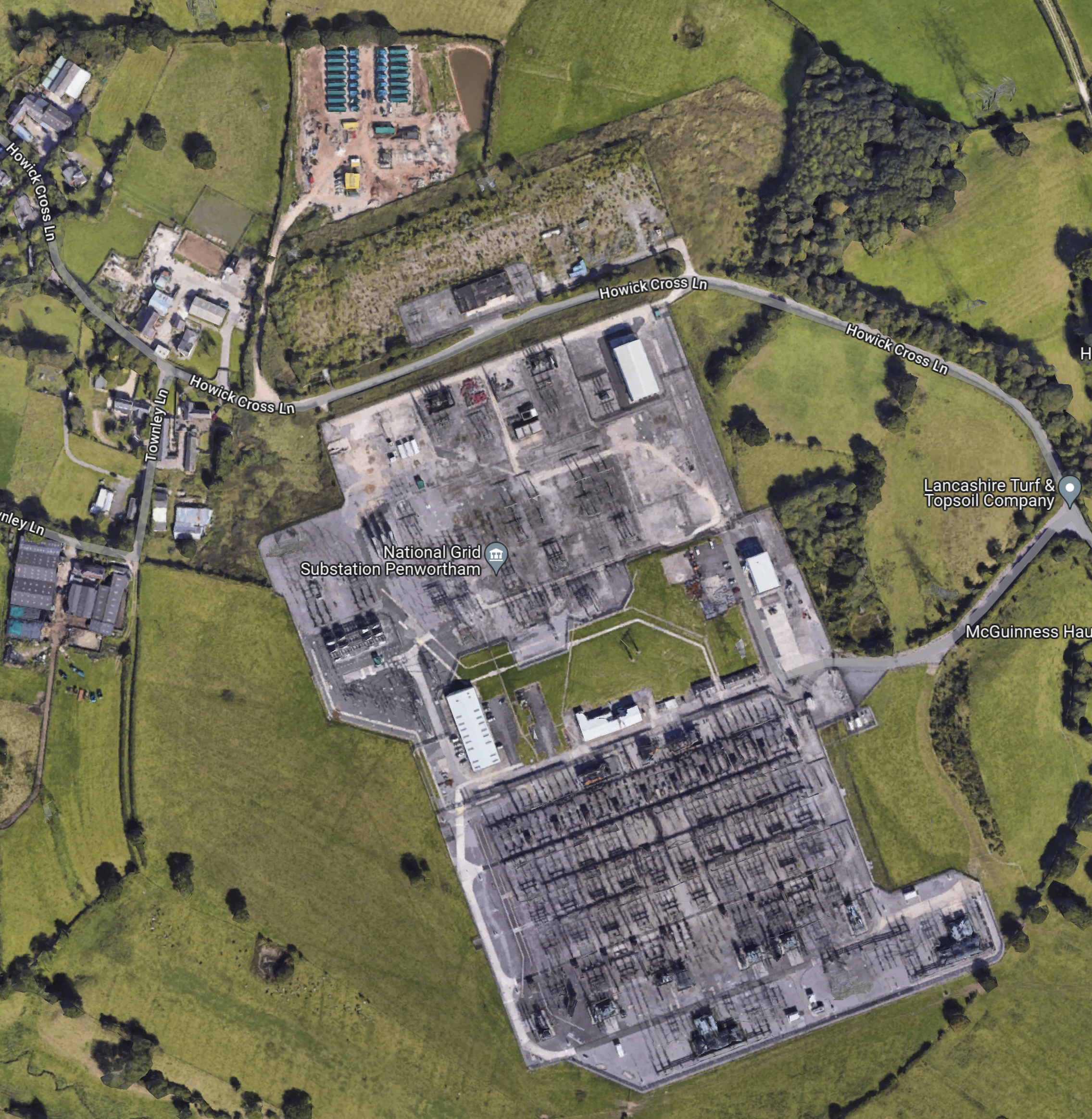
This Google Map shows the battery, which is located next to National Grid’s Penwortham substation.
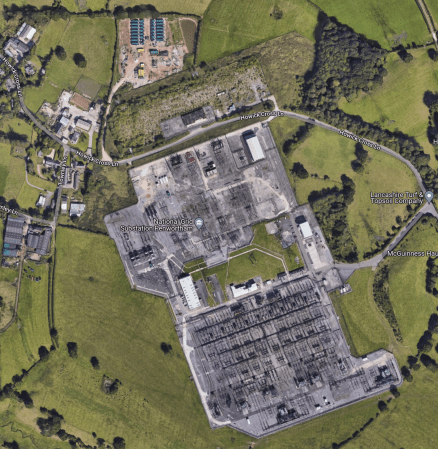
Note.
- The battery is the two rows of green containers at the top of the map.
- The substation appears to be large.
Co-location like this, must surely bring design, construction and operational advantages.
This page on the National Grid web site is entitled Network And Infrastructure, where this is said.
We own the national electricity transmission system in England and Wales. The system consists of approximately 4,500 miles of overhead line, over 900 miles of underground cable and over 300 substations.
If every substation in the UK were to be fitted with a 32 MW/64 MWh two hour battery, these would have a total capacity of 9.6 GW/19.2 GWh.
Compare that with these operational batteries and pumped-storage systems in the UK.
And these systems are under development
There are at least another four substantial pumped storage systems under development.
Conclusion
A twin-track approach of grid-batteries at sub-stations and a few larger grid batteries and pumped storage hydroelectric schemes should be able to provide enough storage.
May 15, 2024
Posted by AnonW |
Energy, Energy Storage | Battery Energy Storage Systems (BESS), Electricity Substation, Gresham House, Grid Battery, Loch Na Cathrach/Red John Pumped Hydro, National Grid, Preston, Pumped Storage Hydroelectricity, Two-Hour BESS |
2 Comments
The title of this post, is the same as that as this news item from Mercia PR.
As it is from the 16th of August last year, I wonder why my Google Alert didn’t pick it up.
This is the sub-heading.
Mercia Power Response, a key provider of flexible power response services to the UK grid, has signed an agreement with RheEnergise to explore the potential deployment of RheEnergise’s new and innovative form of long-duration hydro-energy storage, known as High-Density Hydro® (HD Hydro).
These are the first three paragraphs.
Mercia Power Response, a key provider of flexible power response services to the UK grid, has signed an agreement with RheEnergise to explore the potential deployment of RheEnergise’s new and innovative form of long-duration hydro-energy storage, known as High-Density Hydro® (HD Hydro). Mercia Power Response (“Mercia PR”) and RheEnergise will work together to identify suitable sites for additional HD Hydro storage projects. The two companies’ initial focus will be the feasibility of getting 100MW of HD Hydro in commercial operation by 2030 by utilising Mercia PR’s existing grid connections.
With 40 sites having a combined capacity of 263MW and a number of sites under development and construction over the next 5-10 years, Mercia PR believes that RheEnergise’s HD Hydro storage technology would be a complementary, low carbon solution to its operating portfolio.
Additionally, Mercia PR’s industry partners bring market expertise in energy trading and forecasting, helping RheEnergise to optimise grid-connected energy storage projects.
Note.
- The average size of Mercia PR’s batteries would appear to be 6.5 MW.
- Working on the often-used two-hour duration, that would be a storage capacity of 13 MWh.
- I suspect some of Mercia PR’s sites will be more suitable for lithium-ion batteries and some will be more suitable for RheEnergise’s HD Hydro systems.
- I have witnessed local Nimbys objecting to lithium-ion systems on grounds of the fire risk.
- I am fairly sure, that the National Grid will be able to cope with both lithium-ion batteries and RheEnergise’s HD Hydro systems.
- I suspect Mercia PR’s industry partners, with their market expertise in energy trading and forecasting, could turn a small wind or solar farm into a nice little earner.
This looks to be a good fit between two innovative companies.
May 4, 2024
Posted by AnonW |
Energy, Energy Storage | Grid Battery, Mercia PR, National Grid, Nimbies, RheEnergise, Solar Power, Wind Power |
1 Comment
The title of this post, is the same as that of this article on Energy Storage News.
These are the first three paragraphs.
A 100MW battery storage project in the UK connected to National Grid’s transmission network has gone online, developed by Pacific Green on the former site of a coal plant.
UK transmission system operator (TSO) National Grid has plugged in the 100MW/100MWh battery energy storage system (BESS) project to its 400kV Richborough substation.
The project, dubbed the Richborough Energy Park battery, is owned by asset manager Sosteneo Infrastructure Partners which acquired it from developer Pacific Green in July 2023.
A Transmission-Connected Battery
Thye Energy Storage News article says this about transmission-connected batteries.
Most BESS projects in the UK connect into the lower-voltage networks run by distribution network operators (DNOs) rather than National Grid’s high-voltage network. Benefits of the latter include a more reliable connection and better visibility in National Grid control rooms.
This would look to be a better way to connect a battery to the grid, but the battery must be able to supply electricity at 400 kV.
This Google Map shows the location of Richborough Energy Park.

Note.
- Richborough Energy Park is marked by the red arrow.
- The coast is the East Coast of Kent.
- The Prince’s Golf Club lies between the Energy Park and the sea.
This second Google Map shows the energy park in more detail.

Note.
- Richborough Energy Park is marked by the red arrow.
- The 336 MW coal-fired Richborough power station used to occupy the site.
- To its West is Richborough 400kV substation.
- There is a large solar park to the North.
- The 1 GW Nemo Link connects to the grid at the energy park.
- The 300 MW Thanet Wind Farm connects to the grid here.
It looks like an ideal place to put a 100MW/100MWh battery energy storage system, so that it can balance the wind and solar farms.
Sheaf Energy Park
This page on the Pacific Green web site is entitled Delivering Grid-Scale Energy Storage With A Global Reach.
Four battery projects are shown.
- Richborough Energy Park – In Operation
- Sheaf Energy Park – In Construction
- Limestone Coast Energy Park – In Origination
- Portland Energy Park – In Origination
The first two projects are in Kent and the others are in Australia. That is certainly global reach by Pacific Green.
I then found this page on the Pacific Green web site, that is entitled Pacific Green Acquires Sheaf Energy Limited – 249 MW / 373.5 MWh Battery Energy Storage Development In The UK.
These two paragraphs describe the acquisition and development of Sheaf Energy Park.
Pacific Green Battery Energy Parks 2 Limited, a wholly-owned subsidiary of Pacific Green Technologies, Inc. has acquired 100% of the shares in Sheaf Energy Limited (“Sheaf Energy Park”) for £7.5 million (US$9.1 million) from UK-based energy originator, Tupa Energy (Holdings) Limited.
Sheaf Energy Park will be a 249 MW / 373.5 MWh battery energy storage system (“BESS”) located next to the Richborough Energy Park in Kent, England. Design and construction will begin in the first half of 2023, with the energy park commencing its 35-year operating life in April 2025.
It looks to me that Pacific Green have found the figures for the construction and operation to their liking at Richborough Energy Park and have decided that to more than triple their investment in energy storage at the site will be very much to their advantage.
Conclusion
I suspect we’ll see other locations in the UK and around the world, with wind, solar, interconnectors and batteries working in harmony to make the most of the electricity available.
December 27, 2023
Posted by AnonW |
Energy, Energy Storage | Battery Energy Storage Systems (BESS), Coal-fired Power Stations, Grid Battery, Interconnectors, National Grid, Nemo Link, Pacific Green, Richborough Energy Park, Sheaf Energy Park, Solar Power |
Leave a comment
InterGen are developing two huge lithium-ion batteries, which seem to be rather under the radar of the mainstream media.
InterGen are an energy company, of which few people have heard.
On the About InterGen page, this is the sub-heading of a section describing their business.
InterGen is a uniquely independent energy company. We support the journey to a stable, dependable, net zero energy system through delivering the flexible electricity solutions that underpin it.
These four paragraphs introduce the business.
Founded in 1995, we have decades of experience in the GB market.
Our power stations provide secure, flexible energy to consumers, and help the grid to take on more and more renewables.
Our expert trading team in Edinburgh sells electricity and services to help utilities, system operators and the wider energy market deliver secure power to homes and businesses across the country, whilst our pipeline of new developments includes some of the world’s largest battery storage assets, an essential component in the future energy system.
The world is changing, and we’re proud to be playing an active role in the unfolding energy story for generations to come.
Batteries are very much for generations to come.
These four paragraphs on this page says this about their batteries.
Developing a large-scale energy storage capability will help to resolve the challenge of the intermittency of renewable generation. At InterGen, we’re managing the delivery of one of Europe’s largest battery storage portfolios, with over 2GW of grid scale projects, having dedicated grid connections and proceeding through the permitting process.
The share of wind and solar power is increasing in the UK’s energy mix, but these sources only generate power when the wind blows or the sun shines. The use of batteries to store the excess power generated can help provide low carbon power to balance supply and demand with renewable power during periods of low output.
InterGen’s UK battery projects are world-leading in this kind of technology deployment. The facilities will use proven lithium-ion technology which has zero emissions, has superior flexibility, and will complement the increasing amounts of renewable energy generation in the UK.
In Essex, our project at London Gateway Port to create up to 900MWh of energy received planning permission in January 2023, and when complete will be large enough to provide power for up to 450,000 homes. At Spalding, we have consent to develop up to 1.1GWh of storage capability, adjacent to our existing operational CCGT and OCGT plants. Both of these developments are world-class in terms of size. It’s all part of our goal to support the transition to low carbon generation through the provision of flexible capacity.
Gateway Energy Centre
This page describes the Gateway Energy Centre, where this is said.
InterGen is in late stage development of a world leading battery storage project in the London Gateway Logistics Park, next to the DP World London Gateway Port on the north bank of the River Thames in Essex. InterGen built and continues to operate the existing 800 MW Coryton gas-fired combined cycle power station which is located approximately one kilometre from the proposed Gateway Energy Centre site.
The Gateway project will consist of a Battery Energy Storage System (BESS) with a rated electrical output of up to 900MWh (up to 450MW).
InterGen received Town and Country Planning Permission in January 2023, making the Gateway project the largest battery in the UK once operational. The £300m project will provide power for over 450,000 homes once fully complete.
Note.
- I assume they mean this battery is a 450 MW/900 MWh battery, that will provide 450 MW for two hours.
- It is close to the 732 MW Coryton gas-fired combined cycle power station.
I would assume that one of its tasks will be to make sure the London Gateway complex gets rnough reliable power.
Spalding Energy Park
This page describes the Spalding Energy Park, where this is said.
The Spalding Energy Park, adjacent to InterGen’s existing combined and open cycle gas plants at Spalding, has received Town and Country Planning Permission in June 2023 for one of Europe’s largest battery storage projects. The battery development could deliver up to 1,100MWh of electricity once operational, providing power for up to 500,000 homes.
Spalding Energy Park received planning consent in January 2018 from the Department of Business, Energy and Industrial Strategy. The project is carbon capture ready.
As at Gateway Energy Centre, the battery is located close to a large 860 MW gas-fired power station.
Co-location of a gas-fired power station and a battery must make the grid connection simpler.
Conclusion
A total of 2 GWh of storage is a good start and I’ll suspect we’ll hear more about these two batteries in the next couple of years.
December 17, 2023
Posted by AnonW |
Energy, Energy Storage | bess, CCGT, Gas-Fired Power Stations, Gateway Energy Centre, Grid Battery, Intergen, Lithium-Ion Battery, London Gateway, Spalding Energy Park |
Leave a comment
The title of this post, is the same as that of this article on Renewables Now.
These two paragraphs outline the story.
Houston-based battery systems developer Plus Power LLC unveiled on Tuesday the completion of USD 1.8 billion (EUR 1.7bn) in new financing for the construction and operation of five standalone energy storage projects in Texas and Arizona.
The financing commitments, arranged in the form of construction and term financings, letters of credit, and tax equity investments, are dedicated to five projects with a combined capacity of 1,040 MW/2,760 MWh.
Note.
- This financing indicates how those banks and financial institutions with masses of money are prepared to put that money into energy storage.
- It is also good to see, that the journalist who wrote the story has given both the output of these batteries and their storage capacity.
- I can see many deals like this being done in the next few years.
But when will we see a financing deal like this for some of the other methods of storage that are being developed?
October 17, 2023
Posted by AnonW |
Energy, Energy Storage, Finance & Investment | Arizona, Grid Battery, Lithium-Ion Battery, Plus Power, Texas |
Leave a comment
The title of this post, is the same as that of this article on Energy Storage News.
I like the concept of taking the life-expired batteries out of electric vehicles and giving them a second life as grid batteries.
Smartville seem to have taken this simple and useful idea to a new level.
These are my thoughts.
The Internet Of Batteries
By the use of clever software, it appears, that they can control different types of battery packs, in a manner that could be called the Internet of Batteries.
They can also measure the state and performance and calculate the replacement date of each battery pack.
The Mother Of All Batteries
The implementation of this concept in their MOAB product allows the controlling software to manage a number of battery packs precisely to deliver a battery of the precise number of MWh, that the customer ordered.
- Provided an interface driver can be written, any type and make of battery pack can be incorporated.
- Nearly new, salvaged or elderly battery packs cab be used.
- The operating system can predict, when a battery pack must be replaced.
- Smartville are planning to install a 4MWh grid battery in central California that will be co-located with an existing power plant.
In some ways, the controlling software, is like the Chief Coach of a tug-of-war team, of mixed sexes, weights and strengths, that by asking for the right level of power from each member, gets the required performance.
Working With Tesla
The article talks about why, they don’t work with Tesla, where this is said.
Our experience in the US is that Tesla does not seem to be interested in working with outside partners. They’ve also publicly stated that they’re not focused on battery repurposing, not in their current business model at least, which I think might change over time. But that’s their public stance at the moment. We’re absolutely open to working directly with them but the opportunity hasn’t presented itself.
Does this indicate, that Tesla and Elon Musk are not the easiest people to deal with?
Conclusion
I shall be following Smartville.
December 27, 2022
Posted by AnonW |
Computing, Energy, Energy Storage | Battery Recycling, Elon Musk, Grid Battery, Smartville, Software, Tesla |
Leave a comment
In the two classic Japanese and American films of the fifties, there were seven saviours, who worked together.
This page on the Highview Power web site talks about their proposed CRYOBattery in Yorkshire, where this is said.
Highview Power’s second commercial renewable energy power station in the UK is a 200MW/2.5GWh facility in Yorkshire. This is the first of 18 sites for UK wide deployment strategically located to benefit from the existing transmission infrastructure.
As the UK’s energy problem is much worse than the problems in the films, perhaps we need more saviours.
In this article on the Telegraph, which is entitled Britain Will Soon Have A Glut Of Cheap Power, And World-Leading Batteries To Store It, Rupert Pearce, who is Highview’s chief executive, is quoted as saying the following.
Highview is well beyond the pilot phase and is developing its first large UK plant in Humberside, today Britain’s top hub for North Sea wind. It will offer 2.5GW for over 12 hours, or 0.5GW for over 60 hours, and so forth, and should be up and running by late 2024.
Further projects will be built at a breakneck speed of two to three a year during the 2020s, with a target of 20 sites able to provide almost 6GW of back-up electricity for four days at a time, or whatever time/power mix is optimal.
Is this Humberside CRYOBattery, the one on the web site described as in Yorkshire? It’s certainly in the old East Riding.
In Highview Power’s Plan To Add Energy Storage To The UK Power Network, I came to the conclusion, that the Humberside CRYOBattery will most likely be built near Creyke Beck substation, which is close to Cottingham.
- Dogger Bank A, Dogger Bank B and Hornsea 4 offshore wind farms will all be connected to the Creyke Beck substation.
- These wind farms have a total capacity of 3.4 GW.
- The Humberside CRYOBattery, now looks to have a maximum output of 2.5 GW.
- It looks like the Humberside CRYOBattery would be a well-matched backup to the three planned wind farms and perhaps even a few more turbines.
Building the Humberside CRYOBattery at Creyke Beck substation would appear to be a sensible decision.
We Only Have Half A Story
It looks like we’ve only got half a story, with a lot of detail missing.
- Will there be eighteen or twenty of Highview Power’s CRYOBatteries?
- Will they have a power output of 400 MW or nearly 6 GW for four hours?
- Will they have a storage capacity of 2.5 GWh or 30 GWh?
- Is the web site or the CEO correct?
- Have Highview Power and National Grid signed a deal for the next few CRYOBatteries?
I am expecting to see a big press statement at some time, perhaps even in the next few days, that will clear everything up.
If it was me, I would invite the new Prime Minister to the opening of the Carrington CRYOBattery and make the statement there.
The joint publicity could be equally valuable to both the Prime Minister and Highview Power.
August 28, 2022
Posted by AnonW |
Energy, Energy Storage | CRYOBattery, Dogger Bank Wind Farms, Grid Battery, Highview Power, Humberside, National Grid, Politics |
Leave a comment


 The Anonymous Widower