Grab-Handles In London Underground Train Entrances
I have been taking pictures of the grab-handles in the doors of London Underground trains.
Bakerloo Line
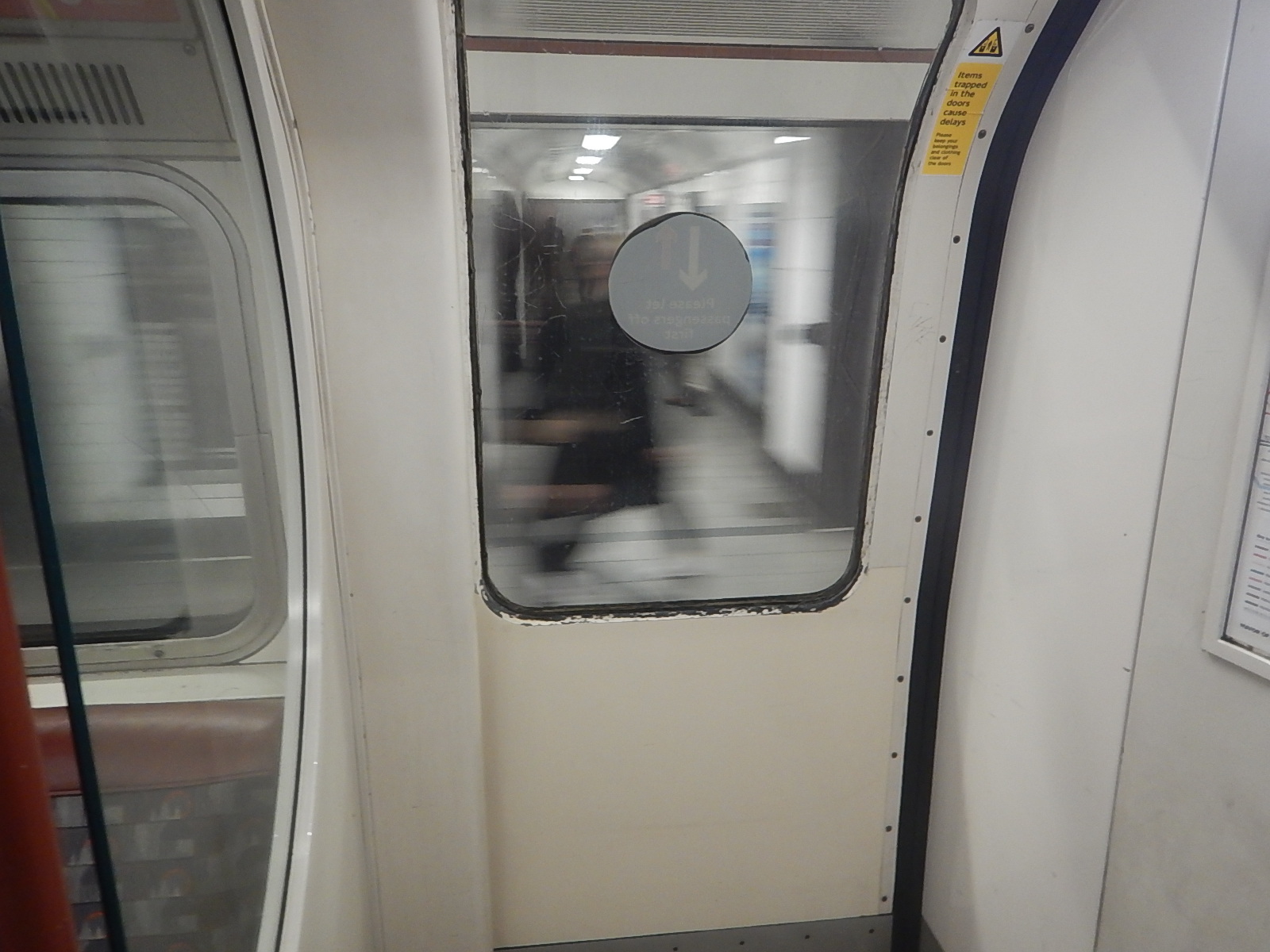
There are no grab-handles.
Central Line

The Central Line trains, which were built in 1991-4, probably set the original standard.
Hammersmith & City Line
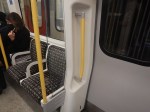



These are probably similar to Circle, District and Metropolitan Line trains.
Jubilee Line
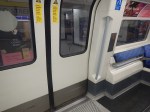
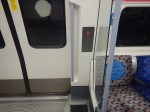
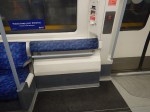
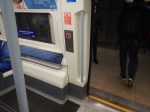
Note the long grab-handles tucked behind the doors.
Northern Line
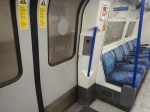
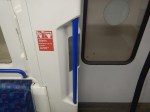

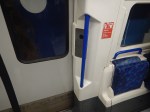
Note the long grab-handles tucked behind the doors.
There is also a cheeky one behind the wheelchair space. Although you would get into a Northern Line train in a wheelchair is another matter.
Piccadilly Line
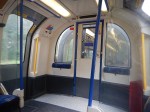


Despite their age, there is a full set of grab-handles.
Victoria Line

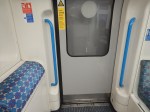
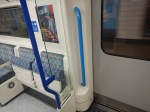
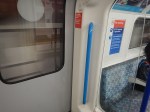
Note the long grab-handles tucked behind the doors.
Conclusion
I do find it strange that all the other Underground trains have vertical handles just inside the door, but the Bakerloo Line trains don’t have this valuable safety feature.
I think this could be dangerous.
I have a damaged left arm because the school bully broke my humerus. It can do most things, but some things are painful.
So when I get on a train, in case there is a step-up into the train, I position myself towards the right of the door. Then if there is a step-up, I reach forward and grab the handle and pull myself into the train.
Recently, I boarded a train on the Bakerloo Line platform at Waterloo. On finding there was no grab-handle I slipped slightly as I pulled back.
In the end I climbed into the train by holding on to the rubber edge of the door and got a very dirty hand.
Could this lack of grab-handles have contributed to a recent death at the station, that I wrote about in Death Of A Commuter At Waterloo?
I very much feel that grab-handles should be fitted to the doors on Bakerloo Line trains.
Should All Trains Have Grab Handles By The Doors?
These pictures show the vertical grab handles on London Overground Class 710 trains.
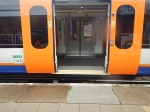
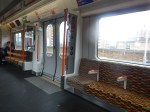
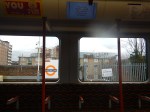
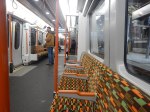
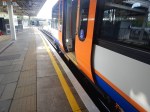


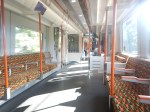
Note the vertical handles everywhere and especially tucked into the corner behind the door.
These pictures show the interior of a 1973 Stock train on the Piccadilly Line.
There are worse trains in the UK.
It should be noted that the trains were extensively refurbished in 1996-2001.
Should all trains have lots of grab handles like these two examples? And especially by the door?
I think they should.
This is an interesting picture of a Siemens design study, which I wrote about in Siemens’ View Of The Future Of The Underground.
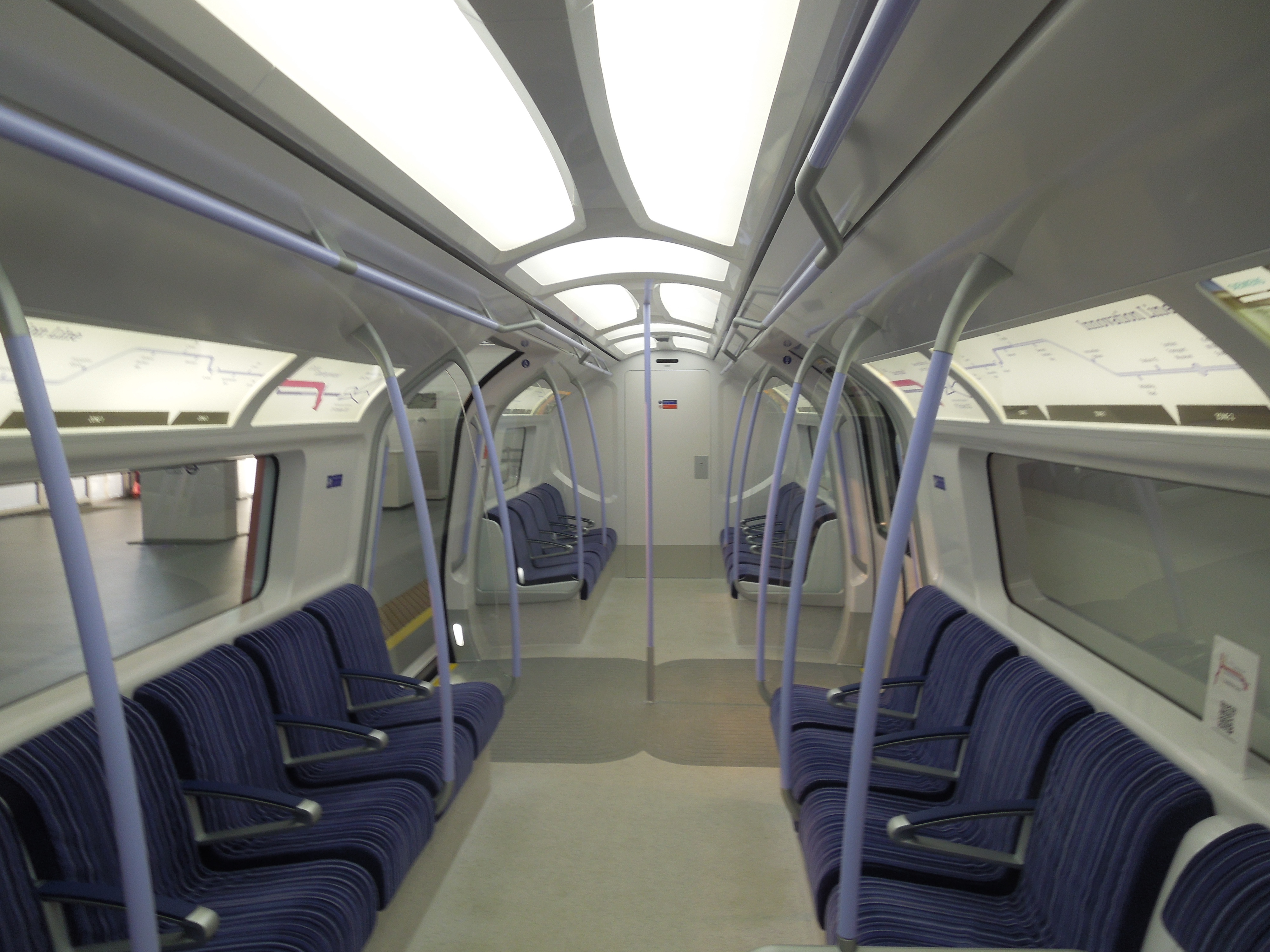
Note the grab handles by the sides of the doors.
So at least Siemens are following the rule of grab handles by the door.
Train-Platform Interface On Platform 1 At Willesden Junction
Access to trains at Willesden Junction station can be difficult for some people.
I took these pictures of the access between train and platform for a Bakerloo Line train at Platform 1.
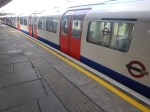

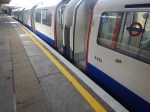
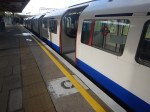
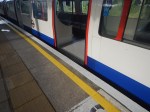
It is a step down from the platform of at least twenty centimetres.
These for a Watford DC Line train are not much better.


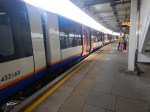
Once at this station, an elderly Indian lady in a sari was getting off one of these trains. She shouted something like “Catch me!” and jumped. Luckily, I caught her and it was smiles all round.
Of the ten stations that are shared by both services, it appears that only Queen’s Park has level access for both services.
These stations are an accident waiting to happen.
Death Of A Commuter At Waterloo
This tragic accident is reported in this article on ITV, which is entitled Commuter Crushed To Death After Falling Unseen Into Tube Gap At Waterloo.
These are the first two paragraphs.
A commuter was trapped and crushed to death by a Tube train after he fell down the gap on the northbound Bakerloo line train at Waterloo, an investigation has found.
Tube staff did not spot the man after he slipped and fell on to the track where he lay for more than a minute before being hit by a second train, the Rail Accident Investigation Branch (RAIB) said.
The accident is partly blamed on the curve of the track in the station.
I took these pictures at Waterloo station.
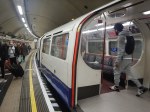

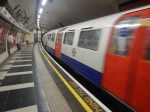
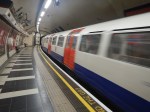
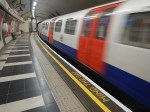


Note.
- Pictures were taken on both platforms, which are similar, as they are above each other.
- The gap is wide, but not the widest on the Underground.
- When I boarded a train, I realised there was no grab handle.
- I got my hand rather dirty using the door to pull myself across the gap.
Could this have been a factor in the death of the commuter, in that he looked for the grab handle, noticed there wasn’t one and then overbalanced?
This picture shows the detail on the inside of the door.
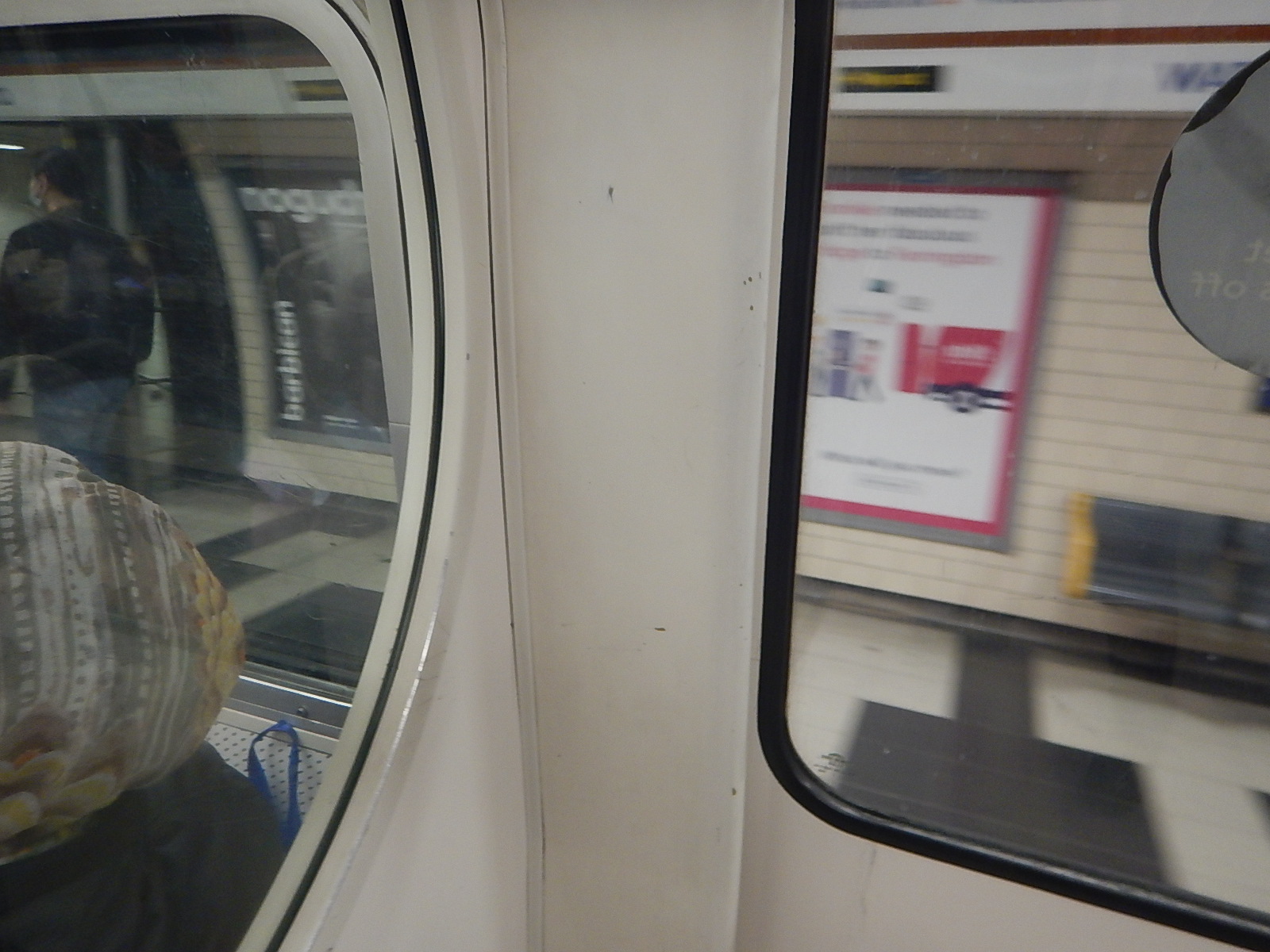
I’m sure a design could be created, that would give those who needed a pull-up something to grab.
Russian Convoys
This article on Railway Gazette is entitled Five-Train Platoons To Operate With Virtual Coupling.
This is the first paragraph.
Russian Railways is planning to use platooning technology to operate flights of up to five freight trains next year using radio data exchange between locomotives to create a virtual coupling. The aims to reduce headways from 12 to 6 to 8 min, increasing capacity on congested sections of the Trans-Siberian main line.
As a Control Engineer, I must believe that if the Russians get the programming right, then it should work.
Similar techniques will probably be used with digital signalling in the UK and Europe, where each train is controlled by the signalling. But each train will probably have a driver.
The problem in Russia could also be the large number of ungated level crossings, which according to some I’ve met are prone to a lot of accidents, as drivers regularly chance it after too much vodka.
ORR’s Policy On Third Rail DC Electrification Systems
The title of this post is the same as that of a document I downloaded from this page on the Office of Rail and Road web site.
It is one of the most boring legal documents, that I have ever read and I have read a few in my time.
As I read it, effectively it says that new third-rail electrification is banned because of Health and Safety issues, which take precedence.
But only once in the document is new technology mentioned, that might make third-rail safer and that is a reference to the Docklands Light Railway, where the third rail is shielded.
I am an Electrical Engineer and I was designing safety systems for heavy industrial guillotines at fifteen as a vacation job in a non-ferrous metals factory.
One design of an ideal electric railway would have battery-electric trains, that were charged in stations by third-rail. The third-rail would only be energised, when a train was over the top and needed to be charged. In effect the train would act as an all-enclosing guard to the conductor rail.
Electrification Of The West Of England Main Line
The West of England Main Line runs between Basingstoke and Exeter via Salisbury. It is one of the longest, if not the longest main lines in England, that is not electrified.
It would probably need to be electrified with 750 VDC third-rail electrification, as that standard is used between London Waterloo and Basingstoke.
In Solving The Electrification Conundrum, I described a system being developed by Hitachi, that would use battery-electric trains that were charged by short sections of electrified line every fifty miles or so. For reasons of ease of installation and overall costs, these short sections of electrification could be third-rail, that was electrically dead unless a train was connected and needed charging. These electrified sections could also be in stations, where entry on to the railway is a bit more restricted.
Conclusion
The Office of Rail and Road needs to employ a few more engineers with good technical brains, rather than ultra-conservative risk-averse lawyers.
As a sad footnote, I live in East London, where trespassers are regularly electrocuted on the railway. But usually, it is when idiots are travelling on top of container trains and inadvertently come into contact with the overhead electrification.
Frankfurt Starts Building Fuel Station For World’s Biggest Zero-Emissions Train Fleet
The title of this post, is the same as that of this article on Reuters.
These are the two opening paragraphs.
German regional transport group RMV began construction on Monday of a filling station near Frankfurt that will use hydrogen generated as a by-product of chemicals manufacturing to fuel the world’s largest fleet of zero-emissions passenger trains.
France’s Alstom will deliver 27 hydrogen-powered fuel cell trains to the Infraserv Hoechst industrial park in the Rhine-Main region in mid-2022. Starting regular local services by that winter, the fleet will replace diesel engines.
All the investment will be partly funded by fares.
Chlorine Manufacture
I find it interesting, that the article also states that the hydrogen comes as a by-product of chlorine manufacture. When I worked in a ICI’s electrolysis plant around 1970, their plant used the Castner-Kellner process to produce both gases.
The process uses a lot of mercury and Wikipedia says this about the future of the process.
The mercury cell process continues in use to this day. Current-day mercury cell plant operations are criticized for environmental release of mercury leading in some cases to severe mercury poisoning as occurred in Japan Minamata_disease. Due to these concerns, mercury cell plants are being phased out, and a sustained effort is being made to reduce mercury emissions from existing plants.
Are INEOS, who now own the Runcorn plant, and the Germans still using the Castner-Kellner process?
I remember two stories about the theft of mercury from the Runcorn plant.
Mercury was and probably still is very valuable, and it was always being stolen. So ICI put a radioactive trace in the mercury, which didn’t affect the process. The result was that all legitimate metal dealers on Merseyside bough Geiger counters to check any mercury before they bought it.
One guy thought he had found the ideal way to steal mercury, so he filled his bike frame with the metal and wheeled it to the gate. Whilst he clocked out, he propped the bike against the gate-house. Unfortunately, it fell over and because of the weight of the mercury, he was unable to pick it up.
My work in the plant, involved devising a portable instrument that would detect mercury in air and a colleague’s project was to develop a way of detecting mercury in urine samples from the plant operatives.
Those projects say a lot, about why we should be careful around any process involving mercury.
An Untidy Railway
I took these pictures as I returned from Eridge.


You see it all over the railways and not just in the UK; general untidiness!
When I joined ICI in 1968, I went on a thorough and excellent induction course.
One very experienced engineer, gave a Health and Safety Lecture and one thing he said, was that a neat and tidy chemical plant was less likely to have silly accidents.
Some years later, I went to the United States to see some of Metier’s clients, of whom some were nuclear power stations. This must have been just after the Three Mile Island accident, which is described like this in Wikipedia.
The Three Mile Island accident was a partial meltdown of reactor number 2 of Three Mile Island Nuclear Generating Station (TMI-2) in Dauphin County, Pennsylvania, near Harrisburg, and subsequent radiation leak that occurred on March 28, 1979. It is the most significant accident in U.S. commercial nuclear power plant history.
Artemis was involved in maintenance at the nuclear stations I visited. I can remember at AEP Donald C Cook nuclear station being shown a database of work to do and many of the actions were referred to as TMIs and checking them had been mandated by the US regulatory authorities.
I should say, the site on the shores of Lake Michigan impressed me, but another I visited later didn’t. I won’t name it, as it is now closed and it was the most untidy industrial plant of any type I have visited.
As we left, I gave my opinion to our support engineer and he told me they had a very large number of TMIs to process. I wasn’t surprised!
So why are railways generally so untidy?
Heated Railway Platforms Tested To Avoid Ice Accidents
The title of this post is the same as the first part of the title on this article on Engineering and Technology.
The platforms have been developed by researchers at Sheffield Hallam University and have received a share of the Government funding, I wrote about in First Of A Kind Funding Awarded For 25 Rail Innovation Projects, where it is Project 4.
These paragraphs describe the project.
The concrete slabs come with a built-in heating system that activates in freezing conditions to prevent dangerous icy conditions for passengers.
Rail Safety and Standards Board figures show that 19 people were killed and more than 7,000 were injured in accidents around platform edges on Britain’s railways in a recent five-year period.
It looks like there’s scope for this simple idea to save a few lives.
COVID-19 Reconstruction Projects
If the trial installation or installations, that will be paid for by the Government grant is or are a success, I can see large numbers of the UK’s three thousand or so stations being fitted with these platforms.
This is surely the sort of project, that could be rolled out on lots of sites across the UK to get the constriction industry working again, after COVID-19!
A Bus For The Twenty-First Century
What puzzles me, is why bus drivers in London, seem to be suffering more from COVID-19 infection, than drivers elsewhere!
In London, all buses have two or three doors and contactless ticketing, whereas in many parts of the UK, there is often only one door and no contactless ticketing.
This must mean, that there is generally less interaction between the driver and passengers in the capital. So logic would say, that outside of London, there should be more passing of infections between everybody on the bus.
An Observation In Manchester
Ten years ago, I observed behaviour on a single-door Manchester bus going to Oldham, with a union rep for bus drivers, who by chance happened to be sitting beside me.
The scrum as passengers entered and left the bus by the same door was horrific and the rep told me, that the local riff-raff were always trying to nick the driver’s money.
He told me, that a London system based on contactless ticketing was union policy and would cut attacks on staff, which he said had virtually stopped in London.
A Bus For The Twenty-First Century
The government has said that millions will be available for new zero-carbon buses, powered by hydrogen. I doubt that batteries will be able to provide enough power for many years.
It is my belief that given the new circumstances, that the bus should also have the following features.
- It should be as infection-unfriendly as possible, as COVID-19 won’t be the last deadly infection.
- Contactless ticketing by credit card or pass.
- Full CCTV to identify non-payers or those with stolen cards.
- Two doors with one in the middle for entry and one at the back for exit.
- It would be possible on some routes for both doors to be used for entry and exit.
- Wheelchairs would enter and leave by the middle door, where the ramp would be fitted.
I would put the stairs to the top deck on the left hand side of the bus, with the foot of the stairs leading directly into the lobby by the middle door.
The Van Hool ExquiCity
The Van Hool ExquiCity is an alternative solution, that is already running in Belfast, where it is named Glider.
It is probably best described as a double-ended articulated bus, that runs on rubber tyres, that thinks it’s a tram.
This press release from Ballard is entitled Ballard-Powered Fuel Cell Tram-Buses From Van Hool Now in Revenue Service in France, describes the latest hydrogen-powered version of the Exquicity, which is now in service in Pau in France.
- Each bus appears to be powered by a 100 kW hydrogen fuel cell.
- The buses are over eighteen metres long.
- Twenty-four metre double-articulated tram-buses are available.
- The buses seat 125 passengers
- The buses have a range of 300 kilometres between refuelling.
I like the concept, as it brings all the advantages of a tram at a lower cost.
Here’s a video.
It certainly seems a quiet bus.
I desperately need to get to Pau to see these vehicles.
Conclusion
We could design a new bus for the twenty-first century, that tackles the problems facing the bus industry.
- Climate change and global warming.
- Control of deadly infections like COVID-19.
- Efficient, fast ticketing.
- Attacks on staff.
- Petty crime.
- Access to public transport for the disabled, the elderly and those with reduced mobility.
We certainly have the skills to design and manufacture a suitable bus.
 The Anonymous Widower