A Design Crime – The Average Smoke Detector
On Saturday Evening, the smoke detector in my bedroom decided to go off.
I was able to silence it about three times, but it refused to go off permanently.
I then decided to take it down, by standing on the bed.
Unfortunately, I slipped and broke the detector.
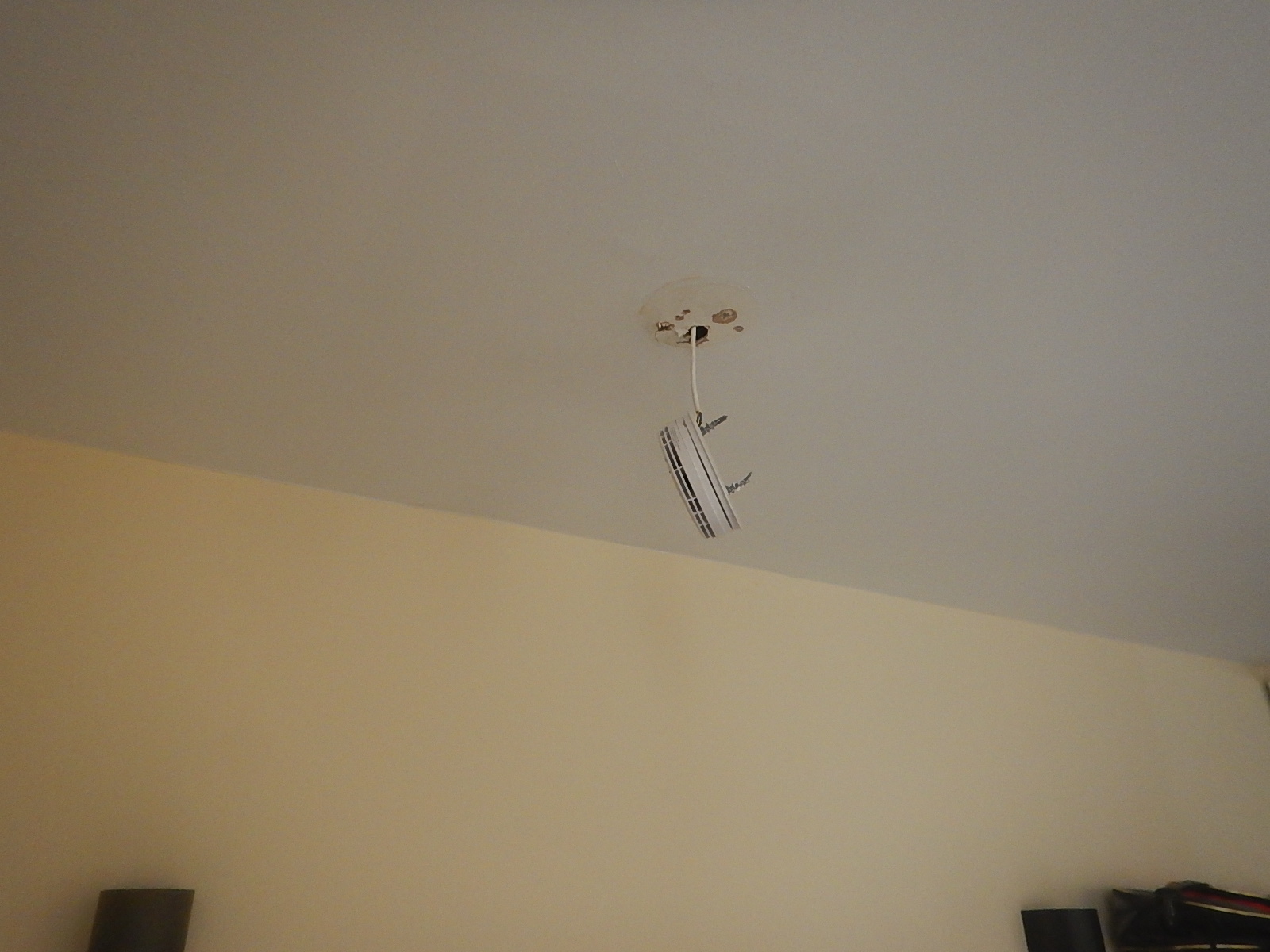
It is not the first altercation, I have had with the cheap and nasty smoke detectors in this house, which were probably bought in Istanbul market for a few pence.
- In my view, there is a need for a superior type of smoke detector wired into a building in a better way.
- It should be possible to replace a failed detector, like I had on Saturday in a simple operation without any tools.
- There should also be a master switch in the house, that switches off all the smoke detectors.
- Instructions on how to deal with the smoke detectors in case of failure should be in an obvious place in the house, like on the door of the meter cupboard.
Smoke detectors are too important, to be designed down to the cheapest possible station and most are a true design crime.
Hands-Free Phone Ban For drivers ‘Should Be Considered’
The title of this post, is the same as that of this article on the BBC.
This is the introductory paragraph.
Drivers could be banned from using hands-free mobile phones in England and Wales, a group of MPs has suggested.
I don’t drive and I rarely use a mobile phone to make or receive a phone all, so it won’t bother me much.
But sitting in my preferred slightly-raised position in the downstairs facing-seats on a New Routemaster bus, it’s amazing the number of drivers you see having a phone conversation or typing.
Recently, I nearly had a collision whilst walking along Moorgate.
A young lady going the other way was having a video call with her phone in front of her face. I went left to pass on the road side, as gentlemen are supposed to do and she went the same way.
Luckily, she saw me at the last minute!
So if drivers are to be banned from mobile use, whilst driving, what about banning pedestrians from mobile use, whilst walking on busy streets?
Thoughts On eScooters!
Consider.
- This article on the BBC is entitled Emily Hartridge: TV Presenter And YouTube Star Dies In Crash. It is an extremely sad tale and it has led to the inevitable call to ban electric scooters.
- There is also this article on the BBC, which is entitled Iris Goldsmith: Teenage girl dies in ‘quad bike’ accident. This is another extremely sad tale and many are questioning, what a teenage girl was doing, riding a quadbike.
- And then there’s this article on the BBC, Which is entitled Govia Thameslink Fined £1m Over Gatwick Express Window Death.
Young people and some older ones too, often do stupid things.
Many also crave danger and go mountaineering, riding on the tops of trains or jumping into rivers from a great height.
Doing things out of the ordinary is a natural reaction and is one of the reason, why humans are the most successful species on this planet.
I think the problem is the way we bring up children.
- My parents let me do anything I wanted up to a point.
- They also taught me lots of skills.
- From about twelve, I used to cycle all over London.
- I spent endless hours in my father’s print works doing things that would be frowned upon now, because they are too dangerous.
A couple of months ago, I was interviewed by a sixth-form girl student, in the volunteering I do at Barts Hospital in giving experience to prospective doctors.
She had lived in an over-protective environment and hardly left home on her own.
It was almost child abuse. She didn’t say, but I suspect she’d even been driven to and from school.
When it came to our own children, C and myself were fairly liberal and it was strange how, two became very street-wise and had the occasional scrapes, whereas the other was generally well-behaved.
Perhaps, we didn’t get everything right, but I like to think, we gave them a good appreciation of risk!
And that is one of the mot important things to learn in life, as often, those that ca’t assess risk, come to unfortunate ends.
I do feel my youngest son’s unhealthy lifestyle was a factor in his getting pancreatic cancer, especially if he was coeliac like me! But then he wouldn’t get tested!
His daughter though, seems to have a good appreciation of risk, but then if your father dies, you probably do!
To return to the eScooter, which is where this post started.
They Look Fun!
They certainly look fun and I constantly want to have a go on one.
Remember, I have crashed a twin-engined aeroplae and ridden horses in the Masai Mara.
At seventeen, I also sat on the back of a motorcycle, the wrong way round and went through the Mersey Tunnel.
Was I wearing a helmet? Of course not!
Are They Dangerous?
The risk depends on where they are used and how competent the rider is!
Ask any A & E doctor, what sport causes the most injuries and they’ll say something like rugby or horse-riding!
When A & E doctors start complaining about eScooters that will be the time for action.
Would Training Help?
Training isn’t the important thing.
However experience, especially that gained in a safe environment is important.
But to legislate that training should be mandatory will only have the reverse affect.
Conclusion
It’s a difficult problem, but we must teach everybody to appreciate risk.
When I joined ICI in 1969, I went on a formal Health and Safety course.
It has proven to be invaluable all my life an I haven’t worked on a chemical plant since 1970.
Ban Gas Hobs And Heating In Six Years, Ministers Told
The title of this post is the same as that as an article on the front page of yesterday’s copy of The Times.
This is the first paragraph.
Gas boilers and cookers should be banned in new homes within six years to meet Britain’s legally binding emissions targets, the government’s climate change advisory body recommends today.
I don’t like gas, as I find that naked gas flames affect my health, so I cook electric.
In addition to its role in carbon dioxide production, I don’t like the safety problems with gas.
Would the Grenfell disaster have been so serious, if there had been no gas in the building?
Station Dwell Times On The London Overground
This afternoon, I had to go to Walthamstow for lunch, so on the way out, I checked how long it was between brakes on at James Street station and the Class 315 train was moving again.
The dwell time was a very respectable thirty seconds, which is probably more down to the driver and the signalling, than the nearly-forty-year-old train.
Coming back, I took the Gospel Oak to Barking Line to Gospel Oak station..
The driver gave a display of precision driving a Class 172 train, with the intermediate stops, all taking thirty seconds or less.
From Gospel Oak, I switched to the North London Line and took a Class 378 train to Canonbury station, from where I walked home.
The dwell times on this line were more variable, with two times at thirty seconds or less, two at nearly two minutes and the rest in-between.
From these small number of observations, it would appear that the minimum dwell time on the London Overground is thirty seconds.
Various factors will determine the actual dwell time.
- Trains must not leave early, as passengers don’t like this.
- Trains must not leave, before the driver has ascertained it is safe to do so.
- If a train arrives early, then the dwell time might be lengthened, even if the train leaves on time.
- Large numbers of passengers or a passenger in a wheelchair, who needs a ramp will lengthen the dwell time.
I should say that today, the trains were not full and there were plenty of empty seats.
Conclusions
If trains and drivers can handle thirty second dwell times, then everything else associated with a station stop, must be capable of the same fast response.
This thirty-second dwell time may have repercussions for rapid charging of battery/electric trains, that I wrote about in Charging A Battery-Powered Class 230 Train.
I think there are three options for charging a train at a station stop.
Plug the Train Into A Power Socket
Can you plug you mobile phone into the mains, give it a reasonable charge and then disconnect it and store all leads in thirty seconds?
Use a Pantograph To Connect To 25 KVAC Overhead Electrification
Even if a driver or automation is very fast at raising and lowering the pantograph, I don’t believe that in a total time of thirty seconds, enough electricity can be passed to the train.
This method might work well in longer stop at a terminal station, but it is unlikely, it could be used successfully at an intermediate stop.
Use 750 VDC Third-Rail Electrification
750 VDC third-rail electrification has a very big advantage, in that, trains can connect and disconnect to the electrification automatically, without any driver intervention.
Look at this picture of a train going over a level-crossing.

The ends of the third-rails on either side or the crossing are sloped so that the contact shoes on the train can disconnect and connect smoothly.
As you have to design the system for a possible thirty-second stop and don’t have the time available for the first two options, I am fairly certain, that the only way a worthwhile amount of electricity can be transferred to the train’s battery, is to use some form of system based on tried-and-tested 750 VDC third rail electrification.
There may also be advantages in using a longer length of third-rail, so that the connection time is increased and more than one contact shoe can connect at the same time.
Automation would control the power to the third-rail, so that no live rail is exposed to passengers and staff.
After all a train on top, is a pretty comprehensive safety guard.
.
New Safety Issue Emerges: LNER Azumas Put On Hold
The title of this post, is the same as that of an article in Edition 863 of Rail Magazine.
One reason is that when running North of York, there is electro-magnetic interference with the signalling in electric mode.
But the other is that the inter-vehicle connectors could be used to climb on the roof. Apparently a man.of very little brain was killed, when he climbed on the roof of a Class 390 train at Manchester Piccadilly using that trains similar connectors.
Perhaps everybody who goes within fifty metres of a railway should have to see a psychiatrist first and be given a certificate. And that would be necessary for driving across a level crossing!
Thoughts On The Lateness Of Crossrail
This article on the BBC is entitled Crossrail Delay: New London Line Will Open In Autumn 2019.
This is the first paragraph.
London’s £15bn Crossrail project is to open nine months after its scheduled launch to allow more time for testing.
I spent most of my working life, writing software for the planning and costing of large projects and despite never having done any serious project management in anger, I have talked to many who have, both in the UK and around the world.
So what are my thoughts?
Crossrail Is A Highly-Complex Project
The project involves the following.
- A 21 km double-track tunnel under London.
- New Class 345 trains
- Four different signalling systems.
- Rebuilt stations at West Drayton, Hayes & Harlington, Southall, West Ealing, Ealing Broadway. Acton Main Line, Forest Gate, Manor Park, Ilford
- Refurbished stations at Hanwell, Maryland, Seven Kings, Goodmayes, Chadwell Heath, Romford, Gidea Park, Harold Wood, Brentford and Shenfield.
- Major interchanges with existing stations at Paddington, Bond Street, Tottenham Court Road, Farrington, Liverpool Street, Whitechapel and Stratford.
- New stations at Custom House, Canary Wharf, Woolwich and Abbey Wood.
Some parts are easy, but a lot are very difficult.
A Shortage Of Specialist Workers
I believe that certain factors could be reducing the pool of workers available to Crossrail.
Less workers than needed would obviously slow the project.
Having to pay more than budgeted to attract or keep workers will also raise costs.
My thoughts on what is causing a possible shortage of specialist workers follow.
Crossrail-Related Development
If you own a site or a building, near to one of Crossrail’s stations, then your property will substantially increase in value, when the line opens.
Walk past any of the Crossrail stations in Central London and some further out and you will see towers sprouting around the station entrance like crows around a road-kill.
Developers know how to cash-in on the best thing that has happened to them since the Nazis flattened acres of Central London.
New sites are also being created over several Crossrail stations including Moorgate, Farringdon (2 sites), Tottenham Court Road (2 sites), Bond Street (2 sites) and Paddington.
But do all these extensive developments, mean that there are not enough sub-contractors, specialist suppliers, electricians, chippies, air-conditioning engineers, plumbers and other trades to do all the work available in London?
I also suspect a developer, building an office block to the world’s highest standard could pay better and faster, than a Crossrail supplier under pressure.
Underground Working
Working underground or in mining is dangerous.
In the 1960s, women were totally banned from working below the surface.
It must have been around 1970, when I met one of ICI’s archivists; Janet Gornall, who a few years previously had organised storage of their masses of historical documents, in the company’s salt mine at Winsford. The mine is still used for document storage, by a company called Deepstore.
Health & Safety found out that Janet would be supervising and indexing the storage underground, so that if any document was required, they could be easily retrieved. This caused them to give the scheme a big thumbs down.
Questions were even asked in the House of Commons, but nothing would change Health & Safety’s view
In the end a simple solution was found..
- As the boxes came up from London they were piled up in a large building on the surface, in the position Janet wanted them underground.
- The pile of boxes was then moved underground and stacked in exactly the same way.
- Nowadays, anybody can work underground, but they must have training and be certified for such work.
Crossrail thought the number of certified underground workers might not be enough, so they set up the Tunnelling and Underground Construction Academy (TUCA) at Ilford. This article on the Crossrail web site is entitled A Legacy To The Construction Industry.
Some points about TUCA.
- It is now part of Transport for London.
- It was funded by Crossrail and the Skills Funding Agency.
- TUCA is Europe’s only specialist soft-ground tunnelling training facility.
I wrote about TUCA in Open House – TUCA, after a visit in 2012.
I was told on my visit, that the Swiss have a similar facility for rock tunnelling and that there were plans for both academies to work together.
Trainees from all over the world would get training in an exotic Swiss mountain and then go on to enjoy the wonders of Ilford.
But at least they’ll be safe workers for all types of tunnelling.
I do wonder if some of the Crossrail delays has been caused by a lack of properly trained underground workers, as now the tunnelling is completed, many have moved on to the next project.
Thames Tideway Scheme
The Thames Tideway Scheme is a £4billion scheme to build a massive sewer under the Thames to clean up the river.
Many Crossrail engineers, tunnellers and workers are now working on the new scheme.
Brexit
Stuttgart 21 is one of numerous mega-projects in Europe.
Many of the workers on Crossrail were originally from Europe and now with the uncertainties of Brexit, some must be moving nearer home, to work on these large European projects.
Well-Paid Jobs In Sunnier Climes
Don’t underestimate, the effect of the Beast From The East last winter.
Skilled personnel have always gone to places like the Middle East to earn a good crust.
With Crossrail under pressure, how many of these key workers have gone to these places for the money?
Conclusion
I wouldn’t be surprised to find that a shortage of specialist workers is blamed for the delays.
In the BBC article, there is this quote
We are working around the clock with our supply chain and Transport for London to complete and commission the Elizabeth line.
Fairly bland, but does the supply chain include specialist suppliers and workers, which are under severe pressure from other projects to perform various works?
It’s probably true that there is only a finite pool of these companies, tradesmen and workers and at least some of the best will have been lured away.
Station Problems
In this article in the Architects Journal, which is entitled Crossrail Delayed Until Autumn 2019, this is said.
Crossrail then revealed in February that it had overspent its budget for the year to 30 March 2018 by £190 million.
At the time TfL said works at Whitechapel station, designed by BDP, and Farringdon station, designed by AHR, were completed later than expected, and there were delays to work at Weston Williamson’s Woolwich station and John McAslan + Partners’ Bond Street station.
I’ll look at Whitechapel station as an example.
You don’t need to be an expert to figure out that Whitechapel station is running late.



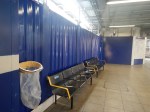
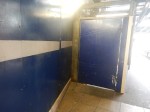
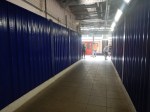
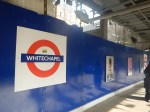
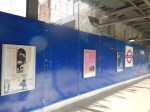
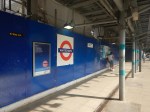
Look at all the blue hoardings.
- I know this only shows what is visible to the public.
- The Crossrail platforms deep underground could be ready.
- The main entrance to the station is still shrouded in plastic.
- The escalators to get down to Crossrail, will be between the two District/Metropolitan Line platforms.
This Google Map shows the area of Whitechapel station.
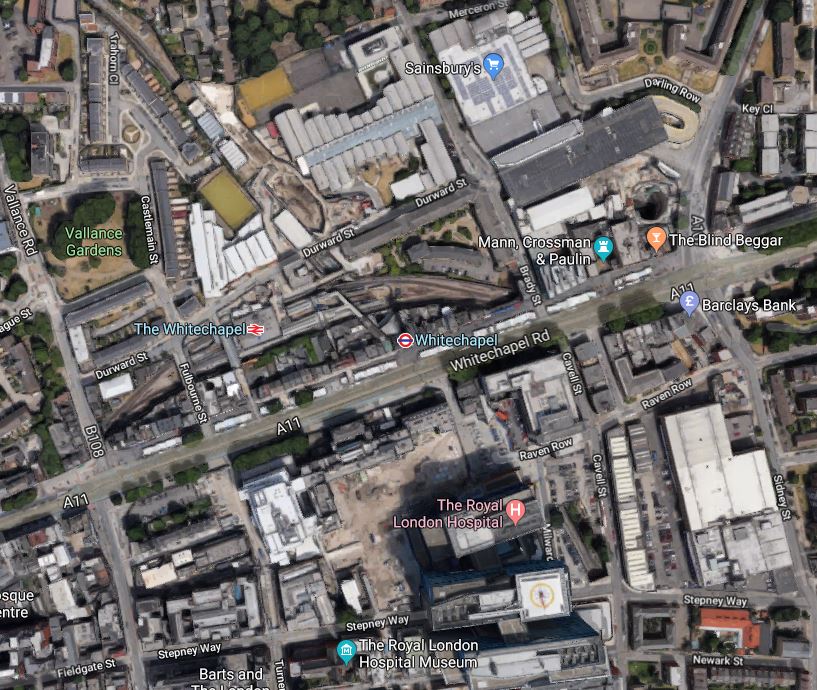
Note how the site is hemmed in, by important buildings including a Sainsburys supermarket and Swanlea School.
See An Innovative Use Of The School Holidays, for an insight about how the builders of the station coped with the lack of space.
I also feel that Whitechapel is an incredibly complex station to build.
- It is crossed by two important railways; the District/Metropolitan Line and the East London Line.
- Innovative techniques from the coal mining industry had to be used to dig the escalator tunnel.
- Whitechapel will be the station, where passengers change between the two Eastern branches.
I do wonder, whether a different design would have been easier to build.
For instance, could Sainsburys have been paid to shut their superstore and that site used to build the station?
But Crossrail has chosen a design and now they must build it.
The New Class 345 Trains
The new Class 345 trains for Crossrail are an almost totally new design called Aventra by Bombardier, that I believe has been specifically created to make the operation of Crossrail as efficient as possible.
The trains must have something about them, as since launch they have attracted five more substantial orders, from five different operators.
The introduction into service of the Class 345 trains, has been reasonably straightforward, but not without some issues.
But I do question, the launching of Aventra trains solely on a line as complex as Crossrail.
Would it have been easier to have built the Class 710 trains first and thoroughly debugged them on the Gospel Oak to Barking Line.
But then that electrification was late.
Four Types Of Signalling
Crossrail needs trains to have four different types of signalling.
- CBTC – Communications-Based Train Control
- ETCS – European Train Control System
- AWS – Automatic Warning System
- TPWS – Train Protection & Warning System
I know that as Crossrail runs on other lines with these signalling and going to a single system like ETCS would need to the changing of signalling systems on much of the railways in the South-East and the trains that use them.
It appears that there are problems for the trains running into Heathrow and one of the reasons for the Crossrail delayed opening, is to allow more time to test the trains and the signalling.
From my experience of writing complex software systems, where my software needed to interface with two operating systems, I know that you can never put too much time into testing complex systems.
So where is the dedicated test track, where trains can simulate the signalling of Crossrail routes, day in and day out?
I believe that not enough time and money was allocated to test this complex system.
Crossrail has found out the hard way.
Europe Has A Lack Of Train Test Tracks
A lot of European nations are ordering new trains and the UK is probably ordering more than most.
Reading the railway stories on the Internet, there are lots of stories about trains being brought into service late. And not just in the UK, but in Germany and Italy for example.
Crossrail identified that there was a need for a training academy for underground workers.
Did anybody do the calculations to make sure, there was enough test tracks for all the trains being built in Europe?
However, it does look as though Wales is coming to rescue Europe’s train makers, as I describe in £100m Rail Test Complex Plans For Neath Valley.
I suspect Crossrail wish this test complex had been completed a couple of years ago.
A Shortage Of Resources
For successful completion of projects on time and on budget, there must be enough resources.
I believe that, when the lateness and overspend on Crossrail is analysed, shortage of resources will be blamed.
- Shortage of people and suppliers, that has not been helped by other projects taking advantage of new opportunities offered by Crossrail.
- Shortage of space for work-sites at stations.
- Shortage of places to fully test trains and signalling.
I suspect that the last will be the most serious.
Hugo Rifkind On A Late Crossrail
In an excellent article in today’s copy of The Times entitled Leavers Have A Cheek Trying To Block HS2, Hugo Rifkind says this about Crossrail.
You think we’ll remember, 50 years from now. that Crossrail took six months longer than expected?
Rubbish. London will rest on it like a spine and boggle that we ever managed without.
I think Rifkind is right.
Will Hutton
Will Hutton has written this article in the Guardian, which is entitled Don’t Moan About Crossrail. Once Complete, It Will Be A Rare Triumph In Our Public Realm.
He says this.
Let’s sing a different tune. The railway line, more than 60 miles long, linking Reading and Heathrow in the west to Shenfield and Abbey Wood in the east – adding 10% to London’s commuter rail capacity – and set to carry around 200 million passengers a year, will be a fantastic achievement. Its 13-mile-long tunnels run more than 100ft under the capital’s streets, navigating everything from underground sewers to the deep foundations of skyscrapers with superb engineering aplomb. The longstanding reproach is that Britain can’t do grand projects. Crossrail, now christened the Elizabeth line, is proof that we can.
He then goes on to criticise the structure of the construction project, the salaries paid and the current Government.
But I suspect that in a few yeas time, Hutton, Rifkind and myself could have a quiet pint and say Crossrail got it right.
Current Developments That Will Help Bridge The Delay
It’s not as if, no new transport developments won’t happen in the time before Crossrail eventually opens in Autumn 2019.
Trains Providing More Capacity
These trains will be providing extra capacity.
- New Class 717 trains will be running on the services to and from Moorgate station.
- New Class 710 trains will be running on the Gospel Oak to Barking Line.
- New Class 710 trains will be running on the Lea Valley Lines to Cheshunt, Chingford and Enfield Town stations.
- New Class 710 trains will be running on the Watford DC Line.
- Cascaded Class 378 trains and new Class 710 trains will be running extra services on the original circular service of the London Overground.
- More Class 345 trains will be providing all of Crossrail’s services to Heathrow and Shenfield.
- New Class 720 trains or something similar or older, will be providing four trains per hour (tph) between Stratford and Meridian Water stations.
Note that before the end of 2019, nearly a hundred new trains will be delivered.
New And Rebuilt Stations
There will be some new or rebuilt stations.
- Acton Main Line
- Forest Gate
- Gidea Park
- Hayes & Harlington
- Manor Park
- Maryland
- Meridian Water
- Northumberland Park
- Tottenham Hale
- West Drayton
- West Ealing
- West Hampstead
This list may contain other stations.
Underground Improvements
There will also be Underground improvements.
- The Central Line Improvements Programme will increase capacity and reliability on the Central Line.
- The Metropolitan Line is being upgraded with new signalling.
- Up to ten Underground stations may be made step-free before the end of 2019.
The improvements to the Central and Metropolitan Lines, through Central London will compensate for the delaying of Crossrail’s core tunnel.
A Few Questions
I have to ask questions.
Will The High Meads Loop Be Used?
This would provide an excellent interchange between the following services.
- Local services to Hertford East and Bishops Stortford stations, including the new STAR service, along the West Anglia Main Line.
- Stansted Express and Cambridge services to and from Stratford.
- Fast Greater Anglia services to Chelmsford, Colchester, Southend and further, along the Great Eastern Main Line.
- Crossrail services between Liverpool Street and Shenfield.
- Central Line services.
There is also only a short, but tortuous walk to the Jubilee Line for London Bridge and Waterloo stations and Central London.
Based on the experience of the Wirral Loop under Liverpool, which handles sixteen tph, I believe that the High Meads Loop could handle a substantial number of trains, that instead of using the crowded lines to Liverpool Street station, would use the new uncrowded route from Tottenham Hale to Stratford via Lea Bridge station.
Moving services to Stratford from Liverpool Street would also free up platforms at the major terminus, which could be used to provide extra services on the Great Eastern Main Line.
The extra capacity might also enable the lengthening of the Crossrail platforms at Liverpool Street to be extended, so they could take full-length Class 345 trains.
No new extra infrastructure would be required at Stratford, although in future, a platform to connect the loop to Stratford International station would be nice.
I will be very surprised if the High Meads Loop is not used creatively in the future.
Will Some New Pedestrian Tunnels At Stations Like Liverpool Street And Paddington Be Opened?
I use Moorgate and Liverpool Street stations regularly.
There are blue walls everywhere, behind which the Crossrail infrastructure is hiding.
I do hope Crossrail and Transport for London are looking at the possibilities of using completed infrastructure to create new walking routes in stations to ease congestion.
Conclusion
Crossrail was designed to be opened in four phases over two years.
I am drawn to the position, that because of various resource shortages and the testing of trains, perhaps the project could have been arranged as perhaps a series of smaller projects delivered over a longer period of time.
Please Do Not Wait In The Green Lanes
These pictures show an experiment in Kings Cross St. Pancras tube station, on the Southbound Victoria Line platform, which aims to make boarding and unloading of trains faster.


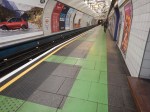
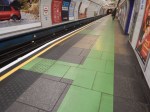
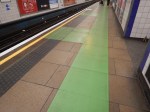
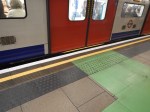
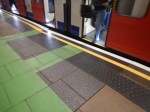
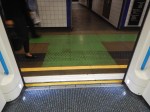
The idea is you don’t wait on the green lines, which are reserved for those getting on and off the trains.
The pictures were taken at ten in the morning, so I’ll go back one day in the Peak, to see how it works at a busy time.
But I do think it could be a good idea and a bit like platform edge doors, without the expense of the doors.
Note how the train stops precisely as indicated by the green lines. But then the stopping position of the train is determined automatically and has been since the Victoria Lie opened in 1967.
UK Ditches Electrification Plans In Wales, The Midlands And The North
The title of this post is the same as that of an article in Global Rail News. This is the first two paragraphs.
The UK government has abandoned plans to electrify the railway between Cardiff and Swansea, the Midland Main Line north of Kettering and the line between Windermere and Oxenholme in favour of bi-mode, or ‘alternative-fuel’, trains.
An announcement from the Department for Transport (DfT) this morning said electrification of the lines was no longer needed and that cancelling the work would result in less disruption for passengers.
So do I agree with the Government’s decision?
Before I answer that question, I will put a few facts into this post!
All Trains Should Be Powered By Electricity
Most trains in the UK are actually powered by electricity.

If you take the noisy and smelly Class 66 locomotive, the wheels are actually turned by electricity, although that electricity is generated by a 2,460 kW diesel engine and an alternator, which is then fed to the traction motors.
The great advantage of electricity is that when you need to deliver precise power to move the train, it is very easy to control.
As an example of precise electric control, think of a variable-speed drill or food mixer.
What makes some trains more efficient than others, is the way they handle the electricity and get it to the traction motors.
Electrification; Overhead Or Third Rail
Ptobably the most efficient way to get electrical power to a train is from an electrification system, which in the UK can be 25 KVAC overhead wire or 750 VDC third rail.
25 KVAC overhead electrification has the following problems.
- Bridges and tunnels must be raised or enlarged to give sufficient clearance for the wires.
- Stations must be designed so that passengers can’t get near the wires.
- Overhead wires are liable to damage.
- Overhead gantries can be unsightly and subject to objection by local interest groups.
- Erecting overhead gantries on an existing railway seems subject to various problems.
I could add that in the UK, we seem to be particularly bad at overhead electrification, but then most other countries electrified their lines decades ago.
750 VDC third rail electrification has one main problem, which is one of Health and Safety.
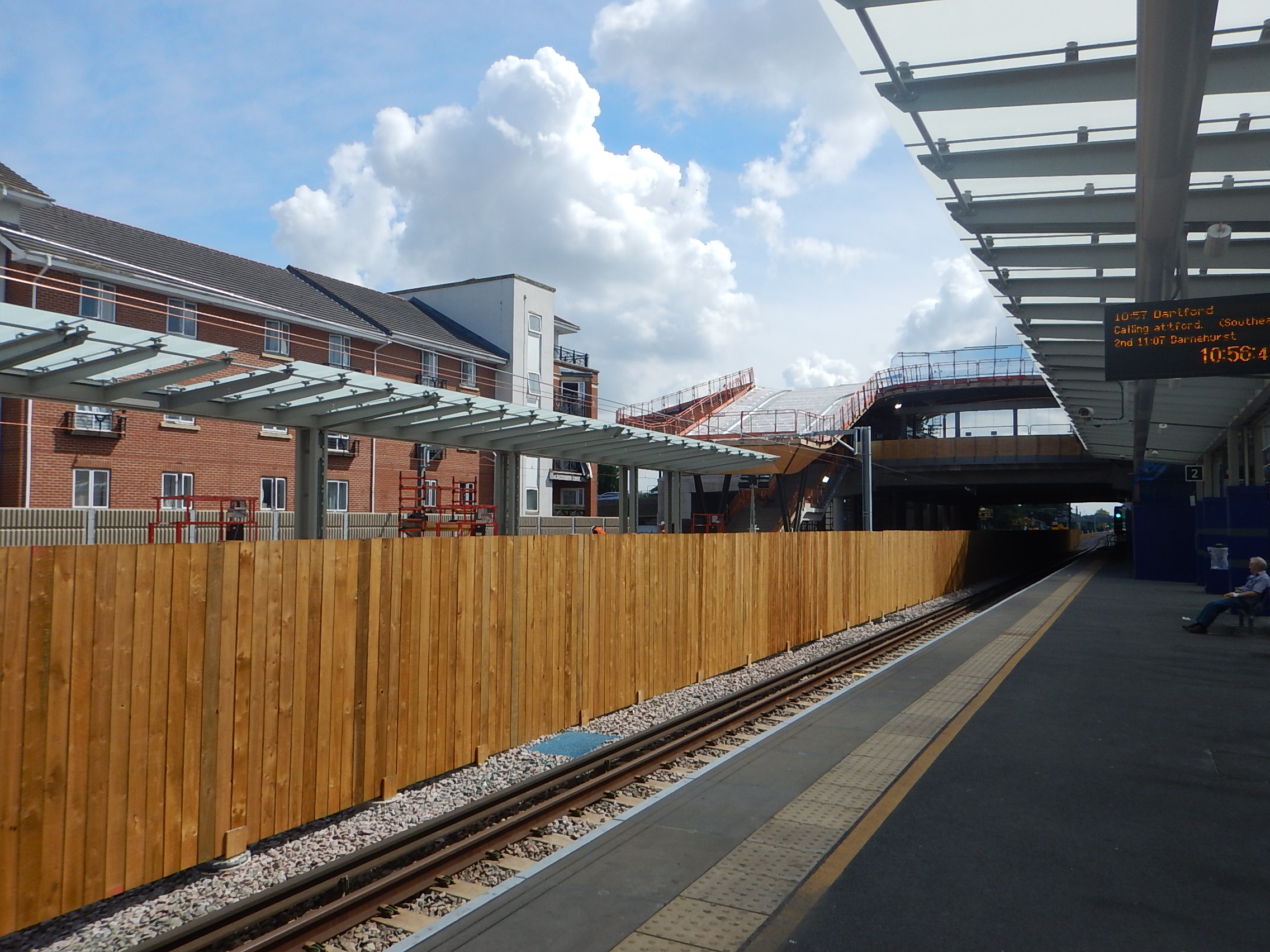
What is the purpose of this palisade fence at Abbey Wood station?
It certainly doesn’t protect passengers on the North Kent Line platform from where I took the photo from the 750 VDC third rail electrification in front of the fence.
The Crossrail tracks behind the fence are electrified with 25 KVAC, which is several metres in the air.
So is the fence to protect passengers on the platform behind the fence from running across the electrified track?
I think it probably is!
Electrification of both types has problems in certain track layouts.
- Switches and crossings sometimes need very complicated layout of the power system.
- Level crossings can present difficult Health and Safety problems.
- Depots can be dangerous places, even without live rails and overhead wires.
Engineers are constantly coming up with ideas to make electrification safer and more efficient.
Diesel Power
Putting an appropriate diesel engine on a train coupled to an alternator is a common way to generate electricity to power the train.
But.
- There is the noise and the smell.
- Diesel engines are very heavy.
- Diesel fuel has to be carried.
- Diesel trains have to be regularly refuelled.
To cap it all, diesel trains are not very green.
Gas Turbine Power
One version of he Advanced Passenger Train of the 1970s was intended to be powered by gas turbines and this shows how engineers tried all sorts of power for trains.
Gas turbine power, although very successful in aircraft is probably not suitable for trains.
Hydrogen Power
The Alstom Coradio iLint is a train powered by a hydrogen fuel cell. This is said in the Wikipedia entry.
Announced at InnoTrans 2016, the new model will be the world’s first production hydrogen-powered trainset. The Coradia iLint will be able to reach 140 kilometres per hour (87 mph) and travel 600–800 kilometres (370–500 mi) on a full tank of hydrogen. The first Coradia iLint is expected to enter service in December 2017 on the Buxtehude-Bremervörde-Bremerhaven-Cuxhaven line in Lower Saxony, Germany. It will be assembled at Alstom’s Salzgitter plant. It began rolling tests at 80km/h in March 2017.
As we have successful hydrogen-powered buses in London, I suspect we might see trains powered by hydrogen fuel cells.
Battery Power
Powering a heavy train for more than a couple of miles, by means of batteries seems very much of a fantasy.
I was sceptical until I rode inn Bombardier’s Class 379 train, that took part in the BEMU trial.

I believe strongly, that the place for a battery in a train is not normally as a primary power source, but as an intermediate electricity store in much the way the battery is used in a hybrid bus or car.
The battery would be charged, when running on electrified track or by using an onboard diesel engine or hydrogen fuel cell.
It could then power the train on a length of track without electrification.
Regenerative Braking
Regenerative braking can save as much of twenty percent of the electricity use of a train.
Every time the train brakes, the traction motors turn into generators and transform the train’s kinetic energy into electricity.
On some systems like the London Underground, the electricity is returned to the network and used to power nearby trains.
But on some trains, it is passed through resistors on the train roof and just turned into heat.
Hybrid vehicles have shown how it is possible to use batteries to store and reuse the energy and I believe that this technique is now starting to be used on trains.
In Thoughts On Batteries, I said this.
A typical four-car electric multiple unit like a new Class 710 train, weighs about 130 tonnes or 138 tonnes with passengers. Going at a line speed of 100 kph, it has a kinetic energy of 15 KwH. So this amount of kinetic energy would be well within the scope of a 75 KwH battery from a Routemaster bus.
I think that the typical four-car electric multiple unit can easily be fitted with a battery to handle the braking for the train.
The physics of steel-wheel-on-steel-rail are also very efficient, as Robert Stephenson, if not his father, would have known.
So it would appear that combining regenerative braking with batteries of a practical size can improve the efficiency of a train.
One of the great advantages of handling the regenerative braking on the train with batteries, is that expensive transformers to handle the return currents are not needed at trackside.
Putting It All Together
I very much feel that the ultimate train should have the following characteristics.
- The ability to work on 25 KVAC overhead and/or 750 VDC third rail electrification.
- A suitable independent power source, which today would probably be diesel.
- Regenerative braking.
- A battery of sufficient size.
- The ability to switch modes automatically.
As a Control Engineer, I feel sure that some form of Automatic Power Management would be welcomed by the driver.
The Class 800 Train
The Class 800 trains, have the following maximum speeds.
- 125 mph on 25 KVAC overhead wires
- 140 mph on 25 KVAC overhead wires with ETCS in-cab signalling.
- 100 mph on diesel.
I think it is true to say, that on 125 mph lines, they may be capable of going faster.
But whatever they can do is probably well known now as Hitachi have over two years of experience of running the trains on British tracks.
In Do Class 800/801/802 Trains Use Batteries For Regenerative Braking?, I analyse the posed question.
After spending several hours searching the Internet, I found this very helpful document on the Hitachi web site.
Reading every word several times, I came to the conclusion, that it is more likely than not, that all variants of Class 80x trains have batteries, that are used for the following.
- Handling regenerative braking
- Providing hotel power for the train in case of complete power failure.
- Providing emergency train recovery in case of complete power failure.
I also discovered the following.
- The all-electric Class 801 train, has at least one onboard diesel engine for emergency situations.
- All Class 80x trains could be modified to use third rail electrification.
- All Class 80x trains can couple and uncouple in under two minutes.
- Class 80x trains can rescue another.
- Class 80x trains can be locomotive-hauled.
Hitachi have worked hard to produce a seriously comprehensive train.
This specification will lead to some interesting operational strategies.
More Destinations
Great Western Railway currently has services between London Paddington and the following destinations in South Wales
- Bridgend
- Carmarthen
- Cardiff
- Llanelli
- Neath
- Newport
- Pembroke Dock
- Port Talbot
- Swansea
But how many other stations in South Wales could benefit from a direct service?
The intriguing thing is that a Class 800 train is narrower at 2.7 metres, than the following trains.
A five-car Class 800 train is also considerably shorter and a lot quieter than an InterCity 125.
So it raises the possibility of direct services between London and the following stations.
- Smaller stations in West Wales like Fishguard Harbour and Milford Haven
- Important stations in the Cardiff Valley Lines.
Could a five-car Class 800 train reach Aberdare, Ebbw Vale and Merthyr Tydfil, with some platform and track modifications?
Or if not a five-car, what about a four- or three-car train, which due to the flexible nature of the trains, I feel is very much possible!
Joining And Splitting Of Trains
In Wales, smaller separate trains could join into a train of up to twelve-cars at say Cardiff or Newport stations and then run to London as a single train.
Similar processes could apply in West Wales, with trains joining at perhaps Port Talbot Parkway station.
Returning from London, the trains would split at an appropriate station.
The big advantage of this approach, is that two or even three services share one path and driver between the join/split station and London, which means an increased number of separate services and total seats between Wales and London.
Similar processes will be possible on the following sets of routes, which will or could be run by Class 80x trains.
- London Paddington to Cheltenham, Gloucester, Hereford, Oxford and Worcester.
- London Paddington to Devon and Cornwall.
- Midland Main Line services.
- East Coast Main Line services.
How many stations on these lines will receive a new direct service to and from London?
Network Rail’s Secret Weapon
I have been suspicious for some time, that Network Rail have a very sophisticated simulation of the UK rail network. In fact, I’d be very surprised if they didn’t have one.
But that’s because I’ve done extensive dynamic simulation and scheduling in my working life and know the power and capabilities of such a system.
It’s just that some of the new franchises have developed some quite radical train patterns.
So I would suspect, a lot of the thinking behind the dropping of electrification has been thoroughly tested on the computer.
So how will the three lines quoted in the article be handled?
Oxenholme To Windermere
The Windermere Branch Line is just ten miles long with four stations.
This article in the Railway Gazette, says this.
‘We have listened to concerns about electrification gantries spoiling protected landscapes’, Grayling said when confirming the cancellation of plans to electrify the Windermere branch in the Lake District, adding that Northern would begin work to trial an ‘alternative-fuelled’ train on the route by 2021. Grayling mentioned the ongoing development of battery and hydrogen power in his statement, but Northern said it had only just begun to explore possible options following the cancellation of the electrification, and so any decision on the technology to be used was still some way off.
From May 2018 Northern plans to operate services to Windermere using Class 769 Flex electro-diesel units to be formed by fitting diesel powerpacks to Class 319 EMUs. New CAF DMUs would then be introduced to the route from December 2019.
It is both a short-term and a long-term solution, that is probably to the benefit of all stakeholders.
Given that the Class 769 train has been designed to serve Manchester to Buxton, you can’t accuse Porterbrook and Northern of hiding their creation under a bushel.
Cardiff To Swansea
The South Wales Main Line between Cardiff Central and Swansea stations is a forty-five mile double-track with the following operating speeds.
- 90 mph from Cardiff Central to East of Bridgend station
- 75 mph from Bridgend to Swansea Loop North Junction
- 40 mph from Swansea Loop North Junction to Swansea
But there is a short section at 100 mph through Pyle station.
This is said in the article in Global Rail News.
Referring to the Cardiff-Swansea route, the statement said, “Rapid delivery of passenger benefits, minimising disruption and engineering work should always be our priority and as technology changes we must reconsider our approach to modernising the railways.”
The argument is based on the planned introduction of bi-mode Class 800 trains later this year.
I have flown my virtual helicopter along the tracks and it doesn’t seem a badly designed route.
- It appears to be fairly straight with flowing curves.
- There are only eleven stations to pass through.
- Looking at the current timetables, it would appear that the fastest trains take about 51-53 minutes to go between Cardiff and Swansea.
- Wikipedia says this about the South Wales Main Line, “resignalling and line speed improvements in South Wales, most of which would be delivered in 2010–2014”.
So have Network Rail found a way to increase the operating speed nearer to the 100 mph of the Class 800 trains, when running on diesel?
I obviously don’t know for sure, but given the improvements to the South Wales Main Line and the performance of the new trains, I wonder if Network Rail’s simulations have shown that there is very little to be gained by full electrification.
As I indicated earlier, by joining and splitting services, the number of trains and the total number of seats can be increased to West Wales without needing more train paths between London and Cardiff.
Midland Main Line
There has been discussions in Modern Railways recently about the problems of devising a timetable for the Midland Main Line.
The article in the Railway Gazette says this.
Hitachi is supplying bi-mode trainsets for Great Western services under the Department for Transport’s Intercity Express Programme, while the operator of the next East Midlands franchise will be required to introduce bi-mode trainsets from 2022. DfT said the use of electro-diesel trainsets instead of electrification would mean passengers would ‘benefit sooner’, because ‘disruptive’ work to install ‘intrusive wires and masts’ would ‘no longer be needed’.
It looks to me that simulation has shown, as in South Wales, there is little to be gained from full electrification.
But there could be a lot to gain from the following.
- Creative joining and splitting of trains.
- Improved track layouts.
- Improving the electrification South of Bedford.
- Adding new stations.
With these intelligent bi-mode trains, electrification can be added selectively, if it is shown to be worthwhile.Control systems linked to GPS, can raise and lower the pantograph appropruiately.
Conclusion
I think that someone asked the heretical question.
What would happen if instead of electrification, we used bi-mode trains?
Both the South Wales Main Line and the Midland Main Line have similar characteristics.
- Operating speed upwards of 90 mph.
- Sections where the operating speed could be raised.
- Partial electrification at the London end.
- All London suburban trains sharing the routes are 100 mph trains.
- Modern signalling
Couple this with the Class 800 trains and a very good simulation, and I suspect that Network Rail have found ways to improve the service.
I very much feel that similar techniques are being used to increase the capacity of the electrified Great Eastern Main Line to achieve Norwich-in-Ninety.
I can’t of course prove my feelings, but then I started writing computer simulations in the mid-1960s and like to think, I know when I see others have done some good numerical analysis.
Where Else Could Bi-Mode Trains Be Used In This Way?
This is very much speculation on my part.
Basingstoke To Exeter Via Salisbury
Consider.
- There have been ambitions to electrify this route for decades.
- The new operator of the route; South Western Railway and Great Western Railway, who will operate Class 800 trains, are partially in the same ownership.
- Third rail or dual voltage Class 800 trains are possible.
- The trains are 100 mph units on diesel against the current 90 mph Class 158 trains.
- The trains would save four minutes between London Waterloo and Basingstoke.
- The trains could take advantage of speed improvement South of Basingstoke.
- If Basingstoke to Exeter was a 100 mph line, then up to fifteen minutes could be saved.
- The trains could join and split to serve multiple destinations.
But perhaps the biggest advantage would be that all trains between London Waterloo and Basingstoke would be 100 mph trains, which must mean that more trains could use the line.
Cardiff to Brighton via Southampton, Portsmouth Harbour and Bristol
Consider.
- This route has significant overcrowding according to Wikipedia.
- Cardiff to Bristol should eventually be electrified with 25 KVAC overhead wires.
- Brighton to Southampton is electrified with 750 VDC third rail.
- Great Western Railway run this route and have Class 800 trains.
- Dual voltage Class 800 trains are possible.
To run this route efficiently, Great Western Railway would need an appropriate number of five-car dual voltage Class 800 trains.
Norwich To Stansted Airport via Ely and Cambridge
The Breckland Line between Norwich and Cambridge has the following characteristics.
- Double-track throughout its just over fofty miles.
- Sections of electrification at Norwich and South of Ely.
- A variable operating speed of up to 90 mph.
The line has recently been upgraded with improved track, removal of level crossings and modern signalling.
As part of their new franchise proposal, Greater Anglia decided to run services from Norwich to Stansred Airport using new Stadler Class 755 trains, with the following characteristics.
- Three- or four-car
- Bi-mode power.
- 100 mph capability.
- Running on 25 KVAC, where available.
I think this is a good plan and is an example of the sort of use of bi-mode trains that will be seen increasingly.
Consider.
- Norwich gets a much better connection to Cambriodge and Stansted Airport.
- Some services on the route are still run by 90 mph Class 158 trains.
- Speed improvements will come because of the nearly fifty miles of electrification between Ely and Stansted Airoport.
- There may be further track improvements possible.
There is also the big possibility of being able to run a direct service between Norwich and London via Cambridge. I estimate that this could be done in about two and a half hours.
This is obviously not as fast as the route via Ipswich, where the current timing is around one hour fifty minutes and plans are in progress to reduce it by twenty minutes, but as an engineering work diversion, it is faster than a bus replacement service.
Peterborough To Colchester via Bury. St. Edmunds and Ipswich
This is an extension of the current Peterborough to Ipswich service that will be run by a bi-mode Class 755 train, under the new franchise agreement.
Consider.
- The route is not electrified, except for Peterborough to Stowmarket.
- Colchester gets a new hourly direct link to Peterborough, which has many services to the North.
- A two train per hour service across Suffolk between Ipswich and Bury St. Edmunds is created.
- Colchester to Peterborough may be reduced by twenty minutes or more.
- Ipswich to Peterborough may be reduced by a few minutes.
If it was decided to electrify from Stowmarket to Peterborough, timings would benefit substantially.
Ipswich To Cambridge via Bury. St. Edmunds and Newmarket
This is an existing service that will be run by a bi-mode Class 755 train, under the new franchise agreement.
Leeds To Glasgow Via Settle
Why not?
If you look at timings for Leeds to Glasgow, they are typically as follows.
- 3 hours 58 minutes with an 11 minute change at Haymarket.
- 4 hours 12 minutes with a 30 minute change at Carlisle
- 4 hours 4 minutes on a direct train via Edinburgh.
The Settle-Carlisle Line has been stoutly repaired after the 2015-2016 Temporary Closures and is probably in its best state for years, if not ever.
- Leeds to Skipton is electrified.
- Carlisle to Glasgow is electrified.
- Virgin Trains East Coast run to Skipton, using InterCity 225s.
I estimate that a Class 800 train could reduce the journey time to around three-and-a-half hours.
Would that be a successful service considering driving between Leeds and Glasgow probably takes almost four hours?
An Interesting Insight Into The Grenfell House Fire
This article on Construction News is a must read.
It describes the experiences of a Morgan Sindall employee, who lived in the tower and was in bed, when the fire started.
He works on Crossrail, so he is obviously fully-trained and actually states that training said to stay put.
He didn’t and got out safely although in very little clothing.
It does appear that the treatment of their employee by Morgan Sindall is exemplary, so it looks to me that as this story gets more well-known, they won’t be short of applicants for permanent positions in the future.
 The Anonymous Widower