Hitachi Plans To Run ScotRail Class 385 EMUs Beyond The Wires
The title of this post is the same as that of this article on Rail Engineer.
This is the first paragraph.
Hitachi are in discussions with the Scottish Government to run a Class 385 variant with underfloor batteries that could either be charged whilst under the wires or whilst stationary at the end of the route.
The article makes these points, about adding batteries to Class 385 trains.
- It would be straightforward to add batteries to give a range of twenty miles on batteries.
- Sixty miles would be possible but more difficult.
- Experience gained with the DENCHA trains in Japan would be used.
The article concludes with this paragraph.
Hitachi’s proposal to operate battery trains in Scotland is at an early stage. However, with their use being recommended by the rail decarbonisation task force and the Scottish Government about to pass new climate change legislation, it may not be long before battery trains are operating in Scotland.
I think it should be noted that Hitachi’s order book is rather thin these days and it appears that innovative technology will sell new trains.
Alstom, Bombardier, CAF, Siemens, Stadler and Vivarail have all designed, demonstrated or sold trains, where batteries are used improve efficiency or extend range.
As Scotland has several routes, where battery trains could provide a service, perhaps Hitachi thought it was time to do some marketing, to make sure that they got any orders for battery trains.
Scotrail would probably prefer to have a battery train similar to their largest fleet of electric trains.
Electric Trains On The West Highland Line Between Glasgow And Mallaig/Oban
This might be considered as difficult as putting a London bus on the Moon.
But consider.
- The West Highland Line is electrified as far as Helensburgh Central station.
- Electrification to Helensburgh Upper station would probably not be a difficult project for Network Rail in Scotland.
- Heleburgh Upper to Mallaig is just under 140 miles.
- Hellensuburgh Upper to Oban is around 76 miles.
- Crianlarich station, where the two routes divide is under forty miles from Helensburgh Upper.
- Fort William station is around halfway between Mallaig and Crianlarich.
- Trains take several minutes to reverse at Fort William.
Vivarail have developed fast charging for battery trains, that I wrote about in Vivarail Unveils Fast Charging System For Class 230 Battery Trains.
If Hitachi can develop a Class 385 train with batteries, that has a range of perhaps sixty miles on a full battery, then I believe it would be possible to run an electric train service between Glasgow and Oban and Mallaig.
- Charging stations would need to be able to fully charge the batteries in perhaps six minutes.
- Trains would leave Hellensburgh Upper with a full battery and charging stations at Crianlarich and Fort William would top up the batteries.
- The longest stretch is between Crianlarich and Fort William and it would probably need an additional charging station at perhaps Tulluch.
What would battery-electric trains to Oban and Mallaig do for tourism in the area?
Hitachi would have one of the most scenic and iconic test tracks in the world!
£18.75m Halton Curve Project Delayed A Further Six Months
The title of this post is the same as that of this article on Rail Technology News.
I could just blame politicians for the latest project to be delayed, but it is not wholly their fault.
Train companies all over the UK, Europe and the Rest of the World have been ordering new trains at an unprecedented rate for the following reasons.
- The replacement of clapped-out trains like Pacers.
- Extra trains to provide extra services.
- Faster trains to provide faster services.
- Bigger or longer trains to provide more capacity.
- New electric trains for newly electrified routes.
- New trains often cost less to service and maintain.
- Affordable finance for quality new trains is available in billions of pounds, euros and dollars of all kinds.
In addition a lot of trains are being updated with new technology like signalling, automatic systems and high-technology interiors.
All of these factors mean that there is a high level of train testing that needs to be done.
These test tracks are in Europe and listed in Wikipedia.
- Czech Replublic – Velim railway test circuit – Two circuits of 4 and 13 km.
- France – Centre d’essais ferroviaires – Near Alstom Valenciennes factory site in Raismes, includes 2.75 km for testing at 100 km/h, a 1.85 km loop for endurance testing at 80 km/h, and a loop for testing driverless trains.
- Germany – Test and validation centre, Wegberg-Wildenrath – Near Wildenrath in North Rhine-Westphalia, Germany. Several loops of standard gauge and metre gauge track with various electrification systems.
- Poland – Test Track Centre near Żmigród – Operated by Warsaw Railway Institute. 7.7 km standard gauge loop, 160 km/h maximum allowed speed.
- Romania – Railway Testing Center Faurei – Total length of lines: 20,2 km, maximum speed 200 km/h.
- United Kingdom – Old Dalby Test Track
- United Kingdom – High Marnham Test Track
Note that Italy and Soain, who build substantial numbers of trains, don’t have a specialist testing centre.
I have read somewhere that each individual train has to be run for so many hours before it can be certified for service.
Consider
- Bombardier is building 412 Aventras with lengths between three and ten cars.
- CAF is building trains for Calodonian Sleeper, Keolis Amey Wales, Northern, TranPennine Express and West Midlands Trains.
- Hitachi is building 182 Class 800/801/802 trains with length of five or nine cars.
- Hitachi is building 80 Class 385 trains with lengths of 3/4 cars.
- Siemens are building trains for Govia Thameslink Railway.
- Stadler is building trains for Greater Anglia, Keolis Amay Wales and MerseyRail.
I haven’t done a detailed calculation must it must be at least 700 trains.
In addition there are various rebuilt and existing trains that will need to be tested.
- ScotRail’s shorterned InterCity 125s
- Porterbrook’s Class 769 trains.
- Vivarail’s Class 230 trains.
- Alstom’s Class 321 Hydrogen trains.
- Crossrail Class 345 trains need further testing.
And there will be new orders for the following franchises and lines.
- East Midlands.
- London Underground Piccadilly Line.
- South Eastern
- West Coast Alliance
I haven’t done a detailed calculation but we must be talking of nearly a thousand new trains of which probably six hundred will be delivered in the next five years.
I’m no expert, but I feel that two short test tracks and short lengths of improvised test tracks in factories, isn’t enough to test all these trains and certify them for service.
I should also blow my own trumpet and I know that when I wrote project management software, I was probably the best programmer in the World, at automatically scheduling resources.
So I tend to know, an impossible scheduling problem, when I see one!
Conclusion
We do send trains to Europe to specialist centres like the one at Velim in the Czech Republic. But these centres are also used by other European manufacturers.
I am led to the inevitable conclusion, that we need more train testing facilities, in both the UK and mainland Europe.
The Welsh Government has come to the same conclusion and are planning a test track at Neath, which I wrote about in £100m Rail Test Complex Plans For Neath Valley.
What would help, would be if Chris Grayling oiled a few wheels with some money. It might even result in some Continental trains coming to Wales for specialist testing like curing them of dracophobia.
I would also have felt that CAF would be happy with a test track fifty miles away from their new factory in Newport.
Come on, Wales! Fire up the dragons and get started!
Class 365 Trains To The Rescue
I had intended to get a ride on a new Class 385 train, but I only caught a glimpse of one going the other way, from a Class 365 train, that I used both ways between Edinburgh and Glasgow.
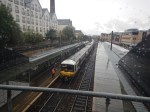
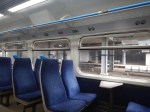
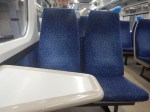
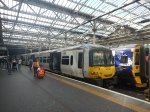
Passengers seemed to be quite happy with the Class 365 trains cascaded from the Cambridge Cruiser.
I really think that Hitachi have got their production of the Class 385 trains, seriously wrong here.
The body shells are made in Japan and then sent to Newton Aycliffe by sea. This must be an easy way to ensure a slow production of trains.
Bombardier make the body shells in the same factory as they design and assemble the trains.
Even if CAF make their body shells in Spain, that is a much shorter and probably more reliable journey.
I must admit if I was the CEO of a train operating company, I wouldn’t buy a Hitachi train.
But then Tony Blair only wanted a new factory, close to his constituency!
Retrofitted Hydrogen Fuel Cell EMU Concept Presented
The title of this post is the same as that of this article on Global Rail News, that was published in April 2014.
This is the first two paragraphs.
The possibility of retro-fitting diesel multiple units (DMUs) to run on hydrogen fuel cell technology has been put to the test as part of an RSSB and Network Rail-funded innovation research programme.
Fuel Cell Systems, which has worked alongside the University of Birmingham and Hitachi Rail Europe, says the six-month study has demonstrated the feasibility of installing hydrogen fuel cell technology on DMUs as an alternative to electrification.
It strikes me that some serious people are involved in this project.
The report on the project was published in June 2016 and it is stored here on the University pf Birmingham web site.
Hitachi Ships TransPennine Express’s First Class 802 From Japan
The title of this post is the same as that of this article on Global Rail News.
To my mind, the Japanese do some inefficient things when building trains.
- It could be sensible to build the first of each different sub-fleet in Japan and ship it to the UK by sea, but what puzzles me is that the body shells are all built and painted in Japan and then shipped half-way round the world.
- The shipping delay must make production difficult to plan and inefficient.
- I would have thought they would have built a body plant somewhere in Europe.
CAF may send their trains by ship, but that is only a short sea crossing and because the Spanish rail gauge they can’t tow them through the Channel Tunnel, as the other European manufacturers do.
Hitachi’s Thoughts On Battery Trains
On page 79 of the January 2018 Edition of Modern Railways, Nick Hughes, who is the Sales Director of Hitachi Rail Europe outlines how the manufacturer is embracing the development of battery technology.
He is remarkably open.
Hitachi’s Battery Development
Nick Hughes says this.
Hitachi has for many years seen great potential in battery technology.
We began studying on train storage energy systems in 2003. Working jointly qith operational partners in Japan and in the UK, we developed a realistic solution based on a lithium-ion battery, that could store the braking energy and reuse it for the traction.
Then came our V-train 2 (nicknamed the Hayabusa), which was tested on the Great Central Railway in 2007, using hybrid battery/diesel power and regenerative charging. This was the world’s first high-speed hybrid train.
This picture show the Hayabusa running in the UK.
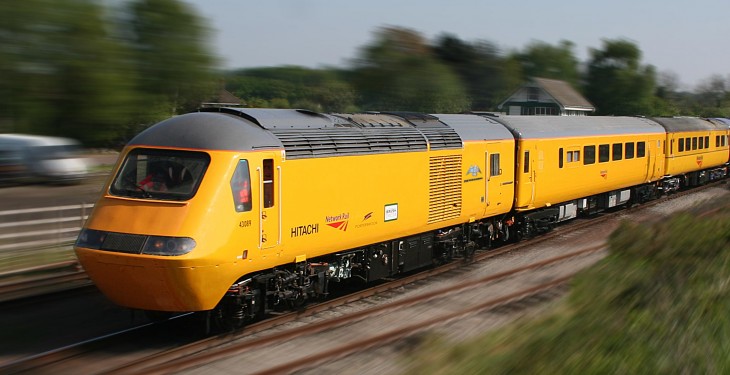
If you think it looks familiar, you are right! It’s a modified Class 43 locomotive from an InterCity 125. The locomotive; 43089, is still in service with East Midlands Trains. But without the batteries!
When the remaining members of the team, who had developed the InterCity 125 in the 1970s, saw these pictures, I suspect it was celebrated with a call for a few swift halves!
BEMU In Japan
Nick Hughes goes on to outline the status of Battery Electric Multiple Units (BEMUs) in Japan, where Hitachi launched a train called the DENCHA in 2016, on the Chikuhi line.
- The train has a range of up to 50 km on batteries.
- DENCHA is popular with passengers.
- The train won a prestigious award.
I don’t know what it is with battery trains, but the Bombardier/Network Rail BEMU Trial was also liked by those who rode the train. As was I!
Nick Hughes Prediction
Nick Hughes follows his description of the DENCHA, with this.
I can picture a future when these sorts of trains are carrying out similar types of journeys in the UK, perhaps by installing battery technology in our Class 395s to connect to Hastings via the non-electrified Marshlink Line from Ashford for example.
This would massively slice the journey time and heklp overcome the issue of electrification and infrastructure cases not stacking up. There are a large number of similar routes like this all across the country.
It is a prediction, with which I could agree.
Renewable Energy And Automotive Systems
Nick Hughes finishied by saying that he believes storing power from renewable energy and the development of automotive systems will drive battery technology and its use.
Conclusion
It is the most positive article about battery trains, that I have read so far!
Hybrid Trains Proposed To Ease HS1 Capacity Issues
The title of this post is the same as an article in Issue 840 of Rail Magazine.
This is the first paragraph.
Battery-powered hybrid trains could be running on High Speed 1, offering a solution to capacity problems and giving the Marshlink route a direct connection to London.
Hitachi Rail Europe CEO Jack Commandeur is quoted as saying.
We see benefit for a battery hybrid train, that is being developed in Japan, so that is an option for the electrification problem.
I found this article on the Hitachi web site, which is entitled Energy-Saving Hybrid Propulsion System Using Storage–Battery Technology.
It is certainly an article worth reading.
This is an extract.
Hitachi has developed this hybrid propulsion system jointly with East Japan Railway Company (JR-East) for the application to next-generation diesel cars. Hitachi and JR-East have carried out the performance trials of the experimental vehicles with this hybrid propulsion system, which is known as NE@train.
Based on the successful results of this performance trial, Ki-Ha E200 type vehicle entered into the world’s first commercial operation of a train installed with the hybrid propulsion system in July 2007.
The trains are running on the Koumi Line in Japan. This is Wikipedia’s description of the line.
Some of the stations along the Koumi Line are among the highest in Japan, with Nobeyama Station reaching 1,345 meters above sea level. Because of the frequent stops and winding route the full 78.9 kilometre journey often takes as long as two and a half hours to traverse, however the journey is well known for its beautiful scenery.
The engineers, who chose this line for a trial of battery trains had obviously heard Barnes Wallis‘s quote.
There is no greater thrill in life than proving something is impossible and then showing how it can be done.
But then all good engineers love a challenge.
In some ways the attitude of the Japanese engineers is mirrored by those at Porterbrook and Northern, who decided that the Class 769 train, should be able to handle Northern’s stiffest line, which is the Buxton Line. But Buxton is nowhere near 1,345 metres above sea level.
The KiHa E200 train used on the Koumi Line are described like this in Wikipedia.
The KiHa E200 is a single-car hybrid diesel multiple unit (DMU) train type operated by East Japan Railway Company (JR East) on the Koumi Line in Japan. Three cars were delivered in April 2007, entering revenue service from 31 July 2007.
Note that the railway company involved is JR East, who have recently been involved in bidding for rail franchises in the UK and are often paired with Abellio.
The Wikipedia entry for the train has a section called Hybrid Operation Cycle. This is said.
On starting from standstill, energy stored in lithium-ion batteries is used to drive the motors, with the engine cut out. The engine then cuts in for further acceleration and running on gradients. When running down gradients, the motor acts as a generator, recharging the batteries. The engine is also used for braking.
I think that Hitachi can probably feel confident that they can build a train, that can handle the following.
- High Speed One on 25 KVAC overhead electrification.
- Ore to Hastings on 750 VDC third-rail electrification.
- The Marshlink Line on stored energy in lithium-ion batteries.
The Marshlink Line has a big advantage as a trial line for battery trains.
Most proposals say that services will call at Rye, which is conveniently around halfway along the part of the route without electrification.
I believe that it would be possible to put third-rail electrification in Rye station, that could be used to charge the batteries, when the train is in the station.
The power would only be switched on, when a train is stopped in the station, which should deal with any third-rail safety problems.
Effectively, the battery-powered leg would be split into two shorter ones.
First Steps To Faster Trains Is Delivered
This is the title of an article in the Hastings and St. Leonards Observer, that has been signed by Amber Rudd.
About Amber Rudd
Amber Rudd is the Home Secretary and in this year’s General Election, she retained the Hastings and Rye constituency with a majority of just 346 votes.
As I doubt she wants to commit political suicide, I therefor consider that what is said in the article is very close to what is intended to happen about the delivery of faster trains between London and Hastings.
London To Hastings In 66 Minutes
This is the first two paragraphs of her article.
Last week I invited Transport Secretary Chris Grayling to visit Ashford International to hear an update on my campaign to secure a high speed rail link between our communities and London St Pancras.
Specifically, I want to see journey times, which are currently around 100 minutes between Hastings and London, reduced to 66 minutes.
The sixty-six minutes is mentioned again later in the article.
Would a politician be so definite about her aims, unless she knew that it was deliverable?
Or is it lucky to say sixty-six in Hastings?
So how feasible is London to Hastings in 66 minutes?
Consider.
- Southeastern’s Highspeed services between St. Pancras and Ashford, generally take between 37-38 minutes for the journey, with some trains a few minutes faster.
- The Marshlink Line between Ashford and Hastings is about 26¼ miles in length
- The operating speed is quoted in Wikipedia as 60 mph.
- There are some serious level crossings.
So could a train go from Ashford to Hastings in twenty-eight minutes to meet Amber Rudd’s quoted target of 66 minutes?
26¼ miles in 28 minutes works out a an average speed of 56.25 mph.
I would give that time a 9/10 for feasibility.
The problem would be the level crossings on the line, so if Network Rail were to remove these and improve the track a bit, I feel that this could even score highly for reliability.
Currently, there doesn’t appear to be many trains passing through and even if the service was doubled to two trains per hour in both directions, I don’t think they would trouble the timetable compiler.
Track Changes At Ashford
Amber Rudd’s article then says this about track changes at Ashford.
This was a very encouraging meeting. I am pleased to announce that the commitment has been made to supporting the development of a proposed track layout at Ashford International which would allow trains from Hastings, Rye, Bexhill and Eastbourne to travel direct to London St Pancras
Work will now begin towards the necessary track connections to join-up the Marshlink and the High Speed 1 line to London.
This change would help make possible the direct service to St Pancras with a journey time of 81 minutes from Hastings.
That seems to be a plan. But where does the 81 minutes come from?
The current Class 171 trains take around 42 minutes between Hastings and Ashford, so 38+42 would say that 81 minutes is a reasonable claim.
This document on the Network Rail web site, is the Technical Appendix of the South East Route: Kent Area Route Study.
This map was extracted from the document.
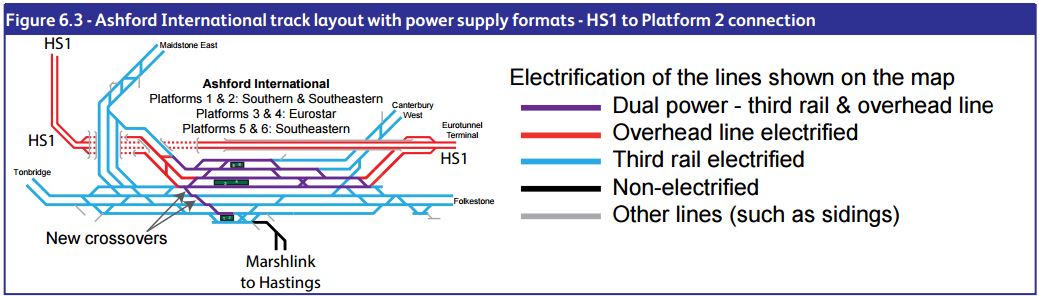
This shows the changes needed to connect HS1 to the Marshlink Line.
Diesel-Electric Or Battery-Electric Trains?
Amber Rudd’s article says this about the trains.
Accompanying the track changes at Ashford, hybrid rolling stock – trains running on diesel-electric or battery-electric power – would make these quick journey times a reality.
This fits in with what is said in the Technical Appendix to the Kent Area Route Study.
The diesel electric train mentioned in the Technical Appendix is a Class 802 train. Production and delivery of these is underway for Great Western Railway, so we’re not talking about an untried class of train.
But there may be problems running trains carrying diesel fuel in the HS1 tunnels.
The battery-electric train mentioned in the Technical Appendix is the IPEMU based on a Class 379 train.

This train is not in production yet and the picture shows the test train, that ran in Essex nearly two years ago.
The Technical Appendix says this about the IPEMU.
In 2015, industry partners worked together to investigate
battery-electric traction and this culminated with a
practical demonstration of the Independently Powered
Electric Multiple Unit IPEMU concept on the Harwich
Branch line in Anglia Route. At the industry launch event,
the train manufacturers explained that battery
technology is being developed to enable trains to run
further, at line speeds, on battery power, indeed, some
tram lines use this technology in the city centres and many
London buses are completely electric powered.The IPEMU project looked at the feasibility of battery power
on the Marshlink service and found that battery was
sufficient for the train to run from Brighton to Ashford
International and back but there was insufficient charge to
return to Ashford International on a second round trip. A
solution to this could be that the unit arrives from Ashford
International at Brighton and forms a service to Seaford and
back before returning to Ashford International with a
charged battery.The IPEMU demonstration train was a Class 379, a similar
type to the Class 377 units currently operated by Southern, it
was found that the best use of the battery power was to
restrict the acceleration rate to that of a modern diesel
multiple unit, such as a Class 171 (the current unit type
operating the line) when in battery mode and normal
acceleration on electrified lines.
Note the following from Network Rail’s text.
- Brighton to Ashford is about 60-70 miles.
- Acceleration should be limited.
- The Class 377 train would not be suitable for HS1, as it is only a 100 mph train.
It is my opinion, that a battery-electric train with the following characteristics could be designed.
- Five to eight cars.
- 140 mph on HS1 using 25 KVAC overhead electrification.
- 100 mph on the East Coastway Line between Brighton and Hastings using 750 VDC third-rail electrification.
- Class 171 train performance using batteries on the Marshlink Line.
- A battery range of sixty miles to allow a fully charged train to go from Ashford to Hastings and back.
Effectively, it’s a dual-voltage high speed train, that can also run on battery power.
How Would A Battery Train Operate?
A train working from St. Pancras to Hastings would go through the following operations.
- Run from St. Pancras to Ashford along HS1, as the current Class 395 trains do using the 25KVAC overhead power.
- Stop in Platform 2 at Ashford station and switch to battery power.
- Run to Hastings on battery power.
- Run to Aahford on battery power.
- Stop in Platform 2 at Ashford station and switch to 25 KVAC overhead power.
- Run from Ashford to St. Pancras along HS1 using the 25 KVAC overhead power
The battery would be charged on HS1 and using the third-rail electrification at Hastings.
How Big Would The Battery Need To Be?
The test IPEMU had a battery capacity of 500 kWh and based on what is said in the Technical Appendix was capable of perhaps 150 miles on battery power.
This works out as a consumption of under one kWh per car per mile.
So a six-car train would need perhaps 200 kWh to do a single trip on the 26¼ mile Marshlink Line. Providing of course it was fully charged before starting the journey.
Could Hitachi Modify a Class 395 Train To Have A Battery Option?
Hitachi have been developing battery trains for several years.
I believe that if Bombardier can create and test a battery-electric version of a Class 379 train, in under a year, then Hitachi could do the same with any of their A train family, which includes Class 800/801/802/395 trains.
This page on the Hitachi web site is entitled AT300 – INTERCITY HIGH SPEED.
The page has a picture of a Class 395 train and it has this caption.
The Class 395 is the first High Speed commuter train in the UK and part of Hitachi’s family of AT300 units. Its introduction to HS1 in 2009 continues to be a success story and it has set new standards for performance in High Speed trains in the UK.
Underneath the picture, it gives a Technical Outline for the trains, where this is said.
Power Supply: (25kVAC / 750 Vdc / Battery)
This may only be for train hotel power, but certainly the trains can use batteries.
Conclusion On The Type Of Train
I have no reason to believe that St. Pancras to Hastings copuldn’t be run by either type of train.
Although there is the problem of whether trains carrying diesel can go throyugh the HS1 tunnels.
The new operator for the Southeastern Franchise will chose the deal they liked.
Destination Stations
The Technical Appendix to the Kent Area Route Study proposes three possible destination stations.
Hastings
Hastings station has some advantages.
- It may be easier for operational reasons.
- Using Platform 1 would allow cross-platform interchange with trains going West.
- Only minimal signalling and track changes are needed.
- A 25-30 minute dwell time at the station is good for recovery after a late arrival.
The big disadvantage is that Bexhill will not be served.
Bexhill
Stakeholders would like the service to go to Bexhill station.
Train operation doesn’t appear to be as simple as at Hastings.
Eastbourne
Eastbourne station also offers advantages.
- There could be a 20-25 minute dwell time at Eastbourne, which would help in service recovery.
- Sic-car trains would offer signification extra capacity between Hastings and Eastbourne, where it is needed.
- The line between Bexhill and Eastbourne was resignalled in 2015.
- Eastbourne to St. Pancras would be a good alternative route in times of perturbation.
- With extra work at Hampden Park station, it could provide a faster route to Brighton and Gatwick Airport.
The only disadvantage is that an extra train would be needed to run the service.
Conclusion On The Destination
All three stations could be a suitable destination.
I feel that if the choice of trains favours battery-electric, that Eastbourne might have a useful advantage in recharging the batteries.
Track Improvements
The Technical Appendix to the Kent Area Route Study proposes various track improvements in various places from Ashford to Brighton.
It looks like Network Rail are preparing the infrastructure for faster services all along the South Coast.
Conclusion
Amber Rudd has put her name to a well-worked article.
Regenerative Braking On A Dual-Voltage Train
Yesterday, I found this document on the Railway People website, which is entitled Regenerative Braking On The Third Rail DC Network.
Although, the document dates from 2008, it is very informative.
Regenerative Braking On 25 KVAC Trains
The document says this.
For AC stock, incoming power from the National Grid at high voltage is stepped down by a transformer. The AC power is transmitted via OHL to the trains. When the train uses regenerative braking, the motor is used as a generator, so braking the axle and producing electrical energy. The generated power is then smoothed and conditioned by the train control system, stepped up by a transformer and returned to the outside world. Just about 100% of regenerated power is put back into the UK power system.
But I have read somewhere, that you need a 25 KVAC overhead electrification system with more expensive transformers to handle the returned electricity.
Regenerative Braking On 750 VDC Trains
The document says this.
After being imported from the National Grid, the power is stepped down and then AC power is rectified to DC before being transmitted via the 3rd rail. Regenerated Power can not be inverted, so a local load is required. The power has to be used within the railway network. It cannot be exported.
So the electricity, is usually turned into heat, if there is no train nearby.
The Solution That Was Applied
The document then explains what happened.
So, until such time as ATOC started to lobby for a change, regenerative DC braking was going nowhere. But when they did start, they soon got the backing of the DfT and Network Rail. It takes a real combined effort of all organisations to challenge the limiting assumptions.
In parallel, there were rolling stock developments. The point at which all the issues started to drop away was when the Infrastructure Engineers and Bombardier, helped out by some translating consultants (Booz & Company), started to understand that new trains are really quite clever beasts. These trains do understand what voltage the 3rd rail is at, and are able, without the need to use any complicated switch gear – just using software, to decide when to regenerate into the 3rd rail or alternatively, use the rheostatic resistors that are on the train.
Effectively, the trains can sense from the voltage if the extensive third-rail network can accept any more electricity and the train behaves accordingly.
As most of the electric units with regenerative braking at the time were Bombardier Electrostars, it probably wasn’t the most difficult of tasks to update most of the trains.
Some of the Class 455 trains have recently been updated. So these are now probably compatible with the power network. Do the new traction motors and associated systems use regenerative braking?
This document on the Vossloh-Kiepe web site is entitled Vossloh Kiepe enters Production Phase for SWTs Class 455 EMU Re-Tractioning at Eastleigh Depot and describes the updating of the trains. This is said.
The new IGBT Traction System provides a regenerative braking facility that uses the traction motors as generators when the train is braking. The electrical energy generated is fed back into the 750 V third rail DC supply and offsets the electrical demands of other trains on the same network. Tests have shown that the energy consumption can be reduced by between 10 per cent and 30 per cent, depending on conditions. With the increasing cost of energy, regenerative braking will have a massive positive cost impact on the long-term viability of these trains. If the supply is non-receptive to the regenerated power, the generated power is dissipated by the rheostatic brake.
So thirty-five year old British Rail trains now have a modern energy-saving traction system.
Has The Solution Worked On The Third-Rail Network?
The Railway People document goes on to outline how they solved various issues and judging by how little there is about regenerative braking on the third-rail network, I think we can assume it works well.
One Train, Two Systems
If you have a train that has to work on both the 25 KVAC and 750 VDC networks, as Thameslink and Southeastern Highspeed trains do, the trains must be able to handle regenerative braking on both networks.
So is there a better way, than having a separate system for each voltage?
In Do Class 800/801/802 Trains Use Batteries For Regenerative Braking?, I investigated how Hitachi’s new Class 800 trains handle regenerative braking.
A document on Hitachi’s web site provides this schematic of the traction system.

Note BC which is described as battery charger.
The regenerative braking energy from the traction motors could be distributed as follows.
- To provide power for the train’s services through the auxiliary power supply.
- To charge a battery.
- It could be returned to the overhead wires.
Hitachi’s system illustrates how using a battery to handle regenerative braking could be a very efficient way of running a train.
Hitachi’s diagram also includes a generator unit or diesel power-pack, so it could obviously fit a 750 VDC supply in addition to the 25 KVAC system on the Class 800 train.
So we have now have one train, with three power sources all handled by one system.
What Has Happened Since?
As the Hitachi document dates from 2014, I suspect Hitachi have moved on.
Siemens have produced the Class 700 train for Thameslink, which is described in this Siemens data sheet.
Regenerative braking is only mentioned in this sentence.
These new trains raise energy efficiency to new levels. But energy efficiency does not stop at regenerative braking.
This is just a bland marketing statement.
Bombardier are building the first batches of their new Aventra train, with some Class 345 trains in service and Class 710 trains about to enter testing.
Nothing has been said about how the trains handle regenerative braking.
But given that Bombardier have been experimenting with battery power for some time, I wouldn’t be surprised to see batteries involved.
They call their battery technology Primove and it has its own web site.
There is also this data sheet on the Bombardier web site.
Class 387 Trains
There is another train built by Bombardier, that is worth investigating.
The Class 387 train was the last and probably most advanced Electrostar.
- The trains have been built as dual-voltage trains.
- The trains have regenerative braking that works on both electrification types.
- They were built at around the time Bombardier were creating the Class 379 BEMU demonstrator.
- The trains use a sophisticated propulsion converter system called MITRAC, which is also used in their battery trams.
On my visit to Abbey Wood station, that I wrote about in Abbey Wood Station Opens, I got talking to a Gatwick Express driver about trains, planes and stations, as one does.
From what he said, I got the impression that the Class 387/2 trains, as used on Gatwick Express, have batteries and use them to keep the train and passengers comfortable, in case of an electrification failure.
So do these trains use a battery to handle the regenerative braking?
How Big Would Batteries Need To Be On A Train For Regenerative Braking?
I asked this question in a post with the same name in November 2016 and came to this conclusion.
I have a feeling that using batteries to handle regenerative braking on a train could be a very affordable proposition.
As time goes on, with the development of energy storage technology, the concept can only get more affordable.
Bombardier make a Primove battery with a capacity of 50 kWh, which is 180 mega-Joules.
So the braking energy of what mass of train could be stored in one of these batteries?
I got these figures.
- 100 mph – 180.14 tonnes.
- 110 mph – 148.88 tonnes.
What is the mass of a Class 387 train?
This is not available on the Internet but the mass of each car of a similar Class 378 train averages out at 32 tonnes.
Consider these points.
- A Class 387/2 train, has 219 seats, so if we assume each passenger and baggage weighs eighty kilograms, that adds up to 17.5 tonnes.
- As the Class 387 trains have a maximum speed of 100 mph on third-rail electrification, it would appear that a Primove 50 kWh battery could handle the braking energy.
- A Primove 50 battery with its controller weighs 827 Kg. according to the data sheet.
It all looks like using one of Bombardier’s Primove 50 batteries on a Class 387 train to handle the regenerative braking should be possible.
But would Bombardier’s MITRAC be able to use that battery power to drive the train in the most efficient manner? I suspect so!
If the traction layout is as I have outlined, it is not very different to the one published by Hitachi in 2014 on their web site for the Class 800 train.
Conclusion
Hitachi have got their traction layout right, as it can handle any number of power sources.
 The Anonymous Widower