Does Your Car Have A Large Capacity, Dash Mounted Refrigerator?
I suspect not, but Wrightbus’s new Contour Coach will have one for the driver and the lucky soul, who sits in the other front seat.
Wrightbus have now put the specification of the Contour coach on a page that is entitled Experience The Contour Difference.
This is the introduction.
Introducing the Wright Contour Diesel Coach, where luxury, innovation, and performance come together. Since 1946, Wright has been at the forefront of transportation innovation, shaping the future with its unwavering commitment to excellence. Today, as UK’s No.1 zero-emission bus manufacturer and one of Europe’s fastest growing brands, Wright is making a bold return to the luxury coach market with the all-new Contour Diesel Coach (available in UK and Europe). In the 1980s, Wright revolutionised the luxury coach industry with its innovative, high-end Contour models, setting new standards in design and comfort. On 5th March 2025, Wright makes a bold return to the coach market with the all-new Contour Diesel Coach, redefining performance, style, and efficiency, offering spacious interiors, advanced safety features, and a high-performance Cummins X11 Euro 6 engine delivering 400hp. With competitive pricing, reduced lead times, and full service support to ‘complete Vehicle OEM and operator support’ from Wright’s All Service One Network, the Contour is built to exceed expectations. Plus, with a 2-year or 200,000km warranty backed fully by Wright, it ensures reliability and peace of mind.
I asked Google AI if the Cummins X11 engine can be converted to hydrogen and was told this.
Yes, while not inherently designed for hydrogen from the factory, the Cummins X11 engine, like many Cummins diesel engines, can be converted to run on hydrogen fuel. This involves modifications, including changing the cylinder head and fuel system.
As I discussed in Wrightbus StreetDeck Ultroliner Next-Gen To Get Cummins Power, it appears Wrightbus are going the Cummins route, to open up the possibility of converting the vehicles to hydrogen at some point in the future.
Cummins have certainly seen a green vision. on the Road to Net Zero, which seems to go via their Darlington factory.
The coach specification includes.
- Premium reclining seats for all passengers.
- Adjustable armrests, and USB ports at every seat.
- Safety features like 3-point seat belts and ‘buckle up’ alerts.
- Powered doors to the lockers underneath.
- Reversing and rear-door cameras.
Wrightbus are also promising reduced lead times, which in my experience as a part-owner of a leasing company, that financed a large number of coaches, is very much to be welcomed.
Hydrogen Fuel Cell-Powered Coaches
Two trips convinced me, that hydrogen fuel cell coaches are the way to go.
In Riding Rail Air Between Reading Station And Heathrow Terminal 5, I did what it says in the title.
I was very disappointed.
The coach may have been a nearly-new top-of-the-range model, but my journey was to the accompanying thump-thump-thump of the diesel engine. There were also no USB ports, which these days many British Rail-era trains are sporting.
In Sutton Station To Gatwick Airport By Hydrogen-Powered Bus, I also did what it said in the title.
I was very impressed and it convinced me that hydrogen fuel cell-powered coaches could be an interesting proposition.
The power unit was mouse-quiet and the bus had more than adequate performance for the route, through the Surrey Hills.
It would be a very fruitful experiment, if say a twenty-mile route to say an airport, that is currently run by a traditional diesel coach, were to be replaced by a hydrogen fuel cell-powered bus, with a more luggage-friendly interior.
- Would passenger numbers increase?
- Would the number of airport workers using the service increase?
I believe that in a few years diesel coaches will be filed under Betamax.
Is There A Market For A Wrightbus Hydroliner FCEV-based Hybrid Coach?
A few years ago, there was a plan, to improve public transport to Heathrow, that would have seen the Elizabeth Line to Terminal 5 extended to Staines. I went to Staines and discussed this with one of the staff at the station.
He was all for this, as it would have given staff at the airport and in the airlines, an easy route to and from work, which would mean, they didn’t have to pay to take their car, especially, when they were working difficult shifts.
A Wrightbus Hydroliner FCEV, with a hybrid interior geared to both passengers with heavy luggage and passengers and airport and airline workers with just a carry-on size bag, might appeal to some operators.
Especially for some of the night bus routes operating to Heathrow.
Wrightbus To Build 1,000 Zero-Emission Buses
The title of this post, is the same as that of this article on The Times.
This is the sub-heading.
Northern Ireland company to ramp up production by 40% and recruit hundreds more employees as it also develops the UK’’s first long-distance hydrogen coach
These are the first two paragraphs, which add more detail.
Wrightbus, the Northern Ireland bus manufacturer, could be supplying as many as 1,000 zero-emission vehicles to depots around the UK as it increases production by 40 per cent over a two-year period and takes on hundreds more workers.
The company, best known for the redesigned 21st century take on the Routemaster ordered by the former mayor of London Boris Johnson, also announced it is to spend £5 million developing the UK’s first long-distance hydrogen coach capable of travelling 1,000km (621 miles) on a single recharging of its fuel cells.
These two paragraphs describe their production and employment plans.
Jean-Marc Gales, the former senior Peugeot director who is Wrightbus’s chief executive, said production at its Northern Ireland plant would go from 1,000 vehicles last year to 1,200 this year and 1,400 in 2026.
Over the same period the company’s workforce will grow from 1,500 to 2,500.
Peter Kyle, the secretary of state for science, innovation and technology, said this.
The level of innovation at Wrightbus and their quality standards have been recognised.
That is surely rare praise for a private company from a Labour Minster.
I first wrote about Wrightbus’s new hydrogen coach in early March, when I wrote Wrightbus Goes Back To The Future As It Relaunches The Contour Coach, which was based on this Wrightbus press release, which has the same title.
I said this in my post.
Wrightbus is entering the coach market for the first time in more than 30 years with the launch of two new vehicles in the next 18 months.
The first vehicle to hit the market is the Contour, a low-emission 55-seater coach that was launched at a customer showcase event today (March 5).
It’s a case of back to the future for Wrightbus, which last produced a Contour coach in 1987 before retiring the vehicle.
The second vehicle, a zero-emission hydrogen coach – which is under development in Ballymena, Northern Ireland – will be added to the Wrightbus coach range within the next 18 months to help drive decarbonisation of the sector.
The low emission Contour has a lead time of just six months from order, which is considerably faster than the current one-to-two-year average wait customers have come to expect from the sector. Featuring a Cummins Euro 6 400BHP X11 engine and a ZF automatic gearbox, the modern-day Contour has been built with comfort in mind, with up to 55 reclining seats – each with its own USB port – alongside other modern safety features. Competitively priced and available with or without PSVAR compliance, there is also the option of the vehicle being ‘pre-prepared’, protecting the vehicle’s ‘second life’ and flexibility.
The coach has a range of bespoke options for customers to choose from and is designed to maximise luggage space and functionality.
The low emission Contour coach was to have been built in China.
But events have moved on fast in the last month, with Trump and China trading insults on tariffs almost daily.
From today’s article in The Times and a press release from the Government, which is entitled Science Secretary Hails Wrightbus As Company Pledges £25 million To Bolster UK’s Green Transport Revolution And Drive Growth, it appears that the Chinese coach has been dropped.
Could the plan now be something like this?
- The low emission Contour coach will either be dropped, built in Ballymena or perhaps even built on JCB’s site in Texas.
- It might possibly be advantageous to build the coach in the United States to balance the tariffs and target the North American market.
- I would feel, that North America could be a lucrative market for the larger thousand kilometre coach.
- With the low emission Contour coach, Cummins get a chance to show the United States their excellent hydrogen technology.
- Trump can claim, that he’s brought jobs back to the United States.
- If Wrightbus and/or JCB build the low emission Contour coach, they could probably create a better product and get it to market earlier.
I suspect we’ll learn more of Wrightbus’s plans in the next few weeks.
Coach Chaos At The Finchley Road Coach Stop On A Sunday Lunchtime
I went to Finchley Road coach stop at lunchtime today and took these pictures.




















































Note.
- Finchley Road coach stop is on the Finchley Road, just to the North of Finchley Road tube station.
- The Finchley Road coach stop is lavelled CL.
- Not all coaches stopped at the Finchley Road coach stop.
- I did see a double-deck coach taking visitors to the Harry Potter Attraction pass through ar Victoria Coach station and the Finchley Road.
- There is a pedestrian subway under Finchley Road.
- There is a second stop for Southbound coaches on the other side of the Finchley Road.
- There are a few tatty shops along the pavement selling snacks, coffee, tea and other travellers needs.
- In the early pictures note, the large number of travellers queuing along the pavement in front of those shops.
- It looks like a lot of those travellers, were waiting for the Flixbus.
- The Flixbus stayed parked for several minutes.
- Finchley Road tube station is not step-free.
- Finchley Road tube station is served by the Metropolitan and Jubilee Lines.
I took most of the pictures from the opposite site to the Northbound coach stop, as the pavement was rather crowded.
This Google Map shows Finchley Road, the tube station and the coach stop.
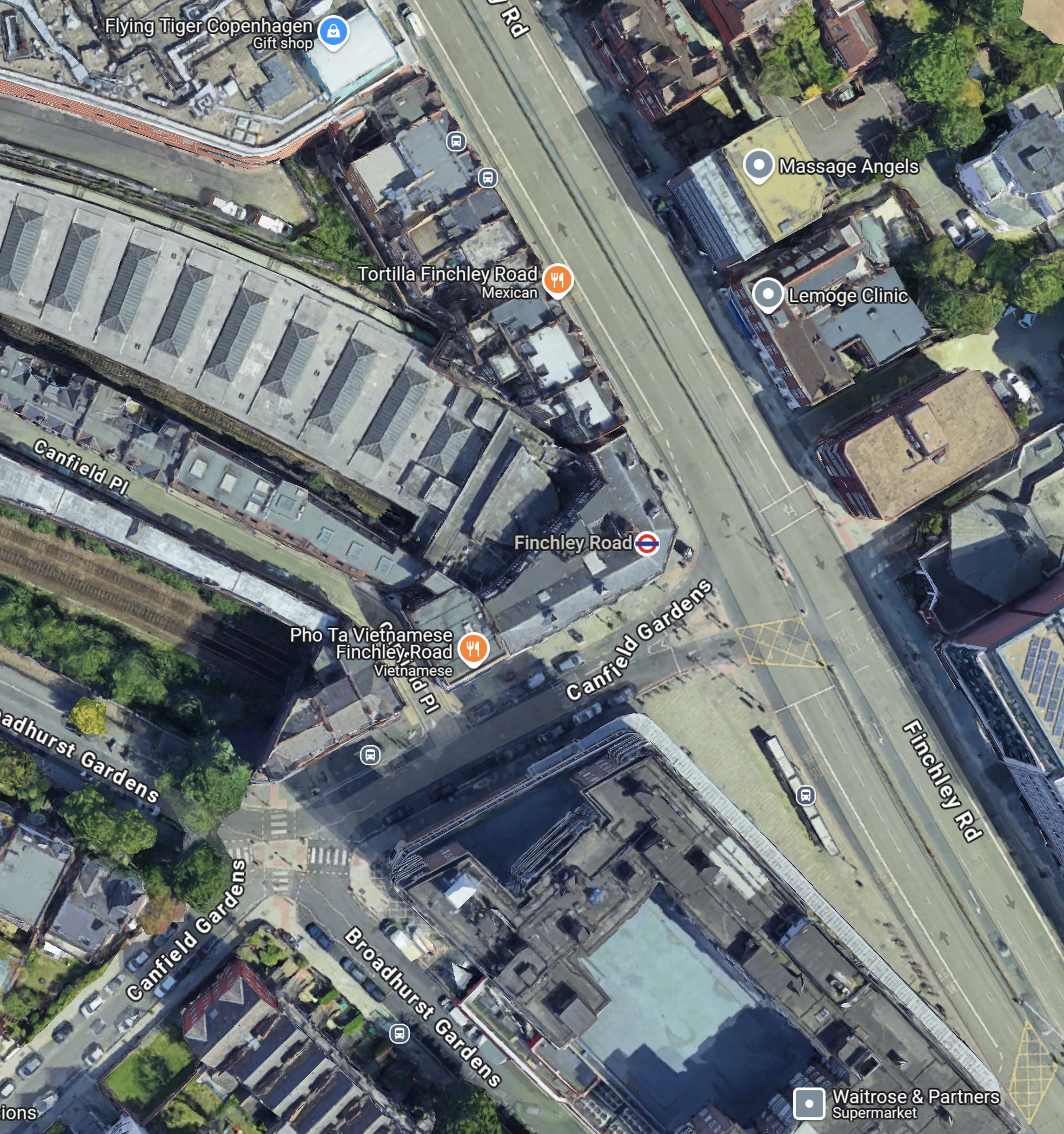
Note.
- The Finchley Road is the dual-carriageway road.
- The two grey dots at the Northend end of the Finchley Road, indicate the Coach stop and to its North a bus stop.
- The larger orange dot indicates the Tortilla restaurant, which is visible in several of the pictures.
- The London Underground roundel indicates Finchley Road tube station.
- The building curving away to the North-West is the train shed for the four platforms of Finchley Road tube station.
South of Finchley Road tube station, is a large Waitrose in the old John Barnes building.
This pictures show some of the Train to Street access at Finchley Road station.





Note.
- There is a high step out of the Jubilee Line trains.
- The steps from platform to the street are steep with a heavy case or a baby in a buggy.
But it’s a long time, since I’ve done any travelling with a baby.
I have some further thoughts.
Travelling With Heavy Luggage, In A Wheelchair Or A Baby Buggy
It might be better to take a 13 or 113 bus to Finchley Road tube station, as the stop is just South of the station and no more than fifty metres from the Finchley Road coach stop.
You could even get the bus from Swiss Cottage station, which is the next station South from Finchley Road and has a complete set of traditional escalators with uplighters.





Note.
A Busy Saturday Lunchtime At Victoria Coach Station
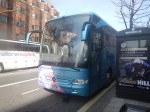
I went to Victoria Coach station at lunchtime today and took these pictures.
























These are my thoughts.
Where Are The British Coaches?
The nearest I saw were the smart coaches of the Oxford Tube, which were built by Plaxtons on a Volvo chassis.
The National Express coaches were made by Caetano in Spain.
I can certainly understand, why Wrightbus’s first product of a new era of British coach-building is an affordable Chinese-built coach, that is fitted with a Cummins engine, that possibly can be converted to hydrogen, as is the case, with some Cummins diesel engines.
As the coach will have a delivery time of six months, I think we’ll see them on the road fairly soon.
There Were Several Three Axle Coaches
In fact, I didn’t know they were very common.
- I suspect that three axles is better for the weight.
- But then you don’t see too many coaches in Central London unless you go to Victoria.
Wrightbus are saying that their hydrogen coach will have three axles.
The Wrightbus Effect
This article on Route One, says of the new Wrightbus Contour coach.
- It will be released this year.
- It will be an affordable product and Chinese-built.
- It will be a 55-seat diesel coach.
- It will have a Cummins engine.
In Wrightbus StreetDeck Ultroliner Next-Gen To Get Cummins Power, I describe how Wrightbus’s new Cummins-powered double-deck bus will be able to be converted to hydrogen-power. I suspect the same option will be available with the Contour diesel coaches.
The article on Route One, says this about the availability of the new coaches.
The Contour’s “competitive price” and lead time of six months promises an edge over some current industry norms, the business says.
That fits with what my finance company found forty years ago, when it was leasing coaches. If there were more coaches, you could lease more.
It looks to me, that the Cummins-powered, Chinese-built Wrightbus Contour coach will be affordable, available and convertible to zero-carbon hydrogen power.
If the quality and reliability of the coaches are high, then these coaches should sell and more coach operators will be wanting to run services from Victoria coach station, with their new affordable Wrightbus Contour coaches.
After what I saw on Saturday, will Victoria coach station have the space to accommodate them?
Coaches To Attractions
I saw coaches to Harry Potter, Legoland and other attractions.
Will this be an area that develops, if there were to be a greater availability of coaches, which Wrightbus, appears to be offering?
FLiXBUS
This is the first paragraph of the Wikipedia entry for FLiXBUS.
FlixBus (styled FLiXBUS) is a German brand that offers low-cost intercity coach services in Europe, North America, South America, and Asia. It is owned by Flix SE , which also operates FlixTrain, FlixCar, Kâmil Koç, and Greyhound Lines. FlixBus operates buses or, in many cases, just handles marketing, pricing, and customer service for a commission, on behalf of bus operators. In 2023, FlixBus had revenues of €2 billion and carried 81 million passengers of which 55 million were in Europe, 14 million were in Turkey, and 12 million were in North America.
They certainly seem to be an ambitious low-cost company, who serve a lot of places in the UK.
As they are a German company and Wrightbus have sold scores of zero-carbon buses to Germany could Wrightbus and FLiXBUS have been talking about affordable, quality coaches?
Could Wrightbus’s New Hydrogen Coach Do A London Scotland Round Trip On A Full Load Of Hydrogen?
Victoria Coach Station And Edinburgh
I have just looked up on the National Express web site and found that I can leave Victoria Coach Station at 22:00 and arrive in Edinburgh at 07:40 the following morning for a ticket price of £29.90.
The road distance would appear to be 638.1 km, which would be a 1276 km round trip. So I would expect that, there would need to be refueling in the round trip.
Victoria Coach Station And Glasgow
I have just looked up on the National Express web site and found that I can leave Victoria Coach Station at 23:00 and arrive in Glasgow at 07:40 the following morning for a ticket price of £23.90.
The road distance would appear to be 652.1 km, which would be a 1300 km round trip. So as with Edinburgh, I would expect that, there would need to be refueling in the round trip.
A Refuelling Strategy
Consider.
- I would expect that a refuelling strategy would minimise, the carrying of large amounts of hydrogen, through the centre of London or any other conurbation.
- The Southern Uplands of Scotland already host a lot of wind farms, including the UK’s largest onshore wind farm at Whitelee, which has a capacity of 539 MW.
- An electrolyser to produce hydrogen is being developed at Whitelee, which is 32.8 km South of Glasgow.
- Newport Pagnell services is 86.5 km. from the Southern end of the M1.
- Toddington services is 62 km. from the Southern end of the M1.
I wonder if two refuelling points, say 50-100 km. from each end of the route, would be a safe an efficient way to fuel the coaches?
Some Services Between London And Scotland
They are in South to North order.
Toddington Services
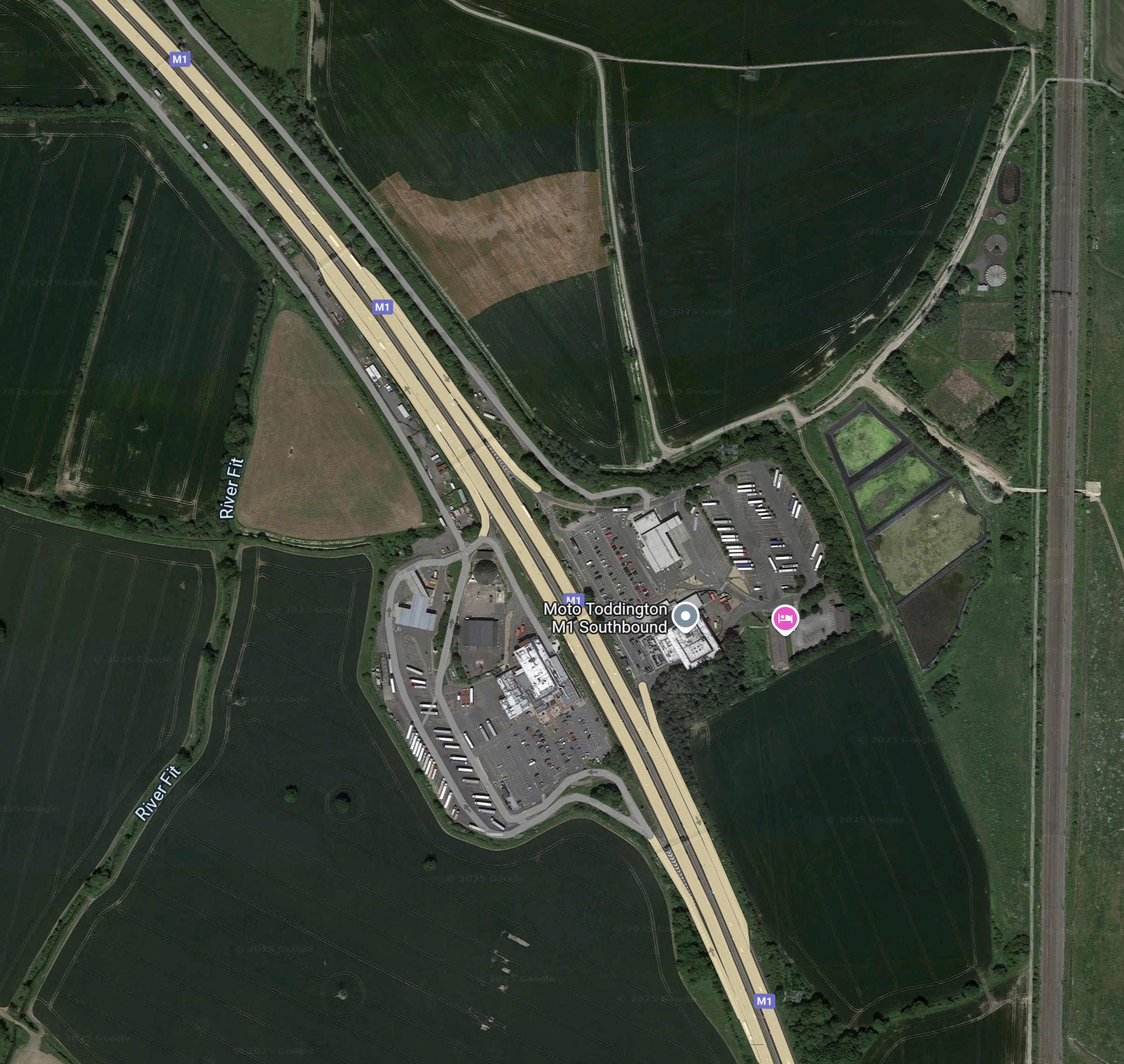
Toddington Services is 62 km. from the Southern end of the M1.
This map shows the services.
Note.
- There is land around the services that could be used to create more parking for hydrogen coaches.
- There doesn’t appear to be much space for a large wind farm to provide electricity to generate hydrogen.
- The Midland Main Line runs up the Eastern side of the map.
I wonder, if hydrogen could be brought to a refuelling site at Toddington services by the use of rail wagons.
Newport Pagnell Services
Newport PagnellServices is 86.5 km. from the Southern end of the M1.
This map shows the services.
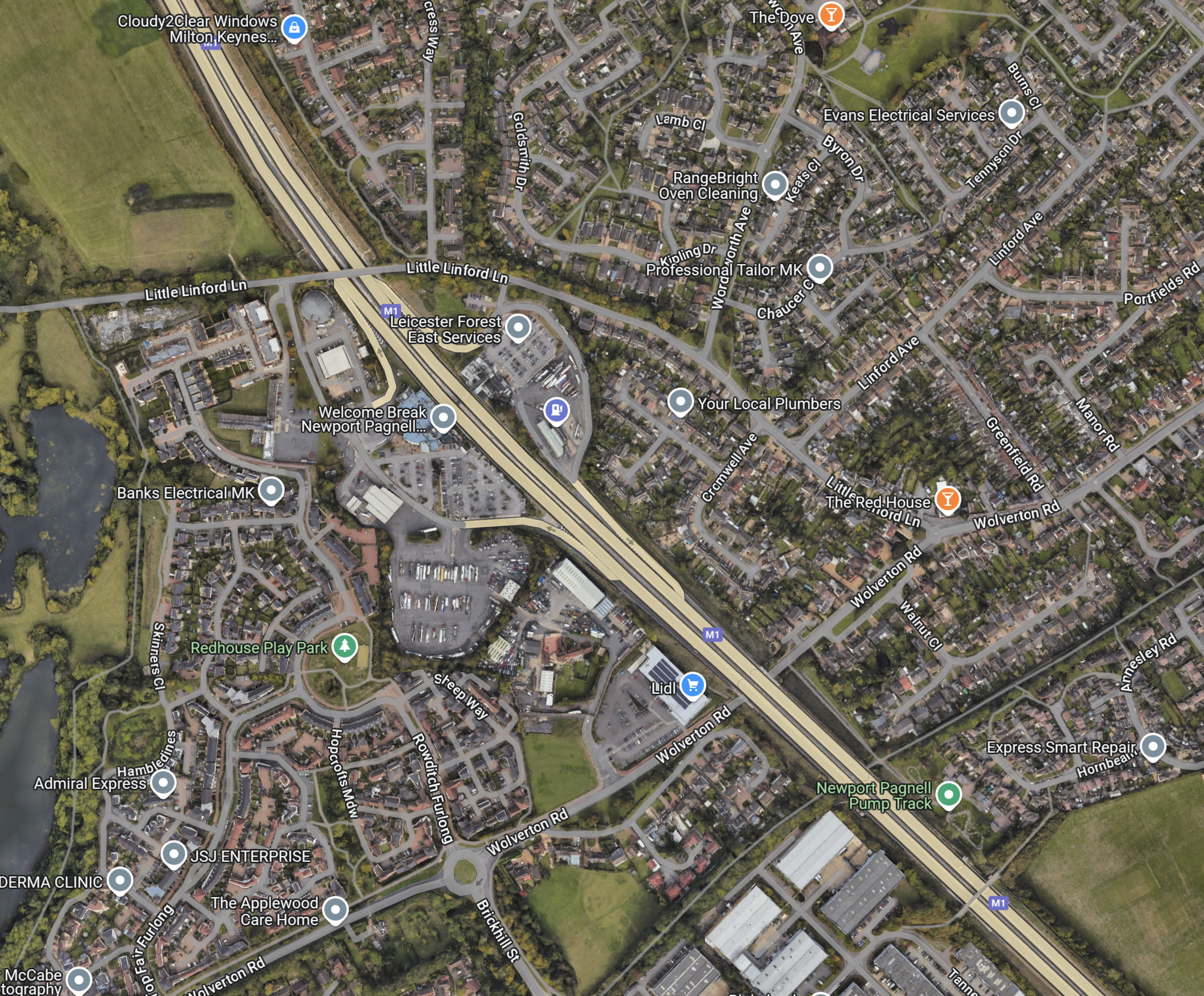
Note.
- The services are labelled as Leicester Forest East.
- The services are tightly surrounded by houses.
I’m not sure the residents would like to have a hydrogen refuelling station in their midst.
Northampton Services
Northampton Services is 104.5 km. from the Southern end of the M1.
This map shows the services.
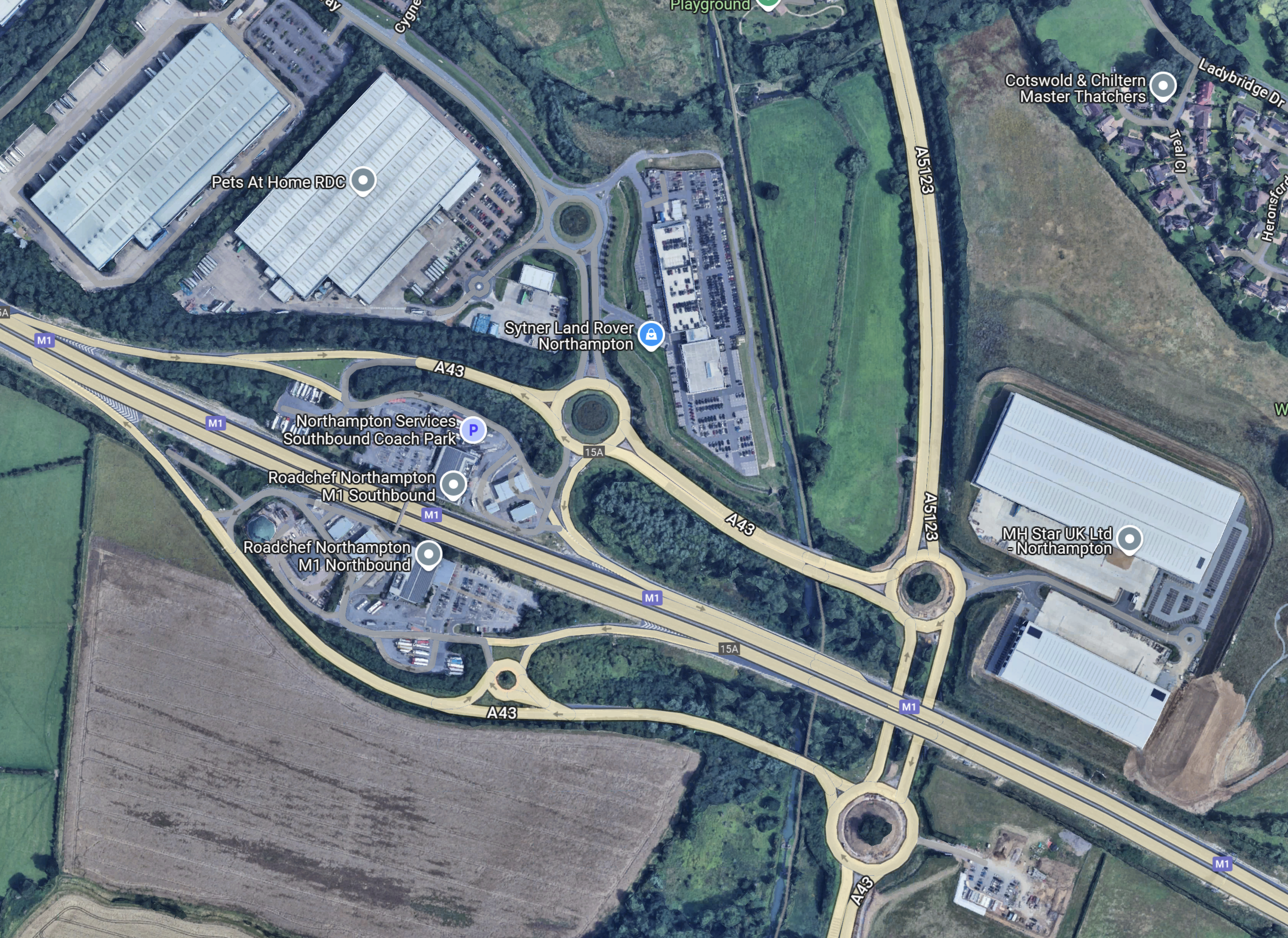
Note.
- It looks a rather complicated services.
- It might be too far from London.
- Provision of hydrogen might be difficult.
I think that this is another services that we can discount.
Watford Gap Services
Watford Gap Services is 120.8 km. from the Southern end of the M1.
This map shows the services.
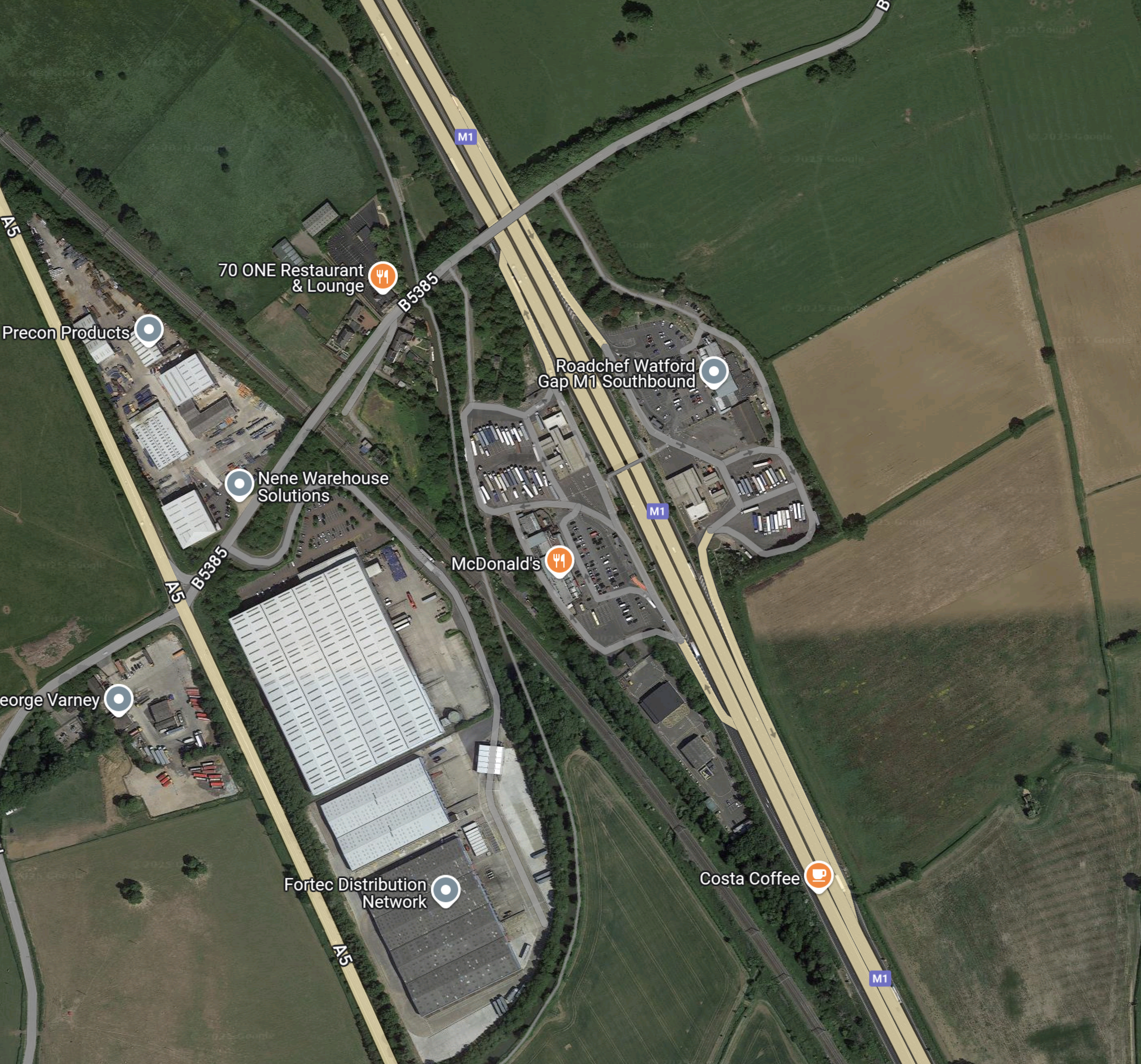
Note.
- There is land around the services that could be used to create more parking for hydrogen coaches.
- There doesn’t appear to be much space for a large wind farm to provide electricity to generate hydrogen.
- The West Coast Main Line runs through the centre of the services.
I wonder, if hydrogen could be brought to a refuelling site at Watford Gap services by the use of rail wagons.
Rugby Services
Rugby Services is 137.8 km. from the Southern end of the M1.
This map shows the services.
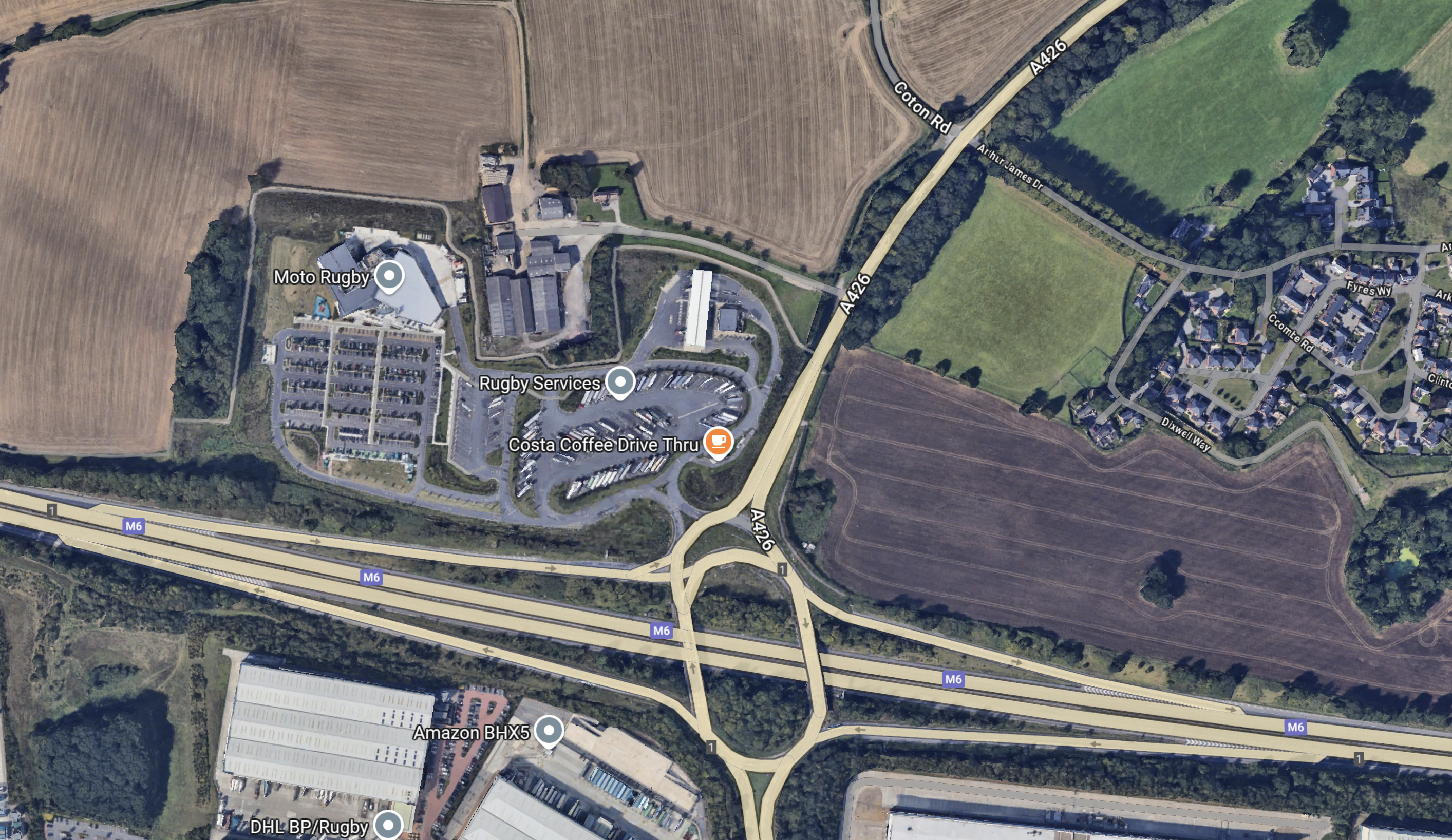
Note.
- There is land around the services that could be used to create more parking for hydrogen coaches.
- It is at Junction 1 of the M6.
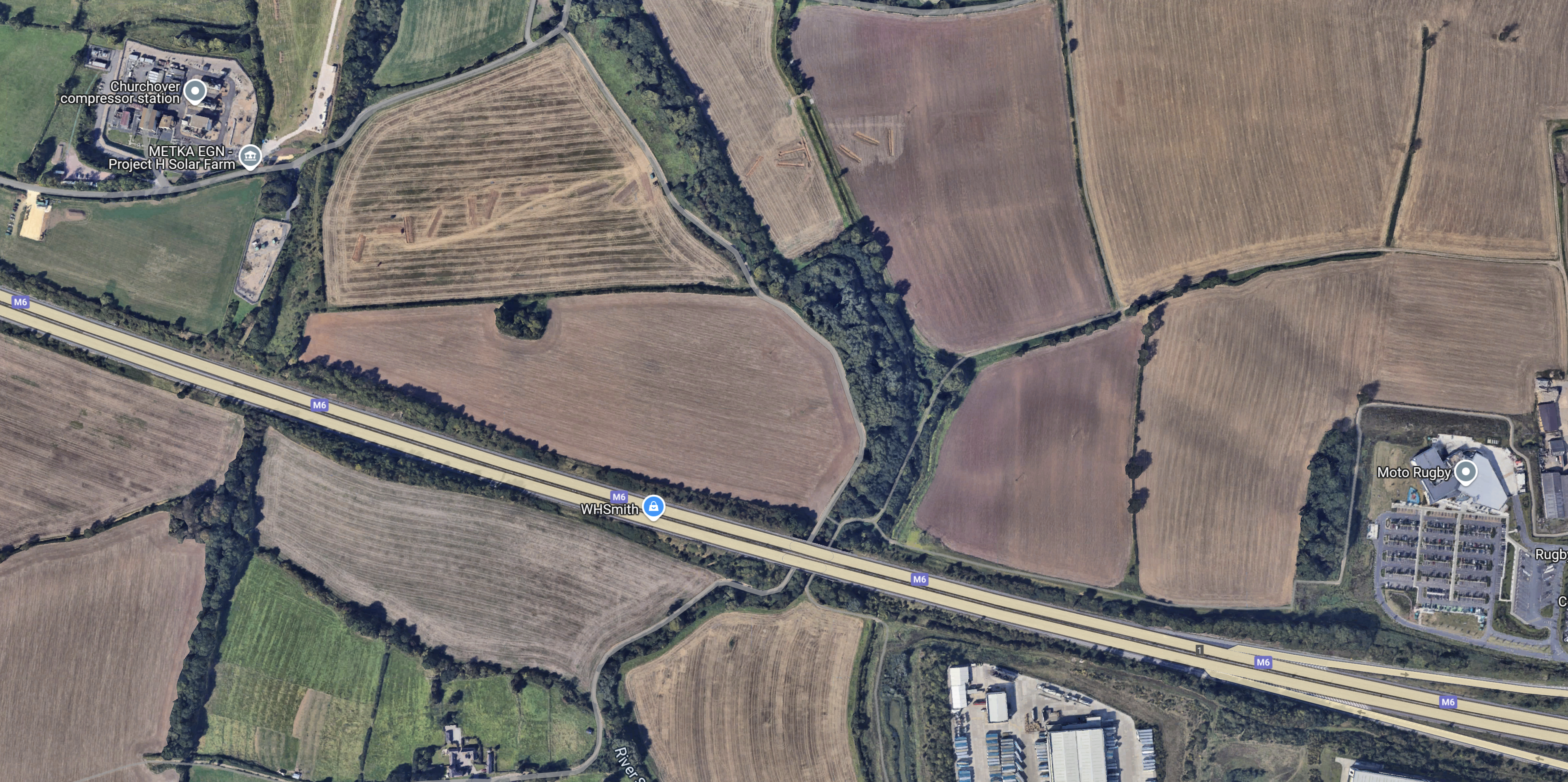
There is also a gas compressor station nearby, so I wonder, if a HiiROC system could be located here to extract hydrogen from the natural gas.
This map shows the location of the Churchover compressor station, with relation to Rugby services.
Note.
- The compressor station is in the North-West corner of the map.
- Rugby services are in the South-East corner of the map.
- From labels on the map it appears, a solar farm might be planned by the compressor station.
With a system like HiiROC creating turquoise hydrogen from natural gas, this could be a major filling station for hydrogen-powered trucks, coaches and cars.
Conclusion
It looks to me, that Toddington services would be best, but there would need to be a large increase in capacity, if a large number of hydrogen coaches, were going to fill up at Toddington for their trip into London.
The alternative would be to give the coach a large enough hydrogen tank for a complete round trip.
Wrightbus Back To Coach With Contour Diesel And Hydrogen Future
The title of this post, is the same as that of this article on Route One.
These are two introductory paragraphs.
Wrightbus has announced details of its return to the coach sector with the launch of the Contour, a new diesel-powered two-axle model built in partnership with Chinese OEM King Long.
Alongside the Contour, the company has spoken in more detail of its plans to introduce a tri-axle integral hydrogen fuel cell-electric coach, due for debut in 2026.
Specific and new product points include.
- The diesel-powered coach will be built in partnership with a Chinese OEM.
- It will be a 12.2m coach with 55 seats plus toilet.
- Left- and right-hand drive variants will be available.
- Luggage space is nine cubic metres, reducing to seven cubic metres with a passenger lift fitted.
This paragraph describes the hydrogen coach.
That vehicle will be its first fully integral coach model, developed entirely in-house. The initial variant will be a 15m overdecker capable of accommodating 69 passengers on the upper deck and up to 15 passengers and two wheelchair users on the lower deck, with 10 cubic metres of luggage space. Wrightbus has not confirmed yet whether it will carry the Contour name, nor where the body will be built.
They also say that a single-deck version is being considered for later, while the coach’s modular construction will make it suited to a number of different drivetrain options, depending on demand.
It would appear that Wrightbus have all options covered.
Wrightbus Goes Back To The Future As It Relaunches The Contour Coach
The title of this post, is the same as that of this press release from Wrightbus.
This is the detail of the press release.
Wrightbus is entering the coach market for the first time in more than 30 years with the launch of two new vehicles in the next 18 months.
The first vehicle to hit the market is the Contour, a low-emission 55-seater coach that was launched at a customer showcase event today (March 5).
It’s a case of back to the future for Wrightbus, which last produced a Contour coach in 1987 before retiring the vehicle.
The second vehicle, a zero-emission hydrogen coach – which is under development in Ballymena, Northern Ireland – will be added to the Wrightbus coach range within the next 18 months to help drive decarbonisation of the sector.
The low emission Contour has a lead time of just six months from order, which is considerably faster than the current one-to-two-year average wait customers have come to expect from the sector. Featuring a Cummins Euro 6 400BHP X11 engine and a ZF automatic gearbox, the modern-day Contour has been built with comfort in mind, with up to 55 reclining seats – each with its own USB port – alongside other modern safety features. Competitively priced and available with or without PSVAR compliance, there is also the option of the vehicle being ‘pre-prepared’, protecting the vehicle’s ‘second life’ and flexibility.
The coach has a range of bespoke options for customers to choose from and is designed to maximise luggage space and functionality.
It will be supported by a full Wrightbus warranty, alongside an unparalleled service and maintenance package from AllServiceOne, the Wrightbus repair and maintenance arm.
With the largest fleet of mobile technicians throughout the UK and Northern Ireland, AllServiceOne is the ultimate one-stop-shop for fleet support and service.
Wrightbus CEO, Jean-Marc Gales, said bringing the Contour to market was a pivotal move.
“The coach market has changed over the last few years and it’s the right time for a new player to come to the market.
We have long spoken about broadening our portfolio to offer customers an even greater range of Wrightbus vehicles.
Our first entry into the coach sector after an absence of more than three decades is another significant step in our expansion plans,” said Mr Gales.
“We know there are gaps in the market and the demand for coaches is growing.
This partnership allows us to bring high-quality low-emission vehicles to market almost immediately.
Throughout the process of readying the vehicle for our UK market, we have worked alongside our partner closely to ensure the Contour meets the exacting Wrightbus high quality standards that customers have come to expect.
Our AllServiceOne technicians have embarked on an extensive training programme and have a full working knowledge of the coach to ensure excellent fleet support. “At the same time as the launch of the Contour, our world-leading engineers are continuing to develop our own zero-emission hydrogen coach from our factory in Northern Ireland. We expect the hydrogen coach to be ready for launch in the next 18 months, which is a hugely exciting prospect.” The hydrogen coach concept was first revealed in 2024 as a prototype vehicle.
When launched, it will be a tri-axle hydrogen fuel cell electric coach capable of a 1,000km range, putting it on a par with traditional diesel-fuelled coaches.
These are my thoughts.
The Coach Has A Cummins Engine
Cummins will probably build the engines in their UK factory in Darlington.
Thirty years ago, I did a small data analysis consultancy for Cummins in Darlington and I was impressed by the operation and the company’s attitude.
One of their policies was that if the customer wants a special engine, then the company, is prepared to give the customer what they need.
So you can be sure, that the Cummins X11 engine to be supplied for the Contour coach, will be exactly what Wrightbus want.
The Cummins X15 Engine Is Convertible To A X15 Hydrogen Engine
Some of Cummins diesel engines are convertible to hydrogenfuel, by changing the cylinder head and the fuel system.
This can be done with a Cummins X15 engine and I wouldn’t be surprised if the X11 engine fitted to the Contour coach can be converted to hydrogen.
So an operator can buy a diesel coach and if they need, they could convert it to hydrogen.
USB Ports
This is stated in the press release.
Contour has been built with comfort in mind, with up to 55 reclining seats – each with its own USB port.
When I rode recently in a Irizar coach, there were no USB ports.
There Is A Promised Delivery Time Of Six Months
In the 1990s, I used to part-own a finance company, that leased vehicles.
One of the vehicles we used to loan money for was upmarket coaches like the Wrightbus Contour.
- They were a relatively large loan of about £50,000.
- The borrower was often very reputable with a good credit history.
- The repossession rate was very low.
The press release says, that a two-year delivery time is normal for coaches and, I can remember that we could have financed more coaches, if they had been available.
So it would appear to me, that if Wrightbus can deliver a new coach in six months, they will sell a lot of coaches and I believe from past experience, that finance will be available from trusted sources.
The Hydrogen Coach Will Be A Hydrogen Fuel Cell Electric Tri-Axle Coach
This is stated in the press release.
When launched, it will be a tri-axle hydrogen fuel cell electric coach capable of a 1,000km range, putting it on a par with traditional diesel-fuelled coaches.
I suspect to get the 1,000 km range of the diesel coach and to protect the hydrogen tank, means some extra weight and an extra axle.
But I wouldn’t be surprised to see a reduced range hydrogen coach without the third axle.
Wrightbus Are The Company Who Launched Ballard Hydrogen Fuel Cells In London
I wrote London’s Hydrogen Buses in July 2013 and all Wrightbus buses hydrogen buses have used hydrogen full cells from Ballard Power Systems in Canada.
But there could be a complication in that Cummins make fuel cells in Germany and we are approaching Trumpian Tariff War Territory.
On the other hand in Australian Volgren Rolls Out First Hydrogen Bus Based On Wrightbus Chassis Technology, it shows how Wrightbus are prepared to licence their technology to reputable companies.
So any country, like Australia, Brazil, Canada, India, Mexico, Singapore or the United States, who can build coaches, can licence Wrightbus’s designs and fit the appropriate components to make a complete coach.
Note.
- Wrightbus is owned by the Bamford family, who own JCB.
- Wrightbus have licenced designs to Australia, Hong Kong and Singapore in the past.
- JCB have large manufacturing facilities in India.
I’m certain that the Bamfords and their advisors can work it out!
Riding Rail Air Between Reading Station And Heathrow Terminal 5
Today, I rode on a Rail Air coach between Reading station And Heathrow Terminal 5.
I took these pictures as I walked through Reading station and from the coach.































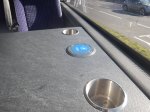






































These are my thoughts on various topics.
Catching The Coach At Reading
Consider.
- The route to Rail Air from the trains at Reading station is well signed.
- The entrance to the Rail Air terminal at Reading station is behind the M & S Simply Food store.
- I estimate that the time between arriving at Reading station and the coach leaving was only a few minutes.
- Rail Air coaches run every twenty minutes.
- My coach had about ten passengers.
- My single fare was £17.30 with my Senior Railcard.
It was all a rather painless process.
On The Coach
Consider.
- The coach was more-or-less what you would expect on a quality route.
- The view was good.
- I had a table, with four seats.
- The table had contactless charging and drink holders.
- There was no charging for my phone and camera, which use USB or 13 amp plugs.
- The seat was reasonably comfortable.
- There was a toilet.
- There was typical storage for heavy luggage underneath the seats.
I would have thought if Wrightbus fit USB ports on their buses, that they are needed.
The Route
This Google Map shows Reading and Heathrow
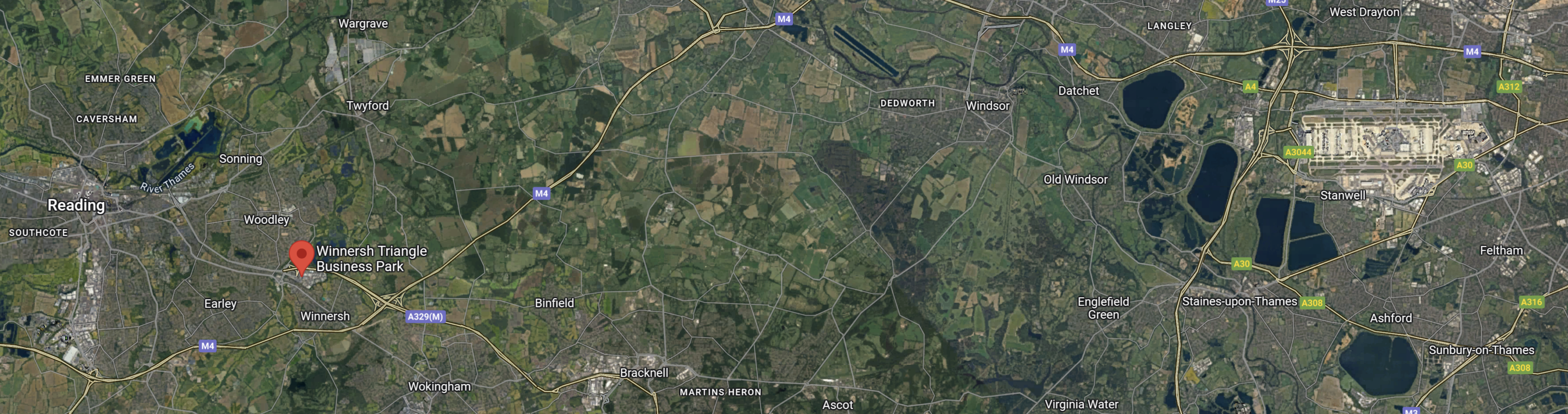
Note.
- Reading is at the Western end of the map.
- Heathrow is at the Eastern end of the map.
- The red arrow indicates Winniersh Triangle station on the Eastern side of Reading.
- The coaches stop at Reading Cemetery and Winnersh Triangle station.
- Most of the route between Winnersh Triangle and Heathrow Airport is on the M4 Motorway or dual-carriageway roads.
- The distance appears to be just under 27 miles and is scheduled to take forty minutes.
- Click the map to show to a larger scale.
It looks to me that it is an ideal route for a coach.
On The Journey
Consider.
- Once clear of Reading and past the stop at Winnersh Triangle, the coach held a good speed all the way to Heathrow, as the motoway was not busy.
- In the UK coaches under twelve metres long, can run at 70 mph and I estimated that this coach was probably at 60 mph.
- The stops were called out like stations on a train.
- Strangely, the roadholding was not as good as that of the Wrightbus hydrogen bus, that I took to Gatwick, a couple of weeks ago.
- The big problem though was the noise of the diesel engine, which was very loud compared to the noise of the fuel cell and electric transmission of the Wrightbus hydrogen bus.
I suspect that transforming the hydrogen bus into a coach, could result in a very high quality coach, with the performance and range of a diesel coach, without the noise, pollution, vibration and carbon emissions.
Heathrow Rail Link Project Could Be ‘Reopened’
The title of this post, is the same as that of this article on the BBC.
This is the sub-heading.
Network Rail has said plans for a rail link between the Great Western mainline and Heathrow Airport could still move forward if funding is found in the future.
These three paragraphs give the current status of the scheme.
The Local Democracy Reporting Service recently reported that the project had been put on hold.
It began in 2012 and involved proposals for a 4 mile (6.5km) rail link to allow train services from Reading and Slough in Berkshire to reach Heathrow using a tunnel.
The £900m scheme would allow people living to the west of Heathrow to travel direct to the airport, instead of having to go into London.
These are some other facts and my thoughts.
The All-Party Parliamentary Group (APPG) For The Western Rail Link To Heathrow
According to the BBC article, this has now been established and this is said.
Labour MP for Slough, Tanmanjeet Singh Dhesi, held a debate in parliament on the western rail link in April and established the All-Party Parliamentary Group (APPG) for the Western Rail Link to Heathrow, to make sure it “remains on the government’s agenda”.
He said the project had been “beset by delays and funding challenges” but still had “wide cross-party and local support”.
Parliamentary backing is surely a good thing.
The Current Scheme
The BBC article shows this map with a rail link connecting the Great Western Main Line to Terminal 5 railway station.
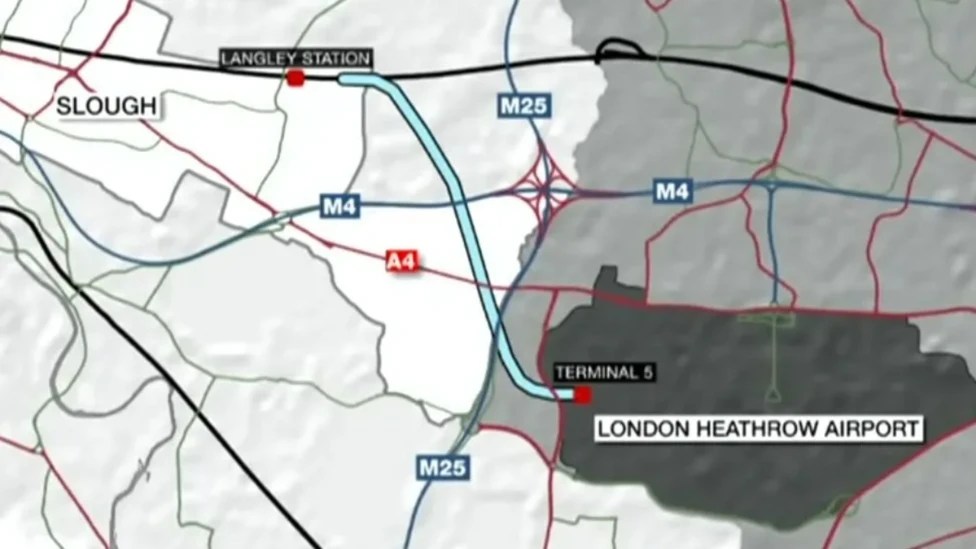
Note.
- The rail link starts from East of Langley station.
- Terminal 5 station can take full-length Elizabeth Line trains.
- Main line trains from Bristol, Cardiff and Wales and the West should be able to access Heathrow.
But I suspect, that there would be extensive changes to Heathrow’s railways to access the other terminals. This would explain the near billion pound cost of the link.
I also suspect that it would take about eight to ten years to build and from what I havc heard, the rail link is urgently needed.
RailAir
RailAir is the current way of travelling between Reading station and Heathrow Airport.
This is the first paragraph of RailAir’s Wikipedia entry.
RailAir describes a number of airport bus and coach services designed to connect the National Rail network to airports in the United Kingdom. Services are currently concentrated on Heathrow Airport, with one other from Luton Airport. RailAir services are operated as public transport services by or on behalf of train operators, where the whole journey is paid for as a through-ticket which combines the railway and bus journey, although journeys can be made using the bus only. As such, many are operated where the train and bus operator are owned by the same company.
Could RailAir be updated to be a more frequent and integrated service?
CoacH2
This page on the Advanced Propulsion Centre UK web site is entitled CoacH2 – Next Generation Hydrogen Fuel-Cell Coach Powertrain Demonstrator.
This is the sub-heading.
Accelerating the development of zero-emission hydrogen fuel-cell electric coaches, with a full on-vehicle technology demonstrator.
These are the first two paragraphs.
Coaches are an integral part of the public transport network, with over 30,000 diesel coaches operating across the UK and Ireland. Due to the specific demands of coach operation (motorway driving, long-range, high passenger and luggage loading capacity) decarbonisation options for this sector are extremely limited with hydrogen fuel-cell technology considered the most viable choice. This project will tackle this difficult to decarbonise sector by developing, testing and validating an innovative hydrogen fuel-cell powertrain suitable for coach applications.
Delivered by a Northern Irish consortium spanning OEM, coach operator and academia, CoacH2 will accelerate the development of zero-emission, fuel-cell electric coaches, with a full on-vehicle technology demonstrator to be manufactured and showcased at Cenex Expo 2024.
As I indicated in British Buses For British Bottoms, Wrightbus build a good well-built, smooth-riding and comfortable bus, so now they can add hydrogen-powered coaches to the product range.
This press release on the Wrightbus web site is entitled Wrightbus Coach Demonstrator Unveiled At Cenex Expo, gives more information on CoacH2.
- The demonstrator has a power of 300 Kw.
- It has a range of 1,000 km. on one refueling.
- An internet search reveals a launch date of 2026 for the hydrogen-powered coach.
I wonder, if RailAir changed their coaches to these new Wrightbus hydrogen-powered coaches, they would transform travel to airports all over the UK.
If the hydrogen-powered coaches are of the same quality of their hydrogen-powered siblings, they will be a quality product with good road-holding, sufficient performance and superb passenger comfort.
RailAir could be the ideal, initial application.
Conclusion
A proper rail link to Heathrow from Reading is needed, but it will take at least ten years to build and cost a billion pounds.
However the RailAir links to Heathrow from Reading and Woking can be improved by using high-performance Wrightbus hydrogen-powered coaches.
From Reading To Gatwick Airport Along The North Downs Line
After writing Connecting Reading And The West To Gatwick Airport And Eurostar, I decided to go and look at the reality of the North Downs Line between Reading and Gatwick Airport stations.
I took my usual route to Reading, which is to go to Moorgate and get the Elizabeth Line direct to Reading using my Freedom Pass, after having breakfast in the Leon on Moorgate.
- I then had to leave the station at Reading, so that I could buy my ticket to Gatwick Airport.
- It would be so much easier, if there ere a couple of ticket machines on the bridge or platform at Reading station, so that passengers, who were changing trains could buy tickets quickly and easily.
In the end, I caught the 11:24 train to Gatwick with only a few minutes to spare.
From Reading To Gatwick Airport Along The North Downs Line
Along the North Downs Line, the train was a well-refreshed Great Western Railway Class 165 train.
These are some of the pictures, that I took on the route.






































Note.
- The route goes through a lot of typical Surrey heathland.
- I noticed several pubs along the way.
- I suspect that there are some good walks from the stations.
- Reading and Guildford are university cities.
- Sandhurst is home to the Royal Military Academy.
- Farnborough Airport used to be home to the Royal Aircraft Establishment.
- Most of the seats on the train were taken.
I would expect that for a mainly rural route it is fairly busy.
Hitachi’s Intercity Battery Trains
Hitachi have developed an Intercity battery train and it is described on this page on their web site, where this is said about converting the trains to battery-electric operation.
A quick and easy application of battery technology is to install it on existing or future Hitachi intercity trains. Hitachi Rail’s modular design means this can be done without the need to re-engineer or rebuild the train and return them to service as quickly as possible for passengers.
Replacing one diesel engine with just one battery reduces emissions by more than 20% and offers cost savings of 20-30%. Our intercity battery powered trains can cover 70km on non-electrified routes, operating at intercity speeds at the same or increased performance.
That performance is certainly enough for Reading and Ashford via Gatwick, as only 37.7 miles in total, is not electrified.
Does The North Downs Line Mirror The East-West Rail?
Consider.
- The East West Rail will encircle London to the North, between Oxford and Cambridge.
- The North Downs Line encircles London to the South, between Reading and Ashford.
They could be considered two complimentary rail lines.
A Milton Keynes And Ashford International Service
Looking at the track layout on OpenRailwayMap, it would appear that one of Hitachi’s proposed Intercity Battery Trains fitted with dual voltage could pick its way elegantly along the East West Rail and the North Downs Line between Milton Keynes and Ashford International via Oxford, Reading and Gatwick Airport.
An Occasional Sheffield And Ashford International Service
If you could run a service between Milton Keynes and Ashford International, why not extend it to Bedford or even Sheffield in the North?
I believe if you put these Hitachi’s proposed Intercity Battery Trains on a cross-country route, that they will quickly suffer from London Overground Syndrome. This is my definition of the syndrome.
This benign disease, which is probably a modern version of the Victorian railway mania, was first identified in East London in 2011, when it was found that the newly-refurbished East London Line and North London Line were inadequate due to high passenger satisfaction and much increased usage. It has now spread across other parts of the capital, despite various eradication programs.
Put simply, it can probably be summed up as Quality Attracts Passengers.
Serving Heathrow
There have been various plans to get rail access into Heathrow from the West, but none have so far got off the starting blocks.
It is my view, that in the interim period, after my trip last weekend in the superb Wrightbus hydrogen double deck bus from Sutton to Gatwick, that I wrote about in Sutton Station To Gatwick Airport By Hydrogen-Powered Bus, that we should ask Wrightbus, who are designing a hydrogen-powered coach, to design the ultimate coach to connect rail hubs to major airports.
I would then run these coaches every ten minutes between Reading station and Heathrow Airport.
Serving Attractions
I believe that pairing Hitachi’s proposed Intercity Battery Trains with Wrightbus’s hydrogen coach could be a winner for passengers and operators.
As an example, Lumo are hoping to run an open access service between Paddington and Carmarthen, if Heidi the Spoilsport permits. Would it not be sensible, if one of Wrightbus’s hydrogen coaches did the last mile duties to the ferry for Ireland at Fishguard harbour.

