Alstom And Eversholt Rail Develop Hydrogen Train For Britain
The title of this post, is the same as that of this article in the International Rail Journal.
This is the first paragraph.
Alstom confirmed on September 11 that it is working with British rolling stock leasing company Eversholt Rail to refit class 321 EMUs with hydrogen tanks and fuel cells for hydrogen operation, in response to the British government’s challenge to eliminate diesel operation on the national network by 2040.
Other points about the conversion of Class 321 trains include.
- Alstom will convert trains in batches of fifteen.
- The first trains could be ready by 2021.
- Up to a hundred trains could be converted..
- A range of up to 1000 km on a tank of hydrogen.
- A maximum speed of 160 kph.
The article also suggests that the Tees Valley Line and Liverpool to Widnes could be two routes for the trains.
A few points of my own.
- Fifteen is probably a suitable batch size considering how Class 769 trains have been ordered.
- Hydrogen is produced in both areas for the possible routes and could be piped to the depots.
- In Runcorn it is plentiful supply from the chlorine cell rooms of INEOS and that company is thinking of creating a pipeline network to supply the hydrogen to users with high energy needs.
- As the maximum speed of the hydrogen train is the same as the current Class 321 trains, I would suspect that it is likely that the hydrogen-powered train will not have an inferior performance.
- I’ve now travelled in Class 321 Renatus trains on three occasions and in common with several passengers I’ve spoken to, I like them.
- I hope the Class 321 Hydrogen trains have as good an interior!
I very much feel that there is a good chance that the Class 321 Hydrogen could turn out to be a good train, powered by a fuel, that is to a large extent, is an unwanted by-product of the chemical industry.
A Comparison Between The Alstom Coradia iLint And The Class 321 Hydrogen
It is difficult for me to compare the Alstom Coeadia iLint or even a bog-standard iLint , as I’ve never rode in either.
Hopefully, I’ll ride the iLint in the next few weeks.
The following statistics are from various sources on the Internet
- Cars – 321 – 4 – iLint – 2
- Electric Operation – 321 – Yes – iLint – Not Yet!
- Loading Gauge – 321 – UK – iLint – European
- Operating Speed – 321 – 160 kph – iLint – 140 kph
- Range – 321 – 1000 km. – iLint – 500-800 km.
- Seats – 321 – 309 – iLint – 150-180
Although the Class 321 Hydrogen will be a refurbished train and the iLint will be new, I suspect passengers will just both trains as similar, given the experience with refurbished trains in the UK.
In some ways, they are not that different in terms of performance and capacity per car.
But the Class 321 Hydrogen does appear to have one big advantage – It can run at up to 160 kph on a suitable electrified line, This ability also means the following.
- Hydrogen power is not the sole way of charging the battery.
- On some routes, where perhaps a twenty kilometre branch line, which is not electrified, is to be served, the train might work as a battery-electric train.
- A smaller capacity hydrogen power unit could be fitted for charging the battery, when the train is turned back at a terminal station and for rescuing trains with a flat battery.
- The depot and associated filling station, doesn’t have to be where the trains run most of their passenger services.
I also suspect that a Class 321 hydrogen could run on the UK’s third-rail network after modification, if required.
If you were an operator choosing between the two trains, you would probably find that because of your location, there would be a strong preference for one of the two trains.
I also doubt we’ll see iLints running in the UK because of the loading gauge problem.
Will the platform height scupper the running of Class 321 Hydrogen trains in Europe?
In Riding Docklands Light Railway Trains In Essen, I reported on seeing redundant Docklands Light Railway trains running in Essen.
For this reason, I wouldn’t totally rule out Class 321 Hydrogen trains invading Europe!
More Thoughts On Aberdeen Crossrail
In A Crossrail For Aberdeen, I put down my initial thoughts for Aberdeen Crossrail.
Now that I’ve been to Aberdeen and travelled on most of the Aberdeen Crossrail route between Inverurie and Montrose stations, I can add more thoughts.
I shall express my thoughts in generally a Southerly direction.
Inverurie Station
Currently, this is a two-platform station on a passing loop.
This picture gives a flavour of the station, which is Grade B Listed.
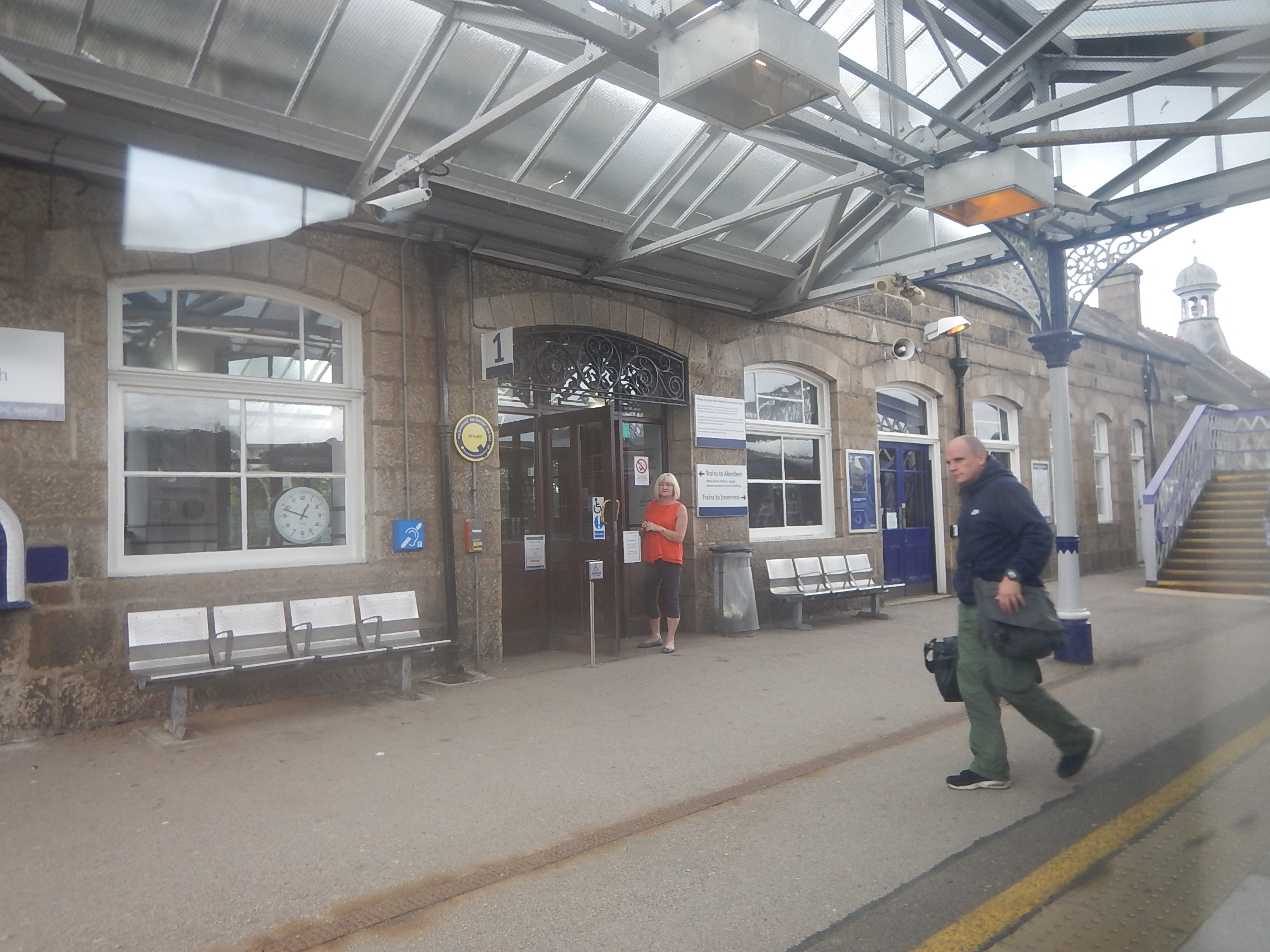
You can just see, the rather elderly iron footbridge across the tracks.
I suspect that platform usage will be as follows.
- Platform 1 – All through trains to and from the West and Inverness.
- Platform 2 – All trains starting or terminating at Inverurie.
If platform 2 is to be in regular use, then there will be pressure to improve the footbridge.
Double Track From Inverurie To Aberdeen
Most of this section seems to be single track, with passing loops at Inverurie and Dyce stations.
The only difficult bit is probably where the track goes under the new Aberdeen Western By-Pass.
This Google Map shows where they cross to the West of Dyce station.
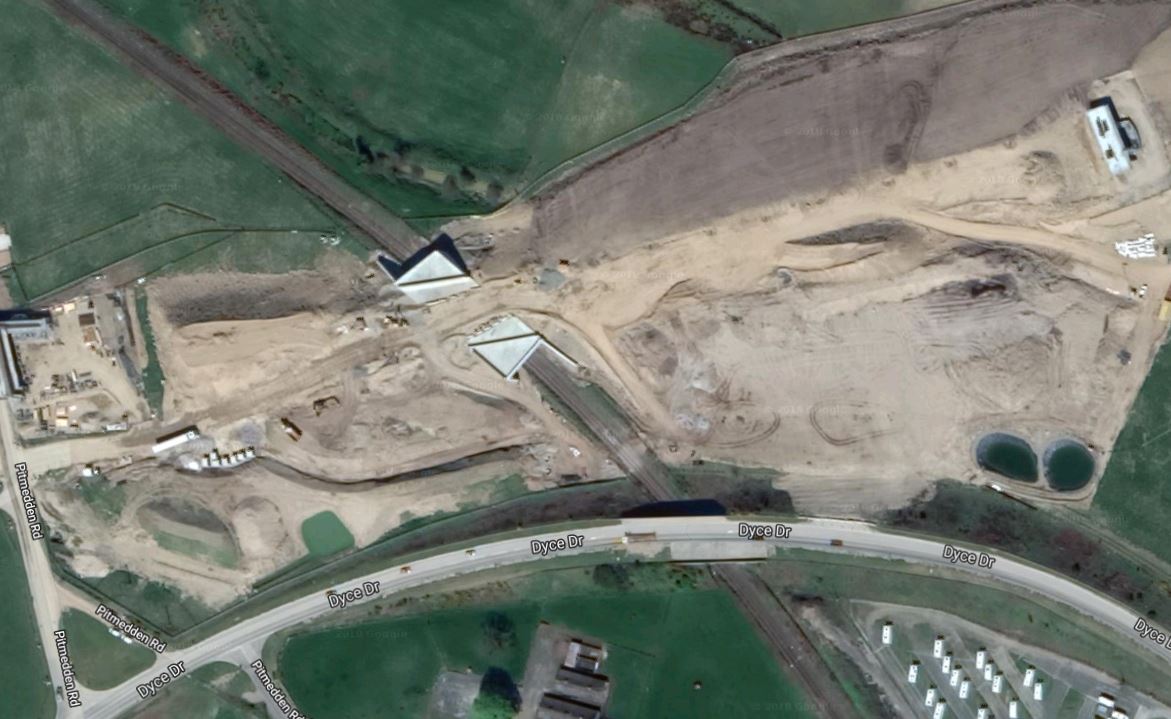
The difficulty is not the engineering, but the insolvency of Carrilion, who were the contractor for the road.
Dyce Station
These pictures show Dyce station, where I changed from train to bus.
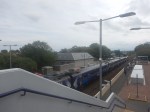
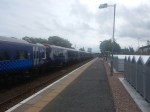
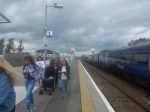
I’m pretty sure that once the track is complete, Dyce station will only need a small amount of work.
Aberdeen Station
Aberdeen station is not only a transport hub with a bus station, but it is also connected directly to the Union Square development.
It is certainly ready for Aberdeen Crossrail.
InterCity 125s
In my travels up and down between, Aberdeen, Montrose, Stonehaven and Dundee, it surprised me, how many journeys were made on an InterCity 125.
I’ve read somewhere, that one of the reasons, ScotRail are bringing in shortened InterCity 125s, is that passengers tend to use these faster trains on journeys like those between Stonehaven and Aberdeen.
Although the shorterned InterCity 125s will be limited to 100 mph, their bags of grunt, will mean good acceleration and surely faster times between Aberdeen and Dundee, Edinburgh, Glasgow and Stirling.
Trains For Aberdeen Crossrail
I timed the InterCity 125s at 100 mph on large sections of the route between Aberdeen and Montrose, as this picture of the SpeedView App on my phone shows.
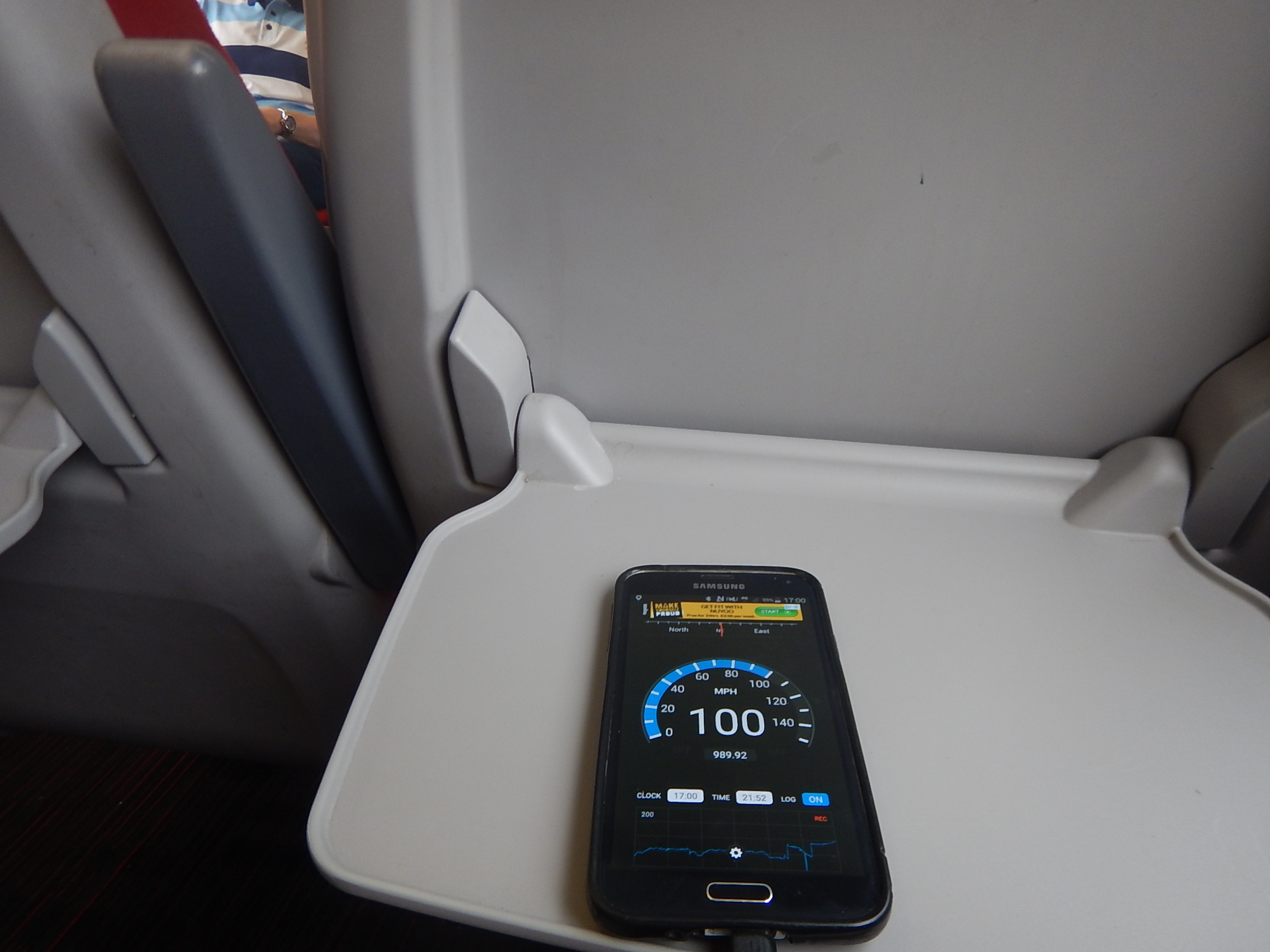
I think this means, that any trains working passenger services on the Edinburgh-Aberdeen and Glasgow-Aberdeen Lines must be capable of continuous operation at 100 mph.
As Wikipedia gives the operating speeds of both lines as being this figure, it does appear that Aberdeen Crossrail will be a fast local service, very much in line with the performance of services from London to Basingstoke, Brighton, Chelmsford and Oxford.
Initially, I suspect that ScotRail will be using Class 170 trains to provide the stopping service on Aberedeen Crossrail. Class 158 trains could also provide the service, but their 90 mph operating speed may not be enough.
ScotRail certainly have enough Class 170 trains, but I suspect that running two-car trains between Montrose and Inverurie stations, which stop everywhere will not have enough capacity. So a pair of trains will need to be used for each service.
In A Crossrail for Aberdeen, I said this under Frequency Issues.
The route of Inverrurie to Montrose has been deliberately chosen.
- Inverurie to Aberdeen takes around 23 minutes.
- Montrose to Aberdeen takes around 35 minutes.
So with slightly faster trains and line speed, than currently used, it should be possible for a train to go from Inverurie to Montrose and back in two hours to include a few minutes to turn the train round.
A two hour round trip means that a train leaving Inverurie at say 06:00 in the morning, will if all goes well, be back in Inverurie to form the 08:00 train.
How convenient is that?
This means that one tph will need two trains, two trph will need four trains and four tph will need eight trains.
These figures would be doubled if four-car trains were to be run on the route.
I feel that four-car trains will be needed on all services on Aberdeen Crossrail, if some of the passenger loading I saw, were to increase. As it surely will do, if they have a more convenient and much better quality service.
Passengers will also see the lots of seats on the shortened InterCity 125s, speeding past and will want some of that.
Two two-car trains working as a four-car train can provide the capacity, but in my view they are not what passengers want, as they can’t circulate in the train to find a preferred seat.
I also think, that at least two tph should run between Montrose and Inverurie stopping at all stations.
This would require four four-car trains.
ScotRail doesn’t at present have any suitable four-car trains.
Will It Be Hydrogen Trains For Aberdeen Crossrail?
Trains will need to be independently powered, as I think it unlikely that the route will be electrified.
I’m sure that CAF, Stadler or another manufacturer, will be happy to supply a small fleet of four-car diesel trains.
But would Abellio want to introduce more diesel trains, when they have enough Class 170 trains to provide a pretty good four-car service
Class 769 trains, which are bi-mode could be used, but they only do around 90 mph on diesel.
I am led to the conclusion, that the only suitable train available to a reasonable time-scale will be Alstom’s proposed conversion of a Class 321 train, running on hydrogen.
- The trains are capable of 100 mph using electric power.
- I would be very surprised if these trains couldn’t do 100 mph on hydrogen power.
- The new interiors fitted under the Renatus project, are a quality upgrade, as I said in A Class 321 Renatus.
- The trains could be available from 2020.
There is plenty of wind in the Aberdeen area to generate the hydrogen.
Conclusion
Aberdeen Crossrail will become a two trains per hour service using four-car trains.
I wouldn’t be surprised if those trains are Alstom’s Class 321 trains, powered by hydrogen.
A Railway That Needs Electric Trains But Doesn’t Need Full Electrification
This article on Rail Magazine is entitled ScotRail Targets Further Electrification Schemes.
This is the first paragraph.
The five years from 2019 could feature more wiring in Scotland, with ScotRail Alliance Managing Director Alex Hynes telling RAIL: “I’d love to see more electrification – Stirling to Perth, East Kilbride and the Edinburgh South Suburban.”
In this post, I will look at electrification of the Busby Railway to East Kilbride station.
- The station is 11.5 miles from Glasgow Central station.
- The station has an altitude of 504 feet.
- It is a single platform station.
- The route to Glasgow is double-track, except for the last section from Busby station, which is single track, with a passing loop at Hairmyres station.
- A two trains per hour (tph) service is provided between Glasgow Central and East Kilbride using two two-car diesel Class 156 trains.
This picture shows East Kilbride station.
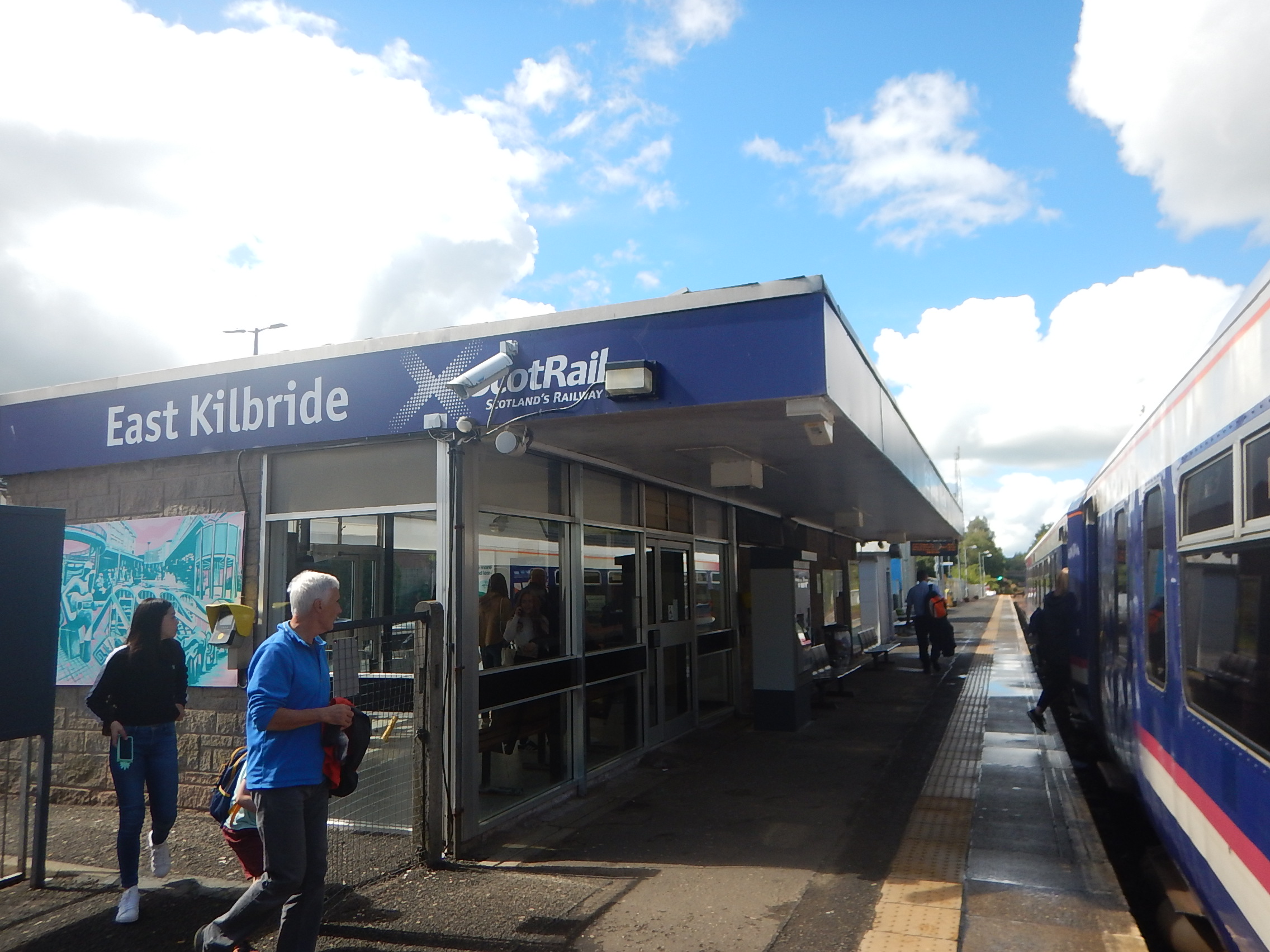
Nothing complicated at this station and it comfortably handles two tph.
In the UK, there are several stations where four tph are handled using a single platform.
- Chester, Kirkby and Ormskirk on Merseyrail.
- Clapham Junction, Dalston Junction, Highbury & Islington, New Cross and West Croydon on the London Overground.
Transport for Wales also intend to run four tph to several single-platform stations including Rhymney, which is high in the valleys.
I suspect that with modern signalling and driver aids, Glasgow’s drivers would be capable of running four tph between Glasgow Central and East Kilbride stations.
Judging by my trip on the route, there is certainly a need for more capacity, as if every seat is taken at two in the afternoon, two-car trains running at a frequency of two tph is just not enough.
So surely running new four-car electric trains to the current timetable, would be the standard solution for this route?
But!
Look at these pictures of the route..






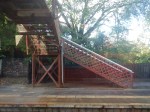
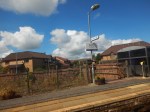
It wouldn’t be a nightmare to electrify, but because of the stone bridges and the steel footbridges, it would be expensive and very disruptive.
The following should also be noted.
- The railway has never gone further than East Kilbride station.
- There is no freight on the line, except for that needed for maintenance.
I am very much drawn to the conclusion, that to electrify the whole route would use money that would probably be better spent on improving step-free access at some of the stations.
Electric Trains To East Kilbride Without Full Electrification
Before I detail the solutions, I shall look at the energy required to raise a train from Glasgow to East Kilbride station.
Consider.
- A four-car electric train like a Class 321 train weighs 138 tonnes.
- This train has 309 seats, so could probably accommodate 400 passengers.
- Assuming each weighs 90 kg with buggies, baggage, bicycles and bagpipes, this gives a train fully-loaded train weight of 174 tonnes.
Using Omni’s Potential Energy Calculator, it would take 73 kWh of energy to raise the train to the 504 feet altitude of East Kilbride station.
It should also be noted that Glasgow Central station and the approaches to the station are fully electrified almost as far as Crossmyloof station.
What solutions are available to have as-new electric trains running between Glasgow Central and East Kilbride station?
The Rhymney Line Solution
The Rhymney Line runs between Cardiff Central and Rhymney stations.
In the design of the new South Wales Metro, the highest section of this line between Ystrad Mynach and Rhymney stations will be run on battery power.
- This section is about eleven miles long.
- It is a mixture of single and double-track.
- The height difference is 410 feet.
This is very similar in severity to the Busby Railway.
Transport for Wales are proposing to use Tri-Mode Stadler Flirt trains on this route.
These trains would be able to handle the East Kilbride route without any modification to the track or electrification.
It would just mean.
- Trains identical to those on the South Wales Metro.
- Building and delivering the trains.
- Training the drivers and other staff.
There would be other advantages.
- Stadler trains seem to be one of the best for step-free access, with automatic gap fillers between platform and train.
- They are 100 mph trains.
- They are ready for modern signalling.
- They can change mode at line speed.
These trains which will be Class 755 trains in Abellio Greater Anglia service, have a central power-pack, that can incorporate diesel or battery power to supplement power from the electrification.
Good engineering design would probably mean.
- The four slots in the power pack, can be fitted with a diesel engine, battery or perhaps even a hydrogen fuel cell to give a power profile tailored to the route.
- The battery would weigh a similar amount to the Deutz diesel engine, which would give a battery capacity of perhaps 100-120 kWh.
- There is an intelligent computer system controlling the power and braking systems.
- The trains come in various lengths from three-cars upwards.
This is a summary of the Stadler multi-mode trains ordered for the UK.
- Abellio Greater Anglia – Electric/Diesel – 14 x three-cars – Two Deutz diesel engines
- Abellio Greater Anglia – Electric/Diesel – 24 x four-cars – Four Deutz diesel engines
- Trains for Wales – Electric/Diesel – 11 x four-cars – Four (?) Deutz diesel engines
- Trains for Wales – Electric/Diesel/Batteries – 7 x three-cars – One Deutz diesel engine and three batteries (?)
- Trains for Wales – Electric/Diesel/Batteries – 17 x four-cars – One Deutz diesel engine and three batteries
I’m sure Abellio Greater Anglia won’t leave Abellio ScotRail, short of operational information.
In addition, they might be ideal for other routes in the Glasgow area.
- The Glasgow South Western Line to Kilmarknock, Dumfries and Carlisle.
- The Ayrshire Coast Line to Ayr and Stranraer.
- The West Highland Line to Oban and Mallaig.
They would use the electrification, when close to Glasgow.
I can’t see any reason, why another version of the Tri-Mode Stadler Flirt won’t be able to run services between Glasgow Central and East Kilbride stations.
The Battery Solution
Transport for Wales intend to run their Tri-Mode Stadler Flirts on battery from Ystrad Mynach to Rhymney. I can’t see any reason why a well-designed battery train can’t do the similar climb to East Kilbride station.
Of the major train manufacturers, only Stadler seem to have declared their hand with the Rhymney Line proposal.
- Bombardier have run prototypes in the UK and Germany, but are very protective with solid information.
- CAF have run battery trams and will introduce them to the UK in the next year or so.
- Hitachi use batteries in their trains and have run battery trains in Japan.
Also, consider that between Glasgow Central and Pollokshields East stations is electrified and extending this electrification to say Busby Junction. where the Busby Railway leaves the Glasgow South Western Line, would have the following benefits.
- The distance to run on batteries would be reduced by about three miles.
- There would be more electrification to ensure that train batteries were full before the climb to East Kilbride.
- If bi-mode trains were to run to Kilmarnock, Dumfries and Carlisle, they would have more electrified line to use.
This short section of electrification would certainly improve the mathematics of running battery trains to East Kilbride.
As Busby Junction to Kilmarnock is around twenty miles, it might even make it possible to run battery trains between Glasgow Central and Kilmarnock stations.
I have no doubts that, a battery train can be built to handle services between Glasgow Central and East Kilbride.
The Hydrogen Solution
I tend to think of trains powered by a hydrogen fuel cell, as battery trains with an environmentally-friendly onboard power source.
The Busby Line route is ideal for battery trains, especially, if there is a few miles of new electrification at the Glasgow Central end of the route.
Alstom’s proposed hydrogen-powered Class 321 train, could also be ideal for this route.
Four-car trains with a decent interior, would certainly solve the overcrowding on the route.
In A Class 321 Renatus, a comment was put, that says that the hydrogen-powered Class 321 trains will share the Renatus interior.
I’d suspected that would be the case, as why would the train’s owners; Eversholt Rail Group, design two different interiors for the same purpose?
The train would be able to leave Glasgow Central station with a full battery and with the help of electricity from the hydogen fuel cell, it would be able to climb to East Kilbride.
Coming down, the train would be partly powered by the battery, but mainly by gravity. Energy generated by the regenerative braking would be stored in the battery.
Alstom will be building a mathematical model of the train and its performance on various routes, so they will know the energy flows, when the train is working.
I said earlier that the following routes would be ideal for Stadler’s bi-mode trains.
- The Glasgow South Western Line to Kilmarknock, Dumfries and Carlisle.
- The Ayrshire Coast Line to Ayr and Stranraer.
- The West Highland Line to Oban and Mallaig.
I feel the same logic applies to Alstom’s hydrogen trains.
Conclusion
All three solutions, I outlined in this post, could be possible.
The solutions have several things in common.
- All will be fully tested elsewhere on the UK rail network.
- None need any electrification between Busby Junction and East Kilbride.
- All would benefit from a few extra miles of electrification between Busby Junction and Glasgow Central station.
- All solutions are backed by respected train building companies.
I think there will be a very keen contest to see who supplies the trains for this and other related routes from Glasgow.
Zillertalbahn Orders Stadler Hydrogen-Powered Trains
The title of this post is the same as that of this article on the International Railway Journal.
This is the first paragraph.
Austria’s narrow-gauge Zillertalbahn announced on May 15 that Stadler is the successful bidder for a €80m contract to supply five hydrogen fuel cell multiple-units.
The Zillertal Railway is in the Tyrol district of Austria and has a gauge of 760 mm.
It looks like Stadler are supplying another market, that is rather special.
A Class 321 Renatus
I finally got to ride in a Class 321 Renatus today.
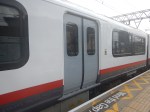
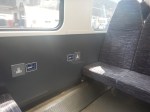
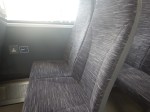

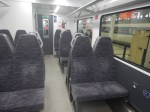
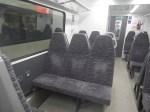

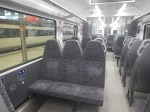
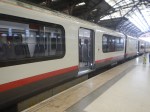
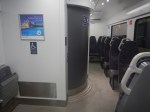
Quite frankly I was impressed.
- The seats were more comfortable than those in a Class 700 train.
- There was wi-fi.
- There were plugs to charge a phone or a laptop everywhere.
- There was air-conditioning.
- There was a new Universal Access Toilet.
- There was new lighting.
Generally, the trains also seemed to have more space.
Will Alstom’s hydrogen-powered version of the Class 321 train have interiors as good as these?
The Battery Trains Are Coming
Every month seems to bring more information about trains where batteries are an important part of the propulsion system of the train.
So what are the various manufacturers offering?
Alstom
Alstom’s Coradia iLint train is hydrogen powered and as this video shows, batteries are an important part of the design of the train, which can probably be considered a hydrogen/battery hybrid train.
As I wrote in Germany Approves Alstom’s Hydrogen Train For Passenger Service, these trains will be entering service in late summer in Germany.
In the UK, Alstom are to convert some of the hundred-plus fleet of Class 321 trains, to running on hydrogen power.
I set out my thoughts on this in Thoughts On A Hydrogen-Powered Class 321 Train.
These were my conclusions.
- The Class 321 train will make a good hydrogen-powered train.
- Alstom would not have looked at converting a thirty-year-old train to hydrogen power, if they thought it would be less than good.
- British Rail’s design of a 750 VDC bus makes a lot of the engineering easier and enables the train to be tailored for world-wide markets, with different electrification systems and voltages.
- Having two different hydrogen-powered trains will give Alstom a better place in an emerging market.
I suspect in a few years time, if these two hydrogen projects are successful, Alstom will design and manufacture, a whole family of hydrogen-powered trains, with different gauges, capacities and operating speeds.
Bombardier
Unlike Alstom, who seem to be telling the world what they are doing with hybrid hydrogen/battery trains, Bombardier are playing their cards close to their chest.
In early 2015, I rode on Bombardier’s Class 379 Battery-Electric Multiple Unit demonstrator between Manningtree and Harwich.
It destroyed my scepticism about battery-electric trains.
Since then, the following has happened.
Class 345 Trains Have Entered Service
Class 345 trains have entered service on Crossrail routes to the East and West of London.
Until denied by Bombardier, I believe that these trains from Bombardier’s new Aventra family use batteries for the following purposes.
- Storing and reuseing the energy generated by regenerative braking.
- Providing an emergency power source, should the main electricity supply fail.
- Allowing depots and stabling sidings without electrification.
The trains should also make Crossrail and the other routes on which they run, more electrically efficient.
Five More Fleets Of Aventras
Bombardier have sold five more fleets of Aventras.
Could electrical efficiency because of clever use of batteries be a reason?
A 125 Mph Bi-Mode Aventra With Batteries Has Been Launched
This article in Rail Magazine is entitled Bombardier Bi-Mode Aventra Could Feature Battery Power.
A few points from the article.
- Development has already started.
- Battery power could be used for Last-Mile applications.
- The bi-mode would have a maximum speed of 125 mph under both electric and diesel power.
- The trains will be built at Derby.
- Bombardier’s spokesman said that the ambience will be better, than other bi-modes.
- Export of trains is a possibility.
In Mathematics Of A Bi-Mode Aventra With Batteries, I analyse the train in detail.
This was my conclusion.
I am rapidly coming to the conclusion, that a 125 mph bi-mode train is a practical proposition.
- It would need a controllable hydrogen or diesel power-pack, that could deliver up to 200 kW
- Only one power-pack would be needed for a five-car train.
- For a five-car train, a battery capacity of 300 kWh would probably be sufficient.
From my past professional experience, I know that a computer model can be built, that would show the best onboard generator and battery sizes, and possibly a better operating strategy, for both individual routes and train operating companies.
Obviously, Bombardier have better data and more sophisticated calculations than I do.
My calculation might be wrong, but it’s in the right area.
Voyager Battery Upgrade
This use of batteries by Bombardier was a total surprise.
In the July 2018 Edition of Modern Railways, there is an article entitled Bi-Mode Aventra Details Revealed.
A lot of the article takes the form of reporting an interview with Des McKeon, who is Bombardier’s Commercial |Director and Global Head of Regional and Intercity.
This is a paragraph.
He also confirmed Bombardier is examining the option of fitting batteries to Voyager DEMUs for use in stations.
I discuss what Bombardier might be doing in Have Bombardier Got A Cunning Plan For Voyagers?.
I feel the simplest use for batteries on these trains would be to store the energy generated by regenerative braking in batteries, from where it would be used for the train’s hotel power!
This would reduce the need for the engines to be running in stations.
Conclusion
I think Bombardier have been thinking very hard about how you design a train with batteries.
CAF
CAF have fitted several of their trams with batteries and this system will be used on the Midland Metro, to create new routes without catenary.
But they only seem to have an on-off order for trains fitted with batteries for Auckland.in New Zealand.
The order seems to be on hold.
Given that CAF, have a reputation for research and development and they have used batteries in trams, I can’t believe that they are not looking seriously at how to use batteries in their train designs.
Hitachi
On page 79 of the January 2018 Edition of Modern Railways, Nick Hughes, who is the Sales Director of Hitachi Rail Europe outlines how the manufacturer is embracing the development of battery technology.
He is remarkably open.
I wrote Hitachi’s Thoughts On Battery Trains, after reading what he said.
Hitachi certainly have working battery trains in Japan and use batteries on Class 800 trains to capture the energy generated by regenerative braking. On these trains, it appears to be used for hotel power.
Siemens
Siemens have now merged with Alstom and they are also developing a hydrogen-powered train.
I wrote about this train in Siemens Joins The Hydrogen-Powered Train Club.
As with Alstom, I suspect this train will be using batteries.
Siemens have also won the order for the New Tube For London.
I wrote about this in Thoughts On The New Tube For London.
In the Future Upgrades section of the Wikipedia entry for the Piccadilly Line, this is said.
Siemens publicised an outline design featuring air-conditioning and battery power to enable the train to run on to the next station if third and fourth rail power were lost. It would have a lower floor and 11% higher passenger capacity than the present tube stock. There would be a weight saving of 30 tonnes, and the trains would be 17% more energy-efficient with air-conditioning included, or 30% more energy-efficient without it
I would suspect, the batteries are also used to handle the energy from regenerative braking
Stadler
Stadler have developed a bi-mode Flirt, which has been ordered by Greater Anglia as the Class 755 train.
They have now sold a diesel/electric/battery tri-mode to KeolisAmey Wales, which from the visualisations look like the trains are closely related to the Class 755 trains.
Stadler are also delivering Class 777 trains to Merseyrail. Wikipedia says this.
In May 2018, it was announced the sixth Class 777 unit to be delivered will be fitted with batteries for a trial.
So it looks like two major fleets of trains for the UK from Stadler will have batteries.
There is also the Stadler Wink, which has been sold to Arriva Nederland.
Wikipedia says this about the design.
It has an aluminium carbody that can be customized in length by the customer, and can be powered by either diesel or electric powertrains with supplemental on board batteries. Arriva units will be delivered with Deutz diesel engines and batteries charged by regenerative braking; the engines are planned to be replaced by additional batteries once electrification is installed over part of their route.
Stadler seem to be putting a lot of effort into batteries.
Vivarail
Vivarail’s Class 230 train started as a diesel-electric and they have now sold a battery version to KeolisAmey Wales, which should be in service in May 2019.
Conclusion
All train manufacturers seem to be applying battery technology to their trains.
The main purpose seems to be to recycle the energy generated by regenerative braking.
Some trains like Alstom’s hydrogen trains, Bombardier’s Aventras and Stadler’s tri-mode Flirt, use the energy for traction, whilst others like Hitachi’s Class 800 trins, use the energy for hotel power.
If a researcher or company comes up with a better battery, they will certainly get a return for their efforts in the rail industry.
Thoughts On A Hydrogen-Powered Class 321 Train
A hundred and seventeen Class 321 trains were built around 1990 and a hundred and four, which are currently in service with Greater Anglia, are due to be replaced by new Class 720 trains.
Alstom and the trains owners; the Eversholt Rail Group, plan to convert some of these trains to hydrogen power.
The Class 321 Train
The basic characteristics of these trains are as follows.
- They have a 100 mph operating speed.
- They are built for operation on 25 KVAC overhead electrification.
- The closely-related Class 456 trains can run on 750 VDC third-rail electrification.
- They have a formation of DTCO+TSO+MSO+DTSO.
- Note that only the third car is powered.
- Thirty of the trains have been refurbished in the Renatus project, which includes an upgraded interior and a new traction package, which includes regenerative braking.
This picture shows on of the driving trailers of a Class 321 train.
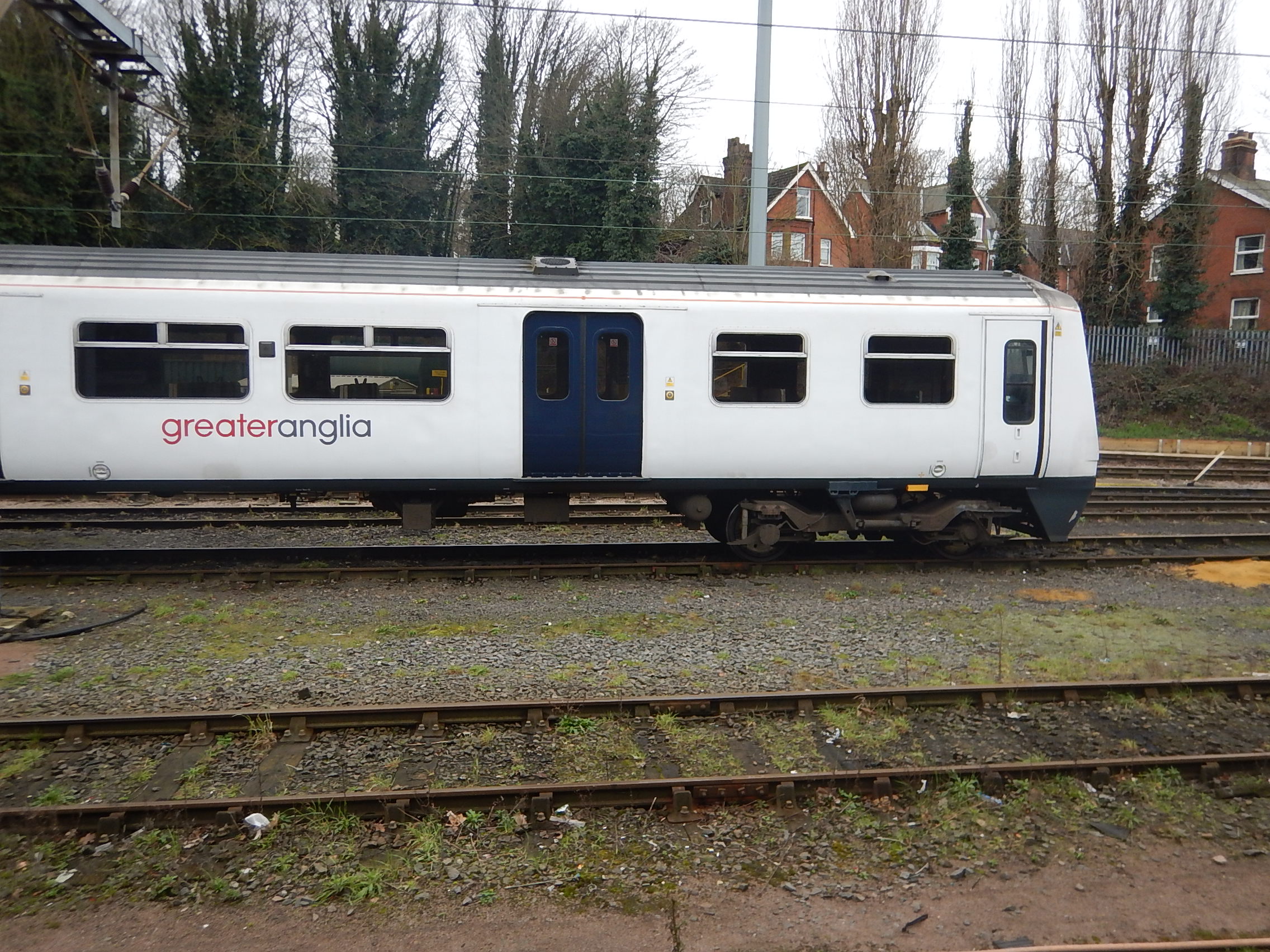
Note the large amount of space underneath.
If the Class 321 train has a problem, when converted to a modern efficient train, it is that the front end of the train has the aerodynamics of a large brick outhouse.
The Electrical System Of A Class 321 Train
I don’t know the electrical system of a Class 321 train, but I do know that of the Class 319 trains, which were built a couple of years earlier in the same factory at York These trains have a 750 VDC bus from one end of the train to the other.
As Class 321 and Class 319 trains have a similar train formation and a common Mark 3 heritage, I suspect that the electrical systems are the same and both have this 750 VDC bus.
Regenerative Braking
Regenerative braking is an important part of any modern train, as it saves energy.
Normally, the energy generated as a train stops, is returned through the electrification to power other nearby trains.
But with a hydrogen-powered train, that may not be connected to the electrification, the energy has to be stored on the train to avoid being wasted.
The Alstom Coradia iLint Train
Alstom have developed a hydrogen-powered version of the Coradia Lint train, which they call an iLint.
This promotional video shows how Alsthom’s hydrogen-powered Coradia iLint works.
<span class=”embed-youtube”></span>
Summarising, Alstom’s video the Coradia iLint works in the following way.
- The hydrogen fuel cell turns hydrogen gas into electricity.
- The electricity is used to power the train or is stored in a lithium-ion battery.
- The computer on the train monitors the system and controls it in an intelligent manner.
I wouldn’t be surprised to find out the system works in the same way as a serial hybrid vehicle like a New Routemaster bus.
- The power source; hydrogen fuel cell in the train or small diesel generator in the New Routemaster, charges the battery directly.
- The power source shuts down automatically, when the charge in the battery reaches a certain high level.
- The power source starts up automatically, when the charge in the battery reaches a certain low level.
- The battery moves the vehicle using one or more electric traction motors.
- The battery powers all the other systems in the vehicle.
- When the vehicle brakes, the traction motors generate electricity, which is stored in the battery.
The great advantage of this system is its simplicity, as the vehicle is effectively powered from a single source; the battery.
There is also an independently-controlled charging system for the battery.
A Possible Layout For A Hydrogen Powered Class 321 Train
Hydrogen powered trains need the following components.
- Hydrogen tank.
- Fuel cell to convert hydrogen to electricity.
- Battery to store energy from both the fuel cell and regenerative braking.
- Intelligent control system to control everything.
Positioning the last item shouldn’t be a problem, but could the other three larger components be placed under the train?
There’s certainly plenty of space under the two driving cars.
The battery would be connected to the following.
- The 750 VDC bus to power the train.
- The regenerative braking system.
- The hydrogen fuel cell.
The train’s computer would control the systems intelligently.
Powering The Class 321 Train From Electrification
Class 321 trains were designed as electric trains and I’m certain they could be made to run on 25 KVAC overhead or 750 VDC third rail electrification.
The electrically similar Class 319 trains are being converted into bi-mode Class 769 trains, so I wouldn’t be surprised to see the hydrogen-powered Class 321 trains being able to use electrification directly.
The Battery Size
How large would a battery need to be to store energy from both the fuel cell and regenerative braking?
I will start by calculating the kinetic energy of a Class 321 train, as the battery must be able to store all the energy generated by regenerative braking, when the train stops in a station from an operating speed of up to 100 mph.
- A Class 321 train weighs 137.9 tonnes
- A train can accommodate a total of about 320 seated and standing passengers.
- With bags, buggies and the other things passengers bring on, let’s assume an average passenger weight of 90 kg, which gives an extra 28.8 tonnes.
- I will assume a total weight of ten tonnes for the battery, hydrogen fuel cell and hydrogen tank
- So I will assume that an in service Class 321 train weighs 176.7 tonnes.
Calculating the kinetic energy of the train for various speeds gives.
- 50 mph – 12.3 kWh
- 75 mph – 28 kWh
- 90 mph – 40 kWh
- 100 mph – 49 kWh
Note that speed increases the kinetic energy much more than weight. This is because kinetic energy is proportional to the square of the speed and only proportional to the weight.
Even if the extra equipment weighed twenty tonnes, the kinetic energy at 100 mph only increases to 51.8 kWh.
As the battery will have to store this energy after a stop from 100 mph, I suspect that the battery will have a capacity somewhere between 50 and 100 kWh.
A Bombardier Primove 50 kWh battery, which is built to power trams and trains, has the following characteristics.
- A weight of under a tonne.
- Dimensions of under two x one x half metres.
- The height is the smallest dimension, which must help installation under the train floor or on the roof.
I conclude that Alstom won’t have any problems designing a battery with sufficient capacity, that can be fitted under the floor of a Class 321 train.
The Train Will Need An Intelligent Computer System
The hydrogen-powered Class 321 train could have up to four methods of charging the battery.
- From 25 KVAC overhead electrification
- From 750 VDC third rail electrification
- From the hydrogen fuel cell.
- From regenerative braking.
The computer would try to ensure the following.
- There was always spare capacity in the battery to accept the energy from regenerative braking.
- Trains stop in a station with a full battery.
- Hydrogen consumption is minimised.
The computer might even be programmed with the route and use GPS or digital signalling to optimise the train to that route.
It’s all very basic Control Engineering.
Alstom’s Marketing Philosophy
Watch Alstom’s video embedded in this post and they stress the environmental credentials of hydrogen power and particularly the Cordadia iLint.
They also show a caption which states that 195 states have made a commitment to zero carbon emissions.
That could be a very big market
The Coradia iLint will probably be a good train, but I suspect it may have a few problems satisfying a large market.
- It is only two cars.
- The current design can’t work on overhead electric power.
- It is based on a Lint 54, which has only 160 seats.
- Operating speed is 140 kph.
- They are new trains and manufacturing may be expensive.
On the other hand, Class 321 trains have the following characteristics.
- They are four car trains.
- The trains can work from 25 KVAC overhead electrification.
- The trains are built to a smaller loading gauge than the iLint.
- I suspect that they could be easily converted to other overhead and third-rail electrification voltages.
- Each train has 309 seats.
- Operating speed is 160 kph.
- They are existing trains and manufacturing may be more affordable.
It should also be said, that there is a massive amount of knowledge accumulated in the UK over thirty and more years, about how to refurbish, modify and update Mark 3-based rolling stock.
Once the concept of a hydrogen-powered Class 321 train is proven and certified, Alstom would probably be able to produce four-car hydrogen-powered trains at a fair rate, as they become available from Greater Anglia.
Conclusion
I have come to the following conclusions.
- The Class 321 train will make a good hydrogen-powered train.
- Alstom would not have looked at converting a thirty-year-old train to hydrogen power, if they thought it would be less than good.
- British Rail’s design of a 750 VDC bus makes a lot of the engineering easier and enables the train to be tailored for world-wide markets, with different electrification systems and voltages.
- Having two different trains will give Alstom better coverage of an emerging market.
I suspect in a few years time, if the hydrogen project is successful, Alstom will design and manufacture, a whole family of hydrogen-powered trains, with different gauges, capacities and operating speeds.
Retrofitted Hydrogen Fuel Cell EMU Concept Presented
The title of this post is the same as that of this article on Global Rail News, that was published in April 2014.
This is the first two paragraphs.
The possibility of retro-fitting diesel multiple units (DMUs) to run on hydrogen fuel cell technology has been put to the test as part of an RSSB and Network Rail-funded innovation research programme.
Fuel Cell Systems, which has worked alongside the University of Birmingham and Hitachi Rail Europe, says the six-month study has demonstrated the feasibility of installing hydrogen fuel cell technology on DMUs as an alternative to electrification.
It strikes me that some serious people are involved in this project.
The report on the project was published in June 2016 and it is stored here on the University pf Birmingham web site.
The Hydrogen Train Of The Future Is A Lot Like The Train Of Today
The title of this post, is the same as that of this article on engardget.
It is an article worth reading ass it gives details of the philosophy of the guy behind the concept; Dr. Jörg Nikutta.
Hydrogen Trains Herald New Steam Age
The title of this post is the same as that of an article on nearly half of Page 4 of today’s Sunday Times.
When I saw the article with its large graphic showing the working of a hydrogen train, the train seemed rather familiar.
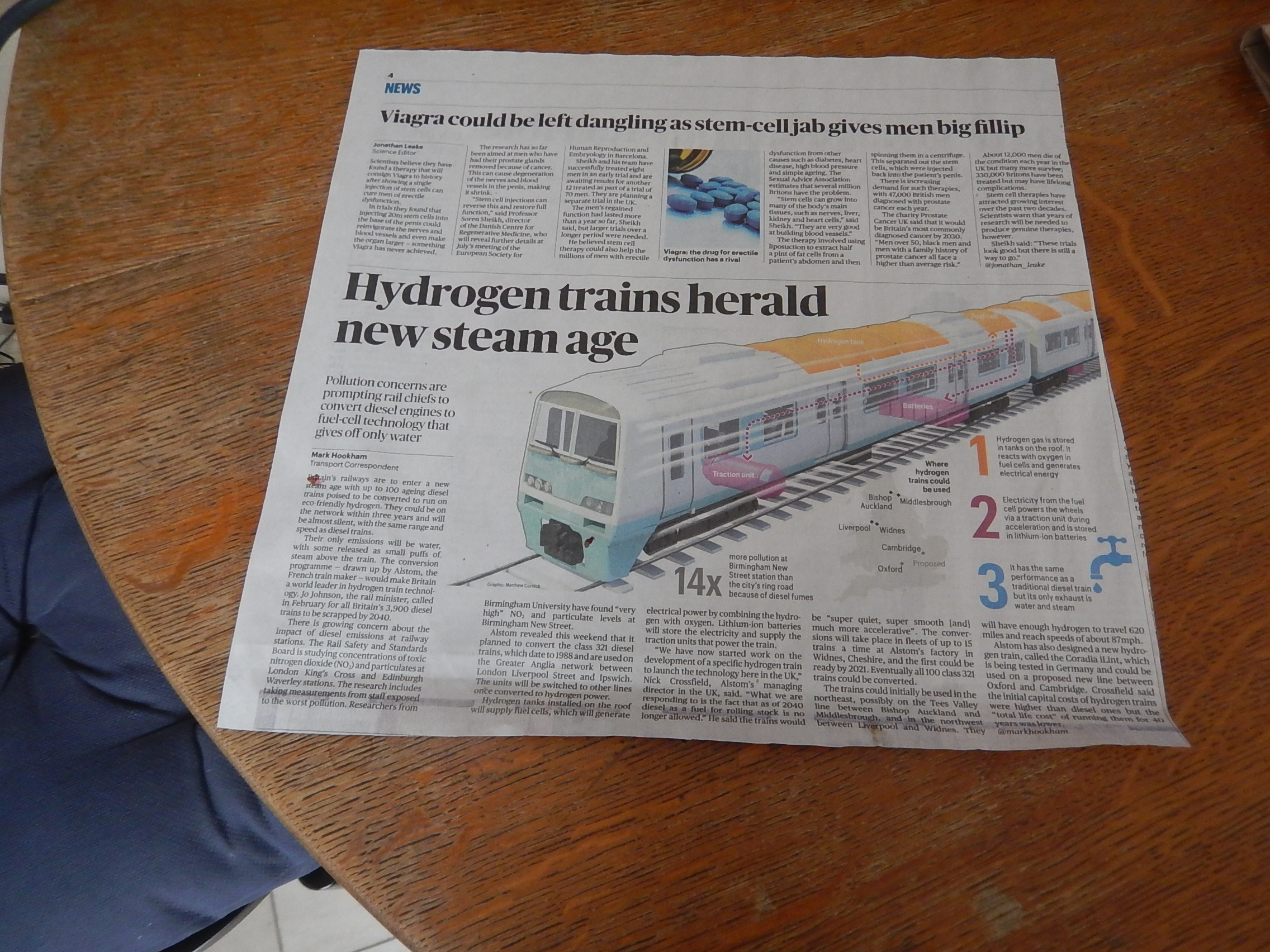
The leaning back front of the train with its two windows and the corrugated roof looked like a Class 321 train.
The large orange area on the roof is the hydrogen tank and the smaller one is the hydrogen fuel cell.
This is a paragraph from the article.
Alstom revealed this weekend that it planned to convert the Class 321 diesel trains, which date to 1988 and are used on the Greater Anglia network between London Liverpool Street and Ipswich. The units will be switched to other lines once converted to hydrogen power.
I suspect Mark Hookham, who wrote the article, has already been told by ninety percent of the train enthusiasts in this country, that Class 321 trains are electric multiple units.
This picture shows the first car of a Class 321 train in the sidings at Ipswich.
Note all the space, under the train, which would be an ideal place for the batteries and traction control, that are shown in that position, in pink, in the Sunday Times graphic.
But there are other reasons, why Class 321 trains may be ideal to convert to hydrogen power.
- Although they are thirty years old, they are a modern train, which meet all the latest regulations.
- They have a 100 mph operating speed on electricity.
- They operate on 25 KVAC overhead electrification.
- There are a hundred and seventeen four-car trains.
- Greater Anglia will be replacing over a hundred Class 321 trains, with new Class 720 trains in the next two years.
- A number of Greater Anglia’s trains have been upgraded to Class 321 Renatus. These trains are a substantial upgrade over the standard train..
- Greater Anglia’s trains appear to be in good condition.
- Designs have been tested to upgrade the traction motors and drive systems of the trains.
But most importantly, the trains are based on the Mark 3 coach, which gives the following advantages.
- An excellent ride and superb brakes.
- Bodies with a legendary strength and toughness.
- There is a vast amount of knowledge in the UK rail industry, that enables the trains to be kept at peak performance.
I doubt, that you could find a better fleet of a hundred trains to convert to hydrogen power anywhere in the world.
The article says or indicates the following.
- Hydrogen tanks will be mounted on the roof.
- An Alstom spokesman is quoted as saying. “We have now started work on the development of a specific hydrogen train to launch the technology here in the UK.”
- He also said that the trains would be super quiet, super smooth and much more accelerative. I assume that is compared to diesel.
- Conversion will take place in fleets of up to 15 trains a time at Alstom’s factory in Widnes.
- The first train could be ready by 2021.
- Eventually, all Class 321 trains could be converted.
- Initial routes could be on the Tees Valley Line and between Liverpool and Widnes.
- Range on a tank of hydrogen will be 620 miles.
- Top speed would be about 87 mph.
The article finishes with a quote from Alstom’s spokesman. “The initial capital costs of hydrogen trains were higher than diesel ones, but the “total life cost” of running them for 40 years was lower.”
I have my thoughts on various things said and not said in the article.
Alstom’s Widnes Factory
Alstom’s Widnes factory has just upgraded, Virgin Trains, fleet of Class 390 trains, so it does seem capable of handling heavy work on a number of trains at one time.
Train Certification
All trains have to be certified, as to being safe and compatible to run on the UK rail network.
Converting an existing train, must make this process a lot easier, especially as many of the hydrogen components and batteries have been used on trains in the EU.
The Proposed Routes
The routes named in the article are in the North East and North West of England, where hydrogen could be readily available from the petrochemical works, so fuelling the trains may not be a problem.
Power Supply
Class 321 trains were only built to work on lines with 25 KVAC overhead wires, but I suspect the parts exist to enable them to run on 750 VDC third-rail lines, if needed.
INEOS
INEOS is a very large multi-national petrochemical company, with a multi-billion pound turnover, which is sixty percent owned by Jim Ratcliffe, who has just been named the UK’s richest man.
So why would a company like that be involved in hydrogen-powered trains?
This news item from Reuters, is entitled AFC In Hydrogen Power Generation Deal With INEOS.
This is the first two paragraphs.
British budget fuel cell maker AFC Energy has signed a deal with British petrochemicals company INEOS to produce electricity using the hydrogen given off in chlorine manufacturing.
AFC said the project with INEOS ChlorVinyls would use surplus hydrogen from the chemical firm’s Runcorn facility in north-west England to supplement the plant’s energy needs.
I used to know the Runcorn plant well, when I worked there for ICI in the 1960s.
The hydrogen was produced when brine was electrolysed to produce chlorine.
So does Jim Ratcliffe, who is a qualified Chemical Engineer, see an opportunity to sell the by-product as train fuel to his neighbour; Alstom, on the other side of the Mersey?
Obviously, I don’t know what Jim Ratcliffe and INEOS are thinking.
But consider.
- The Sunday Times article says that the North West and the North East of England are two promising areas for hydrogen-powered trains.
- INEOS has large petrochemical plants on the Mersey and Teeside.
- I wonder how many plants owned by INEOS around the world have a surplus of hydrogen.
- Alstom would probably like to sell hydrogen-powered trains everywhere.
- A well-respected chemical engineer, once told me, that the only things that should go out of an integrated petrochemical plant is product that someone pays for, air and water.
As the other place in the UK, where INEOS have a large petrochemical plant is Grangemouth in Central Scotland, I wonder, if we’ll see hydrogen-powered trains North of the Border.
Availability of Hydrogen
This article on Process Engineering, which is entitled INEOS project reduces energy bill by £3m, starts with these three paragraphs.
INEOS Chlor is one of the major chlor-alkali and chlorine derivative producers in Europe. Its Runcorn site in north west England has two large chlorine plants: the original J Unit that uses a mercury cell electrolysis process route, and the more recently opened Genesis Membrane Chlorine Plant (MCP).
Continuous improvement of the manufacturing processes has taken the Runcorn site to a ’best in class’ cost base and environmental performance, and as part of this improvement programme the company wanted to minimise vented hydrogen and maximise the value of this resource at both plants.
Without a significant change in market demand for hydrogen, it was not possible to increase sales to existing customers. The only alternative was to increase the amount used as fuel to power on-site boilers, thereby reducing costs for purchased natural gas.
Burning the hydrogen in on-site boilers.obviously helps to reduce the energy bill, but surely, if the hydrogen could be sold to a local customer, that could be more profitable.
You certainly want to minimise the vented hydrogen!
A few days ago I wrote The Liverpool Manchester Hydrogen Clusters Project, which is a project to create a hydrogen network in the Liverpool Manchester area.
Surplus hydrogen from Runcorn and other placed would be piped around the area to augment the natural gas supply.
This network could supply Alstom’s new hydrogen-powered trains and INEOS have a new market for their surplus hydrogen.
I don’t know the petrochemical industry in the North East, but there are a lot of petrochemical plants and some are owned by INEOS.
Is there a surplus of hydrogen, that could profitably sold as fuel for Alstom’s hydrogen-powered trains. I don’t know!
And then there’s Grangemouth in Scotland! My Scottish agent in the Borderlands, used to work at the INEOS plant in Grangemouth and that had a hydrogen surplus.
Even, if we can’t pipe hydrogen to the various depots for the trains around the country, surely it can be transported by rail!
I think that we may be short of some things in this country, but hydrogen might not be one of them.
Given that Alstom have moved so quickly to start planning conversion of the Class 321 trains, they have probably identified sources of enough hydrogen to power the fleet, even if all are converted, as they hinted at in the Sunday Times article.
Eversholt Rail Group’s Involvement
All the trains are leased from the Eversholt Rail Group, who would probably like to see their assets continue to earn the best return possible.
A few days ago, I wrote Eversholt Joins Very Light Rail Consortium.
These two projects may be at both ends of the rail industry, but I believe, they show the willingness of Eversholt to invest in innovation, rather than allow an asset to drift towards the scrapyard.
The Class 321 Renatus
This page on their web site describes the Class 321 Renatus, which was an upgrade developed by Eversholt in conjunction with Greater Anglia, to improve the trains, whilst waiting for Greater Anglia’s new fleet to be delivered.
These are the listed improvements.
- New air-conditioning and heating systems.
- New, safer seating throughout
- Larger vestibules for improved boarding and alighting
- Wi-Fi enabled for passengers and operator
- Improved space allocation for buggies, bicycles and luggage
- Passenger power sockets throughout
- New, energy efficient lighting
- One PRM compliant toilet and a second controlled emission toilet on each unit
- Complete renewal and remodelling of all interior surfaces.
It would be a better interior than most British Rail-era trains.
Comparison With The Class 769 Train
The proposed hydrogen-powered Class 321 train, will inevitably be compared with Porterbrook‘s Class 769 train, which is a bi-mode upgrade of the Class 319 train.
Looking at operating speed on electricity and alternative fuel we find.
- Both trains can operate at 100 mph on lines with 25 KVAC overhead electrification.
- The Class 769 train can also operate at 100 mph on lines with 750 VDC third-rail electrification.
- According to the Sunday Times article, the Class 321 Hydrogen train can operate at about 87 mph on hydrogen.
- According to this article in Rail Magazine, the Class 769 train can operate at 91-92 mph on diesel.
So in terms of operating speed, the trains are more of less comparable, but emissions will be better with the hydrogen-powered train.
When it comes to interiors, as both trains are Mark 3-based, designed around the same time, train operating companies will have what their budget allows.
In the end the choice will come down to cost, which will surely be higher for the Class 321 Hydrogen, as this will require more expensive modifications and additional infrastructure for refuelling the train.
Could Any Other Trains Be Converted?
There are various other classes of electric multiple unit based on the Mark 3 coach.
I think there could be good reasons to only convert trains with the following characteristics.
- Four-cars or more.
- 100 mph capability
- Perhaps fifty or more trains to convert.
These rules would leave us with only the seventy-two Class 317 trains, many of which have been refurbished and are in very good condition.
Conclusion
I’m drawn to the conclusion, that Alstom and Eversholt are serious about producing hydrogen-powered trains for the UK.
I also think, they’ve identified enough hydrogen to power the whole fleet, if it’s converted.
 The Anonymous Widower