Green Hydrogen – Meranti Green Steel Launches Green Iron Project In Oman
The title of this post is the same as that of this article on Hydrogen Central.
The title shows how if you have plenty of energy, you can produce green steel.
Surely, if the Omanis can do it, we can attract a company to make green steel in the UK, as we have lots of renewable energy around our shores.
All the current steelmakers do is blackmail the UK Government into paying them subsidies.
British Gas Owner Mulls Mini-Nuke Challenge To Rolls-Royce
The title of this post, is the same as that of this article in The Telegraph.
This is the sub-heading.
Centrica is looking to follow Rolls-Royce in developing small modular reactors
These are the first three paragraphs.
The owner of British Gas is considering investing in mini nuclear power plants in the UK as it seeks to cash in on burgeoning demand for the technology.
Centrica is in early talks with the Government about a potential future deal that could see the energy giant participate in the development of so-called small modular reactors (SMRs).
It comes after Ed Miliband, the Energy Secretary, last month announced billions of pounds in funding for SMRs, which will form part of a new “golden age” for atomic energy.
In Centrica Really Can’t Lose At Sizewell, I looked at Centrica’s involvement in Sizewell C and in particular the financing of the nuke and what Centrica would do with their share of the electricity, that the nuke will produce.
I listed these uses for hydrogen in the East of England.
- Transport – Buses, Coaches and Trucks
- Large Construction Projects
- Rail
- Ports
- Airports
- Agriculture And The Rural Economy
- Exports
I do wonder, if Centrica made the investment in Sizewell C, when they realised that there were a lot of uses for hydrogen and producing hydrogen using the electricity from a nuclear power station was a good way to generate hydrogen.
- Sizewell B is a 1.2 GW nuclear powerstation.
- Sizewell C is a 3.2 GW nuclear powerstation.
- Their investment in HiiROC surely gives them access to the technology to generate hydrogen.
- Centrica have a lot of experience of selling natural gas to customers, who need energy.
- There were also substantial government guarantees involved.
- Hydrogen made by a nuclear reaxtor is generally referred to as pink hydrogen.
- In Westinghouse And Bloom Energy To Team Up For Pink Hydrogen, I describe how two American companies have formed a partnership to make pink hydrogen.
Before they invested in Sizewell C, they would have done detailed financial and technical due diligence.
Did Centrica then scale the calculations to see if funding a Small Modular Reactor (SMR) to make hydrogen was a viable deal?
- SMRs are typically around 400-500 MW.
- The article mentions Rolls-Royce, but other companies are developing SMRs.
- Centrica use Rolls-Royce mtu generators for some of their installations.
- Some SMR/HiiROC systems could be built close to steelworks or other high energy users.
This is a very interesting development in taking the UK to net-zero.
UK Gov’t Says Offshore Wind Backbone Of 2030 Clean Power System, Plans To Procure 12 GW More In Next Few Allocation Rounds
The title of this post, is the same as that of this article on offshoreWIND.biz.
This is the sub-heading.
Electricity generated by renewable sources and nuclear power will be the foundation of the UK’s electricity system by 2030, according to a new action plan the UK government issued in December 2024. Offshore wind, which now accounts for some 17 per cent of the country’s electricity generation, has “a particularly important role as the backbone of the clean power system”, the government said, revealing plans to make part of the path to building offshore wind farms easier as soon as before the Contract for Difference (CfD) round planned for the summer.
These two paragraphs add a few more details to the plan.
The action plan, issued by the Department for Energy Security and Net Zero (DESNZ), was presented by the UK Energy Secretary Ed Miliband on 13 December and is said to be a “major milestone to deliver on the Prime Minister’s Plan for Change which aims to drive economic growth and rebuild Britain with mission-driven government”.
Clean Power 2030 Action Plan is a roadmap to an (almost) fully clean power system in the UK by 2030, with clean sources making up 95 per cent of Great Britain’s electricity generation with gas being used for no more than 5 per cent of total generation.
This Wikipedia entry is a List of Operational Wind Farms in the UK.
Operational Offshore Wind Farms
In October 2023, there were offshore wind farms consisting of 2,695 turbines with a combined capacity of 14,703 megawatts. Strike price based on £/MWh at 2012 prices.
Wind Farms Under Construction
Offshore wind farms currently under construction (offshore), with a combined capacity in December 2024 of 7,792 MW. Strike price based on £/MWh at 2012 prices.
Pre-Construction Wind Farms
Wind farms that have started onshore construction and have been awarded contracts under the UK Government’s Contracts for Difference Round 3 (2019)/Round 4 (2022). Total capacity of 3,932 MW. Strike price based on £/MWh at 2012 prices. These projects re-bid some capacity in Round 6 (2024) with a higher strike price.
Proposed Wind Farms – Contracts For Difference Round 4
Wind farms proposed under the Round 4 (2022) CFD auction,[88] with a combined capacity of 1,428 MW . Strike price based on £/MWh at 2012 prices.
Proposed Wind Farms – Contracts For Difference Round 6
Wind farms proposed under the Round 6 (2024) CFD auction,[88] with a combined capacity of 3,763 MW . Strike price based on £/MWh at 2012 prices.
Proposed Wind Farms – Previously Awarded In The CfD Round 3
This wind farm was proposed under the UK Government’s Contracts for Difference Round 3 (2019), which it decided to withdraw from. It will likely bid in AR6 with a changed specification from the original submission
Proposed Wind Farms – Early Planning
Wind farms that are in an exploratory phase and have not yet secured a Contract for Difference at auction.
Total capacities: England: 18,423 MW – Wales: 700 MW – Scotland: 30,326 MW
Current Totals
- Operational Offshore Wind Farms – 14,703 MW
- Wind Farms Under Construction – 7,792 MW
- Pre-Construction Wind Farms – 3,932 MW
- Contracts For Difference Round 4 – 1,428 MW
- Contracts For Difference Round 6 – 3,763 MW
- Previously Awarded In The CfD Round 3 – 0 MW
- Earlp Planning – England: 18,423 MW
- Early Planning – Wales: 700 MW
- Early Planning – Scotland: 30,326 MW
Adding up these totals gives 81.067 MW
As I’m typing this, the UK is generating and importing a total of 29,330 MW of electricity.
Conclusion
Another 12 GW of new offshore wind will mean that we will have 81,067 + 12,000 – 29330 MW of electricity to put in store or sell to the Germans and other Europeans.
Perhaps we should be investing in industries, that use large quantities of electricity like hydrogen steel-making or zero-carbon cement making.
H2 Green Steel Raises More Than €4 billion In Debt Financing For The World’s First Large-Scale Green Steel Plant
The title of this post, is the same as that of this press release from H2 Green Steel.
This is the sub-heading.
H2 Green Steel signs definitive debt financing agreements for €4.2 billion in project financing and increases the previously announced equity raised by €300 million. Total equity funding to date amounts to €2.1 billion. The company has also been awarded a €250 million grant from the EU Innovation Fund. H2 Green Steel has now secured funding of close to €6.5 billion for the world’s first large-scale green steel plant in Northern Sweden.
These three paragraphs describe the company and outlines the financing.
H2 Green Steel is driving one of the largest climate impact initiatives globally. The company was founded in 2020 with the purpose to decarbonize hard-to-abate industries, starting by producing steel with up to 95% lower CO2 emissions than steel made with coke-fired blast furnaces. The construction of the flagship green steel plant in Boden, with integrated green hydrogen and green iron production, is well under way. The supply contracts for the hydrogen-, iron- and steel equipment are in place. A large portion of the electricity needed has been secured in long-term power purchase agreements, and half of the initial yearly volumes of 2.5 million tonnes of near zero steel have been sold in binding five- to seven-year customer agreements.
Today H2 Green Steel announces a massive milestone on its journey to accelerate the decarbonization of the steel industry, which is still one of the world’s dirtiest. The company has signed debt financing of €4.2 billion, added equity of close to €300 million and been awarded a €250 million grant from the Innovation Fund. Funding amounts to €6.5 billion in total.
H2 Green Steel has signed definitive financing documentation for €3.5 billion in senior debt and an up-to-€600 million junior debt facility:
Note.
- I first wrote about H2 Green Steel about three years ago in Green Hydrogen To Power First Zero Carbon Steel Plant.
- The Wikipedia entry for Boden in Northern Sweden, indicates it’s a coldish place to live.
- In that original post, H2 Green Steel said they needed €2.5 billion of investment, but now they’ve raised €4 billion, which is a 60 % increase in financing costs in just three years.
Is this Sweden’s HS2?
The Future Of Green Steelmaking
The finances of H2 Green Steel look distinctly marginal.
I have a feeling that green steel, as the technology now stands is an impossible dream.
But I do believe that perhaps in five or ten years, that an affordable zero carbon method of steel production will be developed.
You have to remember, Pilkington developed float glass in the 1950s and completely changed an industry. Today, we’d call that a classic example of disruptive innovation.
The same opportunity exists in steelmaking. And the rewards would be counted in billions.
What Happens When The Wind Doesn’t Blow?
In Future Offshore Wind Power Capacity In The UK, I analysed future offshore wind power development in the waters around the UK and came to this conclusion.
It looks like we’ll be able to reap the wind. And possibly 50 GW of it!
The unpredictable nature of wind and solar power means that it needs to be backed up with storage or some other method.
In The Power Of Solar With A Large Battery, I describe how a Highview Power CRYObattery with a capacity of 500 MWh is used to back up a large solar power station in the Atacama desert in Chile.
But to backup 50 GW is going to need a lot of energy storage.
The largest energy storage system in the UK is Electric Mountain or Dinorwig power station in Wales.
- It has an output of 1.8 GW, which means that we’d need up to nearly thirty Electric Mountains to replace the 50 GW.
- It has a storage capacity of 9.1 GWh, so at 1.8 GW, it can provide that output for five hours.
- To make matters worse, Electric Mountain cost £425 million in 1974, which would be over £4 billion today, if you could fine a place to build one.
But it is not as bad as it looks.
- Battery technology is improving all the time and so is the modelling of power networks.
- We are now seeing large numbers of lithium-ion batteries being added to the UK power network to improve the quality of the network.
- The first Highview Power CRYObattery with an output of 50 MW and a capacity of 250 MWh is being built at Carrington in Manchester.
- If this full size trial is successful, I could see dozens of CRYOBatteries being installed at weak points in the UK power network.
- Other battery technology is being developed, that might be suitable for application in the UK.
Put this all together and I suspect that it will be possible to cover on days where the wind doesn’t blow.
But it certainly will need a lot of energy storage.
Gas-Fired Power Stations As A Back Up To Renewable Power
Last summer when the wind didn’t blow, gas-fired power stations were started up to fill the gap in the electricity needed.
Gas-fired power-stations normally use gas turbines similar to those used in airliners, which have a very fast startup response, so power can be increased quickly.
If you look at the specification of proposed gas-fired power stations like Keadby2, they have two features not found in current stations.
- The ability to be fitted in the future with carbon-capture technology.
- The ability to be fuelled by hydrogen.
Both features would allow a gas-fired power-station to generate power in a zero-carbon mode.
Carbon Capture And Storage
I am not in favour of Carbon Capture And Storage, as I believe Carbon Capture and Use is much better and increasingly engineers, researchers and technologists are finding ways of using carbon-dioxide.
- Feeding to tomatoes, salad vegetables, soft fruits and flowers in greenhouses.
- Producing meat substitutes like Quorn.
- Producing sustainable aviation fuel.
- An Australian company called Mineral Decarbonation International can convert carbon dioxide into building products like blocks and plasterboard.
This list will grow.
Using or storing the carbon-dioxide produced from a gas-fired power station running on natural gas, will allow the fuel to be used, as a backup, when the wind isn’t blowing.
Use Of Hydrogen
Hydrogen will have the following core uses in the future.
- Steelmaking
- Smelting of metal ores like copper and zinc
- As a chemical feedstock
- Natural gas replacement in the mains.
- Transport
Note that the first four uses could need large quantities of hydrogen, so they would probably need an extensive storage system, so that all users had good access to the hydrogen.
If we assume that the hydrogen is green and probably produced by electrolysis, the obvious place to store it would be in a redundant gas field that is convenient. Hence my belief of placing the electrolyser offshore on perhaps a redundant gas platform.
If there is high hydrogen availability, then using a gas-fired power-station running on hydrogen, is an ideal way to make up the shortfall in power caused by the low wind.
Conclusion
Batteries and gas-fired power stations can handle the shortfall in power.
Green Hydrogen Searches For Industrial Outlets
The title of this post, is the same as that of this article on E & T Magazine.
It is a detailed look at the uses for green hydrogen.
A few points from the article.
- Like fossil fuel hydrogen can store energy for months.
- Less that 10 % of green hydrogen will be used for energy storage.
- Hydrogen has a poor round trip efficiency, if you create it with an electrolyser and then convert it back to electricity using appropriate technology.
- Heavy transport may account for 25 % of the use of hydrogen.
- Industrial and home heating applications could account for the use of another third.
- One of the biggest uses today of hydrogen is in oil-refining to make low sulphur fuels.
- Steelmaking could be a big user, but there are many different methods and some have problems.
- Cement making could be a good use of green hydrogen.
The article is a must-read and it makes you think.
Orsted In Gigawatt-Scale Offshore Wind To Green Hydrogen Plan With Steel Giant ArcelorMittal
The title of this post, is the same as that of this article on Recharge.
The title says a lot and at the heart of the plan is a 1 GW electrolyser.
Now that is enormous.
Will it be made in Rotherham by ITM Power?
The article is a must read.
Hydrogen: Can The Lightest Gas Turn Heavy Industry Green?
The title of this post, is the same as that as this article on the FT.
It is an excellent summary of how we will decarbonise heavy industries like steel, cement and chemicals using hydrogen.
If you don’t read anything else this morning, then read this article.
WindH2 Hydrogen Project Commissioned In Germany
The title of this post, is the same as that as this article on Chemical Engineering.
This is the introductory paragraph.
Salzgitter AG, Avacon and Linde have taken an important step on the path to decarbonizing the steel industry. With the commissioning of “Wind Hydrogen Salzgitter – WindH2”, Germany’s only cross-sector project, green hydrogen will be produced in future with electricity generated by wind power on the site of the steelworks in Salzgitter.
This sentence describes the hydrogen production.
Avacon, a member of the E.ON Group, operates seven newly built wind turbines with an output totaling 30 megawatts on the premises of Salzgitter AG. Salzgitter Flachstahl GmbH has installed two Siemens 1.25 megawatt PEM electrolyzer units on its plant site that are capable of producing around 450 m3 per hour of ultra pure hydrogen.
It appears that Salzgitter AG are initially using hydrogen to cut their carbon footprint.
To get an impression of the size of the steelworks, look at this Google Map.
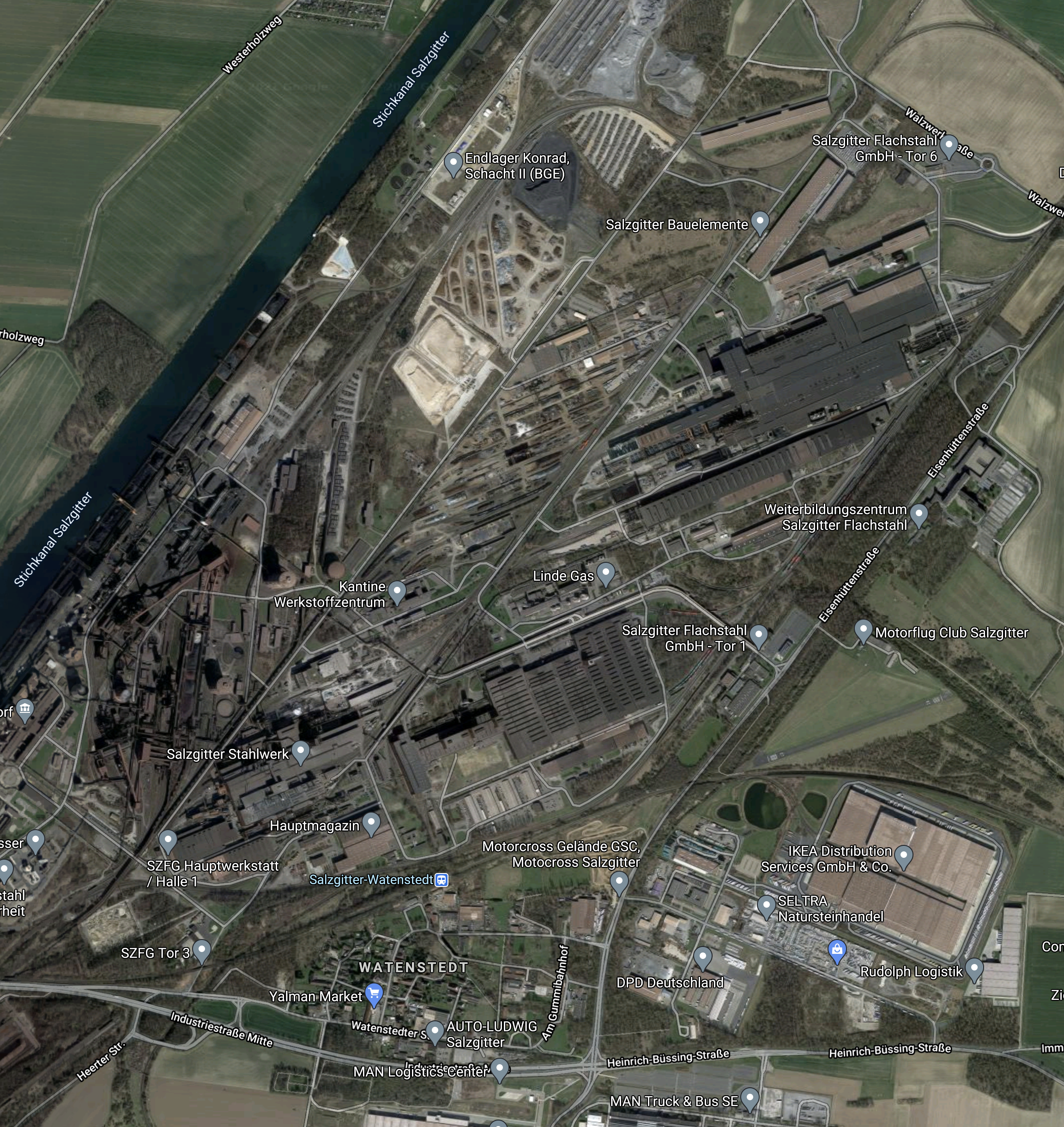
Note that if you click on the map to show it in a large scale, stahl is German for steel.
The article is certainly worth a read.
 The Anonymous Widower