MPS Floating Platform To Feature FibreMax Tendons
The title of this post, is the same as that of this article on offshoreWIND.biz.
This is the sub-heading.
Welsh company Marine Power Systems (MPS) has joined forces with FibreMax to provide integrated floating foundation and tendon solutions to the growing floating offshore wind sector.
And these three paragraphs outline the design.
The tendon solution will be used in the anchoring and moorings of MPS’ tension leg platform (TLP), called PelaFlex, to deliver the highest system stability and zero tilt, the partners said.
It will be the “world’s first” TLP with FibreMax tendons, made with Twaron fiber from Japan-headquartered Teijin.
Compared to traditional steel moorings synthetic cable offers a much better strength-to-weight ratio, longer operational life, and lower levels of maintenance, according to the partners.
Note.
- PelaFlex tension leg platforms are used in the project I wrote about in Simply Blue Group And Marine Power Systems To Pursue INTOG Innovation Project Opportunity.
- Wikipedia is a good source of information on tension leg platforms, where there is a large section on how they could be used for wind turbines.
- Twaron has an informative product page.
- There is more about PelaFlex on the PelaFlex web page including a video.
- The press release for the joint Simply Blue/MPS project talks of six turbines totalling up to 100 MW, which is probably around 17 MW per wind turbine.
It looks to me, that the PelaFlex design is getting better by the simple process of adding lightness and therefore being able to have a higher energy density in a deep area of the sea.
The amount of innovation involved probably makes PelaFlex an ideal component for the upcoming INTOG leasing round.
Mazda Europe Boss: 2035 ICE Ban Is ‘A Disgrace Of The Politicians’
The title of this post, is the same as that of this article on Car Dealer Magazine.
These are the three bullet points.
- Mazda Europe’s CEO lambasts EU’s 2035 ban and labels it a ‘big mistake’
- Martijn ten Brink says he finds new rules ‘hard to get his head around’
- Changes will stifle creativity in the automotive industry, claims Mazda boss
The article is a very interesting read.
The Next Generation Of Fixed Foundation Wind Farms
This article on offshoreWIND.biz, is entitled Offshore Wind Turbines In 2022: 15 MW Prototypes Starting To Spin In Europe, Chinese Rolling Out 16 MW Models, Windcatcher And VAWTs Secure Demo Projects.
The title itself, shows 15-16 MW wind turbines and the text lists three European 15 MW and two Chinese 16 MW wind turbines, that are being developed.
This paragraph also indicates that Siemens Gamesa are in the running for orders.
So far, the SG 14-236 DD wind turbine has been selected as a preferred option for the Norfolk Vanguard and Boreas wind farms offshore the UK, as well as for the MFW Bałtyk II and MFW Bałtyk III wind farms in the Polish Baltic Sea.
Large turbines with a capacity of 15 MW and upwards appear to be becoming the new normal.
Water depths for these large turbines are forecast to be deeper than the two Norfolk wind-farms, which are between 22 and 40 metres.
This means that foundations will get much larger and heavier.
This article on offshoreWIND.biz, is entitled New Monopile Installation Method Attracts Major Backer, describes a new generation of monopiles as 100-130 metres in length, 12-15 metres in outer diameter, and a weight of up to 5,000 tonnes.
Installing these long and heavy objects safely in deep waters, is not a job for the faint-hearted.
The article describes a new method of installation, which I feel is very elegant.
- The XXXL monopiles are built horizontally.
- They are moved on to the jack-up ship by self-propelled modular transporters (SPMT).
- It appears at least two or possibly up to four monopiles can be carried on the ship.
- They are lifted into the vertical position by a lifting beam.
Note.
- No cranes are involved in the process.
- The lifting beam method of erecting the 5,000 tonne XXXL monopile is simple and very efficient.
- Self-propelled modular transporters were used to install the 2000 tonne subway at Hackney Wick station.
- Rollers are fitted on the ship to ease handling of the monopiles.
I can certainly see this specialised jack-up ship speeding up the installation of these giant monopiles.
Consequences For Floating Wind
I do wonder, if this method of installing fixed foundation wind farms, will allow larger foundations and these may mean that there is less need for the more complex floating wind farms.
Low Carbon Construction Of Sizewell C Nuclear Power Station
Sizewell C Nuclear Power Station is going to be built on the Suffolk Coast.
Wikipedia says this about the power station’s construction.
The project is expected to commence before 2024, with construction taking between nine and twelve years, depending on developments at the Hinkley Point C nuclear power station, which is also being developed by EDF Energy and which shares major similarities with the Sizewell plant.
It is a massive project and I believe the construction program will be designed to be as low-carbon as possible.
High Speed Two is following the low-carbon route and as an example, this news item on their web site, which is entitled HS2 Completes Largest Ever UK Pour Of Carbon-Reducing Concrete On Euston Station Site, makes all the right noises.
These three paragraphs explain in detail what has been done on the Euston station site.
The team constructing HS2’s new Euston station has undertaken the largest ever UK pour of Earth Friendly Concrete (EFC) – a material that reduces the amount of carbon embedded into the concrete, saving over 76 tonnes of CO2 overall. John F Hunt, working for HS2’s station Construction Partner, Mace Dragados joint venture, completed the 232 m3 concrete pour in early September.
The EFC product, supplied by Capital Concrete, has been used as a foundation slab that will support polymer silos used for future piling works at the north of the Euston station site. Whilst the foundation is temporary, it will be in use for two years, and historically would have been constructed with a more traditional cement-based concrete.
The use of the product on this scale is an important step forward in how new, innovative environmentally sustainable products can be used in construction. It also helps support HS2’s objective of net-zero construction by 2035, and achieve its goal of halving the amount of carbon in the construction of Britain’s new high speed rail line.
Note.
- Ten of these slabs would fill an Olympic swimming pool.
- I first wrote about Earth Friendly Concrete (EFC) in this post called Earth Friendly Concrete.
- EFC is an Australian invention and is based on a geopolymer binder that is made from the chemical activation of two recycled industrial wastes; flyash and slag.
- HS2’s objective of net-zero construction by 2035 is laudable.
- It does appear that this is a trial, but as the slab will be removed in two years, they will be able to examine in detail how it performed.
I hope the Sizewell C project team are following High Speed Two’s lead.
Rail Support For Sizewell C
The Sizewell site has a rail connection and it appears that this will be used to bring in construction materials for the project.
In the January 2023 Edition of Modern Railways, there is an article, which is entitled Rail Set To Support Sizewell C Construction.
It details how sidings will be built to support the construction, with up to four trains per day (tpd), but electrification is not mentioned.
This is surprising to me, as increasingly, big construction projects are being managed to emit as small an amount of carbon as possible. Sizewell C may be an isolated site, but in Sizewell B, it’s got one of the UK’s biggest independent carbon-free electricity generators a couple of hundred metres away.
The writer of the Modern Railways article, thinks an opportunity is being missed.
I feel the following should be done.
- Improve and electrify the East Suffolk Line between Ipswich and Saxmundham Junction.
- Electrify the Aldeburgh Branch Line and the sidings to support the construction or agree to use battery-electric or hydrogen zero-carbon locomotives.
Sizewell C could be a superb demonstration project for low-carbon construction!
Sizewell C Deliveries
Sizewell C will be a massive project and and will require a large number of deliveries, many of which will be heavy.
The roads in the area are congested, so I suspect rail is the preferred method for deliveries.
We already know from the Modern Railways article, that four tpd will shuttle material to a number of sidings close to the site. This is a good start.
Since Sizewell A opened, trains have regularly served the Sizewell site to bring in and take out nuclear material. These occasional trains go via Ipswich and in the last couple of years have generally been hauled by Class 88 electro-diesel locomotives.
It would be reasonable to assume that the Sizewell C sidings will be served in the same manner.
But the route between Westerfield Junction and Ipswich station is becoming increasingly busy with the following services.
- Greater Anglia’s London and Norwich services
- Greater Anglia’s Ipswich and Cambridge services
- Greater Anglia’s Ipswich and Felixstowe services
- Greater Anglia’s Ipswich and Lowestoft services
- Greater Anglia’s Ipswich and Peterborough services
- Freight services serving the Port of Felixstowe, which are expected to increase significantly in forthcoming years.
But the Modern Railways article says this about Saxmundham junction.
Saxmundham junction, where the branch meets the main line, will be relaid on a slightly revised alignment, retaining the existing layout but with full signalling giving three routes from the junction protecting signal on the Down East Suffolk line and two in the Down direction on the bidirectional Up East Suffolk line. Trap points will be installed on the branch to protect the main line, with the exit signal having routes to both running lines.
Does the comprehensive signalling mean that a freight train can enter or leave the Sizewell sidings to or from either the busy Ipswich or the quieter Lowestoft direction in a very safe manner?
I’m no expert on signalling, but I think it does.
- A train coming from the Lowestoft direction needing to enter the sidings would go past Saxmundham junction on the Up line. Once clear of the junction, it would stop and reverse into the branch.
- A train coming from the Ipswich direction needing to enter the sidings would approach in the wrong direction on the Up line and go straight into the branch.
- A train leaving the sidings in the Lowestoft direction would exit from the branch and take the Up line until it became single track. The train would then stop and reverse on to the Down line and take this all the way to Lowestoft.
- A train leaving the sidings in the Ipswich direction would exit from the branch and take the Up line all the way to Ipswich.
There would need to be ability to move the locomotive from one end to the other inside the Sizewell site or perhaps these trains could be run with a locomotive on both ends.
The advantage of being able to run freight trains between Sizewell and Lowestoft becomes obvious, when you look at this Google Map, which shows the Port of Lowestoft.
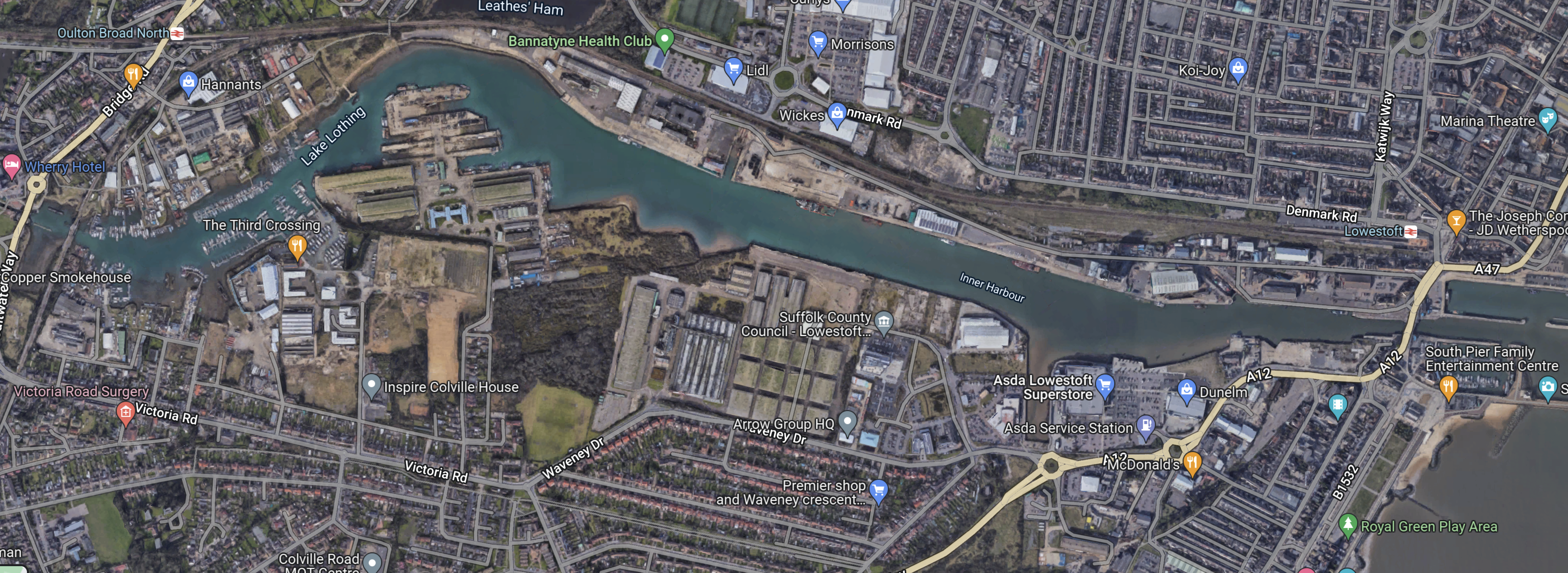
Note.
- The Inner Harbour of the Port of Lowestoft.
- The East Suffolk Line running East-West to the North of the Inner Harbour.
- Lowestoft station at the East side of the map.
I doubt it would be the most difficult or expensive of projects to build a small freight terminal on the North side of the Inner Harbour.
I suspect that the easiest way to bring the material needed to build the power station to Sizewell would be to do the following.
- Deliver it to the Port of Lowestoft by ship.
- Tranship to a suitable shuttle train for the journey to the Sizewell sidings.
- I estimate that the distance is only about 25 miles and a battery or hydrogen locomotive will surely be available in the UK in the next few years, that will be able to provide the motive power for the return journey.
In The TruckTrain, I wrote about a revolutionary freight concept, that could be ideal for the Sizewell freight shuttle.
In addition, there is no reason, why shuttle trains couldn’t come in from anywhere connected to the East Suffolk Line.
Zero-Carbon Construction
Sizewell C could be the first major construction site in the UK to use electricity rather than diesel simply because of its neighbour.
Conclusion
I shall be following the construction methods at Sizewell C, as I’m fairly sure they will break new ground in the decarbonisation of the Construction industry.
Offshore Wind Developers Answer Scotland’s Call For Innovation, Oil And Gas Decarbonisation
The title of this post, is the same as that of this article on offshoreWIND.biz.
This is the sub-heading.
Crown Estate Scotland has received a total of 19 applications for its Innovation and Targeted Oil and Gas (INTOG) offshore wind leasing process.
INTOG
Note that there are two sections to INTOG.
This document on the Crown Estate Scotland web site, is entitled INTOG – Public Summary and it defines the two sections.
Innovation:
- To enable projects which support cost reduction in support of commercial deployment of offshore wind including alternative outputs such as Hydrogen.
- To further develop Scotland as a destination for innovation and technical development which will lead to risk reductions and supply chain opportunity.
Applications in this section should be no more than 100 MW in capacity.
Targeted Oil and Gas:
- To maximise the role of offshore wind to reduce emissions from oil and gas production.
- To achieve target installed capacity in a way that delivers best value for Scotland, creating supply chain opportunity in alignment with Just Transition principles.
A rough estimate is that powering rigs by using offshore wind would increase gas production by around ten percent.
The Applications
The article says this about the applications.
Of the 19 applications, ten are for the Innovation part, while nine have been submitted for the TOG element.
It is expected that up to 500 MW will be awarded to innovation projects and around 4 GW for projects looking to decarbonise oil and gas assets.
The article also lists the known bidders.
Conclusion
I believe that there is going to be some outstanding applications for leases under the INTOG scheme.
I have already written about Cerulean Winds ambitious proposal in Cerulean Winds Is A Different Type Of Wind Energy Company, which could result in 6 GW of wind turbines installed amongst the oil and gas fields to provide electricity and decarbonise the platforms and rigs.
Wabtec Planning For Transition From Diesel
The title of this post, is the same as that of this article on trains.com.
It has this sub-title.
At InnoTrans, company looks at role of batteries, hydrogen in railroading’s future.
It is very much a must-read, that gives a road-map of their plans to decarbonise rail freight, by the use of both battery and hydrogen power.
NET9 Open Ocean Aquaculture Demonstrator Design Unveiled
The title of this post, is the same as that of this news item on the Impact9 web site.
Funding Available For Rail Construction Innovation Projects
The title of this post, is the same as that of this article on Railway Gazette.
These are the two introductory paragraphs.
Innovators from across the UK are being invited to submit proposals for the Innovation in Railway Construction Competition, which is making £7·44m available for ideas which could be tested at the Global Centre of Rail Excellence in South Wales.
The competition is being run by Innovate UK with GCRE and the Department for Business, Energy & Industrial Strategy.
£7.44m doesn’t seem much, but it is only for feasibility studies, as the article explains.
Entries for the first phase close at 12.00 on December 14, with funding available for feasibility studies of up to £25 000. This would be followed by an invite-only phase two, with successful first phase projects able to develop and demonstrate their innovations.
As Innovate UK keeps coming up with these competitions, they must be judged to be worthwhile.
Do they use the same technique in areas like Health and the NHS? If not, why not!
Project To Develop 20+ MW Floating Offshore Wind Technology Kicks Off
This is the introductory paragraph.
New Nanomaterial Offers Efficient Hydrogen Production – Just Add Light
The title of this post, is the same as that of this article on Hydrogen Central.
These are the first two paragraphs.
A new nanomaterial catalyst needs only light to convert ammonia into hydrogen, its developers have said.
Made of inexpensive raw materials, the catalyst was developed by a team from Rice University in Texas, Syzygy Plasmonics Inc., and Princeton University in New Jersey.
I am not surprised, as I am a great believer in the power of catalysts.
In Hydrogen Fuel Cells Could Get A Lot Cheaper With Newly Developed Iron Catalyst, I wrote.
In the early 1970s, I worked with one of ICI’s catalyst experts and he said, that improvements in this area will be large in the future.
Increasingly, I see his prediction being proved right, in the varied fields, where catalysts are used.
It may be over fifty years ago, but then scientific truths don’t fade away and die. They just sit there quietly waiting to be rediscovered.
It is worth looking at the Syzygy Plasmonics web site.
Under a heading of Deep Decarbonisation For Chemical Manufacturing, this is their mission statement.
Syzygy is commercializing a deep-decarbonization platform dedicated to cleaning up the emissions-heavy chemical industry. We use breakthrough technology pioneered in the Laboratory for Nanophotonics at Rice University to harness energy from LED light to power chemical reactions. This new technology has the potential to partially or fully electrify the chemical industry, shifting it to renewable electricity, and cost-effectively reducing its carbon footprint.
The energy transition is here. The time to act is now.
That is some mission statement! But possibly one to expect from Houston.
 The Anonymous Widower