The Class 769 Trains Are Progressing
The August 30th Edition of Rail Magazine gives a few details about the creation and testing of the Class 769 trains at Brush Traction in Loughborough.
- A test rig will be built to test the combination of MAN diesel engine and ABB alternator.
- The first train will be fitted with a power unit in the next eight weeks.
- After static tests it will move to the nearby Great Central Railway. for dynamic testing.
- The first train will be joined by a second train to test compatibility and multiple working.
- After returning to Brush for approval, they will move to Allerton Depot, where they will be based.
- It is planned that all eight trains for Northern will be in the North West by April 2018.
I find it intriguing that the testing is done on the local heritage railway.
There are two parts of the Great Central Railway separated by the Loughborough Gap.
- The Northern part is the Great Central Railway (Nottingham), which runs from the Midland Main Line at Loughborough to the South of Nottingham.
- The Southern part is the Great Central Railway, which runs between Loughborough Central and Leicester North stations.
It is not said, whether the testing is North or South of Loughborough.
The two heritage railways are trying to bridge the gap at present and I can’t help feeling that once it is bridged, there will be winners all round.
We Should All Think Radically!
In the August 2017 Edition of Modern Railways, Ian Walmsley, who is a writer, that I respect, thinks radically about how to upgrade or replace the High Speed Trains on the Midland Main Line.
He has a lot of experience in the rail industry and his views in this issue, are probably worth the price of the magazine alone.
He feels the InterCity 125s should be replaced as you can only make-do-and-mend for so long and he proposes replacing them with a modern equivalent, which would initially be two diesel locomotives topping and tailing a rake of new coaches, and then if electrification happens, the diesels are replaced with electric units.
Ian’s article comes a few days after this article in Rail Technology Magazine, entitled New bi-mode fleet a requirement for East Midlands as consultation opens, was published.
This is the first paragraph.
The DfT has this week launched its public consultation on the new East Midlands franchise, including specifications for a new bi-mode fleet of intercity trains, whilst at the same time revealing that plans to electrify the Midland Main Line north of Kettering have been abandoned.
There is going to have to be a lot of radical thinking to get a solution for that.
To make the replacement harder, Ian indicates various problems, which I won’t disclose here.
But I do think Ian’s idea is sound and it could be the solution to the problem of running modern 125 mph trains from St. Pancras to Derby, Nottingham and Sheffield.
So How Feasible Is Ian’s Plan?
Maths and physics don’t change. so I suspect that the calculations done by Terry Miller and his team in the 19670s, which led to the iconic InterCity 125 are still valid.
Locomotive Haulage
The power output of each Class 43 power car is 2,250 hp, so to propel an appropriate number of new carriages, you still need a locomotive at each end of the train.
The most modern diesel locomotive in the UK is the Stadler-built Class 68 locomotive, which has a power voutput of 3,800 hp, but a top speed of only 100 mph. The only 125 mph diesel locomotive in the UK is the Class 67 locomotive. To complicate matters, there is also the Stadler-built Class 88 locomotive, which is a 100 mph electro-diesel locomotive, but this locomotive is more a powerful electric locomotive with a sensible-sized last-mile diesel engine.
Ian suggests, that as the Class 68 is a few tonnes lighter than the Class 67, that a 125 mph Class 68/2 locomotive would be possible.
I don’t disagree, but given the quality of railway engineering coming out of companies like Bombardier, CAF and Stadler, that someone will do better.
We should also consider that the UK will need more than a few new freight locomotives in the next few years, as they do seem to be scratching around for motive power, as this picture shows.
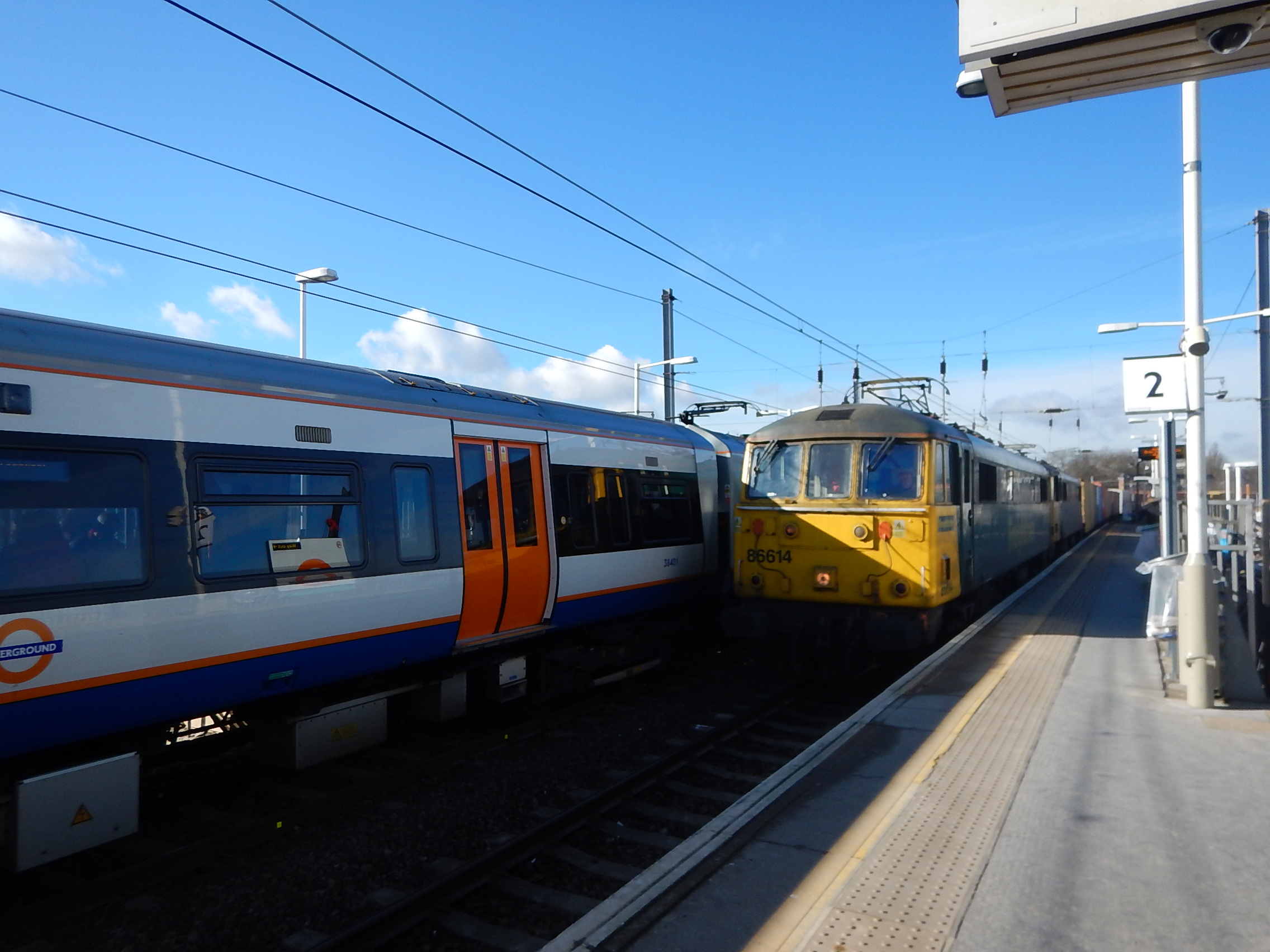
These two Class 86 locomotives date from the mid-1960s. But they do have around 3,600 hp each and a top speed of around 100-110 mph.
I even saw this interesting combination at Shenfield.
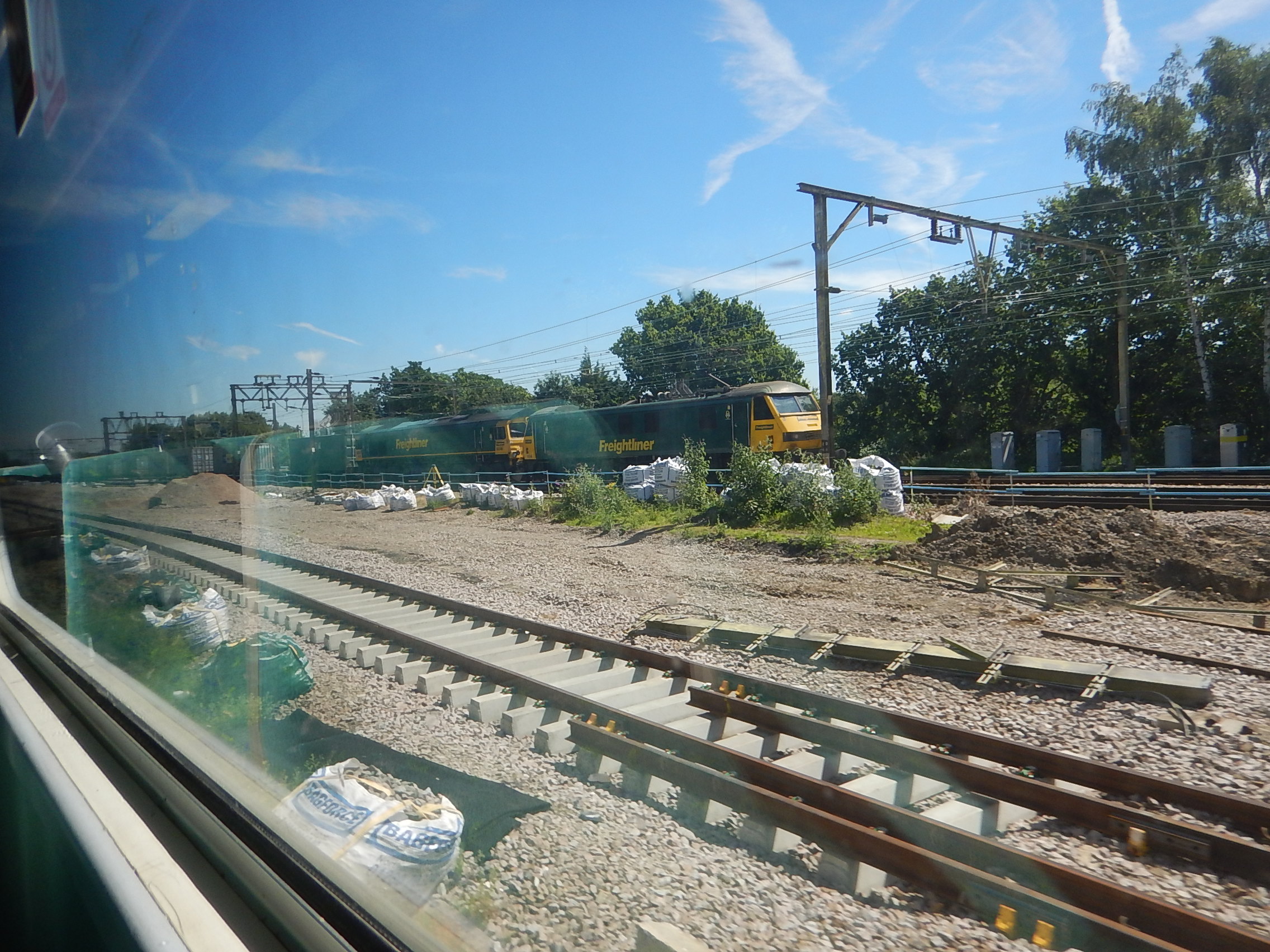
The Class 90 and Class 66 locomotives appear to be double-heading the heavy freight train. The Class 90, of which several will become available soon from Greater Anglia are 5,000 hp units with a top speed of 110 mph, whereas the ubiquitous Class 66 has only 3,300 hp and 75 mph.
With more and more long freight trains appearing on increasingly busy main lines, these freight trains must be becoming unwelcome to the companies running passenger trains and also to those, who live alongside the lines.
So is there another desperate need for a powerful locomotive to pull express freight trains at maximum length and weight around the country?
Some main freight routes like these are electrified with 25 KVAC overhead wires or will be soon.
- East Coast Main Line
- West Coast Main Line
- Greast Eastern Main Line
- Great Western Main Line
- North London Line
- Gospel Oak to Barking Line
But others are not.
- London to Southampton
- Felixstowe to Peterborough and The Midlands
- Peterborough to Doncaster via Lincoln
- Trans-Pennine Routes
And that’s just for starters.
I think it becomes obvious, why Direct Rail Services and Stadler came up with the Class 88 locomotive. The 5,300 hp available under the wires is more than adequate for the heaviest express intermodel freight train and the 1,000 hp under diesel can probably move the train into and out of the docks.
But this amount of diesel power is probably inadequate for hauling a heavy freight train at 100 mph.
A New Electro-Diesel Locomotive
So could we see a new electro-diesel locomotive with the following characteristics?
- The ability of a pair to top-and-tail an express passenger train on both diesel and 25 KVAC overhead electrification.
- The ability to haul the heaviest intermodal freight trains at up to 100 mph on both diesel and 25 KVAC overhead electrification.
- The ability to switch between modes at line speed.
- Regenerative braking underboth elkectricity and diesel.
In a few years time the diesel might be replaced by hydrogen or some other exotic fuel.
Electrification South Of Bedford
It might appear that these locomotives if working the Midland Main Line could switch to electric power South of Bedford or in the near future; Kettering, but the electrification is limited to 100 mph and there is no planned upgrade. This is a familiar story for anybody like me who uses the Great Eastern Main Line, where the inadequate electrification has had to be upgraded over the last couple of years to allow faster services.
The Coaches
The coaches are the least of the problems for Ian’s proposals.
This article on Rail Technology Magazine is entitled First bodyshell completed by CAF for new TPE fleet.
This is the first paragraph.
Pictures of the first bodyshell for new rolling stock to be used by TransPennine Express (TPE) have been unveiled as the operator looks to introduce 13 five-car Mark 5A Coaches – being built by Spanish company CAF – as part of its brand-new fleet.
The Mark 5A coaches, being built by CAF are designed for 125 mph! So all that is needed is to specify the interior!
As the Spanish train manufacturer has just announced the building of a factory at Llanwern in South Wales, that might be an ideal place to build the coaches needed.
Beating The PRM Deadline In 2020
The Mark 5A coaches for TransPennine Express are scheduled for delivery in 2018-2019, so I suspect the coaches for the Midland Main Line could start to be delivered after the TransPennine Express and Caledonian Sleeper orders are complete.
The locomotives might be move problematical, but if they are a derivative of an existing type, then surely this wouldn’t delay fleet introduction.
I suspect that a certain amount of testing can be done in parallel too!
So having some trains in service by the PRM eadline of 2020 could certainly be possible.
Conclusion
Ian Walmsley’s proposal for the next Midland Main Line franchise is possible.
UK Ditches Electrification Plans In Wales, The Midlands And The North
The title of this post is the same as that of an article in Global Rail News. This is the first two paragraphs.
The UK government has abandoned plans to electrify the railway between Cardiff and Swansea, the Midland Main Line north of Kettering and the line between Windermere and Oxenholme in favour of bi-mode, or ‘alternative-fuel’, trains.
An announcement from the Department for Transport (DfT) this morning said electrification of the lines was no longer needed and that cancelling the work would result in less disruption for passengers.
So do I agree with the Government’s decision?
Before I answer that question, I will put a few facts into this post!
All Trains Should Be Powered By Electricity
Most trains in the UK are actually powered by electricity.

If you take the noisy and smelly Class 66 locomotive, the wheels are actually turned by electricity, although that electricity is generated by a 2,460 kW diesel engine and an alternator, which is then fed to the traction motors.
The great advantage of electricity is that when you need to deliver precise power to move the train, it is very easy to control.
As an example of precise electric control, think of a variable-speed drill or food mixer.
What makes some trains more efficient than others, is the way they handle the electricity and get it to the traction motors.
Electrification; Overhead Or Third Rail
Ptobably the most efficient way to get electrical power to a train is from an electrification system, which in the UK can be 25 KVAC overhead wire or 750 VDC third rail.
25 KVAC overhead electrification has the following problems.
- Bridges and tunnels must be raised or enlarged to give sufficient clearance for the wires.
- Stations must be designed so that passengers can’t get near the wires.
- Overhead wires are liable to damage.
- Overhead gantries can be unsightly and subject to objection by local interest groups.
- Erecting overhead gantries on an existing railway seems subject to various problems.
I could add that in the UK, we seem to be particularly bad at overhead electrification, but then most other countries electrified their lines decades ago.
750 VDC third rail electrification has one main problem, which is one of Health and Safety.
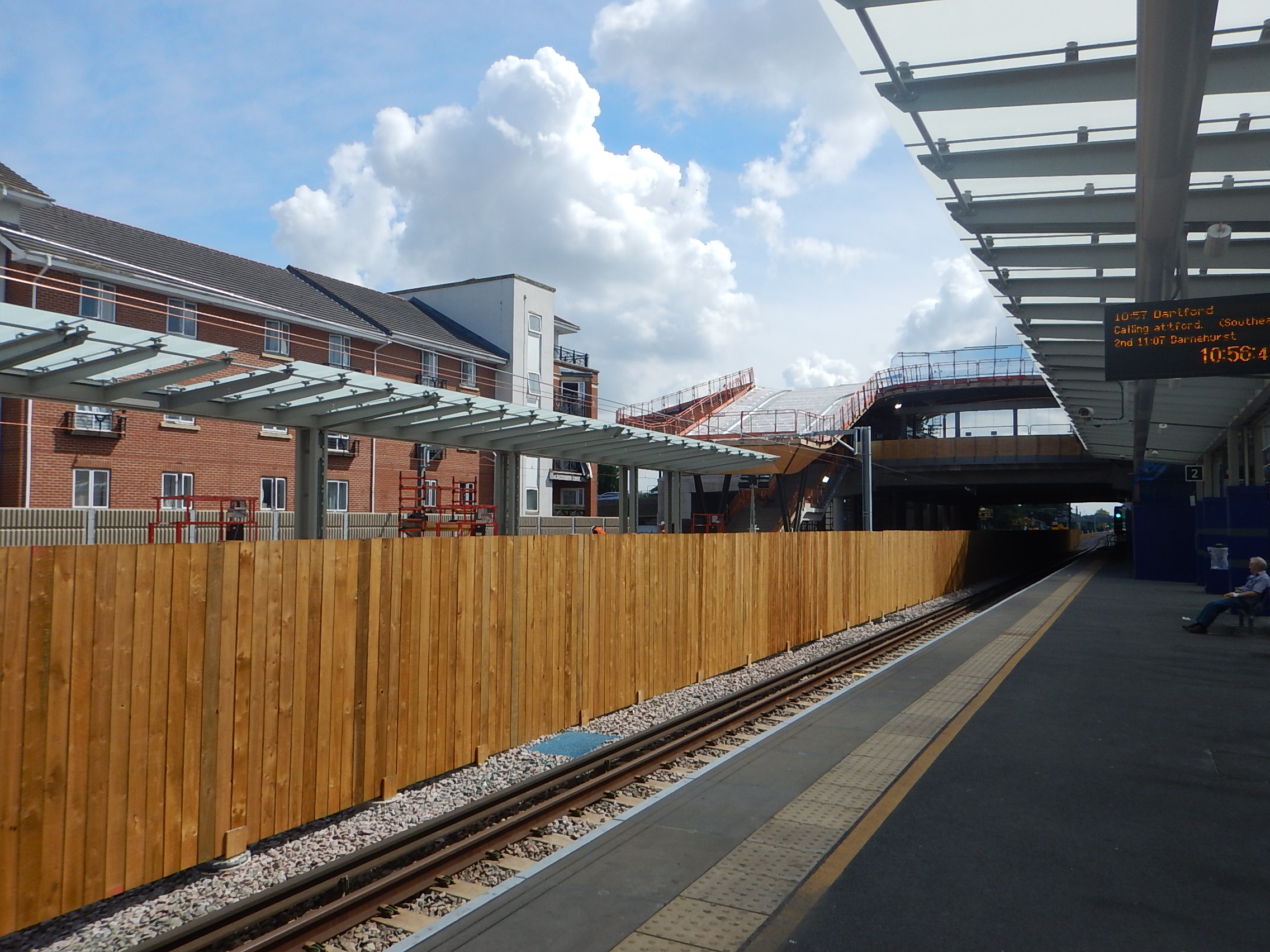
What is the purpose of this palisade fence at Abbey Wood station?
It certainly doesn’t protect passengers on the North Kent Line platform from where I took the photo from the 750 VDC third rail electrification in front of the fence.
The Crossrail tracks behind the fence are electrified with 25 KVAC, which is several metres in the air.
So is the fence to protect passengers on the platform behind the fence from running across the electrified track?
I think it probably is!
Electrification of both types has problems in certain track layouts.
- Switches and crossings sometimes need very complicated layout of the power system.
- Level crossings can present difficult Health and Safety problems.
- Depots can be dangerous places, even without live rails and overhead wires.
Engineers are constantly coming up with ideas to make electrification safer and more efficient.
Diesel Power
Putting an appropriate diesel engine on a train coupled to an alternator is a common way to generate electricity to power the train.
But.
- There is the noise and the smell.
- Diesel engines are very heavy.
- Diesel fuel has to be carried.
- Diesel trains have to be regularly refuelled.
To cap it all, diesel trains are not very green.
Gas Turbine Power
One version of he Advanced Passenger Train of the 1970s was intended to be powered by gas turbines and this shows how engineers tried all sorts of power for trains.
Gas turbine power, although very successful in aircraft is probably not suitable for trains.
Hydrogen Power
The Alstom Coradio iLint is a train powered by a hydrogen fuel cell. This is said in the Wikipedia entry.
Announced at InnoTrans 2016, the new model will be the world’s first production hydrogen-powered trainset. The Coradia iLint will be able to reach 140 kilometres per hour (87 mph) and travel 600–800 kilometres (370–500 mi) on a full tank of hydrogen. The first Coradia iLint is expected to enter service in December 2017 on the Buxtehude-Bremervörde-Bremerhaven-Cuxhaven line in Lower Saxony, Germany. It will be assembled at Alstom’s Salzgitter plant. It began rolling tests at 80km/h in March 2017.
As we have successful hydrogen-powered buses in London, I suspect we might see trains powered by hydrogen fuel cells.
Battery Power
Powering a heavy train for more than a couple of miles, by means of batteries seems very much of a fantasy.
I was sceptical until I rode inn Bombardier’s Class 379 train, that took part in the BEMU trial.

I believe strongly, that the place for a battery in a train is not normally as a primary power source, but as an intermediate electricity store in much the way the battery is used in a hybrid bus or car.
The battery would be charged, when running on electrified track or by using an onboard diesel engine or hydrogen fuel cell.
It could then power the train on a length of track without electrification.
Regenerative Braking
Regenerative braking can save as much of twenty percent of the electricity use of a train.
Every time the train brakes, the traction motors turn into generators and transform the train’s kinetic energy into electricity.
On some systems like the London Underground, the electricity is returned to the network and used to power nearby trains.
But on some trains, it is passed through resistors on the train roof and just turned into heat.
Hybrid vehicles have shown how it is possible to use batteries to store and reuse the energy and I believe that this technique is now starting to be used on trains.
In Thoughts On Batteries, I said this.
A typical four-car electric multiple unit like a new Class 710 train, weighs about 130 tonnes or 138 tonnes with passengers. Going at a line speed of 100 kph, it has a kinetic energy of 15 KwH. So this amount of kinetic energy would be well within the scope of a 75 KwH battery from a Routemaster bus.
I think that the typical four-car electric multiple unit can easily be fitted with a battery to handle the braking for the train.
The physics of steel-wheel-on-steel-rail are also very efficient, as Robert Stephenson, if not his father, would have known.
So it would appear that combining regenerative braking with batteries of a practical size can improve the efficiency of a train.
One of the great advantages of handling the regenerative braking on the train with batteries, is that expensive transformers to handle the return currents are not needed at trackside.
Putting It All Together
I very much feel that the ultimate train should have the following characteristics.
- The ability to work on 25 KVAC overhead and/or 750 VDC third rail electrification.
- A suitable independent power source, which today would probably be diesel.
- Regenerative braking.
- A battery of sufficient size.
- The ability to switch modes automatically.
As a Control Engineer, I feel sure that some form of Automatic Power Management would be welcomed by the driver.
The Class 800 Train
The Class 800 trains, have the following maximum speeds.
- 125 mph on 25 KVAC overhead wires
- 140 mph on 25 KVAC overhead wires with ETCS in-cab signalling.
- 100 mph on diesel.
I think it is true to say, that on 125 mph lines, they may be capable of going faster.
But whatever they can do is probably well known now as Hitachi have over two years of experience of running the trains on British tracks.
In Do Class 800/801/802 Trains Use Batteries For Regenerative Braking?, I analyse the posed question.
After spending several hours searching the Internet, I found this very helpful document on the Hitachi web site.
Reading every word several times, I came to the conclusion, that it is more likely than not, that all variants of Class 80x trains have batteries, that are used for the following.
- Handling regenerative braking
- Providing hotel power for the train in case of complete power failure.
- Providing emergency train recovery in case of complete power failure.
I also discovered the following.
- The all-electric Class 801 train, has at least one onboard diesel engine for emergency situations.
- All Class 80x trains could be modified to use third rail electrification.
- All Class 80x trains can couple and uncouple in under two minutes.
- Class 80x trains can rescue another.
- Class 80x trains can be locomotive-hauled.
Hitachi have worked hard to produce a seriously comprehensive train.
This specification will lead to some interesting operational strategies.
More Destinations
Great Western Railway currently has services between London Paddington and the following destinations in South Wales
- Bridgend
- Carmarthen
- Cardiff
- Llanelli
- Neath
- Newport
- Pembroke Dock
- Port Talbot
- Swansea
But how many other stations in South Wales could benefit from a direct service?
The intriguing thing is that a Class 800 train is narrower at 2.7 metres, than the following trains.
A five-car Class 800 train is also considerably shorter and a lot quieter than an InterCity 125.
So it raises the possibility of direct services between London and the following stations.
- Smaller stations in West Wales like Fishguard Harbour and Milford Haven
- Important stations in the Cardiff Valley Lines.
Could a five-car Class 800 train reach Aberdare, Ebbw Vale and Merthyr Tydfil, with some platform and track modifications?
Or if not a five-car, what about a four- or three-car train, which due to the flexible nature of the trains, I feel is very much possible!
Joining And Splitting Of Trains
In Wales, smaller separate trains could join into a train of up to twelve-cars at say Cardiff or Newport stations and then run to London as a single train.
Similar processes could apply in West Wales, with trains joining at perhaps Port Talbot Parkway station.
Returning from London, the trains would split at an appropriate station.
The big advantage of this approach, is that two or even three services share one path and driver between the join/split station and London, which means an increased number of separate services and total seats between Wales and London.
Similar processes will be possible on the following sets of routes, which will or could be run by Class 80x trains.
- London Paddington to Cheltenham, Gloucester, Hereford, Oxford and Worcester.
- London Paddington to Devon and Cornwall.
- Midland Main Line services.
- East Coast Main Line services.
How many stations on these lines will receive a new direct service to and from London?
Network Rail’s Secret Weapon
I have been suspicious for some time, that Network Rail have a very sophisticated simulation of the UK rail network. In fact, I’d be very surprised if they didn’t have one.
But that’s because I’ve done extensive dynamic simulation and scheduling in my working life and know the power and capabilities of such a system.
It’s just that some of the new franchises have developed some quite radical train patterns.
So I would suspect, a lot of the thinking behind the dropping of electrification has been thoroughly tested on the computer.
So how will the three lines quoted in the article be handled?
Oxenholme To Windermere
The Windermere Branch Line is just ten miles long with four stations.
This article in the Railway Gazette, says this.
‘We have listened to concerns about electrification gantries spoiling protected landscapes’, Grayling said when confirming the cancellation of plans to electrify the Windermere branch in the Lake District, adding that Northern would begin work to trial an ‘alternative-fuelled’ train on the route by 2021. Grayling mentioned the ongoing development of battery and hydrogen power in his statement, but Northern said it had only just begun to explore possible options following the cancellation of the electrification, and so any decision on the technology to be used was still some way off.
From May 2018 Northern plans to operate services to Windermere using Class 769 Flex electro-diesel units to be formed by fitting diesel powerpacks to Class 319 EMUs. New CAF DMUs would then be introduced to the route from December 2019.
It is both a short-term and a long-term solution, that is probably to the benefit of all stakeholders.
Given that the Class 769 train has been designed to serve Manchester to Buxton, you can’t accuse Porterbrook and Northern of hiding their creation under a bushel.
Cardiff To Swansea
The South Wales Main Line between Cardiff Central and Swansea stations is a forty-five mile double-track with the following operating speeds.
- 90 mph from Cardiff Central to East of Bridgend station
- 75 mph from Bridgend to Swansea Loop North Junction
- 40 mph from Swansea Loop North Junction to Swansea
But there is a short section at 100 mph through Pyle station.
This is said in the article in Global Rail News.
Referring to the Cardiff-Swansea route, the statement said, “Rapid delivery of passenger benefits, minimising disruption and engineering work should always be our priority and as technology changes we must reconsider our approach to modernising the railways.”
The argument is based on the planned introduction of bi-mode Class 800 trains later this year.
I have flown my virtual helicopter along the tracks and it doesn’t seem a badly designed route.
- It appears to be fairly straight with flowing curves.
- There are only eleven stations to pass through.
- Looking at the current timetables, it would appear that the fastest trains take about 51-53 minutes to go between Cardiff and Swansea.
- Wikipedia says this about the South Wales Main Line, “resignalling and line speed improvements in South Wales, most of which would be delivered in 2010–2014”.
So have Network Rail found a way to increase the operating speed nearer to the 100 mph of the Class 800 trains, when running on diesel?
I obviously don’t know for sure, but given the improvements to the South Wales Main Line and the performance of the new trains, I wonder if Network Rail’s simulations have shown that there is very little to be gained by full electrification.
As I indicated earlier, by joining and splitting services, the number of trains and the total number of seats can be increased to West Wales without needing more train paths between London and Cardiff.
Midland Main Line
There has been discussions in Modern Railways recently about the problems of devising a timetable for the Midland Main Line.
The article in the Railway Gazette says this.
Hitachi is supplying bi-mode trainsets for Great Western services under the Department for Transport’s Intercity Express Programme, while the operator of the next East Midlands franchise will be required to introduce bi-mode trainsets from 2022. DfT said the use of electro-diesel trainsets instead of electrification would mean passengers would ‘benefit sooner’, because ‘disruptive’ work to install ‘intrusive wires and masts’ would ‘no longer be needed’.
It looks to me that simulation has shown, as in South Wales, there is little to be gained from full electrification.
But there could be a lot to gain from the following.
- Creative joining and splitting of trains.
- Improved track layouts.
- Improving the electrification South of Bedford.
- Adding new stations.
With these intelligent bi-mode trains, electrification can be added selectively, if it is shown to be worthwhile.Control systems linked to GPS, can raise and lower the pantograph appropruiately.
Conclusion
I think that someone asked the heretical question.
What would happen if instead of electrification, we used bi-mode trains?
Both the South Wales Main Line and the Midland Main Line have similar characteristics.
- Operating speed upwards of 90 mph.
- Sections where the operating speed could be raised.
- Partial electrification at the London end.
- All London suburban trains sharing the routes are 100 mph trains.
- Modern signalling
Couple this with the Class 800 trains and a very good simulation, and I suspect that Network Rail have found ways to improve the service.
I very much feel that similar techniques are being used to increase the capacity of the electrified Great Eastern Main Line to achieve Norwich-in-Ninety.
I can’t of course prove my feelings, but then I started writing computer simulations in the mid-1960s and like to think, I know when I see others have done some good numerical analysis.
Where Else Could Bi-Mode Trains Be Used In This Way?
This is very much speculation on my part.
Basingstoke To Exeter Via Salisbury
Consider.
- There have been ambitions to electrify this route for decades.
- The new operator of the route; South Western Railway and Great Western Railway, who will operate Class 800 trains, are partially in the same ownership.
- Third rail or dual voltage Class 800 trains are possible.
- The trains are 100 mph units on diesel against the current 90 mph Class 158 trains.
- The trains would save four minutes between London Waterloo and Basingstoke.
- The trains could take advantage of speed improvement South of Basingstoke.
- If Basingstoke to Exeter was a 100 mph line, then up to fifteen minutes could be saved.
- The trains could join and split to serve multiple destinations.
But perhaps the biggest advantage would be that all trains between London Waterloo and Basingstoke would be 100 mph trains, which must mean that more trains could use the line.
Cardiff to Brighton via Southampton, Portsmouth Harbour and Bristol
Consider.
- This route has significant overcrowding according to Wikipedia.
- Cardiff to Bristol should eventually be electrified with 25 KVAC overhead wires.
- Brighton to Southampton is electrified with 750 VDC third rail.
- Great Western Railway run this route and have Class 800 trains.
- Dual voltage Class 800 trains are possible.
To run this route efficiently, Great Western Railway would need an appropriate number of five-car dual voltage Class 800 trains.
Norwich To Stansted Airport via Ely and Cambridge
The Breckland Line between Norwich and Cambridge has the following characteristics.
- Double-track throughout its just over fofty miles.
- Sections of electrification at Norwich and South of Ely.
- A variable operating speed of up to 90 mph.
The line has recently been upgraded with improved track, removal of level crossings and modern signalling.
As part of their new franchise proposal, Greater Anglia decided to run services from Norwich to Stansred Airport using new Stadler Class 755 trains, with the following characteristics.
- Three- or four-car
- Bi-mode power.
- 100 mph capability.
- Running on 25 KVAC, where available.
I think this is a good plan and is an example of the sort of use of bi-mode trains that will be seen increasingly.
Consider.
- Norwich gets a much better connection to Cambriodge and Stansted Airport.
- Some services on the route are still run by 90 mph Class 158 trains.
- Speed improvements will come because of the nearly fifty miles of electrification between Ely and Stansted Airoport.
- There may be further track improvements possible.
There is also the big possibility of being able to run a direct service between Norwich and London via Cambridge. I estimate that this could be done in about two and a half hours.
This is obviously not as fast as the route via Ipswich, where the current timing is around one hour fifty minutes and plans are in progress to reduce it by twenty minutes, but as an engineering work diversion, it is faster than a bus replacement service.
Peterborough To Colchester via Bury. St. Edmunds and Ipswich
This is an extension of the current Peterborough to Ipswich service that will be run by a bi-mode Class 755 train, under the new franchise agreement.
Consider.
- The route is not electrified, except for Peterborough to Stowmarket.
- Colchester gets a new hourly direct link to Peterborough, which has many services to the North.
- A two train per hour service across Suffolk between Ipswich and Bury St. Edmunds is created.
- Colchester to Peterborough may be reduced by twenty minutes or more.
- Ipswich to Peterborough may be reduced by a few minutes.
If it was decided to electrify from Stowmarket to Peterborough, timings would benefit substantially.
Ipswich To Cambridge via Bury. St. Edmunds and Newmarket
This is an existing service that will be run by a bi-mode Class 755 train, under the new franchise agreement.
Leeds To Glasgow Via Settle
Why not?
If you look at timings for Leeds to Glasgow, they are typically as follows.
- 3 hours 58 minutes with an 11 minute change at Haymarket.
- 4 hours 12 minutes with a 30 minute change at Carlisle
- 4 hours 4 minutes on a direct train via Edinburgh.
The Settle-Carlisle Line has been stoutly repaired after the 2015-2016 Temporary Closures and is probably in its best state for years, if not ever.
- Leeds to Skipton is electrified.
- Carlisle to Glasgow is electrified.
- Virgin Trains East Coast run to Skipton, using InterCity 225s.
I estimate that a Class 800 train could reduce the journey time to around three-and-a-half hours.
Would that be a successful service considering driving between Leeds and Glasgow probably takes almost four hours?
What A Fine Mess Thameslink And The Midland Main Line Is In
This article is prompted by an article in the May 2017 Edition of Modern Railways, which is entitled Crunch Time Nearing For MML Thameslink Timetable.
The author of the report; the respected Roger Ford, explains the problems of getting a timetable that is acceptable to a number of parties.
Govia Thameslink Railway (GTR) want to do the following.
- Run 20 trains per hour (tph) through the central core of Thameslink by May 2018.
- Run 24 trains per hour (tph) through the central core of Thameslink by December 2018.
- Run eight, four and four tph respectively to Bedford, Luton and St. Albans.
East Midlands Trains (EMT) and/or their successor, want to do the following.
- Run their current diesel services.
- EMT want to run new new electric services to Kettering and Corby.
- EMT want to run 6 tph at 125 mph into St. Pancras.
And both companies will have to satisfy the politicians.
Network Rail’s original plan is described under Political Developments in the Thameslink entry in Wikipedia. This is said.
Network Rail had planned to terminate Sutton Loop Thameslink trains at Blackfriars station, rather than have them continue through central London as at present. This would increase the capacity of the central core as the Sutton Loop could only accommodate shorter trains. This upset many residents in South London and their local politicians, who saw it as a reduction in services rather than an improvement. In response to pressure, government has ordered Network Rail to reverse the decision.
It is an awful lot of trains to squeeze into the Midland Main Line.
Some improvements were planned to help with the capacity North of Bedford.
- A fourth track between Bedford and Kettering/Corby.
- !25 mph electrification.
Both these should happen, but the electrification South of Bedford will only be 100 mph capable and there is no date for its upgrade.
So it looks like we have the classic pint pot and everybody is trying to put a quart in it.
Roger points out that the knock-on delays for a late train, could be horrendous and felt all over the North, with several minute increases in journey times to Sheffield and Nottingham.
Roger does highlight a couple of solutions.
Turning Thameslink Services At Kentish Town
The first Roger Ford outlines is to turn some services from the South at Kentish Town.
- ,There is stabling capacity.
- EMT might take over some of the fast outer-suburban commuter services.
- There is a good connection to the Northern Line, which will have an increased capacity in a couple of years.
Perhaps too, a connection could be made with the Gospel Oak to Barking Line at West Hampstead Thameslink and Tufnell Park to improve connectivity.
But would the politicians accept a solution like this?
Has Thameslink Got The Wrong Length Of Trains?
If you look at some recent train orders, they seem to suggest a train and a half-train philosophy.
- GWR’s order for Class 80x trains.
- VTEC’s order for Class 80x trains.
- Greater Anglia’s order for Aventras.
- SWT’s order for Class 707 trains.
In all these orders, it would appear that two half-trains are used to create a full train, when needed. This coupling and uncoupling is done throughout the day and often on an automatic basis.
But Thameslink’s Class 700 trains only come in lengths of eight and twelve cars.
The eight-car train is needed for short platforms on the Sutton Loop Line.
But eight-car trains have disadvantages compared to say a six-car train.
- two trains can’t be joined together to make a long train.
- An eight-car train uses one of the valuable twenty-four hourly paths through the central core of Thameslink, just as a twelve-car train does.
The train length is patently inefficient.
The Sutton Loop Line could be run by using six-car trains that split and join at Streatham station.
Splitting Regional Services With A Change Of Train
This diagram from the Wikipedia entry for East Midlands Trains shows the company’s routes.
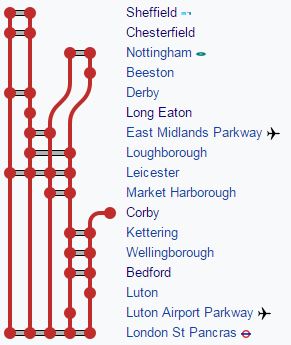
I can’t see that expecting passengers to change trains on a journey say between London and Sheffield would be welcomed by everyone.
Electrification To Leicester, Derby And Nottingham
This section is an aside, but I think that it could be the key to solving the capacity problem.
Electrification to these three cities, shouldn’t be a problem other than the usual one of Network Rail’s competence and it could be completed by 2023, which would include Sheffield.
However, there is a serious problem with electrification between Derby and Sheffield, in that the line goes through the World Heritage Site of the Derwent Valley Mills.
But there is an alternative plan, which is to electrify the Erewash Valley Line, which avoids the World Heritage Site and provides a more direct and possibly faster route between London and Sheffield.
Under Future in the Wikipedia entry for the Erewash Valley Line, this is said.
Network Rail as part of a £250 million investment in the regions railways has proposed improvements to the junctions at each end, resignalling throughout, and a new East Midlands Control Centre.[1]
As well as renewing the signalling, three junctions at Trowell, Ironville and Codnor Park will be redesigned and rebuilt. Since the existing Midland Main Line from Derby through the Derwent Valley has a number of tunnels and cuttings which are listed buildings and it is a World Heritage Area, it seems that the Erewash line is ripe for expansion. As the new signalling is rolled out, train detection is moving away from the traditional Track circuit detection of trains to Axle counting.
I hope all of the work done on the Erewash Valley Line has made sure that whenh they do electrify the line, the bridges are high enough and the signalling cables are well out of the way.
As the East Midlands Hub station for HS2 will be close to Toton TMD on the Erewash Valley Line and would open in 2032/3, it strikes me that it would be sensible to plan electrification of the Midland Main Line and HS2 together.
Bring On The Bi-Modes
Roger Ford dismisses the bi-modes in strong words.
A bi-mode doesn’t really work on the high-speed main line.
Under the wires it is a very heavy EMU, while under diesel power it is an underpowered DEMU. Just consider the roles on the MML. From London to Bedford it would need to run as a 125 mph diesel. From Bedford to Kettering the pantograph would go up for some 125 mph running. And after that it would go back to diesel. So why bother with the electric traction?
I would agree with that, but the Class 80x bi-modes may have other characteristics, that could get the timetable out of trouble.
The current hourly timetable out of St. Pancras is as follows.
- XX:00 – Corby, stopping at Luton, Bedford, Wellingborough and Kettering.
- XX:15 – Nottingham, stopping at Market Harborough, Leicester and East Midlands Parkway
- XX:26 – Sheffield, stopping at Leicester, Loughborough, East Midlands Parkway, Long Eaton, Derby, Chesterfield
- XX:29 – Nottingham, stopping at Luton Airport Parkway, Bedford, Wellingborough, Kettering, Market Harborough, Leicester, Loughborough, Beeston
- XX:58 – Sheffield, stopping at Leicester, Derby, Chesterfield
When Bedford to Corby is electrified, there will be another path.
Note that all the paths except those to Corby go through Leicester.
Currently the services are run by a mixture of 27 x Class 222 trains of 4, 5 and 7 cars and 12 x InterCity 125s of a 2×8 formation.
I said that the Class 80x trains may have other characteristics, that could get the timetable out of trouble.
One is that, two closely-related Class 395 trains can automatically couple and uncouple in under a minute, so I suspect that the Class 80x trains will have the same capability.
So supposing a pair of Class 80x trains ran from St. Pancras to either Bedford, Kettering or Leicester, where they would divide, with each train going to a separate destination.
This would mean that six paths would give twelve services to each of three destinations, Corby, Nottingham and Sheffield via Derby and Chesterfield.
EMT could balance the number of trains with their passenger statistics and could extend services from Corby, Nottingham and Sheffield, as they felt appropriate.
Modern trains would also be able to execute stops quicker than the current Class 222 trains and Inter\City125s.
So could extra stops be introduced South of Bedford to enable Thameslink services to be simplified and thinned out?
Conclusion
These may be consequences.
- Four tph might be able to call at Luton Airport Parkway and East Midlands Parkway.
- Sheffield and Nottingham might get marginally slower services, but they could get four tph.
- All EMT might stop at Bedford, to enable Thameslink services to Bedford to be reduced from 8 tph to 4 tph.
- Two tph between Sheffield and London might use the Erewash Valley Line and stop at Alfreton and Ilkeston.
There’s an optimal solution in there somewhere.
Network Rail Go Diving Again
After the Acton Dive-Under and the Bermondsey Dive-Under, in the April 2017 Edition of Modern Railways, there is an article entitled Dive-Under To Radlett SRFI (trategic Rail Freight Interchange).
This Google Map shows the location of the controversial Radlett SRFI.

It is sited on the old Handley-Page aerodrome at Radlett to the East of Park Street station on the Abbey Line and the West of the Midland Main Line.
The dive-under will go under the Midland Main Line to provide access to the slow lines on the East side of the Midland Main Line.
Seamless Interchangeability
At several places on the UK rail network, two trains running as a pair will split, with one train going to one destination and another going to another.
I wrote about trains splitting and joining in Trains Uncoupling and Coupling at Cambridge.
In the past, UK railways used to use the concept of slip coaches, so that coaches could be dropped from an express without stopping. But the last time it was used in the UK was in September 1960 at Bicester North station.
I have just read this article on the Rail Engineer web site, which is entitled Seamless Interchangeability.
The article talks about a concept of dynamic coupling, where trains are automatically coupled and uncoupled at line speed.
It also talks about the issues this would raise.
As a Control Engineer, I’m fairly certain, that it would be very easy to create a system, where say an eight-car Kings Lynn train could split just before Cambridge station, with the front four-car train going to Kings Lynn and the other four-car train stopping in Cambridge station.
It could either be done using two drivers or by driver-less trains. Although the unions would have a lot to say about the latter.
I also believe that if the trains could uncouple, then coupling at line speed would also be possible.
So what is the point?
An Example From The Brighton Main Line
To make full use of the capacity available, Southern serve Littlehampton and Ore, with a train that divides at Haywards Heath. It is a well-proven technique that has been used for decades.
Automatically splitting the two trains at line-speed, can give journey time advantages.
Take the 19:47 from Victoria, which arrives at Haywards Heath at 20:30 as an example.
The following is taken from the timetable.
- The front portion to Ore leaves at 20:34.
- The rear portion to Littlehampton leaves at 20:36.
- Stops at East Croydon and Gatwick Airport take about a minute.
This leads to the following, if the two trains split immediately after stopping at Haywards Heath and before the trains take different directions after Keymer Junction where the East Coastway Line divides from the Brighton Main Line, a few miles South.
- The Ore train performs a one-minute stop instead of one of four minutes, thus saving three minutes.
- The Littlehampton train performs a one-minute stop instead of one of six minutes, thus saving five minutes.
- The platform at Haywards Heath is only occupied for a minute, as opposed to six.
- The Littlehampton and Ore portions must be capable of providing enough capacity for their route.
For those worried about driver-less trains, the driver of the second train for Littlehampton, would probably step up at the previous stop at Gatwick Airport or at Haywards Heath.
But the outcome would be a small increase in capacity on the line, due to the platform at Haywards Heath being occupied for five minutes less.
Coming North, take the 09:47 from Littlehampton as an example.
The following is taken from the timetable.
- The first train arrives at Haywards Heath at 10:35 and leaves at 10:45.
- The second train arrives at Haywards Heath at 10:41.
The pattern of the trains would be different.
- Whatever was the front portion of the train would go through Keymer Junction first
- The train forming the rear portion would be the next train through the junction.
- The rear portion could catch the front portion and the two trains would be automatically coupled together before Haywards Heath.
- The joined train would stop at Haywards Heath for a minute.
- The driver of the second train could step-down at Gatwick Airport or Haywards Heath.
In some ways the mathematics involved in the coupling, are not unlike those for a fighter jet connecting with a tanker aircraft. Except that speeds are a lot lower and there is no need to control direction only closing speed.
Haywards Heath station would be occupied for up to nine minutes less, thus creating capacity.
This simplistic analysis, shows how automatically coupling and uncoupling trains at line speed can create capacity and decrease journey times.
- Journey time from Victoria to Ore would be reduced by three minutes.
- Journey time from Victoria to Littlehampton would be reduced by five minutes.
- In the Down direction the platform at Haywards Heath station would be occupied for just one minute instead of six.
- Journey time from Littlehampton to Victoria would be reduced by nine minutes.
- Journey time from Ore to Victoria would be reduced by three minutes.
- In the Up direction the platform at Haywards Heath station would be occupied for just one minute instead of ten.
Obviously strategies would have to be developed for various eventualities including.
- Unsuccessful coupling or uncoupling.
- Late trains.
- Signalling and train failures.
- Leaves on the line.
- Extreme weather.
But as during all coupling and uncoupling operations, both trains would have a driver in the cab, keeping an expert eye over the procedure and each train could be driven independently, I think all safety issues could be overcome, to the satisfaction of all parties.
If you read the full article, you’ll see that there are some much more exciting possibilities, than the simple ones I have outlined here.
But I do believe that line speed uncoupling and coupling of trains with a driver in the cab of both trains involved, can be a very powerful tool in creating capacity on the UK’s railways.
The Great Eastern Main Line
I know the Great Eastern Main Line well and several trains are coupled and uncoupled regularly on this line.
As Greater Anglia has ordered new five-car Aventra trains and nearly all platforms can take 12 -car trains, running these trains in pairs and coupling and uncoupling appropriately, is probably in their plans for the line.
As on the Brighton Main Line, could coupling and uncoupling at line speed, unlock capacity on the line?
A few weeks ago, I caught a train from Chelmsford to Manningtree, that divided at Colchester, with the front four-car train going to Clacton and the rear four-car train going to Harwich.
The 16:44 from Liverpool street is a train that divides at Colchester, when it arrives at 17:40. These timinings are from the timetable.
- The Clacton portion of the train leaves at 16:44.
- The Harwich portion of the train leaves at 16:47.
As the Sunshine Coast Line for Clacton leaves the Great Eastern Main Line immediately after Colchester station, it would appear that the two trains must uncouple during the stop at Colchester.
Surely, an improved and well-designed automatic uncoupling system could separate the trains faster, saving minutes on both services.
Towards London, two trains leave Harwich and Clacton at 07:16. The timetable shows.
- The Harwich train arrives at Colchester at 07:47 and leaves at 07:54.
- The Clacton train arrives at Colchester at 07:50 and leaves at 07:54.
Surely, an improved coupling system, could join the trains faster, saving minutes on both services.
The time savings will not be as great as those at Haywards Heath, but automatic coupling and uncoupling must be a worthwhile feature of the new trains.
|As Bombardier are adding automation to the Aventra, could they be adding the ability to automatically couple and uncouple trains, both in the station and at line speed?
The West Coast Main Line
I have seen Class 221 Trains, join at Crewe, but I don’t think this is done any more.
However, with the need for direct services from London to places like Blackpool, Burnley and Huddersfield, the ability to be to couple and uncouple trains quickly must be something that would be useful to make optimal use of the valuable train paths on the line.
The East Coast Main Line, Midland Main Line, Great Western Main Line And South West Main Line
If the West Coast Main Line could benefit, then surely these lines could as well.
Class 800/801 Trains
The Class 395 train is very much related to the Class 800 and Class 801 trains, that are being built by Hitachi for the East Coast Main Line, Great Western Railway and other routes.
In The Impressive Coupling And Uncoupling Of Class 395 Trains, I talked about the design of the coupling system for the Class 395 trains.
I would be very surprised if this feature was not incorporated in the Class 800 and Class 801 trains.
So will we be seeing two five-car Class 800/801 trains dividing and joining at a convenient station and then running as a ten-car train to and from London?
Class 385 Trains
What about the Class 385 trains for Scotland?
- These are another version of Hitachi’s A-Train, like 395s, 800s and 801s.
- These will come in two lengths; three-car and four-car.
- Edinburgh-Glasgow services will need at least two units to be coupled together.
- The trains are being introduced from Autumn next year.
It seems to me, that Scotrail are acquiring a very flexible fleet that can run in various lengths.
Will they have the ability of the 395s to couple and uncouple in under a minute?
And if they do, will Scotrail use this ability to adjust train formation to the traffic?
Aventras
There are three definite orders for Bombardier’s new Aventra train at the present time.
- Class 345 trains for Crossrail.
- Class 710 trains for London Overground.
- Five and ten car units for Greater Anglia.
All trains are fixed formations in a mixture of lengths.
Will Aventras have similar coupling and uncoupling performance to Hitachi’s Class 395 trains?
I suspect normally, the Crossrail trains will never be coupled together, as where are platforms for a four-hundred metre long train?
But suppose a train fails in the central tunnel, will the quickest way to remove it, be to attach it to another train and drag it out?
The routes where the London Overground trains will run, are currently served by a mixture of four-car and eight-car trains. So will London Overground, adjust train length to the known traffic patterns?
Greater Anglia do couple and uncouple trains at present to serve Harwich. So I suspect, we’ll see use of an automatic and fast coupling and uncoupling feature to create a more efficient timetable.
Cross City Lines
There are several cross-city lines in the UK.
- Cross-City Line – Birmingham
- Crossrail
- North Berwick Line – Edinburgh
- Northern Line – Merseyrail
- Snow Hill Lines – Birmingham
- Thameslink
One of the characteristics of cross-city lines, is they are busiest in the centre of the city, where passengers tend to use the trains for short hops , as well as longer distances. Then in the suburbs, outside of Peak hours the trains could run almost empty.
Crossrail’s trains are designed so that hopefully they could cope with the variable traffic, but would it be possible to have half trains, which join and split at outer stations.
Thameslink
I think that Thameslink could be the line that might benefit most, as it would probably want to serve more places.
In All Change On Thameslink, I detailed the current proposed schedule of trains.
- 4 trains per hour (tph) – Sutton to St. Albans (2 tph via Wimbledon, 2tph via Mitcham)
- 2tph – Brighton to Bedford
- 2 tph – Three Bridges/Gatwick Airport to Bedford
- 2 tph – Brighton to Cambridge North
- 2 tph – Horsham to Peterborough
- 2 tph – Maidstone East to Cambridge
- 2 tph – Sevenoaks to Blackfriars
- 2 tph -Orpington to Kentish Town/West Hampstead
- 2 tph – Rainham to Luton (via Dartford and Greenwich)
- 2 tph – East Grinstead to Bedford
- 2 tph – Littlehampton to Bedford
This makes a total of twenty-four tph, which is the design limit for the central tunnel.
In this schedule 4 tph go to Cambridge and 2 tph go to Peterborough. Suppose, it was decided that Peterborough needed 4 tph.
The path limit of 24 tph through the central tunnel makes this impossible, but if Peterborough and Cambridge services joined and split at perhaps Stevenage, then both Cambridge and Peterborough would get 6 tph through the core tunnel.
It would need new six-car trains, that could couple and uncouple quickly.
Conclusion
I believe that improving the coupling and uncoupling of all modern trains to the standard of that of the Class 395 trains could be very beneficial, to train operators, staff and customers.
If coupling and uncoupling could be done at line speed, this might bring extra benefits.
A Fur Coat And No Knickers Station
St. Pancras station is not my favourite.
My hate affair with the station started when I wrote Could St. Pancras Thameslink Station Have Had An Island Platform?, where I first called the dreadful concoction a fur coat and no knickers station. I said this.
St. Pancras is very much a fur coat and no knickers station!
Show on top and draughty and lacking at the bottom!
I don’t take back one word of what I said.
The station is the interchange between the following lines.
- Metropolitan and Circle Lines of the Underground
- Midland Main Line to Corby, Derby, Leicester, Nottingham and Sheffield.
- Piccadilly Line of the Underground
- South-Eastern Highspeed services to Kent.
- Thameslink between Bedford and Brighton
- Victoria Line of the Underground.
So to say the least it’s complicated.
Problems For Train Operators
The three main operators of the services in the above ground station, must despair at how few platforms, they have been allocated.
If you catch a Midland Main Line train to Nottingham say, you often have to walk to the second train in the platform. If they had a couple more platforms, then this walk would be avoided and extra services like a Luton Airport Express, that I wrote about in Luton Trains Its Eye On Sub 30-Minute Express, would become possible.
It’s the same with South-Eastern Highspeed services on the other side of the station.
Eurostar is perhaps better. But, if other operators wanted to run services, is there the space to accommodate their trains and the services they require?
Endless Walking For Passengers
Problems for passengers are very much concerned with the difficulty of changing between the various lines at the station.
I’ll give exchanging between the Victoria Line and Thameslink as an example.
It’s a very long walk down a tunnel to get from the Victoria Line to St. Pancras station and then you have to descend into Thameslink.
I wonder how many trains out of St. Pancras are missed because first-time passengers, assume that the time they’d habitually allow at Waterloo, London Bridge or Euston, is totally inadequate?
Thameslink Is Not An Island Platform
Thameslink needs this so that passengers on the Bedford branch can easily walk across the platform to get the Cambridge/Peterborough branch.
But it’s all too late now to do anything.
Elizabeth Line
It is a mistake that the Elizabeth Line doesn’t call at King’s Cross St. Pancras station for Eurostar and East Coast services.
Crossrail 2
How do you fit Crossrail 2 into this mess?
What Would I Do?
I would ask a friendly earthquake to completely destroy the complex, so it is rebuilt as a properly functioning station.
My serious ideas follow.
Short Term Improvements To St. Pancras
These would mainly be concerned with handling passengers.
- Thameslink needs a link at the Southern end of the platforms to the Metropolitan Line Ticket Hall.
- The Metropolitan Line Ticket Hall is decluttered and just serves as an interchange between lines.
- Eurostar needs to educate its passengers, so they use contactless bank card ticketing or Oyster.
- Perhaps Eurostar in-train staff, should sell a suitably-valued Oyster on board.
- Less shopping and more ticket machines and staff to handle passengers from and to Eurostar.
- More escalators are needed to the Midland Main Line platforms.
I suspect all operators have their own pet projects.
A Luton/Gatwick Express
Four Thameslink trains an hour between Gatwick and Luton Airports could be dedicated as Luton/Gatwick Expresses.
- Paint them red, so passengers don’t end up in Peterborough instead of Luton.
- Use trains with tables, wi-fi and space for luggage.
- Run them between Bedford and Brighton.
- Stop at Luton, Luton Airport Parkway, St. Albans City, West Hampstead Interchange, St. Pancras, Farringdon, City Thameslink, Blackfriars, London Bridge, East Croydon, Gatwick Airport, Three Bridges and Haywards Heath or whatever travel patterns say.
This would give Luton Airport the service they desire, without needing any extra platforms in the Midland Main Line station.
Since the opening of the Luton DART, services to Luton Airport have improved.
It would be interesting to see the passenger patterns to and from the airports. Do they have a different pattern than that of commuters, so some degree of smoothing numbers, will be naturally applied?
A Heathrow Express
Four trains per hour to Heathrow via West Hampstead Interchange and Old Oak Common for HS2, would be what Heathrow and HS2 needs.
But where do you find the single platform to turn the trains at St. Pancras?
More Platforms At St. Pancras
On resource grounds alone this is essential.
Conclusion
The architects who created this mess, shouldn’t be let near a station again.
Luton Trains Its Eye On Sub 30-Minute Express
This was the headline on a small piece in The Times on Monday.
Luton Airport want the following from the new East Midlands Franchise.
- A dedicated fast train.
- Four trains an hour (tph) to and from St. Pancras.
- A journey time of less than thirty minutes.
The airport says it won’t need any new infrastructure, but they are planning a fast link from Luton Airport Parkway station, which I wrote about in Luton Airport Goes For Light Rail.
This is an extract from the article..
The move would add up to £110million of extra fare revenue to the government over ten years and take almost 1 million cars off the road, a study by North Star, the consultancy found.
At present there are two separate services to Luton Airport.
- Thameslink, which leaves from the low-level Thameslink platform takes 45 minutes to the airport, with a frequency of six tph.
- East Midlands Trains, which leave from the high-level platforms take around 30 minutes to the airport, with a frequency of 1-2 tph.
Note these points about the current service.
- The lack of a dedicated platform for the fast trains to the airport, must confuse occassional passengers.
- The time of sub-thirty minutes is certainly possible on East Midlands Trains.
- There is not enough platforms in the high-level station for a dedicated platform for an express Luton Airport service.
The problems are made worse by A Fur Coat And No Knickers Station at St. Pancras.
The new franchise will probably be buying new electric trains for the Midland Main Line services. These could be key to providing an express airport service to Luton Airport.
Abellio has stated that their new Flirts and Aventras for Greater Anglia, will have a very fast stop and restart time, thus enabling services like Norwich in Ninety and Ipswich in Sixty.
So we then have the possibility of similar trains on the Midland Main Line to Corby, Derby, Leicester, Nottingham and Sheffield stopping at Luton Airport Parkway, without adding a large delay to the service. This would give Luton Airport, the following express services.
- At least four tph to and from St. Pancras in under thirty ,minutes.
- At least two tph to and from Derby, Nottingham and Sheffield.
- At least three tph to and from Leicester.
The only complaints would come from East Midlands Airport.
As there will be at least eight tph on Thameslink, this should be enough trains for everyone.
Would High-Speed Trains With Onboard Energy Storage Enable Environmentally-Friendly High-Speed Lines?
If you stand on the platform at Stratford International station, when a Eurostar Class 373 train comes through, it is a very noisy experience.
For this and other reasons high-speed trains usually have their own fenced-off tracks, well away from centres of population.
High-speed trains like Eurostar tend to have a journey profile, where they accelerate to line speed and then run at this speed, until they stop at the next station.
High speed lines are also designed, so that trains don’t lose energy on gradients and curves for energy efficiency.
I’d love to see an energy use profile for a modern high-speed train like a Class 374 train, as it goes from London to Paris.
Onboard energy storage is rather primitive today, but who’s to know how far the next generation of battery technology will take a train in say ten years time.
Say a high speed train has to go through an area that is highly-sensitive with respect to visual and/or audio intrusion!
If the section was not electrified, which would cut the visual intrusion to just the trains passing through and reduce the pantograph noise to zero, how far would a mix of battery power and the kinetic energy of the train power it until it could get electric power on the other side of the electrification gap?
We could be closer than anybody thinks to the use of batteries on high-speed trains.
The Midland Main Line is being electrified and Ian Walmsley in Modern Railways has speculated that 125 mph Aventras could be used between London and Sheffield. I wrote about this in A High-Speed Train With An IPEMU-Capability.
Could we see sections of the fast lines deliberately built without wires, so that noise is reduced?
Leicester station is a serious bottleneck, so could track be arranged there with two quiet fast lines without wires, through the centre of the city and the station?
It’s an interesting possibility to both reduce the effects on the environment and cut the cost of electrification.
I also think there are other reasons why trains will increasingly have on-board energy storage or in the case of electric locomotives, a small diesel engine.
- A get-to-the-next-station capability for when electric power to the line fails.
- Depots could be without electrification.
- Complicated stations could be electrically-dead.
It is a technology, that will have a large number of positive effects in the coming years.
Does Sheffield Need A Super High Speed Line To London?
I ask this question because HS2 was put forward in the days, when brute force and high speed was the only way to get fast journey times.
In this article on the BBC, which is entitled HS2 South Yorkshire route change threatens new estate, the following is stated.
- 120 mins – Fastest existing Sheffield to London service
- 79 mins – Fastest Sheffield to London service via HS2
I have not seen any details as to how fast conventional trains could do Sheffield to London, but we do have some useful figures from the Great Eastern Main Line, which I wrote about in Could Class 387 Trains Do Norwich In Ninety And Ipswich In Sixty? I came to the conclusion that a 200 kph Aventra with modest track improvements could reduce the current 120 minutes to ninety.
Compare the Great Eastern Main Line (GEML) with the Midland Main Line (MML)
The GEML is about 180 km long and fully electrified, with only two tracks except South of Shenfield and a 160 kph line speed.
The MML is about 250 km long and not electrified past Bedford, with generally more than two tracks and quite a bit of 200 kph running.
The MML has a lot of potential for improvement.
- In several places there is space to add extra tracks and improve junctions.
- A fully-developed Erewash Valley Line, could possibly be used as a higher-speed diversion, avoiding the line through the Derwent Valley, which is a World Heritage Site.
- The MML is currently being electrified.
- Modern electric trains with regenerative braking would speed stops on the MML.
- Some of the stations on the MML, could be rebuilt to speed trains through.
- This is just the sort of line for which the Digital Railway could have a large positive affect.
I feel that after the line is fully electrified and upgraded between London and Sheffield, that there could be a big improvement in journey times.
I do wonder if the revised plan for HS2 to serve Sheffield, , has come about because engineers have been able to devise a plan to improve the MML, that has created enough capacity from Clay Cross to Sheffield, to allow HS2 to share.
In HS2 Does The Right Thing In Sheffield, I postulated that if the MML from Clay Cross, where it bis joined by HS2 to Sheffield, were to be built to HS2 standards, when it was electrified, then this would have benefits for both lines.
- HS2 trains could approach Sheffield, using the sort of speed profile, they’d use into other stations.
- 200+ kph trains on the MML would knock a few minutes off schedules.
- Any extra tracks would probably fit on railway land.
- Chesterfield station could be rebuilt to accept HS2 trains.
There would be a large saving in costs, as only two tracks would be built. They would also be built when the MML is electrified.
We might not see trains on the classic route between London and Sheffield do the trip in the 79 minutes of HS2, but they would certainly be some minutes quicker than the two hours of today.
 The Anonymous Widower