Gresham House Energy Storage Reaches 1 Gigawatt Of Capacity
The title of this post, announcing a major milestone for Gresham House Energy Storage Fund appears on several web pages.
Many grid batteries are designed to give full power for two hours, so applying that rule to the Gresham House Energy Storage fleet, will mean that the total fleet would be a 1 GW/2 GWh battery.
Consider.
- In Centrica Business Solutions And Highview Power, I showed how Highview Power’s batteries could be used, instead of lithium-ion batteries.
- Highview Power’s largest battery is 200 MW/2.5 GWh, which compares well with the largest lithium-ion batteries, in the UK fleet.
- The Ffestiniog Power Station is a 360 MW/1.44 GWh pumped-storage hydroelectric power station in Wales. It is slightly smaller than Highview Power’s largest battery.
- Moss Landing Power Plant in California is proposing to have a 1,500 MW / 6,000 MWh lithium-ion battery.
- Other GWh-scale systems are under trial.
It would appear that battery systems are widening the sizes of where they can be employed.
This hopefully, will mean more competition and keener prices for battery systems.
National Grid To Accelerate Up To 20GW Of Grid Connections Across Its Transmission And Distribution Networks
The title of this post, is the same as that of this press release from National Grid.
These four bullet points, act as sub-headings.
- Connection dates of 10GW of battery projects accelerated at transmission level, and 10GW of capacity unlocked at distribution level, both part of the Electricity System Operator (ESO)’s connections five-point plan.
- Battery energy storage projects connecting to the transmission network to be offered new connection dates averaging four years earlier than their current agreement.
- The accelerated 20GW equates to the capacity of six Hinkley Point C nuclear power stations.
- Work is part of ongoing collaborative industry efforts, together with Ofgem and government, to speed up and reform connections.
This is the opening paragraph.
National Grid is accelerating the connection of up to 20GW of clean energy projects to its electricity transmission and distribution networks in England and Wales as part of ongoing collaborative work across industry.
As I write this, the UK is generating 38.5 GW of electricity, so another 20 GW will be a large increase in capacity.
I shall look at what National Grid are proposing in sections.
10 GW Of Battery Power
These two paragraphs, outline the plan for 10 GW of battery power.
On its transmission network, 19 battery energy storage projects worth around 10GW will be offered dates to plug in averaging four years earlier than their current agreement, based on a new approach which removes the need for non-essential engineering works prior to connecting storage.
The new policy is part of National Grid’s connections reform initiative targeting transmission capacity, spearheaded by the ESO – which owns the contractual relationship with connecting projects – and actioned jointly with National Grid Electricity Transmission (ET), the part of the business which designs and builds the transmission infrastructure needed in England and Wales to plug projects in.
It looks to me that someone has been doing some serious mathematical modelling of the UK’s electricity network.
Fifty years ago, I provided the differential equation solving software, that enabled the Water Resources Board to plan, where reservoirs and pipelines were to be built. I have no idea how successful it was, but we don’t seem to have any serious water supply problems, except when there is equipment failures or serious drought.
But modelling water and electrical networks is mathematically similar, with rainfall, pipelines and reservoirs in the water network and power generation, transmission lines and batteries and pumped storage hydroelectricity in the electricity network.
I’d be interesting to know what software was used to solve the mathematical model.
I certainly agree with the solution.
Two of our modern sources of renewable energy; solar and wind are not very predictable, but cost a lot of capital investment to build.
So it is very wrong not to do something positive with any excess electricity generated. And what better place to put it than in a battery, so it can be retrieved later.
The earlier, the batteries come on stream, the earlier, the batteries can save all the excess electricity.
So moving the plug in dates for battery storage four years earlier is a very positive thing to do.
A simple calculation shows that for 10 GW, we would need nineteen batteries of about 526 MW.
Ideally, like power stations, they would be spread around the country.
Could Pumped-Storage Hydroelectricity Be Used?
The largest battery in the UK is the Dinorwig pumped-storage hydroelectric power station, which is commonly known as Electric Mountain or Mynydd Gwefru if you’re Welsh.
- It opened in 1984, after a ten years of construction.
- It has a power output of 1.8 GW.
- The energy storage capacity of the station is around 9.1 GWh.
Roughly, every gigawatt of output is backed up by 5 GWh of storage.
If the proposed nineteen new batteries have the same power to storage ratio as Electric Mountain, then each battery will have a storage capacity of 2.63 GWh
SSE Renewables are planning two large pumped-storage hydroelectric power stations in Scotland.
- Coire Glas – 1.5 GW/30 GWh – Possible completion in 2031.
- Loch Sloy – 152.5 MW/25 GWh – See SSE Unveils Redevelopment Plans For Sloy Hydro-Electric Power Station.
A quick calculation, says we’d need seven pumped-storage hydroelectric power stations, which need a lot of space and a handy mountain.
I don’t think pumped-storage hydroelectric would be feasible.
Could Lithium-Ion Batteries Be Used?
My mathematical jottings have shown we need nineteen batteries with this specification.
- An output of about 526 MW.
- A storage capacity of around 2.63 GWh
This Wikipedia entry gives a list of the world’s largest battery power stations.
The current largest is Vistra Moss Landing battery in California, which has this specification.
- An output of 750 MW.
- A storage capacity of 3 GWh
Reading the Wikipedia entry for Vistra Moss Landing, it appears to have taken five years to construct.
I believe that nineteen lithium-ion batteries could handle National Grid’s need and they could be built in a reasonable time.
Could Any Other Batteries Be Used?
Rounding the battery size, I feel it would be better have twenty batteries with this specification.
- An output of 500 MW.
- A storage capacity of 2.5 GWh
Are there any companies that could produce a battery of that size?
Form Energy
Form Energy are well-backed with an MIT heritage, but their largest proposed battery is only 10 MW/1 GWh.
They could be a possibility, but I feel it’s only a small chance.
Highview Power
Highview Power say this about their next projects on this page of their web site.
Highview Power’s next projects will be located in Scotland and the North East and each will be 200MW/2.5GWh capacity. These will be located on the national transmission network where the wind is being generated and therefore will enable these regions to unleash their untapped renewable energy potential and store excess wind power at scale.
Note.
- This is more like the size.
- Work is now underway at Carrington – a 50MW / 300MWh plant at Trafford Energy Park near Manchester.
- Highview’s technology uses liquid air to store energy and well-proven turbo-machinery.
- Highview have a co-operation agreement with Ørsted
They are a definite possibility.
10 GW Of Extra Unlocked Capacity
These two paragraphs, outline the plan for 10 GW of extra unlocked capacity.
On its distribution network in the Midlands, South West of England and South Wales, the additional 10GW of unlocked capacity announced recently is set to accelerate the connection of scores of low carbon technology projects, bringing forward some ‘shovel ready’ schemes by up to five years.
National Grid has already been in contact with more than 200 projects interested in fast tracking their distribution connection dates in the first wave of the capacity release, with 16 expressing an interest in connecting in the next 12 months and another 180 looking to connect within two to five years.
This page from National Grid ESO, lists the actions that were taken to release the extra grid capacity.
Conclusion
This looks to be a very good plan from National Grid.
Could Norfolk And Suffolk Be Powered By Offshore Wind?
This week this article on the BBC was published, which had a title of Government Pledges £100m For Sizewell Nuclear Site.
These are the first three paragraphs.
The government is putting up £100m to support the planned Sizewell C nuclear plant in Suffolk, Business and Energy Secretary Kwasi Kwarteng has announced.
The investment marks the latest stage in efforts to build the £20bn reactor on the east coast of England.
However, it does not commit the government to approving the project, which is still subject to negotiations.
My view of the proposed Sizewell C nuclear plant is that of an engineer, who used to live within thirty minutes of the Sizewell site.
- Hinckley Point C power station, which is currently being constructed, will have a nameplate capacity of 3.26 GW.
- Sizewell C would probably be to a similar design and capacity to Hinckley Point C.
- Sizewell C would likely be completed between 2033-2036.
- Sizewell B is a 1250 MW station, which has a current closing date of 2035, that could be extended to 2055.
- East Anglia and particularly the mega Freeport East, that will develop to the South at the Ports of Felixstowe and Harwich will need more electricity.
- One of the needs of Freeport East will be a large supply of electricity to create hydrogen for the trains, trucks, ships and cargo handling equipment.
- Sizewell is a large site, with an excellent connection to the National Grid, that marches as a giant pair of overhead cables across the Suffolk countryside to Ipswich.
But.
- We still haven’t developed a comprehensive strategy for the management of nuclear waste in the UK. Like paying for the care of the elderly and road pricing, it is one of those problems, that successive governments have kept kicking down the road, as it is a big vote loser.
- I was involved writing project management software for forty years and the building of large nuclear power plants is littered with time and cost overruns.
- There wasn’t a labour problem with the building of Sizewell B, as engineers and workers were readily available. But with the development of Freeport East, I would be very surprised if Suffolk could provide enough labour for two mega-projects after Brexit.
- Nuclear power plants use a lot of steel and concrete. The production of these currently create a lot of carbon dioxide.
- There is also a large number of those objecting to the building of Sizewell C. It saddened me twenty-five years ago, that most of the most strident objectors, that I met, were second home owners, with no other connection to Suffolk.
The older I get, the more my experience says, that large nuclear power plants aren’t always a good idea.
Small Modular Nuclear Reactors
In Is Sizewell The Ideal Site For A Fleet Of Small Modular Nuclear Reactors?, I looked at building a fleet of small modular nuclear reactors at Sizewell, instead of Sizewell C.
I believe eight units would be needed in the fleet to produce the proposed 3.26 GW and advantages would include.
- Less land use.
- Less cost.
- Less need for scarce labour.
- Easier to finance.
- Manufacturing modules in a factory should improve quality.
- Electricity from the time of completion of unit 1.
But it would still be nuclear.
Wind In The Pipeline
Currently, these offshore wind farms around the East Anglian Coast are under construction, proposed or are in an exploratory phase.
- East Anglia One – 714 MW – 2021 – Finishing Construction
- East Anglia One North 800 MW – 2026 – Exploratory
- East Anglia Two – 900 MW – 2026 – Exploratory
- East Anglia Three – 1400 MW – 2026 – Exploratory
- Norfolk Vanguard – 1800 MW – Exploratory
- Norfolk Boreas – 1800 MW – Exploratory
- Sheringham Shoal/Dudgeon Extension – 719 MW – Exploratory
Note.
- The date is the possible final commissioning date.
- I have no commissioning dates for the last three wind farms.
- The East Anglia wind farms are all part of the East Anglia Array.
These total up to 8.13 GW, which is in excess of the combined capacity of Sizewell B and the proposed Sizewell C, which is only 4.51 GW.
As it is likely, that by 2033, which is the earliest date, that Sizewell C will be completed, that the East Anglia Array will be substantially completed, I suspect that East Anglia will not run out of electricity.
But I do feel that to be sure, EdF should try hard to get the twenty year extension to Sizewell B.
The East Anglia Hub
ScottishPower Renewables are developing the East Anglia Array and this page on their web site, describes the East Anglia Hub.
This is the opening paragraph.
ScottishPower Renewables is proposing to construct its future offshore windfarms, East Anglia THREE, East Anglia TWO and East Anglia ONE North, as a new ‘East Anglia Hub’.
Note.
- These three wind farms will have a total capacity of 3.1 GW.
- East Anglia ONE is already in operation.
- Power is brought ashore at Bawdsey between Felixstowe and Sizewell.
I would assume that East Anglia Hub and East Anglia ONE will use the same connection.
Norfolk Boreas and Norfolk Vanguard
These two wind farms will be to the East of Great Yarmouth.
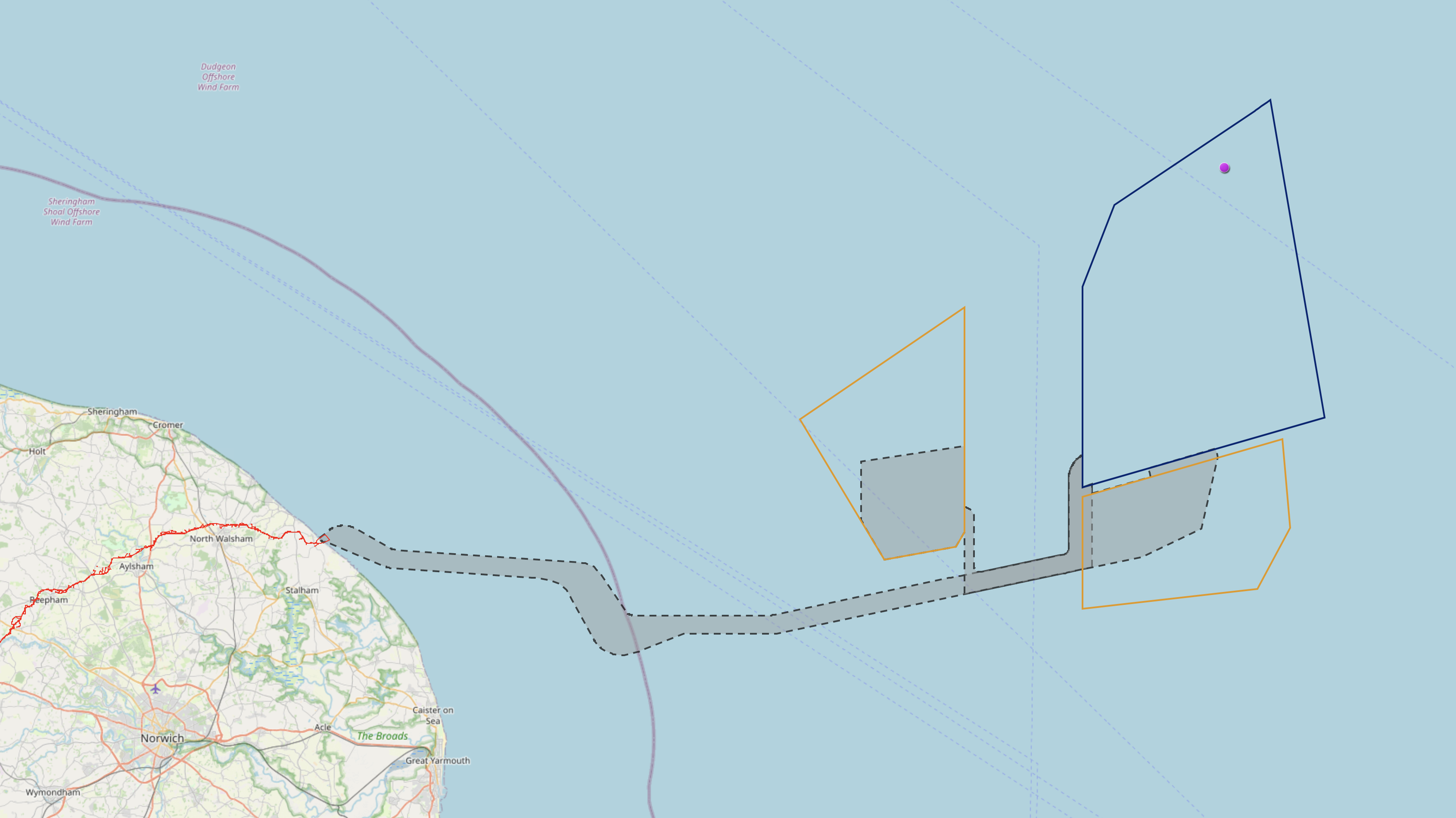
This map from Vattenfall web site, shows the position of the two wind farms.
Note.
- Norfolk Boreas is outlined in blue.
- Norfolk Vanguard is outlined in orange.
- I assume the grey areas are where the cables will be laid.
- I estimate that the two farms are about fifty miles offshore.
This second map shows the landfall between Eccles-on-Sea and Happisburgh.
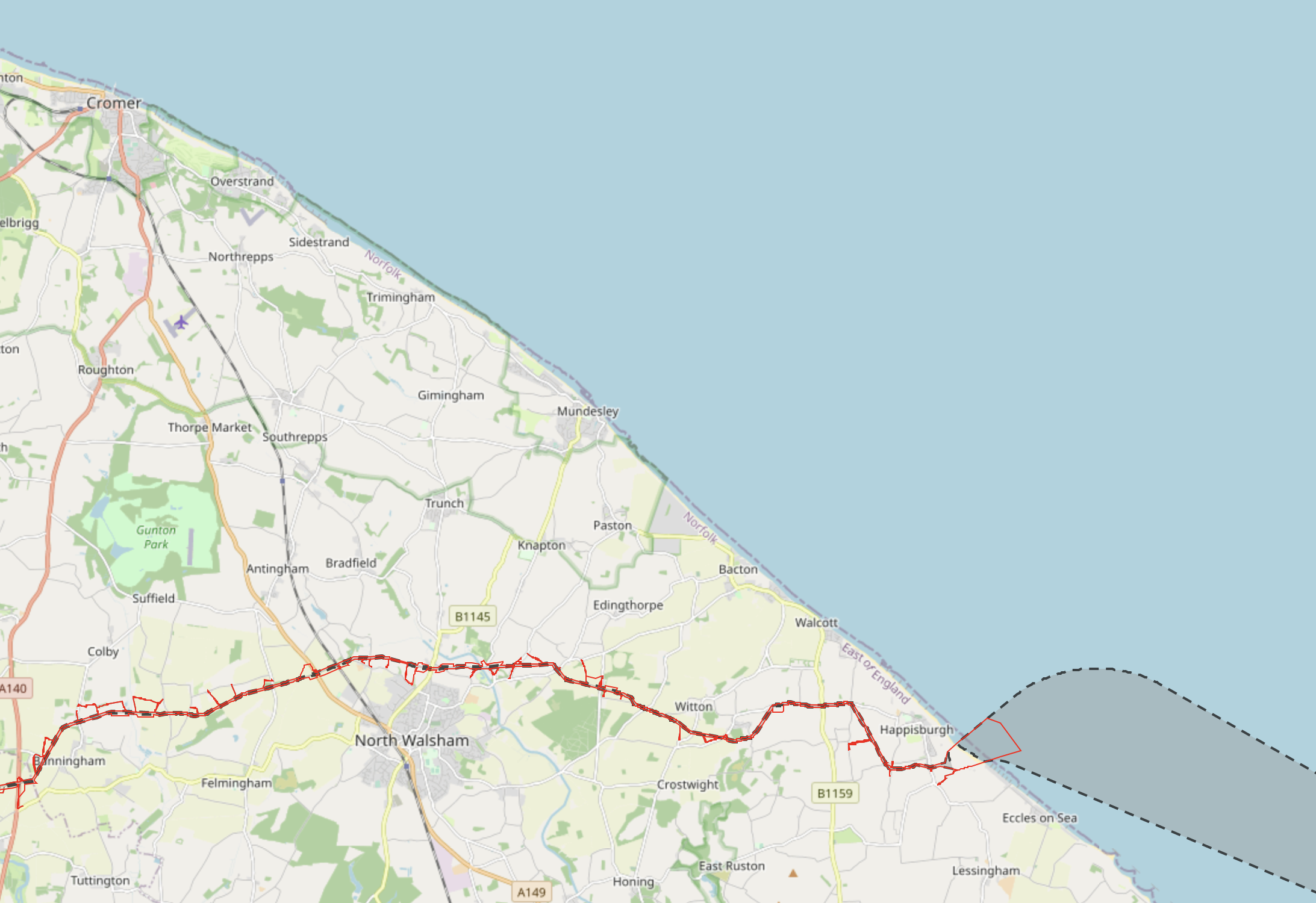
Note the underground cable goes half-way across Norfolk to Necton.
Electricity And Norfolk And Suffolk
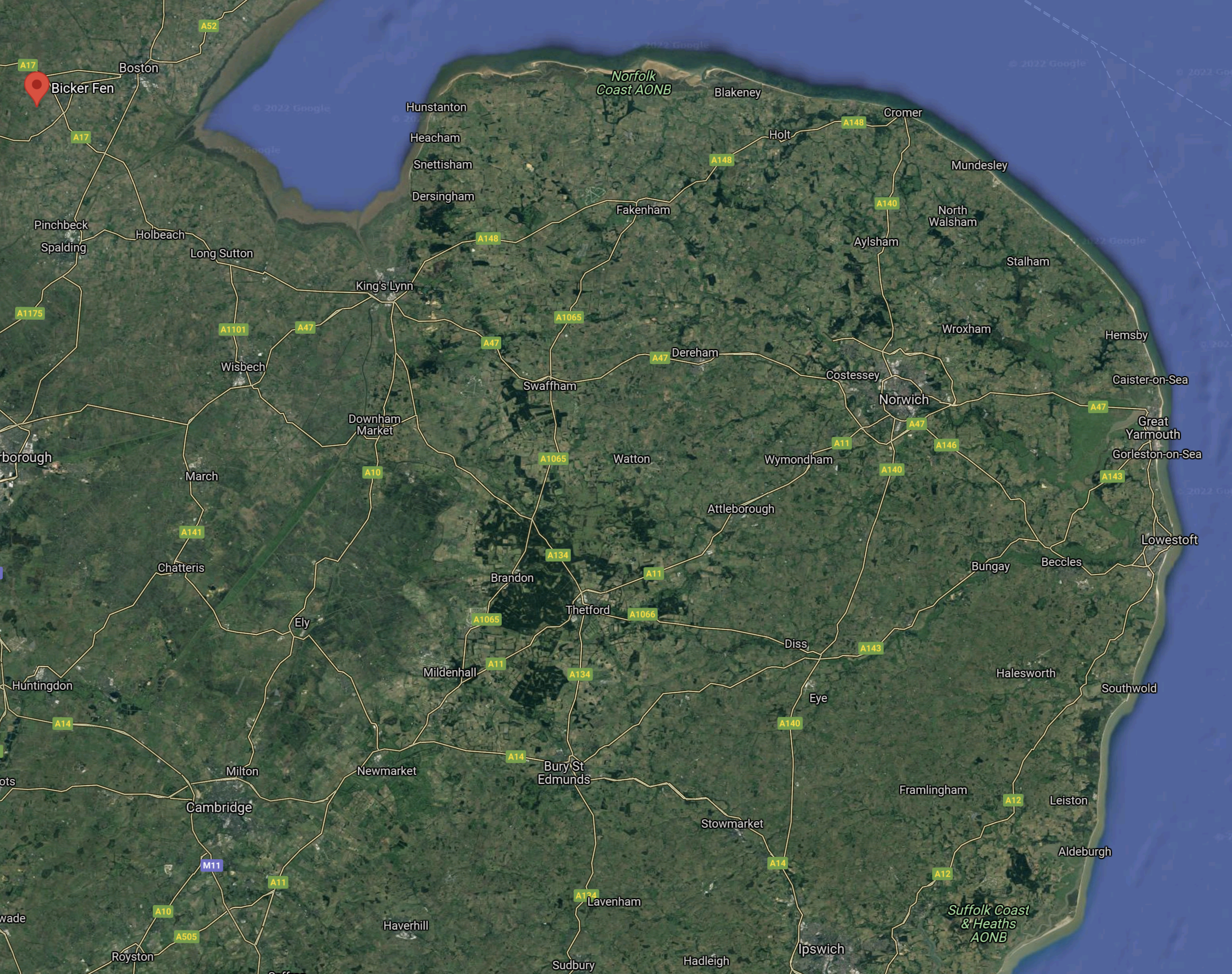
This Google Map shows Norfolk and Suffolk.
Note.
- The red arrow in the North-West corner marks the Bicker Fen substation that connects to the Viking Link to Denmark.
- The East Anglia Array connects to the grid at Bawdsey in the South-East corner of the map.
- Sizewell is South of Aldeburgh in the South-East corner of the map.
- The only ports are Lowestoft and Yarmouth in the East and Kings Lynn in the North-West.
There are few large towns or cities and little heavy industry.
- Electricity usage could be lower than the UK average.
- There are three small onshore wind farms in Norfolk and none in Suffolk.
- There is virtually no high ground suitable for pumped storage.
- There are lots of areas, where there are very few buildings to the square mile.
As I write this at around midday on a Saturday at the end of January, 49 % of electricity in Eastern England comes from wind, 20 % from nuclear and 8 % from solar. That last figure surprised me.
I believe that the wind developments I listed earlier could provide Norfolk and Suffolk with all the electricity they need.
The Use Of Batteries
Earlier, I talked of a maximum of over 7 GW of offshore wind around the cost of Norfolk and Suffolk, but there is still clear water in the sea to be filled between the existing and planned wind farms.
Batteries will become inevitable to smooth the gaps between the electricity produced and the electricity used.
Here are a few numbers.
- East Anglian Offshore Wind Capacity – 8 GW
- Off-Peak Hours – Midnight to 0700.
- Typical Capacity Factor Of A Windfarm – 20 % but improving.
- Overnight Electricity Produced at 20 % Capacity Factor – 11.2 GWh
- Sizewell B Output – 1.25 GW
- Proposed Sizewell C Output – 3.26 GW
- Largest Electrolyser – 24 MW
- World’s Largest Lithium-Ion Battery at Moss Landing – 3 GWh
- Storage at Electric Mountain – 9.1 GWh
- Storage at Cruachan Power Station – 7.1 GWh
Just putting these large numbers in a table tells me that some serious mathematical modelling will need to be performed to size the batteries that will probably be needed in East Anglia.
In the 1970s, I was involved in three calculations of a similar nature.
- In one, I sized the vessels for a proposed polypropylene plant for ICI.
- In another for ICI, I sized an effluent treatment system for a chemical plant, using an analogue computer.
- I also helped program an analysis of water resources in the South of England. So if you have a water shortage in your area caused by a wrong-sized reservoir, it could be my fault.
My rough estimate is that the East Anglian battery would need to be at least a few GWh and capable of supplying up to the output of Sizewell B.
It also doesn’t have to be a single battery. One solution would probably be to calculate what size battery is needed in the various towns and cities of East Anglia, to give everyone a stable and reliable power supply.
I could see a large battery built at Sizewell and smaller batteries all over Norfolk and Suffolk.
But why stop there? We probably need appropriately-sized batteries all over the UK, with very sophisticated control systems using artificial intelligent working out, where the electricity is best stored.
Note that in this post, by batteries, I’m using that in the loosest possible way. So the smaller ones could be lithium-ion and largest ones could be based on some of the more promising technologies that are under development.
- Highview Power have an order for a 50 MW/500 MWh battery for Chile, that I wrote about in The Power Of Solar With A Large Battery.
- East Anglia is an area, where digging deep holes is easy and some of Gravitricity’s ideas might suit.
- I also think that eventually someone will come up with a method of storing energy using sea cliffs.
All these developments don’t require large amounts of land.
East Anglia Needs More Heavy Consumers Of Electricity
I am certainly coming to this conclusion.
Probably, the biggest use of electricity in East Anglia is the Port of Felixstowe, which will be expanding as it becomes Freeport East in partnership with the Port of Harwich.
One other obvious use could be in large data centres.
But East Anglia has never been known for industries that use a lot of electricity, like aluminium smelting.
Conversion To Hydrogen
Although the largest current electrolyser is only 24 MW, the UK’s major electrolyser builder; ITM Power, is talking of a manufacturing capacity of 5 GW per year, so don’t rule out conversion of excess electricity into hydrogen.
Conclusion
Who needs Sizewell C?
Perhaps as a replacement for Sizewell B, but it would appear there is no pressing urgency.
Expansion Plan To Take World’s Biggest Battery Storage Project To 3GWh Capacity
The title of this post, is the same as that of this article on Energy Storage News.
These are the first two paragraphs.
Plans to nearly double the output and capacity of the world’s biggest battery energy storage system (BESS) project to date have been announced by its owner, Vistra Energy.
The Texas-headquartered integrated utility and power generation company said it wants to add another 350MW/1,400MWh BESS to the Moss Landing Energy Storage Facility in California’s Monterey Bay.
The project is based at the Moss Landing Power Plant, which was once the largest power plant in the state of California, with a generation capacity of 2560 MW.
There appear to be three phases.
- Phase 1 is 300MW/1,200MWh and went online at the end of 2020
- Phase 2 is 100MW/400MWh and went online in August 2021.
- Phase 3 will be 350MW/1,400MWh.
This gives a maximum power output of 750 MW and prospective total capacity of 3 GWh. At full power, the battery could supply 750 MW for four hours.
For comparison, the two Scottish batteries I talked about in Amp Wins Consent For 800MW Scots Battery Complex, have a combined output of 800 MW and a total capacity of 1600 MWh, which would give a full power run of two hours.
Could the difference be that Scotland has 9.3 GW of installed windpower, whereas the much larger California has only 6 GW?
Both Scotland and California also have some pumped storage power stations.
- Drax Group who own the 7.1 GWh Cruachan power station, plan to increase its generating capacity from 440MW to 1040MW.
- California has two larger stations at Castaic and Helms.
- After writing about the Western HVDC Link in Amp Wins Consent For 800MW Scots Battery Complex, I wonder if when the wind is blowing in Scotland and it isn’t in Wales, that electricity can be exported from Scotland to Wales for storage.
This all shows the complex integrated nature of electricity networks.
 The Anonymous Widower