Birth Of A Station
Thanet Parkway station is under construction and should be opened in May next year.
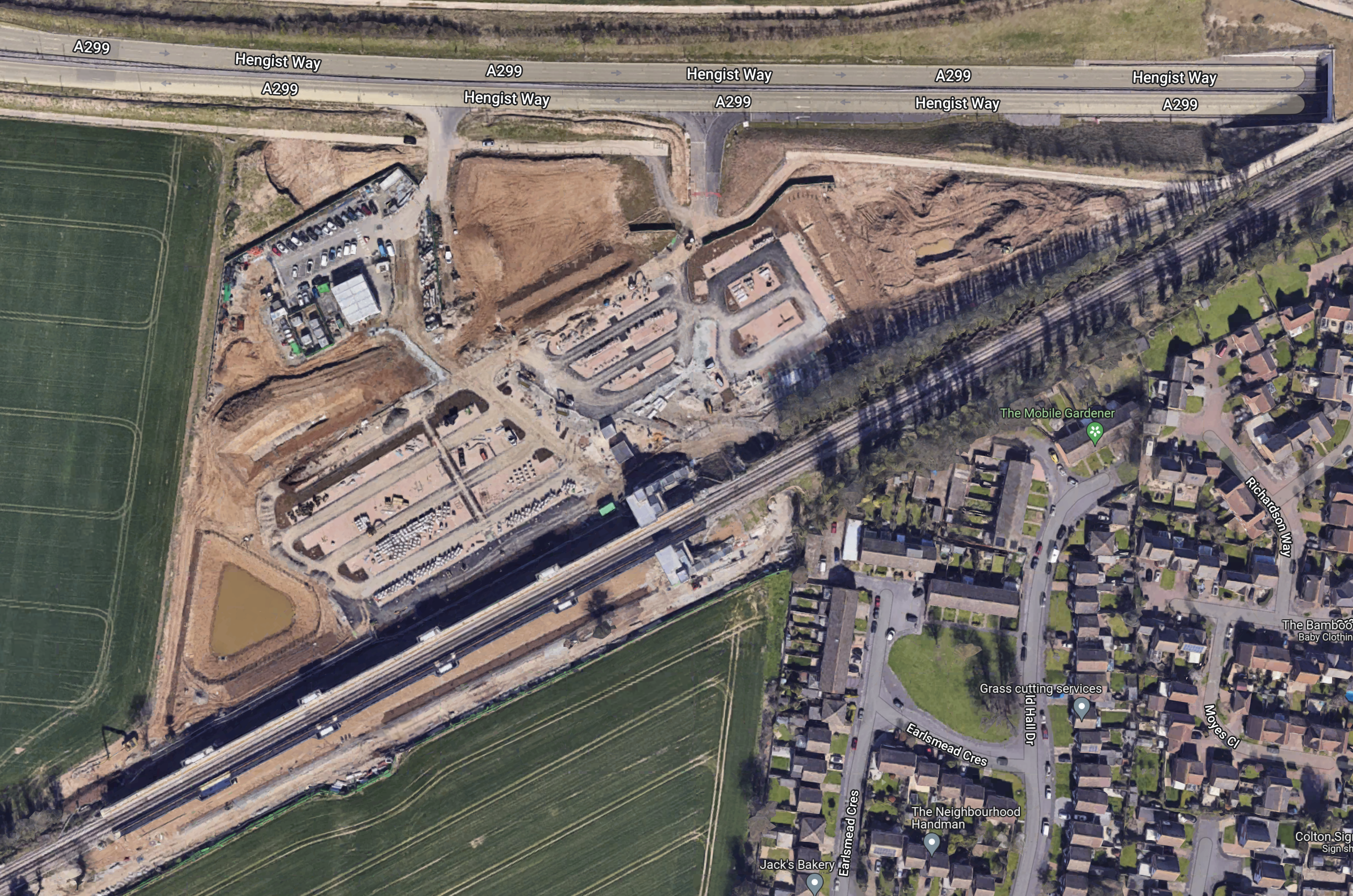
Work is progressing as this Google Map shows.
Note.
- The A299 goes across the top of the map.
- The Ashford – Canterbury – Ramsgate Line runs diagonally from South-West to North-East across the map.
- Ashford and Canterbury are to the South-West.
- Ramsgate is to the North-East.
The new Thanet Parkway station appears to be being built on the triangular site between the A299 and the railway.
- There appear to be two entrances/exits to the station from the A299.
- The pedestrian bridge over the railway is under construction.
- The roads and walkways around the station are being laid.
This video gives more details of the station.
Parking At Thanet Parkway
According to the video, there are nearly three hundred parking spaces, with a number of disabled spaces and spaces with charging for electric cars.
Is that going to be enough spaces?
But at least, there may be fields around the station, that could be used to provide additional parking.
Richborough Energy Park
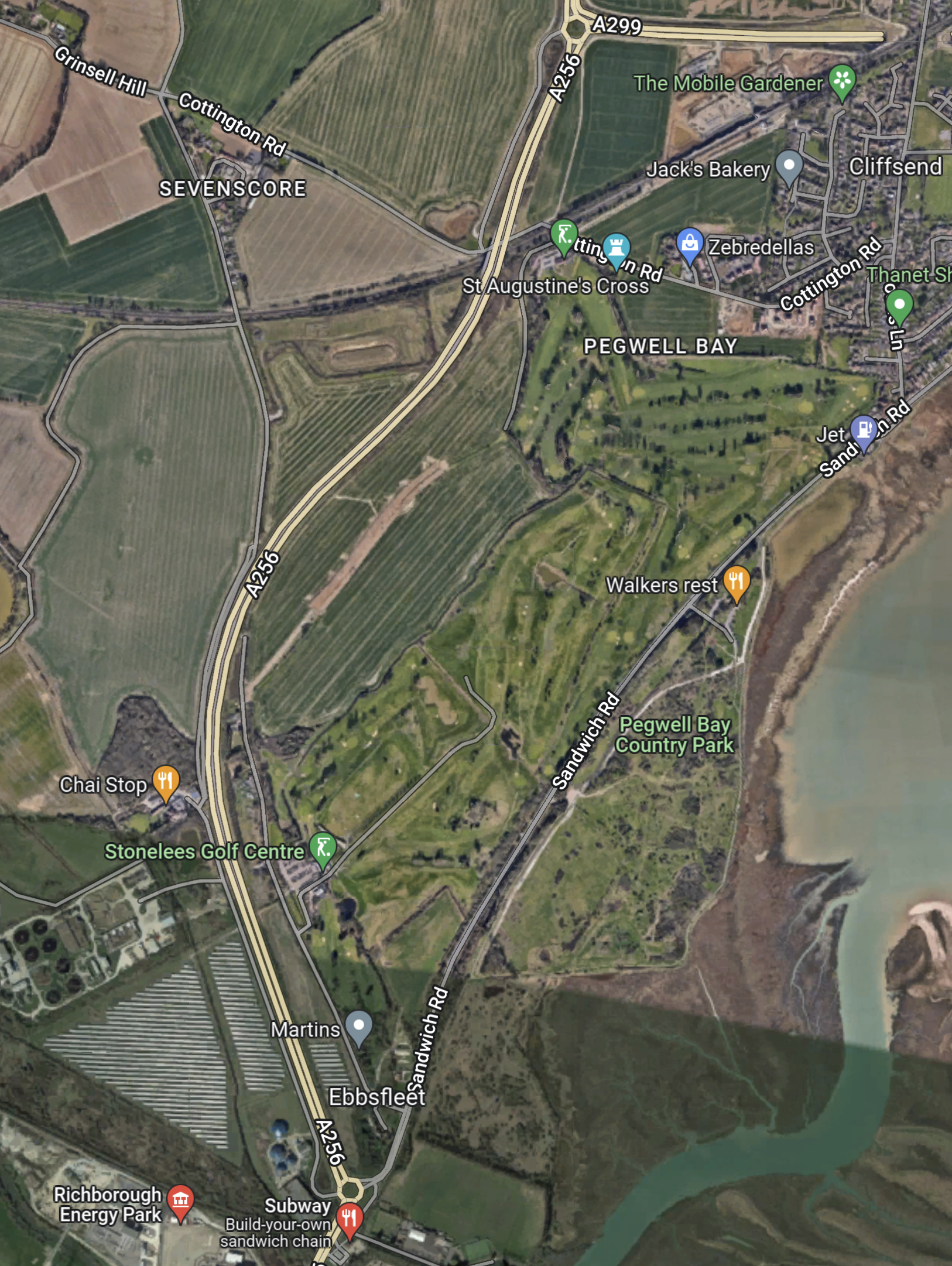
This Google Map shows the area around the station and to the South towards Richborough.
Note.
- The under-construction Thanet Parkway station is in the North-East corner of this map to the West of the village of Cliffsend.
- The dual-carriageway of the A256 runs North-South down the map to a roundabout.
- To the West of the roundabout is Richborough Energy Park.
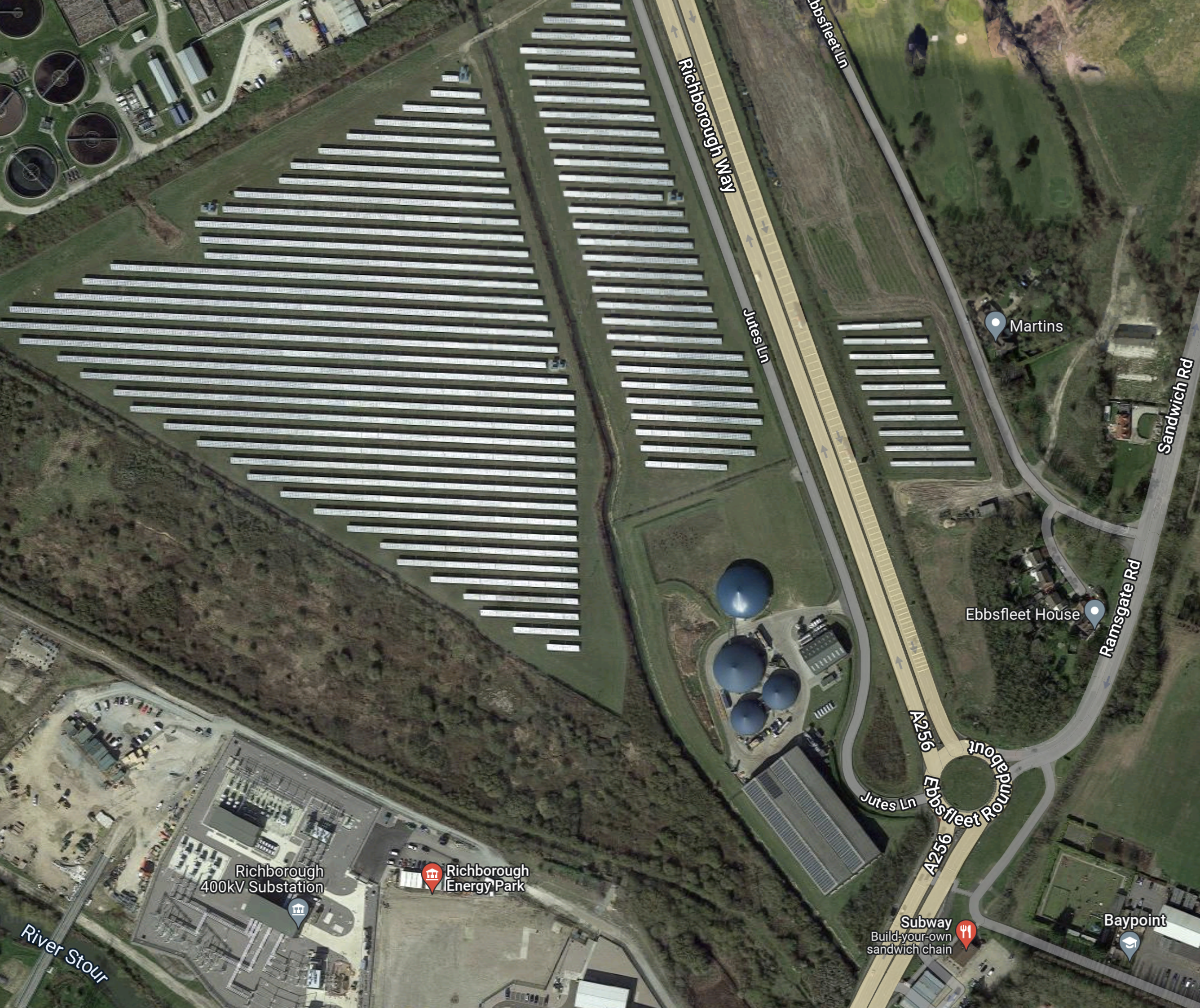
This Google Map shows the are round the energy park and the roundabout in more detail.
Note.
- The Richborough substation in the South-West corner of the map.
- The Richborough Energy Park sits to the East of the substation.
- The solar panels to the North of the roundabout are the 4.9 MW Ebbsfleet Solar Farm, which is part of Richborough Energy Park.
Richborough Energy Park is an ongoing project.
The national grid interconnector from the original power station is still in place, and is now the grid link for the 300 MW offshore Thanet Wind Farm.
It is the terminal for the NemoLink interconnector to Belgium.
Wikipedia says this about future plans.
The current owner of the site, BFL Management Ltd, plan to bring the site back into use as a £750 million green energy park. There are additional plans to create additional recycling and green energy facilities on site, including an anaerobic digester, a waste processing plant, a biomass combined heat and power generator, a pyrolysis plant and a peak demand 30MW diesel generator. When fully operational, the park could provide up to 1,400MW of power, employing 100 full-time equivalent, with up to 500 jobs in the construction phase.
I am surprised, that there is no mention of batteries or energy storage.
This press release from Network Rail is entitled Charge While You Travel With New Electric Vehicle Charging Points At Network Rail Stations.
This the body of the press release
Rail passengers with electric vehicles will be able to charge while they travel thanks to the introduction of 450 new electric vehicle charging points at Network Rail-managed car parks at railway stations.
The charging points, powered by guaranteed renewable energy, provide enough power to fully charge a vehicle in as little as 3-4 hours.
In this phase, Network Rail has powered: 160 charging points in Reading, 111 in Manchester, 84 in Edinburgh, 56 at Leeds and 41 in Welwyn Garden City.
Electric vehicle charging points will be installed across 10% of car parking spaces (approximately 779 spaces) at car parks managed by Network Rail by March 2024.
Rail is already the leading form of green public transport and this marks another milestone in Network Rail’s commitment to a low-emission railway – making sure rail is environmentally-friendly, resilient to climate change and able to provide an excellent service for years to come.
The new Compleo charging points are marked with green parking bays and passengers can pay for what they need quickly and easily via the APCOA Connect app.
Note, that there is no mention, if these are vehicle-to grid (V2G) chargers.
In Airport Plans World’s Biggest Car Parks For 50,000 Cars, I stated my belief that car parks, with hundreds or even thousands of vehicles could be turned into giant grid batteries.
- All electric vehicles, when they are parked would be plugged in to V2G chargers.
- The vehicle and the grid, would know your expected return time and how much power you would need. Probably from a parking app, assisted by AI!
- If the grid borrowed your electricity, whilst you were away, you wouldn’t know, until you received the payment for the loan.
- If your car runs on hydrogen, the parking could also handle the battery, that all hydrogen-powered vehicles have.
Thanet Parkway station would be an ideal station for such a parking system for electric vehicles.
Norfolk Boreas Offshore Windfarm Contract Awarded
The title of this post, is he same as that of this article on the BBC.
These are the introductory paragraphs.
A government contract has been awarded for the first phase one of the biggest offshore wind zones in the world.
The Norfolk Boreas is expected to secure renewable electricity to meet the needs of around 1.5 million homes, Swedish firm Vattenfall said.
Alongside the Norfolk Vanguard project, it is part of the Norfolk Offshore Wind Zone, which was approved in February.
Together, Norfolk Boreas and Norfolk Vanguard will probably produce over 3 GW of electricity.
Ørsted Awarded Contract For World’s Single Biggest Offshore Wind Farm
The title of this post, is the same as that of this press release from Ørsted.
This is the sub-title.
The UK Department for Business, Energy and Industrial Strategy (BEIS) has awarded Ørsted a contract for difference for its Hornsea 3 offshore wind farm. The project was awarded at an inflation-indexed strike price of GBP 37.35 per MWh in 2012 prices.
And this is the first paragraph, which describes the size of the farm.
With a capacity of 2,852 MW, Hornsea 3 will produce enough low-cost, clean, renewable electricity to power 3.2 million UK homes, making a significant contribution to the UK Government’s ambition of having 50 GW offshore wind in operation by 2030 as part of the British Energy Security Strategy.
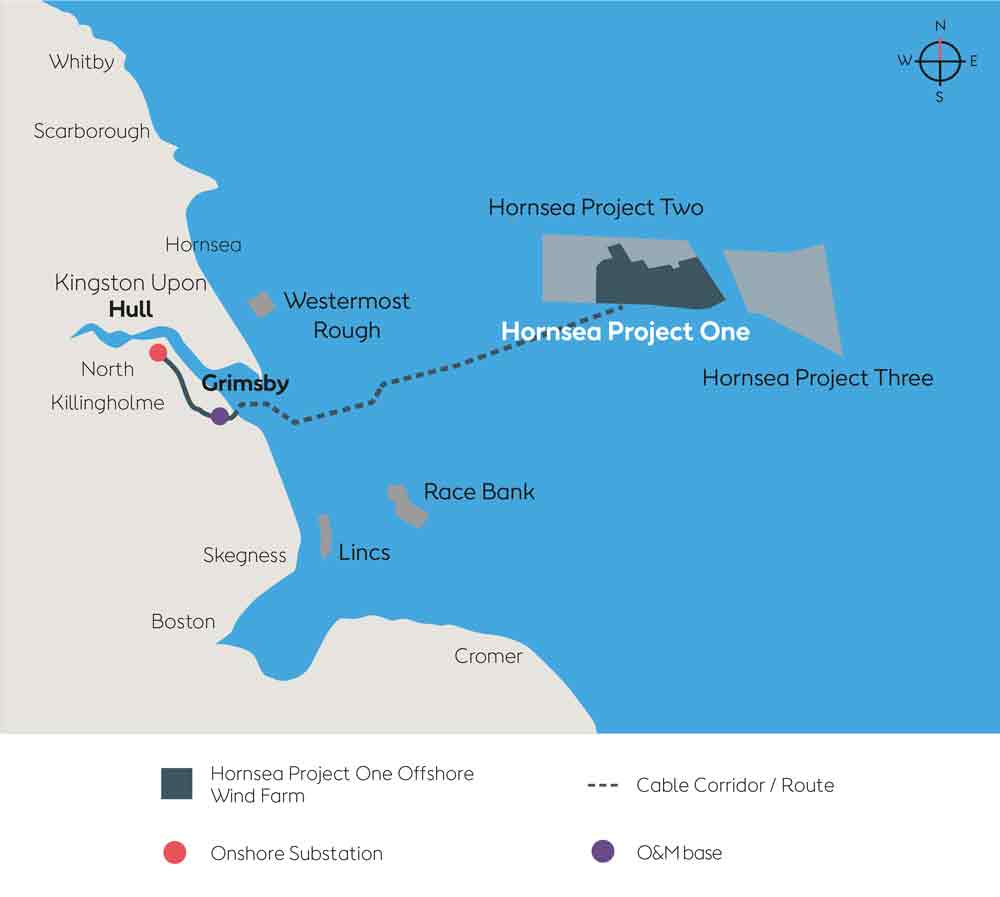
This map from Ørsted shows the location of the Hornsea wind farm and its three sections.
Note.
- The Hornsea Wind Farm, when fully developed, with a fourth section, is likely to have a capacity of around six GW.
- The Lincs, Race Bank and the Westernmost Rough wind farms are about another GW.
Looking at the map, I can see Humberside hosting the world’s largest hydrogen electrolyser to feed into the Humber Zero hydrogen network.
Shell To Start Building Europe’s Largest Renewable Hydrogen Plant
The title of this post, is the same as that of this press release from Shell.
This is the first paragraph.
Shell Nederland B.V. and Shell Overseas Investments B.V., subsidiaries of Shell plc, have taken the final investment decision to build Holland Hydrogen I, which will be Europe’s largest renewable hydrogen plant once operational in 2025.
Theconstruction timeline for Holland Hydrogen 1 is not a long one.
The next paragraph describes the size and hydrogen production capacity.
The 200MW electrolyser will be constructed on the Tweede Maasvlakte in the port of Rotterdam and will produce up to 60,000 kilograms of renewable hydrogen per day.
200 MW is large!
The next paragraph details the source of the power.
The renewable power for the electrolyser will come from the offshore wind farm Hollandse Kust (noord), which is partly owned by Shell.
These are my thoughts.
Refhyne
Refhyne is a joint project between Shell and ITM Power, with backing from the European Commission, that has created a 10 MW electrolyser in Cologne.
The 1300 tonnes of hydrogen produced by this plant will be integrated into refinery processes.
Refhyne seems to have been very much a prototype for Holland Hydrogen 1.
World’s Largest Green Hydrogen Project – With 100MW Electrolyser – Set To Be Built In Egypt
The sub-title is the title, of this article on Recharge.
It looks like Holland Hydrogen 1, is double the current largest plant under construction.
Shell is certainly going large!
Will ITM Power Be Working Again With Shell?
Refhyne has probably given Shell a large knowledge base about ITM Power’s electrolysers.
But Refhyne is only 10 MW and Holland Hydrogen 1 is twenty times that size.
This press release from ITM Power is entitled UK Government Award £9.3 m For Gigastack Testing.
This is the first paragraph.
ITM Power (AIM: ITM), the energy storage and clean fuel company, announces that the Company has been awarded a contract by The Department for Business, Energy and Industrial Strategy (BEIS), under its Net Zero Innovation Portfolio Low Carbon Hydrogen Supply 2 Competition, to accelerate the commercial deployment of ITM Power’s 5 MW Gigastack platform and its manufacture. The award for the Gigatest project is for £9.3m and follows initial designs developed through previous BEIS funding competitions.
Note.
- The Gigastack is 2.5 times bigger, than ITM Power’s previously largest electrolyser.
- Forty working in parallel, in much the same way that the ancient Egyptians built the pyramids, will be needed for Holland Hydrogen 1.
- ITM Power have the world’s largest electrolyser factory, with a capacity of one GW. They have plans to create a second factory.
ITM Power would probably be Shell’s low-risk choice.
My company dealt with Shell a lot in the 1970s, with respect to project management software and we felt, that if Shell liked you, they kept giving you orders.
The Hollandse Kust Noord Wind Farm
This wind farm is well described on its web site, where this is the introduction on the home page.
CrossWind, a joint-venture between Shell and Eneco, develops and will operate the Hollandse Kust Noord subsidy-free offshore wind project.
Hollandse Kust Noord is located 18.5 kilometers off the west coast of the Netherlands near the town of Egmond aan Zee.
CrossWind plans to have Hollandse Kust Noord operational in 2023 with an installed capacity of 759 MW, generating at least 3.3 TWh per year.
This Google Map shows the location of Egmond aan Zee.

Note that the red arrow points to Egmond aan Zee.
Will The Electrolyser Be Operational In 2025?
If Shell choose ITM Power to deliver the electrolysers, I don’t think Shell are being that ambitious.
I would suspect that connecting up an electrolyser is not the most complicated of construction tasks.
- Build the foundations.
- Fix the electrolyser in place.
- Connect power to one end.
- Connect gas pipes to the other.
- Switch on and test.
Note.
- If ITM Power deliver electrolysers that work, then the installation is the sort of task performed on chemical plants all over the world.
- ITM Power appear to have tapped the UK Government for money to fund thorough testing of the 5 MW Gigastack electrolyser.
- Enough wind power from Hollandse Kust Noord, should be generated by 2025.
I feel it is very much a low risk project.
Shell’s Offshore Electrolyser Feasibility Study
This is mentioned in this article in The Times, which describes Holland Hydrogen 1, where this is said.
Shell is also still involved in a feasibility study to deploy electrolysers offshore alongside the offshore wind farm. It has suggested this could enable more efficient use of cabling infrastructure.
I very much feel this is the way to go.
Postscript
I found this article on the Dutch Government web site, which is entitled Speech By Prime Minister Mark Rutte At An Event Announcing The Construction Of Holland Hydrogen 1.
This is an extract.
By building Holland Hydrogen 1, Shell will give the Dutch hydrogen market a real boost.
So congratulations are in order.
And this is only the beginning.
Because countless companies and knowledge institutions are working now to generate the hydrogen economy of tomorrow.
The government is supporting this process by investing in infrastructure, and by granting subsidies.
Because we want to achieve our climate goals, though the war in Ukraine won’t make it any easier.
We want to reduce our dependence on Russian gas.
We want the Netherlands to lead the way in the European energy transition.
And all these ambitions are combined in the Holland Hydrogen 1 project.
Mark Rutte seems to believe in hydrogen.
Conclusion
This is a very good example of the sort of large electrolyser, we’ll be seeing all over the world.
In fact, if this one works well, how many 200 MW electrolysers will Shell need all over the world?
Will they all be identical?
SSE Thermal And Equinor To Acquire Triton Power In Acceleration Of Low-Carbon Ambitions
The title of this post, is the same as that as this press release from SSE.
These are the first three paragraphs.
SSE Thermal and Equinor have entered into an agreement to acquire Triton Power Holdings Ltd from Energy Capital Partners for a total consideration of £341m shared equally between the partners.
The transaction represents another step forward for the two companies’ existing collaboration, supporting the long-term decarbonisation of the UK’s power system whilst contributing to security of supply and grid stability through flexible power generation in the shorter term.
Triton Power operates Saltend Power Station which is 1.2GW CCGT (Combined Cycle Gas Turbine) and CHP (Combined Heat & Power) power station located on the north of the Humber Estuary in East Yorkshire.
This deal is more complicated than it looks and these are my thoughts.
What About The Triton Power Workers?
The press release says this.
The 82 existing employees will continue to be employed by Triton Power. In line with just transition principles, the joint venture is committed to transitioning the assets for the net zero world through responsible ownership and operation, and in consultation with the local workforce and representatives.
It does sound that they are following the right principles.
Saltend Power Station
Saltend power station is no tired ancient asset and is described like this in Wikipedia.
The station is run on gas using single shaft 3 × Mitsubishi 701F gas Turbines machines with Alstom 400 MWe generators. The station has a total output of 1,200 MW; of that 100 MW is allocated to supply BP Chemicals. Each gas turbine has a Babcock Borsig Power (BBP) heat recovery steam generator, which all lead to one steam turbine per unit (single shaft machine means Gas turbine and Steam Turbine are on the same shaft). The waste product of electricity generation is steam at the rate of about 120 tonnes/h which is sold to BP Chemicals to use in their process. This makes Salt End one of the most efficient[clarification needed] power stations in the UK. The plant is scheduled to use hydrogen from steam reformed natural gas for 30% of its power.
Note.
- It was commissioned in 2000.
- It appears there are seven CCGT power stations in England that are larger than Saltend.
- The power station seems to have had at least four owners.
The press release says this about SSE and Equinor’s plans for Saltend power station.
The transaction underscores SSE Thermal and Equinor’s shared ambition to decarbonise the Humber, which is the UK’s most carbon-intensive industrial region, as well as the UK more widely. Initial steps to decarbonise Saltend Power Station are already underway, targeting partial abatement by 2027 through blending up to 30% of low-carbon hydrogen. In addition, carbon capture provides an additional valuable option for the site. SSE Thermal and Equinor will continue to work towards 100% abatement.
Note.
- It appears that initially, Saltend power station will move to running on a mixture of 30 % hydrogen and 70 % natural gas.
- Carbon capture will also be applied.
- It looks like that in the future all carbon-dioxide emitted by the power station will be captured and either stored or used.
The press release says this about the source of the hydrogen.
Saltend Power Station is a potential primary offtaker to Equinor’s H2H Saltend hydrogen production project. H2H Saltend is expected to kick-start the wider decarbonisation of the Humber region as part of the East Coast Cluster, one of the UK’s first carbon capture, usage and storage clusters.
H2H Saltend is described in this page on the Equinor web site, which has a title of The First Step To A Zero Carbon Humber, where this is said.
This project represents a bold but practical first step towards delivering the world’s first net zero industrial cluster by 2040. This unparalleled project can play a leading role in the UK’s journey to net zero by 2050, renew the UK’s largest industrial cluster, and unlock technology that will put the UK at the forefront of a global hydrogen economy.
There is also a video.
SSE Thermal And Equinor Low-Carbon Thermal Partnership
This is a section in the press release, where after giving their policy about the workers, it says this about the acquisition of Triton Power.
This acquisition strengthens SSE Thermal and Equinor’s portfolio of joint projects, which bring together expertise in power, natural gas, hydrogen and carbon capture and storage. This portfolio includes three development projects within the Humber region:
- Keadby 3 Carbon Capture Power Station, which could be the UK’s first flexible power station equipped with carbon capture.
- Keadby Hydrogen Power Station, which could be one of the world’s first 100% hydrogen-fuelled power stations.
- Aldbrough Hydrogen Storage, located in East Yorkshire, which could be one of the world’s largest hydrogen storage facilities.
The two companies are also developing Peterhead Carbon Capture Power Station, situated on the Aberdeenshire coast in Scotland and there are further opportunities for hydrogen blending across SSE’s generation portfolio, including at Keadby 2.
Note.
- There is no mention of the three Dogger Bank Wind Farms, each of which will be 1200 MW, that are owned by SSE Renewables and Equinor.
- I wrote about Aldbrough Gas Storage in The Massive Hydrogen Project, That Appears To Be Under The Radar.
- According to this press release from Equinor, which is entitled SSE Thermal And Equinor Join Forces On Plans For First-Of-A-Kind Hydrogen And Carbon Capture Projects In The Humber, Keadby Hydrogen power station will have a capacity of 1800 MW.
The Complete System
The system has the following power sources.
- Dogger Bank A – 1200 MW – Expected commissioning in 2023/24
- Dogger Bank B – 1200 MW – Expected commissioning in 2024/25
- Dogger Bank C – 1200 MW – Expected commissioning in 2024/25
- Keadby power station – 735 MW
- Keadby 2 power station – 893 MW – Could be Part-Hydrogen
- Keadby 3 power station – 910 MW – Carbon Capture
- Keadby Hydrogen power station – 1800 MW – Hydrogen
- Saltend power station – 1200 MW – Part-Hydrogen
That totals up to 9138 MW.
Fuel will come from three sources.
- The God of the winds.
- Natural gas
- Hydrogen
Hydrogen will be sourced from.
- Blue hydrogen from H2H Saltend
- Green Hydrogen could come from electrolysers driven by wind power.
Hydrogen would be stored in Aldbrough Gas Storage.
I am by training a Control Engineer and controlling these power sources is either a wonderful dream or your most entwined and complicated nightmare.
Conclusion
I suspect on an average day, this cluster of power stations and sources could reliably supply as much zero-carbon power as two large nuclear stations.
Could Rolls-Royce SMRs Be The Solution To Europe’s Gas Shortage?
Of all the offshore wind farms, that I’ve looked at recently, I find Magnora’s ScotWind N3 wind farm the most interesting.
I wrote about it in ScotWind N3 Offshore Wind Farm.
I said this.
In any design competition, there is usually at least one design, that is not look like any of the others.
In the successful bids for the ScotWind leases, the bid from Magnora ASA stands out.
- The company has an unusual home page on its offshore wind web site.
- This page on their web site outlines their project.
- It will be technology agnostic, with 15MW turbines and a total capacity of 500MW
- It will use floating offshore wind with a concrete floater
- It is estimated, that it will have a capacity factor of 56 %.
- The water depth will be an astonishing 106-125m
- The construction and operation will use local facilities at Stornoway and Kishorn Ports.
- The floater will have local and Scottish content.
- The project will use UK operated vessels.
- Hydrogen is mentioned.
- Consent is planned for 2026, with construction starting in 2028 and completion in 2030.
This project could serve as a model for wind farms all round the world with a 500 MW power station, hydrogen production and local involvement and construction.
I very much like the idea of a concrete floater, which contains a huge electrolyser and gas storage, that is surrounded by an armada of giant floating wind turbines.
These are my thoughts.
Floating Concrete Structures
To many, they may have appear to have all the buoyancy of a lead balloon, but semi-submersible platforms made from concrete have been used in the oil and gas industry for several decades.
Kishorn Yard in Scotland was used to build the 600,000-tonne concrete Ninian Central Platform,in 1978. The Ninian Central Platform still holds the record as the largest movable object ever created by man.
The Ninian Central Platform sits on the sea floor, but there is no reason why a semi-submersible structure can’t be used.
Electrolysers
There is no reason, why a large electrolyser, such as those made by Cummins, ITM Power or others can’t be used, but others are on the way.
- Bloom Energy are working on high temperature electrolysis, which promises to be more efficient.
- Torvex Energy are developing electrolysis technology that used sea water, rather than more expensive purified water.
High Temperature Electrolysis
High temperature electrolysis needs a heat source to work efficiently and in Westinghouse And Bloom Energy To Team Up For Pink Hydrogen, I described how Bloom Energy propose to use steam from a large nuclear power station.
Offshore Nuclear Power
I’ve never heard of offshore nuclear power, but it is not a new idea.
In 1970, a company called Offshore Power Systems was created and it is introduced in its Wikipedia entry like this.
Offshore Power Systems (OPS) was a 1970 joint venture between Westinghouse Electric Company, which constructed nuclear generating plants, and Newport News Shipbuilding and Drydock, which had recently merged with Tenneco, to create floating nuclear power plants at Jacksonville, Florida.
Westinghouse’s reactor was a 1.150 MW unit, which was typical of the time, and is very similar in size to Sizewell B.
The project was cancelled before the reactors were towed into position.
Nuclear Knowledge Has Improved
Consider.
- In the fifty years since Offshore Power Systems dabbed their toes in the water of offshore nuclear power, our knowledge of nuclear systems and engineering has improved greatly.
- The offshore oil and gas industry has also shown what works impeccably.
- The floating offshore wind industry looks like it might push the envelop further.
- There has been only one nuclear accident at Fukushima, where the sea was part of the problem and that disaster taught us a lot.
- There have been a large number of nuclear submarines built and most reached the planned end of their lives.
- Would a small modular nuclear reactor, be safer than a large nuclear power plant of several GW?
I would suggest we now have the knowledge to safely build and operate a nuclear reactor on a proven semi-submersible platform, built from non-rusting concrete.
An Offshore Wind Farm/Small Modular Reactor Combination Producing Hydrogen
Consider.
- A typical floating offshore wind farm is between one and two gigawatts.
- A Rolls-Royce small modular reactor is sized to produce nearly 0.5 GW.
- The high temperature electrolyser will need some heat to achieve an optimum working temperature.
- Spare electricity can be used to produce hydrogen.
- Hydrogen can be stored platform.
- Hydrogen can be sent ashore using existing gas pipes.
- Hydrogen could even be blended with natural gas produced offshore to create a lower-carbon fuel.
- It would also be possible to decarbonise nearby offshore infrastructure.
A balance between wind and nuclear power can be obtained, which would provide a steady output of energy.
Conclusion
There are a large numbers of possibilities, to locate a Rolls-Royce small modular reactor close to a wind farm to use high temperature electrolysis to create green hydrogen, which can be used in the UK or exported through the gas network.
Wind And Solar Boom Will Bring Energy Surplus
The title of this post, is the same as that of this article on The Times.
Under the picture, is this sub-title.
The government has set a target of 50 gigawatts of offshore wind farms by 2030, up from about 10 gigawatts at present.
According to this Wikipedia list of offshore wind farms, the UK currently has 2180 offshore turbines with a capacity of 8113 MW.
These wind farms appear to be planned.
Hornsea
The Hornsea wind farm is currently supplying 1.2 GW to the grid, but it is planned to be expanded to 6 GW, which is another 4.8 GW.
East Anglia Array
The East Anglia Array is currently supplying 0.7 GW to the grid, but it is planned to be expanded to 7.2 GW, which is another 6.5 GW.
Sofia
The Sofia wind farm will supply 1.4 GW from 2026.
Moray East
The Moray East wind farm will supply 0.95 GW from 2022.
Neart Na Gaoithe
The Neart Na Gaoithe wind farm will supply 0.45 GW from 2023.
Triton Knoll
The Triton Knoll wind farm will supply 0.86 GW from 2022.
Seagreen
The Seagreen wind farm will supply 1.1 GW from 2023.
Dogger Bank
The Dogger Bank wind farm will supply 3.6 GW from 2025.
Moray West
The Moray West wind farm will supply 1.2 GW from 2025.
Rampion 2
The Rampion 2 wind farm will supply 1.2 GW before 2030.
Norfolk Boreas
The Norfolk Boreas wind farm will supply 1.8 GW before 2030
Norfolk Vanguard
The Norfolk Vanguard wind farm will supply 1.8 GW before 2030
These wind farms total up to 31.1 GW
Morgan And Mona
The Morgan and Mona wind farms will supply 3 GW from 2028.
ScotWind
This map shows the wind farms in the latest round of leasing in Scotland.

These wind farms should be providing 24.8 GW by 2030.
Celtic Sea
In Two More Floating Wind Projects In The Celtic Sea, I give details of six wind farms to be developed in the Celtic Sea, that will produce a total of 1.2 GW.
All should be delivered by 2030.
Northern Horizons
In Is This The World’s Most Ambitious Green Energy Solution?, I talk about Northern Horizons, which will produce 10 GW of wind energy from 2030.
An Armada Of Wind Farms
As many of these wind farms will be floating and wind-powered, the collective noun must surely be an armada.
These are some figures.
- The size is certainly spectacular at 70.1 GW.
- As the UK electricity consumption in 2020-2021 was 265.4 TWh, the average hourly production throughout the year is 30.3 GW.
- As I write this post, the UK is generating 30.1 GW.
As the best offshore wind farms have a capacity factor of around fifty percent, we should be able to power the UK with wind power alone.
So when The Times says this in the first two paragraphs of the article.
Britain will have excess electricity supplies for more than half of the year by 2030 as a huge expansion of wind and solar power transforms the energy system, a new analysis suggests.
Energy storage technologies, including batteries and electrolysers to make hydrogen, will need to be deployed at massive scale to prevent this surplus electricity going to waste, according to LCP, a consultancy.
The article would appear to correct.
The Need For Energy Storage
If we look at energy production at the current time, energy production is as follows.
- Biomass – 0.5 GW
- Gas – 17 GW
- Nuclear – 5 GW
- Onshore Wind – 12 GW with 20 % capacity factor – 2.4 GW
- Offshore Wind – 8.1 GW with 30 % capacity factor – 2.4 GW
- Interconnects – 0.4 GW
- Others – 0.5 GW
This totals up to 28.2 GW.
In 2030, energy production could be as follows.
- Biomass – 0.5 GW
- Nuclear – 5 GW
- Onshore Wind – 12 GW with 20 % capacity factor – 2.4 GW
- Offshore Wind – 30 GW with 30 % capacity factor – 9 GW
- Floating Offshore Wind – 40 GW with 50 % capacity factor – 20 GW
- Others – 0.5 GW
This totals up to 37.4 GW.
So if you take a typical day, where on average throughout the day we are producing around 7 GW more of electricity than we need, we will actually produce around 7 * 24 GWh = 168 GWh of excess electricity
Whichever was you look at it, we have got to do something concrete with a large amount of electricity.
- Store it in batteries of various types from lithium ion, through new types of batteries like those being developed by Highview Power and Gravitricity to pumped hydro storage.
- Store the energy in the batteries of electric cars, vans, buses, trucks, trains and ships.
- Store the energy in Norwegian pumped hydro storage.
- Convert it to hydrogen using an electrolyser and blend the hydrogen with the natural gas supply.
- Convert it to hydrogen using an electrolyser and use the hydrogen to make zero-carbon steel, concrete and chemicals.
- Convert it to hydrogen using an electrolyser and develop new zero-carbon industries.
- Convert it to hydrogen using an electrolyser and store the hydrogen in a depleted gas field.
- Sell it to Europe, either as electricity or hydrogen.
Note.
- We are going to have to build a lot of batteries and I suspect they will be distributed all round the country.
- We are going to have to build a lot of hydrogen electrolysers.
- We have world class battery and electrolyser companies.
We should also fund the following.
- Developments of technology, that makes better batteries, electrolysers, boilers and heat pumps.
- I would also do a lot of work to increase the capacity factor of wind farms.
I also believe that if we have masses of electricity and hydrogen, we might find as a country, it’s very beneficial in terms of jobs, exports and a healthier economy to invest in certain industries.
Conclusion
The future is rosy.
DP Energy And Offshore Wind Farms In Ireland
DP Energy are a company that are developing these offshore wind farms in Ireland.
Located off the West Coast of Ireland, the Clarus Offshore Wind Farm project will utilise Floating Offshore Wind (FOW) technology and upon completion, will have the potential capacity of up to 1 GW.
Located off the South Coast of Ireland, the Inis Ealga Marine Energy Park project will utilise Floating Offshore Wind (FOW) technology and upon completion, will have the potential capacity of up to 1 GW.
Latitude 52 Offshore Wind Farm
DP Energy has given the name Latitude 52 to the area it is exploring for a potential future offshore wind farm off the coast of Counties Wicklow and Wexford.
It appears to be another 1 GW project.
Located off the East Coast of Ireland, the Shelmalere Offshore Windfarm project will utilise fixed bottom wind turbines and upon completion, will have the potential capacity of up to 1 GW.
Note.
- These wind farms are being developed in a partnership with Spanish Energy company; Iberdrola.
- Each is a one GW offshore wind farm.
They are also developing the Gwynt Glas offshore wind farm in the UK sector of the Celtic Sea.
- In January 2022, EDF Renewables and DP Energy announced a Joint Venture partnership to combine their knowledge and
expertise, in order to participate in the leasing round to secure seabed rights to develop up to 1GW of FLOW in the Celtic Sea. - The wind farm is located between Pembroke and Cornwall.
The addition of Gwynt Glas will increase the total of floating offshore wind in the UK section of the Celtic Sea.
- Blue Gem Wind – Erebus – 100 MW Demonstration project – 27 miles offshore
- Blue Gem Wind – Valorus – 300 MW Early-Commercial project – 31 miles offshore
- Falck Renewables and BlueFloat Energy – Petroc – 300 MW project – 37 miles offshore
- Falck Renewables and BlueFloat Energy – Llywelyn – 300 MW project – 40 miles offshore
- Llŷr Wind – 100 MW Project – 25 miles offshore
- Llŷr Wind – 100 MW Project – 25 miles offshore
- Gwynt Glas – 1000 MW Project – 50 miles offshore
This makes a total of 2.2 GW, with investors from several countries.
It does seem that the Celtic Sea is becoming the next area of offshore wind around the British Isles to be developed.
Interconnectors
Interconnectors are to be built to connect Ireland, UK and France.
The Celtic Interconnector is being built between County Cork in Ireland and the North West Coast of France.
Greenlink is being built between County Wexford in Ireland and Pembroke in Wales.
Conclusion
Are the British, Irish and French governments, planning to build a large wind power resource in the Celtic Sea?
A Massive Task For Ukraine?
After the Russians are thrown out of Ukraine, it will be a massive task to rebuild Ukraine.
But one of Ukraine’s traditional industries can also be used to transform the world.
The Transformation Of Energy Production To Floating Offshore Wind
I believe that over the next few years, we will see an enormous transformation of zero-carbon energy to floating offshore wind.
- The floating offshore wind industry is planning to use the next-generation of larger wind turbines of up to 20 MW.
- These turbines are too large and intrusive to install onshore.
- Floating wind turbines generally have a higher capacity factor of over 50 %, than onshore turbines.
- Each wind turbine will be mounted on a substantial semi-submersible float, which is built out of large-diameter steel tubes
- The wind turbines are of the same design, as those installed onshore.
- There are several designs for the floats and they are usually based on designs that have worked in the oil and gas industry.
The world will need millions of floating turbines and an equivalent number of floats to fully decarbonise.
Could The Ukrainians Build The Floats?
Consider.
- The Russians have destroyed Mariupol, whilst the Ukrainians have defended the city in the steelworks.
- Mariupol used to have a large shipbuilding industry.
- Ukraine is in the world’s top ten of iron ore producers.
- There is a lot of scrap steel available in the Ukraine, that the Russians have left behind.
- The Ukrainians probably have a lot of workers, who have the skills to build the floats.
I’m sure something could be arranged for the benefit of everybody.
Highview Chief Rupert Pearce On The Cold Batteries That Could Save The Planet
The title of this post, is the same as that of this article on The Sunday Times.
It is an article very much worth a read, as it talks about former Inmarsat boss; Rupert Pearce and his new position as boss at Highview Power.
I have followed Highview Power for a few years.
I first wrote about the company in British Start-Up Beats World To Holy Grail Of Cheap Energy Storage For Wind And Solar, after reading about the company in the Daily Telegraph in August 2019.
They seem to have had good press in the last three years and have generated a steady stream of orders from Spain, Chile and Scotland.
But progress seems to have been slow to get the first full-size system at Carrington completed.
It does seem , that Rupert Pearce could be the professional boss they need?
Highview Power ‘s CRYOBatteries certainly have potential.
Highview Power CRYOBatteries Compared To Lithium-Ion Batteries
Highview Power ‘s CRYOBatteries do not use any exotic metals or materials, that are not readily available, whereas lithium-ion batteries use lots of rare metals and electricity in their manufacture.
CRYOBatteries can also be expanded in capacity by just adding more liquid-air tanks.
Highview Power CRYOBatteries Typically Cost £500 Million
This figure is disclosed in the Sunday Times article.
For that you probably get a power station, with these characteristics.
- 50 MW Output.
- Five to eight hour storage.
- No emissions.
- Well-understood maintenance.
- An environmentally-friendly plant.
- Long battery life.
But my experience tells me, that like large lithium-ion batteries used for grid storage, that CRYOBatteries could be an asset that will appeal to large financial companies.
- At present, Highview Power have not run a 50 MW CRYOBattery, but once they show high reliability, I can envisage the energy storage funds taking a good look.
- At £500 million a throw, they are a good size with probably a decent return for insurance companies and pension funds.
See World’s Largest Wind Farm Attracts Huge Backing From Insurance Giant for Aviva’s view on investing in massive green infrastructure.
I very much feel, that with his City connections and experience, that Rupert Pearce might be the right person to arrange financing for CRYOBatteries.
I will add a story from the financing of Artemis, which was the project management system, that I wrote in the 1970s.
Normally we leased or rented the systems, but some companies wanted to buy them outright, so we came up with a price of something like £125,000. Our bank were happy to fund these systems, when the purchaser was someone like BP, Shell, Bechtel, Brown & Root or British Aerospace. Later on, the bank would package together several systems and get us a better deal.
Intriguingly, £125,000 in the late 1970s is about half a billion now. I suspect, I’m being naive to suggest that Highview’s problem of funding multiple sales is similar to the one we had fifty years ago.
Highview Power CRYOBatteries And Wind And Solar Farms
I discussed the use of CRYOBatteries with solar power in The Power Of Solar With A Large Battery.
As the Highview Power press release, on which I based the article has now been deleted, I would assume that that project has fallen through. But the principles still apply!
But surely, a wind farm paired with an appropriately-sized CRYOBattery would ensure a steady supply of power?
Could CRYOBatteries Be Used With Floating Offshore Wind Farms?
In ScotWind N3 Offshore Wind Farm, I described an unusual wind farm proposed by Magnora ASA.
- This page on their web site outlines their project.
- It will be technology agnostic, with 15MW turbines and a total capacity of 500MW
- It will use floating offshore wind with a concrete floater
- It is estimated, that it will have a capacity factor of 56 %.
- The water depth will be an astonishing 106-125m
- The construction and operation will use local facilities at Stornoway and Kishorn Ports.
- The floater will have local and Scottish content.
The floater will be key to the whole wind farm.
- It will certainly have an offshore substation to connect the wind turbines to the cable to the shore.
- Magnora may be proposing to add a hydrogen electrolyser.
- Tanks within the concrete floater can be used to store gases.
I wonder if CRYOBatteries could be installed on the concrete floaters, that would be used to smooth the electrical output of the wind farm?
Note that in the past, concrete semi-submersible concrete structures have been used to host all kinds of gas and oil processing equipment.
Conclusion
I feel that Highview Power have made a good choice of Chief Executive and I have high hopes he can awaken a company with masses of potential.

