East-West Rail: Route For £5bn Bedford To Cambridge Link Announced
The title of this post, is the same as that of this article on the BBC.
This is the sub-heading.
The preferred route of part of £5bn railway line connecting Oxford and Cambridge has been announced.
The first two paragraphs summarise the route.
The East-West Rail (EWR) project confirmed details of the section between Bedford and Cambridge.
It will include new stations at Tempsford and Cambourne, and enter Cambridge via the south of the city.
This map from East West Rail shows the route.

Note.
- The proposed route is shown in blue.
- The possible Southern extension to Aylesbury is shown dotted.
- The Wikipedia entry for East West Rail has conflicting information, as to when trains can run between Bicester and Bedford.
These related posts describe and discuss various parts and issues of the route.
East-West Rail: Along The Marston Vale Line
East-West Rail: Aylesbury Spur
East-West Rail: Electrification
East-West Rail: Oxford And Bedford
East-West Rail: Through Bedford
We’re Increasing Capacity At Oxford Station To Accommodate Additional Services From 2024
The title of this post, is the same as that of this news item on the Network Rail web site.
This is the sub-heading.
The rail infrastructure in the Oxford Station area is close to full capacity and currently wouldn’t support the start of East West Rail services from the end of 2024. Through Oxfordshire Connect, the station is being expanded and the wider area upgraded, bringing a range of benefits to passengers and residents alike.
I have a few thoughts,
East West Rail Services
East West Rail is aiming to get these services up and running. for Phase 2 of the project.
- Oxford and Milton Keynes Central via Oxford Parkway, Bicester Village, Winslow and Bletchley – two trains per hour (tph)
- Oxford and Bedford via Oxford Parkway, Bicester Village, Winslow, Bletchley, Woburn Sands and Ridgmont – one tph
- Aylesbury and Milton Keynes Central via Aylesbury Vale Parkway, Winslow and Bletchley – one tph.
I suspect not all services will be delivered by the end of 2024. But extra platforms may be needed at Oxford station to accommodate services on East West Rail.
Direct Services Between Oxford And London
There are two direct services in each hour, between Oxford and London Paddington.
- One service terminates at Oxford and the other service terminates at either Great Malvern, Hereford or Worcester.
- Both services stop at Slough and Reading.
- Both services are run by Class 800 electro-diesel trains.
Distances without electrification are as follows.
- Hereford – 96.9 miles
- Great Malvern – 76.1 miles
- Worcester Shrub Hill – 67.6 miles
- Oxford – 10.5 miles
Hitachi are developing a series of battery-electric Intercity trains, which I described in Hitachi Rail And Angel Trains To Create Intercity Battery Hybrid Train On TransPennine Express.
This Hitachi infographic shows the Hitachi Intercity Battery Hybrid Train.
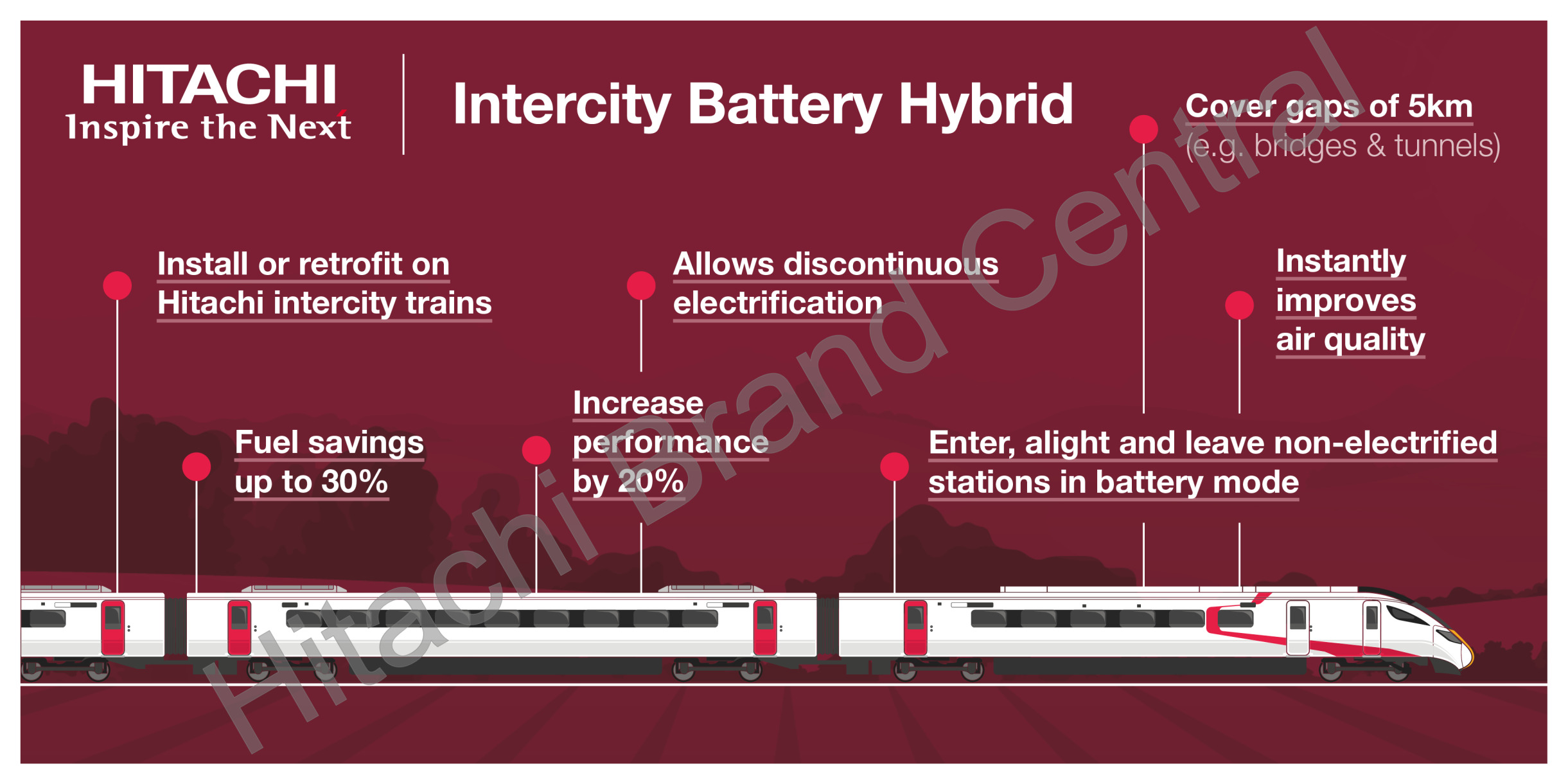
And this Hitachi infographic shows the Hitachi Intercity Battery Hybrid Train.

It looks to me, that one or both of these trains could work some or all of the the four routes to and through Oxford.
A battery train with a range of 21 miles would certainly be able to go between Paddington and Oxford, with battery charging to the East of Didcot.
These trains could be running services by the end of 2024.
The Development of Liverpool Street And Paddington Stations
This article in The Telegraph is entitled Row Over ‘Grotesque’ £1.5bn Liverpool Street Revamp.
There is no doubt that Liverpool Street and Paddington stations will need a higher number of trains per hour and this will probably mean more platforms. But there is no space in either station.
Suppose a long-distance version of the current nine-car Alstom/Bombardier trains were to be built with toilets, a 110 mph top speed, but dimensionally identical to the existing Class 345 trains.
The Central Tunnel of the Elizabeth Line could probably handle more trains, than it currently does, given that Dear Old Vicky handles 36 trains per hour.
So services like Southend and Oxford or Beaulieu and Newbury could be run through the Central Tunnel, replacing the current Greater Anglia and GWR services.
This would relieve platform space in the current terminals and the high-speed Elizabeth Line trains, would just be more trains going through the Central Tunnel at 80 mph.
The important Oxford and Cambridge route would be one change at either Farringdon or Liverpool Street, Or with some track modifications, it might be possible to run direct via the Central Tunnel, Stratford and the West Anglia Main Line.
Sorting out the trains, would ease the development of Liverpool Street and Paddington stations.
Could Chiltern Go Battery-Electric?
In the October 2022 Edition of Modern Railways, there is an article, which is entitled Chiltern Considers Turbo Future, with a sub-title of Battery Replacement Could Be On The Cards.
These are the first two paragraphs.
In early September Chiltern Railways was preparing to launch a market sounding exercise to consider options for the future of the Class 165 Turbo DMU fleet.
The operator has 28×2-car and 11×3-car ‘165s’. which operate alongside its more modern Class 168 DMUs and its loco-hauled sets. The market sounding exercise will consider two options for the future of the fleet – some sort of hybrid conversion, or outright replacement.
The Class 165 Trains
The Class 165 trains were built in 1990-1991.
- Maximum Speed – 75 mph
- Prime Movers – One per car, Perkins 2006-TWH
- 2-car Trains – 28
- 3-car Trains – 11
One is being converted to a diesel/battery hybrid.
The Class 168 Trains
The Class 168 trains were built in 1998-2004.
- Maximum Speed – 100 mph
- Prime Movers – One per car, MTU 6R 183TD13H
- 2-car Trains – 9
- 3-car Trains – 8
- 4-car Trains – 11
One has been converted to a diesel/battery hybrid.
Conversion To Hybrid Operation
If this proves to be feasible, it will surely be the more affordable of the two options.
But it does leave Chiltern with a mixed fleet with two types of train with different maximum speeds and these lengths.
- 2-car Trains – 37
- 3-car Trains – 19
- 4-car Trains – 11
Would a fleet of similar trains, with perhaps a maximum speed of 100 mph, be better operationally?
Battery-Electric Operation
The Modern Railways article introduces the concept of battery-electric operation with this paragraph.
If a replacement fleet is considered the best option for the Turbo units, the replacements could take the form of a straight battery EMU, taking advantage of recent advances in ‘fast charge’ technology.
The article also says this about battery technology and electrification.
There is optimism that advances in battery technology will provide a smooth pathway to decarbonise Chiltern’s operations – the company serves the only non-electrified London terminus.
In the longer-term, it is hoped electrification from Birmingham to Banbury as part of a strategy to decarbonise CrossCountry and freight services would enable Chiltern to run a battery EMU on London to Birmingham duties, running under battery power as far north as Banbury and switching to overhead wires from there, both powering the unit and enabling the batteries to be recharged.
The Modern Railways article looked at each route and I will do this in more detail.
London Marylebone And Aylesbury via High Wycombe
London Marylebone and Oxford would be under battery operation for 40 miles.
Trains would be charged at London Marylebone and Aylesbury stations.
London Marylebone And Aylesbury Vale Parkway
London Marylebone and Oxford would be under battery operation for 41 miles.
Trains would be charged at London Marylebone and Aylesbury Vale Parkway stations.
It might be better to electrify between Aylesbury and Aylesbury Vale Parkway stations.
London Marylebone And Banbury
London Marylebone and Oxford would be under battery operation for 69 miles.
Trains would be charged at London Marylebone and Banbury stations.
Leamington Spa And Birmingham Moor Street
Assuming the Birmingham and Banbury section of the route is electrified, this route will be electrified.
London Marylebone And Birmingham Moor Street Or Birmingham Snow Hill
Assuming the Birmingham and Banbury section of the route is electrified, this route can be considered to be in two sections.
- London Marylebone and Banbury – Battery operation – 69 miles
- Banbury and Birmingham – Electric operation – 42 miles
Trains would be charged at London Marylebone station and on the electrified section.
London Marylebone And Gerrards Cross
London Marylebone and Oxford would be under battery operation for 19 miles or 38 miles both ways.
Trains would be charged at London Marylebone station.
London Marylebone And High Wycombe
London Marylebone and Oxford would be under battery operation for 28 miles or 56 miles both ways.
Trains would be charged at London Marylebone station.
London Marylebone And Oxford
London Marylebone and Oxford would be under battery operation for 66.8 miles.
Trains would be charged at London Marylebone and Oxford stations.
London Marylebone And Stratford-upon-Avon
Assuming the Birmingham and Banbury section of the route is electrified, this route can be considered to be in two sections.
- London Marylebone and Banbury – Battery operation – 69 miles
- Banbury and Hatton Junction – Electric operation – 26 miles
- Hatton Junction and Stratford-upon-Avon – Battery operation – 9 miles
Trains would be charged at London Marylebone station and on the electrified section.
Chiltern’s Mainline Service
Chiltern’s Mainline service between London and Birmingham is run by either a Class 68 locomotive pulling a rake of six Mark 3 coaches and a driving van trailer or two or three Class 168 trains.
As the locomotive-hauled train is about eight coaches, it could surely be replaced by two four-car multiple units working together.
I believe that if Chiltern obtained a fleet of four-car battery electric trains, this would be the most efficient fleets for all their routes.
Charging At London Marylebone Station
I took these pictures at Marylebone station today.
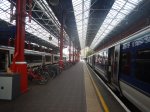
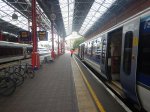
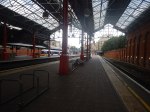

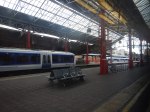


Note.
- It is a surprisingly spacious station and I feel that Furrer+Frey or some other specialist company could add some form of charging to the platforms.
- Charging would probably performed using the train’s pantograph.
It appears that the turnround time in Marylebone is typically twelve minutes or more, which should be adequate to fully charge a train.
Conclusion
Both solutions will work for Chiltern.
But I prefer the new battery-electric train, which has some crucial advantages.
- Battery-electric trains will be quieter than hybrid trains.
- Marylebone station has a noise problem and battery-electric trains are very quiet.
- Chiltern have ambitions to built new platforms at Old Oak Common and to serve Paddington. This could be easier with a battery electric train.
Rhe only disadvantage is that Banbury and Birmingham would need to be electrified.
Extending The Elizabeth Line – Connecting Great Western Main Line Services To The Central Tunnel
If say it was ever needed to run a train between Oxford or Swindon stations and the Central Tunnel of the Elizabeth Line, three things must be possible.
Trains Would Have To Be Compatible With The Central Tunnel Of The Elizabeth Line
As any train would have to be compatible with the platform-edge doors in the central tunnel of the Elizabeth Line, the trains would have to be dimensionally identical to the current Class 345 trains.
- Nine cars
- Possibility of lengthening to ten cars.
- 204.73 metres long.
- 6 sets of doors per carriage
- Ability to run under full digital signalling.
I covered this in detail in Extending The Elizabeth Line – High Speed Trains On The Elizabeth Line.
Trains Would Need A 125 mph Capability To Travel On The Fast Lines Of The Great Western Main Line
They would be designed for a higher speed of at least 110 or 125 mph, to enable running on the fast lines.
The faster running would ease scheduling of the trains.
Effectively, the train would be a Class 345 train with more features and considerably more grunt.
Trains Must Be Able To Connect Between The Fast Lines And The Central Tunnel Of The Elizabeth Line At Royal Oak
This map from cartometro.com shows the track layout at Royal Oak.
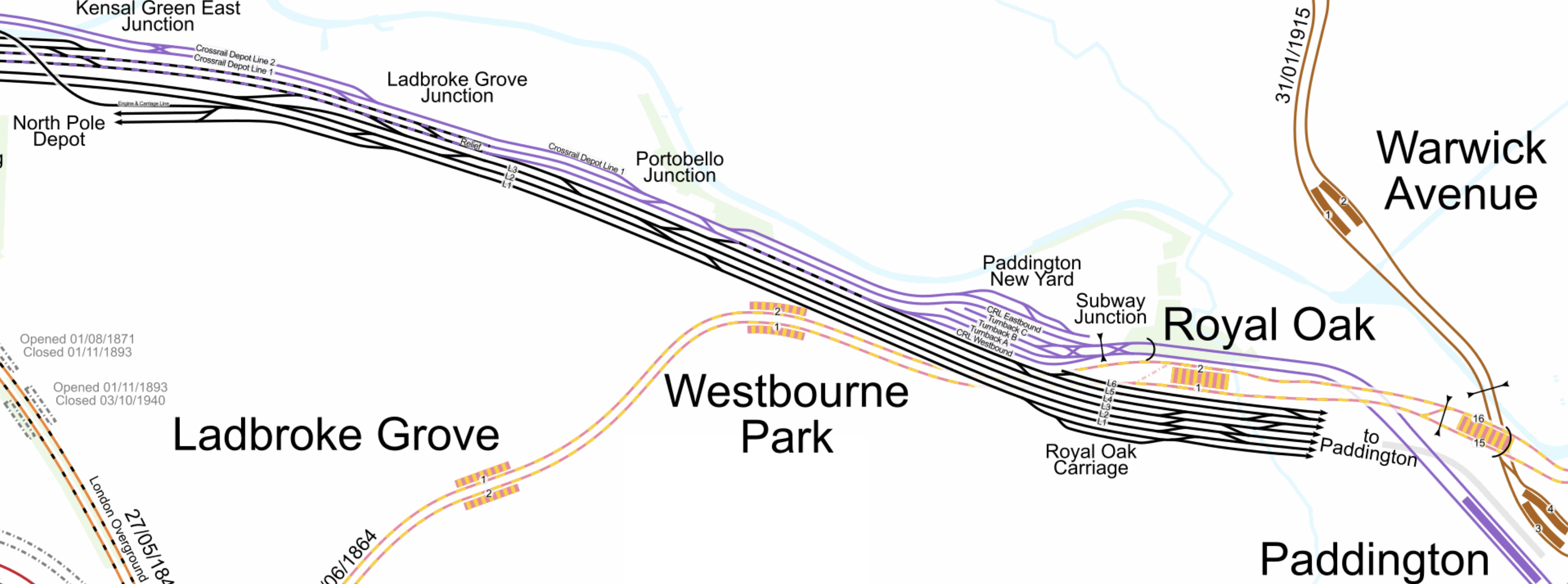
Note.
- The Elizabeth Line is shown in purple.
- Great Western Railway (GWR) tracks are shown in black.
- Where the Elizabeth Line shares the tracks with GWR services the tracks are shown in black and purple.
This map shows an enlargement of Kensal Green East Junction in the North-West corner of the previous map.
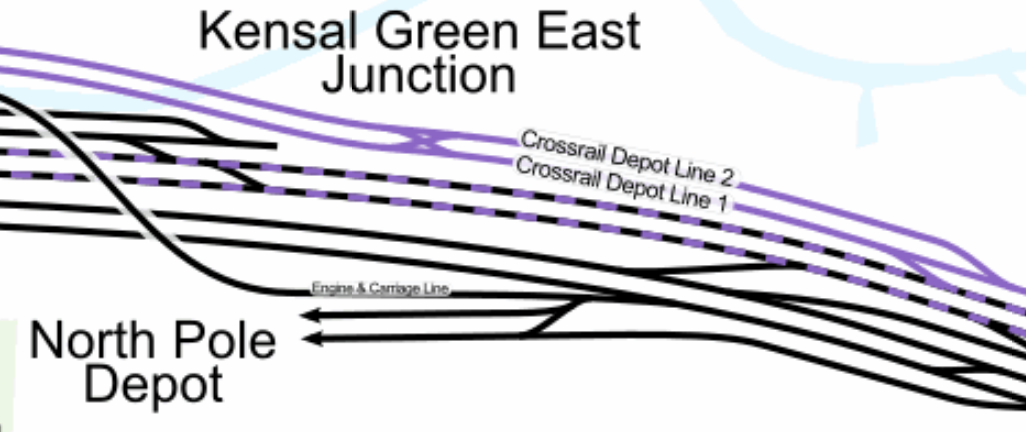
Note.
- The top pair of lines lead to the Elizabeth Line Depot at Old Oak Common.
- the pair of lines that are shown in black and purple handle Elizabeth Line and GWR local services.
- The pair of black lines are the Great Western Main Line.
- North Pole Depot is used by GWR for their Hitachi trains.
This map shows an enlargement between Ladbroke Grove Junction and Royal Oak.
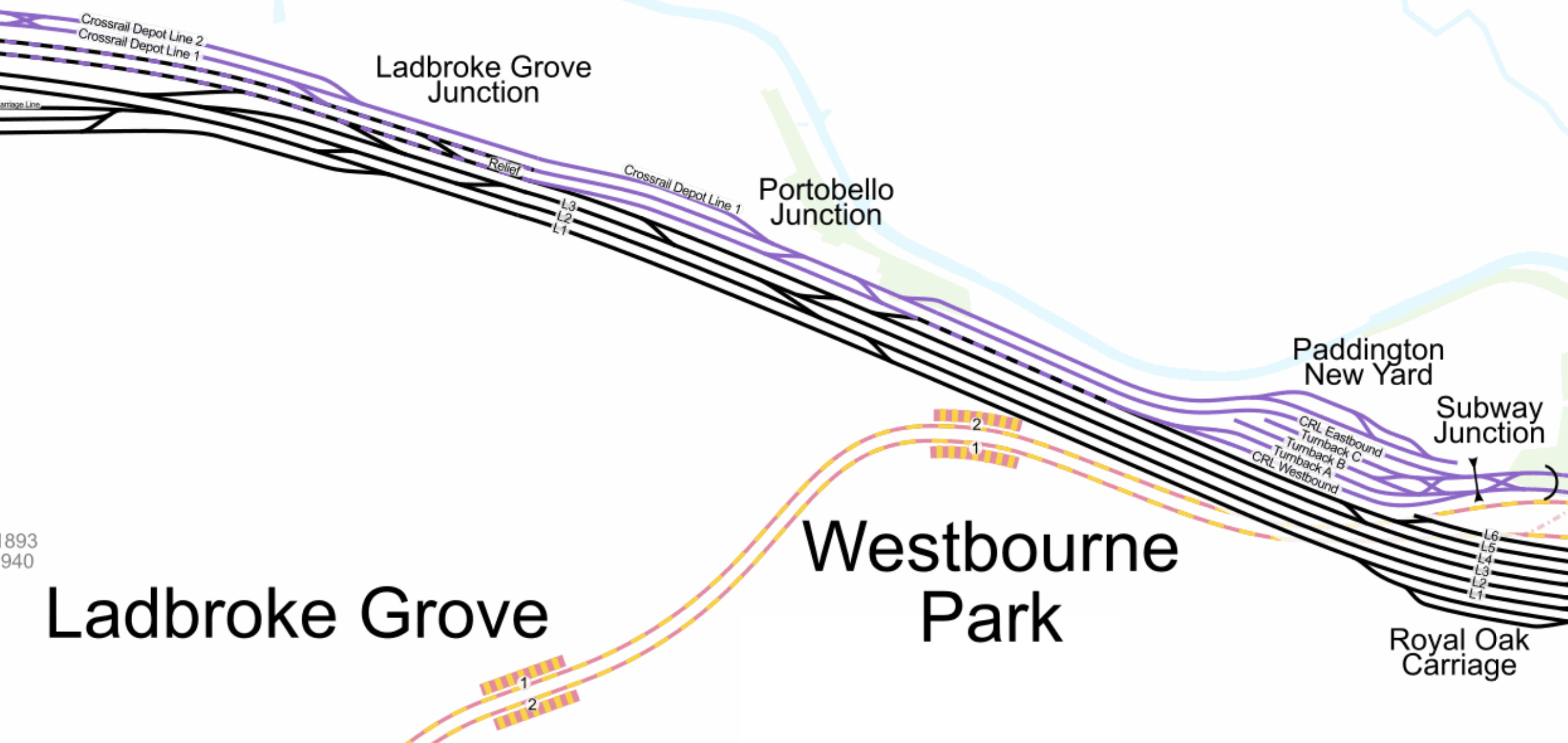
Note.
- In the South-East corner of the map is Subway junction, which appears to have two crossovers for maximum flexibility.
- To the East of Subway junction the curved line indicates the Royal Oak Portal of the Elizabeth Line Central Tunnel.
- To the West of Subway junction, there is Paddington New Yard, where there is five tracks labelled CRL Eastbound, Turnback C, Turnback B, Turnback A and CRL Westbound from North to South.
- Turnback C, Turnback B and Turnback A are the three turnback sidings, where trains are turned back East through the Elizabeth Line Central Tunnel.
- CRL Eastbound and CRL Westbound can be followed across the map to the black and purple lines of the Elizabeth Line to the West of Ladbroke Grove junction.
- At present the Western section of the Elizabeth Line terminates in Paddington station. Crossovers at Portobello junction appear to connect the Western section of the Elizabeth Line into Paddington station.
- More crossovers also appear to connect the Great Western Main Line to the CRL Eastbound and CRL Westbound through Paddington New Yard.
I am fairly sure that the track layout at Royal Oak allows trains to go both ways between Great Western Main Line and the Elizabeth Line Central Tunnel.
Extending The Elizabeth Line – High Speed Trains On The Elizabeth Line
This may seem rather fanciful, but could it be the way to maximise the use of the Elizabeth Line?
- I feel that the Elizabeth Line will eventually serve other destinations like Basingstoke, Beaulieu, Oxford, Southend and Swindon.
- The capacity of the Elizabeth Line will grow to over thirty trains per hour (tph) under control of digital signalling.
These are a few thoughts.
The Design Of The Trains
As any train would have to be compatible with the platform-edge doors in the central tunnel of the Elizabeth Line, the trains would have to be dimensionally identical to the current Class 345 trains.
- Nine cars
- Possibility of lengthening to ten cars.
- 204.73 metres long.
- 6 sets of doors per carriage
- Ability to run under full digital signalling.
They would be designed for a higher speed of at least 110 or 125 mph, to enable running on the fast lines of these routes.
- East Coast Main Line
- Great Western Main Line
- Midland Main Line
- West Coast Main Line
They would also be able to run at 100 mph on the Chiltern Main Line, the Great Eastern Main Line and the North Kent Line.
The faster running would ease scheduling of the trains.
Extra facilities could include.
- Toilets
- Tables
- A third-rail capability for running in Kent.
Effectively, it would be a Class 345 train with more features and considerably more grunt.
Note that in A High Speed Train With An IPEMU-Capability, I started the post with the following.
Bombardier were reported by Ian Walmsley in the April 2016 Edition of Modern Railways, to be developing Aventra, with a 125 mph capability.
Bombardier have also told me, that all Aventras will be wired so they could be fitted with on-board energy storage.
Could it be that the design of a Class 345 train could be modified to run at higher speeds? I wouldn’t be surprised.
Oxford To Southend Victoria
This could be a typical route.
- Between Oxford and Paddington, it would follow a route similar to the GWR’s Oxford service with stops at just Reading and Slough.
- At Paddington the train would take the Central Tunnel of the Elizabeth Line and travel under London, at the same speed as the other trains.
- It would emerge at Stratford and move to the Great Eastern Main Line.
- It would probably stop at Stratford, Romford, Shenfield and all stations to Southend Victoria.
Note.
- Digital signalling would enforce the precise timekeeping needed.
- Much of the Oxford and Paddington section would be up to speeds of at least 125 mph.
- Times in the Central Tunnel of the Elizabeth Line would be identical to the current Class 345 trains.
- Much of the Stratford and Southend section would be up to speeds of at least 100 mph.
I estimate that total time would be a few minutes under two hours.
Connecting To The Central Tunnel Of The Elizabeth Line At Royal Oak
I discuss this in Extending The Elizabeth Line – Connecting Great Western Main Line Services To The Central Tunnel.
Connecting To The Central Tunnel Of The Elizabeth Line At Stratford
I discuss this in Extending The Elizabeth Line – Connecting Great Eastern Main Line Services To The Central Tunnel.
Connecting To The Central Tunnel Of The Elizabeth Line At Abbey Wood
This map from cartometro.com shows the track layout at Abbey Wood.
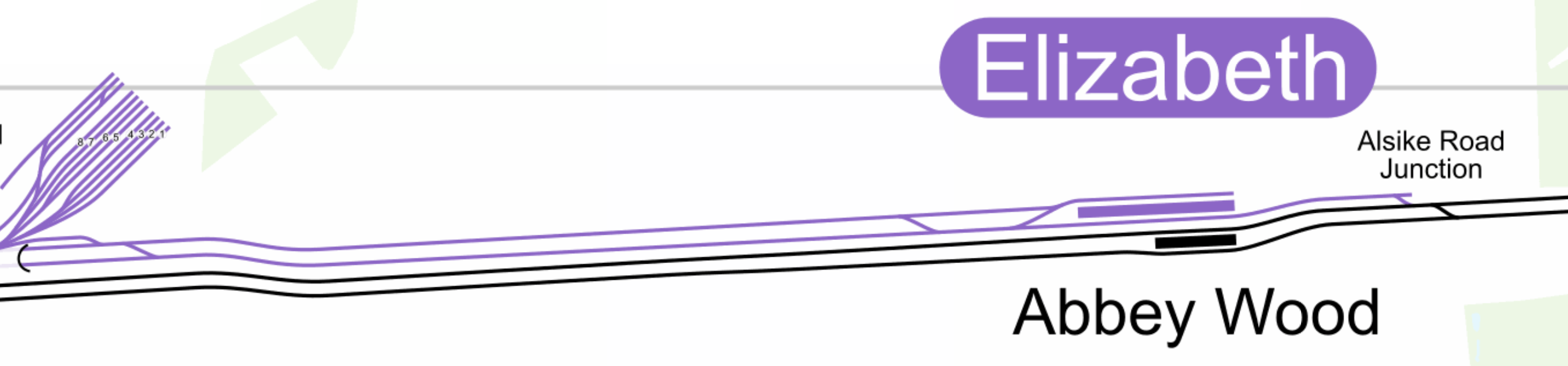
Note.
- The Elizabeth Line is shown in purple.
- The North Kent Line is shown in black.
- The North Kent Line platform to London is the Southernmost platform and is numbered 1.
- The North Kent Line platform from London is the other Southern platform and is numbered 2.
- The Elizabeth Line platforms are numbered 3 and 4.
- Platform 4 is the Northernmost platform.
At present the Elizabeth Line service to Abbey Wood station is twelve tph, with each platform handling six tph.
This picture shows trains in both Platform 3 and 4 looking towards the station buildings.

Note.
- Platform 3 is on the right.
- Platform 4 is on the left.
In Elizabeth Line To Ebbsfleet Extension Could Cost £3.2 Billion, I talk about this proposal as described in this article on Ian Visits.
One of the key features of Crossrail To Ebbsfleet (C2E) project is that instead of all trains terminating at Abbey Wood, trains will terminate as follows.
- Abbey Wood – 4 tph
- Northfleet – 4 tph
- Gravesend – 4 tph
This will mean that 8 tph would pass through Abbey Wood station.
- Platform 4 could certainly handle the four that terminated on the Elizabeth Line.
- Platform 3 would need to handle eight tph in both directions or sixteen tph to fulfil the proposed C2E service.
- This would be one train every 225 seconds.
I believe that digital signalling could handle this easily and safely.
I am fairly sure that the track layout at Abbey Wood allows eight tph to go both ways between the North Kent Line and the Elizabeth Line Central Tunnel.
The Maximum Capacity At Abbey Wood Station
Because of the current track layout at Abbey Wood, I believe that without track modifications, Abbey Wood station will not be able to handle more than 12 tph.
Thameslink
These proposed trains would also be compatible with Thameslink, as this route has no platform edge doors.
No platform extensions would be needed, as the Class 345 trains are shorter than the 12-car Class 700 trains.
If they were 125 mph trains, then this would ease timetabling on the East Coast Main Line, as the trains could mix it with the expresses on the fast lines.
Could These High Speed Trains For The Elizabeth Line Have A Cruising Speed Of 140 mph?
It is likely, when full authority digital ERTMS signalling is installed on main lines out of London, that 140 mph will be possible on some at least these routes.
- East Coast Main Line
- Great Western Main Line
- Midland Main Line
- West Coast Main Line
The extra speed would maximise capacity.
Could An Oxford And Cambridge Service Be Run Via The Lizzie Line?
This article on the BBC is entitled East-West Rail: Part Of £5bn Scheme ‘Appears To Be Unachievable’.
These are the first four paragraphs.
A £5bn rail project “appears to be unachievable” in parts, a government report said.
The East-West Rail scheme will create a link from Oxford to Cambridge, with services being introduced in stages.
Stage two, between Oxford and Bedford, and stage three, between Bedford and Cambridge, have “major issues”, the Infrastructure and Projects Authority said.
A spokesman for East-West Rail said the delivery programme was “under review”.
As someone, who used to live near Cambridge, I have seen the transport routes improve in East Anglia, but not the area’s connections to the rest of the country.
The article describes Stage 2 and 3 of the East West Railway like this.
Stage two involves predominantly upgrading existing infrastructure, between Bletchley and Bedford, to allow services between Oxford and Bedford.
Stage three involves building a new line, between Bedford and Cambridge, to extend the railway and facilitate services from Oxford to Cambridge.
So if the Government feel that the major issues and opposition should lead to cancellation of the scheme to the East of Bedford or even Bletchley, what are the problems and alternatives?
Freight
The Port of Felixstowe is the UK’s busiest container port and it handles 48% of Britain’s containerised trade.
Having lived as a teenager in Felixstowe and in Suffolk for probably half my life, there is only one certainty about the port in my mind. It will get bigger and will generate more rail and road traffic in East Anglia.
- The roads have improved greatly, since the 1960s, when I used to cycle between Ipswich and Felixstowe, along a two-lane single carriageway road.
- The renamed A14 has replaced the A45 and now connects the port to the M1 and the M6.
- Tens of long freight trains every day now connect Felixstowe with the rest of the country.
- The East West Railway will be a very useful link between Felixstowe and South Wales and the West of England.
- Global warming will mean the decarbonisation of heavy freight, with more traffic on an electrified railway.
Felixstowe’s connections to the North and Midlands may have improved greatly, but they will need to be improved a lot more.
The Port of Southampton is the UK’s second busiest container port.
- Most freight trains from Southampton go North via Basingstoke, Reading and Oxford.
- A plan some years ago was for an Electric Spine, that would have connected the Port of Southampton to the Northern cities.
- The Electric Spine would have envisaged electrification of the East West Railway to the West of Bedford and electrified connections with the West Coast Main Line and the Midland Main Line.
- The Midland Main Line is now planned to be fully electrified, under the the Integrated Rail Plan for the North and Midlands.
Southampton, like Felixstowe will be in need of improved transport connections.
In an ideal world, an electrified East West Railway, would improve freight connections between the UK’s two busiest container ports and major cities in the UK.
Problems With Freight
Could this be the major problem East of Bletchley, where the residents living along the route, don’t want to see large numbers of freight trains running close by?
In this document on the East-West Rail Consortium web site, this is said.
Note that doubling of Warren Hill Tunnel at Newmarket and
redoubling between Coldham Lane Junction and Chippenham Junction is included
in the infrastructure requirements. It is assumed that most freight would operate
via Newmarket, with a new north chord at Coldham Lane Junction, rather than
pursuing further doubling of the route via Soham.
Will the residents of Newmarket object to a double-track freight railway through the town? Freight trains and horses are not a good mix.
I do wonder, if freight trains hauled by noisy and unfriendly diesel locomotives are one of the reasons a full Oxford and Cambridge railway is losing its appeal and becoming a vote loser for the Government.
Cambridge Has An Accommodation And Commuting Problem
There is a shortage of accommodation in Cambridge for offices, laboratories, workshop and above all workers.
So it looks to the surrounding towns and cities to provide help.
London and Ely have good links, but the city needs better links to Bedford, Bury St. Edmunds, Haverhill, Ipswich, Norwich, Kings Lynn, Peterborough, Soham, Stansted Airport, Stevenage, Sudbury and Thetford.
Cambridge may be the place in the South East with the largest numbers of commuters from London.
Cambridge Needs A Decent Rail Network
In my view Cambridge needs at least the following services in trains per hour (tph)
- Colchester via Haverhill, Sudbury and Marks Tey – 2 tph
- Ipswich via Newmarket, A14 Parkway, Bury St. Edmunds, Stowmarket and Needham Market – 2 tph
- King’s Lynn via Cambridge North, Ely and Downham Market – 2 tph
- Oxford via Bedford, Milton Keynes/Bletchley and Bicester – 2 tph
- London King’s Cross via Cambridge South – 2 tph
- Norwich via Cambridge North, Ely, Thetford, Attleborough and Wymondham – 2 tph
- Peterborough via Cambridge North, Ely and March – 2 tph
- Stansted Airport via Cambridge South and Audley End – 2 tph
- Stevenage via Royston and Hitchin – 2 tph
- Wisbech via Cambridge North, Ely and March – 2 tph
Note.
- Some services already exist.
- Some of these services duplicate each other to give 4 tph or even 6 tph on certain routes.
- Some services could be back-to-back through Cambridge.
- A 14 Parkway station is a new station proposed by the East West Railway. I wrote about it in detail in Soham Station – 14th December 2021.
- Haverhill would be served by a rebuilt Stour Valley Railway.
- Wisbech would be served by restoring the railway to March.
To complete the network there would be a two tph service between Peterborough and Ipswich, which would go via March, Ely, Soham, A 14 Parkway, Bury St. Edmunds, Stowmarket and Needham Market.
Oxford Could Probably Argue that It Needs A Decent Rail Network Like Cambridge
Oxford would argue this and they have a point.
The East West Railway Is The Odd Line Out
Looking at the rail networks at Cambridge and Oxford, it appears, that with the exception of Cotswold services at Oxford and a few CrossCountry services, it appears that the East West Railway is a bit of an odd line out, as everything else is a local service.
The Effects Of Not Building The Bedford And Cambridge Section Of The East-West Railway
What will it mean, if the Bedford and Cambridge Section of The East-West Railway is not built?
- Cambourne will not get the promised station.
- Bedford and Cambridge journeys will be by bus, train via London or private car.
- Commuting into Cambridge from the West will be difficult.
- Milton Keynes and Cambridge journeys will be by bus, train via London or private car.
- Oxford and Cambridge journeys will be by bus, train via London or private car.
- Train journeys between Cambridge and much of the rest of the UK, will need to go via London.
It would appear that by not building the third section of the East West Railway, a lot of potential passengers will be denied a rail service.
Could Services Be Run Using Existing Infrastructure Through London?
The Elizabeth Line will eventually be able to handle a lot more services than it does at present.
Would Extending The Elizabeth Line To Oxford Be A Good Start?
Consider.
- Oxford has two services to London; Chiltern to Marylebone and Great Western Railway (GWR) to Paddington.
- The GWR service to Paddington stops only at Reading and Slough, has a frequency of two tph and takes under an hour.
- The fastest journey between Oxford and Liverpool Street using a fast GWR train and the Elizabeth Line takes one hour and 20 minutes.
- Only 10.6 miles of the route between Oxford and Paddington is without electrification.
- There is also a two tph stopping shuttle train between Oxford and Didcot Parkway stations and a two tph stopping train between Paddington and Didcot Parkway.
I feel that combining the two Didcot Parkway services and moving them to the Elizabeth Line would be an experiment worth trying.
This would give 2 tph direct to the following stations.
- Bond Street for the West End
- Canary Wharf for finance.
- Farringdon for Cambridge, Gatwick and Brighton.
- Hayes & Harlington for Heathrow.
- Liverpool Street for the City of London, Cambridge and Stansted
- Reading for Wales and the West.
Note.
- No-one would have a worse service than currently, but many passengers would avoid a change on their journey.
- Services could terminate at either Abbey Wood or Shenfield stations.
- Services could be an extension of the two tph to Reading or additional services.
- Between Didcot Parkway and Oxford is shown on OpenRailwayMap, as proposed for electrification.
- There may need to be some new platforms at Didcot Parkway station.
- I estimate that between Oxford and Liverpool Street would take one hour and fifty minutes.
It certainly looks, that it would be possible to replace the current GWR service between Oxford and Paddington, with an all-electric Elizabeth Line service.
The direct stopping service between Oxford and Liverpool Street would be thirty minutes slower, than the current fastest train.
The current fastest train between Liverpool Street and Cambridge takes 71 minutes, so with a change at Liverpool Street Oxford and Cambridge would probably be just over three hours.
Google Maps estimate a driving time of two hours between the two University Cities.
Could The Elizabeth Line Be Extended To Cambridge?
There is no train connection between the Elizabeth Line and the West Anglia Main Line at Liverpool Street station, although the walk for passengers is not that long.
In Extending The Elizabeth Line – Connecting West Anglia Main Line Services To The Central Tunnel, I describe how it could be possible to connect the West Anglia Main Line to the Elizabeth Line at Stratford station.
This connection would allow services from Cambridge, Harlow and Stansted to anywhere on the Elizabeth Line to the West of Stratford.
Oxford and Cambridge and Heathrow and Stansted would be distinct possibilities.
Could A High Speed Limited Stop Service Run Between Oxford And Cambridge?
In Extending The Elizabeth Line – High Speed Trains On The Elizabeth Line, I proposed running faster long-distance trains through the Central Tunnel of the Elizabeth Line.
- They would have to be dimensionally identical to the Class 345 trains to fit the platform edge doors.
- They would have a long-distance interiors.
- In the Central Tunnel, they would behave like 345 trains. with Paddington to Stratford taking 19 minutes.
- But on main lines like the Great Western Main Line, they could rattle along at 125 mph.
If the trains could keep up with Class 802 train performance between Oxford and Paddington and enter the Central Tunnel quickly, these times could be possible.
- Oxford and Paddington – 55 minutes
- Paddington and Stratford – 19 minutes
- Stratford and Tottenham Hale – 14 minutes
- Tottenham Hale and Cambridge – 65 minutes
Just over two-and-a-half hours, without a change of train, sounds fine to me.
What About The Trains From Great Malvern?
The fast services between Paddington and Oxford, run twice an hour, with the service formed of one hourly Paddington and Oxford service and another hourly Paddington and Great Malvern service.
- If Oxford gets electrified soon, this will mean that the Oxford and Paddington service would be all-electric.
- But the Great Malvern service would need to be able to handle 65.5 miles of line without electrification each way.
- The speed limits between Oxford and Great Malvern vary between 70 and 100 mph.
I’m certain that Stadler could design and build a train, with the following characteristics.
- Class 345 dimensions.
- 125 mph performance.
- Ninety miles range on battery power.
The trains would be charged between Paddington and Oxford and by a charger at Great Malvern.
Conclusion
Would an Oxford and Cambridge service through Central London be an alternative to the East-West Railway?
Perhaps not an alternative, but an addition?
The New Winslow Station Site
This Google Map shows the site of the new Winslow station, on the East West Railway.
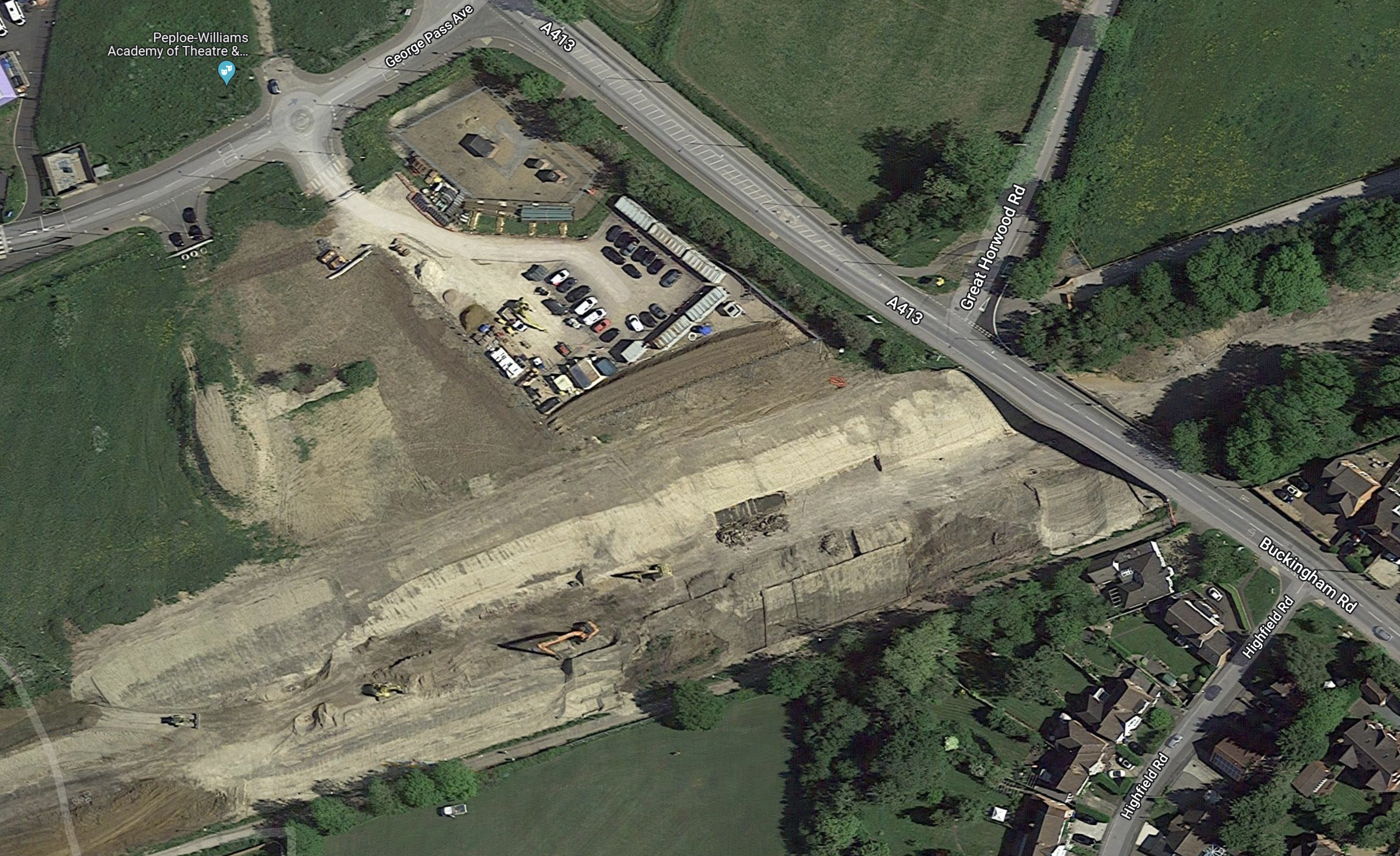
Note.
- The line from north of Wolvercote Tunnel (just north of Oxford) through Bicester to Bletchley would be enabled for 100 mph (160 km/h) double-track running.
- There will be two platforms at Winslow station.
- The station is planned to open in 2024.
Services at the station are likely to be.
- Two tph – Oxford and Milton Keynes via Oxford Parkway, Bicester Village, Winslow and Bletchley
- One tph – Oxford and Bedford via Oxford Parkway, Bicester Village, Winslow, Bletchley, Woburn Sands and Ridgmont
Note.
- tph is trains per hour.
- It appears the current Bedford and Bletchley service will continue.
It looks like the one tph service between Aylesbury and Milton Keynes via Aylesbury Vale Parkway, Winslow, Bletchley has been deferred indefinitely.
Consider.
- Building a single track railway between Aylesbury Vale Parkway station and Claydon Junction on the East West Railway can’t be that challenging or expensive.
- A single track railway should be able to handle the required train service of up to two tph at Aylesbury Vale Parkway station and occasional freight trains.
It doesn’t look too difficult or costly. So why? The only valid reason I can think of is that High Speed Two doesn’t want it for some reason.
Alstom Hydrogen Aventras And Great Western Branch Lines Between Paddington And Oxford
In Alstom And Eversholt Rail Sign An Agreement For The UK’s First Ever Brand-New Hydrogen Train Fleet, I give my thoughts on Alstom’s new hydrogen train, which I have called the Alstom Hydrogen Aventra.
One reader suggested these lines in a comment, as they are all run by diesel Class 165 trains.
These are the lines, that could be converted to Hydrogen operation.
Greenford Branch
The branch runs between West Ealing and Greenford via Drayton Green, Castle Bar Park and South Greenford.
- It has a frequency of two trains per hour (tph).
- The branch is 2.5 miles long.
- Services take eleven minutes.
- It needs a single train to run the service.
Note.
- In GWR To Test Battery Train On Branch Line, I wrote about Great Western Railway’s plans to test battery-eclectic trains on this line.
- The platform at Greenford station may need lengthening to accommodate the Alstom Hydrogen Aventra.
- It is my view that the branch needs four tph.
- It might also be possible to run Peak hour services to and from Paddington.
I do think that if the train length issue is solved that a single Alstom Hydrogen Aventra could work this branch.
A two-car Class 230 train would certainly fit.
Windsor Branch
The branch runs between Slough and Windsor & Eton Central.
- It has a frequency of three tph
- The branch is 2.8 miles long.
- Services take six minutes.
- It needs a single train to run the service.
Note.
- The extra capacity of the Alstom Hydrogen Aventra could be welcome.
- Prince Charles would like it.
I do think that a single Alstom Hydrogen Aventra could work this branch.
Marlow Branch
The branch runs between Maidenhead and Marlow via Furze Platt, Cookham and Bourne End.
- It has a frequency of one tph
- The branch is 7.1 miles long.
- Services take twenty-three minutes.
- The service reverses at Bourne End.
- It needs a single train to run the service.
Note that the three-car Alstom Hydrogen Aventra may be too long to execute the reverse at Bourne End.
I do think that if the Bourne End problem can be solved that a single Alstom Hydrogen Aventra could work this branch.
The two-car Class 165 train, that currently works the branch is 46 metres long, so a two-car battery-electric train may be needed for this branch. A two-car Class 230 train would certainly fit.
Regatta Line
The branch runs between Twyford and Henley-on-Thames via Wargrave and Shiplake.
- It has a frequency of two tph
- The branch is 4.6 miles long.
- Services take twelve minutes.
- It needs a single train to run the service.
Note.
- If this line needed more capacity trains could be doubled up, as there are no length issues.
- It might also be possible to run Peak hour services to and from Paddington.
I do think that a single Alstom Hydrogen Aventra could work this branch.
North Downs Line
The line runs between Reading and Gatwick Airport via Wokingham, Crowthorne, Sandhurst, Blackwater, Farnborough North, North Camp, Ash, Guildford, Shalford, Chilworth, Gomshall, Dorking West, Dorking Deepdene, Betchworth, Reigate and Redhill
- It has a frequency of two tph
- The route is 53.1 miles long.
- The route is partially-electrified with 750 VDC third-rail electrification.
- The route has been planned for 100 mph trains.
- Services take eighty-two minutes.
- It needs six trains to run the service.
Note.
- The route is proposed to be run by four-car Class 769 bi-mode trains.
- Would a three-car train be sufficient for this route?
- The Alstom Hydrogen Aventras are only 90 mph trains and would they be fast enough?
I do think that Alstom Hydrogen Aventras could work this route, but given the number of trains and possible capacity and speed issues, a four-car battery-electric train could be better suited to the route.
Reading And Basingstoke Line
This line runs between Reading and Basingstoke via Reading West, Mortimer and Bramley
- It has a frequency of two tph
- The route is 15.4 miles long.
- There is 25 KVAC overhead electrification at Reading.
- There is 750 VDC third-rail electrification at Basingstoke, but the platform used by the service is unelectrified.
- The route has been planned for 100 mph trains.
- Services take twenty-eight minutes.
- It needs two trains to run the service.
Note.
- For a battery-electric train to work this route, it might need a charging system at Basingstoke.
- The Alstom Hydrogen Aventras are only 90 mph trains and would they be fast enough?
I do think that a pair of Alstom Hydrogen Aventras could work this service.
Oxford Canal Line
This route runs between Didcot Psrkway and Banbury via Appleford, Culham, Radley, Oxford, Tackley, Heyford and Kings Sutton.
- It is effectively two routes with a combined frequency of two tph between Didcot Junction and Oxford and half that between Oxford and Banbury.
- The full route is 33 miles long.
- There is 25 KVAC overhead electrification at Didcot Parkway.
- Services take forty-one minutes.
- It probably needs four trains to run the service.
I do think that a small fleet of Alstom Hydrogen Aventras could work this service.
Some General Thoughts
These are a few general points.
Stabling And Hydrogen Fuelling
Reading Train Care Facility is a large depot to the west of Reading.
- It is ideally placed for all the lines, that I’ve mentioned.
- It is connected to all the lines by electrified lines.
I am sure that it would be possible to build a hydrogen fuelling facility at the depot.
Two-Car Battery-Electric Trains
It looks like the Greenford and Marlow Branches might need to be served by two-car battery-electric trains.
Four-Car Trains
Some of the services might be run by four-car trains, as these would be more suitable for the number of passengers.
Total Number Of Trains
My rough estimates of numbers of trains are as follows.
- Greenford Branch – 1 train
- Windsor Branch – 1 train
- Marlow Line – 1 train
- Regatta Line – 1 train
- North Downs Line – 6 trains
- Reading And Basingstoke Line – 2 trains
- Oxford Canal Line – 4 trains
This would be a total of sixteen trains or ten, if the Class 769 trains were used on the North Downs Line.
Additional Routes
There may be other routes, where the trains could be used, that are handy for Reading Train Care Facility.
Hydrogen or battery power may give advantages in opening new routes.
Would Hydrogen Trains Attract Passengers And Tourists?
I think they could, as if nothing there is a curiosity value.
Conclusion
This collection of routes surround Reading Train Care Facility and would be a nice package to run with hydrogen or battery-electric trains.
The Route Map Of The East West Main Line
This image shows a schematic map of the East West Main Line.

Note.
- There is a lot of detail at the Eastern end. Is that the East Anglia influence in the Partnership?
- Bury St. Edmunds has been missed out. Is that the Ipswich influence in the Partnership?
- Of the four new stations only Winslow is not in Cambridgeshire. Is that the Cambridge influence in the Partnership?
It should also be noted that there are two links at the East, to the two ports of Freeport East; Felixstowe and Harwich.
Conclusion
This map makes a bold statement.
Related Posts
 The Anonymous Widower