Great Yarmouth Terminal Set For Redevelopment Under Port Of East Anglia Name
The title of this post, is the same as that of this article on offshoreWIND.biz.
This is the sub-heading.
The UK’s Peel Ports Group has decided to invest a further GBP 10 million (approximately EUR 11.3 million) into its Great Yarmouth site, which is being rebranded as the Port of East Anglia.
These four paragraphs add details to the story.
The newly announced GBP 10 million brings this year’s total investment to GBP 70 million across the site and will be used to redevelop the port’s Northern Terminal, helping to accommodate the next generation of offshore wind projects across the region, according to Peel Ports.
Earlier this year, a substantial investment into its Southern Terminal was announced by the port, which has earmarked GBP 60 million to transform capacity and improve efficiencies.
This involves ensuring the port can support multiple hydrogen, carbon capture, offshore wind, and nuclear projects for decades to come.
Its existing terminals service a variety of construction customers, including infrastructure projects such as Sizewell C and offshore energy projects based in the southern North Sea.
Note.
- In Yarmouth Harbour To Be ‘Completed’ In £60m Project, I talk about the work to be done on the Southern Terminal.
- The work on the Southern Terminal includes a roll-on roll-off (RORO) lift ramp and a large storage area.
- Start on the work on the Southern Terminal will start in 2026.
With all the construction work mentioned in the last two paragraphs, I suspect that the Port of Great Yarmouth will be busy?
These are some further thoughts.
Why Is The Port Of Great Yarmouth Being Renamed?
The article says this.
The new name, which will come into effect in early 2026, also aligns with the creation of a new combined authority for Suffolk and Norfolk, according to Peel Ports.
Peel Ports name change is fairly sensible, but as I was conceived in Suffolk and I’m an Ipswich Town supporter, I don’t feel that the two counties should be merged.
Does The Mention Of Hydrogen Mean That The Port Of Great Yarmouth Will Be Hosting A Hydrogen Electrolyser, To Fuel Trucks And Ships?
I asked Google AI, “If A Hydrogen Electrolyser is To Be Built In The Port Of Great Yarmouth?”, and received this answer.
While there are no current public plans for an immediate construction of a large-scale hydrogen electrolyser within the Port of Great Yarmouth, significant port expansion and infrastructure upgrades are underway to ensure it can support future hydrogen projects and related clean energy initiatives.
Note.
- If technology to handle hydrogen, is copied from North Sea gas, there is certainly a lot of proven technology that can be used again.
- There may even be depleted gas fields, where captured carbon dioxide, hydrogen or North Sea gas can be stored.
I find the most exciting thing, would be to send hydrogen to Germany.
Why Would Anybody Export Hydrogen To Germany?
I asked Google AI, the question in the title of this section and received this answer.
Countries would export hydrogen to Germany because Germany has a large, growing demand for hydrogen to power its heavily industrialised economy and achieve its decarbonisation goals, but lacks sufficient domestic renewable energy capacity to produce the required amounts.
Germany also, uses a lot of bloodstained Russian gas and indigenous polluting coal.
How Could Anybody Export Hydrogen To Germany?
- Wilhelmshaven is one of the main import ports for hydrogen in North West Germany.
- Great Yarmouth is probably the closest larger port to Germany.
- Great Yarmouth and Wilhelmshaven are probably about 300 miles apart, by the shortest route.
- Great Yarmouth would need to build infrastructure to export hydrogen.
The easiest way to transport the hydrogen from Great Yarmouth to Wilhelmshaven, is probably to use a gas tanker built especially for the route.
This Google Map shows the route between Great Yarmouth and Wilhelmshaven.
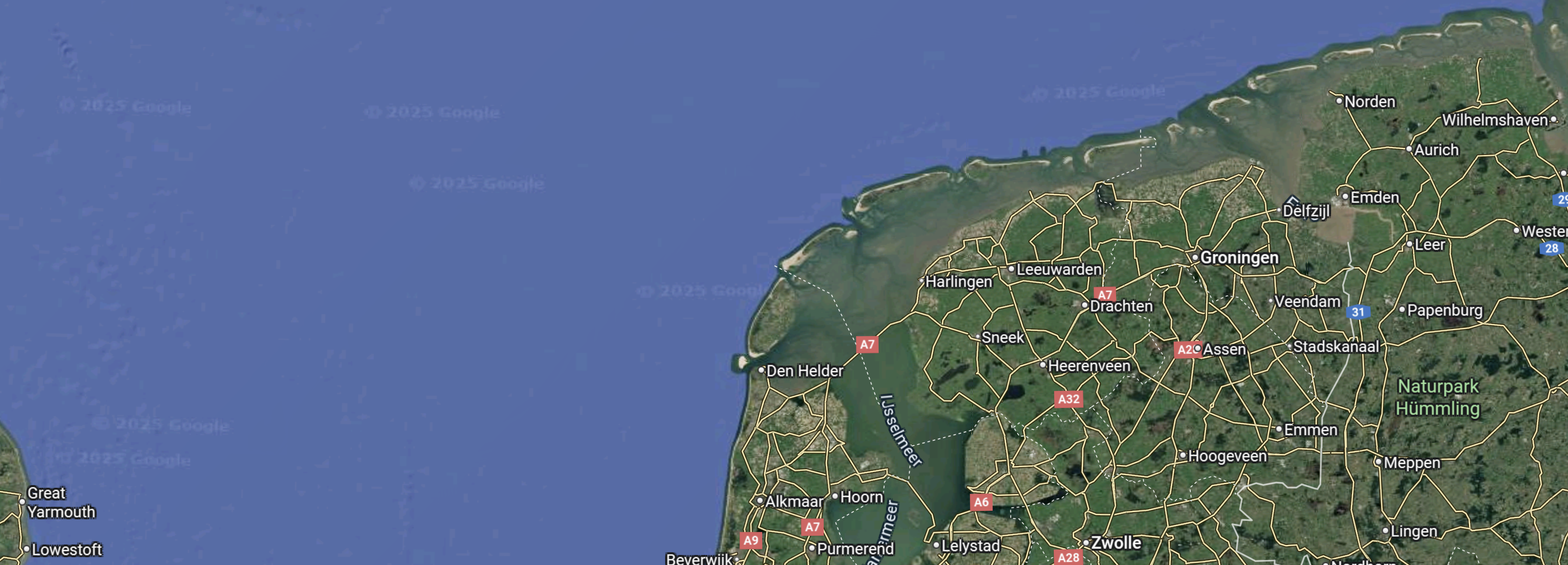
Note.
- The North-East corner of East Anglia with Great Yarmouth to the North of Lowestoft, is in the bottom-left corner of the map.
- Wilhelmshaven is a few miles inland in the top-right corner of the map.
- Could a coastal tanker go along the Dutch and German coasts to Wilhelmshaven?
I have no skills in boats, but would Great Yarmouth to Wilhelmshaven to take hydrogen to Germany?
RWE Are Developing Three Wind Farms To The North-East of Great Yarmouth
RWE are a large German Electricity company and the UK’s largest generator of electricity.
The company is developing three wind farms to the North-East of Great Yarmouth.
- Norfolk Boreas – 1.2 GW – 45 miles offshore
- Norfolk Vanguard West – 1.2 GW – 29 miles offshore
- Norfolk Vanguard East – 1.2 GW – 28 miles offshore
Note.
- The electricity for all three wind farms is to be brought ashore at Happisburgh South, which is about 22 miles North of Great Yarmouth.
- The original plan was to take the electricity halfway across Norfolk to the Necton substation to connect to the grid.
- The natives will not be happy about a 4.2 GW overhead line between Happisburgh and Necton.
- RWE have built offshore electrolysers before in German waters.
- Could an electrical cable or a hydrogen pipe be laid in the sea between Happisburgh South and the Port of Great Yarmouth?
- The electrolyser could either be offshore at Happisburgh or onshore in the Port of Great Yarmouth.
As I don’t suspect these three wind farms will be the last connected to the Port of Great Yarmouth, I would expect that RWE will put the electrolyser offshore at Happisburgh and connect it by a hydrogen pipeline to the Port of Great Yarmouth.
Could There Be A Connection To The Bacton Gas Terminal?
Consider.
The Bacton Gas Terminal, which feeds gas into the UK Gas Network, is only 4.2 miles up the coast from Happisburgh South.
Some climate scientists advocate blending hydrogen into the gas supply to reduce carbon emissions.
In Better Than A Kick In The Teeth – As C Would Say!, I disclosed that I now have a new hydrogen-ready boiler, so I’m not bothered, if I get changed to a hydrogen blend.
So could hydrogen from the Norfolk wind farms be fed into the grid to reduce carbon emissions?
Could The Port Of Great Yarmouth Become A Hydrogen Distribution Centre?
Thinking about it, the port could also become a distribution centre for green hydrogen.
Consider.
- Hydrogen-powered ships, tugs and workboats could be refuelled.
- Hydrogen-powered trucks could also be refuelled.
- Tanker-trucks could distribute hydrogen, to truck and bus operators, farms and factories, that need it for their transport and operations.
- I believe, that construction equipment will be increasingly hydrogen-powered.
In my life, I have lived at times in two country houses, that were heated by propane and there are about 200,000 off-grid houses in the UK, that are heated this way.
The two houses, where I lived would have been a nightmare to convert to heat pumps, but it would have been very easy to convert them to a hydrogen boiler and power it from a tank in the garden.
It should be noted, that the new boiler in my house in London is hydrogen-ready.
So the Port of Great Yarmouth could be the major centre for hydrogen distribution in Norfolk.
In the 1960s, I used to work in ICI’s hydrogen plant at Runcorn. If you ride in a hydrogen bus in England, it is likely that the hydrogen came from the same plant. Handled correctly, hydrogen is no less safe and reliable than natural gas or propane.
Yarmouth Harbour To Be ‘Completed’ In £60m Project
The title of this post, is the same as that of this article on the BBC.
This is the sub-heading.
A major port is set to expand to prepare for construction work linked to several national infrastructure projects.
These first two paragraphs, which give more details.
Peel Ports said it would invest between £50m and £60m in Great Yarmouth’s Outer Harbour by developing the southern terminal, creating a roll-on roll-off (RORO) lift ramp and a large storage area.
Port director Richard Goffin said the construction work, which is set to begin in 2026, would “complete” the port as laid out in a business case in the early 2000s.
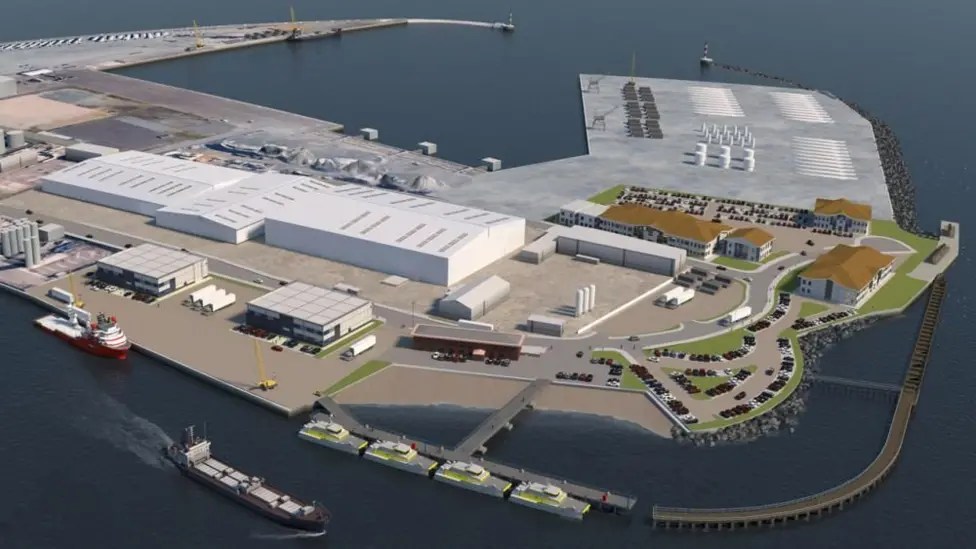
This image from Peel Ports Group shows how the Port of Great Yarmouth will look after the the proposed development.
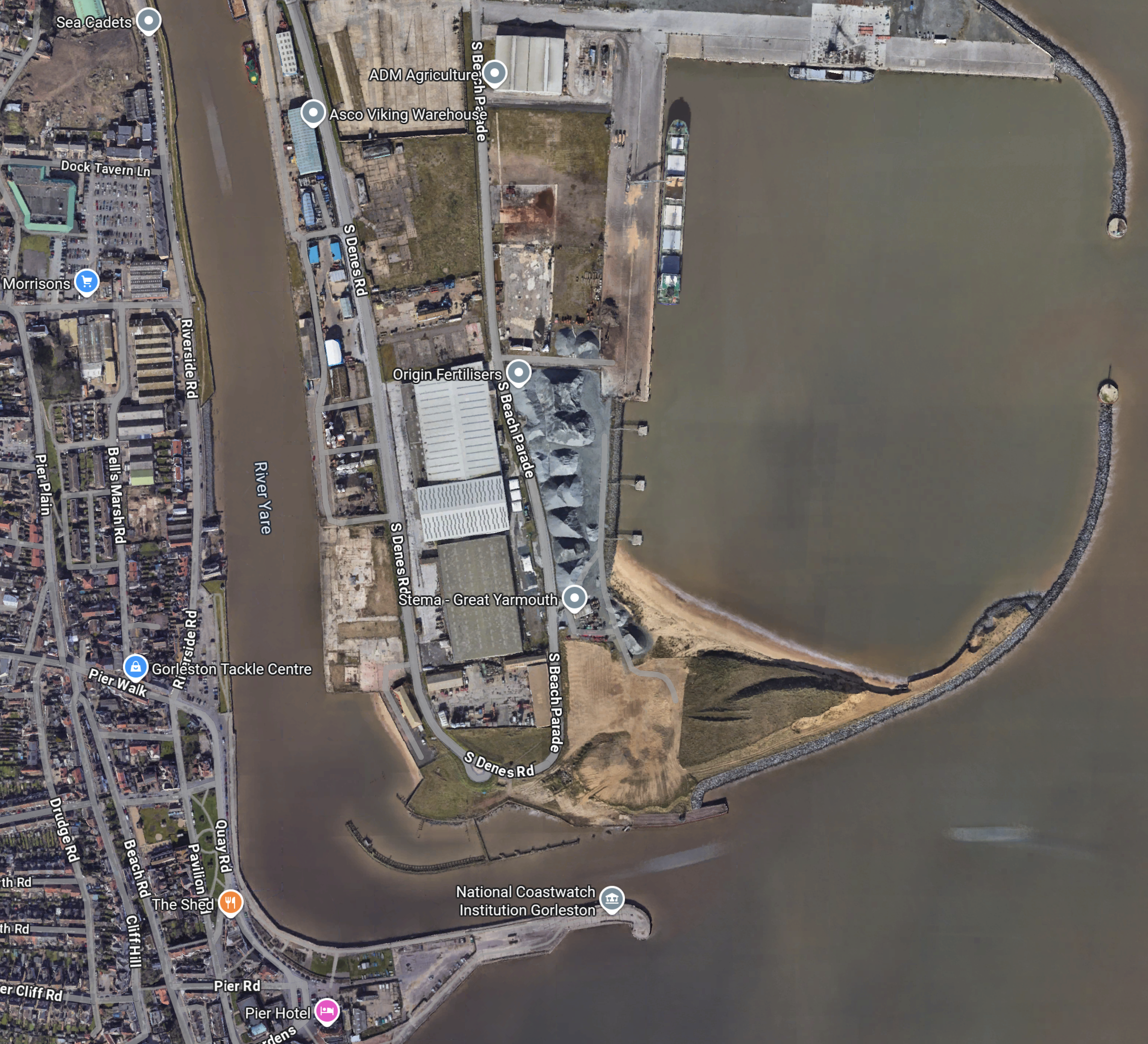
And this Google Map shows the port as it is today.
Note.
- The large triple shed, with the cross-wise middle section can be picked out in both the image and the map.
- The label by the shed says Origin Fertilisers, so I suspect the three objects on the quayside, which are visible in both the image and the map could be conveyors for loading and unloading ships with fertiliser.
- The two breakwaters are visible in both the image and the map.
It looks like the development would mainly involve filling in the Southern part of the current harbour.
With only a quick look and scant details, it looks to me, that it is a development that could be easily realised.
I have some thoughts.
Rail Access To The Port
There is no rail access to the port and I couldn’t see how it could be provided, without demolishing half of the town.
But there are carriage sidings at Great Yarmouth station, which are described in this Wikipedia entry like this.
New sidings were provided at the western end of the station to cope with the additional services operating into the station, following the closure of the M&GN system. It is a crescent-shaped site between the A47 road and Wherryman’s Way at the northernmost point of the River Yare, about 1⁄4 mi (400 m) north-west of the station. It had fallen out of use in the 1980s when Norwich Crown Point depot was built.
In 2010, the unused sidings were purchased by Great Yarmouth Borough Council; they were intended for use as a freight terminal, despite the lack of rail connection to the town’s port. It was hoped that 10,000 tonnes of sugar cane per week would be carried from Yarmouth to Cantley. The need to use a lorry shuttle between the docks and the rail yard, along with a £3.2 million quote for replacing the sidings at Cantley, saw the plan dropped.[19]
In May 2020, Eastern Rail Services commenced a lease with Norfolk County Council and Network Rail for Yarmouth Vauxhall sidings. Managing director James Steward said the siding “matched ERS’s requirement for an East Anglian site to base its rolling stock.” Following extensive de-vegetation works, Direct Rail Services 37402 became the first locomotive in 19 years to run into the sidings on 26 May 2020, followed the next day by it delivering five former Greater Anglia Mark 3 coaches for storage. On 6 July 2020, ERS was authorised a licence exemption permitting them to operate trains within the site
The Port of Great Yarmouth appears to be keen to do its part in the construction of Sizewell C. Could components for the power station, be brought into the port through the new roll-on/roll-off berth and then transferred to rail in the former carriage sidings?
This 3D Google Map shows the carriage sidings.
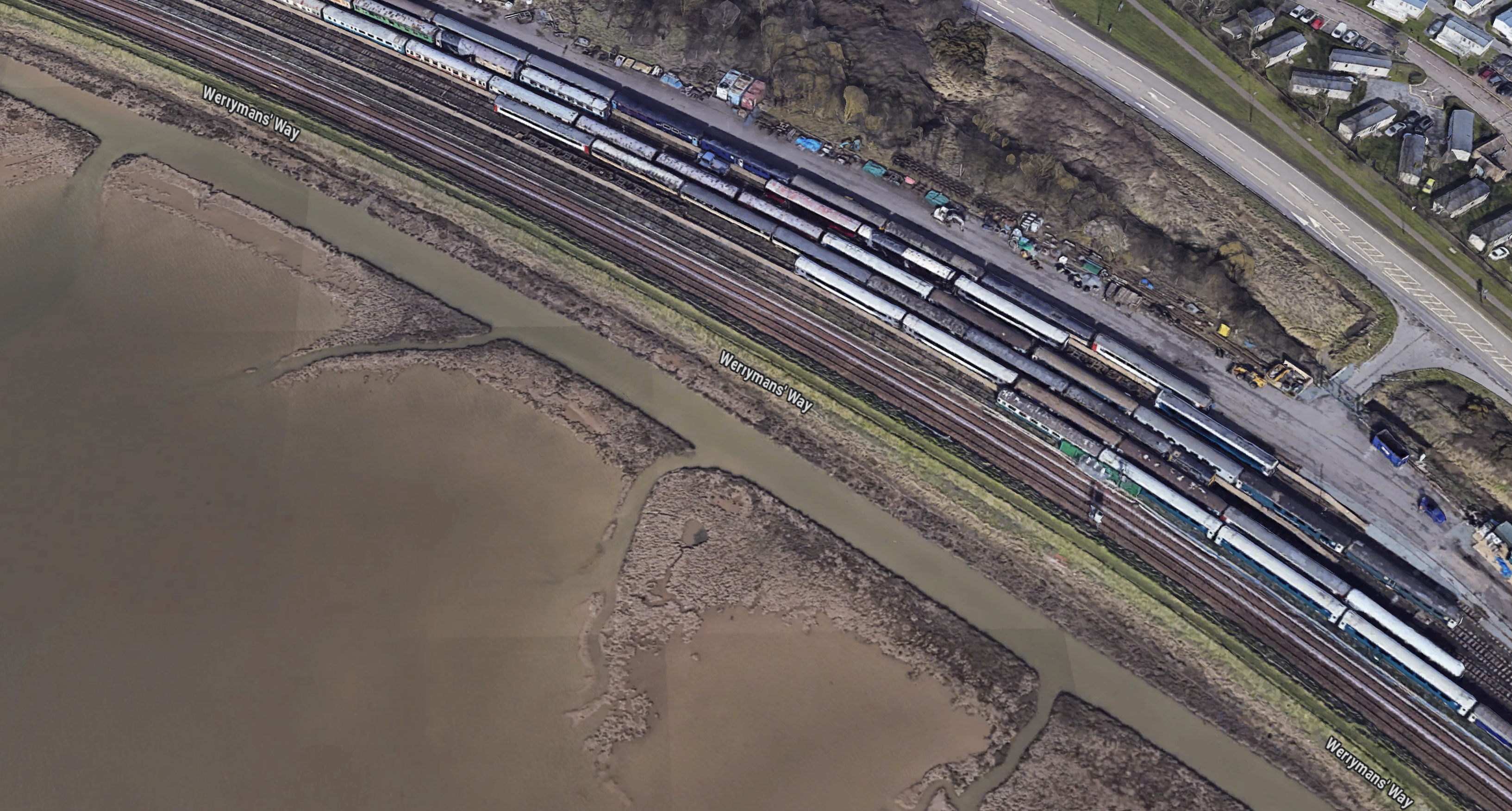
Most of the rolling stock appears to be retired Mark 2 and M3 coaches.
Road Access To The Port
This Google Map shows Great Yarmouth and the Port and roads in the area.
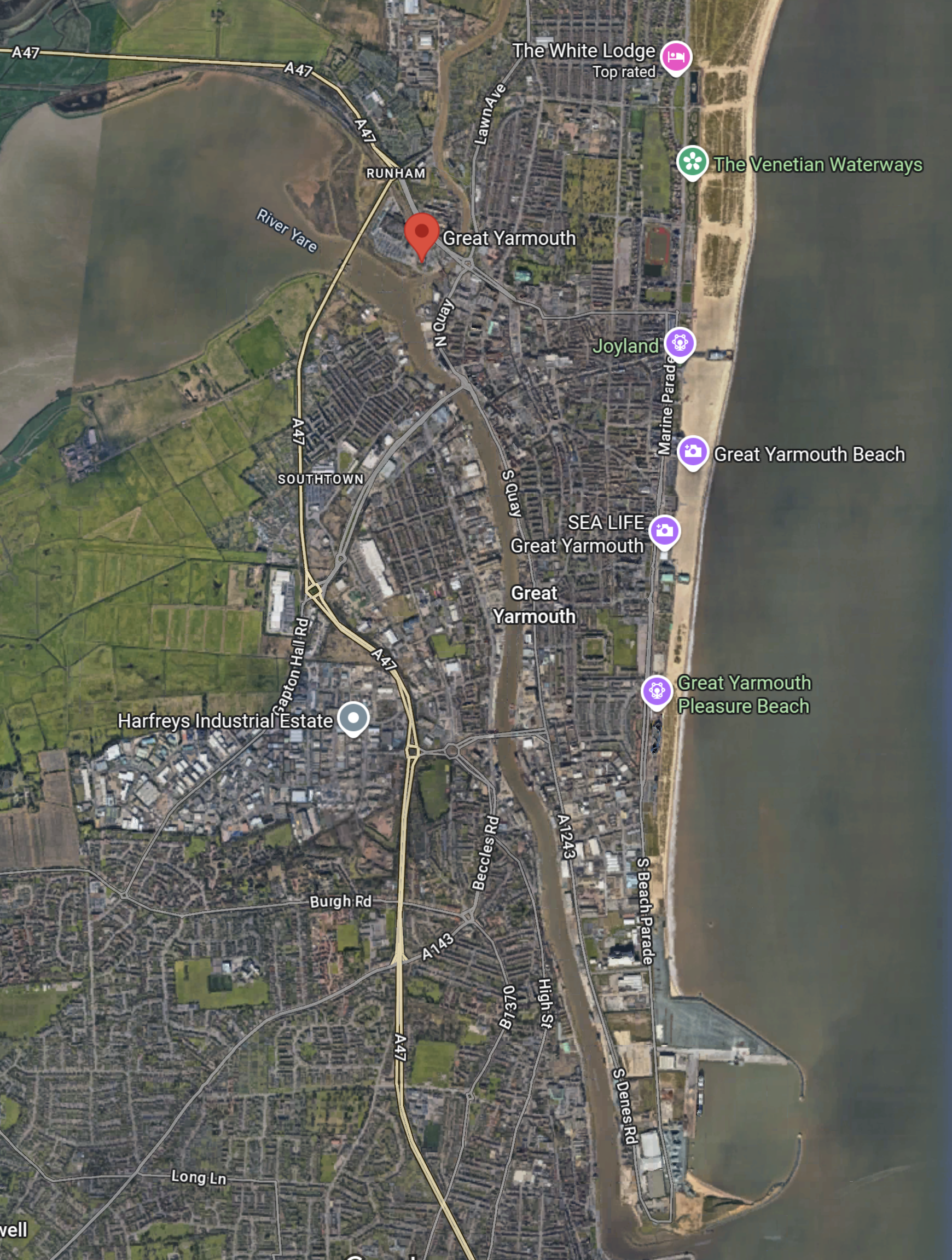
Note.
- The red arrow indicates Great Yarmouth station.
- The Port of Great Yarmouth is in the South-East corner of the map.
- The A 47 runs down the West side of the town.
- The River Yare runs from the railway station to the sea, just below the port.
There is a road on the East bank of the River Yare, that connects to the A 47 and could easily connect to a rail cargo terminal to the North-West of the station in the derelict carriage sidings.
I can certainly see Nimbies not liking the new roll-on/roll-off ferry creating traffic in the town.
The Construction Of Sizewell C
Sizewell C is very similar to Hinckley Point C and this extract from the Wikipedia entry for Hinckley Point C describes some of that power station’s construction.
In March 2017, EDF, after the Office for Nuclear Regulation (ONR) gave approval to start building, the building of the first parts of the plant proper began with a network of tunnels to carry cabling and piping. Work was also under way on a jetty to land building materials, a seawall, and accommodation blocks.
In January 2018, EDF said that they were on track to start generating electricity by 2025 and that they planned to start constructing above-ground structures for the power station by June 2019.
The approximate 2,000 cubic metres (71,000 cu ft) concrete pour for the first reactor started on 11 December 2018. It was completed over a 30-hour period, creating the first part of the unit one 4,500 tonne base, a platform 3.2 metres (10 ft 6 in) thick. The reactor building will be built on the (to be completed) platform. This construction start marks the first new reactor build in the UK after a 30-year break, and the second PWR in the UK, after Sizewell B.
Completion of the base for the first reactor, the final 8,954 cubic metres (316,200 cu ft) of concrete, was achieved in June 2019. Completion of the base for the second reactor, 8,991 cubic metres (317,500 cu ft) of concrete, was achieved in June 2020.
Construction utilises the world’s largest crane, the Sarens SGC-250 double ring crane, which is responsible for lifting Hinkley Point C’s heaviest components. More than 600 heavy fabrications, including the five major parts of each unit’s steel containment liner and dome, are positioned by the SGC-250. The crane, named Big Carl, was delivered in modular form, consisting of over 400 deliveries.
In February 2023, the first nuclear reactor pressure vessel was delivered to site via the Bristol Channel Hinkley-dedicated wharf at Combwich. The pressure vessel was built in France in 2022 by Framatome.
In May 2024, the first of the 520 tonne steam generators was delivered to site in the same manner as the reactor pressure vessel.
Note.
- A good proportion of the power station and the materials to build it were brought in by sea.
- The size of everything is huge.
- Big Carl seems to make appearances in all big projects.
- According to the BBC, Peel Ports are spending £60million on a new roll-on/roll-off terminal, 350 metres of quay and ten hectares of high quality storage space.
I wouldn’t be surprised, if they have the contract for Sizewell C’s logistics, that Peel Ports will be laughing all the way to the bank.
If nothing else, after Sizewell C is completed, they will have a high-class port facility at the end of the A 47 from Birmingham, Leicester, Peterborough and Norwich, which could open up possible ferry routes to Europe.
Between Great Yarmouth And Sizewell
If the components come in to Great Yarmouth on trailers on the RORO ferries from France, they could be taken to Sizewell on the A 12 road.
Smaller components may be taken by road, but I wouldn’t rule out a transfer to rail in the carriage sidings at Great Yarmough, as I indicated earlier.
ScottishPower Renewables Picks Port For East Anglia Two Pre-Assembly
The title of this post, is the same as that of this article on offshoreWIND.biz.
This is the sub-heading.
ScottishPower Renewables, Iberdrola’s UK arm, has selected Peel Ports Great Yarmouth as the staging ground for pre-assembly works for its 960 MW East Anglia Two offshore wind project.
This is the introductory paragraph.
The companies have signed a reservation agreement that will see the Siemens Gamesa turbine components and sections come together for assembly at the Norfolk site before installation in the southern North Sea in 2028.
Note.
- The Port of Great Yarmouth was used for this task with East Anglia One.
- The turbine blades will be manufactured at Siemens Gamesa’s offshore wind blade factory in Hull.
- The monopiles will come from Sif in Rotterdam.
This is the first sentence of the Wikipedia entry for the East5 Anglia Array.
The East Anglia Array is a proposed series of offshore wind farms located around 30 miles off the east coast of East Anglia, in the North Sea, England. It has begun with the currently operational East Anglia ONE, that has been developed in partnership by ScottishPower Renewables and Vattenfall. Up to six individual projects could be set up in the area with a maximum capacity of up to 7.2 GW.
These articles on offshoreWIND.biz indicate that ScottishPower Renewables has been busy signing contracts for East Anglia Two.
- December 4th, 2024 – Nexans Lands Export Cable Contract For East Anglia Two Offshore Wind Farm.
- November 28th, 2024 – Hitachi Energy to Integrate 960 MW East Anglia Two Wind Farm into UK Grid.
- November 12th, 2024 – Siemens Gamesa Bags GBP 1 Billion Turbine Contract For East Anglia Two.
- November 6th, 2024 – Seaway7 Wins East Anglia Two Inter-Array Cable Contract.
- October 31st, 2024 – Sif, Smulders to Deliver Monopiles and TPs For ScottishPower’s East Anglia Two Offshore Wind Farm.
They must have employed lawyers on roller skates to get five contracts signed in just over a month.
Conclusion
East Anglia Two appears to be definitely under way and the Wikipedia extract says there could be a lot more, if all the other wind farms are developed in the same way using the Port of Great Yarmouth.
A total capacity in the East Anglia Array of 7.2 GW will surely be good for both East Anglia and the UK as a whole, but will the natives be happy with all the onshore infrastructure?
I wouldn’t be surprised to see further wind farm developed to generate hydrogen offshore, which will be either brought ashore to the Bacton gas terminal, using existing or new pipelines or distributed using tanker ships to where it is needed.
Permission Granted For Ayrshire Renewables Hub
The title of this post, is the same as that of this article on Scottish Construction Now.
This is the sub-heading.
Planning consent has been granted for a £150 million upgrade to an Ayrshire marine yard, paving the way for increased offshore wind power off the UK’s west coast.
These are the first three paragraphs.
Peel Ports Clydeport has secured permission for the complete redevelopment of the Hunterston marine yard as it prepares the site for major renewables infrastructure. The redevelopment works – which are expected to start in early 2025 and last for around two years – will include substantial upgrades to the marine yard, including infilling the current dry-dock basin and the creation of a new quay wall.
Highview Power recently announced it is to construct the world’s largest Liquid Air Energy Storage (LAES) facility at Hunterston, the latest in a string of renewables projects that are either underway, or in the pipeline, at the site.
The overall redevelopment of Hunterston is expected to attract £3.5 billion in inward investment and create over 5,000 jobs.
Note.
- The Highview Power battery will be 200 MW/3.25 GWh.
- There is also a 400 MW/400 MWh BESS being built at Hunterston.
- The 2 GW MacHairWind project is planned off the coast of Islay.
- According to their web site, MacHairWind will export its first power in the early 2030s.
More renewable infrastructure will surely follow.
Highview Power Plans To Develop 2.5GWh LDES Project In Scotland
The title of this post is the same as that of this article on Power Technology.
This is the sub-heading.
The liquid air energy storage plant at Hunterston is set to deliver a substantial increase in storage capacity
These first three paragraphs add a few more details.
Highview Power has announced plans to develop a long-duration energy storage (LDES) project in Ayrshire, Scotland, with a capacity of 2.5 gigawatt hours (GWh).
The project will be built at Peel Ports’ property at Hunterston, North Ayrshire and will provide five times the existing battery storage capacity of Scotland.
It is supported by the Scottish government and its strategic location optimises the use of renewable electricity produced in the country.
Note.
- Highview Power talks of 200MW/2.5GWh capacity batteries in Scotland on its web site, so I suspect this battery is one of those.
- This battery is as large as some pumped storage hydro systems.
- In UK Infrastructure Bank, Centrica & Partners Invest £300M in Highview Power Clean Energy Storage Programme To Boost UK’s Energy Security, I described the funding now behind Highview Power. The funding appears to be solid, as it includes the UK Infrastructure Bank, Centrica, Goldman Sachs and Rio Tinto.
This is a good start for Highview Power.
 The Anonymous Widower