WES Starts Testing Combined Floating Wind And Wave Energy Models
The title of this post, is the same as that of this article on offshoreWIND.biz.
This is the sub-heading.
Wave Energy Scotland (WES) has started a series of tank tests of floating wind and wave energy structures at the University of Edinburgh’s FloWave facility to explore the potential benefits the synergy between the two technologies could bring.
These two paragraphs introduce the technology.
The tank tests currently being completed by WES use sea states which are representative of one of the future floating wind lease sites on the west coast of Scotland, leased through the ScotWind program and which has an appropriate water depth and wave resource for large-scale wave energy exploitation.
The physical model used for the testing incorporates multiple identical wave energy absorbers mounted onto a semi-submerged, triangular floating platform.
Have we got enough research facilities to test devices like these?
I can find these.
With Edinburgh, that makes five.
Canary Wharf Move Means Expansion For Drug Trials Operator
The title of this post, is the same as that of this article on The Times.
These three paragraphs outline the story.
An Aim-listed company that tests infectious and respiratory disease products on volunteers is preparing to move its operations to Canary Wharf.
Amid booming demand for its services, hVIVO, which infects volunteers with safe doses of virus agents, then quarantines them before testing the efficacy of vaccines and antivirals — in so-called human challenge trials — will move from its clinics in Whitechapel, east London, to a new larger facility near by owned by Canary Wharf Group early next year.
Canary Wharf is aiming to attract businesses from the life sciences and health sectors in a drive to become a sciences hub and less reliant on the financial services industry.
This is the second story about life science companies moving to Canary Wharf after Canary Wharf Boosts Its Science Ambitions.
I have my thoughts.
Canary Wharf Is A Transport Hub
Canary Wharf is served by the following transport links.
- Buses
- Docklands Light Railway
- Elizabeth Line
- Jubilee Line
- Thames Clipper
It is very well-connected, which means that staff and volunteers can get there easily.
Canary Wharf Is A Leisure Destination
Canary Wharf is very much more than a collection of expensive offices.
There are shops, bars, restaurants, a museum and a cinema complex.
There Is A Shortage Of Lab-Rats
I volunteer for medical research and regularly, I’m called in to help with the recruitment of more volunteers.
I suspect, that many would prefer to volunteer at Canary Wharf, rather than some parts of London.
Conclusion
I suspect that we’ll see an expansion of medical research of all kinds at Canary Wharf.
Airbus To Trial In-flight Auxiliary Power Entirely Generated By Hydrogen
The title of this post, is the same as that of this press release from Airbus.
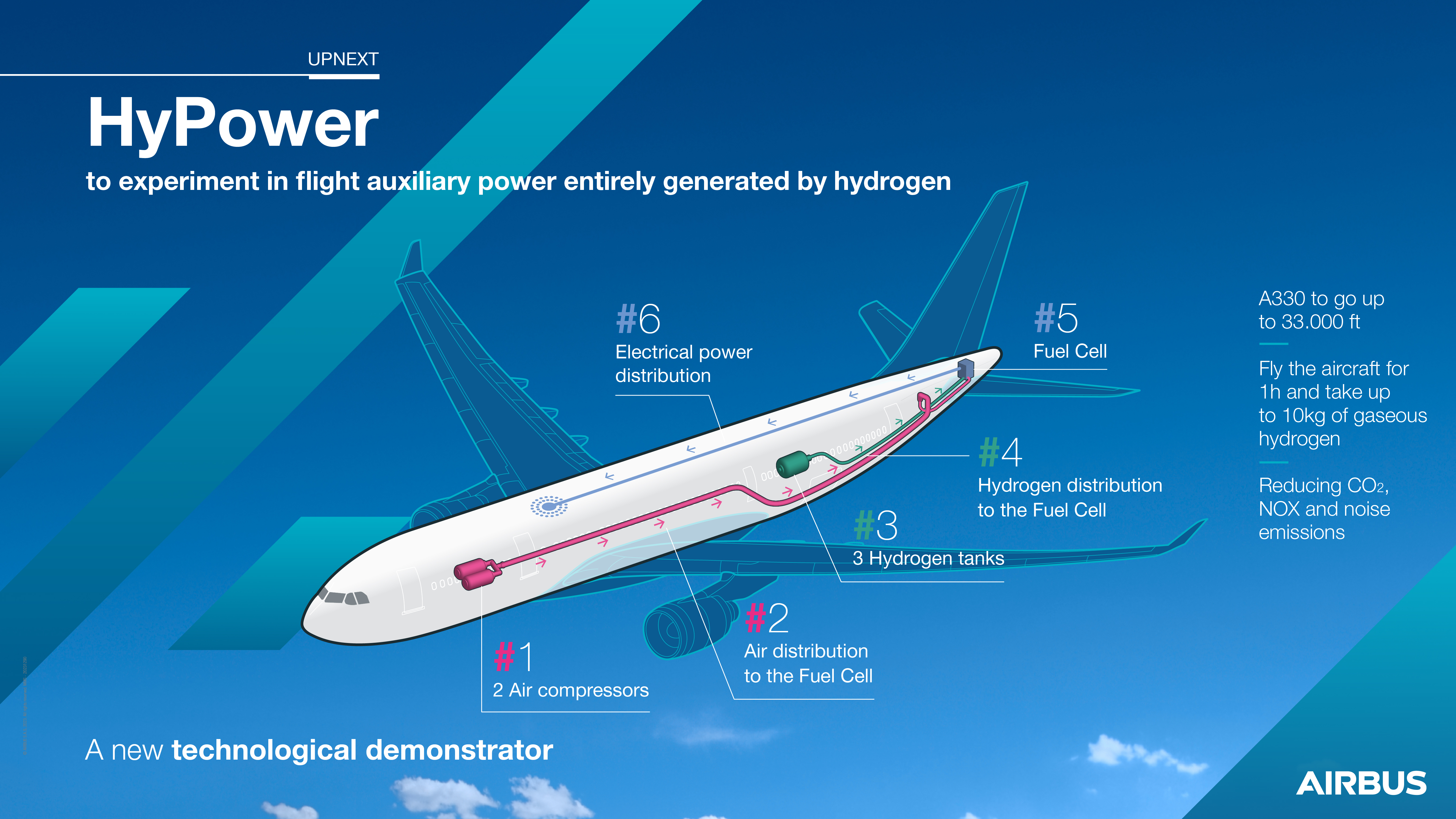
Airbus UpNext has launched a new demonstrator programme to explore, on the ground and in flight, a new architecture for the generation of non propulsive energy through the use of hydrogen fuel cells.
On conventional airliners, the APU (Auxiliary Power Unit), a small additional engine that runs on traditional jet fuel, provides together with the engines the energy required to power a number of non-propulsive aircraft functions, such as air conditioning, onboard lighting and electric power for avionics. With this new technology demonstrator, led from its facilities in Spain, Airbus UpNext will replace the actual APU of an A330 with a hydrogen fuel cell system that will generate electricity. Known as HyPower, the hydrogen fuel cell demonstrator also aims to reduce the emissions of CO2, nitrogen oxides (NOx) and noise levels associated with a traditional APU.
New design features and integration techniques will also contribute to maturing the safety and operations of future hydrogen-powered aircraft and will demonstrate the stable operation of a fuel cell in-flight, including its restart.
This Airbus infographic describes the system.
This looks to be a well-thought out project and I suspect Airbus will learn a lot about hydrogen and how to use it.
I have some thoughts.
The Noise Factor
Reduction of noise is mentioned in both the text and the infographic, so it must be important.
Years ago, I remember a take-off from St. Lucia, where on the previous day, there had been an engine failure on the flight from London. This meant we were treated to the view of a rare site of a five-engined Jumbo Jet, as the next day’s flight brought in a spare engine on the spare mounting under the wing. Engineers then worked all night to put this engine on the previous day’s stricken plane, whilst we had an extra night in the Carribean.
When it eventually came to leaving, we were on the absolutely crammed-full rescue plane, which was an almost new 747-300.
I remember the plane being positioned at the very Western end of the runway and we waited a long time before take-off. From our position towards the rear of the plane, I couldn’t see if they topped up the fuel tanks but they may have done. The pilot then gave us the good news, that we would be going to Heathrow without the usual intermediate stop at Barbados to take on fuel.
We had no problems, but I suspect the airport’s neighbours on the island didn’t like the screaming noise of the APU (Auxiliary Power Unit) disturbing the peace, whilst we waited for take-off.
A hydrogen fuel cell-powered APU could have advantages in some take-offs from perhaps smaller airports. The plane would be towed into position for take-off by a battery-electric aircraft tug, with all aircraft systems running on the hydrogen-powered APU. When everything was ready, the first engine would be started by the power from the APU and then after all engines were started and everything was ready, the plane would take off.
It looks to me, that a hydrogen-powered APU and a zero-carbon aircraft tug, could work together to reduce pre-take off pollution, carbon-dioxide emissions and noise at airports.
The Inflight Restart
Two air incidents, illustrate the need for an inflight restart of the APU.
The Wikipedia entry for the flight describes the crash like this.
British Airways Flight 38 was a scheduled international passenger flight from Beijing Capital International Airport in Beijing, China, to London Heathrow Airport in London, United Kingdom, an 8,100-kilometre (4,400 nmi; 5,000 mi) trip. On 17 January 2008, the Boeing 777-200ER aircraft operating the flight crashed just short of the runway while landing at Heathrow. No fatalities occurred; of the 152 people on board, 47 sustained injuries, one serious. It was the first time in the aircraft type’s history that a Boeing 777 was declared a hull loss, and subsequently written off.
Wikipedia gives this as the cause of the accident.
Ice crystals in the jet fuel were blamed as the cause of the accident, clogging the fuel/oil heat exchanger (FOHE) of each engine. This restricted fuel flow to the engines when thrust was demanded during the final approach to Heathrow.
Suppose this problem had occurred earlier and shut the engines down in the middle of Russia. At the 40,000 feet, they were flying, they could have probably been able to glide into the nearest suitable airport and land without main engine power. But the APU would have been needed to power the aircraft’s systems like instruments and air-conditioning.
One of my favourite books is All Four Engines Have Failed by Betty Toothill, who was a passenger on BA 009 on the 24th June 1982.
The Wikipedia entry of the flight starts like this.
British Airways Flight 009, sometimes referred to by its callsign Speedbird 9 or as the Jakarta incident, was a scheduled British Airways flight from London Heathrow to Auckland, with stops in Bombay, Kuala Lumpur, Perth, and Melbourne.
On 24 June 1982, the route was flown by the City of Edinburgh, a Boeing 747-200 registered as G-BDXH. The aircraft flew into a cloud of volcanic ash thrown up by the eruption of Mount Galunggung around 110 miles (180 km) south-east of Jakarta, Indonesia, resulting in the failure of all four engines. Partly because the event occurred at night, obscuring the cloud, the reason for the failure was not immediately apparent to the crew or air traffic control. The aircraft was diverted to Jakarta in the hope that enough engines could be restarted to allow it to land there. The aircraft glided out of the ash cloud, and all engines were restarted (although one failed again soon after), allowing the aircraft to land safely at the Halim Perdanakusuma Airport in Jakarta.
In this incident, the APU would have been needed to start the engines.
These incidents show how important the APU is to safe flying.
Some might even argue that a hydrogen fuel cell-powered APU running on its own independent hydrogen supply would be preferable than an APU based on a small gas turbine using the same fuel as the main engines.
DOE Announces 7 Awards To Cut Heliostat Costs
The title of this post, is the same as that of this article on Solar Paces.
I haven’t talked about heliostats much before and can only find these two posts; one about Australia and one about Spainspain
- ‘Unique’ Solar-Storage Solution Providers Plot 300MW / 3.6GWh Australia Project
- Spanish Govt Approves Energy Storage Strategy, Sees 20 GW In 2030
I feel it is good that the Americans are backing this technology.
These are a summary of the projects.
- SunRing: Advanced Manufacturing and Field Deployment: This project by Solar Dynamics LLC and partners will develop processes to maximize cost-competitiveness, performance, and reliability of Solar Dynamics’ existing SunRing heliostat design.
- HELIOCOMM: A Resilient Wireless Heliostats Communication System: This components-and-controls project by the University of New Mexico will model a resilient wireless communication system based on the principles of integrated access and backhaul (IAB) technology, entropy-based routing, dynamic spectrum management, and interference mitigation.
- An Educational Program on Concentrating Solar Power and Heliostats for Power Generation and Industrial Process: This project by Northeastern University will develop an educational program focused on concentrating solar power (CSP) and heliostats for power generation and industrial processes.
- Demonstration of a Heliostat Solar Field Wireless Control System: Solar Dynamics LLC, with partners Remcom and Vanteon Corporation, will carry out a project aimed at demonstrating the reliable operation of a wireless heliostat solar field control system using commercially available products and developing analytical tools to de-risk the large-scale deployment of the wireless technology to solar fields with tens of thousands of heliostats.
- Twisting Heliostats With Closed-Loop Tracking: This project will design, manufacture, and test a new type of heliostat and study its application for high-concentration CSP.
- Digital Twin and Industry 4.0 in Support of Heliostat Technology Advancement: The Tietronix project aims to leverage technologies from the Fourth Industrial Revolution (Industry 4.0) to enhance the CSP industry and achieve the cost reduction experienced by other industries that have already adopted such advancements.
- Robotic-Assisted Facet Installation (RA-FI): Sarcos Technology and Robotics Corp., in collaboration with Heliogen, will investigate the feasibility of a novel mobile robotic system capable of supporting the installation of mirror facets onto a heliostat.
Governments and institutions and individuals with money should support this sort of research and development.
Bonus For GPs If Patients Join Drug Trials In Plan To Lure Firms To NHS
The title of this post, is the same as that of this article on The Times.
This is the sub-heading.
£650m boost for medical research after number of participants slumps
These three paragraphs outline what is to be done.
Tens of thousands more patients will be signed up for clinical trials as ministers promise drug companies better access to the NHS to expand the economy and develop cutting-edge treatments.
Jeremy Hunt, the chancellor, is promising a £650 million package to boost life sciences as he attempts to lure pharmaceutical giants to Britain.
GPs will be offered financial incentives to recruit patients into trials of new treatments and hospitals will be given research targets under plans to reverse a slump in clinical testing while the NHS struggles with the backlog from Covid-19.
It all sounds good to me.
I have been involved in several trials and medical research projects.
- As part of my coeliac disease diagnosis, one endoscopy was performed by Rebecca Fitzgerald at Cambridge, as she was taking samples of bile fluids for her research into Barrett’s esophagus.
- After the death of my wife, I was interviewed by PhD students in the Psychology Department at Liverpool University for their research into widowhood.
- Oxford University interviewed me on diet for their coeliac disease research.
- After my stroke, I spent an entertaining afternoon at the University of East London doing balance tests by computer. Their aim was to develop a reliable balance test for stroke and other patients, that could be carried out by physiotherapists quickly, than by more expensive doctors.
- I have also been on a drug trial at Queen Mary University, but that drug was useless and had no good or bad affects, so the trial was halted. However, it did lead to other enjoyable activities in the field of patient relations with treatment and research.
As a confirmed coward, I should note that with the exception of the drug trial, all of the other projects were low risk.
I should say, that I also sponsor pancreatic cancer research at Liverpool University, in memory of my son, who died from the disease. I wrote about the first Liverpool project in There’s More To Liverpool Than Football And The Beatles!.
A Database Of Projects Open For Volunteers
I believe that this is needed, so that those like me, who like to contribute to research can volunteer.
Perhaps some of the £650 million, that has been promised by Jeremy Hunt, could be used to create the database.
I also believe the database could be used for other non-medical research.
Can ‘Enhanced Rock Weathering’ Help Combat Climate Change?
The title of this post, is the same as that of this article on the BBC.
This is the sub-heading.
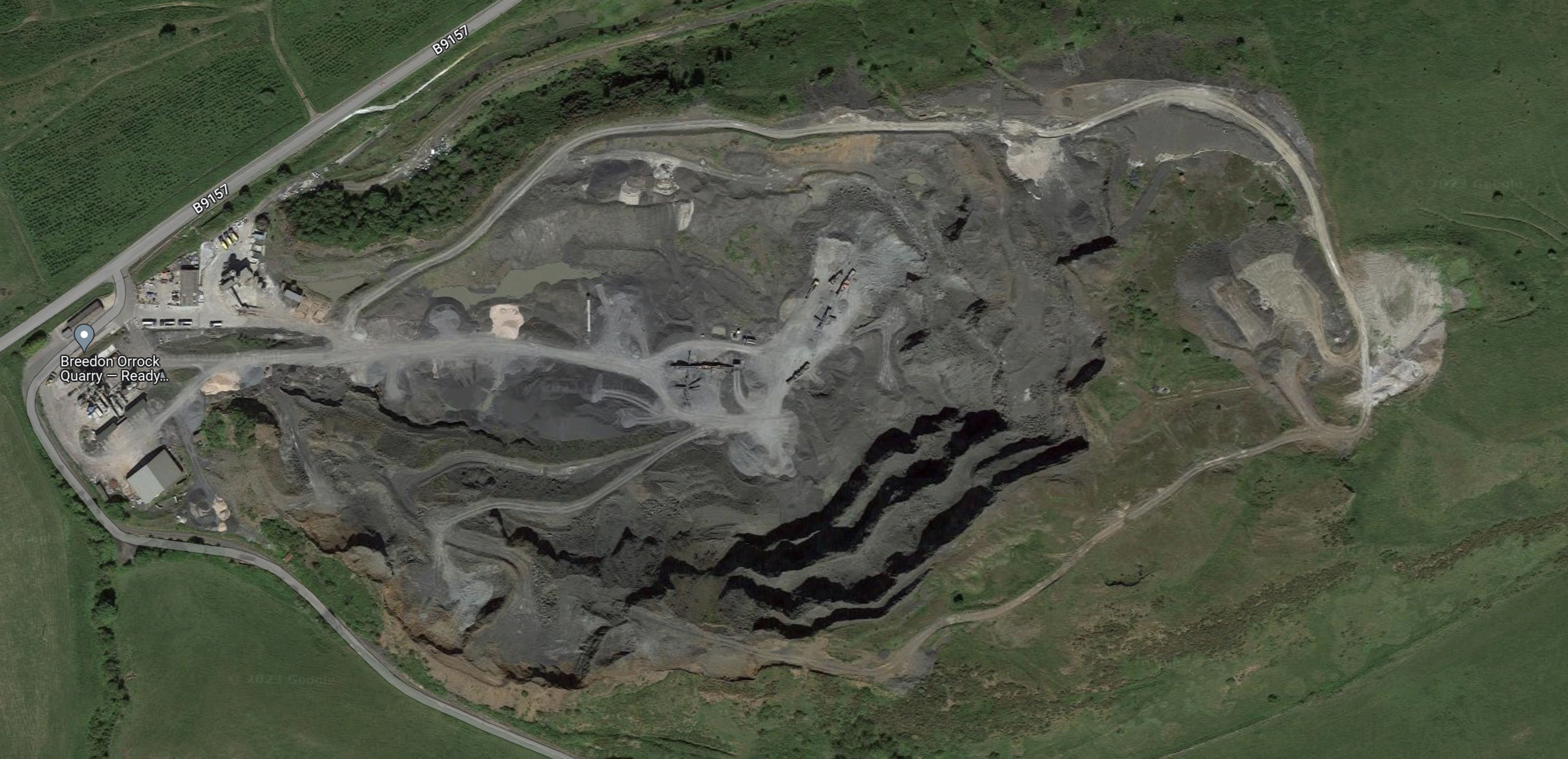
In a quarry surrounded by the din of heavy machinery Jim Mann crouches down and picks up a handful of tiny black rocks.
These three sentences introduce Jim and his magic dust.
“This is my magic dust,” he says with a smile, gently rubbing them between his fingers.
He’s holding pieces of basalt. It’s a hard volcanic rock that is neither rare nor particularly remarkable.
But through a process known as ‘enhanced rock weathering’ it could help to cool our overheating planet.
This Google Map shows Orrock Quarry, where the basalt is mined.
The article then gives a simple explanation of enhanced rock weathering.
When one of the companies, I’d backed won a green design award it was presented by David Bellamy. I remember having a very radical conversation with him, about some of the projects, where he’d been an advisor.
Some might have dismissive views about Jim Mann’s work as being too good to be true, but when I see the chemistry, I suspect,I’ll find it to be sound.
It would be a very interesting process to mathematically model!
£77 Million Investment For UK Heavy Duty And Commercial Vehicle Projects
The title of this post is the same as that of this press release from the Advanced Propulsion Centre.
These are the projects.
Ford to design, develop, and build a fleet of 8 hydrogen fuel cell powered Transit vans, with the latest advances in technology
£8 million awarded by government, matched by industry to a total £16.3 million.
This research project will design and develop a hydrogen fuel cell-powered version of the Ford Transit van, with a Ford Dagenham estate facility re-purposed for upfitting of the vehicle. By bringing the manufacturer, vehicle operator and supply chain businesses together, this project aims to establish a business case for the wider rollout of hydrogen Light Commercial Vehicles.
Project partners include: Ocado, BP, Cygnet Texkimp, Cambustion, Viritech.
Note.
- I suspect Ocado will do the road testing.
- BP will probably supply the hydrogen.
- Cygnet Texkimp are a company based in Northwich and is a leading global provider of fibre handling and converting technology. Have they developed a machine for knitting hydrogen fuel tanks?
- Cambustion‘s Engineering Services team provides powertrain development and testing services to a range of global clients from our Cambridge, UK base.
- Viritech’s web site has a mission statement of Rewiring the DNA of Hydrogen Powertrains.
Ford seem to have assembled a team of all the talents.
Wrightbus to develop a new world-leading zero-emission battery and hydrogen fuel-cell electric, multi-axle vehicles
£6.4 million awarded by government, matched by industry to a total £12.7 million.
This project will produce a new, market-leading platform for battery and fuel cell electric driven buses. Whilst demand is growing for zero-emission vehicles, there are currently few options available for heavy, multi-axle vehicles like large buses.
Project partners include: Queens University Belfast, Grayson Thermal Systems, Hutchinson Engineering, Translink.
Note.
- Grayson Thermal Systems are based in Birmingham and specialise in providing HVAC for vehicles and especially zero-carbon ones.
- Hutchinson Engineering are based in Widnes and invest in state-of-the-art machinery and technology to give our customers the most advanced, cost-effective solutions in design, fabrication and manufacturing.
- Translink provides public transport in Northern Ireland.
It looks like Wrightbus have excellent partners.
ULEMCo creating a zero-emission hydrogen fuel cell range extender for prototype ambulance, fire engine and road sweepers
£3.9 million awarded by government, matched by industry to a total £7.9 million.
This project will develop a hydrogen fuel cell range extender for electric vehicles used for special purposes, such as ambulances, fire engines and street sweepers. The zero-emissions range extender will be based on existing, proven technology from the Toyota Mirai, and demonstrate how zero emissions vehicles can be used in a wide range of specialised and challenging settings.
Project partners include: Altair Engineering, Emergency One, Technical Services Ltd, Oxon Fire & Rescue Services
Note.
- ULEMCo are based in the Liverpool City Region and it is very much in Liverpudlian DNA to repurpose something that works. Hence the use of The Toyota technology.
- Altair Engineering is a multinational engineering and technology company.
- Emergency One is a Scottish manufacturer of fire engines and emergency vehicles.
- Technical Services Ltd, who are based in Cleckheaton, supply thermal management systems and solutions.
- Oxon Fire & Rescue Services will obviously be doing the testing.
In Hydrogen-Powered Ambulance Drives Into Glasgow Ahead Of London Trial, I wrote about a prototype hydrogen-powered ambulance, that was built by ULEMCo and industry partners, that was shown at COP26.
Is this project turning the prototype into a system, that can be manufactured in large volumes?
Bramble Energy developing a hydrogen double-deck bus, using innovative, low-cost fuel cell technology
£6.3 million awarded by government, matched by industry to a total £12.7 million.
This project will demonstrate a fuel cell/battery hybrid powertrain on a double-decker bus. This novel product will be cheaper than the equivalents currently available for large vehicles like buses and uses innovative new electronics and energy recovery technologies.
Project partners include: University of Bath, Equipmake, Aeristech
Note.
- Bramble Energy‘s Printed Circuit Board Fuel Cell (PCBFC™) is a patent protected, revolutionary design which leverages existing manufacturing routes from the printed circuit board industry to offer a cost-effective, scalable hydrogen fuel cell solution.
- Equipmake are based at Snetterton in Norfolk.
- In Equipmake Hybrid To Battery Powered LT11, I describe Equipmake’s conversion of a New Routemaster to battery operation.
- Aeristech are based in Crawley and have developed a range of award-winning compressors for Tier-1, OEMs and other customers.
- Is the compressor needed to pump a mixture of hydrogen and air through the fuel cell?
I have a feeling, that this could be a very revolutionary design.
BorgWarner developing hydrogen combustion systems for heavy-duty commercial transport
£4.9 million awarded by government, matched by industry to a total £9.8 million.
This project aims to speed up the rollout of hydrogen-burning internal combustion engines, as an alternative to diesel. Hydrogen is a clean fuel, producing only water when burned. Project Cavendish will develop new fuel and air management systems, so that existing heavy duty diesel technologies can be repurposed to use hydrogen as fuel.
Project partners include: Mahle, Cambustion, Hartridge
Note.
- BorgWarner is a large American automotive supplier.
- Mahle is a large German automotive supplier.
- Cambustion‘s Engineering Services team provides powertrain development and testing services to a range of global clients from our Cambridge, UK base.
- Since the brand formation in 1930 Hartridge, who are based in Buckingham, has become a world leader in diesel fuel injection test equipment.
- Project Cavendish is obviously named after Henry Cavendish, who discovered hydrogen.
In Ricardo Supports Industry Leaders To Develop Innovative Dedicated Hydrogen Engine, I talk about another project involving BorgWarner. Is Project Cavendish a follow-on from the original project or a new one?
Leyland Trucks scaling up the production of electric trucks through innovations in automation and advanced testing
£2.6 million awarded by government, matched by industry to a total £5.1 million.
By better use of automation and advanced testing, Leyland Trucks aim to increase productivity and step up their production of battery electric trucks. A ‘digital twin’ of the Leyland production line will be set up, meaning any changes can be run in simulation before being rolled out physically.
Project partners include: Expert Tooling, HSSMI
Note.
- Leyland Trucks is one of Britain’s leading manufacturing companies. It is PACCAR’s established centre for light and medium duty truck design, development and manufacture. The company is based in Leyland.
- Expert Technologies are specialists in delivering industrial automation solutions. The company is based in Coventry.
- HSSMI is a sustainable manufacturing consultancy.
As I have done a lot of simulation in my time, I’m very much in favour of digital twins.
JLR leading a consortium research project to develop a high-efficiency and highly integrated 800V inverter designed and built in the UK
£6.3 million awarded by government, matched by industry to a total £12.6 million.
This project will explore and develop technology for inverters – a key component in electric vehicles. As well as developing a best-in-class product, this work will support the growth of a UK supply chain in components for electric vehicles.
Project partners include: University of Bristol, Custom Interconnect Ltd, API Capacitors Ltd
Note.
- JLR is Jaguar Land Rover.
- Custom Interconnect is an advanced electronics manufacturing company, which is based in Andover.
- API Capacitors is the UK’s leading designer and manufacturer of high quality power capacitors for power electronic applications. The company is based in Great Yarmouth.
I suspect this invertor will have several applications.
Conclusion
The grants seem to have been widely spread around the UK.
Coeliac Journey Through Covid-19 – Medical Research
Medical Research
I first got involved as a lab-rat in medical research, when I had my second endoscopy to check for coeliac disease at Addenbrooke’s Hospital in 1997. Rebecca Fitzgerald took a sample of fluid from my gut for her Barrett’s oesophagus research.
After my wife died, I asked my contact in Alumni Relations at Liverpool University, if they did widowhood research.
They are one of the few universities that do and I did several interviews for PhD students in the unit, which is in the Psychology Department. It was very much a positive experience and certainly helped with my grieving.
In some ways the most enjoyable piece of research I have been involved in, was at the University of East London, where they were using computers to measure the balance of those recovering from strokes.
My GP also suggested that I get involved in drug tests at Queen Mary University. The tests were abandoned as the drug didn’t have any good or bad effects, but now I’m one of the William Harvey Centre’s lab-rats.
I also help to sponsor pancreatic cancer research at Liverpool University in memory of my son.
In There’s More To Liverpool Than Football And The Beatles!, I detail some research, that I sponsored in a small way.
I may be tempted to do the fund-raising trip again.
I always advise people to get involved in medical or psychological research, as I have found it such a beneficial experience.
One thing that is needed, is an on-line database of all research projects that are looking for volunteers.
Remember, that much medical and psychological research is about as dangerous as meeting someone in a GP’s surgery for a chat or perhaps in a cafe and having a coffee.
Northern Unveils ‘Supersonic’ Leaf Busting Tech
The title of this post, is the same as that of this article on Rail Technology Magazine.
These two paragraphs outline the project.
A collaborative effort between Northern and The University of Sheffield has resulted in the development of an innovative piece of technology, small enough to be fitted onto passenger trains, that clears leaves from the line.
A recent demonstration at the Wensleydale Railway has highlighted the effectiveness of this tech, meaning that the disruptions from fallen leaves to rail operations could soon be a thing of the past.
The process is described in this paragraph.
The new cleaning system, developed by researchers from the University’s Department of Mechanical Engineering, works via firing dry ice pellets in a stream of air at supersonic speed at the railhead, resulting the freezing of the leaves stuck on the line, which are subsequently blasted away as the dry ice pellets turn back into a gas. The dry ice pellets themselves are provided from waste carbon dioxide from other industries.
I suppose the only problem, is that it releases carbon dioxide into the atmosphere.
More Details
This page on the Sheffield University web site, which is entitled End Of The Line For Rail Delays Caused By Autumn Leaf Fall, gives more derails.
ORE Catapult, ABP, Microsoft & Co To Create World’s Biggest Offshore Wind ‘Living Lab’ In UK
The title of this post, is the same as that of this article on offshoreWIND.biz.
This is the sub-heading.
A consortium led by the Offshore Renewable Energy (ORE) Catapult has launched a project that will create the biggest offshore wind “living lab” in the world in the UK through the development of a 5G Testbed that includes Grimsby Port and the Lynn and Inner Dowsing offshore wind farm.
These two paragraphs outline the project, its aims and partners.
The GBP 2.8 million (approximately EUR 3.2 million) project, which will run until March 2024, involves setting up a 5G Testbed to allow technology providers to test and demonstrate their equipment in real-world conditions, with access to reliable, high-speed communications.
The aim is to kickstart a digital revolution in offshore wind operations and maintenance (O&M) and accelerate the development of a new generation of digital technologies essential for the expansion of offshore wind generation, according to ORE Catapult, which partnered with Microsoft, Vilicom, JET Connectivity, XceCo, Associated British Ports (ABP), Acceleran and Satellite Applications Catapult to realise the project.
This seems to me to be a very good idea and it is certainly well-backed.
 The Anonymous Widower