What Will Happen To Northern’s Class 195 Trains?
Northern’s Class 195 trains could be a problem in the future.
- They are diesel multiple units.
- There are twenty-five two-car trains and thirty-three three-car trains.
- All cars have a Rolls-Royce MTU 6H1800R85L diesel engine, that drives the train through a ZF EcoLife 6-speed transmission.
- They are 100 mph trains, which is adequate for the routes they serve.
- According to Wikipedia, the trains are designed for a lifespan of thirty-five years, which takes the trains past the date, when it is intended that all trains should be zero-carbon.
It looks to me, that a plan will be needed to decarbonise these trains, as they are probably too new and costly to scrap.
These are possibilities to upgrade them to zero-carbon.
Rebuild as Class 331 Electric Trains
The design of the Class 195 trains is based on the same platform as that of the Class 331 trains.
I would expect that it could be possible to rebuild the Class 195 trains as Class 331 trains.
But it would be an expensive and disruptive process and would require a lot of electrification.
Some battery-electric versions could be created to cut the need for electrification.
Run The Trains On Net-Zero Hydrogenated Vegetable Oil Or Other Fuels
In Powered By HVO, I wrote about research going on into the use of Hydrogenated Vegetable Oil or HVO.
There is also ongoing research into other net-zero fuels that can be used in a diesel engine.
The process used by Velocys to create sustainable aviation fuel can also be used to produce diesel from various sources like disposable nappies, household waste and scrap wood.
Run The Trains On A Dual Fuel Basis With Hydrogen
In Grand Central DMU To Be Used For Dual-Fuel Trial, I talk about how Grand Central in collaboration with a company called G-volution are running experiments with dual-fuelling a Class 180 train. G-volution state that they could dual fuel with hydrogen using their technology.
The Class 180 trains have Cummins engines, but I suspect G-volution’s technology or something similar could be applied to the Rolls-Royce MTU engines in the Class 195 trains.
This could be a very promising route.
Convert The Diesel Engines To Run On Hydrogen
Cummins and JCB have developed internal combustion engines, that can run on hydrogen. I would be very surprised if Rolls-Royce MTU are not developing this technology.
Conclusion
There are options to convert the Class 195 trains into low or zero-carbon trains.
.
The Mathematics Of A Hydrogen-Powered Freight Locomotive
If we are going to decarbonise the railways in the UK and in many countries of the world, there is a need to replace diesel locomotives with a zero-carbon alternative.
In looking at Airbus’s proposal for hydrogen powered aircraft in ZEROe – Towards The World’s First Zero-Emission Commercial Aircraft, it opened my eyes to the possibilities of powering freight locomotives using gas-turbine engines running on liquid hydrogen.
A Hydrogen-Powered Equivalent Of A Class 68 Locomotive
The Class 68 Locomotive is a modern diesel locomotive used on UK railways.
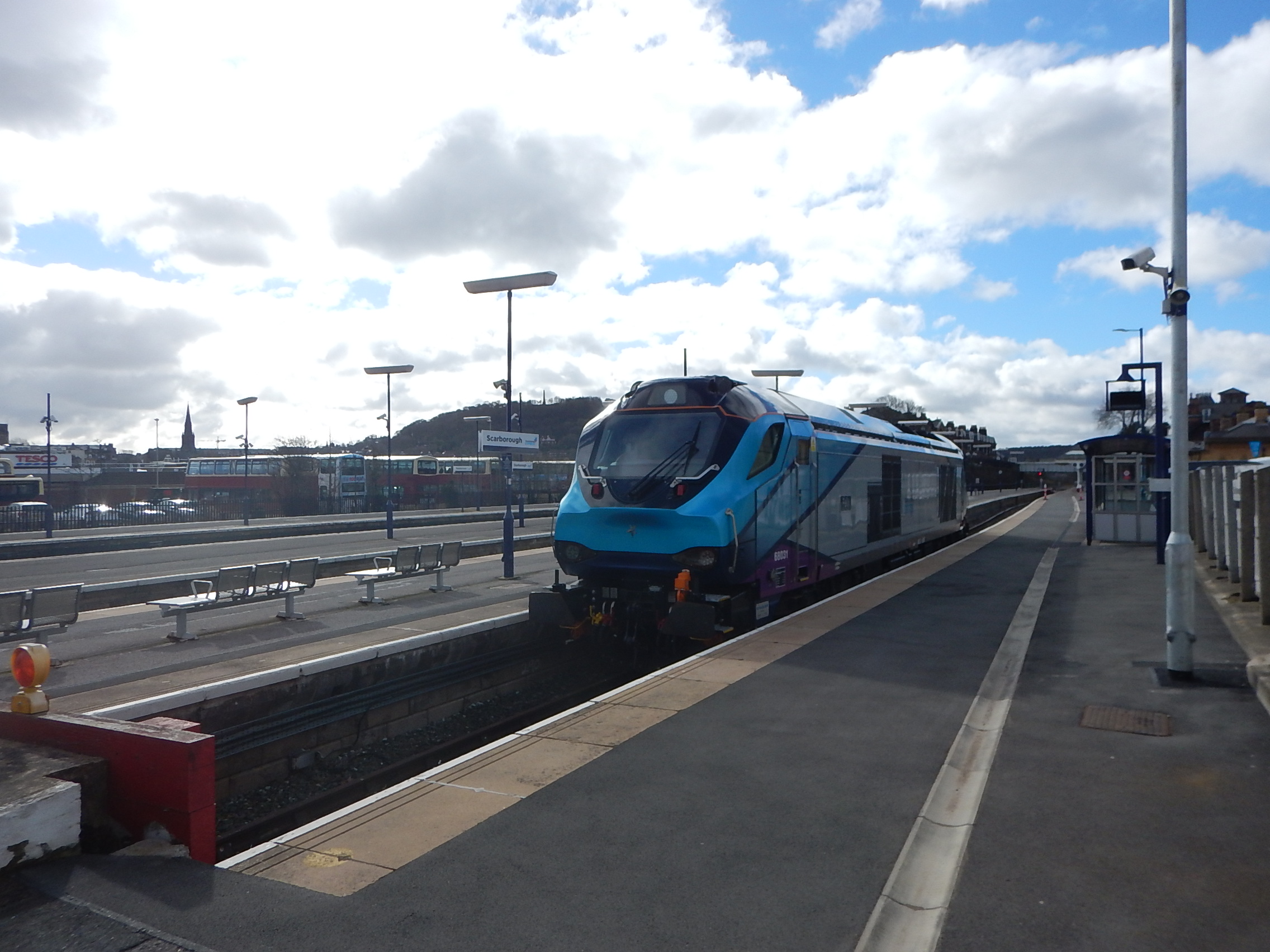
This is a brief specification
- It can pull both passenger and freight trains.
- It has an operating speed of 100 mph.
- The diesel engine is rated at 2.8 MW
- It has an electric transmission.
- It has a 5,000 litre diesel tank.
- It weighs 85 tonnes.
- It is 20.5 metres long.
There are thirty-four of these locomotives in service, where some haul passenger trains for Chiltern Railways and TransPennine Express.
Rolls-Royce’s Staggering Development
Staggering is not my word, but that of Paul Stein, who is Rolls-Royce’s Chief Technology Officer.
He used the word in a press release, which I discuss in Our Sustainability Journey.
To electrify aviation, Rolls-Royce has developed a 2.5 MW generator, based on a small gas-turbine engine, which Paul Stein describes like this.
Amongst the many great achievements from E-Fan X has been the generator – about the same size as a beer keg – but producing a staggering 2.5 MW. That’s enough power to supply 2,500 homes and fully represents the pioneering spirit on this project.
This generator is designed for flight and the data sheet for the gas-turbine engine is available on the Internet.
- It has a weight of under a couple of tonnes compared to the thirteen tonnes of the diesel engine and generator in a Class 68 locomotive.
- It is almost as powerful as the diesel.
- It looks to be as frugal, if not more so!
- Rolls-Royce haven’t said if this gas-turbine can run on aviation biofuel, but as many of Rolls-Royce’s large engines can, I would be very surprised if it couldn’t!
Rolls-Royce’s German subsidiary; MTU is a large producer of rail and maritime diesel engines, so the company has the expertise to customise the generator for rail applications.
Could this generator be modified to run on liquid hydrogen and used to power a Class 68-sized locomotive?
- The size of the generator must be an advantage.
- Most gas-turbine engines can be modified to run on natural gas and hydrogen.
- Its power output is electricity.
- There’s probably space to fit two engines in a Class 68 locomotive.
In addition, a battery could be added to the transmission to enable regenerative braking to battery, which would increase the efficiency of the locomotive.
Storing Enough Hydrogen
I believe that the hydrogen-powered locomotive should carry as much energy as a Class 68 locomotive.
- A Class 68 locomotive has a capacity of 5,000 litres of diesel fuel.
- This will have a mass of 4.19 tonnes.
- Each kilogram of diesel can produce 47 Mega Joules of energy.
- This means that full fuel tanks contain 196,695 Mega Joules of energy.
- Each litre of liquid hydrogen can produce 10.273 Mega Joules of energy
This means that to carry the same amount of energy will need 19,147 litres or 19.15 cubic metres of liquid hydrogen.
- This could be contained in a cylindrical tank with a diameter of 2 metres and a length of 6 metres.
- It would also weigh 1.38 tonnes.
The E-Fan-X aircraft project must have worked out how to store, similar amounts of liquid hydrogen.
Note that I used this Energy And Fuel Data Sheet from Birmingham University.
Running On Electrification
As the locomotive would have an electric transmission, there is no reason, why it could not run using both 25 KVAC overhead and 750 VDC third-rail electrification.
This would enable the locomotive to haul trains efficiently on partially electrified routes like between Felixstowe and Leeds.
Hydrogen-Powered Reciprocating Engines
When it comes to diesel engines to power railway locomotives and big trucks, there are few companies bigger than Cummins, which in 2018, turned over nearly 24 billion dollars.
- A large proportion of this revenue could be at risk, if governments around the world, get serious about decarbonisation.
- Cummins have not let the worst just happen and in 2019, they acquired Hydrogenics, who are a hydrogen power company, that they now own in an 81/19 partnership with Air Liquide.
- Could all this expertise and Cummins research combine to produce powerful hydrogen-powered reciprocating engines?
- Other companies, like ABC and ULEMCo are going this route, to modify existing diesel engines to run on hydrogen or a mixture of hydrogen and diesel.
I believe it is very likely, that Cummins or another company comes up with a solution to decarbonise rail locomotives, based on a conversion of an existing diesel engine.
Refuelling Hydrogen-Powered Rail Locomotives
One of problems with hydrogen-powered trucks and cars, is that there is no nationwide refuelling network providing hydrogen. But railway locomotives and trains usually return to depots at the end of the day for servicing and can be fuelled there.
Conclusion
I feel that there are several routes to a hydrogen-powered railway locomotive and all the components could be fitted into the body of a diesel locomotive the size of a Class 68 locomotive.
Consider.
- Decarbonising railway locomotives and ships could be a large market.
- It offers the opportunities of substantial carbon reductions.
- The small size of the Rolls-Royce 2.5 MW generator must offer advantages.
- Some current diesel-electric locomotives might be convertible to hydrogen power.
I very much feel that companies like Rolls-Royce and Cummins (and Caterpillar!), will move in and attempt to claim this lucrative worldwide market.
 The Anonymous Widower