Young Break For The Border To Ring In The New Year
The title of this post, is the same as that on this article on The Times.
This a subtitle to the report, above a picture of five Scots girls enjoying themselves in Newcastle.
Revellers from Scotland and Wales dodging Covid restrictions at home flocked to clubs and bars in England
It will be interesting to see how the Scottish and Welsh Covid statistics pan out in the next few days.
As a trained Control Engineer, I am totally against lockdowns, except as a very last resort.
It’s like trying to ride a bike only turning the handlebars full left and full right.
Try it and you will soon fall off.
EMEC And Gravitricity Pick Up Scottish Green Energy Awards
The title of this post, is the same as this article on renews.biz.
These are the first two paragraphs.
The European Marine Energy Centre (EMEC), energy storage innovator Gravitricity and Crown Estate Scotland were among the winners announced last night at the Scottish Green Energy Awards in Edinburgh.
EMEC won the Champion of Renewables award for its ocean energy test facility, while Gravitricity’s energy storage system, which uses excess electricity to winch weights to charge the system and then releases these when energy is required, was announced as the Best Innovation winner.
I am pleased, as I own a small part of Gravitricity, which I contributed through crowdfunding.
Nuggets From The Union Connectivity Review
The Union Connectivity Review has now been published and it can be read online.
This paragraph outlines the objective of the Review.
The UK Government asked Sir Peter Hendy CBE to undertake a detailed review into how transport connectivity across the UK can support economic growth and quality of life in England, Scotland, Wales and Northern Ireland.
Sir Peter was also asked to make recommendations as to whether and how best to improve transport connectivity between the nations of the UK.
Sir Peter Hendy is the Chairman of Network Rail.
In no particular order, these are some nuggets from the review.
The Case For UKNET – A Strategic Transport Network For The Whole United Kingdom
This paragraph introduces the case for UKNET.
Having identified the importance of good connections across internal borders and the challenges that currently prevent a pan-UK strategic vision or investment strategy, the Review recommends that the UK Government develop UKNET – a strategic transport network for the whole United Kingdom which would connect all the nations of the
UK, with appropriate funding and coordination with the devolved administrations to deliver it.
The creation only follows best practice from the European Union and large countries like the United States.
These three paragraphs sum up how UKNET would work and how it would bring benefits to the whole of the UK.
UKNET would provide a network into which transport investment would be made on a pan-UK basis to support economic growth, jobs, housing and social cohesion, across the nations of the UK, for the benefit of the whole country.
It would allow transport appraisals for schemes on the network to be undertaken on a UK-wide basis with all costs and benefits being fully accounted for. This would limit the risk of cross-border schemes being deprioritised.
The development of such a network would provide additional certainty for businesses and the private sector, allowing them to plan complementary investments in specific regions and to invest in the supply chain across the country.
I think overall that UKNET is sound thinking, but my only feeling is that it should also look at transport links to and from the whole island of Ireland.
The Case for Faster Rail Journey Times Between England And Scotland
These three paragraphs probably apply to most rail journeys in the world, that compete against air and road travel.
Both the UK and Scottish Governments have previously agreed to develop options which could support a rail journey time between London and Scotland of three hours. A journey time improvement of this size, even when compared to expected journey times once HS2 opens, would dramatically increase the number of people travelling by rail.
There is a correlation between journey times and how many people choose to travel by rail over air. If it takes the same amount of time to travel by rail or by air, the evidence shows that people choose to travel by rail. Rail is typically favoured when the journey time is around three hours between city centres.
Work undertaken by Network Rail and HS2 Ltd on behalf of the Review has demonstrated the potential for increased trips by rail if journey times are reduced. For assurance purposes, two forecasting models were used to assess savings of 20, 35 and 50 mins on the journey times forecast for HS2 Phase 2b. The outcomes for both models were broadly similar and the approach built upon the changes in mode share observed between rail and aviation following previous UK and European rail investments.
Three hours between London and Scotland could be a tough ask.
Note these points about the East Coast Main Line.
- An InterCity 225 ran between London and Edinburgh on the 26th September 1191 in three hours and 29 minutes.
- Full digital in-cab signalling will allow running at 140 mph.
- There are improvements to come on the East Coast Main Line.
- As now, the review says two tph will run between London and Edinburgh.
- London Kings Cross and Edinburgh is 393 miles
- On the East Coast Main Line a non-stop train between would need to average 131 mph.
Three hours is tough but not impossible.
And these points about the West Coast Main Line.
- Trains will run on High Speed Two between London Euston and Crewe.
- High Speed Two are claiming fifty-six minutes between London Euston and Crewe.
- Full digital in-cab signalling will allow running at 140 mph.
- Crewe and Glasgow Central is 243.4 miles.
- Current fastest time between Crewe and Glasgow Central is three hours and five minutes.
- Between Crewe and Glasgow Central, a non-stop train would need to average 118 mph.
A well-driven InterCity 125, with a clear track, could average that speed between Crewe and Glasgow Central.
Three hours is tough but very possible.
This paragraph sums up the mode shift expected between air and road to rail.
These initial estimates indicated that a three-hour journey time was forecast to increase the number of passengers by around four million a year and increase rail mode share from the 2019 level of 29% to around 75%. It was also forecasted that journey times in the region of three hours would generate considerable transport user benefits and revenues over the lifetime of the scheme.
People travelling from the Midlands and North West England to and from Scotland would also get substantial reductions in journey times.
Linking High Speed Two With The WCML
The review says this about linking High Speed Two with the West Coast Main Line.
The UK Government has already acknowledged some of the issues identified by the Review. The ‘Golborne Link’—the current proposed connection between HS2 and the WCML—is expected to deliver quicker journey times and more capacity between England and Scotland and resolve some of the constraints between Crewe and Preston.
However, the ‘Golborne Link’ does not resolve all of the identified issues. The suitability of alternative connections between HS2 and the WCML have been considered by the Review. The emerging evidence suggests that an alternative connection to the WCML, for example at some point south of Preston, could offer more benefits and an opportunity to reduce journey times by two to three minutes more than the ‘Golborne Link’. However, more work is required to better understand the case for and against such options.
These benefits could also include additional operational flexibility when timing freight services and less disruption to the WCML than major upgrades as most construction could take place away from the railway.
An infrastructure philosophy is also detailed.
- Replacing and enhancing track, signalling and power supply.
- Possible new sections of line north of Preston.
- Maximising of line speed.
My feeling is that for good project management reasons and to give faster journey times with the existing trains, that a lot of these improvements should be started as soon as possible.
Borders Railway
The Review says this about the Borders Railway.
Communities in the Scottish Borders region are enthusiastic about the economic and social benefits they see resulting from an extension of the Borders Railway south, across the border, to Carlisle.
The Review also welcomes the £5 million in funding that the UK Government has made available for the development of a possible extension to the Borders Railway which would support improved connections to and from Scotland and with the WCML at Carlisle.
I would build this early, as when the West Coast Main Line is being upgraded between Carlisle and Glasgow, this would be available as a diversion route.
Perhaps too, the Glasgow South Western Line should be improved and electrified as well.
Air Passenger Duty
The Review has a sizeable session on Air Passenger Duty, where it concentrates on the problems of its application to domestic flights.
The Review makes this recommendation.
Where journeys are too long to be reasonably taken by road or rail, the UK Government should reduce the rate of domestic aviation tax.
I believe that before the end of this decade, there will be smaller zero-carbon airliners, that will be ideal for domestic routes, which could totally change the regime of domestic Air Passenger Duty.
Decarbonisation And The Future Of Flight
This is a section in the Review, where this is the first paragraph.
In July 2021, the Department for Transport published the Jet Zero Consultation: a consultation on our strategy for net zero aviation127, alongside the Transport Decarbonisation Plan. This includes the ambition to have zero-emission routes connecting different parts of the UK by 2030 and a commitment to assess the feasibility of serving PSO routes with low carbon aviation. The Review welcomes the commitments made in both publications to accelerate the uptake of sustainable aviation fuels (SAFs) and develop low and zero-emission aircraft.
The Review goes on to make two recommendations.
- Drive the uptake of sustainable fuels and zero emission technologies on domestic aviation through a combination of incentives, tax benefits and subsidies to make the UK a world leader in developing these fuels and technologies.
- Support the development of sustainable aviation fuel plants in parts of the United Kingdom that are particularly reliant on aviation for domestic connectivity.
Note.
- PSO means Public Service Obligation.
- One of the world leaders in the field of sustainable aviation fuels is Velocys, which is a spin out from Oxford University.
- The Review also suggests building a sustainable aviation fuel plant in Northern Ireland.
The Review gives the impression it is keen on the use of sustainable aviation fuel
Conclusion
There are some good nuggets in the sections I have read in detail.
This post is not finished and there will be additions to the list.
Arcola Showcases Scottish Hydrogen Conversion
The title of this post is the same as an article in the December 2021 Edition of Modern Railways.
The article has this sib-title.
Class 614 Demonstration Runs at Bo’ness Next Year
This is a key paragraph early in the article.
The aim is to build capability within the Scottish supply chain with a view to future conversion of hydrogen fleets within Scotland. The choice of a ‘314’ to provide the donor vehicles was based solely on availability, following the withdrawal of the EMU fleet by ScotRail at the end of 2019.
I don’t think they would have been my choice of donor train, as the Class 314 trains were built over forty years ago.
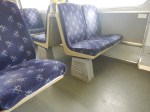


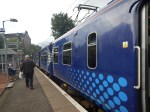

But, as Merseyrail have shown, British Rail trains of that era scrub up well.
The article is worth a full read and worth the cover price of the magazine, as it has details on the conversion and tips on how you might design a hydrogen train.
- All the hydrogen tanks , fuel cells and batteries are designed to be fitted in the vehicle underframes and don’t take up space in the passenger compartment.
- There is a fuel cell raft under both driving motor vehicles.
- Each raft contains a 70 kW fuel cell from Ballard and hydrogen cylinders.
- 40 kg. of hydrogen at a pressure of 350 bar can be carried in each raft.
- Waste heat from the fuel cell is used to heat the train.
- The DC traction motors have been replaced by modern three-phase AC motors.
- The hydrogen fillers come from the automotive industry, which is surely an obvious move.
- The interior looks good in the picture and has uses seats reclaimed from Pendolino refurbishment.
The article also reveals that Arcola are working with Arup on a study to convert a Class 158 DMU to hydrogen power.
Conclusion
I wish all the engineers and suppliers well, but I feel that these two projects are both driven by Scottish politics, rather than sound engineering principles.
Calcutta Cup By Lumo
According to Scottish Rugby, the Culcutta Cup between Scotland and England next year is at Murrayfield on the 5th of February 2022.
I have just looked up services that day on Lumo’s web site.
- It would be possible to travel North on the 05:45 train, which arrives in Edinburgh at 10:06.
- After the match, there is a train South at 17:56, which arrives back in London at 22:29.
- Tickets are available at £45.50 both ways.
As Lumo could probably run both services with ten-car trains, that hold eight hundred passengers, this could earn ticket revenue for Lumo of £72,800.
A Satisfied Lumo Customer In Marks & Spencer
I got talking to an assistant in Marks today and noticed she had a Scottish accent, which isn’t that common in my part of London amongst the young. So I remarked on it.
It turned out she was a student from Fife at University in London, so out of curiosity, I asked her, if she’d heard about Lumo?
She said yes and indicated she was going home on Friday and very much liked the price.
Is Lumo’s message getting through? I think it is!
Enforcement Of Covid-19 Vaccine Passports Comes Into Effect In Scotland
The title of this post, is the same as that of this article on ITV.
I am going to Edinburgh on Wednesday and thought I had better check if I needed a Covid-19 passport.
This paragraph describes where I will need one.
The policy will now be enforceable for nightclubs, strip clubs and unseated indoor events with more than 500 people, unseated outdoor events with over 4,000 and any event with more than 10,000 people.
As I’m only likely to have lunch with less than five fully-vaccinated friends, I’m fairly certain I won’t need one.
I’m also certain at my age, I won’t be visiting any strip clubs.
And given the going on you get with hypodermics in the average night club, I wouldn’t visit any of those if you paid me thousands of pounds.
It should be remembered that my family has issues with identity cards and their cousins.
My father ceremonially burned his wartime one, when he found it around 1955 and gave me a warning about ever letting governments introduce them.
Construction Ramps Up At £260 Million Mossend International Railfreight Park In Scotland
The title of this post, is the same as that of this article on Rail Engineer.
This is the first paragraph.
The development of a major new low carbon, multi-modal rail freight facility located in the heart of Scotland has taken a significant step forward with the laying of a private rail track to facilitate construction. Once complete, Mossend International Railfreight Park (MIRP) will provide 2.2 million sq ft of logistics space and Scotland’s first 775-metre electric rail terminal.
This looks to be all good stuff.
But Glasgow has needed the capability to handle 775-metre electric freight trains for some time.
- 775 metres is the length of the longest freight trains in use in the UK, after an increase in length, that I wrote about in New 775m-Long Freight Trains Begin Operating On UK’s Rail Network.
- Electric locomotives will cut carbon emissions.
- Mossend International Railfreight Park (MIRP) has a fully electrified connection to the West Coast Main Line (WCML).
- From the WCML routes are electrified most of the way to major freight destinations in England and to the Channel Tunnel.
So what took politicians so long to decide to upgrade the MIRP, as surely the ability to handle the longest electric freight trains will surely encourage the following?
- The movement of freight from road to rail.
- A reduction in freight traffic on the roads of Scotland and to a lesser extend England.
- The ability to run electric freight trains between Glasgow and Continental Europe.
If freight ramps up after the MIRP is completed, there’ll probably be a need for the following.
Some new highly capable locomotives like the Class 93 locomotive.
More than the proposed 16 trains per day (tpd).
They will certainly need the planned 24/7 operation.
This Google Map shows the site of the MIRP at the current time.
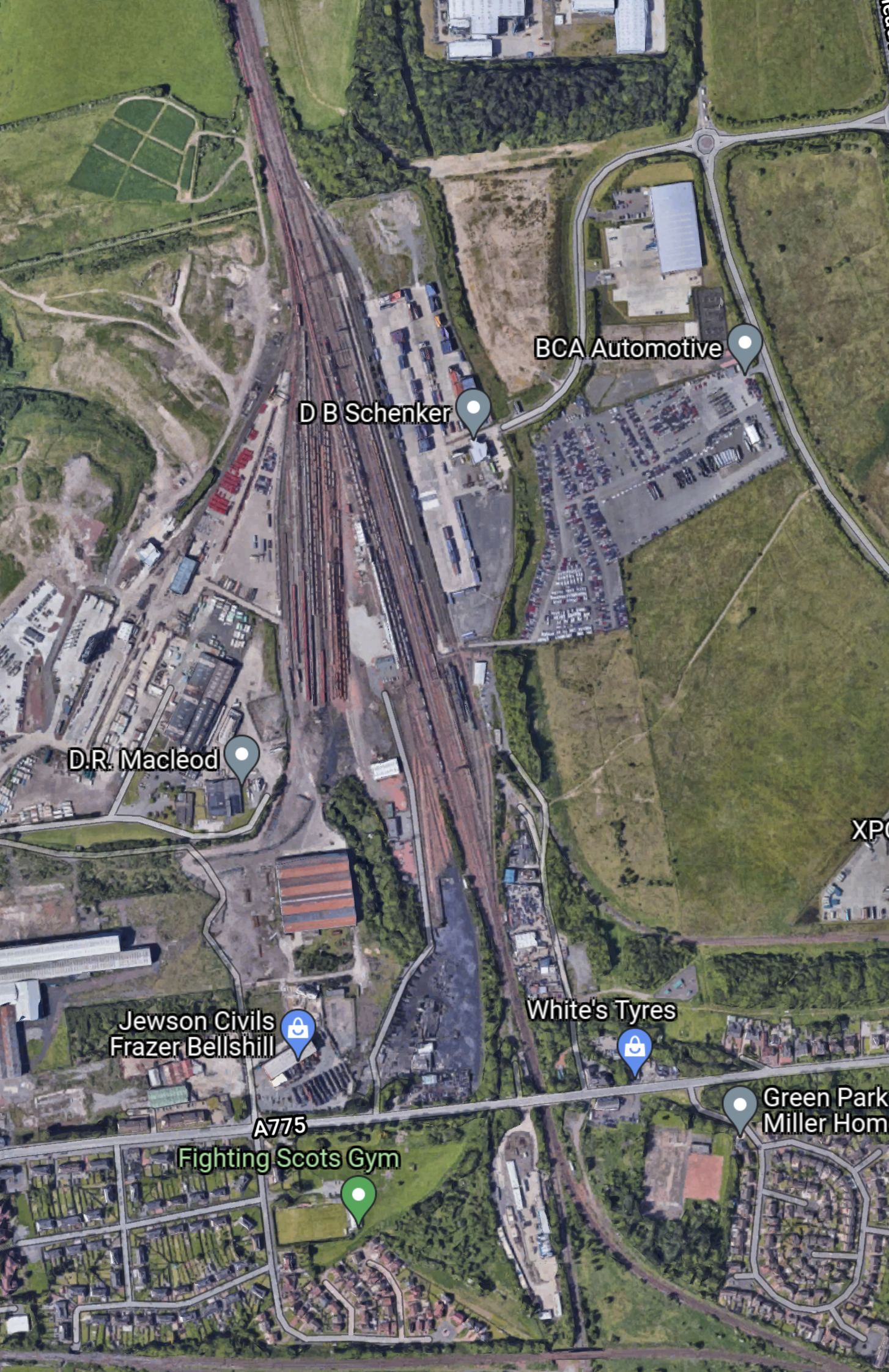
It will be interesting to see how the site grows.
New Rail Service From Newcastle To Edinburgh To Stop At These Northumberland Stations
The title of this post, is the same as that of this article on the Chronicle Live.
Details of the service are as follows.
- It will be run by TransPennine Express.
- It starts in December 2021.
- It will run five times per day (tpd)
- It will call at Cramlington, Morpeth, Widdrington, Alnmouth, Berwick-upon-Tweed, Reston and Dunbar.
It is planned to run at least until May 2023.
These are my thoughts.
What Trains Will TransPennine Express Use?
The service will probably need a single train, if it was run by a dedicated fleet of trains, that just shuttled between Edinburgh and Newcastle. TransPennine could use either an electric Class 802 train or a diesel Class 185 train.
The diesel train might not be a good idea for operational reasons as TransPennine’s current services to Newcastle and Edinburgh use Class 802 trains.
But this service wouldn’t need a Class 802 train, as the route is fully electrified, so TransPennine might use a Class 800 train, if one were available from another company in the First Group.
TransPennine could also extend selected Manchester Airport and Newcastle services to Edinburgh, which might be the most efficient ways of using both trains and platforms in Newcastle.
This would give those using the intermediate stations between Edinburgh and Newcastle a service to and from Manchester Airport and the intervening stations, with a change at Newcastle, which would involve staying on the same train.
I’d organise the service as five tpd between Manchester Airport and Edinburgh with calls at Manchester Piccadilly, Manchester Oxford Road, Manchester Victoria, Huddersfield, Dewsbury, Leeds, York, Northallerton, Darlington, Durham, Chester-le-Street, Newcastle, Cramlington, Morpeth, Widdrington, Alnmouth, Berwick-upon-Tweed, Reston and Dunbar.
The big advantage of this, is that TransPennine could use the existing Class 802 trains, although they may need one more.
Reston Station
It looks like it will be a much needed service, that will get the new Reston station up and running.
I suspect that, passenger numbers at Reston station will determine the calling pattern after May 2023.
Will Other Services Continue?
TransPennine Express only has one service that stops between Newcastle and Edinburgh and that is the hourly service between Liverpool Lime Street and Edinburgh stations and that only stops at Morpeth.
I doubt this service will be changed, although after May 2023, it may make some extra stops depending on passenger numbers on the new service.
It should be noted that CrossCountry and LNER call irregularly at Alnmouth, Berwick-upon-Tweed and Dunbar.
As LNER are in rather a mess over their new timetable, I suspect that after May 2023, there could be a bit of a sort out of services.
How Will The New Service Fit With The Reopened Northumberland Line?
Initially the Northumberland Line will run as far as Ashington and won’t open until 2023 at the earliest.
But plans exist to extend the Northumberland Line to Morpeth.
The new service would fit well with an extended Northumberland Line service.
How Will The New Service Fit With East Coast Trains New London And Edinburgh Service?
East Coast Trains will be running a new Open Access service between London and Edinburgh from this autumn.
- It will have a frequency of 5 tpd.
- It will stop at Newcastle, Morpeth and Stevenage.
- It will offer one way fares of £25.
East Coast Trains are another First Group company.
As both services are five tpd in both directions, will the two services co-ordinate stops, so that passengers between say London and Reston can take advantage?
Going North, the stopping train could follow the East Coast Trains express and going South the stopping train would be a few minutes in front of the express.
This would also help with maximising capacity between Edinburgh and Newcastle on the busy East Coast Main Line.
Conclusion
This new stopping service between Edinburgh and Newcastle looks to be a simple solution to improve passenger services for intermediate stations between the two important cities.
East Kilbride Electrification Underway
The title of this post, is the same as that of this article on Modern Railways.
These are the last two paragraphs.
As well as electrification, improvements on the line will include an upgrade of East Kilbride station, relocation of Hairmyres station 600 metres to the west, platform extensions and accessibility upgrades. The aim is to provide a four trains per hour eight-car electric service at peak periods. A parallel project will cover electrification between Busby Junction and Barrhead.
The Scottish Government’s plan is to decarbonise its passenger rail services by 2035, chiefly through electrification. It has recently been confirmed that partial electrification of the Borders and Fife Circle routes will follow after the East Kilbride and Barrhead lines, with battery EMUs deployed on these lines.
Because partial electrification is mentioned, it looks like Scotland is getting serious about using battery-electric trains.
This map clipped from Wikipedia, shows the section of the Glasgow South Western Line, that includes Kilmarnock station and the branch to East Kilbride station.
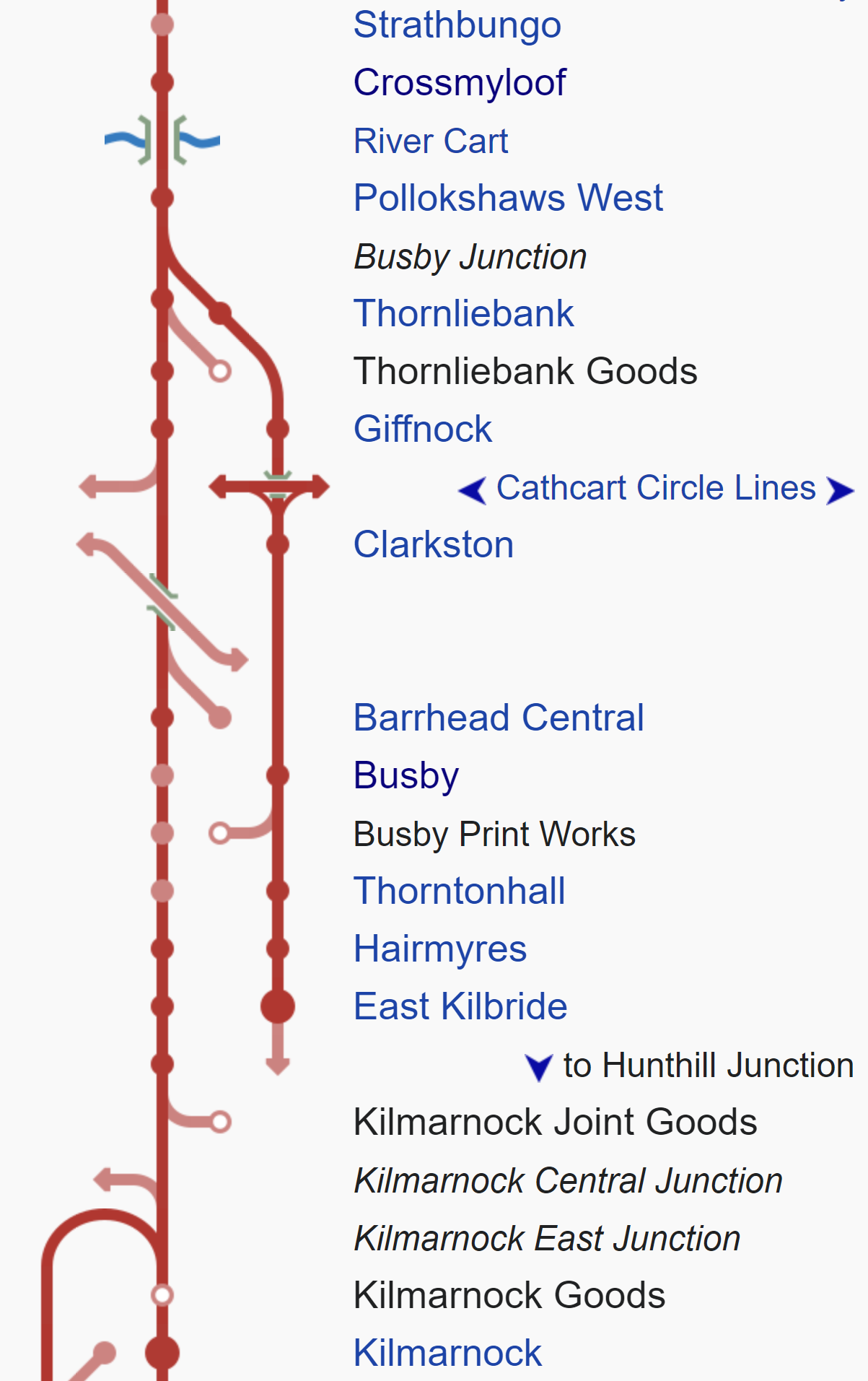
The route North of Strathbungo continues to Glasgow Central station.
Which Sections Will Be Electrified?
I will take each of the sections in turn starting at the North.
Between Muirhouse South And Busby Junctions
This sentence is from the Modern Railways article.
Contractor SPL will commence on-site activities between Muirhouse South Junction and Busby Junction, including piling and construction steelwork foundations to support overhead masts.
On the map, Muirhouse South Junction is to the North of Stratbumgo and Busby junction is clearly marked and is where the East Kilbride branch joins the main line.
This section of new electrification is only around two miles long.
This article on Rail Technology Magazine is entitled Network Rail: Strathbungo Locals Vote For New Footbridge.
There have been many bridge replacements for electrification, but this surely must be one of the first, where local people have voted for their preferred design.
The only other bridges on this section appear to be two substantial road bridges, where with any luck, it should be possible to squeeze the wires underneath.
Between Busby Junction And Barrhead Station
The other section listed for electrification is between Busby junction and Barrhead station.
This second section is only around 3.7 miles long and there are only two overbridges, both of which look modern.
Taking the two sections of electrification together they total under twelve track-miles and they are in a continuous straight line
I doubt, that together, they are the one of the world’s most challenging railway electrification projects.
Busby Junction and East Kilbride Station
There is no specific information about electrification between Busby junction and East Kilbride station.
- The branch is 7.8 miles long.
- There are fifteen overbridges on the branch.
In Plans To Introduce Battery Powered Trains In Scotland, Hitachi are quoted as saying that their trains will do sixty miles on batteries.
This should be more than enough range to run services to East Kilbride on battery power.
Barrhead and Kilmarnock Stations
There is no specific information about electrification between Barrhead and Kilmarnock stations.
- The distance is 16.8 miles.
- There are eleven overbridges between the two stations.
It would appear that Hitachi’s quoted sixty mile range, would be sufficient to enable battery-electric trains to run between the electrification at Barrhead and Kilmarnock station.
Operation
The various services between Glasgow Central and East Kilbride and Kilmarnock stations will probably operate as follows.
- Glasgow Central To East Kilbride – Electrification for traction and battery charging to Crossmyloof station and then battery power.
- East Kilbride To Glasgow Central – Battery power and gravity to Crossmyloof station and then electrification.
- Glasgow Central To Barrhead – Electrification for traction all the way.
- Barrhead to Glasgow Central – Electrification for traction all the way.
- Glasgow Central To Kilmarnock – Electrification for traction and battery charging to Barrhead station and then battery power.
- East Kilbride To Glasgow Central – Battery power to Barrhead station and then electrification.
Note.
- All power changeovers could be arranged to take place in stations.
- Gravity can be used to assist trains from East Kilbride to Glasgow Central.
- Glasgow Central and Barrhead services don’t need trains with batteries.
- The return trip between Crossmyloof and Glasgow central stations, should be more than enough to charge the batteries.
The project would appear to have been very well-designed for a fleet of battery-electric trains, with respect to reliability and electrical efficiency.
Onward To Carlisle And Stranraer
Hitachi’s system for discontinuous electrification, that I discussed in Solving The Electrification Conundrum, would appear to be ideal to extend electric trains to Carlisle and Stranraer.
Barrhead and Carlisle are 108 miles apart and Barrhead and Stranraer are 90 miles apart.
By adding two or three intermediate sections of 25 KVAC overhead electrification, it should be possible for electric trains to reliably travel between Glasgow Central and Carlisle or Stranraer.
Project Management
This electrification project could be a Project Manager’s dream.
Electrification projects in the UK can turn out to be nightmares, as if it can go wrong, it inevitably will.
But with this project, it appears that it is planned to get the often-troublesome job of erecting the gantries out of the way early.
The electrification between Muirhouse South junction and Barrhead station can even be completed first, so that passengers can see the benefit of electric trains and the electrification can be fully tested.
There are then a series of independent projects, that can be performed in the most convenient order.
- Track upgrades.
- Rebuild East Kilbride station.
- Move Hairmyres station to its new position.
- Platform extensions.
- Improve accessibility.
- Deliver the new battery-electric trains.
Note.
- It looks to me, that all of these smaller projects can be performed, whilst maintaining a full rail service on the railway. Doing that with conventional electrification usually results in some disruption.
- Late delivery of the battery-electric trains will not delay the overall project, if there are enough diesel multiple units to fill in.
- Passengers will see benefits and new facilities delivered in a stream, rather than all at once.
Similar processes can be used to extend the network to Carlisle and Stranraer.
Conclusion
This is a well-designed project.
 The Anonymous Widower