Siemens and Macquarie Form Calibrant Energy To Tackle Distributed Energy Market
The title of this post is the same as that of this article on Greentech Media.
This is the introductory paragraphs.
Macquarie Capital and Siemens have formed a joint venture to finance and build distributed energy projects, joining an increasingly competitive landscape in the growing corporate renewables market, the two announced this week.
The partnership, called Calibrant Energy, will initially focus its energy-as-a-service model in the United States, where corporate and industrial customers have become heavyweight renewables buyers as they seek to reach decarbonization goals.
It looks a good idea for a business venture.
I also like it, that two big corporate beats have got together tp finance and install renewable energy systems like solar.
Rival Site For £100m Powys Rail Testing Project
The title of this post, is the same as that of this article on Powys County Times.
This is the first two paragraphs.
Plans to build a £100 million rail testing centre on the edge of Powys could be derailed by a rival plan in England, it has emerged.
The major testing facility at the former Nant Helen open cast mining site on the border between Powys and Neath Port Talbot could face a rival application from German multinational Siemens, which has earmarked a site in Lincolnshire for a rival bid.
It seems, you wait many years for a rail test track and then two come along at the same time.
Siemens To Build One Of Europe’s Largest Energy Storage Systems
The title of this post, is the same as that of this article on Smart Energy International.
This is the introductory paragraph.
Siemens Smart Infrastructure and Fluence have been awarded a contract by the Portuguese energy provider EDA – Electricidade dos Açores to build a battery-based energy storage system on Terceira.
Read the article, as it shows how battery storage and advanced methods of generation, can transform the electricity systems of islands and other remote places.
We will be seeing many systems like this, all over the world.
Partners On Board For In-Cab Signalling Project On East Coast Main Line
The title of this post, is the same as that of this article on Rail Advent.
This is the introductory paragraph.
Network Rail has announced that it has brought Siemens and Atkins on as its partners in a project to introduce in-cab signalling on the southern section of the East Coast Main Line.
It is good, that a start is being made on this significant project, which should increase capacity between Kings Cross and Doncaster.
First Order For Mireo Plus B Battery EMUs
The title of this post is the same as that of this article on Railway Gazette.
This is the introductory paragraph.
The Land of Baden-Württemberg’s rolling stock body SFBW has ordered 20 battery-equipped Mireo Plus B electric multiple-units from Siemens Mobility, which will then be responsible for their availability over a 29½-year operating life.
The Siemens Mireo Plus B Battery EMUs appear to have the following specification.
- Ability to use overhead electrification.
- Ability to use battery power for a range of eighty kilometres.
- Two underfloor lithium-ion battery packs.
- Batteries handle regenerative braking.
- 160 kph operating speed.
Delivery is by December 2023.
Clean Air For All: Lampposts To Charge Electric Cars
The title of this post, is the same as that of this article on The Times.
This is the introductory paragraph.
An “electric avenue” has been developed where lampposts have been converted into chargers for battery-powered cars.
The project has been led by Siemens.
Surely, all lampposts should have an electric car charging point.
A Regret
I am limiting my travel because of COVID-19 and only using Shanks’s pony, so I will not be able to provide one of my pictures of the chargers.
Dwell Times And End Doors
Chris Stokes finishes his column in the January 2019 Edition of Modern Railways, with this paragraph.
Dwell times remain critical too. The new TransPennine units provide more seats, but have single end doors. For an operation with high numbers joining and alighting at many stops, dwell times are going to increase significantly at stations such as Manchester Victoria, Huddersfield, Leeds, Boltonand Preston, chewing up any savings in running times, and exacerbating the problems at platforms 13 and 14 at Manchester Piccadilly.
I haven’t seen a TransPennine Mark 5A coach in the flesh yet, but I’ve seen several pictures, which show each coach has single end doors.
This picture of the 100 mph Class 755 train shows the door layout is totally different.
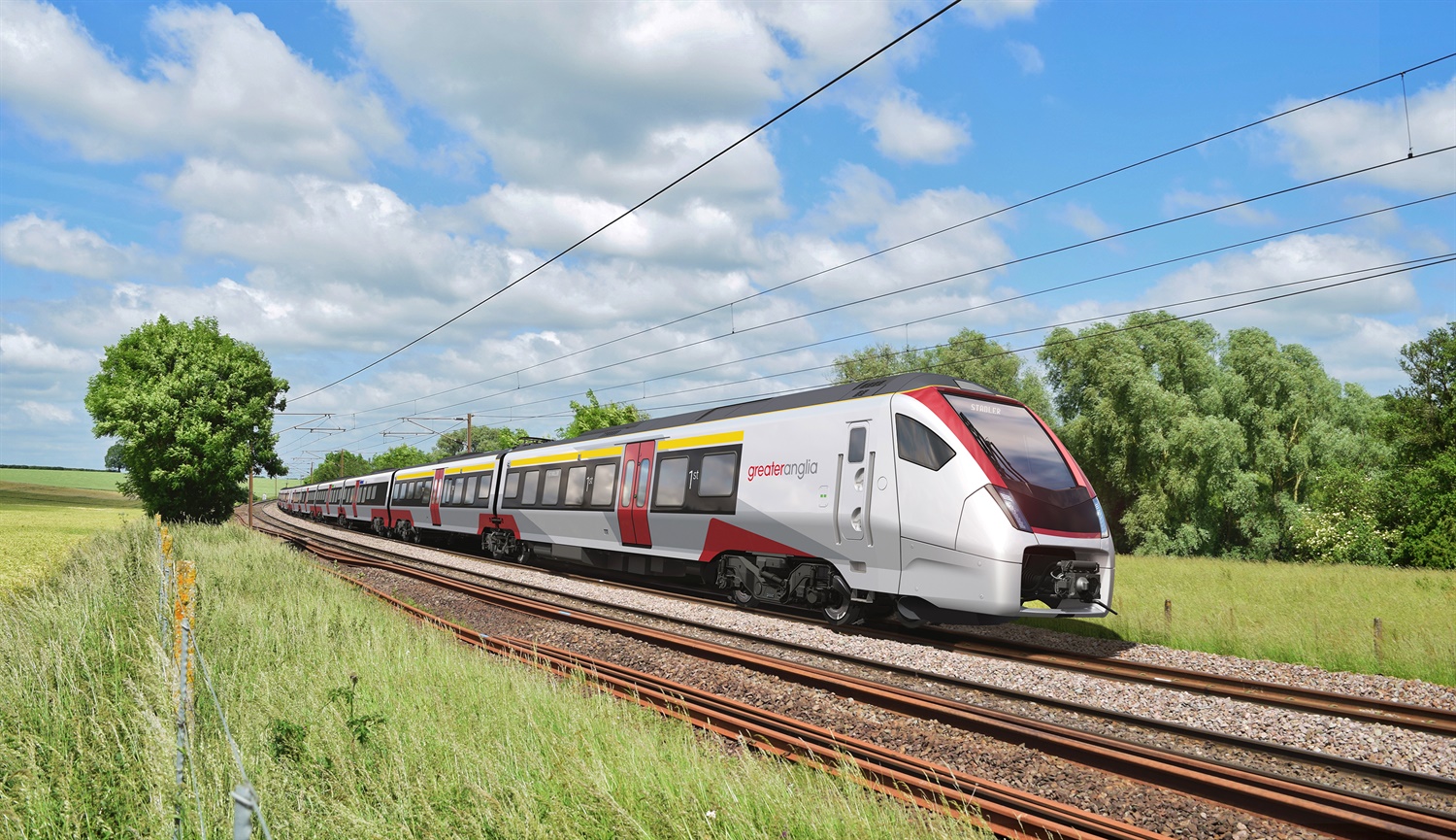
It looks like it has a single double door on each coach.
It appears that the electric Class 745 trains have more doors.
If you look at a typical Bombardier Aventra or Electrostar, Stadler Flirt or Siemens Desiro City, there are generally no end doors.
Have CAF commited a design crime of the highest order?
Or is it TransPennine’s fault?
Could The Unwanted Class 707 Trains Be Converted To Hydrogen-Power?
South West Trains ordered a fleet of thirty Class 707 trains from Siemens for the route between Waterloo and Windsor and to increase services generally.
However, the new franchise holder; South Western Railway has decided to replace these new trains with new Class 701 trains from Bombardier.
Various reasons have been put forward for the very early replacement.
- Lower leasing costs.
- Lack of toilets on the new trains.
- The bad reputation with customers of the closely-related Class 700 trains on Thameslink.
- SWR want a unified fleet.
My observations include.
- MTR, who are a partner in SWR and the Crossrail operator, have got good reports of the Crossrail Aventras.
- SWR have ordered sixty ten-car trains and thirty five-car trains. So perhaps, SWT ordered the wrong mix of trains.
Crossrail 2 will probably use Aventras and it will take over some of SWR’s routes, So is there a degree of future-proofing for Crossrail 2 in the decision to abandon the Class 707 trains.
The Search For A New Operator For The Class 707 Trains
Wikipedia sums up the current situation.
Consequently, Angel Trains is looking for a future operator to lease these trains from 2019.
Will they find one?
The new franchise holder on Southeastern could be a possibility, if they decide to replace all their older units.
- Class 375 trains – 10 x 3 and 102 x 4
- Class 376 trains – 36 x5
- Class 465 trains – 147 x 4
- Class 466 trains – 46 x 2
This totals to 1,300 carriages. So they would have to buy a lot more trains of the same type to have an easy-to-manage unified fleet.
Buying that number of carriages, you will have to be very sure, that you had the design and the price right!
Northern and Scotrail could have been possible homes, but they have bought substantial numbers of other train manufacturers products.
\st.Pancras to Corby could be a possibility, but I think that route needs a faster train.
So is there a fleet of thirty five-car trains, that just don’t fit what train operating companies want?
The Need For A 100 mph Diesel Multiple Unit Replacement
Currently, there are the following larger DMUs on the UK network with speeds in the range of 90-100 mph.
- Class 158 train – 90 mph – 147 x 2 and 27 x 3
- Class 159 train – 90 mph – 30 x 3
- Class 165 train – 75/90 mph – 48 x 2 and 27 x 3
- Class 166 train – 90 mph – 21 x 3
- Class 168 train – 100 mph – 9 x 2, 8 x 3 and 11 x 4
- Class 170 train – 100 mph – 85 x 3 and 34 x 2
- Class 171 train – 100 mph – 12 x 2 and 8 x 4
- Class 172 train – 100 mph – 24 x 2 and 15 x 3
- Class 175 train – 100 mph – 11 x 2 and 16 x 3
This totals about 1200 carriages.
Note.
- Most are in good condition.
- Some are being replaced.
- They are run by most train operating companies.
- Some run on routes that are partially electrified.
- Trains sometimes run in longer formations to increase capacity
This story in City AM is entitled Transport Minister Jo Johnson Calls For Diesel-Only Trains To Be Ditched By 2040 And Fast Rollout Of Hydrogen Train Trials.
So is what Jo Johnson said feasble?
On a rough estimate there must be somewhere between two and four thousand carriages to replace before 2040, with some form of zero-carbon trains powered by batteries, hydrogen or Aunt Jemina’s extra strong knicker elastic.
Replacing four thousand carriages in twenty years is just two hundred a year or just four per week . Given that Bombardier have been quoted as saying that production rates as high as twenty-five carriages a week is possible in a single production line, I don’t think building the trains will be a problem.
|When you develop new or adapt technology in a disruptive way, you must be thorough in your development and testing.
So I think that Jo Johnson has come up with a feasible plan to decarbonise a lot of UK trains.
Lessons From The Alstom Coradia iLint
The world’s first hydrogen-powered train is a version of the Alstom Coradia Lint.
Alstom and Siemens have now merged their transportation interests, so could we be seeing a hydrogen-powered version of the Desiro City, which is the train family to which the Class 707 train belongs?
A hydrogen-powered Class 707 train, would probably be a useful train for a train operating company to have in its fleet.
Perhaps, the current unwanted thirty trains could be converted to dual-voltage hydrogen-powered trains?
Wikipedia gives details on the hydrogen-powered Alstom Coradia iLint.
- It is two-cars
- It is based on a successful train.
- It has a 140 kph operating speed.
- It has a range of 600-800 kilometres on a tank-full of hydrogen.
- It also uses a battery to store energy from traditional electrification, generated by hydrogen or from the regenerative braking system.
One of the keys to making it all work, is an intelligent computer system, that optimises energy generation and use according to the route.
A Hydrogen-Powered Class 707 Train
Could a conversion of a Class 707 train be tweaked to have the following performance and features?
- A 160 kph (100 mph) operating speed on hydrogen.
- The train already has this speed on electrification.
- Dual-voltage of 25 KVAC overhead and 750 VDC third-rail.
- A range on hydrogen in the region of four hundred miles.
- An interior designed for hundred mile trips, with toilets, wi-fi and power sockets.
The trains would need a substantial rebuild, but probably nothing too radical provided the hydrogen-powered generator, Hydrogen tank and the battery could be fitted in.
In The Formation Of A Class 707 Train, I describe hoe the Class 707 train, is two motored-cars, with three trailer-cars in between. I suspect, that the train can be lengthened or shortened by adding or removing trailer cars.
So could appropriate trailer cars be placed in the middle to create Battery, electric or hydrogen trains?
It very much looks like it!
Possible Routes
This train would be very useful for 100 mph partially-electrified routes.
- Basimgstoke to Exeter.
- Brighton to Ashford.
- London Bridge to Uckfield.
- Liverpool to Holyhead via the Halton Curve.
- Leeds to Carlisle via Settle.
- Newcastle to Carlisle
- Carlisle to Preston via Barrow and the Cumbrian Coast Line.
- Blackpool to Leeds via the Calder Valley.
- Blackburn to Manchester Airport via Todmorden
There are other routes, but most train operating companies have gone for a diesel or bi-mode solution.
Conclusion
I think that a hydrogen-powered Class 707 train is possible.
Siemens Unveils Plans For £200m Train Factory In East Yorkshire
The title of this post, is the same as that of this article in Rail Technology Magazine.
This is a key paragraph.
While the factory is only in the planning stage at the moment, Siemens hopes to begin construction later this year if the company can confirm some “major future orders.”
As to major future orders in the UK, the following would appear to be possibilities.
- New London Underground train orders for the Piccadilly, Bakerloo and Central Lines.
- New trains for HS2.
- New trains for the new East Midlands Franchise.
- New trains for the new Southeastern Franchise.
Note.
- Siemens have shown designs for the Underground, which I discussed in Siemen’s View Of The Future Of The Underground.
- HS2 will be built to the same standard as most European High Speed Lines.
- The trains for the East Midlands could probably be based on German ICE trains.
- Desiro City trains would handle a lot of Southeastern’s needs.
I suspect, that Siemens have designs that could be adapted for most of the UK’s possible large orders.
I shall a few thoughts to these orders.
New Tube For London
The New Tube For London is a very large project, that will do the following.
- Replace the current rolling stock on the Bakerloo, Central, Piccadilly and Waterloo and City Lines.
- Initially, there will be 250 new trains.
- Increase capacity.
- Increase frequency.
- Run under a much higher level of automation.
- Hopefully, the first train will run on the Piccadilly Line by 2023.
- It is also intended that the new trains will replace the current trains on other lines.
Wikipedia says this about the project cost.
The project is estimated to cost £16.42 billion (£9.86 bn at 2013 prices)
The following companies were on an approved short list.
- Alstom
- Siemens
- Hitachi,
- CAF
- Bombardier
Since this list was published, Bombardier and Hitachi have said they will propose a joint bid and Siemend and Alstom have merged their train-building interests.
So we are left with the following bidders.
- Alstom-Siemens, who have various small factories in the UK.
- Bombardier-Hitachi, who have two large factories in the UK.
- CAF, who are building a factory at Newport in South Wales.
Various factors will come into the choice of manufacturer.
- The London Underground order, is probably one of the largest train orders, that will be placed in the next few years and fulfilling it will most likely require a large manufacturing capacity in the UK.
- Bombardier-Hitachi and Alstom-Siemens have the resources to create such a manufacturing capacity. Would CAF have that capacity?
- Bombardier has been working with Transport for London for about thirty years and their recent trains for London have been generally well received.
- Hitachi will add Japanese technology and finance to the bid.
- Do Hitachi have a lot of space at Newton Aycliffe?
- Siemens are Europe’s biggest industrial company, so they can invest heavily to ensure they get the order.
- Delivering the first trains for the Piccadilly Line in 2023, could be a tough ask!
In a Brexit World, it will be interesting to see who gets the order.
Trains For HS2
Note these points about Siemens, High Speed Trains and the trains required for HS2.
- It would appear that most German ICE trains are built by Siemens or the company is involved in a consortium.
- Siemens latest trains for Eurostar have been well-received.
- The High Speed Train market around the World is increasing in size.
- The initial HS2 contract will be sixty trains, each of which will hold a thousand passengers.
As trains will be of two types;HS2-only and classic-compatible, the designing of the trains will be a challenging exercise.
But Siemens experience from Germany, where classic-compatible trains have to be extensively used, may give them an edge.
I have ridden High Speed Trains in France, Germany, Italy, Spain and Kent, and single-deck trains are very similar, especially where trains are classic-compatible.
They are certainly more similar, than say commuter trains, which all seem to suffer from lots of local preferences.
Another factor is the size of the site at Goole, which is 23 hectares or the size of 23 football pitches.
- Could Siemens be planning a new site to build its High Speed Trains?
- Are Siemens short of space for expansion at Krefeld?
- There is probably space for a test track at Goole, that could be connected to the factory.
- The site would be well-connected to the East Coast Main Line and the rest of the UK’s High Speed Network and the Channel Tunnel.
- Exports to the Rest of the World, could use the ports of the Humber.
- Siemens have a lot of investment in other industries in East Yorkshire.
It looks to be a logical choice of location to manufacture and commission trains.
If they get the order for the new trains for HS2, it would be the ideal manufacturing site.
But if they do, will Siemens manufacture High Speed Trains for export?
This could explain, why Chris Grayling was present for the announcement in Goole.
New Trains For The New East Midlands Franchise
With these trains, which will likely be bi-modes, it depends on whether they are trains like Hitachi Class 800 trains or classic-compatible versions of High Speed Trains.
But this order will be smaller than the London Underground or HS2 orders, so9 I wouldn’t be surprised if it went to the company with the best of the previous generation of 125 mph bi-mode trains.
New Trains For The New Southeastern Franchise
Surely, if Siemens get this order it will be for Desiro City trains and like the Class 700 trains for Thameslink, Siemens would seriously, think about building them in Germany.
On the other hand, Southeastern’s routes could be very much in Crossrail territory and as I showed in Is Crossrail Having An Affect On Train Purchases In The South East?, I think it is very likely that the nod will go to Aventras for the franchise.
But I estimate, there are 1,300 trains needed, so with the right offer, they might get the order and decide to build them at Goole.
Once this franchise is settled, there probably aren’t too many large train orders left in the UK, for this class of train.
And Then There Is Hydrogen!
I believe that just as Alstom converted a Alstom Coradia Lint, into a hydrogen version, that Siemens could apply the same process to create a hydrogen-powered Class 707 train, which would probably be a useful train for a train operating company to have in its fleet.
I describe my thinking in Could The Unwanted Class 707 Trains Be Converted To Hydrogen-Power?
Perhaps, the current unwanted thirty trains could be converted to dual-voltage hydrogen-powered trains?
But this is not a project that would require a large factory!
Unless of course, it was linked to the 1,300 new trains that the new Southeastern franchise could need.
Conclusion
I feel that Siemens is in pole position to build the High Speed Trains, but it could be more than that!
Are Siemens developing Goole as their main manufacturing site for High Speed Trains, due to limitations at Krefeld in Germany?
Does this leave the Bombardier-Hitachi consortium to pick up the London Underground order?
It’s all getting very interesting!
 The Anonymous Widower