Could Trains From The North Connect To High Speed One At St. Pancras?
I was casually flying my virtual helicopter over the throat of St. Pancras International station, when I took a few pictures.
This Google Map shows the Northern ends of the platforms and the tracks leading in.
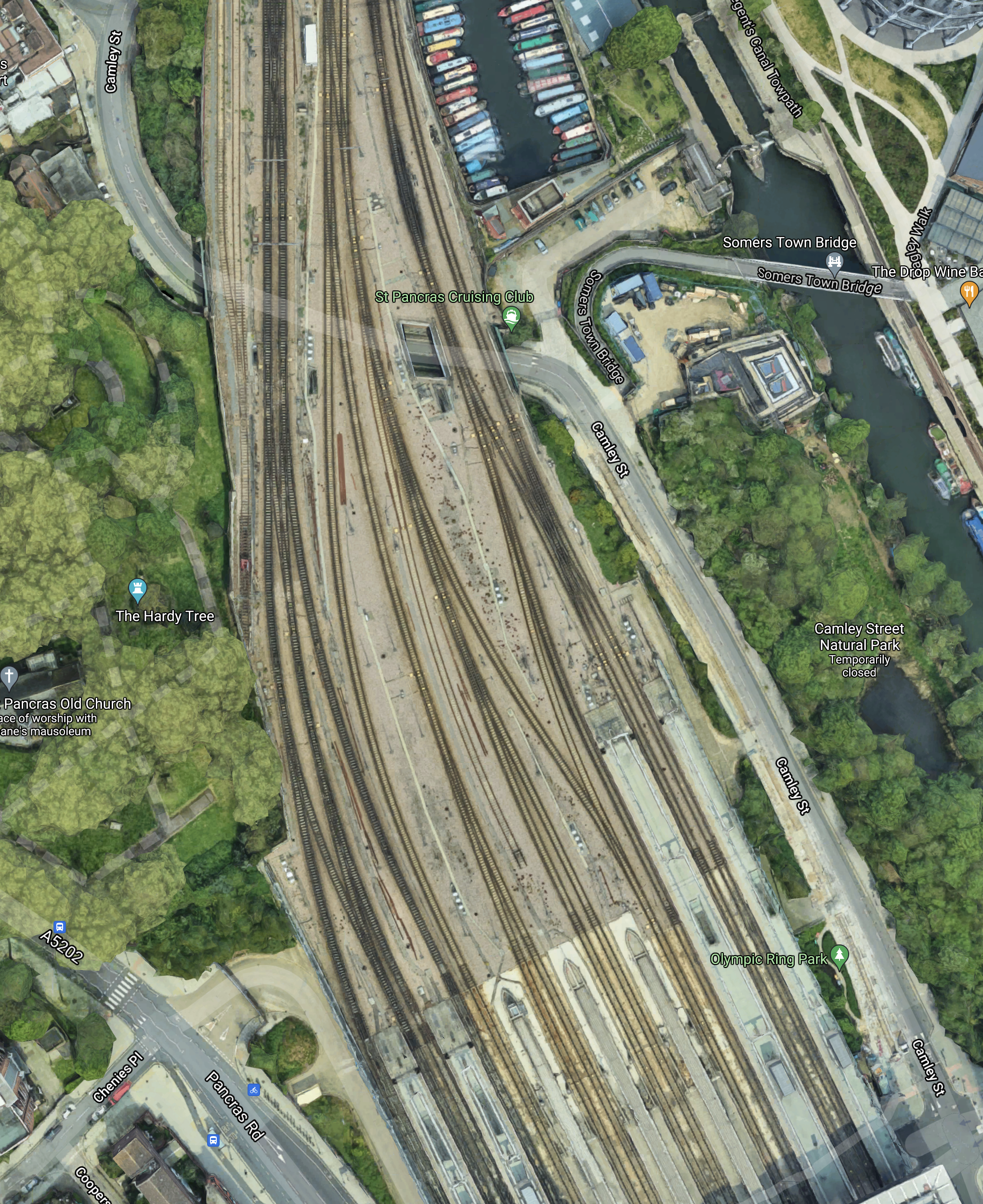
Note.
- Platforms 1-4 to the West with darker tracks handle the East Midlands Railway services.
- Platforms 5-10 in the centre with lighter tracks formed of three shorter islands handle the Eurostar services.
- Platforms 11-13 to the East with longer platforms handle the Southeastern HighSpeed services.
This Google Map shows the East Midlands Railway platforms.
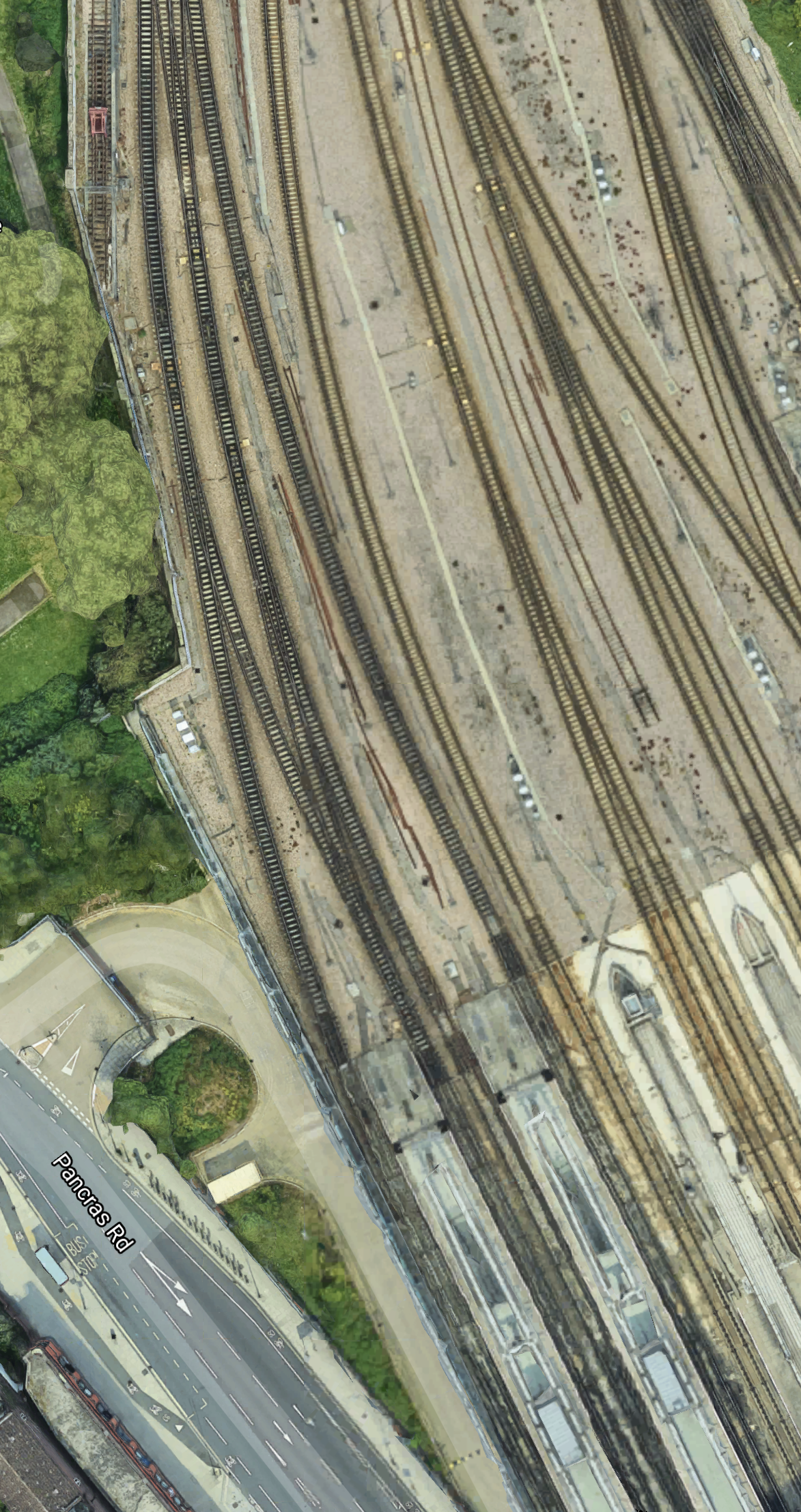
Note.
- There are two island platforms; 1-2 and 3-4.
- The four platforms are served by two tracks, that connect to the fast lines of the Midland Main Line.
- The platforms will be able to handle a pair of Class 810 trains, which will be 240 metres long.
- Will the two trains per hour (tph) using Class 360 trains between London and Corby always use the same platform at St. Prancras station?
This Google Map shows the Eurostar platforms.
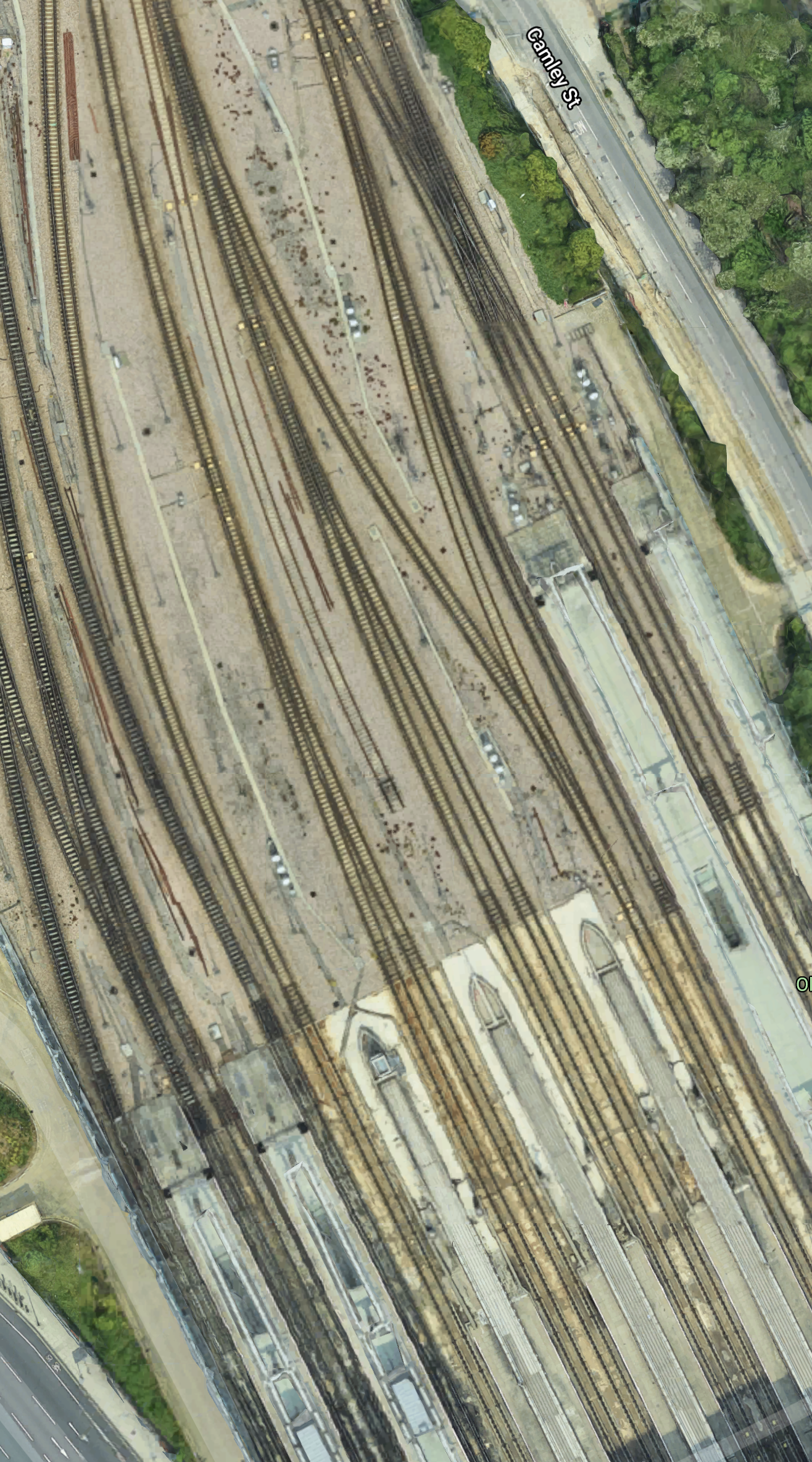
Note.
There are three island platforms; 5-6, 7-8 and 9-10.
The two island platforms in the West are for East Midlands Railway services.
The two longer island platforms in the East are for Southeastern HighSpeed services.
The six platforms connect to two fast lines, that are shared with the Southeastern services.
This Google Map shows the lines proceeding to the North.
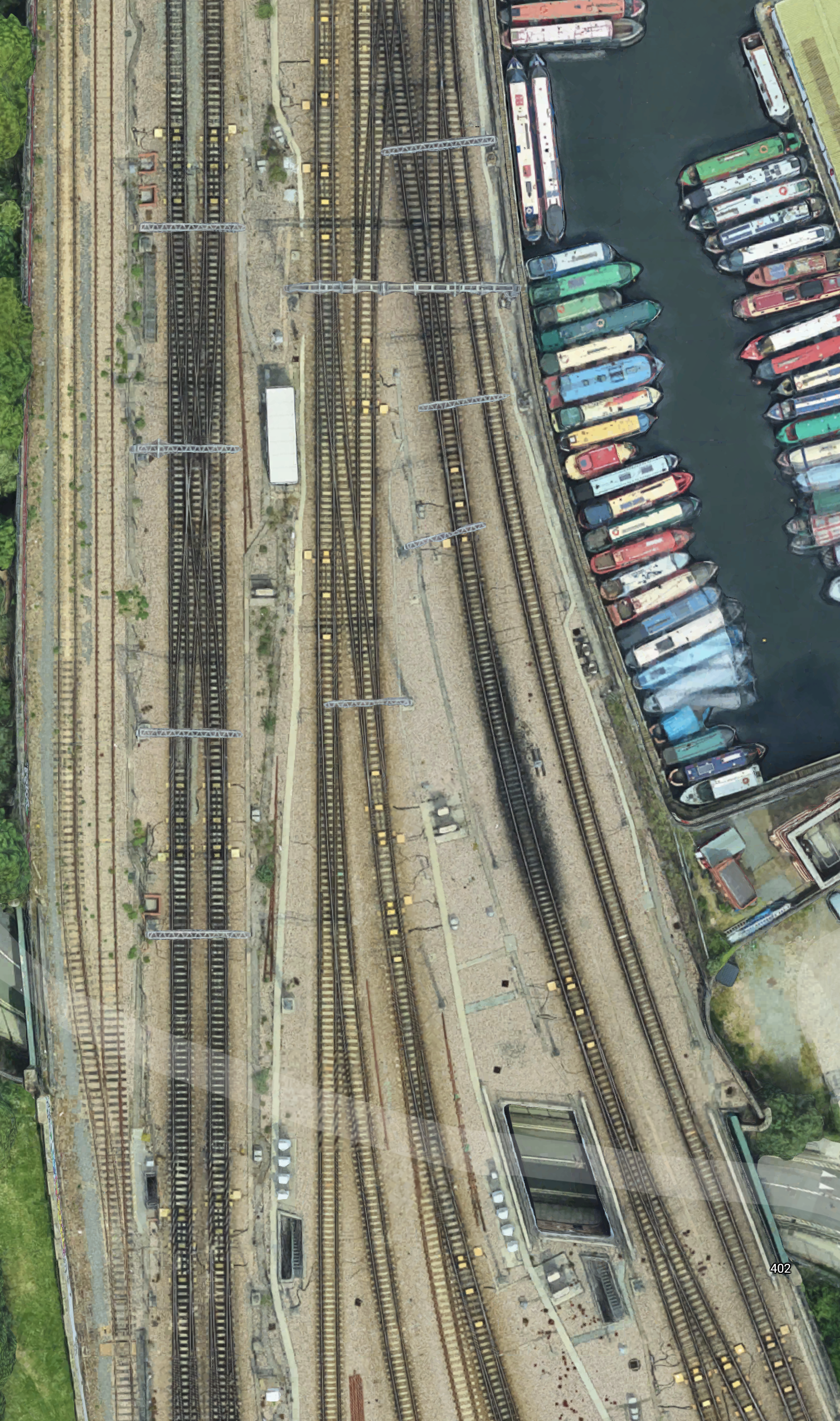
Note.
- There are four sets of tracks.
- The two light-coloured tracks on the left are for Thameslink or sidings.
- The next two dark-coloured tracks are the two tracks of the Midland Main Line.
- The next set of tracks are those connecting to the six Eurostar platforms.
- The two tracks on the right are those connecting to the Southeastern Highspeed platforms.
- There are crossovers between the Eurostar and Southeastern Highspeed tracks to allow efficient operation of the trains going to and from the twin tracks of High Speed One.
This Google Map shows where the Midland Main Line and High Speed One divide.
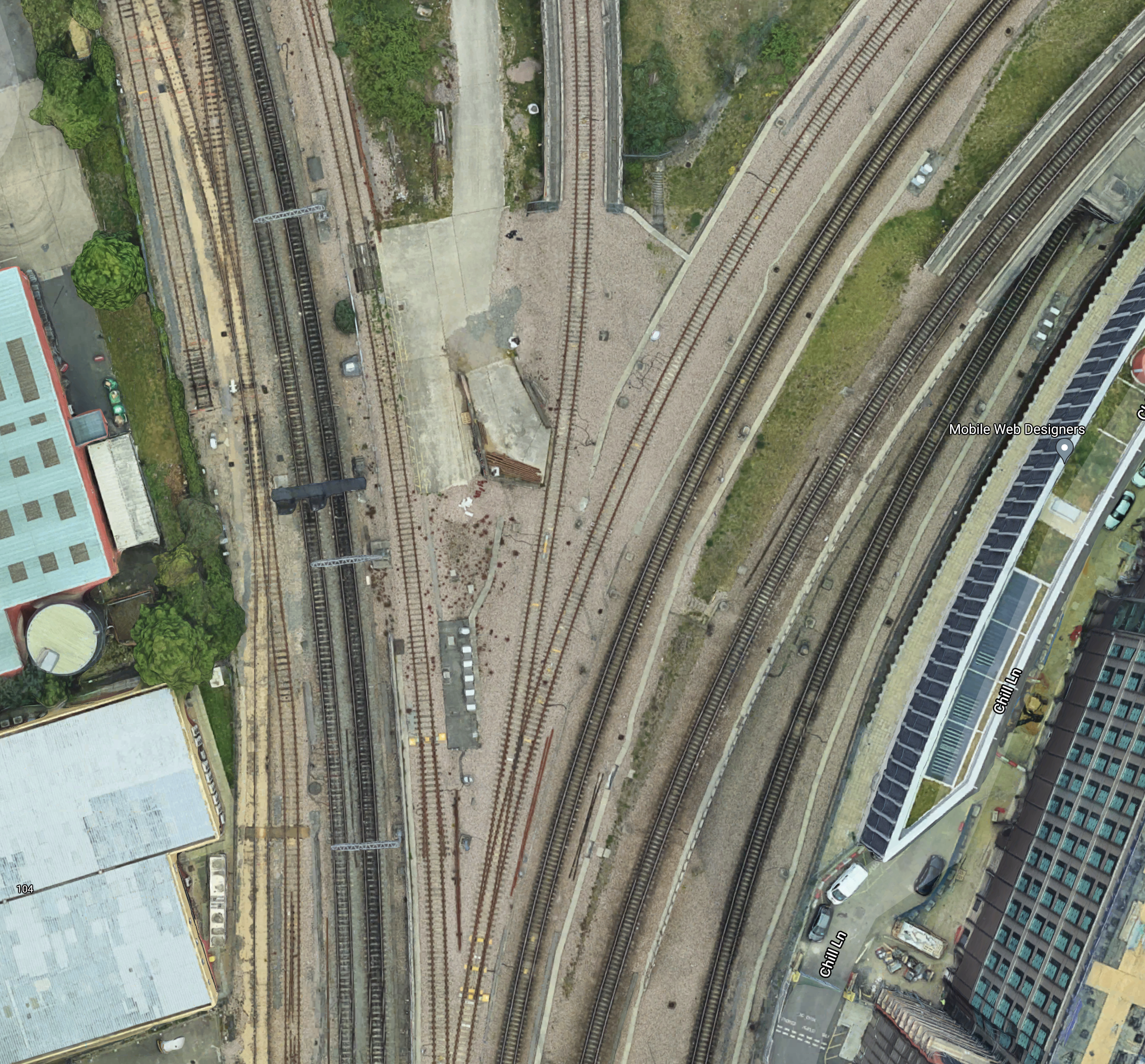
Note.
The two dark-coloured tracks of the Midland Main Line running North.
There appear to be four tracks running North East towards High Speed One.
Between the two sets of tracks two further tracks lead to the North.
The track closest to the Midland Main Line joins to the slow lines of the Midland Main Line.
The other one connects to the North London Line.
This Google Map shows the connecting lines to the High Speed One tunnel.
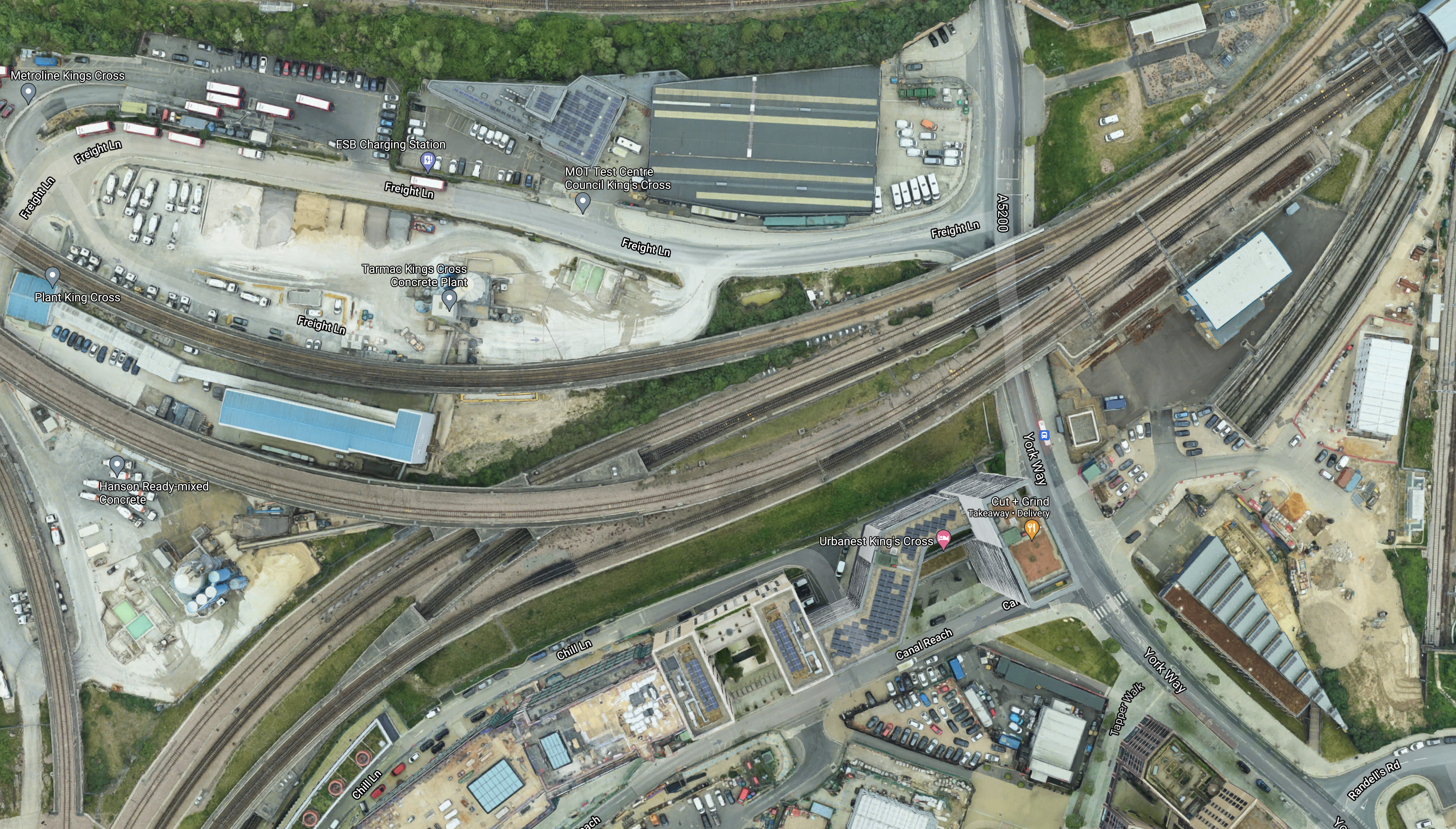
Note the tunnel portal is in the North-East corner of the map.
- It looks to me that the following connections are possible.
- St. Pancras station Eurostar platforms and Midland Main Line.
- St. Pancras station Eurostar platforms and North London Line to the West.
- High Speed One and North London Line to the West.
These connections are in addition to those connections needed to run scheduled services.
They would enable trains to take the following routes.
- St. Pancras station Eurostar platforms and Midland Main Line.
- St. Pancras station Eurostar platforms and the West Coast Main Line via North London Line
- High Speed One and the West Coast Main Line via North London Line
- St. Pancras station Eurostar platforms and the Great Western Main Line via North London Line
- High Speed One and the Great Western Main Line via North London Line
I suspect most of the times, that these routes are used it is for engineering purposes or behaps dragging a failed train out of St. Pancras.
But the track layout would seem to allow the following.
Direct electric freight and passenger services between High Speed One and Birmingham, Cardiff, Glasgow, Liverpool and Manchester.
Direct electric passenger services between High Speed One and Sheffield and Leeds, with a reverse at St. Pancras, after the Midland Main Line were to be fully electrified.
Was this by design for Eurostar or was it just what Network Rail ended up with?
A Modern Regional Eurostar Service
These are my thoughts on a modern Regional Eurostar service.
Rolling Stock
High Speed Two is coming and this year, the company will order some of the rolling stock.
There will be fifty-four trains
The trains will be Classic-Compatible for running on the West Coast Main Line.
They will be 200 metres long and be able to run in pairs.
They will be able to operate at 225 mph.
The operating speed of High Speed One is 186 mph.
I can see no reason why trains of this type, couldn’t run between St. Pancras and many destinations in Europe.
North Of England And The Continent
Could this be the service pattern?
- One train could start in the North West and another in the North East.
- Both trains would proceed to St. Pancras picking up passengers en route.
- At St. Pancras the two trains would join together.
- The driver could then position themselves in the front cab and take High Speed One, through the Channel Tunnel.
The train could even split at Calais to serve two different Continental destinations.
Going North, the spitting and joining would be reversed.
What Infrastructure Would Be Needed?
I suspect the following will be needed.
- The West Coast Main Line and the Midland Main Line would need in-cab digital ERTMS signalling.
- Full electrification of the Midland Main Line would probably be necessary, as I don’t think the tunnel allows diesel trains to pass through.
- Some platform lengthening might be needed.
It would not be an expensive scheme.
What Timings Would Be Possible?
Using current timings you get the following times.
- Leeds and Paris – Five hours
- Leeds and Brussels – Four hours forty minutes
- Manchester and Paris – Five hours
- Manchester and Brussels – For hours forty minutes
- Newcastle and Paris – Six hours
- Newcastle and Brussels – Five hours thirty minutes
Note, that the times are best estimates and include a long stop of several minutes at St. Pancras.
Could Sleeper Service Be Run?
I don’t see why not!
Conclusion
It looks like it may be possible to run regional services to Europe, where pairs of train split and join at St. Pancras.
St
Thoughts On The Class 360 Trains On The London St. Pancras And Corby Route
In May the Class 360 electric trains will be introduced by East Midlands Railway on the service between St. Pancras and Corby stations.
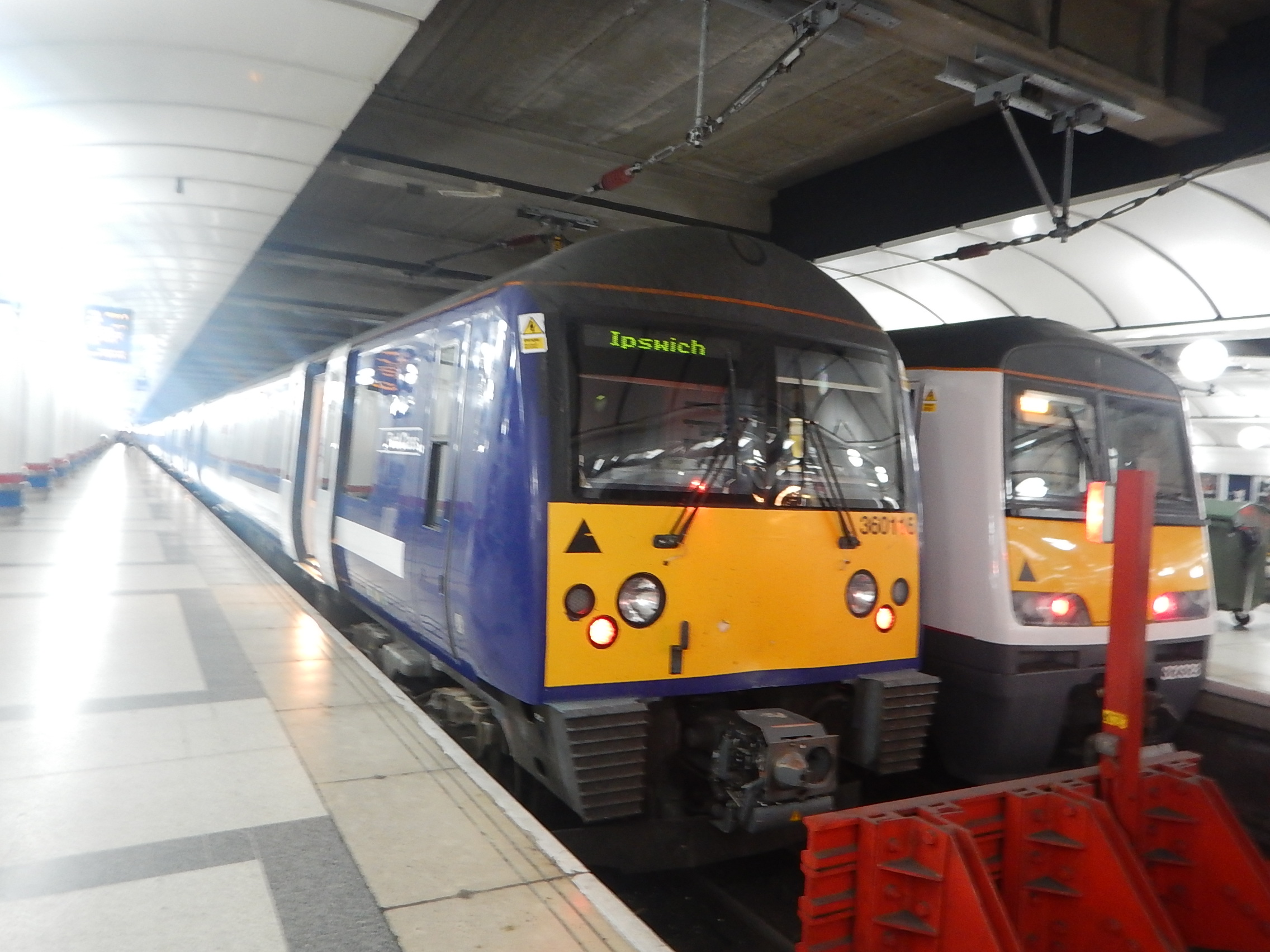
The Class 360 train is on the left.
The following data has come from Real Time Trains.
- St. Pancras and Corby are 79.3 miles apart.
- The current service stops at Kettering, Wellingborough, Bedford and Luton.
- The new electric service stops at Kettering, Wellingborough, Bedford and Luton and Luton Airport Parkway.
- Current services take between 67 and 73 minutes
- The new electric services take between 71 minutes
- Services leave St. Pancras at XX:15 and XX:45
- Services leave Corby at XX:11 and XX:40
- Turnround at St. Pancras appears to be about 23-25 minutes
- Turnround at Corby appears to be about 12-16 minutes.
- St. Albans and St. Pancras takes 14 minutes.
Note.
- The Class 222 train has a top speed of 125 mph and a maximum acceleration: of 0.80 ms-2
- The Class 360 train has a top speed of 110 mph and a maximum acceleration: of 0.98 ms-2
Looks like a case of swings and roundabouts to me!
I can deduce the following.
Average Speed
Consider.
- Assuming a trip time of seventy minutes for the Class 222 train, gives an average speed of 68 mph including stops.
- Assuming a trip time of seventy-one minutes for the Class 360 train, gives an average speed of 62 mph including stops.
These speeds don’t seem to be too difficult to achieve. Especially, as the Midland Main Line is a series of straight line between a number of stations., which are ideal for a quick dash in between.
It’s A Three Hour Round Trip
Add up the two 71 minute trips and the turnaround times and it looks to be a comfortable three hour round trip.
So for a two trains per hour (tph) service, you will need six formations of Class 360 trains.
As it looks like each formation will be twelve cars long, that will mean that eighteen of the current twenty-one trains will be needed.
The three spare trains will be very useful, whilst the trains are refurbished with new liveries and interiors.
Route Capacity
This picture shows a five-car Class 222 train at Corby station.
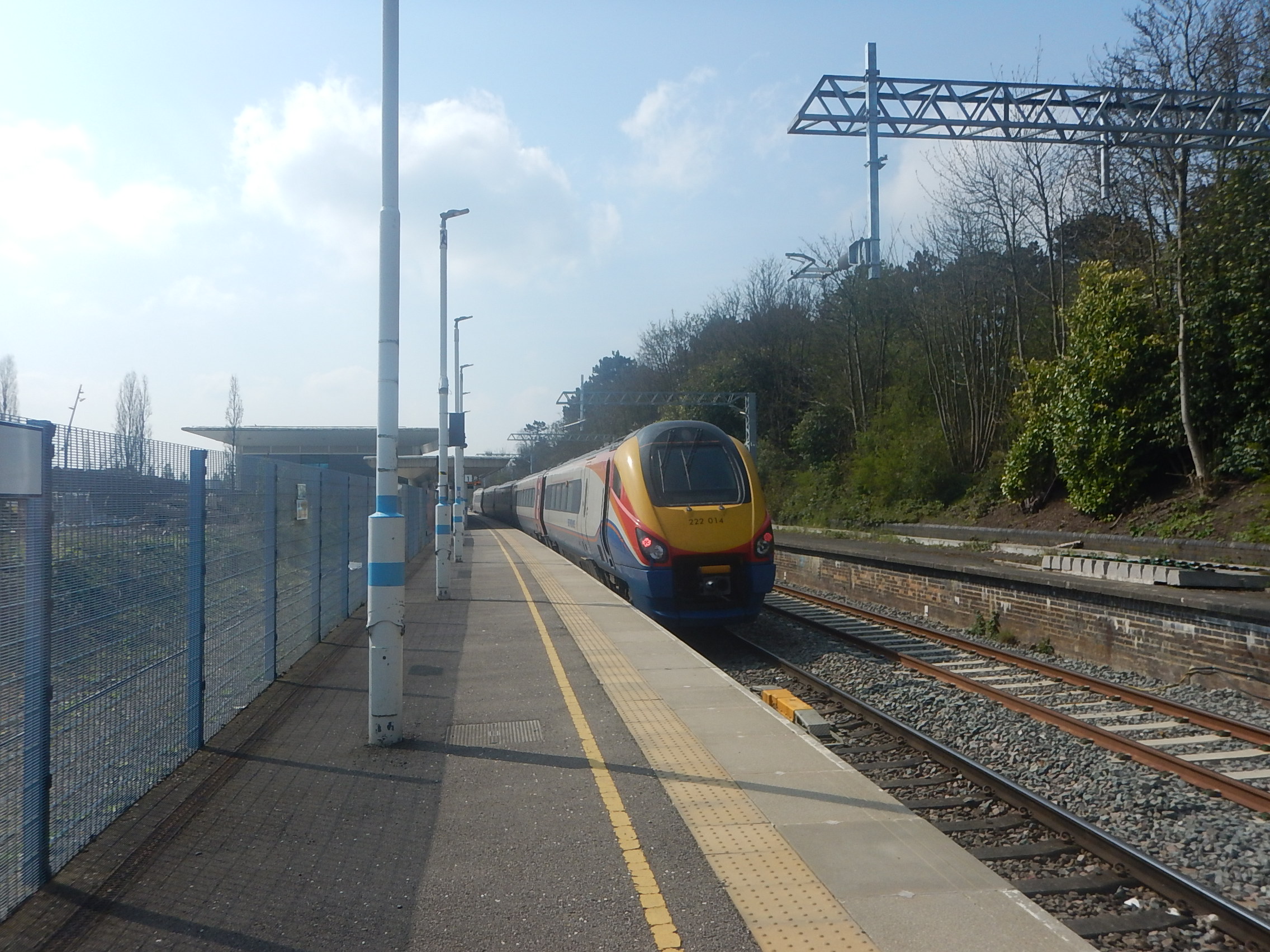
Consider.
- The current five-car Class 222 trains have a capacity of 50 First Class and 192 Standard Class seats
- Four-car Class 222 trains have a capacity of 33 First Class and 132 Standard Class seats.
- A four-car Class 360 train has a capacity of 16 First Class and 264 Standard Class seats.
I can do a simple calculation.
- The current one tph service, if run by a five-car Class 222 trains would have an hourly capacity of 50 First Class and 192 Standard Class seats.
- The planned two tph service if run by twelve-car 360 trains has an hourly capacity of 96 First Class and 1584 Standard Class seats.
First Class capacity on the route has doubled and Standard Class accommodation has gone up by a massive 8.25 times.
The latter figure will probably be reduced as some of the seats are to be removed for a more spacious interior with tables.
Serving Luton Airport
It looks like these trains will enable a quick journey to Luton Airport.
- The St. Pancras and Corby train will take 22 minutes between St. Pancras and Luton Airport Parkway stations.
- There will be the Luton DART connecting Luton Airport Parkway to the Airport from 2022.
- I suspect Luton Airport will be aiming for a thirty minute journey between St. Pancras and the Airport.
- The fast service will have a frequency of two tph.
It will not compare badly with rail times from London to Gatwick of 35 minutes and to Stansted of 50 minutes.
Services To Oakham And Melton Mowbray
Consider.
- Oakham and Melton Mowbray stations are on the route between Corby station and the Midland Main Line North of Leicester.
- Oakham and Melton Mowbray stations have a one train per day (tpd) in both directions to London via Corby.
- In Beeching Reversal – Increased Services To Nottingham And Leicester, via Syston And Loughborough From Melton Mowbray. I wrote about how the local MP wants better services at Melton Mowbray.
- Oakham is 11.5 miles from Corby.
- Melton Mowbray is 25.8 miles from Corby.
- Leicester is just over forty miles from Corby and could be covered in under an hour.
- A pair of Class 810 trains are the same length as a trio of Class 360 trains, so both trains would fit all platforms.
I think that there are a lot of possibilities for services through Corby.
- Class 810 trains could use Corby as a diversion, when the Midland Main Line is closed for engineering works.
- Class 810 trains could run a service between St. Pancras and Leicester via Corby, Oakham and Melton Mowbray.
- If the Class 360 trains could be fitted with batteries, they should be able to provide a service from St. Pancras to Melton Mowbray and perhaps Leicester.
It could even provide an alternative route to London, if Leicester station has to be substantially rebuilt for electrification..
Conclusion
This not the longest of electric services, but I can see it carrying a lot of passengers.
It will also give a boost to Luton Airport.
Is The Eastern Leg Of High Speed Two Under Threat?
This page on the High Speed Two web site is entitled HS2 Phase 2b Eastern Leg.
These are the opening three paragraphs.
Earlier this year the government made clear in its response to the Oakervee Review its commitment to Phase 2b of HS2, ensuring we boost capacity, improve connectivity between our regions and share prosperity.
As part of this, the government plans to present an Integrated Rail Plan for the North and Midlands by the end of the year, informed by an assessment from the National Infrastructure Commission, which will look at how to deliver HS2 Phase 2b, Northern Powerhouse Rail, Midlands Rail Hub and other rail programmes better and more effectively.
In the meantime, the government has asked HS2 Ltd to pause work on the Eastern Leg. We recognise that this causes uncertainty and our Eastern Leg community engagement teams remain in place to support you.
The page then says that the work on the Western Leg should proceed, with the aim of a Western Leg Bill in early 2022.
In Northern Powerhouse Rail – Significant Upgrades Of The East Coast Main Line From Leeds To Newcastle (Via York And Darlington) And Restoration Of The Leamside Line, I showed that the current and future upgrades to the East Coast Main Line, required by the East Coast Main Line, Northern Powerhouse Rail and High Speed Two, will greatly reduce the times on services from London Kings Cross to Doncaster, Yorkshire, the North East and Scotland.
I said this on timings on the East Coast Main Line.
- London Kings Cross and Doncaster could be around an hour.
- London Kings Cross and Leeds could be around one hour and thirty minutes, using the current Doncaster and Leeds time, as against the one hour and twenty-one minutes for High Speed Two.
- London Kings Cross and York could be around one hour and twenty-three minutes, using the current Doncaster and York time, as against the one hour and twenty-four minutes for High Speed Two.
- Timings between York and Newcastle would be the same fifty-two minutes as High Speed Two, as the track will be the limitation for both services.
- High Speed Two’s timing for York and Newcastle is given as fifty-two minutes, with York and Darlington as twenty-five minutes.
- London Kings Cross and Darlington could be around one hour and forty-nine minutes
- London Kings Cross and Newcastle could be around two hours and sixteen minutes.
- London Kings Cross and Edinburgh would be under three-and-a-half hours, as against the proposed three hours and forty-eight minutes for High Speed Two.
LNER’s Azuma cavalry will hold the fort for as long as is needed.
I’ll now look at how various stations, will be affected if the Eastern Leg of High Speed Two is not built, until a couple of decades in the future.
Leeds
Current Long Distance Services At Leeds Station
Leeds station has the following long distance services in trains per hour (tph)
- CrossCountry – 1
- LNER – 2
- TransPennine Express – 5
It is a bit thin compared to say Birmingham or Manchester.
Northern Powerhouse Rail And Leeds
Northern Powerhouse Rail has plans for Leeds with these services to other Northern cities.
- Hull – two tph in 38 minutes
- Manchester – six tph in 25 minutes
- Newcastle – four tph in 58 minutes
- Sheffield – four tph in 28 minutes.
From what they have written, the following could also be possible.
- Bradford – six tph in a few minutes
- Liverpool – four or more tph in 51 minutes
- Manchester Airport – four or more tph in 35 minutes
It is an ambitious plan.
High Speed Two And Leeds
High Speed Two is planning to run the following trains to Leeds in every hour.
- Birmingham Curzon Street and Leeds – 200 metre train
- Birmingham Curzon Street and Leeds via East Midlands Hub – 200 metre train
- London Euston and Leeds via Old Oak Common and East Midlands Hub – 200 metre train
- London Euston and Leeds via Old Oak Common and East Midlands Hub – 400 metre train
- London Euston and Leeds via Old Oak Common, Birmingham Interchange and East Midlands Hub – 400 metre train
Timings will be as follows.
- Birmingham Curzon Street and Leeds – 49 minutes.
- London Euston and Leeds – One hour and 21 minutes.
There will be about 1000 seats per hour between Birmingham Curzon Street and Leeds and 2500 seats per hour Between London Euston and Leeds.
High Speed Two And Leeds Via Manchester
This report on the Transport for the North web site, is entitled At A Glance – Northern Powerhouse Rail.
This map shows Transport for the North’s ideas for connections in the West linking Crewe, Liverpool, Manchester, Manchester Airport, Warrington and Wigan.

A black line goes East from Manchester to link it to Leeds via Huddersfield and Bradford.
- This is proposed as a route shared between High Speed Two and Northern Powerhouse Rail.
- High Speed Two are promising that London Euston and Manchester will be timed at one hour and eleven minutes.
- London Euston and Manchester will have a frequency of three tph and will all be 400 metre High Speed Two Full Size trains, with about a thousand seats.
- Northern Powerhouse Rail have an objective of a twenty-five minute journey time between Manchester and Leeds.
I would also build the Manchester and Leeds route with the following characteristics.
- As a full-size tunnel capable of taking High Speed Two Full Size trains and the largest freight trains.
- Intermediate and underground stations at Huddersfield and Bradford.
- It could be built as a base tunnel, like the similarly-sized Gotthard base tunnel in Switzerland.
- The Swiss tunnel has a maximum operating speed for passenger trains of 125 mph.
If it can be built for a reasonable cost and in a reasonable time-scale, it could be a way of doing the following.
- Creating a straight 150 mph plus route across the Pennines, with a capacity of 18 tph.
- Running high-capacity fast trains between London Euston and Leeds via Manchester Airport and Manchester.
- Running freight trains between the two sides of the Pennines.
- Creating a high frequency route between Liverpool and Hull via Manchester Airport, Manchester, Huddersfield and Bradford and Leeds.
The passenger service between Liverpool and Hull could be the world’s first high speed metro.
If the London Euston and Manchester trains, were to be extended to Leeds, London Euston and Leeds would take one hour and thirty-six minutes, which would only be fifteen minutes slower, than is promised for the route going via the Eastern Leg of High Speed Two.
London Kings Cross And Leeds
When the in-cab digital signalling is complete between London Kings Cross and Leeds, I am fairly confident that with a few other improvements and more zoom from the Azumas, that a London Kings Cross and Leeds time of one hour and fifty minutes will be possible.
But will two nine-car or pairs of five-car trains per hour (tph), be enough capacity? Especially, as pairs of five-car trains will split and join to serve a wider catchment area, which will harvest more passengers.
LNER will in a couple of years have an extra path every hour into Kings Cross.
I would feel that best use of this path would be to run between London Kings Cross and Edinburgh via Leeds and Newcastle.
- Leeds and Newcastle could be the only intermediate stops.
- Leeds would be the ideal place to change to Northern Powerhouse Rail for anywhere in the North of England.
- My estimates, say it could run between London Kings Cross and Edinburgh in around three-and-a-half hours.
- It would run non-stop between London Kings Cross and Leeds, Leeds and Newcastle and Newcastle and Edinburgh.
It would increase capacity, between the four major destinations on the route; London Kings Cross, Leeds, Newcastle and Edinburgh.
It could start running, once the digital signalling and current improvements to the East Coast Main Line are complete.
London St. Pancras And Leeds
I discussed, Northern Powerhouse Rail’s plan for Sheffield and Leeds in Northern Powerhouse Rail – Connecting Sheffield To HS2 And On To Leeds.
This could see the following new infrastructure.
- Electrification between Clay Cross North Junction and Sheffield station of the route shared by the Midland Main Line and High Speed Two.
- Electrification through Sheffield and on to Leeds, via the Wakefield Line
- New stations for High Speed trains at Rotherham and Barnsley Dearne Valley.
I could see East Midlands Railway taking advantage of this route, with their new Class 810 trains and running a regular Leeds and St. Pancras service.
- It would call at Wakefield Westgate, Barnsley Dearne Valley, Rotherham and Meadowhall. between Leeds and Sheffield stations.
- It would take twenty-eight minutes between Leeds and Sheffield, if it met Northern Powerhouse Rail’s objective.
- Perhaps one of the two tph between London St. Pancras and Sheffield could be extended to Leeds.
As the current time between London St. Pancras and Sheffield, is a few minutes under two hours, I can see a time of comfortably under two-and-a-half hours between London St. Pancras and Leeds.
A Summary Of Journey Times Between London And Leeds
I can summarise my estimates, between London and Leeds.
- High Speed Two – Direct via Eastern Leg – One hour and twenty-one minutes.
- High Speed Two – via Manchester – One hour and thirty-six minutes.
- East Coast Main Line – via Doncaster – One hour and thirty minutes.
- Midland Main Line – via Derby and Sheffield – Two hours and twenty minutes.
The direct High Speed Two route is the fastest., but others could be viable alternatives for some passengers.
Bradford
Consider.
- Under current plans Bradford won’t be getting any high speed service from High Speed Two.
- The best it can get under current plans is several direct services per day, between Bradford Forster Square and London Kings Cross in perhaps two hours.
- The layout of the city and its two stations doesn’t give good connectivity.
Bradford, Harrogate, Huddersfield and Skipton could probably be served by trains to and from London Kings Cross that join and split at Leeds.
But if Northern Powerhouse Rail goes for a tunnel between Manchester and Leeds with Bradford as an underground station, it could be served by High Speed Two services going between London Euston and Leeds via Manchester.
I would estimate that if London Euston and Leeds via Manchester took around one hour and thirty-six minutes, London Euston and Bradford could take around an hour-and-a-half.
Darlington
I can summarise my estimates, between London and Darlington.
- High Speed Two – Direct via Eastern Leg – One hour and forty-nine minutes.
- High Speed Two – via Manchester and Leeds – Two hours and six minutes.
- East Coast Main Line – via Doncaster – One hour and forty-nine minutes.
Improvements on the East Coast Main Line, needed to enable and speed-up High Speed Two services to York, Darlington and Newcastle; will speed up East Coast Main Line services to Darlington.
Edinburgh
I can summarise my estimates, between London and Edinburgh.
- High Speed Two – Direct via Western Leg – Three hours and forty minutes.
- High Speed Two – via Manchester and Leeds – Three hours and forty-eight minutes.
- East Coast Main Line – via Doncaster – Three hours and thirty minutes.
Improvements on the East Coast Main Line, needed to enable and speed-up High Speed Two services to York, Darlington and Newcastle; will speed up East Coast Main Line services to Newcastle.
Harrogate
Consider.
- Under current plans Harrogate won’t be getting any high speed service from High Speed Two.
- The best it can get under current plans is several direct services per day, between Harrogate and London Kings Cross in perhaps two hours.
Bradford, Harrogate, Huddersfield and Skipton could possibly be served by trains to and from London Kings Cross that join and split at Leeds.
Huddersfield
- If Huddersfield is served by underground platforms beneath the current Huddersfield station, a lot of what I said for Bradford would apply to Huddersfield.
- The timings would probably be around an-hour-and-a-half from London Euston.
Bradford, Harrogate, Huddersfield and Skipton could possibly be served by trains to and from London Kings Cross that join and split at Leeds.
Hull
Hull is an interesting destination.
- Reaching Hull from the current High Speed Two network will need a change at Leeds or another station.
- Using Northern Powerhouse Rail’s objectives on timings, London Euston and Hull via Manchester on High Speed Two, would be a few minutes under two-and-a-half hours.
- I strongly feel, that London Kings Cross and Hull via Selby could be reduced to below two hours.
Hull would also make a superb Eastern terminal station for both Northern Powerhouse Rail and a High Speed Two service from London via Manchester and Leeds.
You pays your money and takes your choice.
Middlesbrough
Reaching Middlesbrough from the proposed High Speed Two network will need a change at York or another station.
But a time of two hours and twenty minutes, should be possible using the East Coast Main Line via Doncaster.
Improvements on the East Coast Main Line, needed to enable and speed-up High Speed Two services to York, Darlington and Newcastle, will speed up East Coast Main Line services to Middlesbrough.
Newcastle
I can summarise my estimates, between London and Newcastle.
- High Speed Two – Direct via Eastern Leg – Two hours and seventeen minutes.
- High Speed Two – via Manchester and Leeds – Two hours and thirty-four minutes.
- East Coast Main Line – via Doncaster – Two hours and sixteen minutes.
Improvements on the East Coast Main Line, needed to enable and speed-up High Speed Two services to York, Darlington and Newcastle; will speed up East Coast Main Line services to Newcastle.
Nottingham
I will compare average speeds on the Midland Main Line between London St. Pancras and Nottingham and on the East Coast Main Line, between London Kings Cross and Leeds.
Currently.
- London St. Pancras and Nottingham services, over the 126 mile route, take one hour and fifty minutes. which is an average speed of 69 mph.
- London Kings Cross and Leeds services, over the 186 mile route, take two hours and thirteen minutes, which is an average speed of 94 mph.
Note.
- The two routes are of similar character and are fairly straight with large sections of 125 mph running and quadruple tracks.
- The East Coast Main Line to Leeds is fully electrified, whereas the Midland Main Line is only partially electrified.
- Both routes have a small number of stops.
- In a few years time, services on both routes will be run by different members of the Hitachi AT-300 train family.
I don’t feel it would be unreasonable to assume that a London St. Pancras and Nottingham service could be run at an average speed of 94 mph, if the Midland Main Line were upgraded to the same standard as the East Coast Main Line.
This could mean a time of around one hour and twenty-one minutes between London St. Pancras and Nottingham, or a saving of twenty-nine minutes.
Is that possible?
- The new Class 810 trains, will have four engines instead of the normal three for a five-car AT-300 train. Will they be able to be closer to the 125 mph line-speed on diesel power, where it is available on the Midland Main Line.
- The trains will be able to use electrification between London St. Pancras and Market Harborough.
- There have been hints, that more electrification may be installed on the Midland Main Line.
- Hitachi have announced a battery electric version of the AT-300 train called an Intercity Tri-Mode Battery Train, where one or more of the diesel engines are replaced by battery packs.
- The new trains will be ready to accept in-cab ERTMS digital signalling, so they could be able to run at up to 140 mph, if the track were to be upgraded.
I certainly feel, that substantial time savings could be possible between London St. Pancras and Nottingham.
Eighty-one minutes would be very convenient, as it would comfortably allow a three hour round trip, which would mean just six trains or more likely pairs of trains would be needed for the current two tph service.
Eighty-one minutes would not be the fifty-two minute service promised by High Speed Two!
But!
- The new trains are planned to be introduced from 2023.
- Who knows, when High Speed Two will arrive at the East Midlands Hub station?
- They won’t need any new substantial infrastructure to replace the current trains.
I also suspect the new trains will have more seats, but, the capacity of the Class 810 train, has not been published.
Nottingham could also be served by a high speed service from London Kings Cross via Grantham, which I estimate would take about one hour and twenty minutes.
Sheffield
A lot of what I said for Nottingham can be applied to Sheffield.
- Currently, London St. Pancras and Sheffield services, over the 165 mile route, take two hours, which is an average speed of 82.5 mph.
- High Speed Two is promising a journey time of one hour and twenty-seven minutes.
- An average speed of 90 mph, would mean a journey time of one hour and fifty minutes.
- This would allow a four hour round trip, which would mean just eight trains or more likely pairs of trains would be needed for the current two tph service.
It would be very convenient for the operator.
It looks like if pairs of trains were to be run on both the Nottingham and Sheffield routes, that twenty-eight trains would be needed to run both services.
This fits well with a fleet size of thirty-three trains.
The only caveat, is that to get the required journey times, it might be necessary to rebuild and electrify the tracks, between Sheffield and Clay Cross North Junction.
- These tracks will be shared with the future Sheffield Branch of High Speed Two.
- It would only be 15.5 miles of double-track to rebuild and electrify.
- It could be rebuilt to allow 140 mph running. Several minutes could be saved!
The electrification could allow Hitachi’s Intercity Tri-Mode Battery trains to be able to run the Sheffield service.
These trains would certainly be a way of avoiding the tricky electrification of the Derby and Clay Cross section of the route, which goes through the World Heritage Site of the Derwent Valley Mills.
Sheffield could also be served by a high speed service from London Kings Cross via Doncaster, which I estimate would take about one hour and thirty minutes.
Skipton
Consider.
- Under current plans Skipton won’t be getting any high speed service from High Speed Two.
- The best it can get under current plans is several direct services per day, between Skipton and London Kings Cross in perhaps two hours.
Bradford, Harrogate, Huddersfield and Skipton could possibly be served by trains to and from London Kings Cross that join and split at Leeds.
Sunderland
Reaching Sunderland from the proposed High Speed Two network will need a change at York or another station.
But a time of two hours and thirty minutes, should be possible using the East Coast Main Line via Doncaster.
Improvements on the East Coast Main Line, needed to enable and speed-up High Speed Two services to York, Darlington and Newcastle, will speed up East Coast Main Line services to Sunderland.
York
I can summarise my estimates, between London and York.
- High Speed Two – Direct via Eastern Leg – One hour and twenty-four minutes.
- High Speed Two – via Manchester and Leeds – One hour and forty-two minutes.
- East Coast Main Line – via Doncaster – One hour and twenty-four minutes.
Improvements on the East Coast Main Line, needed to enable and speed-up High Speed Two services to York, Darlington and Newcastle; will speed up East Coast Main Line services to York.
I believe strongly, that York would be about as fast from London, by either of the direct routes, but both would serve different intermediate destinations.
Conclusion
My first conclusion is a surprising one, but the promised timings from High Speed Two and the current timings in the timetable make it clear.
To achieve the required timings for High Speed Two, major improvements must be made to existing track and these improvements will mean that existing services will be competitive with High Speed Two on time.
These improvements fall into this category.
- Improving the East Coast Main Line between York and Newcastle, will make East Coast Main Line services to York, Darlington, Durham and Newcastle competitive with High Speed Two services.
- Improving the East Coast Main Line between York and Newcastle, may also mean that London Kings Cross and Edinburgh will be faster than the High Speed Two service between London Euston and Edinburgh.
- Electrifying the route shared between Sheffield and Clay Cross North Junction, will speed up London St. Pancras and Sheffield services and make them more competitive with High Speed Two.
I suspect there may be similar mutual improvements on the Western leg of High Speed Two.
Other smaller conclusions from my analysis of the improvements include.
- These improvements will create some extra capacity on the East Coast and Midland Main Lines, by removing bottlenecks and improving line speeds.
- Electrification, even if it is only partial or discontinuous, will improve services on the Midland Main Line.
- Some places like Harrogate, Middlesbrough and Skipton will never be served directly by High Speed Two, but are easily served by East Coast Main Line services from London Kings Cross.
- Northern Powerhouse Rail is very much part of the North-South capacity for England.
- In-cab ERTMS signalling will play a large part in increasing capacity and line speeds.
Perhaps in our planning of High Speed Two, we should plan all the routes in the North and Midlands in a much more holistic way.
If we look at the capacity between London and the North, I feel that with the addition of Phase 1 of High Speed Two to Birmingham in 2029-2033 and hopefully Phase 2a soon afterwards, that Phase 2b will not be needed for reasons of speed and capacity until years later.
So, I would pause most construction of the Eastern Leg of High Speed Two until Phase 1 and Phase 2a are complete.
I would make exceptions for the following.
- Improvements to the shared section of the East Coast Main Line and High Speed Two, between York and Newcastle.
- Building a high speed connection between Leeds and York for the use of Northern Powerhouse Rail and the East Coast Main Line.
- Rebuilding and electrification of the shared section of the Midland Main Line and High Speed Two, between Clay Cross North Junction and Sheffield.
- Improve and electrify the route between Sheffield and Leeds.
But I would continue with the design, as I feel that East of Leeds is very much sub-optimal at the present time.
The route of the Eastern leg of High Speed Two would be safeguarded.
But the biggest problem with the Eastern Leg of High Speed Two to Leeds, is that however it is built travellers to and from Leeds, York and further North will not see any improvements for some years, but improving the East Coast Main Line wouldn’t exactly see jam tomorrow, but tons of it by 2024.
Direct London-Bordeaux Service By 2022 – SNCF
The title of this post is the same as that of this article on Rail Magazine.
Diego Diaz, who is International President of SNCF is quoted as saying this.
With the view to opening up to the international scene, SNCF Gares & Connexions and HS1 Ltd, the owner of St Pancras station, have decided to twin the two stations and the operating teams.
I hope I can be on the first service, when it happens.
The Missing Link At St. Pancras Station
This picture was taken inside St. Pancras station.
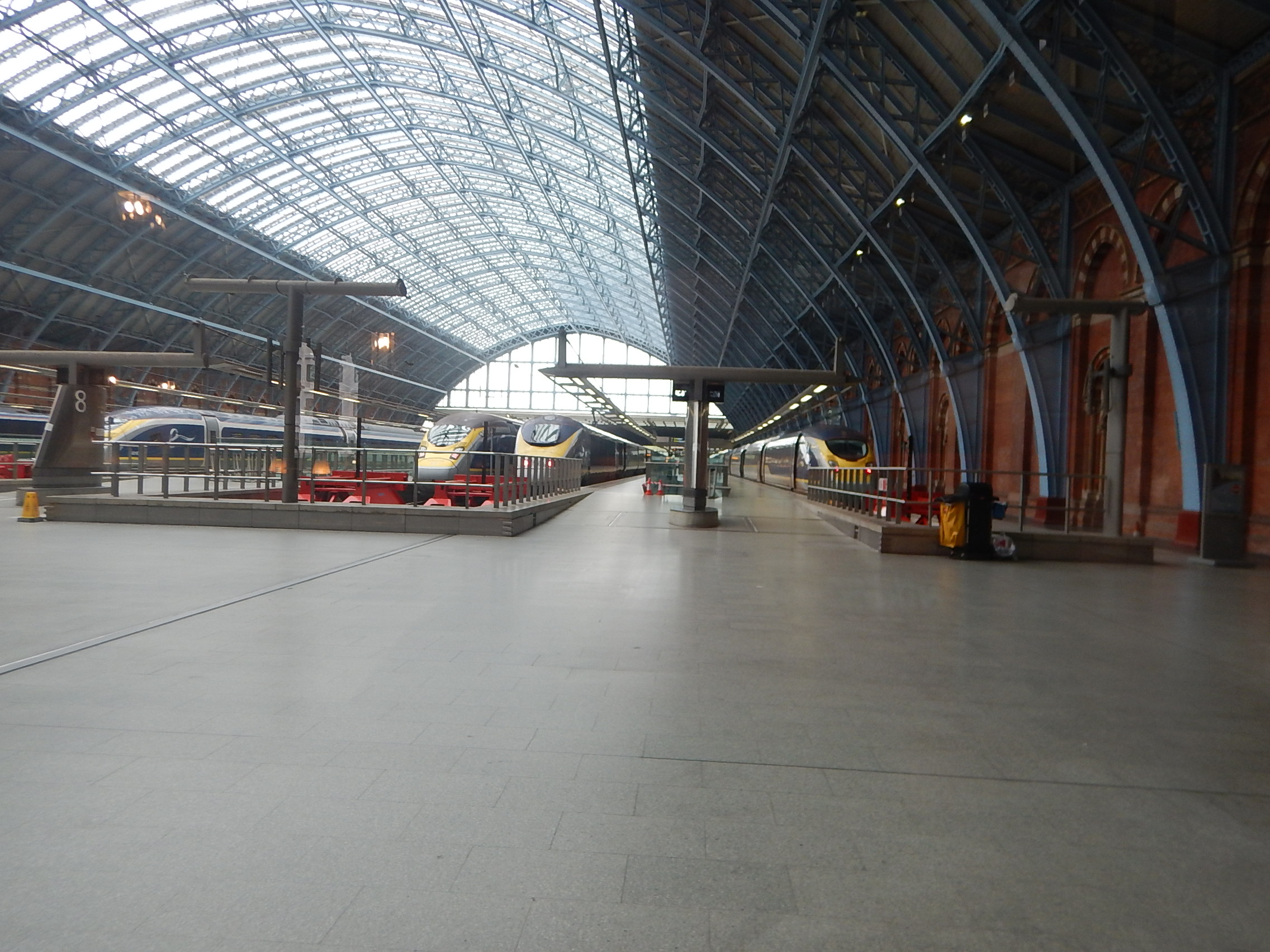
I was standing in front of the glass security wall, towards the East (Kings Cross) side of the station.
On the British Library side of the station it is possible to walk along to the four platforms for East Midlands Railway trains.
I wonder why, there isn’t a link down the Kings Cross side of the station, so that it would be possible to walk from the front of the station to the Souyjeastern HighSpeed commuter routes.
How Will Abellio East Midlands Railway Maximise Capacity On The Midland Main Line?
In this post, I will try and get a feel to how Abellio East Midlands Railway, will maximise capacity on the Midland Main Line.
The Current Service
There are currently two trains per hour (tph) to both Nottingham and Sheffield and one tph to Corby from London.
Ignoring the Corby service, which will be using electric trains, intermediate calls have these frequencies, from South to North.
- Bedford – One tph
- Wellingborough – One tph
- Kettering – One tph
- Market Harborough – Two tph
- Leicester – Four tph
- Loughborough – Two tph
- East Midlands Parkway – Two tph
- Long Eaton – One tph
- Beeston – One tph
- Derby – Two tph
- Chesterfield – Two tph
As the new bi-mode trains will be more modern, with probably shorter dwell times at each station, I suspect that when Abellio East Midlands Railway implement their ultimate timetable, there will be more stops, without degrading journey times.
These are fastest times.
- London and Nottingham is one hour forty minutes
- London and Sheffield is two hours
I feel that round trips to both destinations will be four hours with some speed increases and shorter station dwell times.
- The current two tph to Nottingham and Sheffield needs eight trains to each destination.
- This is a total of sixteen trains.
As each train could be two five-car trains working as a ten-car train, train numbers for the current service could be as high as thirty-two trains.
A first look seems to indicate that there .will be no overall increase in train frequency, although, as I said earlier, the performance of the new trains should allow extra station stops.
It also indicates to me, that any increases in frequency between London and Nottingham/Sheffield will need extra trains.
The Electrified High Speed Line South Of Kettering
Midland Main Line services South of Kettering are as follows.
- Two tph to London and Nottingham
- Two tph between London and Sheffield
- One tph between London and Corby.
From December 2021, there will be two tph between London and Corby.
The maximum number of services between London and Kettering on the electrified section currently envisaged is only six tph or one train every ten minutes.
As the Class 700 trains on Thameslink are capable of using digital signalling and all the new trains will also be similarly equipped, I wouldn’t be surprised that the theoretical capacity of the electrified fast lines could be higher than the proposed six tph. |Especially, when digital signalling is installed.
The number of trains in the fleet, is much more of a limit on services, than the capacity of the Midland Main Line.
If all trains were ten cars, the following numbers of trains would be needed.
- Current two tph – 32 trains
- Increase to three tph – 48 trains
- Increase to three tph – 64 trains
Are there enough passengers to fill all these trains?
Does St. Pancras Have Enough Capacity?
St. Pancras station has four platforms for Midland Main Line services.
- The platforms are long enough to take two five-car Class 222 trains,.
- They would surely accommodate a ten-car formation of the new Hitachi trains.
- Each platform can probably handle three or four tph, giving a total capacity of 12-16 tph.
As four tph to Nottingham and Sheffield and two tph to Corby is only a total of ten tph, there is enough platform capacity for several years to come.
If there is a problem, it is that the large numbers of passengers would overwhelm the stairs and escalators between the ground level of the station and the platforms.
I am certain, that just like the Eurostar platforms at St. Pancras, the Midland Main Line platforms will need better passenger access and facilities.
Will it even be enough, when up to six tph, all of which could be 240 metres long, start to arrive in December 2021?
What could be done to help solve the capacity problem at St. Pancras station in the future?
Better Access To The Midland Main Line Platforms
Consider.
- Space is limited to add extra escalators, lifts and places to wait
- St. Pancras is a Grade I Listed Building.
- As I don’t travel through the station in the Peak, the escalators seem to always be going the wrong way.
Improving the current access will be very difficult.
This Google Map shows the Northern End of the station.
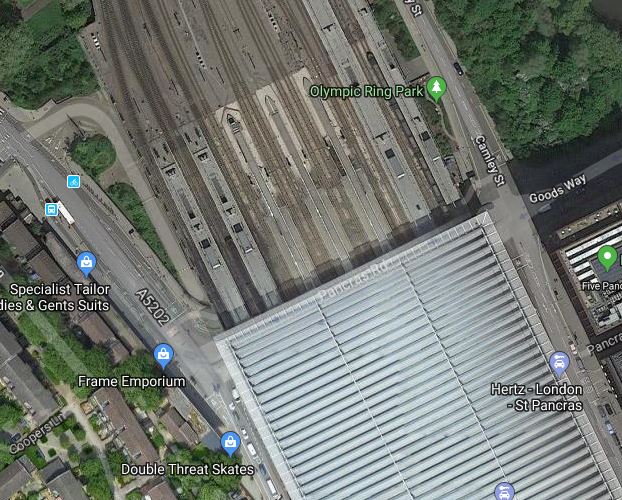
Note.
- The Midland Main Line platforms are the two island platforms on the left.
- The Southeastern HighSpeed platforms are the two island platforms on the right.
- The Eurostar platforms are the three island platforms in the middle.
Could a second entrance to some of the platforms be built here?
It would be very difficult, unless the extension was future-proofed when it was built.
Underground Improvements
Getting between the Midland Main Line platforms and the Underground is an obstable course.
As a Londoner, who’s had the operation to have the Underground Map implanted in my brain, I generally go to the Midland Main Line platforms at St. Pancras by taking one of the following.
A bus from close to my house to outside the station.
- A Metropolitan Line train from Moorgate
- A Northern Line train from Angel.
- A Piccadilly Line train from Manor House
- A Victoria Line train from Highbury & Islington
The last four need a bus to get to the Underground.
I usually come back home, by spending just over a tenner on a black cab!
Crossrail 2
Crossrail 2 should improve matters, but will it ever be built?
Will The New Brent Cross Thameslink Station Allow Cross Platform Interchange Between Midland Main Line and Thameslink Services?
Consider.
- The proposed Brent Cross Thameslink will be just North of Cricklewood station.
- Midland Main Line services through the station would be six tph.
- Thameslink services through the station would be fourteen tph
- The West London Orbital Railway could be built to connect the station to High Speed Two and Heathrow
Would it take the pressure off St. Pancras?
It might do, if a cross-platform interchange could be arranged.
Could Some Midland Main Line Services Use Thameslink?
Consider.
- The obvious service to go through Thameslink would be the two tph service between Corby and St. Pancras.
- Thameslink is currently setup to handle 24 tph, but it has been designed for 30 tph.
- The Corby service will stop at Kettering, Luton and Luton Airport Parkway, to the North of London.
- It could perhaps terminate at the soon-to-be-rebuilt Gatwick Airport station in the South.
It might work!
Especially, if Kettering station were to be rebuilt to have cross-platform interchange between Corby sewrvices and the bi-mode ones going further North.
Splitting And Joining Trains
In Rock Rail Wins Again!, I gave this simple example of how the splitting and joining capability of Hitachi AT-300 trains can be used.
A ten-car train might leave St. Pancras as two five-car units running as a pair. It could split at East Midlands Parkway station and one train could go to Nottingham and the other to Derby. Coming South the two trains would join at East Midlands Parkway.
I feel that Derby, East Midlands Parkway and Leicester are ideal stations on the Midland Main Line, where services could be split and joined.
- They have at least four platforms.
- The platforms are long and straight.
The two terminals at Nottingham and Sheffield could also probably be used to enable services to serve more destinations.
Shorter trains must have advantages on some routes.
- Capacity is better matched to demand.
- Platforms may not need to be extended.
- Services can be run by a driver and a conductor.
Will Abellio East Midlands Railway use splitting and joining to increase the coverage of their services?
Great Western Railway’s Class 800, 801 and 802 trains have the capability to split and join and the operator doesn’t seem to use it. Although, they do split and join Class 387 trains.
Extended Services To And From The North And East
The ability to split and join, that could be used to extend services to the North And East.
Serving Barnsley, South Yorkshire And Leeds
Consider.
- In Sheffield Region Transport Plan 2019 – A New Station At Barnsley Dearne Valley, I talked about a proposed new station at Barnsley Dearne Valley on the route between Sheffield and Leeds.
- The Sheffield Region Transport Plan 2019, also envisages a new Midland Main Line station at Rotherham.
- This report on the Transport for the North web site, is entitled At A Glance – Northern Powerhouse Rail.
- The report states that there will be a fast Sheffield and Leeds service at a frequency of four tph, that taqkes twenty-eight minutes.
- Currently, East Midlands services on this route take just over half-an-hour with only a stop at Wakefield Westgate.
I wonder if there are paths and need for a London and Sheffield service to split at Sheffield with, the two five-car trains going to different destinations.
- Leeds via Rotherham, Barnsley Dearne Valley and Wakefield Westgate, is one possibility.
- Could a service go to Huddersfield?
- Hull is probably too far.
One tph could terminate at Sheffield and one splitting and one tph could split and serve other destinations.
Advantages could include.
- Barnsley and Rotherham get a direct hourly service to London.
- South Yorkshire and Leeds have a direct hourly service to the East Midlands.
- Sheffield and Leeds have an hourly fast service.
I’m sure Abellio have a very workable plan to improve services North of Sheffield.
Serving Lincolnshire And Nottinghamshire
Consider.
- Splitting and joining at Nottingham may allow an increase in direct services to and from Lincoln.
- Perhaps parts of North Lincolnshire could be well-served by a fast train from Nottingham.
- Would Mansfield and Worksop benefit from a direct service from London on the Robin Hood Line, after a reverse at Nottingham.
The five-car trains give the flexibility to do the previously unthinkable.
Conclusion
There is a lot of developments that can or will happen with Midland Main Line services.
Could London Get A New Tube Line Between Canary Wharf And Euston?
The title of this post is the same as that as this article on CityMetric.
The article makes some interesting points.
- The line has been proposed by the owners of Canary Wharf.
- Getting to Canary Wharf from Euston, Kings Cross and St. Pancras is difficult.
- Property developers have always decided where London’s railways go.
- The plan would seem to have just one intermediate stop at Blackfriars station.
These new or improved services will be happening in the next ten years.
- More and faster services to/from the Midlands and the North West at Euston.
- High Speed Two services at Euston
- More and faster services to/from the East Midlands and Sheffield at St. Pancras.
- More Continental services at St. Pancras
- More and faster services to/from Yorkshire, the North East and Scotland at Kings Cross.
These lead me to the conclusion, that a new rail link is needed across London.
A Possible Western Extension To The Docklands Light Railway
In A Connection Between City Thameslink Station And The Docklands Light Railway, I wrote about a possible Western extension of the Docklands Light Railway.
his map from Transport for London, shows this possible Western extension of the DLR.
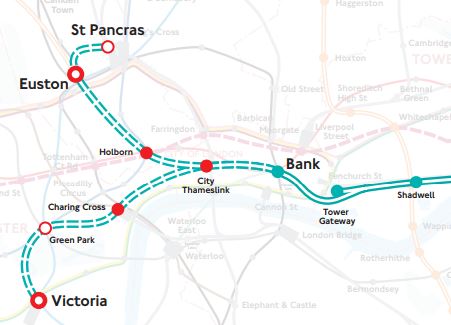
This was my analysis.
With all the problems of the funding of Crossrail 2, that I wrote about in Crossrail 2 Review Prompts Fresh Delays, could this extension of the DLR, be a good idea?
Consider,
- Victoria, Euston and St. Pancras are prosposed Crossrail 2 stations.
- It would link Canary Wharf and the City of London to Eurostar, Northern and Scottish services and High Speed 2.
- It would give all of the Docklands Light Railway network access to Thameslink.
- A pair of well-designed termini at Euston and St. Panras would probably increase frequency and capacity on the Bank branch of the system.
- The DLR is getting new higher capacity trains.
- Bank station is being upgraded with forty percent more passenger capacity.
- Holborn station is being upgraded and hopefully will be future-proofed for this extension.
- One big advantage at City Thameslink, is that Thameslink and the proposed DLR extension will cross at right-angles, thus probably making designing a good step-free interchange easier.
- The Bank Branch of the DLR currently handles 15 tph, but could probably handle more, if they went on to two terminal stations at St Pancras and Victoria..
- Waterloo and City Line can run at twenty-four tph.
Cinderella she may be, but then she always delivers, when there is a desperate need, just as she did magnificently at the 2012 Olympics.
The only problem with this extension of the DLR, is that compared to the rest of the system, the views will be terrible.
For myself and all the others living along the East London Line, with a step-free change at Shadwell, we would get excellent access to Euston, Saint Pancras and Victoria
But could the line still be called the Docklands Light Railway, as it spreads its tentacles further?
Will Cinderella come to the help of Canary Wharf for a second time?
I remember, when the Lewisham extension of the DLR was built without fuss, fanfare and cost and time overruns a couple of decades ago.
It was a triumph of sensible engineering.
Google Grabs The Best Site In London For Its Massive Groundscraper
This Google Map the site where the massive groundscraper is being built.

Note.
- Kings Cross station, which is on the right of the map, has extensive connections to the North-East of England and Scotland.
- St. Pancras station, which is on the left of the map, has extensive connections to the Midlands and Belgium, France and the Netherlands, with more services to come including Germany, Switzerland and Western France.
- Thameslink runs North-South beneath St. Pancras station, has extensive connections to Bedfordshire, Herfordshire, Kent, Surrey and Sussex.
- There are also six Underground Lines.
- Gatwick and Luton Airports have direct connections and City, Heathrow and Southend Airports only need a step-free change.
- Improvements in the next few years could mean that HS2 and all of London’s five airports will have a fast direct connection to the area.
In the middle of all these railway lines, sits Google’s groundscraper, which shows as a white structure towards the top of the map.
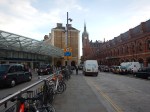
These pictures show the area between the two stations, the under-construction groundscraper and the new blocks.





And these pictures show the progress on the site.
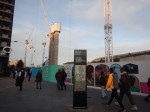



There is not much that is visible yet!
More Pictures!
But the building will be more visible soon! For those who can’t wait, this article from the Daily Mail has a lot of visualisations.
Heavyweight Backing Expected For £1.5bn Crossrail Extension
The title of this post, is the same as that of this article on New Civil Engineer.
This is the first paragraph.
Government infrastructure tsar Sir John Armitt is this week expected to throw his weight behind a £1.5bn extension to Ebbsfleet.
The article also says.
- Circumstances have changed greatly since the 2008 Crossrail Act.
- Canary Wharf Group, who contributed £150million to the building of Canary Wharf station, may be prepared to contribute, as this will give access from their site to Eurostar.
- The extension could support the construction of 55,000 new homes and 50,000 jobs.
The extension would take ten years to design and construct.
Eurostar
After my forays to and from Europe recently by Eurostar, I feel that a Crossrail link to Ebbsfleet will be heavily used.
- As more destinations are served by trains from St. Pancras, more passengers will find Ebbsfleet a more convenient station for the Continent.
- Ebbsfleet will be linked directly to Canary Wharf, the City of London, the West End and Heathrow.
- Crossrail will give an easy Undergound-free link between Wales and the West Country and Ebbsfleet stations with a single change at Paddington station.
- When HS2 opens, there will be an easy Underground-free link between the Midlands and the North and Ebbsfleet stations with a single change at Old Oak Common station.
- St. Pancras only has four platforms with no space to expand, but it could be relatively easy to add capacity at Ebbsfleet.
If I was in charge of designing and building the Crossrail extension, I’d make sure that Eurostar made a contribution, as they will be big winners from the extension.
The City Of London
The extension may be beneficial to the City of London.
- The extension would add more stations within easy reach of terminal stations in the City.
- The extension might give an easier route to and from the City.
- After Brexit, I suspect the institutions of the City will want more good connections to Amsterdam, Brussels, Frankfurt and Paris.
,Perhaps one of the big City companies might like to finance construction and charge a royalty on each rain?
London City Airport
Should the project to build the extension also include building a Crossrail station at London City Airport?
This would mean that passengers between places like Aberdeen, Belfast, Dublin, Edinburgh, Glasgow, the Isle of Man and Manchester, and Continental destinations served by train would have a more convenient interchange in London.
Ebbsfleet Valley
Ebbsfleet Valley is a proposed new town of 16,000 homes being built on brownfield land close to Ebbsfleet station.
£300million of government money has been pumped into the project. But according to Wikipedia, there has been criticisms of the project.
London Paramount Entertainment Resort
London Paramount Entertainment Resort is described like this in Wikipedia.
London Paramount Entertainment Resort (commonly referred to as London Paramount) is a proposed theme park for the London Resort in Swanscombe, Kent. The project was announced on 8 October 2012 and it was estimated to open by around 2023.. In June 2017, it was announced that Paramount had pulled out of the project[2]. However, London Resort Company Holdings still insist the project is going ahead.
I’ve never been to a theme park, as I prefer the real thing!
But others will like it!
Conclusion
The beneficiaries of extending Crossrail to Ebbsfleet, include a lot of big players with possibly large financial resources.
I would suspect that some could be persuaded to fund particular parts of the project.
After all, if a housing developer invested say £10 million, in a new station for a development and then found it easier to sell the houses, there comes a point, where they make more profit and house buyers get a much better place to live.
A Connection Between City Thameslink Station And The Docklands Light Railway
In the Wikipedia entry for the Docklands Light Railway, there is a section describing a proposed Euston/St. Pancras Extension.
This is said.
In 2011, strategy documents proposed a DLR extension to Euston and St Pancras. Transport for London have considered driving a line from City Thameslink via Holborn north to the rail termini. The main benefit of such an extension would be to broaden the available direct transport links to the Canary Wharf site. It would create a new artery in central London and help relieve the Northern and Circle lines and provide another metro line to serve the High Speed line into Euston.
This map from Transport for London, shows the possible Western extension of the DLR.
With all the problems of the funding of Crossrail 2, that I wrote about in Crossrail 2 Review Prompts Fresh Delays, could this extension of the DLR, be a good idea?
Consider,
- Victoria, Euston and St. Pancras are prosposed Crossrail 2 stations.
- It would link Canary Wharf and the City of London to Eurostar, Northern and Scottish services and High Speed 2.
- It would give all of the Docklands Light Railway network access to Thameslink.
- A pair of well-designed termini at Euston and St. Panras would probably increase frequency and capacity on the Bank branch of the system.
- The DLR is getting new higher capacity trains.
- Bank station is being upgraded with forty percent more passenger capacity.
- Holborn station is being upgraded and hopefully will be future-proofed for this extension.
- One big advantage at City Thameslink, is that Thameslink and the proposed DLR extension will cross at right-angles, thus probably making designing a good step-free interchange easier.
- The Bank Branch of the DLR currently handles 15 tph, but could probably handle more, if they went on to two terminal stations at St Pancras and Victoria..
- Waterloo and City Line can run at twenty-four tph.
Cinderella she may be, but then she always delivers, when there is a desperate need, just as she did magnificently at the 2012 Olympics.
The only problem with this extension of the DLR, is that compared to the rest of the system, the views will be terrible.
For myself and all the others living along the East London Line, with a step-free change at Shadwell, we would get excellent access to Euston, Saint Pancras and Victoria
But could the line still be called the Docklands Light Railway, as it spreads its tentacles further?
 The Anonymous Widower