Elon Musk’s Starlink Lined Up To Solve Train Wi-Fi Rage
The title of this post, is the same as that, as this article on the Telegraph.
This is the sub-heading.
Using the billionaire’s network of satellites could help rail passengers make reliable phone calls
These two paragraphs give more details.
Elon Musk’s Starlink satellites are being looked at as a potential solution to solving the issue of patchy Wi-Fi on Britain’s trains.
Train operators in England and Wales are examining whether the satellite-based internet provider could be used to boost connectivity after a six-month trial of the technology began in Scotland last month.
I don’t see any obvious technical reason, why not the technology wouldn’t work.
This Wikipedia entry describes the 2024 Talerddig Train Collision, when two trains collided on the Cambrian Line.
Better communications might have helped in avoiding or sorting out the incident.
I Seemed To Have Improved My Left Knee
My left knee has always been weaker than my right.
- What really made it bad was living with C and our three children in a fourth floor walk-up flat with no lift.
- I usually carried the double-pushchair up the stairs a couple of times a day.
- It should also be born in mind, that my left humerus was broken by the school bully, when I was fifteen.
Our GP at the time, we were living in the flat, thought I should have an operation on the knee, but luckily I didn’t as another GP a few later gave me a set of exercises, that improved it to a certain extent.
Since my stroke and returning to London, I have relied on buses and trains, as I can’t drive and don’t even have a car.
My knee seemed to be getting worse and I reasoned it wasn’t being helped, by the high step in and out, you get on some trains and buses.
This picture shows the high step into a Northern Line train at Moorgate station.
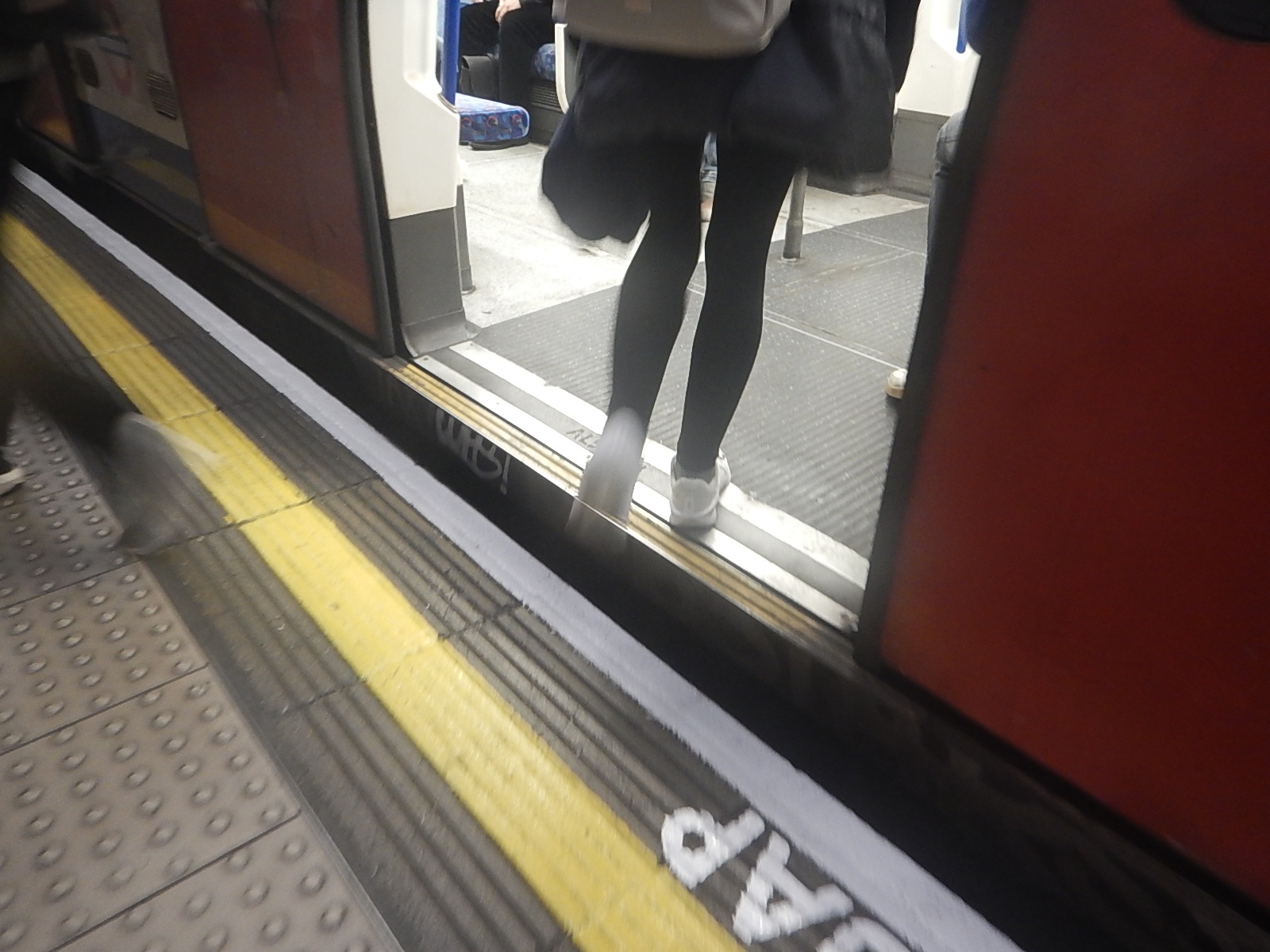
I found that the step-down here, gives a bang on my knee every time I get out of the train.
This second picture shows Bank station, which is a new platform and level.
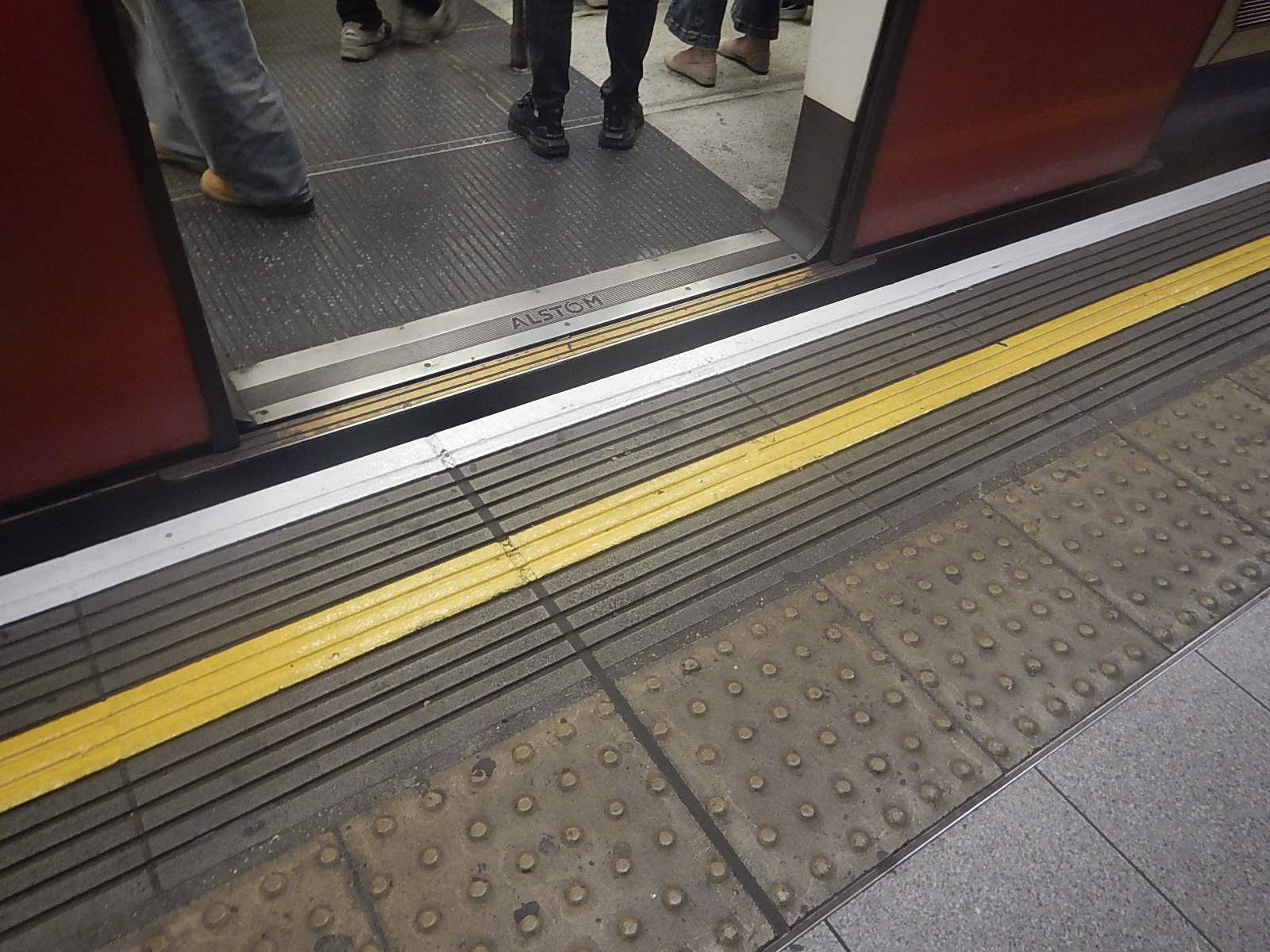
It’s surely very much a matter of GCSE mathematics and geometry, with a bit of money to get many more train and bus entries level.
So I have developed a maneuver to get out of the train or bus.
- Most doors have a vertical rail on either side. You can see one rail in the first picture.
- As I want to avoid hurting my left leg any more, I grab the rail on the left side of the door going out, with my left hand.
- I have my bag in my strong right hand. If I have two bags, one is usually My Faithful Servant, so I can hold them both in my right hand.
- I then swing around the vertical rail holding on with my left hand.
- So far, every time I’ve landed safely and lightly on my right foot.
My left knee seems to be improving.
Surprisingly, the extra pulls on my left arm don’t seem to harm it.
Level Boarding Included In Rail Innovation Funding Competition
The title of this post, is the same as that of this article in Railway Gazette.
This is the introductory paragraph.
Innovate UK has opened the latest calls for grant funding proposals under the First of a Kind programme, which supports the demonstration of innovative technologies to give them a better chance at being deployed by railway companies.
What annoys me about boarding trains (and some buses for that matter!), is how variable it is.
- Trains in East Anglia, Merseyside and Switzerland are particularly good, but then they have the common Stadler factor.
- Will the Newcastle Metro and the Glasgow Subway be as good?
- Some European countries, including Germany, could do much better!
- Once at Leipzig, I helped four hefty Germans lift a guy and his wheel-chair out of the bottom-deck of a double-deck train.
- In London, the Docklands Light Railway, the Elizabeth Line and some parts of the Overground are acceptable, but there is need for improvement.
- Southeastern, including the HighSpeed is particularly dodgy and I need help at some stations like Clapham Junction and Lewisham.
- Bank has a notorious platform on the Central Line.
- Perhaps the worst in London are some stations on theBakerloo Line, where it shares with the Watford DC Line.
All passengers on buses and trains deserve the best access that designers and bus and train manufacturers can devise.
In one incident, a slight, elderly Indian lady in a sari, was having difficulty getting down from an Overground train on the Watford DC Line at Willesden Junction station.
I was the only person on the platform, so I called out. “Can You Jump?”
Which she did and landed safely on her feet! I caught her and it was smiles all round!
I suspect she’d done that before.
So is one idea to give all passengers, lessons in jumping on and off buses and trains?
Seriously though, could Lego devise a large-scale engineering version of their product, that could be used to create steps and humps, which could be glued together for strength.
Alternatively, 3D printing could be used to create gap-fillers.
I think this challenge from Innovate UK will bring forward some good solutions.
Heathrow: Where Was The Redundancy?
In the early 1970s, I was involved in a small way, in the design of chemical plants for ICI.
When designing a chemical plant, you obviously want a plant that will have a high availability, so output is maximised, even if some parts have to be shut down.
With chemical plants, you might duplicate some reaction vessels, pipework or pumps for example.
But surely, when you are designing large infrastructure, it should be designed to keep going.
This document from Network Rail is entitled £140m Transformation Of Liverpool Lime Street Completed On Time.
These bullet points serve as sub-headings.
- Track, platform and signalling improvements
- Paving the way for bigger, better trains with more seats for more customers in future
- Part of the wider Great North Rail Project
- Part of #StationsDay – celebrating the £5.2billion investment to regenerate Britain’s rail stations
But I also believe two other important sub-projects were carried out during the work.
The Station Has Been Substantially Prepared For High Speed Two
Consider.
- Platforms were lengthened so they can accept 265.3-metre long eleven-car Class 390 trains.
- Platforms were widened, so they could handle the 607 passengers, that can be carried in an eleven-car train.
- There appears to be five full-size platforms numbered 6-10.
- Is there the possibility of a sixth platform, which is currently numbered E (for Emergency (?))?
- The approaches to the station have been remodeled, so trains can enter the station very efficiently.
- The Class 390 trains are going between Crewe and Liverpool Lime Street stations, in times that are not far off those expected from High Speed Two trains.
As Liverpool Lime Street will only need to handle half-length 200-metre long classic compatible High Speed Two trains, Liverpool Lime Street station is now ready for High Speed Two.
Liverpool Lime Street Station Is Now Effectively Two Five Platform Stations
This OpenRailwayMap shows the platform layout at Liverpool Lime Street station.
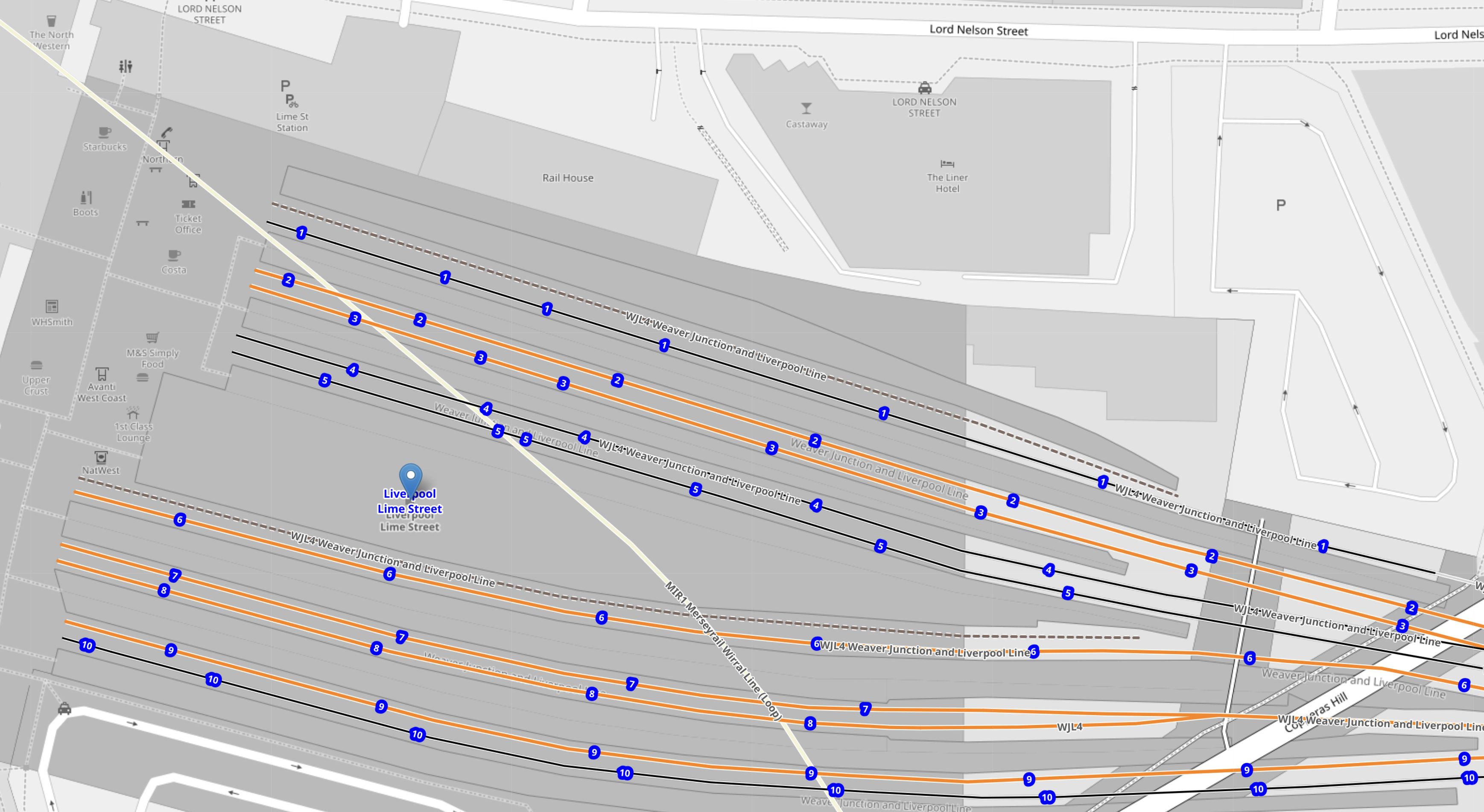
Note.
- The platforms indicated by blue dots with numbers are the ten platforms of the station.
- The platforms in the Northern-half of the station are numbered 1-5.
- The platforms in the Southern-half of the station are numbered 6-10.
- All platforms; 1-10 are electrified.
- The white line running diagonally across the map, shows the route of the loop of the Wirral Line.
Click the map to show it to a larger scale.
These are some of my pictures of the station.


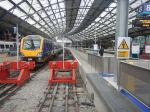

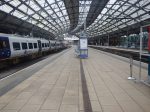
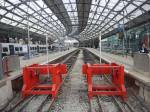

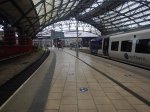
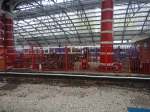
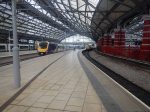

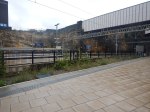
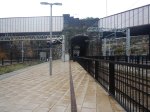

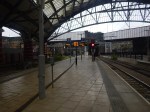
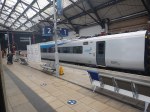
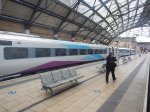
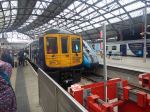
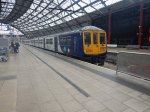


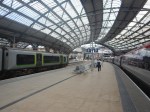
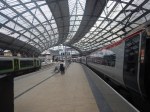
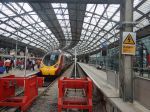
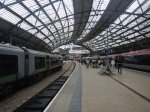
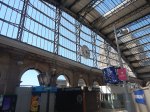
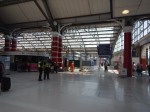

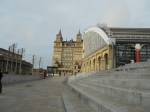

It is without doubt, one of the best stations aesthetically and operationally in the world.
A Bespoke Tram-Train For The UK
Trams, tram-trains, trains and anything that runs on rails is generally very expensive.
Does this partly explain, why the UK has relatively few urban tramways and railways?
In Stadler Presents Mock-Up Of Tram-Trains For German And Austrian Operators, I discussed how five German and Austrian operators had got together to create a common tram-train design, that would be suitable for all the operators.
The mayor of one of the cities involved in the joint order, said savings of the order of a million euros per vehicle may have resulted from the common design.
I would also feel that savings in operational costs, design of infrastructure, spares inventory and other costs would also result.
Identical tram-trains would make through running between networks easier.
Where Could Tram-Trains Be Used In The UK?
Consider.
- Currently, tram-trains are running in Sheffield and a battery-electric version of the same Stadler Citylink tram-train will soon be running in Cardiff.
- Cardiff, is developing a Cardiff Crossrail on tram-train principles across the city.
- Sheffield have said that they will be replacing their trams and I believe they could use developments of their excellent Stadler tram-trains.
- Sheffield is likely to extend their tram system and might include tram-trains to Doncaster.
- Cities that have talked about adding tram-trains to their tram networks include Birmingham, Blackpool, Manchester and Nottingham.
- Leeds is developing a metro system, which could be developed using tram-train principles.
- Glasgow has talked about a tram-train to Glasgow Airport for some time.
- The East-West Rail Link is proposing a tram-train link between Ipswich and Felixstowe to allow more freight trains into the Port of Felixstowe.
There could be quite a number of tram-trains being used in the UK, especially if they are used as at Felixstowe, to increase freight capacity into ports.
These are a few of my thoughts.
Battery-Electric Tram-Trains
I would envisage, that a lot of the new tram-trains would operate using batteries. Especially, as battery-electric trains are showing quite long ranges of upwards of thirty miles.
Already trams in Birmingham and trains on Merseyside, are operating using batteries and it avoids the expense of putting up catenary, if enough exists to charge the trams.
Replacement of Diesel Multiple Units By Battery-Electric Tram-Trains
There are some branch lines, where diesel multiple units run off a branch of an electrified main line.These services could be decarbonised by changing the rolling stock.
This OpenRailwayMap shows the St. I’ves Bay Line in Cornwall.
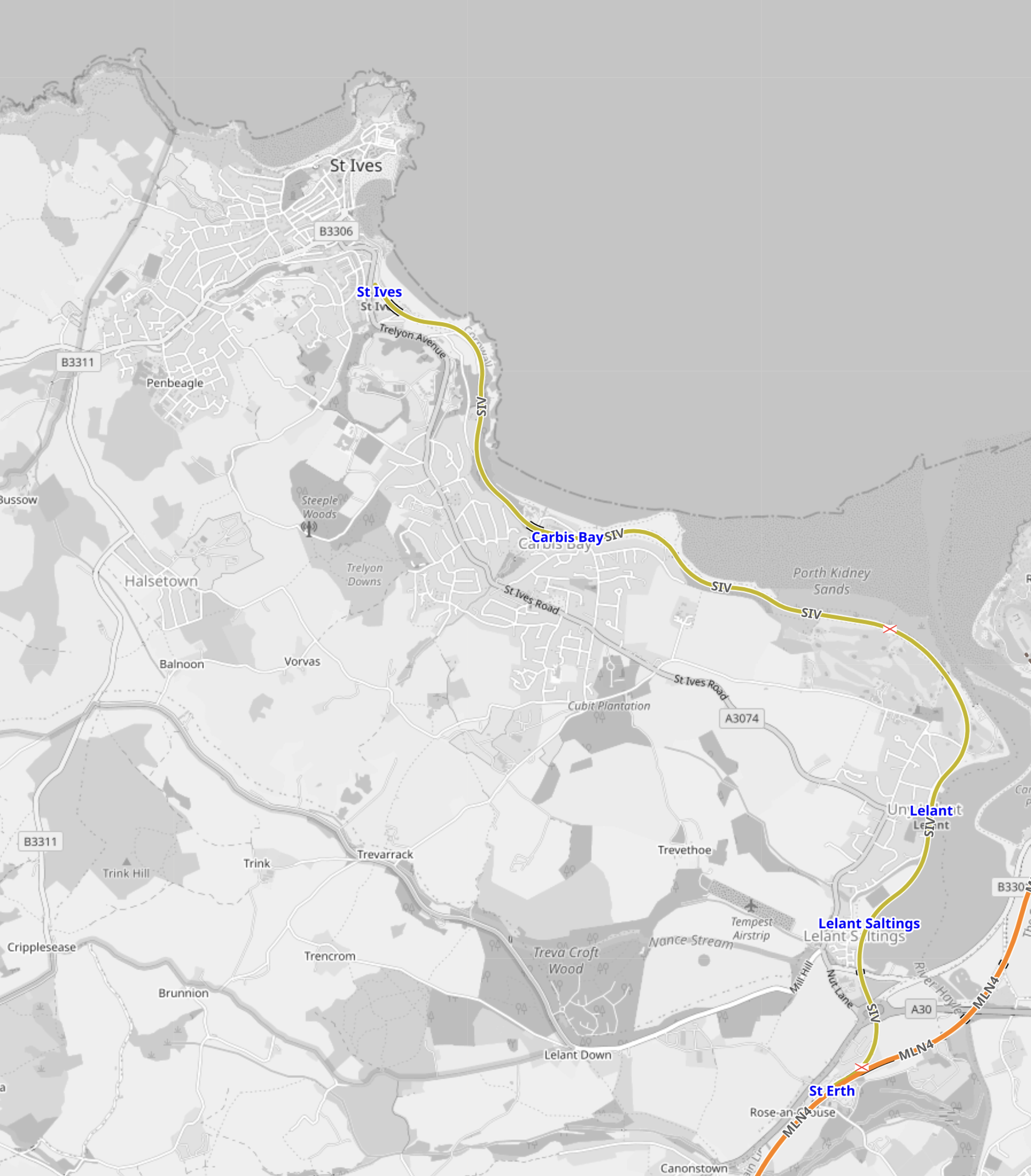
Note.
- The St. Ives Bay Line is shown in yellow.
- The Southern terminal is St. Erth station, where it connects to the Cornish Main Line, which is shown in orange.
- The Northern terminal is St. Ives station, which is towards the top of the map.
- The St. Ives Bay Line is 4.25 miles long.
- No tracks are electrified.
- There are three intermediate stations.
This second OpenRailwayMap shows St. Erth station in more detail.
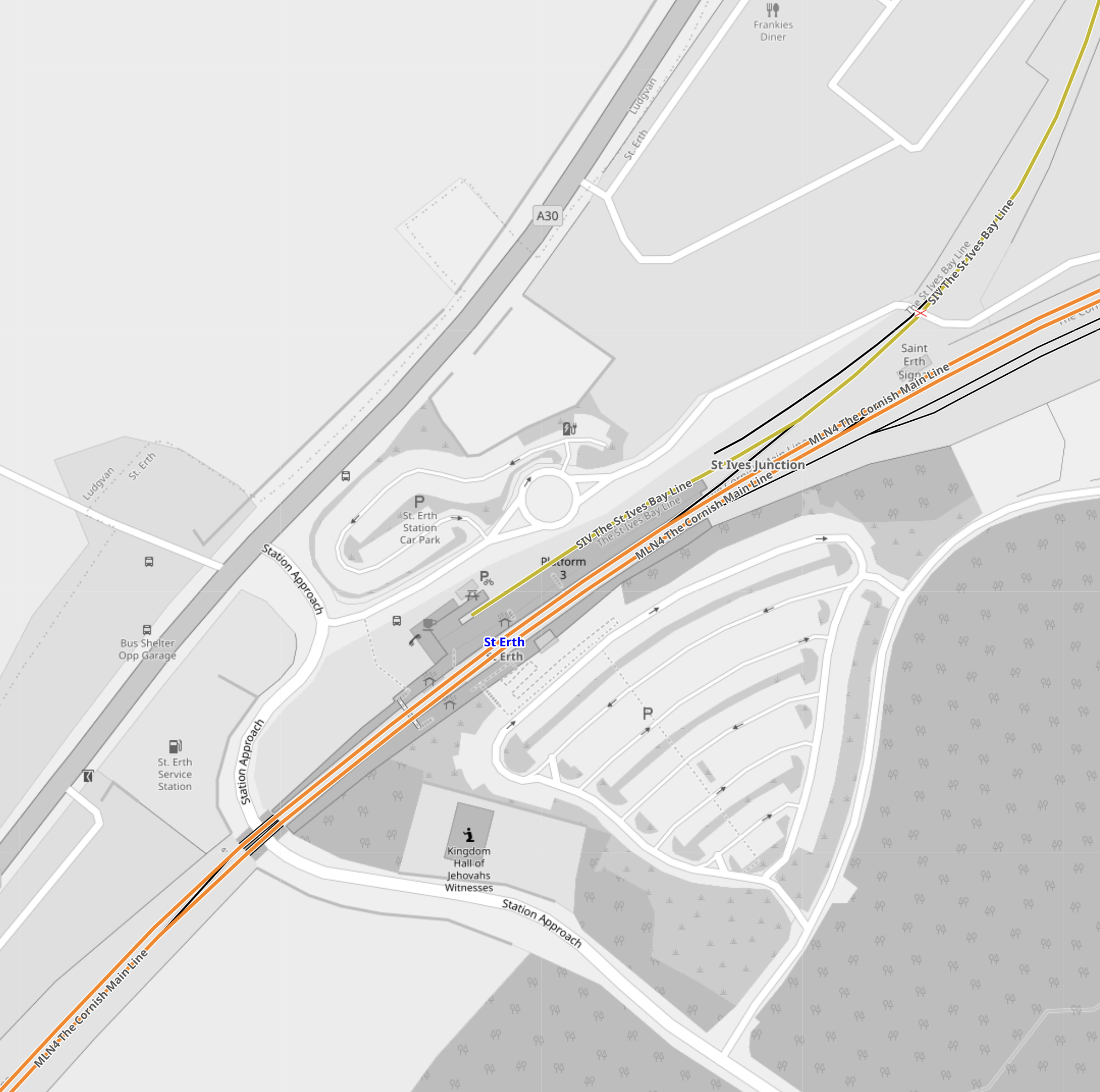
Note.
- The St. Ives Bay Line has its own platform at the side of the station.
- I am fairly certain, that some form of charging could be installed in this platform.
- At the other side of the Cornish Main Line are two sidings, which could be used for cleaning and maintenance.
A neat zero-carbon branch line could easily be created.
New Branch Lines To New Developments
In Sheffield Region Transport Plan 2019 – A New Tram-Train Route To A New Station At Waverley, I gave my view on a tram-train loop from the Sheffield-Lincoln Line to serve the Advanced Manufacturing Centre and new housing at Waverley.
The tram-train would run as a train to the branch line for the development and then run as a battery-electric tram, through the development.
As the Midland Main Line to Sheffield will be electrified, the tram-trains could be charged on the electrification in Sheffield station.
Build Them In Doncaster
Wabtec are closing Doncaster works.
Surely this would be the site to assemble the scores of tram-trains that could be needed in the UK.
Conclusion
Tram-trains could do a lot to improve the railways of the UK.
They would also help to decarbonise the existing system.
Why Do Major Rail Projects Go Over Budget?
The title of this post, is the same as that of this article on Rail Technology Magazine.
This is the sub-heading.
Experts from the National Infrastructure Commission (NIC) will be questioned by the Transport Committee on their work advising the Government on planning major transport projects this week.
This is the introductory paragraph.
The cross-party Committee will ask witnesses, including NIC Chair Sir John Armitt, why infrastructure projects such as HS2 go over budget, how the Department for Transport can manage them more successfully, and the Government’s ability to learn from mistakes or from positive examples in other countries.
In my time, I have written a lot of project management software and it has generally sold well, especially in the fields of aerospace, construction, defence, oil & gas and vehicles. It has also sold well in Australia, France, Korea, Norway, The Netherlands and the United States.
In the UK, two major areas of Government ; rail and the NHS did not use any of my software, despite having large numbers of suitable projects, whereas nationalised companies like British Aerospace, British Leyland and Ferranti were big users. The Chevaline project, which was the refurbishment of the UK’s nuclear deterrent by the Callaghan Government also used my software.
I do find this split strange. A retired MP once told me, that it is traditional.
But Rail and the NHS always seem to get it wrong! Is it because, they are two government departments that deal a lot with the General Public?
On the other hand, the Inland Revenue seem to do better. But my planning software was used to plan the move to Telford!
Perhaps, there is a lot less traditional thinking in the Inland Revenue.
Wales’ Public Transport Priorities All Wrong, Expert Says
The title of this post, is the same as that if this article on the BBC.
This is the sub-heading.
The Welsh government has got its priorities wrong over public transport, an expert has said.
These five paragraphs outline the story.
Ministers should have improved bus and train services before reducing speeds from 30mph to 20mph on many Welsh roads, said Stuart Cole, Emeritus Professor at University of South Wales.
He said public transport facilities should have been “put in before any other anti-motorist legislation”.
The Welsh government said current arrangements were complex across Wales.
But Prof Cole said the Welsh government had “gone about it the wrong way round” although “what they’ve done is not in itself a bad idea”.
He said he wanted to see Wales emulate the Netherlands, where there’s been massive investment in trains and buses to entice motorists out of their cars.
I agree with Professor Cole and I feel that the Welsh Government’s approach has been all stick and no carrot!
He also criticises the lack of a Welsh travel card.
The article gives a classic example of bad transport planning.
Llanelli, in Carmarthenshire, which happens to be Transport Minister Lee Waters’ constituency, is a good example of how buses and trains are not integrated.
The bus station is a mile away from the train station, and there are no buses linking the two.
In fact there are no buses at all from the railway station.
There must be other examples like this all over the country.
Perhaps we need a UK-wide complaints department for idiocies like this.
Can Park-And-Ride Stations Be Used To Increase Motorway Capacity?
This article on the BBC is entitled New Smart Motorway Plans Being Scrapped.
I’ve never driven or even been driven on a smart motorway. But one incident in the 1970s, convinced me that we should have full hard shoulders on motorways and probably some dual carriageway roads.
I was travelling North on the then-two-lane M11 just North of Stansted Airport, doing around seventy in the outside lane of a not very busy motorway.
From nowhere an MGB convertible appeared in my mirrors and I pulled over to let the other car through.
There was a slight bend to the right at that point and the road was in a cutting.
The MGB just went straight on, climbed the banking and then turned over and rolled down and into the middle of the motorway.
A couple of other cars stopped on the hard shoulder and I initially pulled in behind them.
Miraculously, the driver had got out of the upside-down MGB and was standing beside the car.
I noticed that someone was using the emergency telephone by the side of the motorway, but I was worried that someone could come along too fast.
So as I had a large white car, I switched on the hazard lights and reversed down the hard shoulder. It certainly slowed everybody down and there were no more bumps or injuries. But what would have happened if the motorway had been busy?
When I first heard that smart motorways were going to be introduced in 2007, I was immediately against the idea because of that serious incident on the M11.
So what can we do to increase the capacity of our motorway and main road network?
Mathematical Modelling
In the 1970s, my software was used to model water supply in the UK. This piece of software just solved simultaneous differential equations and was used by the Government’s Water Resources Board.
I believe that software like I wrote fifty years ago and other more modern systems can be applied to traffic flows.
This should mean that any solutions put forward should be able to be tested.
Use Of Trains
If people can be encouraged to mode-shift and use trains, that must reduce the number of cars on the motorways.
But to get people out of their cars, there must be more Park-and-Ride stations.
And these new Park-and-Ride stations, must be attractive to motorists.
In Was Baldrick An Essex Man?, I looked at the design of the new Beaulieu Park station.
I feel that this is almost a new type of Park-and-Ride station, so is it part of a cunning plan to attract more passengers to the trains.
- It has a high-quality specification.
- Seven-hundred parking spaces will be built with hopefully an adequate number of chargers for electric vehicles.
- There will be five-hundred bicycle spaces.
- As it appears the station will be surrounded by 14,000 houses, I expect Network Rail are hoping lots of passengers will use the station.
But what is most unusual is that the station has an avoiding line, which should increase capacity and speed on the line through the station.
I also think, that the station is not just about journeys to London and Chelmsford, but also to other places in East Anglia like Cambridge, Ipswich and Norwich.
So have Network Rail designed a station that will maximise the return on their investment?
Only time will tell!
Conclusion
I think that Network Rail are trying to see if there is money to be made in the design of Park-and-Ride stations.
Appliance Of Science To Boost Stevenage
The title of this post, is the same as that of this article in The Times.
These two paragraphs introduce the article.
Planning permission has been granted for a former TK Maxx outlet and two other stores in the middle of Stevenage to be knocked down and replaced with laboratories.
The £500 million development, funded by UBS Asset Management and designed by Reef Group, is the latest example of how Britain’s town centres can be adapted and brought up to date.
Note.
- We have a laboratory shortage in the UK, which is especially serious in Oxford and Cambridge.
- Canary Wharf is also turning offices into laboratory space.
- There was even an article in The Times yesterday about converting offices to laboratories in Harley Street.
It’s probably a sign of success!
If Stevenage is to become a worldwide centre for life sciences and medical research, it probably needs the town’s excellent rail links to London and Cambridge to be further improved.
- LNER runs two fast trains per hour (tph) to and from London King’s Cross.
- Other fast services call during the day.
- Local services include two tph to Cambridge, London and Peterborough.
Services need to be improved, especially to and from Cambridge.
ERTMS Is Being Installed Through Stevenage
Installation of full digital signalling on the East Coast Main Line could have various effects.
- LNER and other fast services could be faster to places like Doncaster, Leeds and York.
- Fast Cambridge, Ely and King’s Lynn services would have to be run by 125 mph trains to keep out of the way of the expresses.
- 125 mph services to Cambridge would reduce journey times by a few minutes and might allow the Cambridge Cruisers to sneak in a stop at Stevenage, whilst maintaining the current times.
- Will the Thameslink Class 700 trains have to stick to the slow lines?
- As the Hertford Loop Line will also be digitally signalled, it might be possible to divert some trains via Hertford North.
There will be a lot of hard thinking going on to find out the best way to run services on the Southern section of the East Coast Main Line.
High Speed Norfolk
I like the concept of running high speed trains to Ely, Norwich and Kings Lynn.
- It would open up a lot of West Norfolk for laboratory space and commuter towns for Cambridge.
- The Breckland line between Ely and Norwich would be improved for higher speeds. It could even become a 125 mph line.
- High Speed Norfolk trains would have a frequency of two tph and call at Stevenage, Cambridge South, Cambridge, Cambridge North and Ely before alternatively going on to Norwich and King’s Lynn.
- Cambridge and Norwich services would alternate with the Norwich and Stansted Airport service.
Norwich could be the overspill city that Cambridge needs.
Funding Available For Rail Construction Innovation Projects
The title of this post, is the same as that of this article on Railway Gazette.
These are the two introductory paragraphs.
Innovators from across the UK are being invited to submit proposals for the Innovation in Railway Construction Competition, which is making £7·44m available for ideas which could be tested at the Global Centre of Rail Excellence in South Wales.
The competition is being run by Innovate UK with GCRE and the Department for Business, Energy & Industrial Strategy.
£7.44m doesn’t seem much, but it is only for feasibility studies, as the article explains.
Entries for the first phase close at 12.00 on December 14, with funding available for feasibility studies of up to £25 000. This would be followed by an invite-only phase two, with successful first phase projects able to develop and demonstrate their innovations.
As Innovate UK keeps coming up with these competitions, they must be judged to be worthwhile.
Do they use the same technique in areas like Health and the NHS? If not, why not!
 The Anonymous Widower