Potential Tram Builders Announced For New London Trams
The title of this post, is the same as that of this article on RailAdvent.
These three paragraphs outline the design of the new trams.
Transport for London has issued an Invitation to Tender for four manufacturers to design and build a new fleet of trams.
Alstom UK, CAF, Hitachi and Stadler are the four manufacturers who can now proceed to the next stage of the procurement process with Transport for London to design and build the new trams.
The new trams are expected to feature air-conditioning, real time travel info and charging points, along with areas designed for wheelchair users and those with pushchairs and luggage.
It sounds that the new trams will be to a higher standard with more comfort and interior space.
These are my observations and thoughts.
Will There Be The Same Number of Trams?
These two paragraphs indicate the number of trams.
The initial contract will be for 24 new trams to replace the oldest trams on the network – which are now nearly 25 years old.
There is an option in the contract to replace the trams that were introduced from 2012.
Could this mean, that each tram would be replaced on a one-to-one basis?
It would surely make it easy to introduce the new fleet.
Will The New Trams Be Longer?
To me, the most significant words in the article are “areas designed for wheelchair users and those with pushchairs and luggage”.
As passengers seem to want to carry more and more with them on buses, trains and probably trams in London, I believe the new trams will probably need more interior space.
Increasing the width of the tram, would probably mean gauging difficulties, but with the lengthening of some platforms longer trams might be possible.
The current trams are as follows.
- 24 x Bombardier CR4000 – 30.1 metres – 70+138=208 = 6.9 pass/metre
- 12 x Stadler Variobahn – 32 metres – 72+134 = 206 = 6.4 pass/metre
Note.
- The total number of each tram type is at the left.
- Seats+Standing=Total Passengers.
- The Bombardier trams only have a single articulation, but it looks like the Stadler ones have four.
The longer Stadler trams seem less crowded, despite carrying two fewer passengers.
I have looked at the terminal platforms on maps and it appears, that 35 metre and possibly 40 metre trams would be possible.
At least in London, passengers are used to being told not to use the end door.
A 40 metre tram could probably handle over 250 passengers based on the Stadler passenger density.
Longer Trams Could Increase Capacity By Up To 25 %
I believe my figures show this could be possible.
More Articulations Should Mean A Tighter Turning Circle
This could help operation on some existing or new sections of London Tramlink.
Would Battery Tram-Train Operation Be Useful?
CAF’s trams in the West Midlands already have batteries and Stadler’s tram-trains in Cardiff will have batteries to extend routes on rail tracks, that don’t have electrification.
In Could Beckenham Junction To Birkbeck Be Run Using Third-Rail Tram-Trains?, I detailed how third-rail tram-trains could be used between Harrington Lane tram stop and Beckenham Junction station to create more capacity.
I believe that third-rail tram-trains would work, but that Health and Safety would outlaw the concept.
On the other hand, battery-electric tram trains could probably handle the link between train and tram routes.
If I was bidding for the TramLink contract, I’d make sure the trams could be updated with a battery-electric tram-train capability.
Increasing Capacity At Elmers End Tram Stop
Elmers End tram stop, is the only terminal on the London Tramlink with a single platform.
This map from OpenRailwayMap shows the platform layout at Elmers End station.
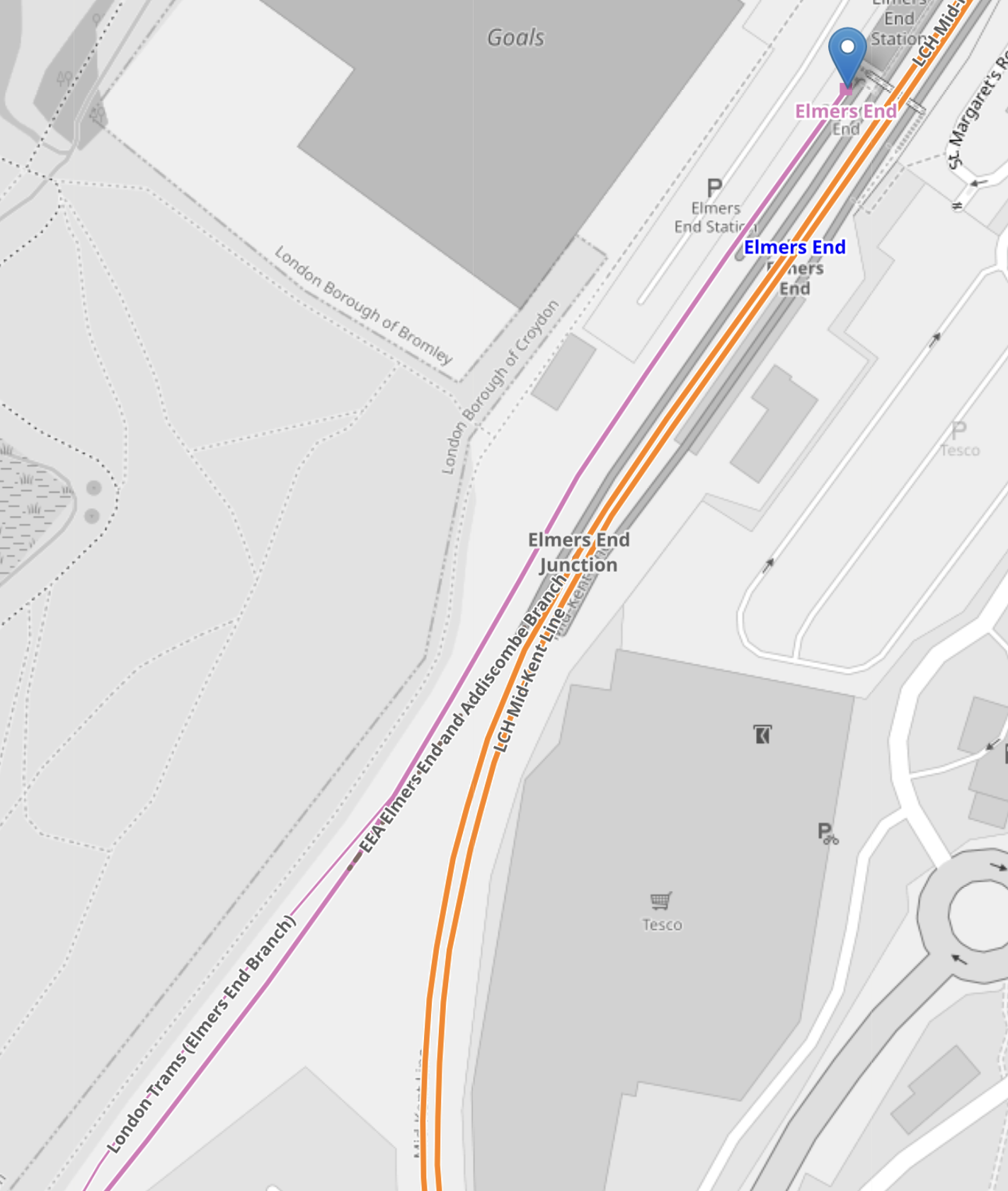
Note.
- The orange lines are the Hayes Line.
- The mauve line is the London Tramlink.
- The London Tramlink has a single platform on the North-West side of the Hayes Line.
These pictures show Elmers End station and a tram in the London Tramlink platform.
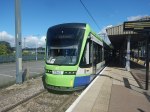
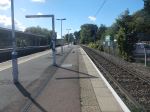
Note.
- The bridge in the station is not step-free.
- The tram is a five-section Stadler Variobahn.
- The tram platform would appear to be able to handle a tram, that is several metres longer than the 32.0 metre Stadler Variobahn.
- The London Tramlink has a typical off-peak service to Wimbledon every ten minutes from Elmers End tram stop.
The Wikipedia entry for Elmers End station, says this about Tramlink developments at the station.
Work is underway to open a second tram platform and double the tram line to Arena to increase capacity. As of March 2019, vegetation has been cleared to make way for the new line. The platform was due to open in December 2020, but has been delayed.
My pictures show no ongoing work or evidence of the second Tramlink platform.
There are two main ways, that capacity can be increased at Elmers End station.
- Install a second platform and run more trams to the station.
- Run longer trams with a higher capacity.
Perhaps, Transport for London have decided, that the second way, is the best, especially, if the money saved, allows them to build a much-needed step-free footbridge at Elmers End station.
From my observations, I would estimate that Elmers End tram stop could accommodate a forty metre tram and possibly, one that was even longer.
Arena Tram Stop
The Arena tram stop, is where the Beckenham Junction and Elmers End branches join and split.
This map from OpenRailwayMap shows the platform layout at Arena tram stop.
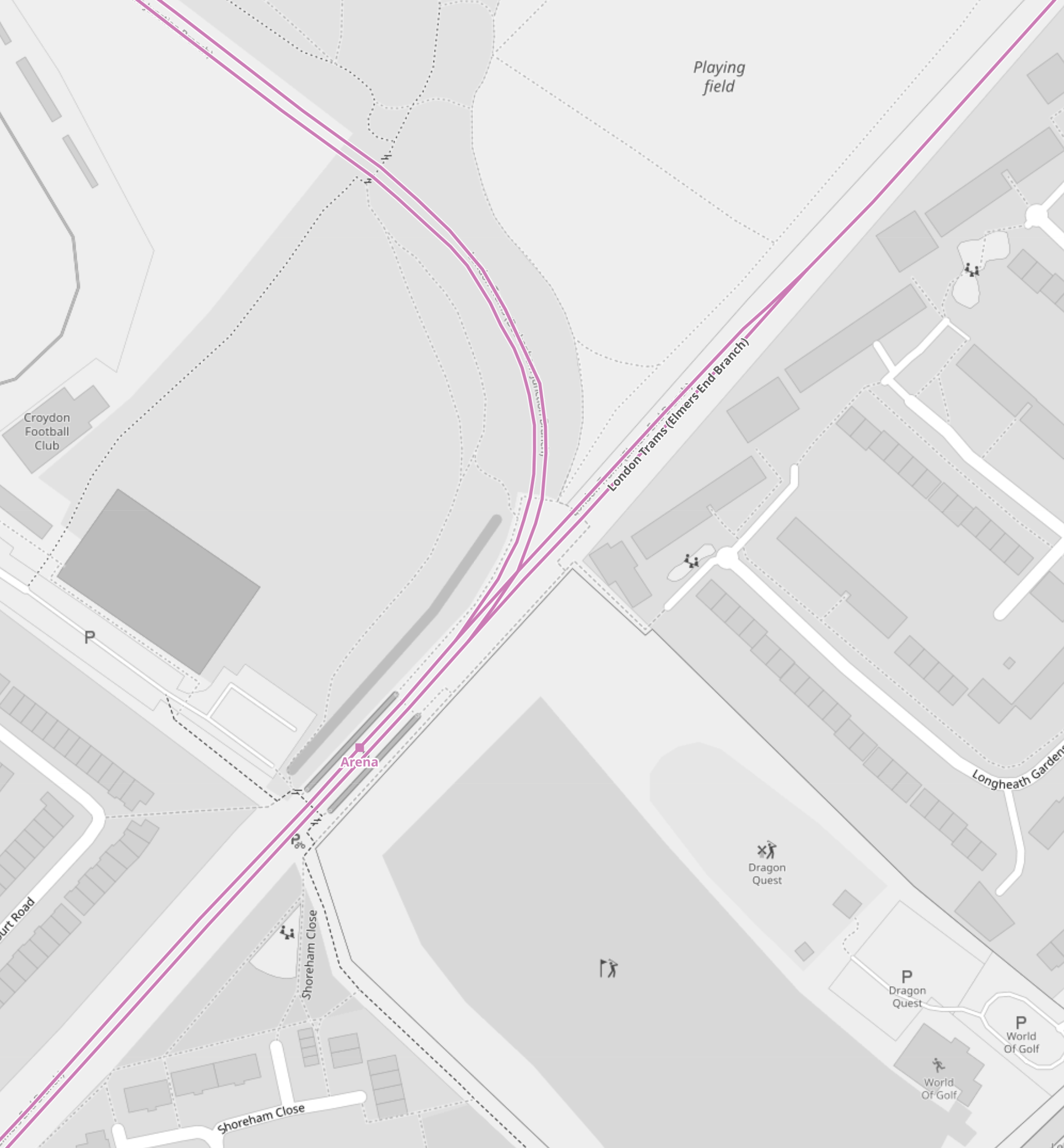
Note.
- The mauve lines are the London Tramlink.
- The line going North-East runs to Elmers End. It starts off as double-track at Arena tram stop and quickly becomes single track all the way to Elmers End. tram stop.
- The line going North-West runs to Beckenham Junction.
- The line going South-West runs to East Croydon and Wimbledon.
- The platforms are on the outside of both tracks.
These pictures show Arena tram stop and some trams passing through.
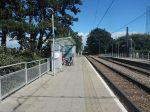
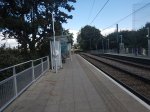
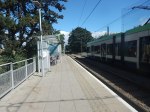
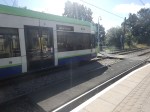
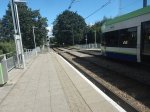
Note.
- The tram platforms are generally a few metres longer than the trams.
- All tram doors are step-free to the platform.
- Passengers walk across the line in front or behind the trams.
- The platform is wide, so that passengers can stay well clear of the occasional passing tram. One picture shows a tram is signed “Not In Service”
I believe, that with some judicial platform lengthening, some selective door opening and trams stopping automatically in the right place on the platform, that longer trams could be handled in a stop like Arena.
As with Elmers End, I believe a forty metre tram will be possible, but this might not be the limit with clever design.
Handling Longer Trams At Beckenham Junction Tram Stop
This map from OpenRailwayMap shows the platform layout at Beckenham Junction tram stop.
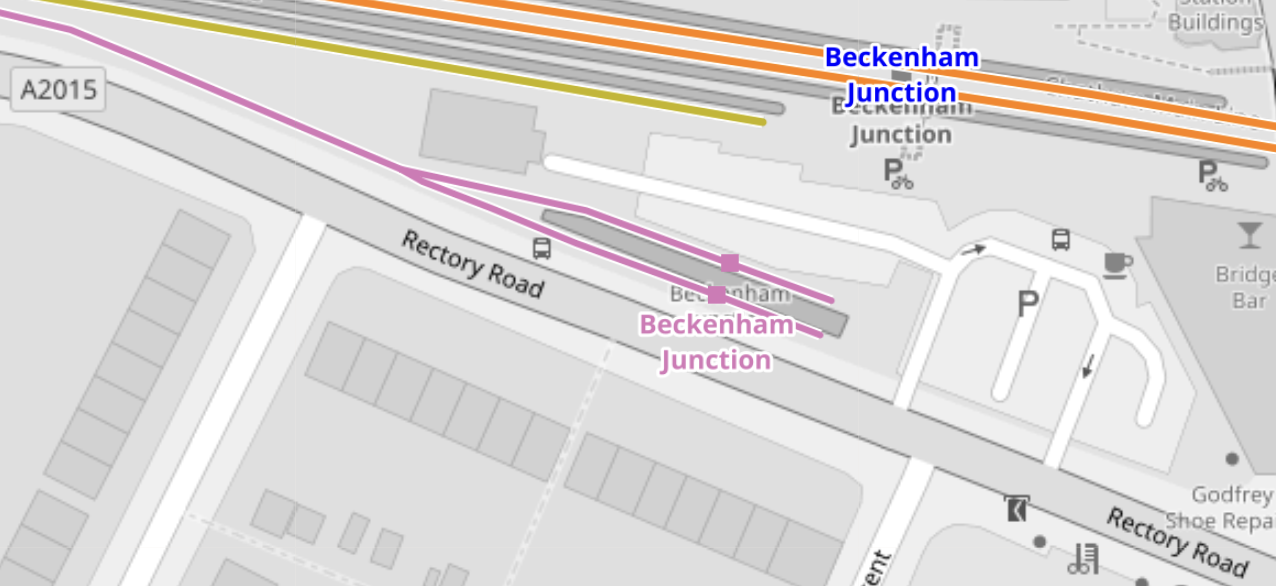
Note.
- The orange lines are the Chatham Main Line.
- The mauve line is the London Tramlink.
- There are a pair of short platforms for the London Tramlink.
- The platforms would be difficult to extend to the East.
- The platforms would be difficult to extend to the West, as the map above shows a building, just to the North of the junction of the two Tramlink platforms.
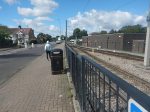
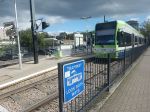
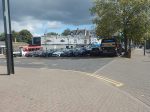
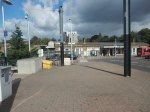
These pictures show Beckenham Junction station and the London Tramlink platforms.
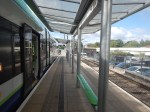
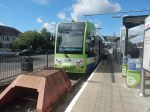
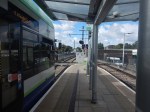
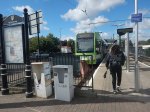
The Wikipedia entry for Beckenham Junction tram stop, says this about the Tramlink service.
Tram services at Beckenham Junction are operated by Tramlink. The tram stop is served by trams every 10 minutes to Wimbledon via Croydon. This is reduced to a tram every 15 minutes on Saturday evenings and Sundays.
Perhaps, the solution to lengthen Tramlink platforms at Beckenham Junction is to do the following.
- Rebuild the building to the North of the junction of the two Tramlink platforms.
- Extend the two Tramlink platforms to the West.
- Move the junction between the two Tramlink platforms to the West.
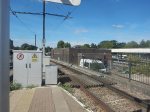
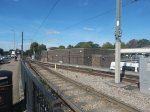
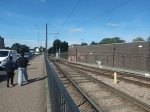
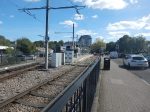
These pictures show the building in detail.
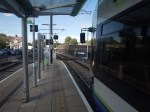
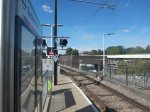
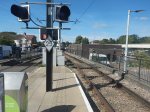
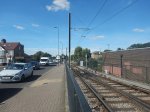



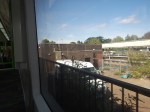
Note.
- There is a Network Rail van outside the building.
- The building looks like it dates from about 2000, when the Tramlink was built.
- Perhaps, the building houses power supply or signalling equipment for the Tramlink.
After the modifications, operation would be the same, but longer trams could be handled.
Trams And Trains Between Birkbeck And Beckenham Junction Stations
This short section of track must be one of the most unusual and complicated in the UK.
- There are three dual National Rail and Tramlink stations; Birkbeck, Avenue Road and Beckenham Road.
- Each station has a single bi-directional National Rail track and/or platform.
- Birkbeck has a single bi-directional Tramlink platform.
- Avenue Road and Beckenham Road each have two Tramlink platforms.
Engineer; Baldrick was obviously having one of his cunning phases.
This map from OpenRailwayMap shows the track/platform layout at Birkbeck station/tram stop.
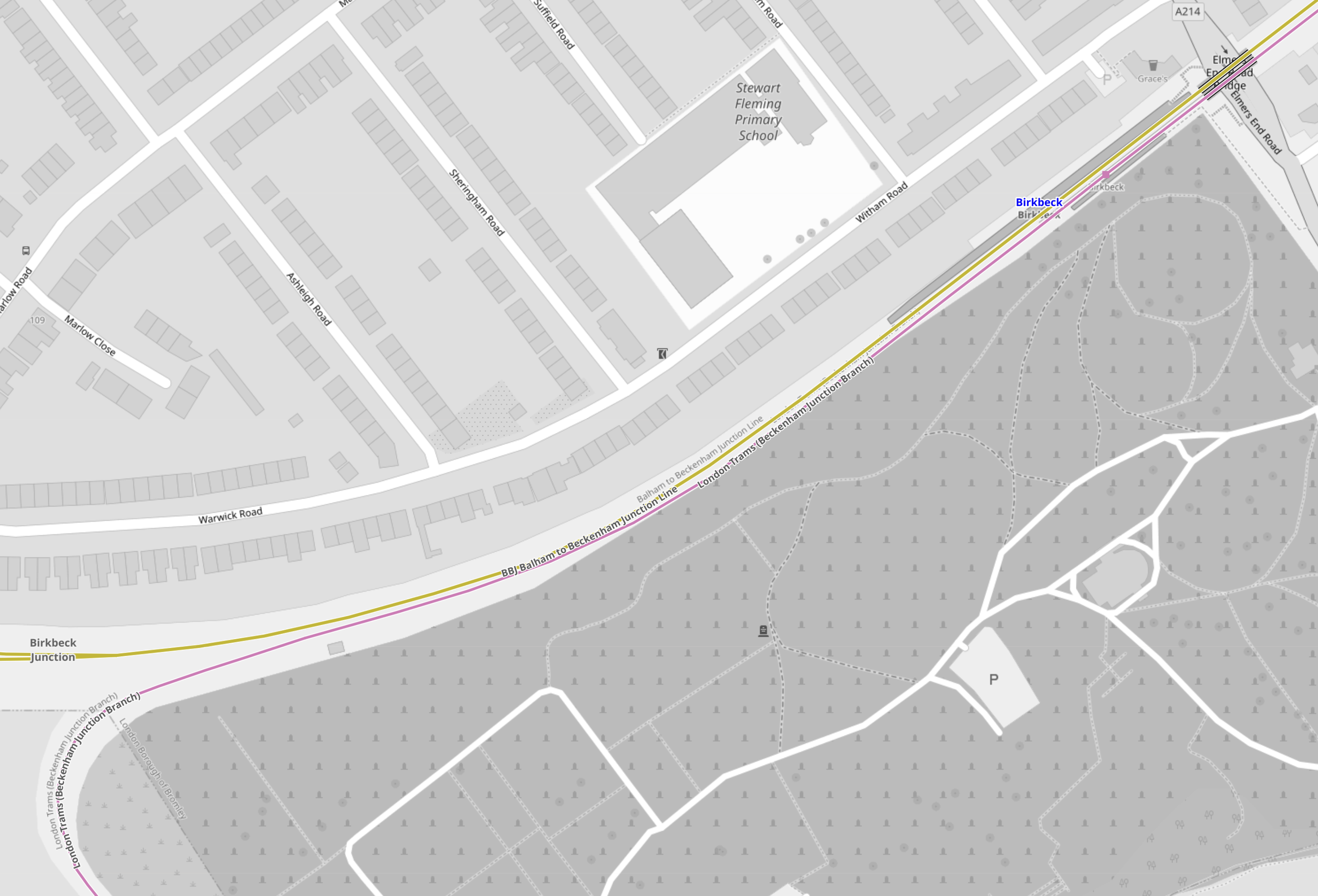
Note.
- The yellow line is the National Rail line between Crystal Palace and Beckenham Junction.
- The mauve line is the London Tramlink between Croydon and Beckenham Junction.
- There is no rail connection between the two lines.
Birkbeck station/tram stop has bi-directional platforms on both National Rail and London Tramlink.
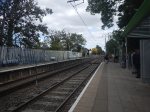
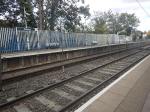
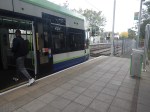
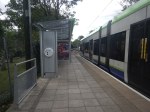
These pictures were taken at the Birkbeck station/tram stop.

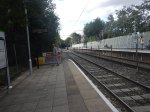
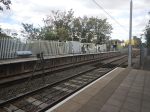
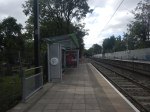
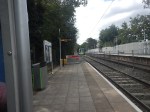
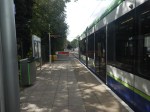
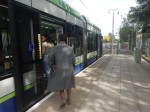
Note.
- The two bi-directional platforms.
- The wire fence between the tracks.
- The two tracks appear to be the same level, but the National Rail platforms seem quite a bit higher.
From the pictures, I would estimate that the Birkbeck tram stop platform is currently about thirty-five metres and could probably handle a forty metre tram with selective door opening.
This map from OpenRailwayMap shows the track/platform layout at Avenue Road station/tram stop.
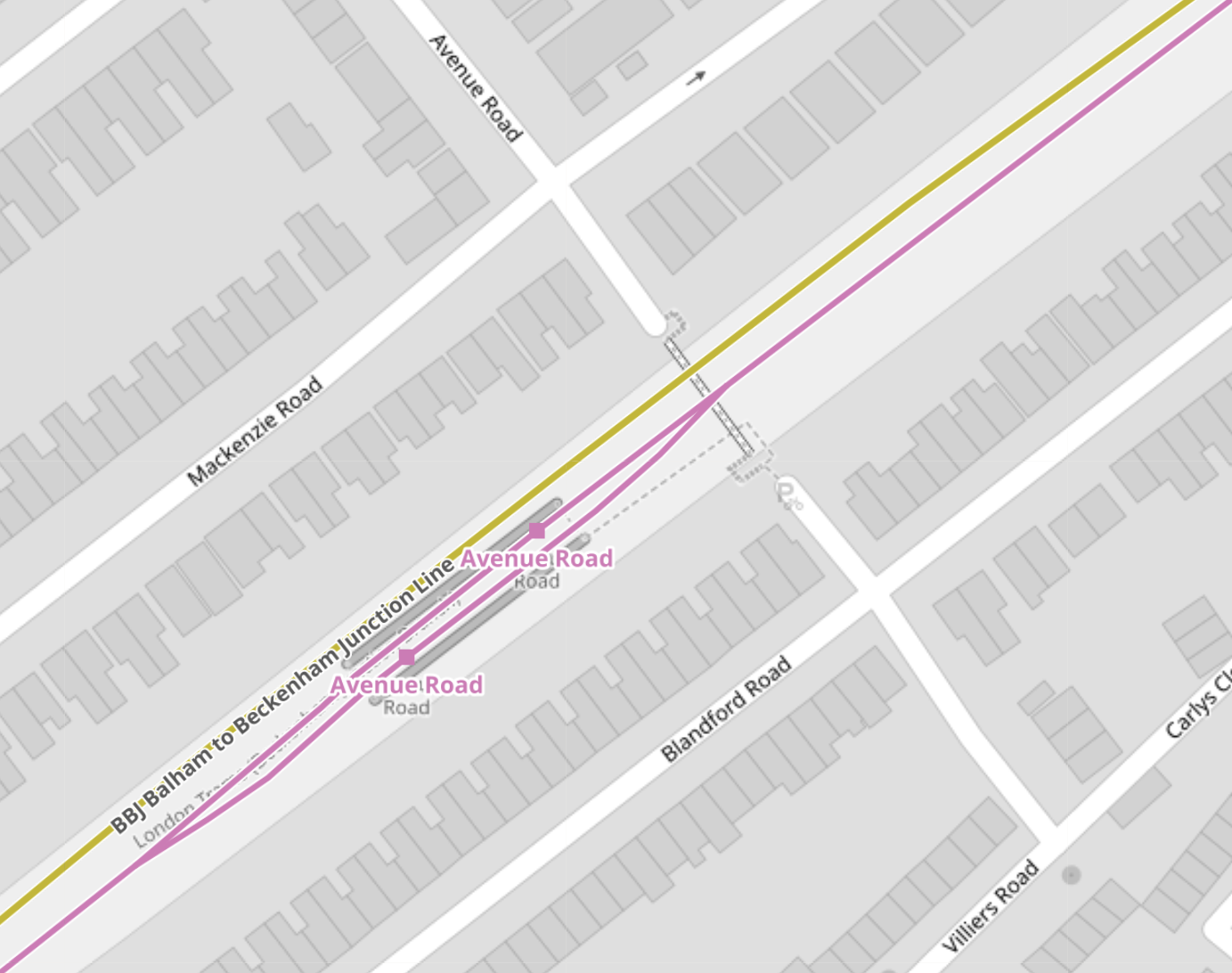
Note.
- The yellow line is the National Rail line between Crystal Palace and Beckenham Junction.
- The National Rail line isn’t shown to have a platform.
- The mauve line is the London Tramlink between Croydon and Beckenham Junction.
- There is no rail connection between the two lines.
London Tramlink has a loop through the tram stop and each branch has a platform.
These pictures were taken at the Avenue Road tram stop.
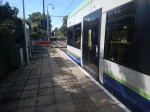
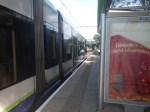
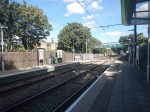
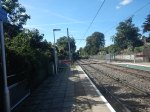
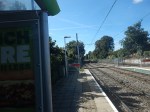
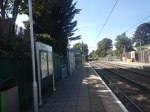
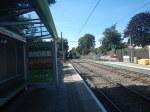
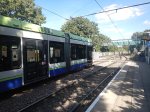
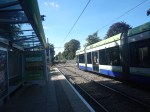
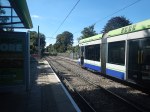
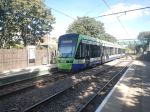
I would estimate the the loop at Avenue Road tram stop could handle a forty metre tram and possibly one of forty-five metres, judging the loop against this thirty-two metre Stadler tram.
This map from OpenRailwayMap shows the track/platform layout at Beckenham Road station/tram stop.
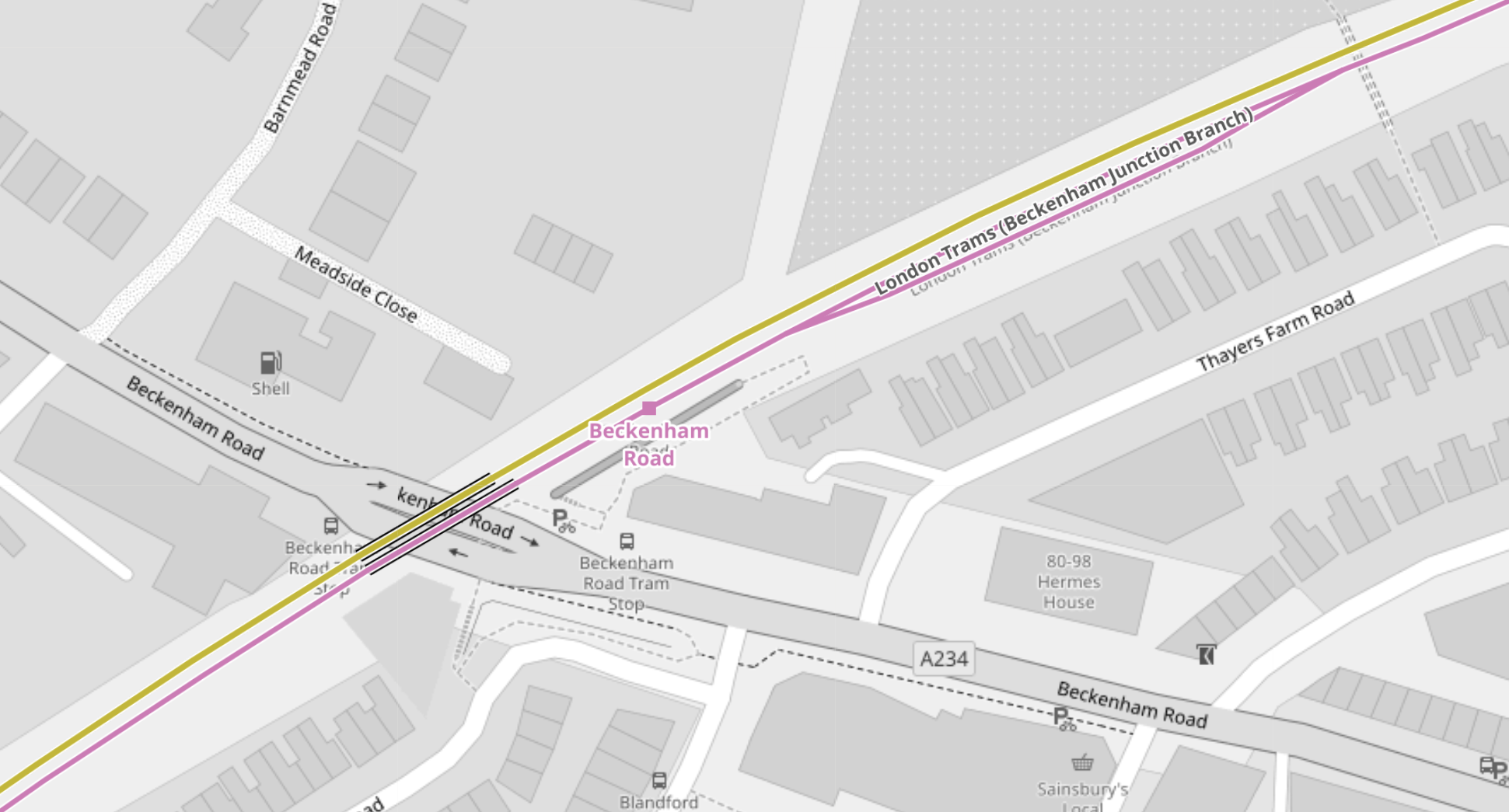
Note.
- The yellow line is the National Rail line between Crystal Palace and Beckenham Junction.
- The National Rail line isn’t shown to have a platform.
- The mauve line is the London Tramlink between Croydon and Beckenham Junction.
- There is no rail connection between the two lines.
The London Tramlink has a single bi-directional platform.
There is also a loop in the London Tramlink to the East of Beckenham Road station/tram stop to allow trams to pass.
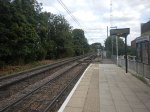
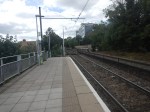
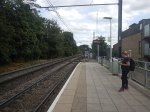
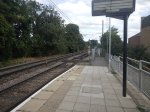
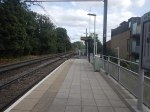
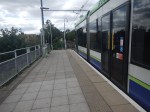
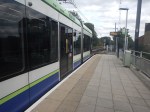
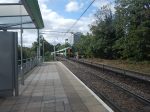
These pictures were taken at the Beckenham Road tram stop.
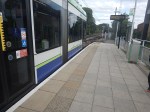
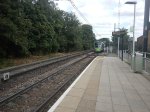
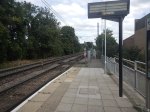
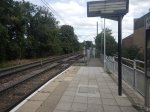
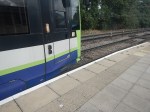
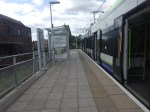
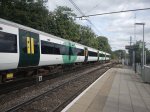
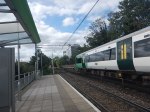
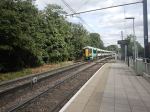
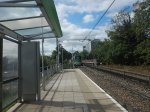
Note.
- A train conveniently came through from London Bridge to Beckenham Junction, when I was taking pictures.
- Several pictures show trams using the loop to the East of the tram stop.
- Both types of tram were pictured in the tram stop.
- The platform in the tram stop is wide.
From the pictures, I would estimate that the Beckenham Road tram stop platform is currently about thirty-five metres and could probably handle a forty metre tram with selective door opening.
Tram-Train Operation Between Birkbeck And Beckenham Junction Stations
I am certain that if this track was being designed today, tram-train operation would be used.
- There would be two tracks, with one for each direction, through Birkbeck, Avenue Road and Beckenham Road stations.
- Both tracks would have dual-height platform at each station/tram stop, so tram and train passengers got level boarding.
- Trains would use third-rail power and trams would use battery-power.
Unfortunately, tram-trains didn’t exist, when the London Tramlink was designed.
Handling Longer Trams At New Addington Tram Stop
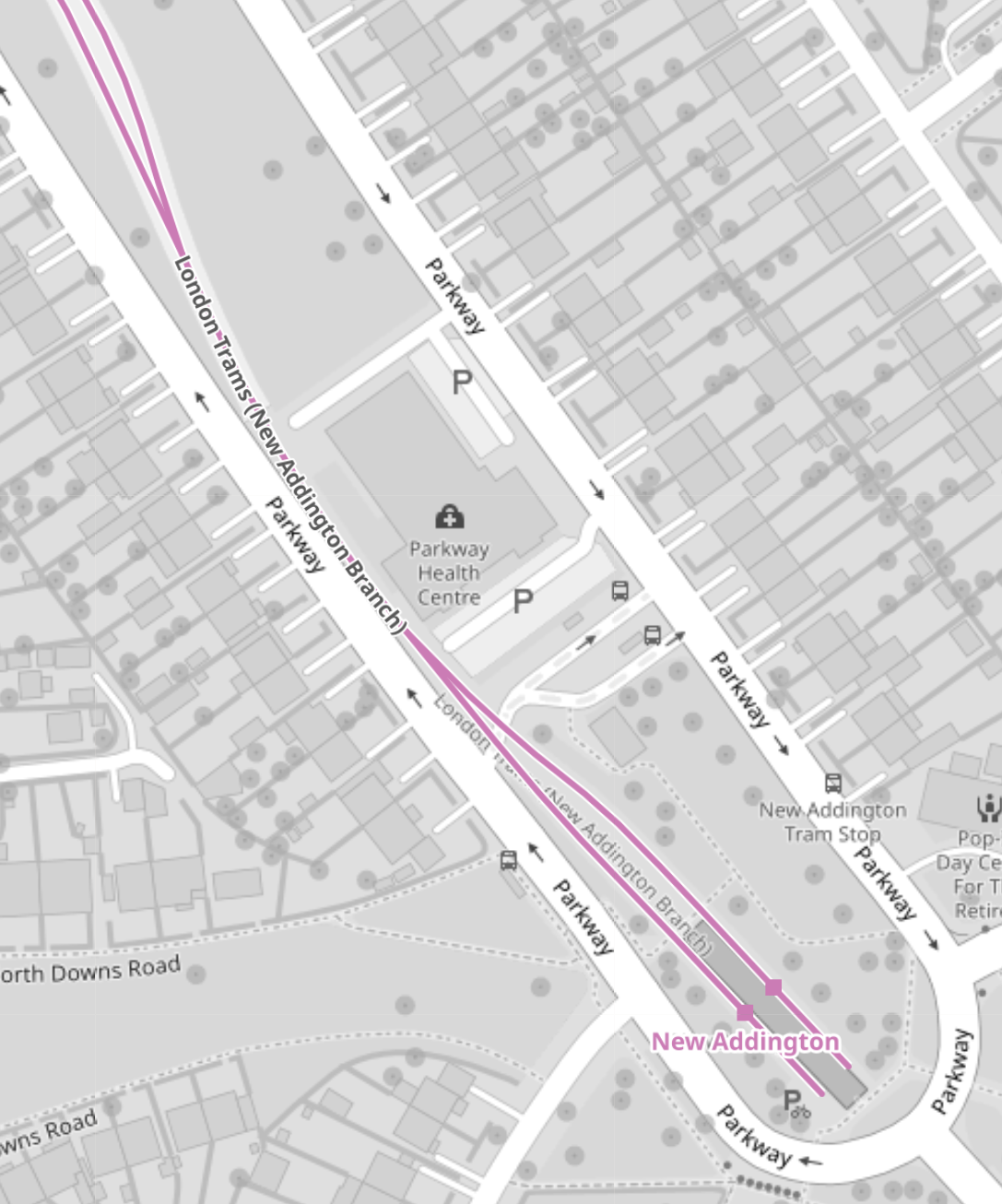
This map from OpenRailwayMap shows the platform layout at New Addington tram stop.
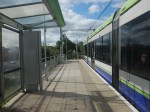
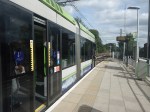
These pictures show the New Addington tram stop and the London Tramlink platforms.
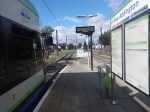

If some of the grassland around the platforms was allocated to the tram stop, I suspect the platforms could be lengthened.
Handling Longer Trams At Wimbledon Station
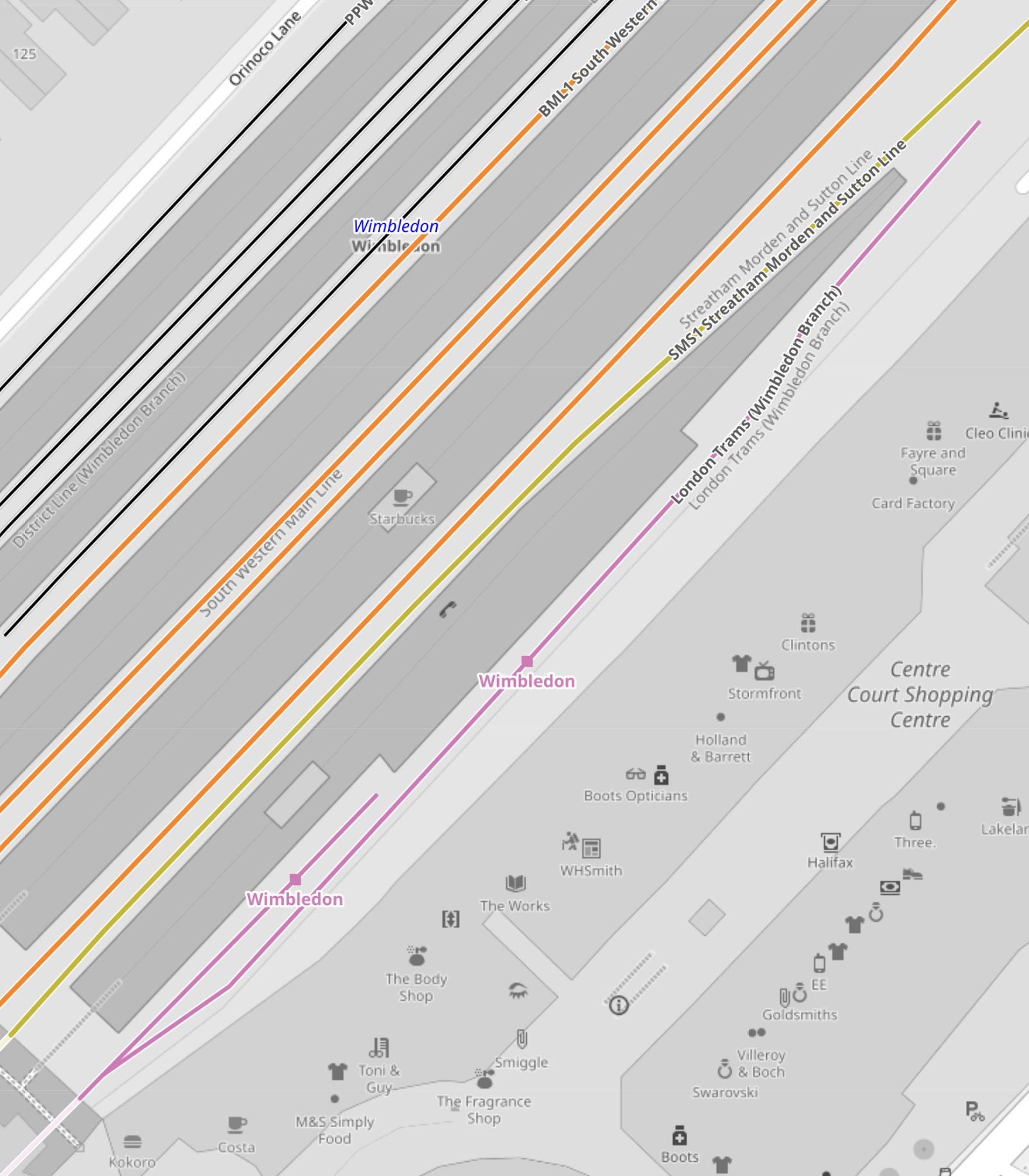
This map from OpenRailwayMap shows the platform layout at Wimbledon station.
Note.
- The mauve line is the London Tramlink.
- There are two platforms; 10A and 10B, which are indicated with a separate dot.
- Platform 9, which is used by Thameslink, is the other side of Platform 10, so interchange to Thameslink is excellent.
- The main tram platform 9/10 is wide.
- The platforms are step-free to the trams, with lifts to the station bridge and the other platforms and Way Out.
I suspect that when the second platform was built, both platforms were made longer than the thirty-two metres needed for the Stadler trams.
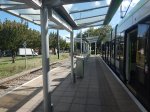
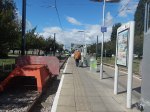
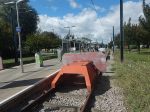
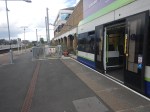
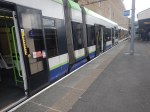
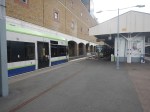
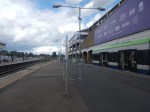
These pictures show the two platforms.
Could another platform be created on the other side of the tracks to give better access to the tracks?
Conclusions
My first conclusion is that the London Tramlink could be run by a new fleet of the same number of trams, that were a few metres longer than the current 30.7/32 metres of the current trams.
- I suspect that forty metre trams would be possible, with a few modifications to platforms.
- It might even be possible to have forty-five metre trams, with a more substantial rebuild at Beckenham Junction.
- Trams could overhang platforms and selective door opening could be used.
- Forty metre trams would carry 25 % more passengers than the current trams.
- The Elmers End and Wimbledon terminals already seem to be capable of handling forty metre long trams and possibly could take trams a few metres longer.
I suspect that Elmers End and Wimbledon, could be the first route, where the longer trams were introduced, as the trams should be able to shuttle between the two end terminals to the current timetable.
The New Addington tram stop would be brought into operation next.
- Platforms would be lengthened as required.
- Trams operate a frying pan loop from New Addington to Croydon, with an Off Peak frequency of 7-8 minutes.
- I suspect that one platform won’t be able to handle this frequency.
- The last point probably means that the two platforms will need to be lengthened.
Works at the New Addington tram stop could be tricky, but not substantial.
Initially, the service to Beckenham Junction could be run by the existing Stadler Variobahn trams.
I believe that a lot of work will need to be done to get Beckenham Junction ready for the new trams if they are longer, which I suspect they are.
- The Network Rail installation will have to be relocated.
- The two platforms will have to be lengthened.
I suspect the works will be substantial.
But I do believe, that there is scope to plan all the works at the terminals, so they can be done efficiently, whilst at least maintaining a partial service.
My second conclusion, is that it will be possible to build a financial model, which shows infrastructure costs against tram lengths.
Longer trams will cost more and cost more for infrastructure, but they will carry more passengers and collect more fare revenue.
BMF And NMC: ‘Plans To Charge Motorcyclists To Use The Silvertown And Blackwell Tunnels Are Flawed’
The title of this post, is the same as that as this page on the British Motorcyclists Federation.
These are the first two paragraphs.
The British Motorcyclists Federation (BMF) and the National Motorcyclists Council (NMC) have responded to the Transport for London (TFL) consultation on plans to charge motorcyclists to use the Silvertown and Blackwell tunnels from 2025. TfL are urged to “think again” on flawed plans that fail to take into account the positive impact of motorcycles on London’s pollution and congestion levels.
The BMF and NMC, in a combined response to TfL’s consultation on the proposed Charging Scheme for the Silvertown and Blackwall tunnels, have lodged detailed objections to the proposals to implement charges for motorcycles to use the Tunnels from 2025. Both UK motorcycling organisations have urged TfL to reconsider their proposed strategy and to exempt motorcyclists from the charges.
I think that the two organisations have a point and they emblazon this across the article.
To equate motorcycles with cars, with the same fee charged for both, is completely illogical.
But then, when were the Mayor of London and Transport for London ever logical and mathematically-correct?
Will The Charging System Identify Motorcycles Correctly?
On a project, I worked on in the 1970s, I was told it was difficult. I doubt that has changed.
Conclusion
The article makes some powerful arguments, but I doubt they’ll get anywhere with the stubbornest man in the UK.
Orpington Station And The 358 Bus
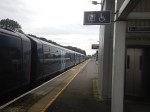
This morning, I went to Orpington station, to look at the preparations for the 358 bus and took these pictures.

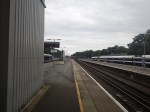
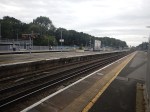
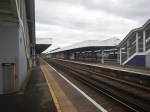
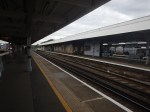
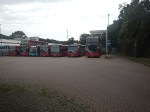
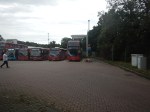


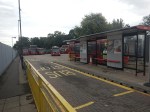
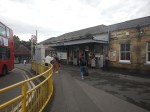
Note.
- Orpington station is a eight -platform station with full step-free access.
- There are three bay platforms.
- The platforms are long.
- There was no sign of the new Irizar ie Trams, that will be used on the 358 route.
- The charger had been installed.
Transport for London have said the new vehicles will be running in Summer 2024.
But then TfL’s promises, must be taken with a large pinch of salt.
Jurgen Maier To Chair Great British Energy
This article in The Times is entitled Pylons Are The Price Of Lower Bills, Keir Starmer Tells Rural Britain.
These are two paragraphs from the article.
Starmer confirmed that Jürgen Maier, the former UK chief executive of the Siemens conglomerate, would chair the energy company.
Maier has advised Labour on rail and transport since December. He was openly critical of the party’s decision to drop a pledge to spend £28 billion a year on green investment, saying the figure was an “absolute minimum” and that scrapping the promise was “not good for climate change or for the growth of our economy”.
Note.
- His Wikipedia entry is impressive.
- He has dual Austrian and British citizenship.
- He went to school in Leeds and is a graduate of Nottingham Trent University.
- He rose to be Chief Executive of Siemens UK and retired in 2019 at 55.
- I have heard him several times on the radio and he seems to talk a lot of sense.
In my view he could be an excellent choice as Chair of Great British Energy.
I also have some further thoughts.
Jürgen Maier And Peter Hendy
Jürgen Maier and Peter Hendy, who is Starmer’s Rail Minister, have remarkably similar backgrounds and I wouldn’t be surprised if they know each other well, through dealings around Siemens’ contract for Transport for London’s new trains for the Piccadilly Line.
When last, were two technological heavyweights, so close to the heart of a UK government?
RWE
German energy company; RWE are the UK’s largest power generator.
- RWE have five gas-fired power stations with a total output of 6.56 GW.
- RWE have two onshore wind farms in operation with a total output of 67 MW.
- RWE have four offshore wind farms in operation with a total output of 1.88 GW.
- RWE have eight offshore wind farms under development with a total output of 9.90 GW.
- RWE also has other electrical gubbins, like an electrolyser in South Wales.
Would Jürgen Maier be an ideal person, to persuade RWE to keep investing in the UK?
When he was with Siemens, he certainly invested heavily in the UK.
The German Problem
Germany’s problem is how they generate electricity.
Sources are as follows for Germany and the UK.
- Coal – 26 % – 1 %
- Natural Gas – 10.5 % – 32 %
- Wind – 32 % – 29.4 %
- Solar 12.2 % – 4.9 %
- Biomass – 9.7 % – 12.3 %
- Nuclear – 1.5 % – 14.2 %
- Hydro – 4.5 % – 1.8 %
- Oil – 0.7 % – 0 %
- Other – 2.9 % – 0 %
- Storage – 0 % – 1 %
- Imports – 0 % – 10.7 %
Note.
- Figures are for 2023.
- Germany is the first percentage.
- UK is the second percentage.
- Germany has pledged to end coal-fired electricity production by 2030.
- Both countries seem to generate similar amounts of electricity from wind, biomass and hydro.
To replace the coal and make up for lack of nuclear, Germany needs to find a new power source.
The German Solution
The Germans are going for hydrogen in a big way.
The title of this page of the RWE web site is Welcome To The Age Of Hydrogen.
The page starts with this paragraph.
RWE is actively involved in the development of innovative hydrogen projects. The H2 molecule is considered to be an important future building block of a successful energy transition. RWE is a partner in over 30 H2 projects and is working on solutions for decarbonising the industry with associations and corporations like Shell, BASF and OGE. Hydrogen projects are comprehensively supported in the separate Hydrogen department of the subsidiary RWE Generation.
I also suggest, that you read this page on the RWE web site called AquaVentus.
The page starts with this RWE graphic.
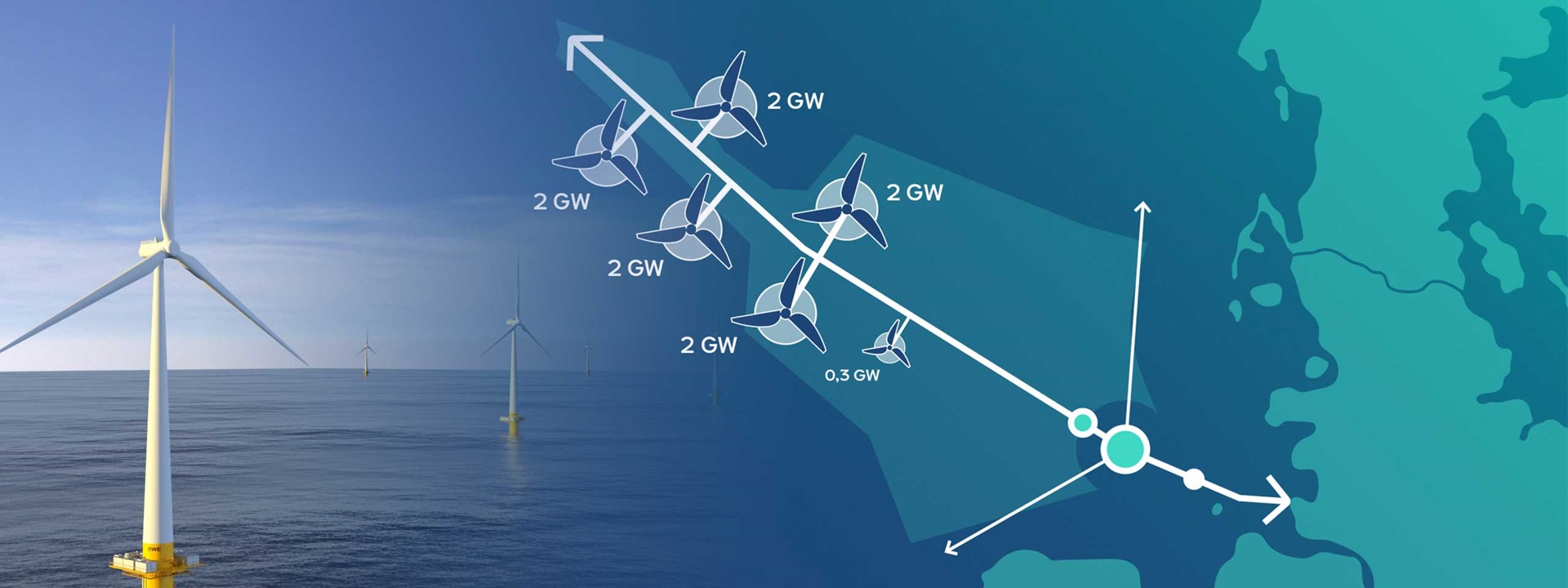
It appears that 10.3 GW of hydrogen will be created by wind farms and piped to North-West Germany.
These two paragraphs outline the AquaVentus initiative .
Hydrogen is considered the great hope of decarbonisation in all sectors that cannot be electrified, e.g. industrial manufacturing, aviation and shipping. Massive investments in the expansion of renewable energy are needed to enable carbon-neutral hydrogen production. After all, wind, solar and hydroelectric power form the basis of climate-friendly hydrogen.
In its quest for climate-friendly hydrogen production, the AquaVentus initiative has set its sights on one renewable energy generation technology: offshore wind. The initiative aims to use electricity from offshore wind farms to operate electrolysers also installed at sea on an industrial scale. Plans envisage setting up electrolysis units in the North Sea with a total capacity of 10 gigawatts, enough to produce 1 million metric tons of green hydrogen.
The page also gives these numbers.
- Total Capacity – 10 GW
- Tonnes Of Green Hydrogen – 1 million
- Members – 100 +
The web site says this about commissioning.
Commissioning is currently scheduled for early/mid 2030s.
The Germans can’t be accused of lacking ambition.
AquaVentus And The UK
This video shows the structure of AquaVentus.
I clipped this map from the video.

Note.
- There is a link to Denmark.
- There appears to be a undeveloped link to Norway.
- There appears to be a link to Peterhead in Scotland.
- There appears to be a link to just North of the Humber in England.
- Just North of the Humber are the two massive gas storage sites of Aldbrough owned by SSE and Brough owned by Centrica.
- There appear to be small ships sailing up and down the East Coast of the UK. Are these small coastal tankers distributing the hydrogen to where it is needed?
In the last century, the oil industry, built a substantial oil and gas network in the North Sea. It appears now the Germans are leading the building of a substantial hydrogen network.
AquaVentus And Aldbrough And Rough Gas Storage
Consider.
- In The Massive Hydrogen Project, That Appears To Be Under The Radar, I describe the Aldbrough Gas Storage.
- In Wood To Optimise Hydrogen Storage For Centrica’s Rough Field, I describe Centrica’s plans to turn Rough Gas Storage into the world’s largest hydrogen store.
- There is a small amount of hydrogen storage at Wilhelmshaven.
It looks like the East Riding Hydrogen Bank, will be playing a large part in ensuring the continuity and reliability of AquaVentus.
Dogger Bank South And AquaVentus
This Google Map shows the North Sea South of Sunderland and the Danish/German border.
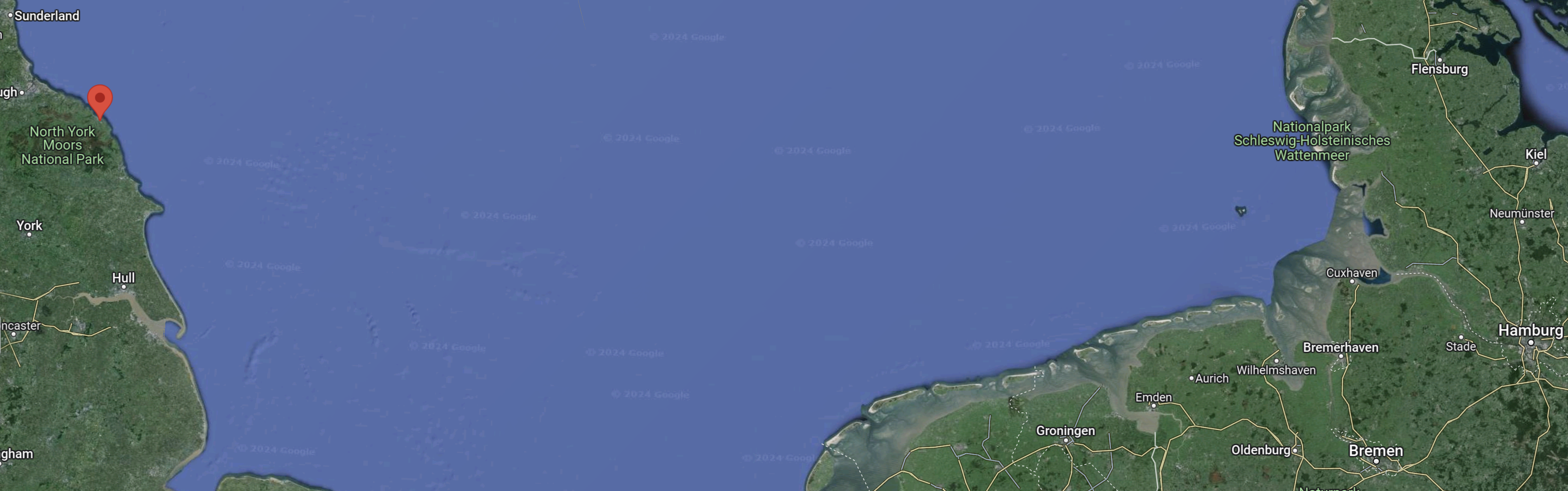
Note.
- Sunderland is in the top-left hand corner of the map.
- A white line in the top-right corner of the map is the Danish/German border.
- Hamburg and Bremen are in the bottom-right hand corner of the map.
If you lay the AquaVentus map over this map, I believe that RWE’s Dogger Bank South wind farm could be one of the three 2 GW wind farms on the South-Western side of the AquaVentus main pipeline.
- Two GW would be converted to hydrogen and fed into the AquaVentus main pipeline.
- Two GW of hydrogen will be a nice little earner for UK plc.
- One GW of electricity would be sent to the UK.
But this is only one of many possibilities.
Conclusion
Could Jürgen Maier, be the man to develop British links to AquaVentus for the benefit of both the UK and Germany?
- The UK’s wind farms could provide a lot of hydrogen for AquaVentus.
- Aldbrough And Rough Gas Storage are conveniently places to add the hydrogen storage, that AquaVentus needs.
- AquaVentus can certainly be expanded to Norway, and possibly Orkney and Shetland.
He certainly has a lot of relevant experience.
Could London Drivers Be Charged On A Cost Per Mile Basis?
This article on CarWow is entitled Transport for London Investing £150 million In Technology Capable Of Enforcing Pay-Per-Mile Road Charging.
These reasons are given for the new system.
- Transport for London developing new ANPR technology
- Set to be used for Ulez and congestion charging for now
- Could be expanded in the future to include pay-per-mile road charging
- Estimated project cost of £150 million
In addition, this paragraph gives another reason.
A new platform for existing road user charging schemes, such as Ulez and the Congestion Charge, is being developed by Transport for London to replace the outsourced system currently in place as the contract is due to expire in 2026.
I can understand, that if it is brought in house, that this might create more jobs in London, rather than somewhere far away.
Speeding
If you read the article on CarWow, nothing is said about speeding.
But surely, if a sophisticated computer system knew you were at A and B at certain times, it could calculate your speed.
Coupled with a 20 mph speed limit, it could be a big money earner.
It also gets Sadiq Khan off the hook with pay-per-mile charging. He just introduces fines for people, who break the law by speeding.
Conclusion
I don’t drive, so it doesn’t bother me.
But I would advise anyone, who does, to think long and hard about who they vote for.
First Look Inside £2.2bn Silvertown Tunnel
The title of this post, is the same as that of this article on the BBC.
These are the first five paragraphs.
For the first time, Transport for London has invited journalists inside what is one of the most controversial infrastructure projects in the capital.
The Silvertown Tunnel is 1.4km (just under one mile) long and stretches from Silvertown in Newham to the Greenwich Peninsula.
Inside the tunnel, it is extremely wide. A lot bigger than other tunnels like the supersewer or Crossrail. Boring was finished a few weeks ago.
Transport for London (TfL) says the scheme will address queues at the Blackwall Tunnel and reduce pollution. But it has faced fierce opposition from those who think it will do the total opposite and increase pollution and congestion.
And the big question is – even with mitigation – can a road tunnel ever be green?
Note.
- There is a good picture, showing the width of the tunnel.
- It is very wide and can’t be much narrower than the four-lane Queensway Tunnel, which was opened under Mersey in 1934.
These are my thoughts.
I Am Against The Tunnel Being Built
My main reason I am against the Silvertown Tunnel is that Transport for London’s mathematical modelling of and rerouting of buses past my house has been some of the worst I’ve seen. I talk about the bus problems I now have in Is The Nightmare On The Buses Going To Get Worse?
So until the two tunnels; Blackwall and Silvertown are complete and open with tolling, I won’t trust any of Transport for London’s pronouncements.
I also feel that as the Silvertown Tunnel will allow trucks to pass though, there will be times, when they will cut through the East End to get to the Motorways going North.
But now, it’s more or less finished, we will probably need to use it.
How Is The Tunnel Being Paid For?
The Wikipedia entry for the Silvertown Tunnel has a section called Costs, where this is said.
In 2012, the cost was stated to be £600m. A consultation in 2015 stated that the cost of construction was estimated to be £1bn. In March 2020, the cost was increased again, to £1.2 billion. Operation, maintenance and financial costs of the tunnel over 25 years is expected to cost another £1bn.
The £2.2 billion will be repaid by tolls on both tunnels. Effectively, it’s a Private Finance Initiative or PFI.
Can A Road Tunnel Ever Be Green?
This is the question the BBC asked in the last paragraph of my extract.
Although, I am very much against this tunnel, I do believe this tunnel can be green.
- Suppose, the tunnels were made free for zero-carbon vehicles, that were powered by batteries, hydrogen or possibly ammonia.
- This might nudge vehicle owners and operations to go zero-carbon.
This extra number of zero-carbon vehicles would help to clean up London’s air.
I wonder which will be the preferred route for trucks associated with construction to go to and from sites in Central London?
- These trucks are major polluters in Central London.
- There are sensible moves to make construction sites zero-carbon.
If the Silvertown Tunnel didn’t have tolls for zero-carbon trucks, then surely this would nudge, this sizeable group of trucks to go zero-carbon to the benefit of everyone in Central London.
The only problem with making zero-carbon vehicles toll-free, is that it probably ruins the finances of the tunnels, from the point of view of the investors.
Conclusion
I can see lots of conflict starting over the operation of this tunnel.
London Overground Train Makes Rare Diversion To London Bridge Station
The title of this post, is the same as that of this article on Ian Visits.
This is the sub-heading.
On Sunday morning, a London Overground train paid a visit to London Bridge station — a station that the Overground doesn’t usually visit.
These were the first two paragraphs.
It was here for a test run ahead of a special service that will run on Easter Sunday, and the test was needed to ensure that what worked on paper also worked in practice.
The reason for the Easter Sunday special is weekend engineering works elsewhere which would mean no Southern trains between Victoria and London Bridge, while at the same time, the London Overground south of the river can’t go north.
Note.
- Judging by Ian’s pictures, it was a very thorough test of clearances and ramp functions.
- According to Real Time Trains, the two services used platform 5 at Crystal Palace and Platform 13 at London Bridge.
- The distance was 7.5 miles.
- Services took 23 minutes to London Bridge and 19 minutes for the return.
This image shows a London Overground train in Platform 5 at Crystal Palace station.
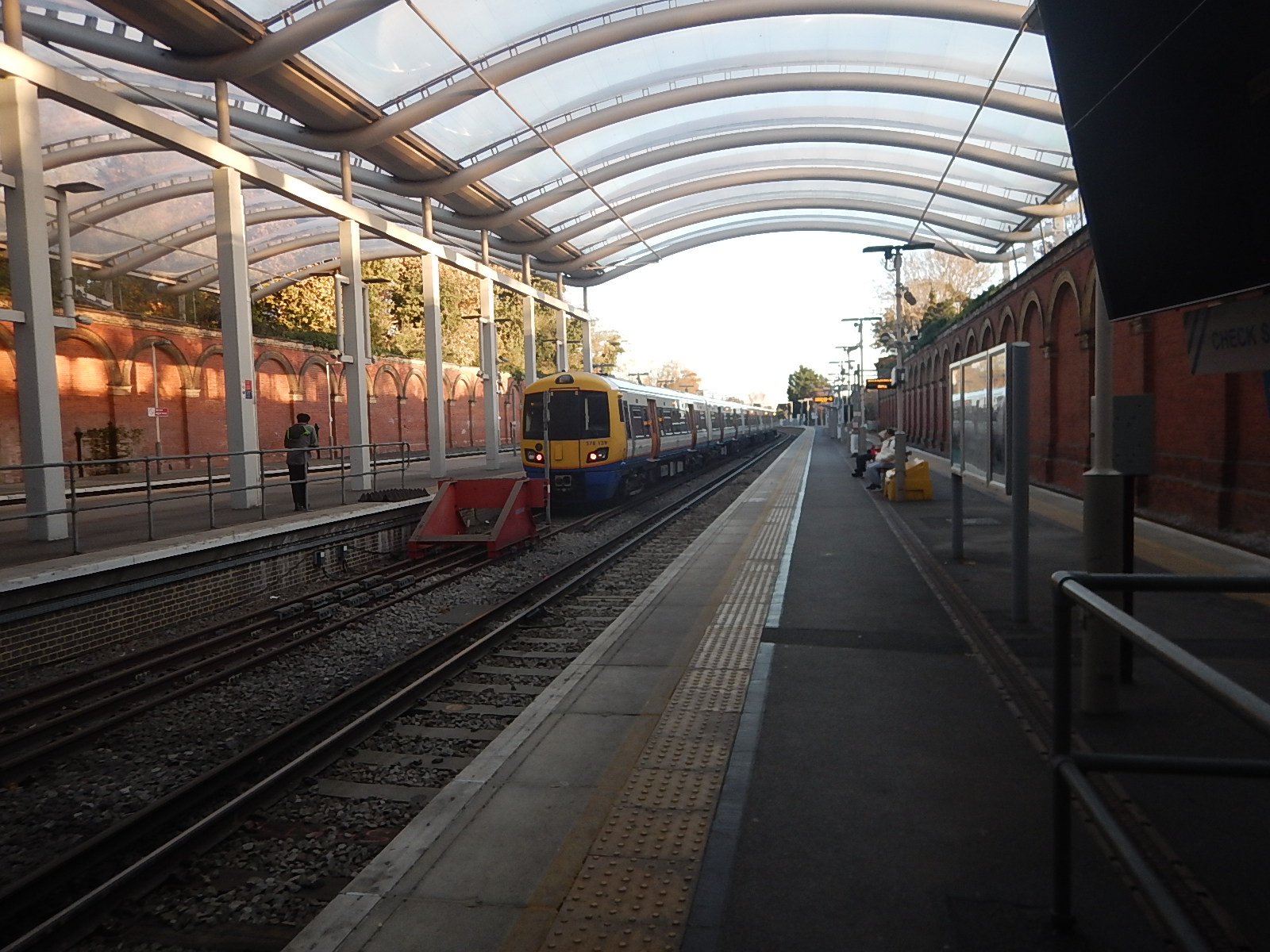
In Overground To London Bridge Under Consideration, I talked about how Transport for London were thinking about creating a new Overground service between London Bridge and Crystal Palace.
Sunday’s test also shows that if the paths are available, London Overground can run a service between London Bridge and Crystal Palace.
Given that the times for the out and return trips were 23 and 19 minutes on Sunday, it appears to me, that the following is possible.
- One train could run an hourly service.
- Two trains could run a two trains per hour (tph) service.
Trains could terminate in platform 3, which is on the right in the image and only has two trains per day.
There would be the following trains to London from Crystal Palace.
- London Overground – Four tph to Canada Water, Whitechapel and Highbury and Islington.
- London Overground – Two tph to London Bridge
- Southern – Two tph to London Bridge
- Southern – Four tph to London Victoria
These would total to.
- Canada Water – four tph for Jubilee Line
- Highbury & Islington – four tph for Victoria and North London Lines
- London Bridge – four tph for Thameslink, Jubilee and Northern Lines
- London Victoria – four tph for Victoria, Circle and District Lines
- Whitechapel – four tph for Elizabeth, Victoria, Circle, District and Hammersmith & City Lines
Note.
- The two extra tph to London Bridge even everything up to four tph.
- The London Bridge and Crystal Palace service could be run by any suitable train and I suspect it could be eight cars. What about using some of the spare Class 379 trains?
The London Bridge and Crystal Palace service wouldn’t need trains with a tunnel evacuation capability, so could use Class 378, 379, 387 or 710 trains.
How Not To Organise A Piss-Up In A Brewery
This afternoon, I wanted to get some lunch and buy my food for the weekend.
I live close to the junction of Southgate Road, Mildmay Park and the Balls Pond Road.
From the four bus stops there, I can get buses to the stopping centres of Angel, Dalston Kingsland, Hackney Central and Moorgate.
But not today, as all the bus stops had been closed!


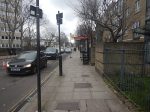
As my leg was playing up, there was no way, I could have walked to the next stop.
In the end I created a fuss and a kind driver let me on a 141 bus to get to Moorgate.
Coming back, I got another 141 bus, which got stuck in the traffic jam, that the part-closure of the junction was creating.


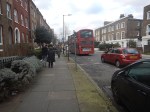
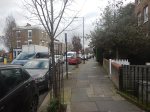
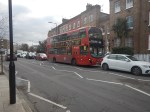
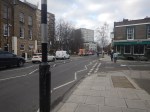

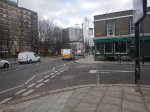
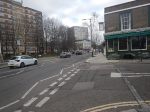


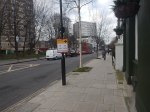


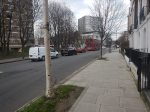

Note.
- The 141 bus took five minutes to pass through the junction.
- Luckily, the driver was sensible and he let a lot of us out.
- As I live South of the Balls Pond Road, it was very convenient.
Obviously, the driver knew more about customer service, that the idiots who organised this megashambles.
I have a few thoughts.
Where Was The Publicity?
I use the 141 bus most days and I didn’t see anything at the bus stops and didn’t get any leaflets through the door.
The Traffic Lights At Southgate And Balls Pond Roads Are Unreliable
They were even worse, when I moved here and Transport for London replaced them a few years ago.
But they seem to have got more unreliable.
Where is John Cleese to give them a good thrashing?
The Silvertown Tunnel Effect
Consider.
- I asked a regular delivery driver, what is the gossip about the Silvertown Tunnel and he felt that it will gum up East London.
- This is my feeling, as before my stroke, I had driven all over the East End trying to save time and knew it well.
- I also feel, that a lot of heavy traffic will end up on the Balls Pond Road, trying to get to and from the M1 and A1, especially, when the Dartford Crossing is closed.
I am fairly certain, that at certain times the junction at Southgate Road, Mildmay Park and the Balls Pond Road is going to get very congested.
The Non-Availability Of Taxis
One of the reasons, I chose to live where I do, is that I am just off the route which taxis use to go back to Liverpool Street station.
But the number of taxis in the area has decreased substantially in the last few years.
- Islington’s Low Traffic Neighbourhoods are scaring taxis away.
- Many drivers are giving up.
- Taxis are expensive.
Consequently, I rarely use a taxi. I never saw one today, when it was needed.
The Junction Is Busy For Pedestrians
Crossing the junction is dangerous, as cyclists only consider the lights optional.
If I’d had a pound for every time, I’d nearly been hit by a cyclist or car on this junction, I could pay for a year’s electricity.
Mildmay Park Station
The area used to have its own station at Mildmay Park about 120 metres to the North of the junction.
This Google Map shows the site of the station.
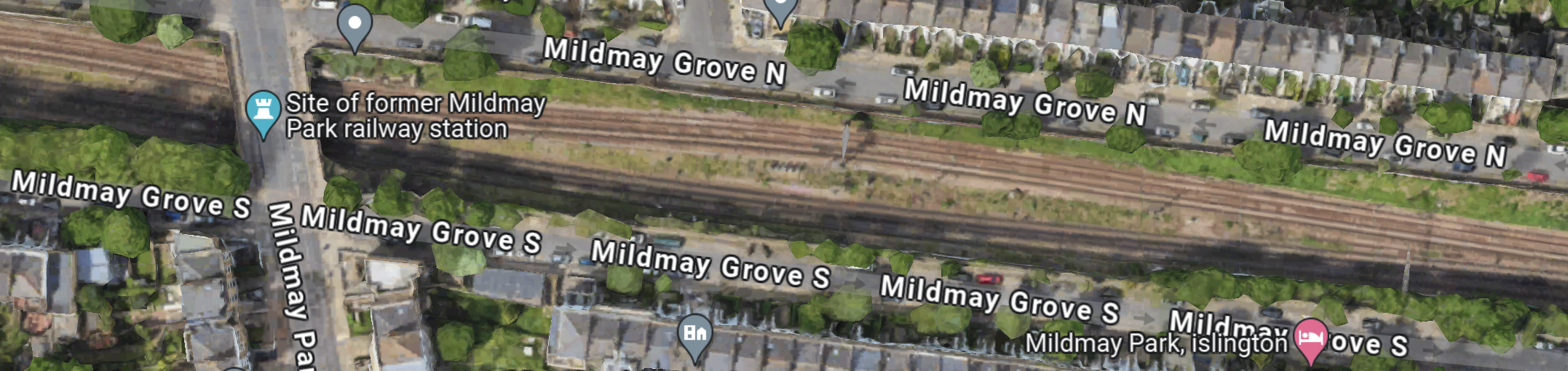
Note.
- The railway is the North London Line.
- Highbury & Islington station is to the West.
- Dalston Kingsland station is to the East.
Mildmay Park station is marked by the blue arrow on the bridge over the railway.
It would be a very handy Coming-Home station, as its downhill all the way, from the station to my house.
Conclusion
Reopening Mildmay Park station would be good for the price of my house, by I doubt that anything will be done.
What Will Khan Call The West London Orbital Railway?
The Mayor has the problem of what to call the West London Orbital Railway, which could likely be the next part of the Overground to be created.
As that area of London is closely associated with a former Mayor of London, it could possibly be called the Ken Line or the Livingstone Line.
But seeing that the Overground was thought up under Ken’s Mayoralty and it has greatly expanded, then perhaps it should be called the Beyond Our Ken Line.
But then it doesn’t go anywhere near the Balls Pond Road!
 The Anonymous Widower