Could The Silvertown Tunnel Handle More Buses?
In A Return Journey Through The Silvertown Tunnel On A 129 Bus, I took these pictures inside the Silvertown Tunnel when the bus was coming North.
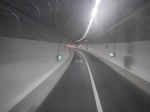
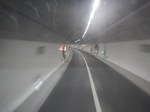
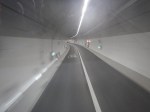
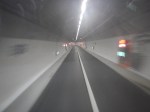
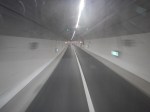
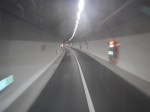
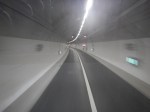
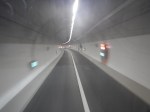
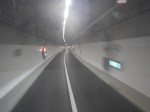
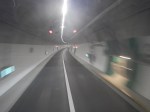
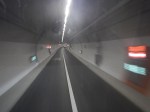
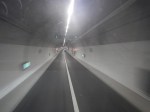
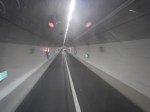
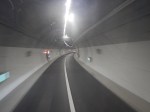
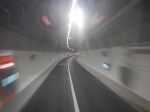
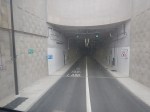
Note.
- The left lane is marked Bus Lane.
- Only one car is visible in the right lane.
- The tunnel seems well-lit.
I have some thoughts
Where’s The Traffic?
It does appear that two apparently empty lanes in each direction, don’t carry a large number of vehicles.
- Have the tolls and arguments frightened traffic away?
- Are the tolls too high?
- From the full set of pictures in the linked post, it would appear more vehicles were using the Blackwall Tunnel.
- Could it be that drivers are frightened of getting a speeding ticket?
- Are drivers frightened of sharing the tunnel with buses and heavy trucks?
Both bores of the Silvertown Tunnel seem to have similar traffic levels.
What’s The Capacity Of A Bus Lane?
In the Wikipedia entry for bus lane, this is said.
The busiest bus lane in the United States is the Lincoln Tunnel XBL (exclusive bus lane) along the Lincoln Tunnel Approach and Helix in Hudson County, New Jersey, which carries approximately 700 buses per hour during morning peak times an average of one bus every 5.1 seconds.[ In contrast, the Cross-Harbour Tunnel in Hong Kong carries 14,500 buses per day, or an average of about 605 an hour all day (not just peak times), but the bus lane must give way to all the other road users resulting in long queues of buses.
Perhaps a more realistic example of tunnel capacity from the UK, would be the Victoria Line, which handles thirty-six * eight-car trains per hour (tph) in both directions in two tunnels.
I would certainly expect that if Dear Old Vicky can manage 36 x 8-car trains per hour, then the Silvertown tunnel could handle thirty-six buses per hour.
Especially, if the buses had a distance keeping capability, as many trains do.
How Many Buses Per Hour Are Planned to Use The Silvertown And Blackwall Tunnels?
This handy map from Transport for London, shows the three bus routes passing through the Silvertown and Blackwall Tunnels.
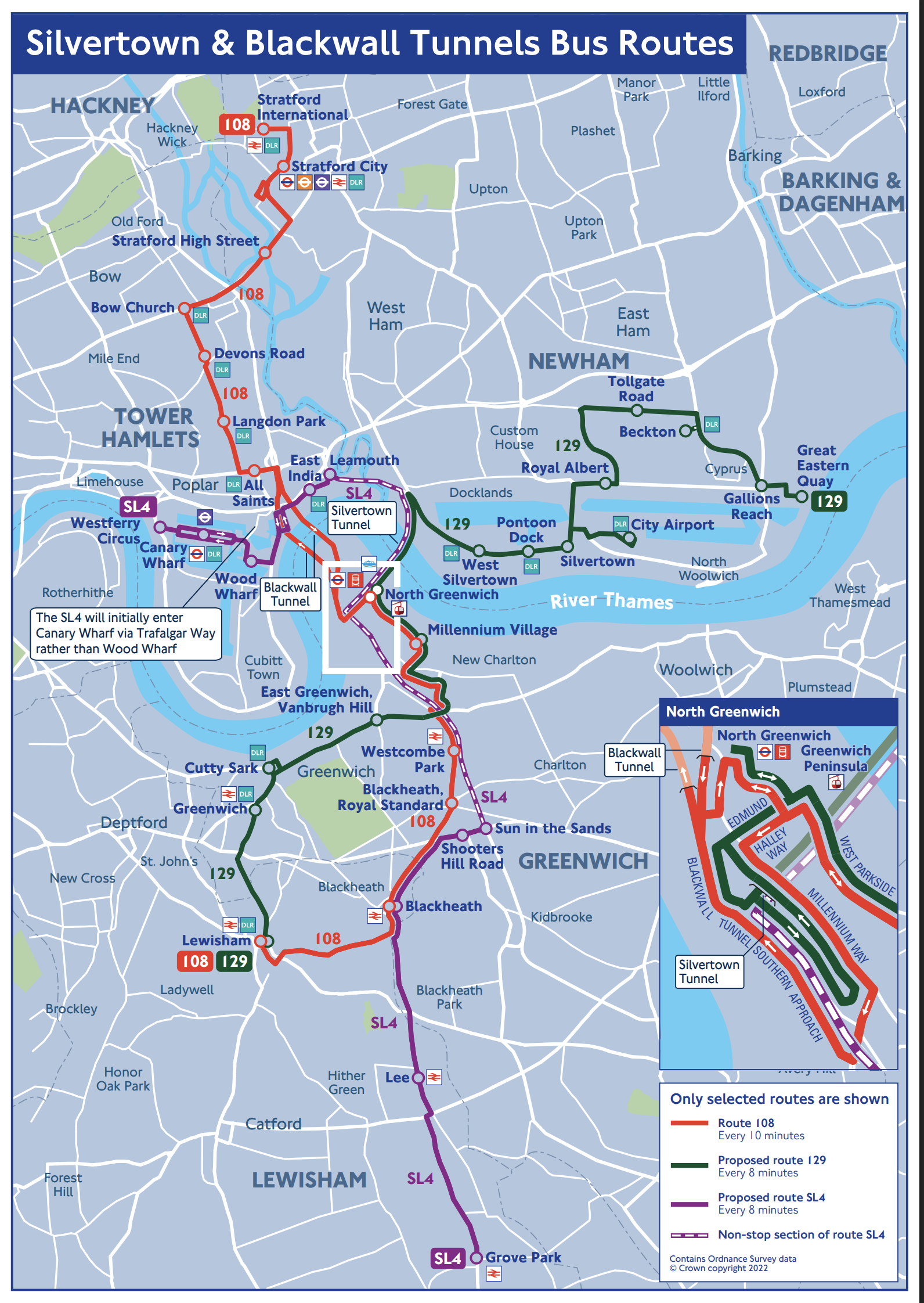
Click the map to show it to a larger scale.
The map gives these frequencies for the three bus routes using the tunnels.
Bus Route SL4
Operates once every 8 minutes or at seven buses per hour.
Bus Route 108
Operates once every 10 minutes or at six buses per hour.
Bus Route 129
Operates once every 8 minutes or at seven buses per hour.
Silvertown Tunnel Bicycle Shuttle
Google AI says this.
The Silvertown Tunnel cycle shuttle bus runs approximately every 12 minutes, operating daily from 6:30 am to 9:30 pm, except for Christmas Day, offering a safe and quick way for cyclists to cross the Thames.
This operates at five buses per hour.
Number Of Buses Through The Tunnels
There will be around nineteen buses per hour, through the Silvertown Tunnel and six through the Blackwall.
The Silvertown Tunnel looks like it has been designed to accept more buses.
One thing this means, is that if the Blackwall gets shut, then the 108 can use some of the spare capacity in the Silvertown Tunnel.
Could A Coach Station For Europe Use Some Of The Spare Capacity?
In Development To The West Of The North Entrance Of The Silvertown Tunnel, I displayed this.
This Google Map shows the site to the West of the North entrance of the Silvertown Tunnel.
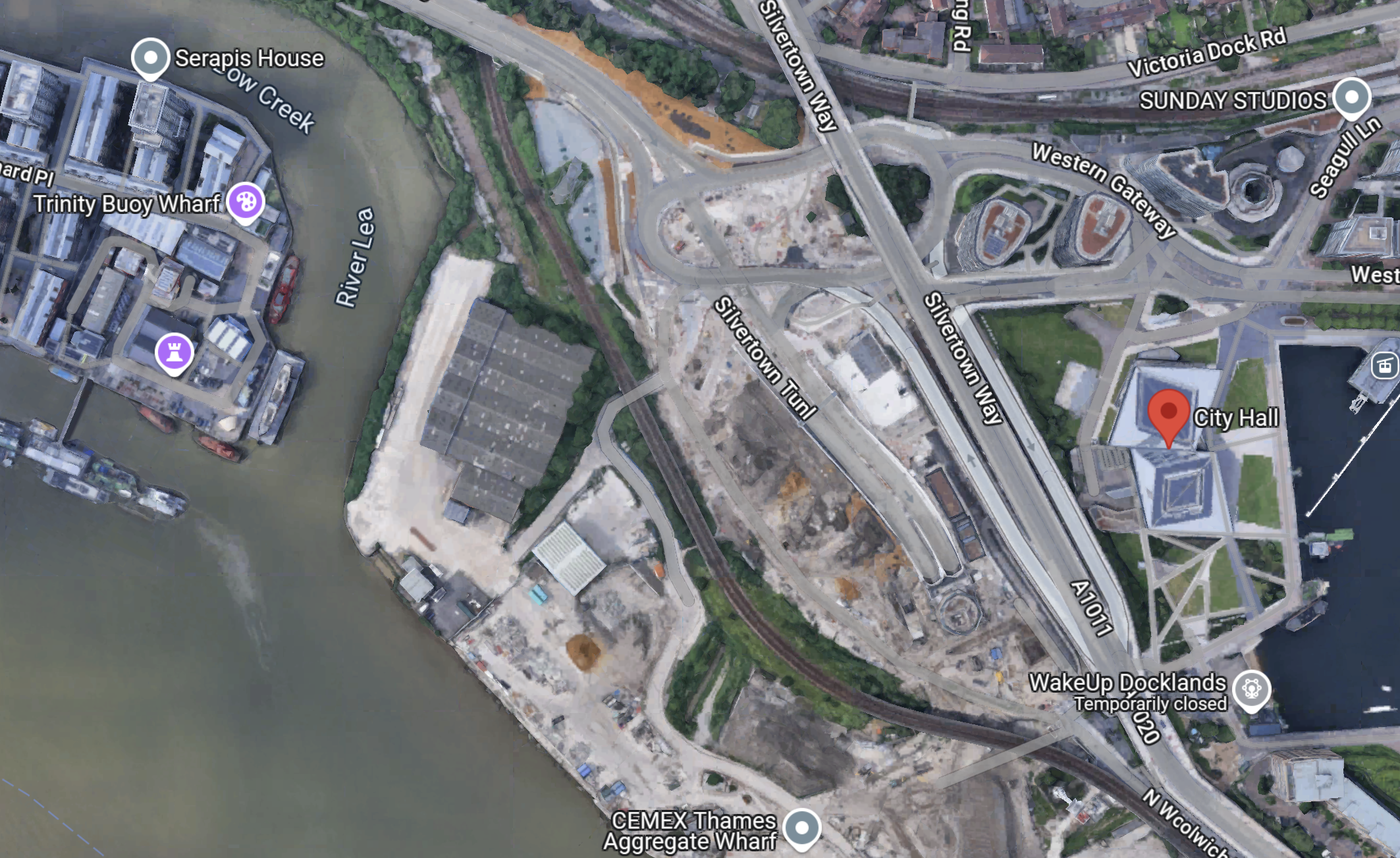
Note.
- The red arrow indicates City Hall.
- There is a large site between the DLR and the river.
- The Docklands Light Railway separates the site from the North entrance of the Silvertown Tunnel.
- The CEMEX Thames Aggregate Wharf seems to occupy part of the site.
This picture shows the North entrance of the Silvertown Tunnel from the cable-car.
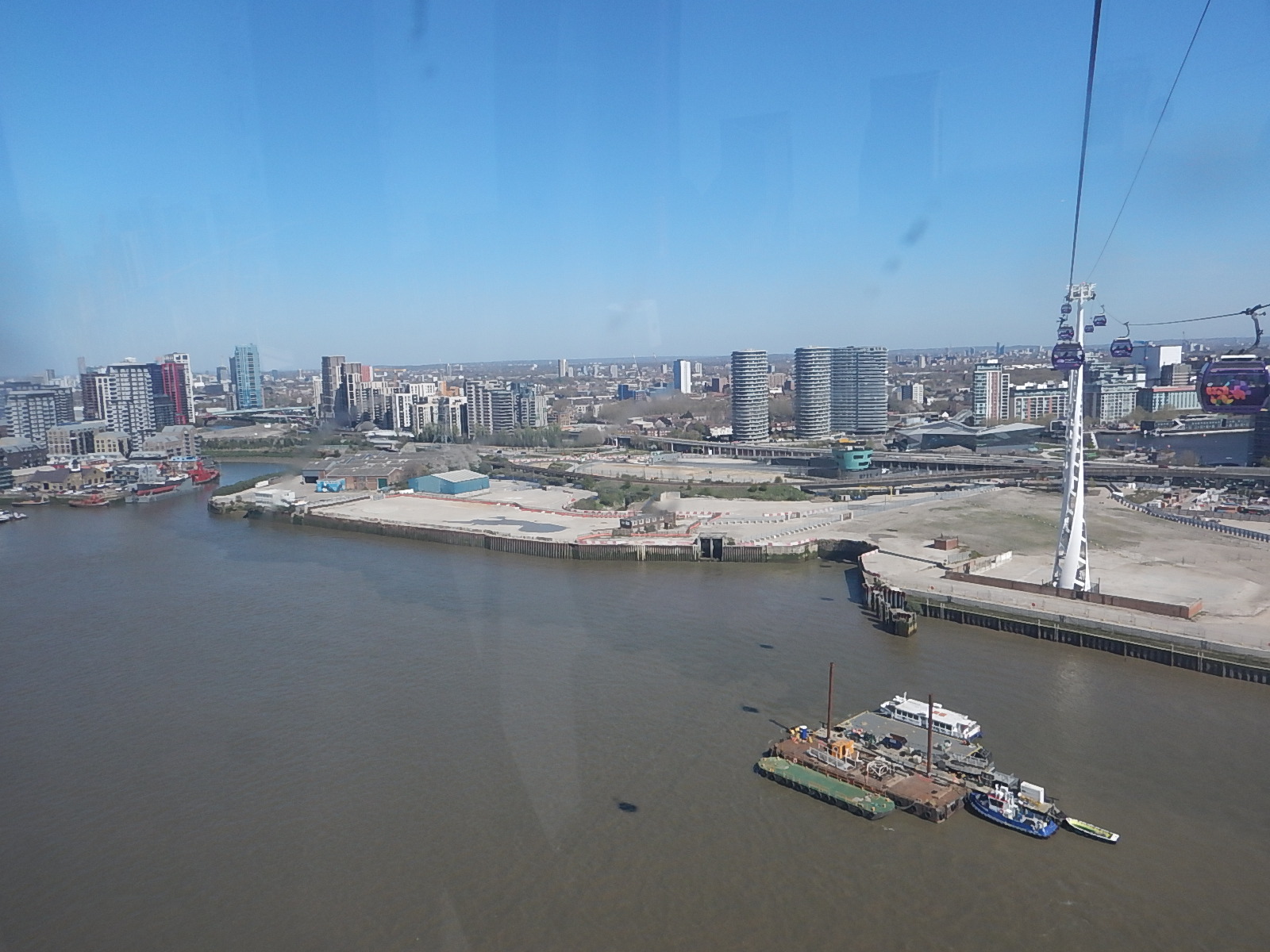
It is surely a site with development potential, as Roy Brooks would say.
It will probably be used for more tower blocks along the Thames.
But could it be used for a coach station to handle the increasing number of coaches between London and the Continent?
- A Docklands Light Railway station could be built to serve the site.
- Thames Clippers could also serve the site.
- Coaches could use the Silvertown Tunnel to start their journey out of the capital.
It is certainly a possibility.
Could The Silvertown Tunnel Be Used For Route-Proving For The Docklands Light Railway?
In TfL Considering Extending DLR As Far As Abbey Wood, I discussed extending the Docklands Light Railway to Thamesmead or Abbey Wood.
This map from Ian Visits shows the area.
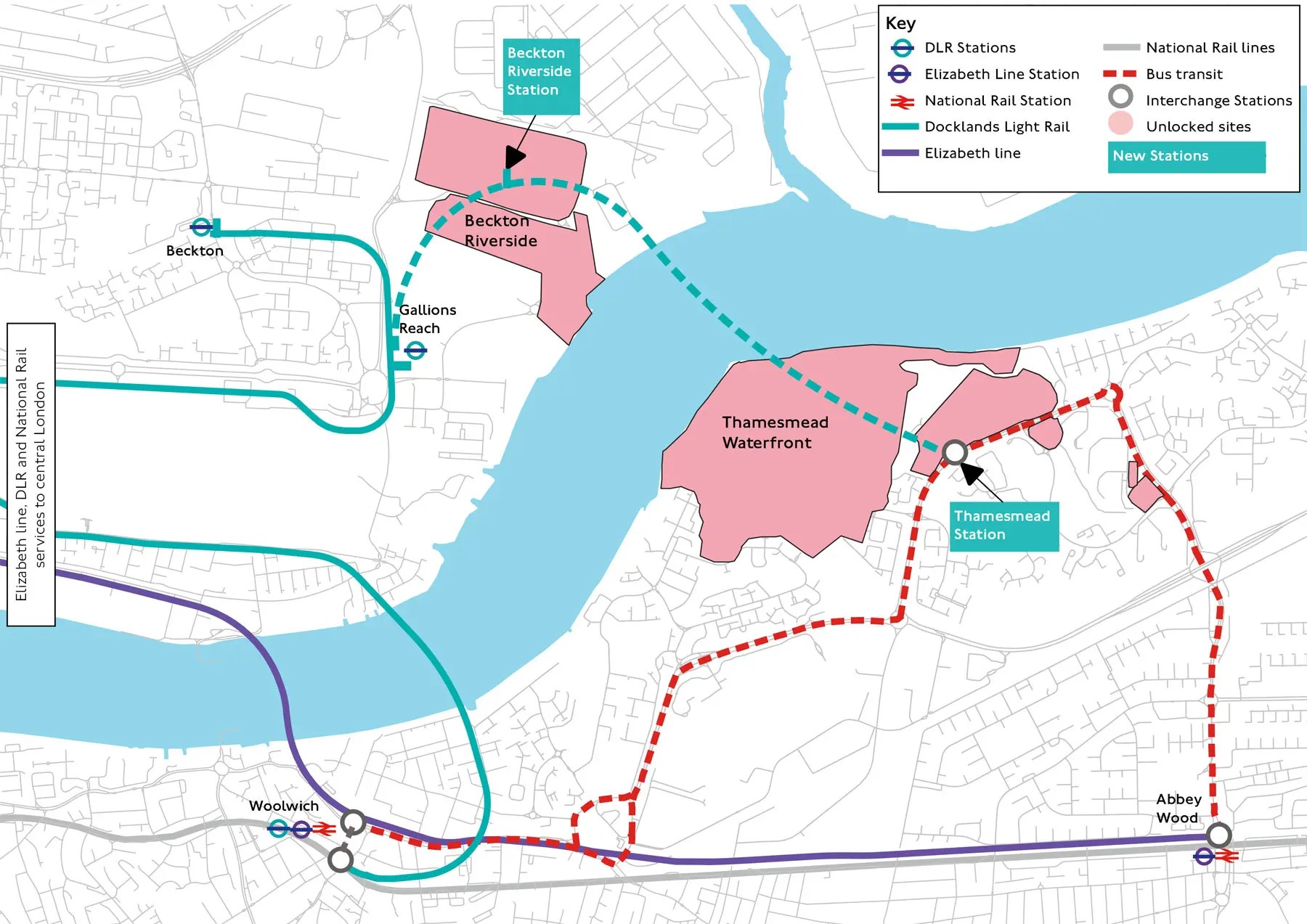
Running a four buses per hour service through the Silvertown Tunnel, would be an ideal way of proving what is the best route.
Extending The Docklands Light Railway To The West
No matter how the Docklands Railway is extended to the East, either by physical means like extra branches or by virtual means like connecting to bus routes, this will mean that there will need to be more terminal capacity in the West, to take the pressure off Bank and Tower Gateway stations.
In A Connection Between City Thameslink Station And The Docklands Light Railway, I described a proposal to extend the Docklands Light Railway to Euston, St. Pancras and Victoria.
In the Wikipedia entry for the Docklands Light Railway, there is a section describing a proposed Euston/St. Pancras Extension.
This is said.
In 2011, strategy documents proposed a DLR extension to Euston and St Pancras. Transport for London have considered driving a line from City Thameslink via Holborn north to the rail termini. The main benefit of such an extension would be to broaden the available direct transport links to the Canary Wharf site. It would create a new artery in central London and help relieve the Northern and Circle lines and provide another metro line to serve the High Speed line into Euston.
This map from Transport for London, shows the possible Western extension of the DLR.
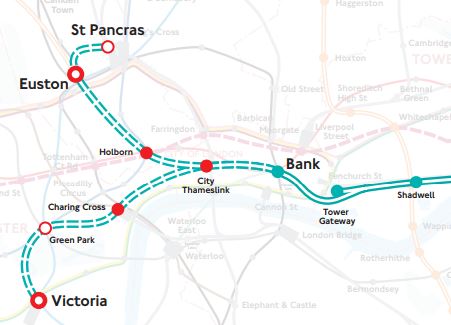
With all the problems of the funding of Crossrail 2, that I wrote about in Crossrail 2 Review Prompts Fresh Delays, could this extension of the DLR, be a good idea?
Consider.
- Victoria, Euston and St. Pancras are prosposed Crossrail 2 stations.
- It would link Canary Wharf and the City of London to Eurostar, Northern and Scottish services and High Speed Two.
- It would give all of the Docklands Light Railway network access to Thameslink.
- A pair of well-designed termini at Euston and St. Pancras would probably increase frequency and capacity on the Bank branch of the system.
- The DLR is getting new higher capacity trains.
- Bank station is being upgraded with forty percent more passenger capacity.
- Holborn station is being upgraded and hopefully will be future-proofed for this extension.
- One big advantage at City Thameslink, is that Thameslink and the proposed DLR extension will cross at right-angles, thus probably making designing a good step-free interchange easier.
- The Bank Branch of the DLR currently handles 15 tph, but could probably handle more, if they went on to two terminal stations at St Pancras and Victoria..
- Waterloo and City Line can run at twenty-four tph.
Cinderella she may be, but then she always delivers, when there is a desperate need, just as she did magnificently at the 2012 Olympics.
Something is needed to handle the extra passengers at Euston, that will be brought to London by High Speed Two. Cinderella is the only way to deliver a connection in a reasonable time.
The only problem with this extension of the DLR, is that compared to the rest of the system, the views will be terrible.
For myself and all the others living along the East London Line, with a step-free change at Shadwell, we would get excellent access to Euston, St. Pancras and Victoria.
But could the line still be called the Docklands Light Railway, as it spreads its tentacles further?
When Silvertown Opens, Blackwall Tolls Start Too
The title of this post, is the same as that of this article on the BBC.
This is the sub-heading.
In under a month, tolls will be introduced for drivers at the new Silvertown Tunnel and the existing Blackwall Tunnel in east London.
These four paragraphs add detail to the story.
For car drivers it will cost £8 a day in peak. These are huge changes to London’s transport network and awareness seems to be low.
The new highly controversial Silvertown Tunnel opens on 7 April.
Critics have dubbed the crossing a huge polluting white elephant that will do nothing to cut congestion and pollution with little or no business case.
Supporters say it will reduce congestion on the old, existing Blackwall Tunnel and improve resilience on the crossing that closes between 600-700 times a year. It will also provide more cross river bus routes as well as a bus that can carry bikes.
As a very experienced mathematical modeller, my gut feeling is that four new tolled lanes under the River Thames is not the solution.
These are my thoughts.
Transport for London Are Not Good Mathematical Modellers
As a non-driver, I rely heavily on the 141 bus for transport.
- It stops close to my house.
- It takes me to and from Moorgate, where I also pick up the Elizabeth Line.
- It takes me to and from Bank, where I also pick up the Central Line.
- It takes me to and from River Thames, from where I pick up the Thames Clippers.
- It takes me to and from London Bridge station, where I also pick up theThameslink.
- It takes me to and from Manor House station, where I pick up the Piccadilly Line.
- It takes me to and from Harringay Green Lanes station, where I pick up the Gospel Oak to Barking Line.
I must admit some of the reasons I like the bus route, are that it connects me to my childhood memories of WoodGreen, Southgate, Oakwood and Cockfosters.
When, I moved here, there were two North-South buses that ran within fifty metres of my house.
- The 21 bus ran between Newington Green and Lewisham.
- The 141 bus ran between Palmers Green and London Bridge station.
Then, two years ago the Elizabeth Line and the rebuilt Bank station both opened, followed a year later by an upgraded Old Street station.
These three improvements, added a lot more passengers to the North-South corridor, between London Bridge station and Newington Green roundabout.
I suspect a quality modelling of bus passengers North-South, through the city of London, would have shown, that more buses were needed on the combined 21/141 route.
So what did Sir SadIQ and Transport for London do? They rerouted the 21 bus away from the busiest section through De Beauvoir Town.
In their modelling, I suspect.
- They overestimated how many travellers used the Northern Line.
- They ignored the fact, that the Piccadilly Line doesn’t serve the City of London.
- They ignored the fact, that the Piccadilly Line doesn’t connect to the Elizabeth Line.
- They ignored the fact, that the 141 bus, is the only direct way between Palmers Green, Wood Green, Turnpike Lane and Manor House to the City of London.
- They felt De Beauvoir Town was a posh area and doesn’t need more buses, as residents can use their cars.
Halving the number of buses was a seriously bad decision.
I now have a damaged left knee due to constant standing on overcrowded buses.
It’s also got a lot worse lately due to constant bus diversions and cancellations, due to Islington’s LTNs and constant road works.
I’ve heard similar tales of bad bus planning from all over London.
So why should I trust Transport for London’s traffic modelling on the Silvertown and Blackwall Tunnels?
The Silvertown And Blackwall Tunnel Share Approach Routes
This map from the BBC article shows the layout of the two tunnels and their approach roads.
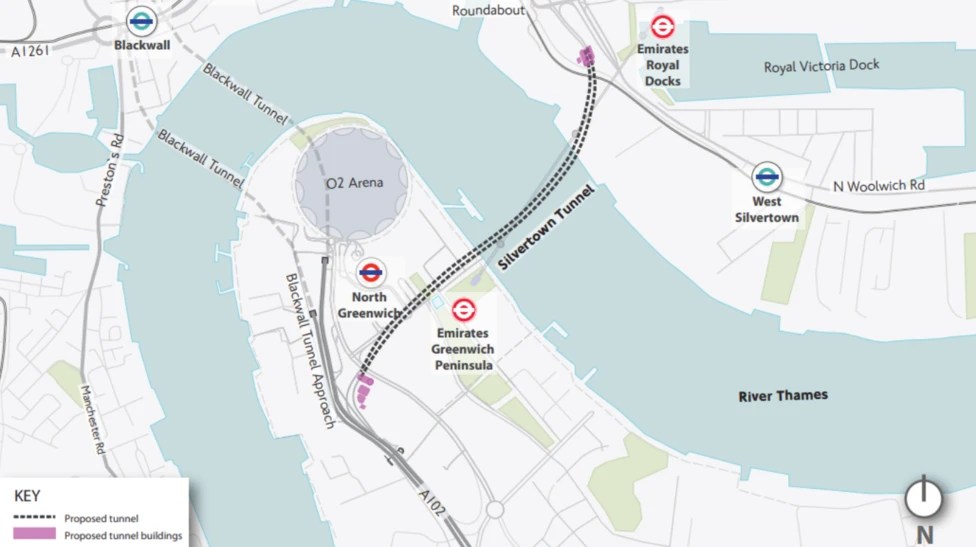
Note.
- The Blackwall Tunnel is two, two lane tunnels, one in each direction.
- The Silvertown Tunnel is one four lane tunnel, with two lanes in each direction.
- The O2 lies between the two tunnels.
The map shows the shared approach road for both tunnels.
What happens if there is an accident on the approach to the tunnels?
Tolling Problems
I feel that the tolling regime is overly complicated.
Hopefully, any problems this causes will lessen, as drivers know what to do.
The Sat-Nav Route Between The Tunnels And The M1
I’ve just looked one recommended route up, not that I have a Sat-Nav and I’ve never used one and the route is straightforward.
- Blackwall Tunnel Northern Approach to Hackney Wick.
- Wick Lane to Hackney Central.
- Graham Road and Dalston Lane to Dalston Junction
- Balls Pond Road to Southgate Road/Mildmay Park
- St. Paul’s Road to Highbury & Islington station.
- Holloway Road to Archway.
- Archway Road, Aylmer Road and Falloden Way to Henly’s Corner.
- North Circular Road and Great North Way to the M1.
I live just South of the Southgate Road/Mildmay Park junction and often these days it is jammed solid.
But there is another route from Hackney Wick.
- A12 to Redbridge Roundabout on the North Circular Road.
- North Circular Road to the M1.
I dread to see what happens, when the Dartford Crossing is closed and heavy trucks from the Channel Tunnel to the M1, decide to take the Silvertown Tunnel as an alternative route.
A True Underground Advert
I spotted this advert at Swiss Cottage station today.
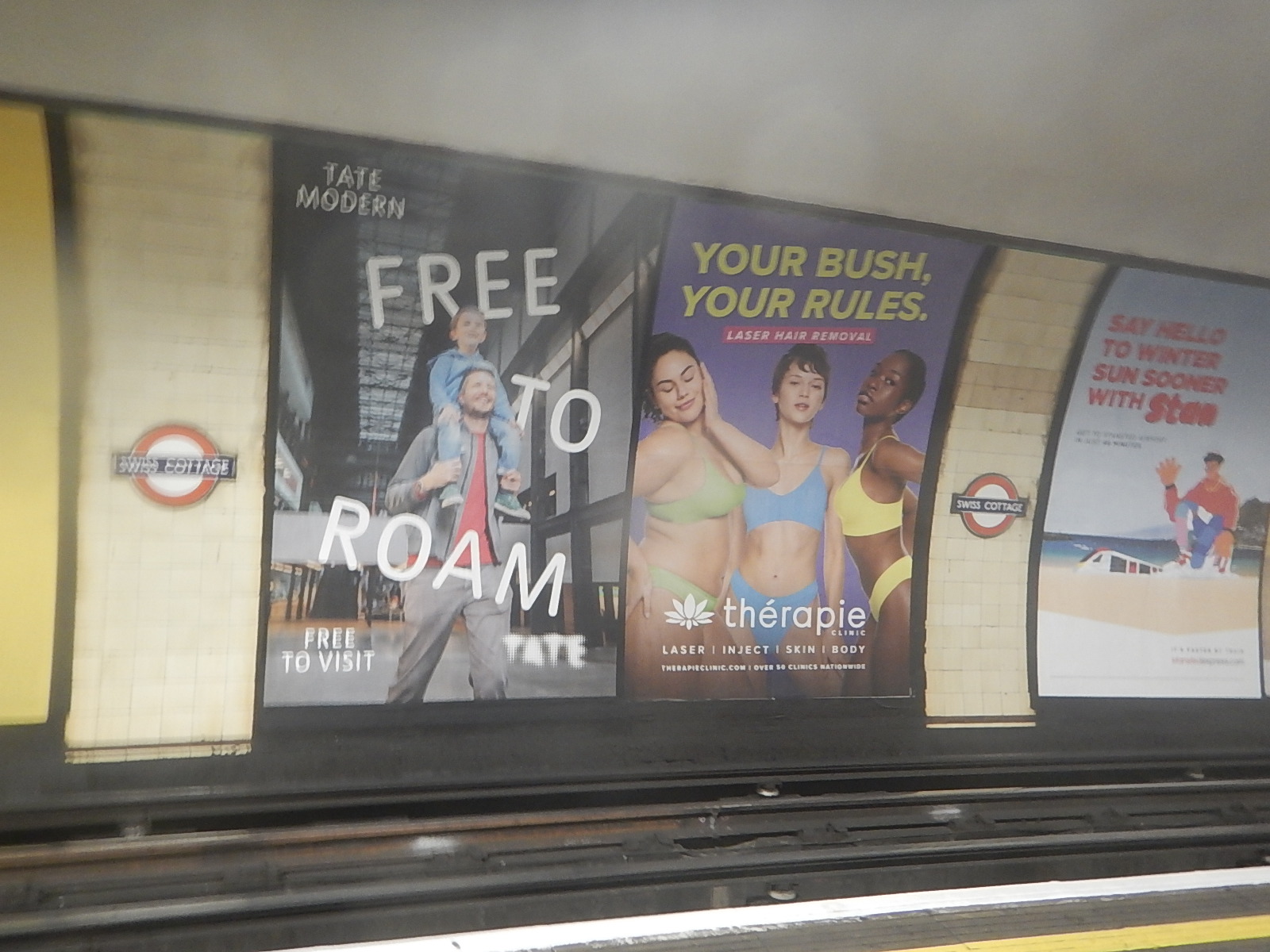
I’m surprised the censors of Transport for London didn’t ban it.
Another version of the advert is also running around on a 476 bus near me. But in that one a single lady is lying down to fit the bus.
Great British Railways And Private Sector To Compete For Ticket Sales
The title of this post, is the same as that of this article on Railway Gazette.
This is the introductory paragraph.
The Department for Transport has announced that the future Great British Railways will sell tickets online, while retaining a ‘thriving’ private sector market where third party ticket retailers can compete in an ‘open and fair’ manner.
I would certainly like to see more innovation in the selling of rail tickets.
A few things I would like to see in ticketing include.
Ticketing Machines At Busy Interchanges
When, I wrote My First Trip On The Northumberland Line – 18th December 2024, I bought my Lumo ticket between Kings Cross and Newcastle at King’s Cross and needed to buy my ticket for Ashington at Newcastle station.
There is no ticket machine on the long walk between where Lumo trains arrive and leave and the Northumberland Line.
This is a common problem and someone needs to design a ticketing machine for interchanges to simplify the changing of trains for passengers.
Stations that need such a machine include.
- Clapham Junction on the bridge.
- Ipswich on the central platform.
- Leeds on the bridge.
- Reading on the bridge.
It should be noted, that in some cases train staff will sell you a ticket, which gets round the problem. But other train companies are getting tough on revenue enforcement.
These ticket machines could be provided by Great British Railways or a private company.
Automatic Freedom Pass Extension
If I don’t want to buy a physical ticket for Gatwick Airport, I can use my Freedom Pass to East Croydon. Then I exit the station and come back in using a credit card or my phone. I then exit at Gatwick, using the method I used to reenter at East Croydon.
But wouldn’t it be so much easier, if I could link a credit card to my Freedom Pass, so that the charge for East Croydon and Gatwick Airport was automatically charged to my credit card.
Collection Of Tickets
In Collecting National Rail Tickets, I had a moan at Transport for London about their unwillingness to provide facilities for passengers to pick up National Rail tickets.
This was their unfriendly notice at Tottenham Court Road station.
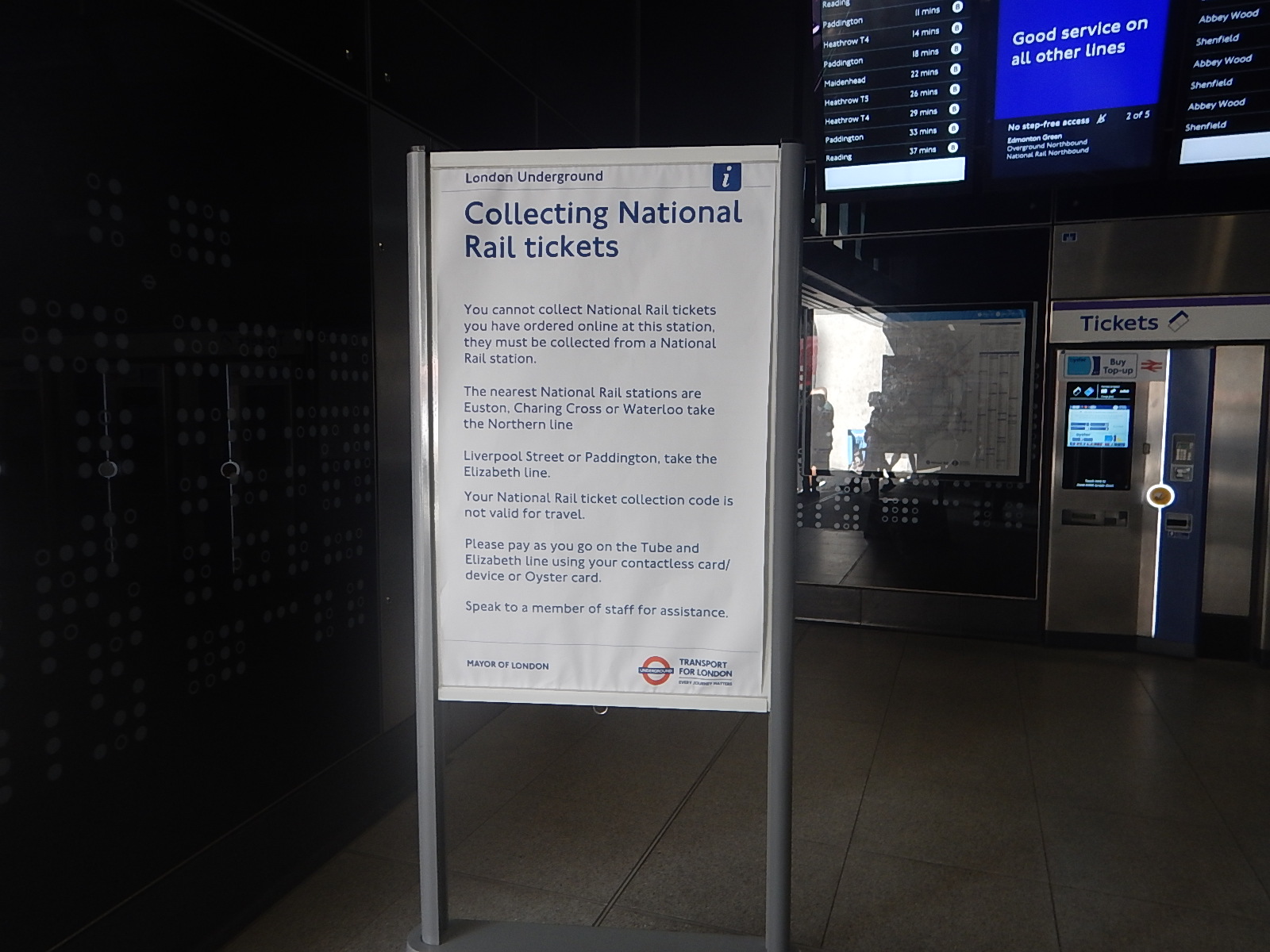
Facilities should be provided in many more places, where passengers can pick up rail tickets bought on-line.
These ticket collection machines could be provided by Great British Railways or a private company.
Stratford Station – New Gittins Road Entrance
I’ve been meaning to check out this new entrance at Stratford station for some time, as it opened in July 2024.

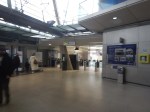
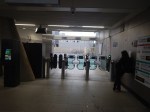
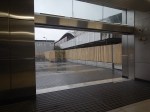

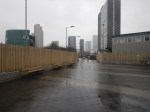
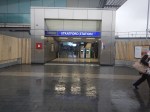

It is only a simple entrance with a gate-line, ticket machines, information displays and a warm hut for a ticket checker.
Transport for London and other transport operators could do with a few of these entrances, to cut off travelers, who don’t think they should pay.
Petition Calls Made To Scrap Blackwall And Silvertown Tolls
The title of this post, is the same as that of this article on the BBC.
This is the sub-heading.
A petition containing more than 37,000 signatures calling for proposed tolls on the Blackwall and Silvertown tunnels to be scrapped has been presented at City Hall.
These four paragraphs give more details.
Toll charges of up to £4 per journey through the soon-to-open Silvertown Tunnel and the neighbouring Blackwall Tunnel were announced by Transport for London (TfL) on 26 November.
The Silvertown Tunnel will open next spring and will provide a new road crossing under the Thames between Silvertown and the Greenwich Peninsula.
The charges are “designed to manage levels of traffic using the tunnels”, TfL has said.
A TfL spokesperson added that without the tolls, “traffic would increase in both tunnels causing delays and congestion, which contribute to poorer air quality”.
Note.
- 37,000 is a large petition.
- If Transport for London wanted to reduce pollution, they could encourage greater use of hydrogen.
I have done some simple modeling using Excel.
- There are six vehicle crossings; Dartford Bridge, Dartford Crossing, Woolwich Ferry, Silvertown Tunnel, Blackwall Tunnel and Rotherhithe Tunnel.
- Matters are complicated by each crossing being a different size.
- There are several reliable rail crossings and a number of foot crossings, which offer alternatives, for those travellers on foot.
- Currently the worst disruption occurs, when more than one route is out of action at the same time.
It is a very complex river crossing,
I feel strongly that we aren’t going to get a true picture of traffic flow through the two new tunnels, until we see serious disruption on the Dartford Crossing.
But what worries me most, is that in the last few years, TfL have made decisions, where they must have done extensive mathematical modelling and they seem to have come up with answers, that are wide of the mark.
Congestion Prediction
I believe that we now have enough data, that by the use of modern computing, advanced vehicle detection techniques and a liberal dollop of artificial intelligence we should be able to accurately predict the traffic flow over the Thames between Dartford and Silvertown, better than we have done in the past.
But will this just mean, that everybody just takes the least-congested route?
Struggling To Get Home From Moorgate Station
In most cases to get back to my house, I take a convenient 141 bus from Moorgate station.
- The bus stop at Moorgate is the same side of the road as the exit from Moorgate station.
- At the stop at my home, I just cross the not very busy road and there is a zebra crossing, if the road is busy.
- The walks at both ends are not more than fifty metres.
- The 141 bus, used to share the route with the 21 bus, which meant there was a bus every five minutes.
- The 21 buses are more comfortable New Routemasters.
Now, that the 21 bus no longer shares the route, timings of the 141 are much extended, with sometimes a wait of as long as 15 minutes.
This is because.
- The traffic has got a lot heavier.
- One fleet of buses, is taking both groups of passengers.
- Islington has laid out numerous Low Traffic Neighbourhoods.
Consequently, the remaining 141 buses have a much higher passenger density and I don’t always get a seat.
This Saturday and Sunday, the Elizabeth Line wasn’t running, so the buses were overcrowded.
On both days, I had to get a 76 bus from Moorgate to De Beauvoir Town, as I had waited for a long time and one had not been shown on the app.
Yesterday, I would have had to wait 26 minutes for the 141 bus to do the last mile to get home.
So I walked and took these pictures of Islington’s not so pretty pavements.

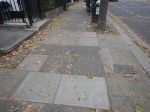


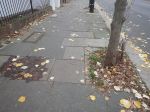
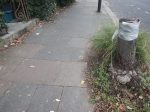
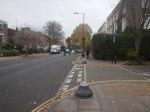
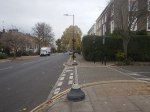
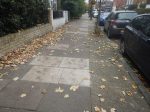


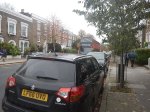
Compared to Hackney, they are not a pretty sight. And the pavements did make walking difficult.
As I did the last leg to my house, five 141 buses passed me, as Transport for London don’t believe in spreading them out, where there are punters.
Luckily, I wasn’t carrying anything heavy!
Today, I was even luckier in that a 141 bus stopped, soon after I got off the 76.
More Mushroom Management On TfL Buses
After my experience in Mushroom Management On TfL Buses, I’ve changed my weekend breakfast routine at weekends, to one where on Saturdays and Sundays, I eat breakfast in London’s poshest Leon at Hanover Square, which I wrote about in A Quality Takeaway With A Station And A Large Garden.
It is a large restaurant.
It has comfortable seating.
It is within my not very long walking distance of the Bakerloo, Central, Elizabeth, Jubilee and Victoria Lines, and Oxford Street with all its buses.
There is a garden with seating in the square.
This picture shows the frontage of the building.
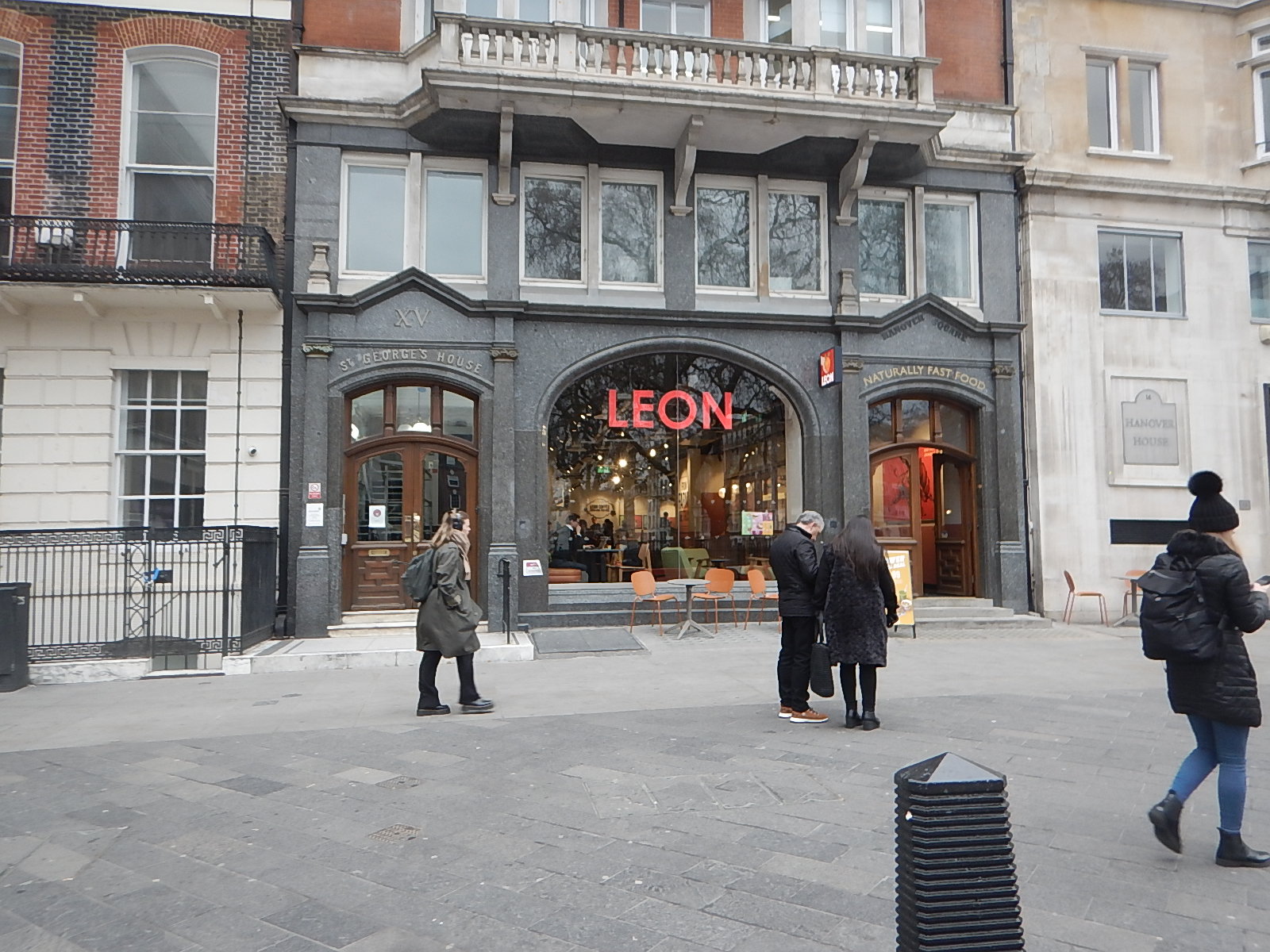
It’s certainly not your average takeaway or fast food outlet.
Normally, Hanover Square is a very easy location for me to travel to.
- I walk round the corner to the stop for the 38 bus.
- The 38 buses are usually every 3-4 minutes and I travel to Tottenham Court Road station.
- I go one stop on the Elizabeth Line, travelling in the rear of the train to Bond Street station.
- I’m then at the right end of the station to exit directly into Hanover Square, after riding up from the depths on a long escalator.
Leon is just a fifty metre walk away.
Today, there were no problems, although I did cut it a bit tight.
But all was fine in the end and I had a good full-English breakfast.
A Difficult Journey Home!
When, I set off from home, I wasn’t sure which way, I would come home.
In the end, I decided to come home the simple way of taking the Elizabeth Line to Moorgate station and then getting the 141 bus from there, as it stops close to my home.
But this route has the Elizabeth Line end-changing problem, in that the Hanover Square entrance at Bond Street station is at the Eastern end of the train and the Moorgate entrance at Liverpool Street station is at the Western end of the train.
So at some point in the journey, I would have to take a two-hundred metre walk, either on the platform or inside the train. The latter is not easy on a train to and from Heathrow, as it is often stuffed full with cases in the aisle. Why do people want to take all the contents of their house on holiday?
So I decided to go via a reverse at Whitechapel, where I positioned myself at the Western end of the train for exit at Moorgate.
It really was necessary to install travellators at Liverpool Street station on the Elizabeth Line, as between the two entrances is a long walk, as this graphic shows.
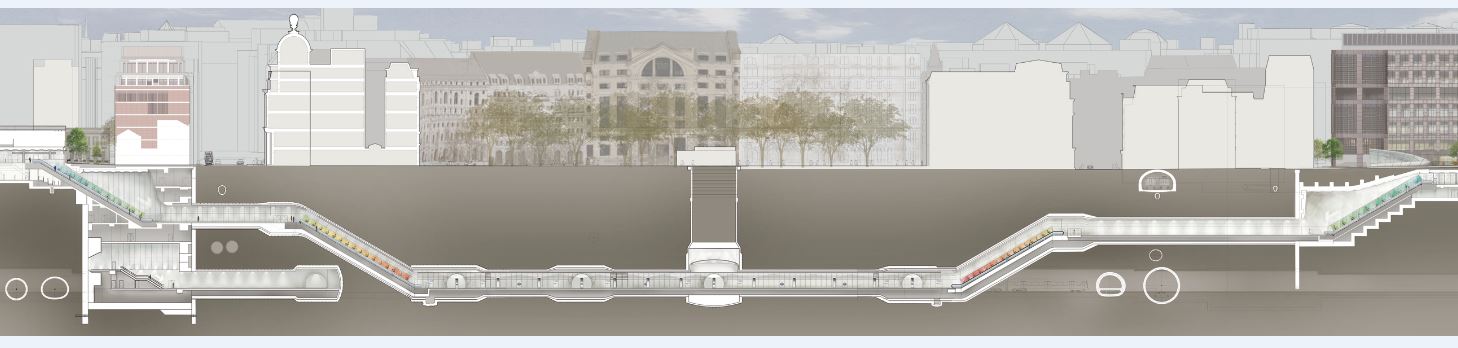
Note.
- Moorgate is to the left
- Liverpool Street is to the right.
But then Transport for London wanted a spectacular line with spectacular stations, that would win awards. Which it has!
I alighted from the train at the Moorgate end of the station, which meant that after two escalator rides and a short walk, I was at the 141 bus stop on the surface.
But there were no buses of any numbers calling at the stop.
This was because of the Lord Mayor’s Show, which meant there were no buses through the City.
But.
- There were no posters at stations saying that the show was taking place and buses would be diverted.
- Displays on bus stops were not saying anything about the show.
- The BBC hadn’t mentioned the Lord Mayor’s Show on the TV this morning.
- The BBC doesn’t have a local news at weekends, which would surely have mentioned the show and its effects on public transport.
- The display on the bus stop at Moorgate was still broken, as it has been for six months.
- There was a small information poster on the bus stop, but it was positioned too high for me to see.
- Taxis seemed to be avoiding the City.
There were a few stewards about and one suggested, that I walked to Old Street, which would not be easy on my legs.
In the end, I decoded that a retreat via Whitechapel and Dalston Junction was probably the best way to get home, as the Overground would be unlikely to be effected.
But I made the mistake of getting on a Circle Line train at Moorgate, so I didn’t get to Whitechapel.
Instead, I walked to the 141 and 21 bus stop at Monument station and caught a 21 bus North. I hoped that I would be able to connect to the 141 bus, that I needed to get home.
I did get safely home, but only after two long waits at bus stops, where I changed bus routes twice.
Conclusion
Transport for London need to devise bus plans for all major events and publicise them well in advance.
In London’s New 733 Bus Route, I described how Transport for London put in a temporary bus route between Finsbury Square and Oval stations to replace the Northern Line during the upgrade of Bank station.
As the Lord Mayor’s Show happens every year, surely the same plan can be rolled out each year, with any appropriate changes.
I’d be interested to know whether other large cities have plans for big celebrations in city centres.
TfL May Increase e-Scooter Speed Limit And Lower Age Restriction
The title of this post, is the same as that of this article on the Telegraph.
This is the sub-heading.
Riders would be able to travel at 15.5mph including 16-year-olds who hold a provisional driving licence
I’m now seventy-seven and I’ve never ridden one of these devices. I didn’t even have one of the push-only variety, as a child in the 1950s.
The article says this about serious injuries.
The authority’s own data shows that e-scooter operators have reported 35 serious injuries since 2021. A serious injury is classified as those requiring hospital “in-patient” treatment, fractures, concussion, internal injuries, crushing, burns, severe cuts or injuries causing death 30 or more days after the collision.
A death figure is not given, but deaths have happened.
My feeling is that thirty-five serious injuries in three years is too high.
But then allowing those as young as sixteen to use these devices without adequate training is surely asking for trouble. I was sixteen once and know how irresponsible, I was on an unpowered bike, at that age.
I have to ask the question, if safety would be improved, if some form of training were to be compulsory?
My parents had a relaxed attitude to my road safety training.
- I was allowed on a bike in the suburban streets of London without training.
- I never took any Cycling Proficiency training.
- At sixteen, I used to cycle down the A45, which is now the A14, between Ipswich and Felixstowe amongst all the heavy trucks.
- I never had any formal driving lessons and had my own car soon over my seventeenth birthday.
In all the miles, I cycled and drove, I never had a serious accident.
- But I am still unhappy at the two proposals in the title of this post.
- Is it that many e-Scooters are ridden irresponsibly or outside the law?
- I am also worried about the propensity of e-Scooters and e-Bikes to catch fire.
I would certainly be happier if a reasonable set of rules for these devices had been devised and was strictly enforced.
Mushroom Management On TfL Buses
Transport for London or as all Londoners abuse them as TfL, are getting the masters at applying mushroom management to running the buses. Especially at the weekends.
For those of you not familiar with the last century term, it means keeping everybody in the dark and throwing in lots of manure. As in the 1970s, I used to live next door to a mushroom factory, I know it at least works with fungi, but I’m not sure of it’s effectiveness with fleets of buses about moving passengers.
Most Saturdays, I take a 141 bus to Moorgate and have a full English gluten-free breakfast in the Leon cafe there, as I like to set myself up for the weekend.
The 141 bus may be one of the least reliable buses in the capital, but last Saturday, I was dropped close to Liverpool Street station and yesterday, I was dropped under the Barbican.
No warning, advice or apology about the change of plan.
But then like the Mayor, TfL are never in the wrong.
Today was different!
After taking a 56 bus from near my house to the Angel I had another full English gluten-free breakfast in the Leon cafe there, before taking the Northern Line to Euston station.
I was hoping, I could take a trip somewhere, but there were extensive engineering works, so I just came home from Euston on the Overground via Willesden Junction station.
I ended up at Hackney Central station, where I did a bit of shopping in the excellent M & S Food shop.
Normally, I just get a 38 bus home from the side of the station, but there weren’t any around.
Again, there was no warning, advice or apology. Just loads of people looking for non-existent buses.
It was a full three hours before I completed my round trip.
Transport for London has no respect for its passengers.
Normal businesses would go bust, if they treated their customers like this.

