‘A Gift For Putin’: Czech E-shop Sells Tanks And Grenades To Support Ukrainian Army
The title of this post, is the same as that of this story on expats_cz.
This is the introductory paragraph.
The Czech Republic has been among the most active countries in supporting the Ukrainian military with donations and sales of weapons and ammunition, including shipments of Soviet-era tanks, multiple rocket launchers, howitzers, infantry fighting vehicles, and anti-aircraft weapons.
I hope the gift, will calm Vlad the Mad.
Putin Burns $10m Of Gas A Day In Energy War With The West
The title of this post, is the same as that of this article in The Times.
This is the first paragraph.
Russia is burning off an estimated $10 million of natural gas a day from a single plant, leading to accusations that President Putin is deploying his country’s vast energy reserves as a weapon against Europe.
It just showed the sort of idiot we’re dealing with!
- He doesn’t care about the planet.
- He’s effectively burning his country’s cash reserves.
- He’s spurring Western engineers on, to on the one hand find ways to beat him and on the other to find ways to make our gas go further, so we don’t need to buy his bloodstained gas.
- If he thinks, that he might provoke a war with Finland, I suspect the Finns are too bright for that.
They’ll be waiting and if the Russian Army should invade, they’ll get the kicking of a lifetime, just like Stalin’s thugs did in the Winter War of 1939-1940.
I
Should The World Call A Halt To Large Nuclear Power Stations?
When I left Liverpool University in the 1960s with an engineering degree, my fellow graduates and myself felt that nuclear power would be a sensible way to provide the electricity we need. Aberfan and other disasters had ruined coal’s reputation and not one of my colleagues joined the National Coal Board.
Over the intervening years, nuclear power has suffered a greater proportion of adverse events compared to other forms of electricity generation.
Large nuclear has also suffered some of the largest time and cost overruns of any energy projects.
My optimism for nuclear power has declined, although I do hope and feel, that small modular factory-built reactors, like those proposed by Rolls-Royce and others, might prove to be as reliable and economic as gas-fired, hydro-electric and tidal power stations, or solar and wind farms.
The smaller size of an SMR could be advantageous in itself.
- Smaller factory-built power stations are more likely to be built on time and budget.
- The amount pf nuclear material involved is only about twenty percent of that of a large nuclear station.
- A smaller site would be easier to protect from terrorists and Putinistas.
- Would the risk of a serious accident be reduced?
- SMRs would be less of a blot on the landscape.
- SMRs would not need such a high-capacity grid connection.
- An SMR integrated with a high temperature electrolyser could be the easiest way to generate hydrogen for a large customer like a steelworks.
Overall, I believe an SMR would be involve less risk and disruption.
Zaporizhzhya
Zaporizhzhya is probably the last straw for large nuclear, although the incident isorchestrated by an evil dictator, who is much worse, than any of James Bond’s cruel adversities.
I doubt Putin would get the same leverage, if Zaporizhzhya were a gas-fired or hydroelectric power station.
Conclusion
I feel, the world must seriously question building any more large nuclear power stations.
Sizewell C Nuclear Plant Campaigners Challenge Approval
The title of this post, is the same as that of this article on the BBC.
These three paragraphs introduce the article.
Campaigners against the Sizewell C nuclear power station have written to Business Secretary Kwasi Kwarteng to legally challenge his decision to give the scheme the go-ahead.
The £20bn project for the Suffolk coast was given government approval in July.
However, the decision was against the advice of the Planning Inspectorate and those against the scheme said the consent was therefore “unlawful”.
I summed up my attitude to nuclear power in Sizewell C: Nuclear Power Station Plans For Suffolk Submitted, where I said this.
As a well-read and experienced engineer, I am not against the technologies of nuclear power.
But I do think, by the time it is completed , other technologies like wind and energy storage will be much better value. They will also be more flexible and easier to expand, should we get our energy forecasts wrong.
I wrote that in May 2020, which was before Vlad the Mad started his war in Ukraine. So our energy forecasts are totally wrong! Thanks for nothing, Vlad!
In Plan To Build £150m Green Hydrogen Plant At Felixstowe Port, I talked about ScottishPower’s plan to build a large electrolyser at Felixstowe.
The Port of Felixstowe has in the past talked of using electricity from Sizewell C to create hydrogen.
So is the port backing another horse or just playing safe?
The EuroAsia Interconnector
The Wikipedia entry for the EuroAsia Interconnector, introduces the project like this.
The EuroAsia Interconnector is a proposed HVDC interconnector between the Greek, Cypriot, and Israeli power grids via the world’s longest submarine power cable (310 kilometres (190 mi) from Israel to Cyprus and 898 kilometres (558 mi) from Cyprus to Greece, for a total of 1,208 kilometres (751 mi)). Connecting Kofinou, Cyprus to Hadera, Israel and Korakias, Crete, Greece and stated to finish construction in 2023.
When completed it will have a capacity of 2 GW.
From Wikipedia, it appears that at least initially, Israel will export electricity produced in gas-fired power stations from their own more than adequate supplies of natural gas.
In Andrew Forrest’s Fortescue Future Industries Inks Deal With Kingdom of Jordan For Green Hydrogen Study, I published this Google Map of Jordan.
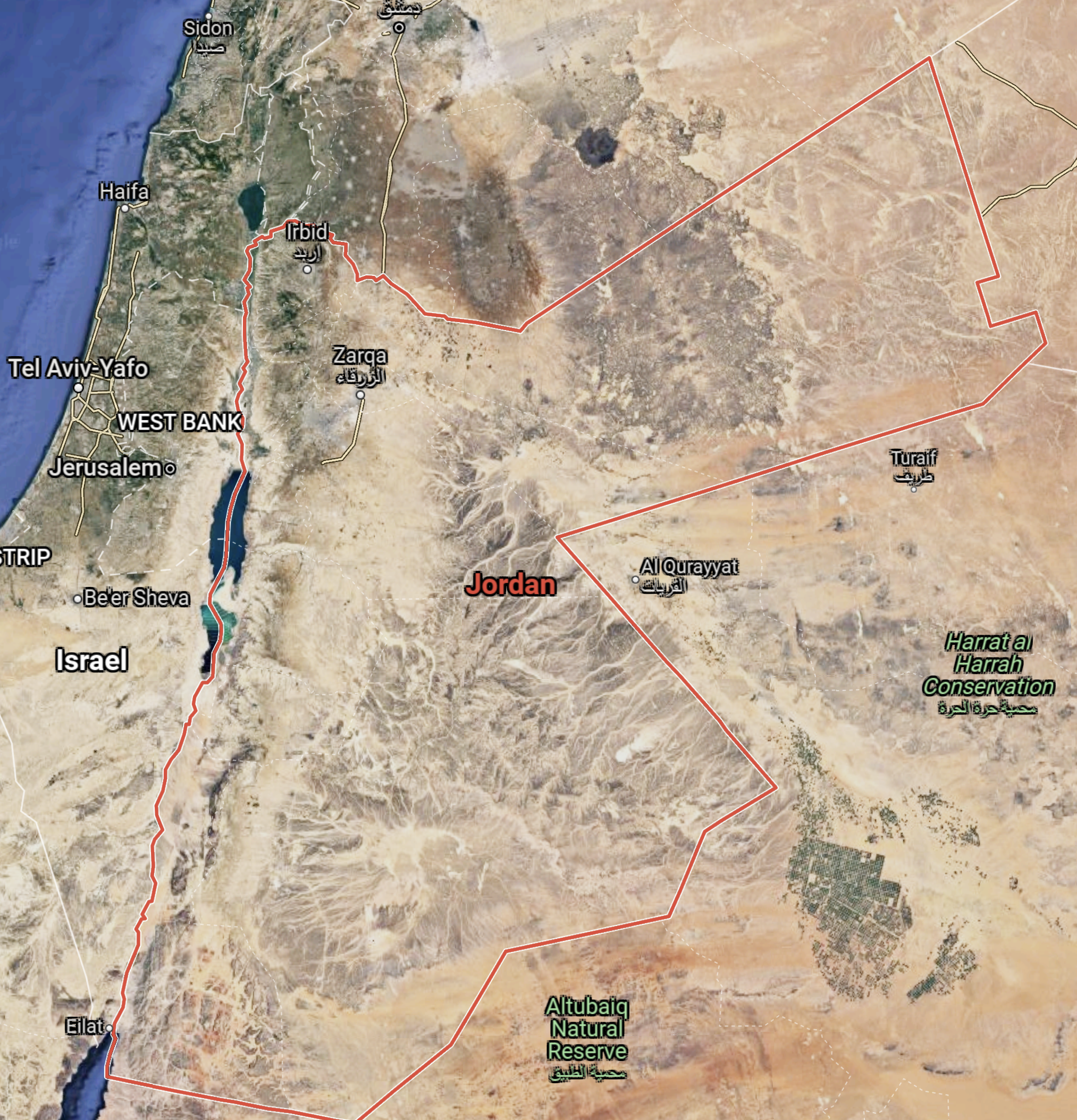
Surely, in the future, the EuroAsia interconnector could be carrying solar generated green electricity from Iraq, Jordan and Saudi Arabia to Cyprus and Greece.
As, according to Reuters, Greece covers about 40% of its annual energy needs with Russian gas, this can’t be good for Vlad the Mad and his bloodstained gas.
Will We Run Out Of Power This Winter?
Someone asked me if we will run out of power, if Vlad the Mad cuts all the gas to Western Europe.
This was my reply.
It appears that this year, 3.2 GW of new offshore wind farms could start producing electricity, followed by similar amounts in both 2023 and 2024.
One of those to come on stream about now is the 1.4 GW Hornsea 2 wind farm!
The follow-up 2.9 GW Hornsea 3, signed a contract last week for delivery in 2026/27.
Moray East in Scotland and Triton Knoll off Lincolnshire, are also scheduled to come on stream this year and they’re around 900 MW each.
As someone, who used to write project management software, I hope the companies building these fields have enough resources, in terms of people, boats, cranes and money. But as the companies are all the Shells of the wind industry, I would hope they have got their sums right.
What About The Contracts for Difference Awarded In Allocation Round 4?
We are currently fighting two wars at the moment.
- The main war in Ukraine, where we are giving that unfortunate country all the help we can.
- The secondary war in the UK against energy prices.
Would it help our cause in both wars, if we produced more energy?
- More renewable energy would reduce our dependence on imported gas.
- The gas saved could go to Europe.
- Europe would not be buying Vlad the Mad’s bloodstained gas.
- Replacing gas with solar and wind power might reduce energy prices.
If I put myself in the position of a struggling farmer with a contract for difference to build a solar farm on a poor field, I would want that farm to be earning money as soon as possible.
- Now that I have the contract can I start assembling that solar farm?
- Similar arguments can probably be used for onshore wind, which must be easier to assemble, than offshore wind.
- I don’t think that the hard-pressed energy suppliers would bother, if they received some quality cheap electricity earlier than they expected.
- Obviously, all the cables and the substations would need to be in place.
So I think that it is reasonable to assume, that energy might ramp up quicker than expected.
It could even be more front-loaded, if all the installers got a shift on.
Every little helps!
New Renewable Energy In 2023?
These wind farms are scheduled for commissioning in 2023.
- Neart Na Gaoithe – 450 MW
- Sofia Offshore Wind Farm – 1400 MW
- Seagreen Phase 1 – 1075 MW
We could see 2925 MW of offshore wind power commissioned in 2023.
New Renewable Energy In 2024?
These renewable energy sources are scheduled for commissioning in 2024.
- Dogger Bank A – 1200 MW
- Round 4 Solar – 125.7 MW
- Dogger Bank B – 1200 MW
- Dogger Bank C – 1200 MW
Note, where a windfarm is given a commissioning date of 2023/24 in Wikipedia , I will put it in 2024.
We could see 3726 MW of renewable energy commissioned in 2024.
New Renewable Energy In 2025?
These renewable energy sources are scheduled for commissioning in 2025.
- Moray West – 1200 MW
- Round 4 Solar – 1958 MW
- Round 4 Onshore Wind – 888 MW
- Round 4 Energy from Waste – 30 MW
- Vanguard Boreas Phase 1 – 1400 GW
We could see 6476 MW of renewable energy commissioned in 2025.
New Renewable Energy In 2026?
These renewable energy sources are scheduled for commissioning in 2026.
- East Anglia 1 North – 800 MW
- East Anglia 2 – 900 MW
- Round 4 Tidal Stream – 5.62 MW
We could see 1705 MW of renewable energy commissioned in 2026.
New Renewable Energy In 2027?
These renewable energy sources are scheduled for commissioning in 2027.
- Round 4 Tidal Stream – 35.2 MW
- Round 4 Floating Offshore Wind – 32 MW
- Round 4 Offshore Wind – 5594 MW
- Hornsea 3 Offshore Wind – 2852 MW
- Hinckley Point C Nuclear – 3,260 MW
We could see 13173 MW of renewable energy commissioned in 2027.
Too Much Electricity!
Summarising the figures for new capacity gives.
- 2022 – 3200 MW
- 2023 – 2925 MW
- 3024 – 3726 MW
- 2025 – 6476 MW
- 2026 – 1705 MW
- 2027 – 11773 MW
This totals to 28554 MW.
One problem we may have is too much electricity and as we are not blessed with much storage in the UK, where will be able to put it?
In a strange way, Vlad the Mad may solve the problem, by cutting off Europe’s gas.
We have a few interconnectors, where we can export the electricity to allow the Belgians, Dutch, French and the Germans to have a shower.
- BritNed – 1 GW – Isle of Grain and Rotterdam
- ElecLink – 1 GW – England and France through the Channel Tunnel.
- HVDC Cross-Channel – 2 GW – England and France
- IFA-2 – 1 GW – England and France
- Nemo Link – 1 GW – Richborough and Zeebrugge
- North Sea Link – 1.4 GW – Blyth and Norway
- Viking Link – 1.4 GW – Lincolnshire and Denmark
It looks like construction may be starting soon for another interconnector. NeuConnect will have a capacity of 1.4 GW between the Isle of Grain and Wilhelmshaven.
Conclusion
If I was the German Chancellor, I’d do everything in my power to accelerate the construction of NeuConnect!
Equinor And Partners Consider 1 GW Offshore Wind Farm Off The Coast Of Western Norway
The title of this post, is the same as that of this press release from Equinor.
This is the first paragraph.
Equinor and its partners Petoro, TotalEnergies, Shell and ConocoPhillips in the Troll and Oseberg fields, have initiated a study and are looking into possible options for building a floating offshore wind farm in the Troll area some 65 kilometres west of Bergen, Norway.
This second paragraph describes the production and use of the electricity.
With an installed capacity of about ~1 GW and an annual production of ~4.3 TWh, with a startup in 2027, Trollvind could provide much of the electricity needed to run the offshore fields Troll and Oseberg through an onshore connection point. The Bergen area already serves several of these installations with power – and needs more input to its electricity grid. The plan is that the partnership will buy as much energy as the wind farm can produce at a price that can make the project possible.
The press release includes a map of the wind farm, the oil and gas fields and Bergen.
This is not the first time, I’ve heard of plans to use wind-generated electricity to power offshore oil and gas fields.
It could be argued that if the gas is sold to the UK or Germany, then that country is responsible for the carbon emissions.
I doubt that Vlad the Mad’s bloodstained gas is produced using a carbon-free process.
Namibia Proposes Green Hydrogen Supply To EU To Replace Russian Oil And Gas
The title of this post, is the same as that of this article on H2 Fuel News.
These paragraphs explain the plan.
The African country has considerable wind and sunshine resources available, providing the opportunity to use renewable energy for the production of H2. Namibia is located along the African South Atlantic coastline and is among the world’s driest countries. Its 3,500 hours of sunshine per year mean that solar panels will be able to absorb a tremendous amount of energy, without much unexpected downtime.
That energy will be used for producing yellow H2, a form of green (renewable) H2 made using electrolysers powered by solar electricity. The electrolyser will split seawater, another abundant resource for the country due to its position on the map. As a result, it has the potential to offer the European Union a clean fuel source that can help it to simultaneously combat the energy crisis and the climate crisis.
Note.
- Liquid hydrogen will be shipped to Europe by tanker.
- I don’t think Vlad the Mad will like the plan!
- How many other countries have the resources like Namibia to become hydrogen exporters?
This plan was proposed at the World Economic Forum at Davos.
Rail Baltica Electrification Procurement Begins
The title of this post, is the same as that of this article on Railway Gazette.
These two paragraphs define the project.
Rail Baltica project promoter RB Rail has begun procurement of the electrification systems for the future standard gauge line between Poland, Lithuania, Latvia and Estonia, saying it will be the largest railway electrification scheme in Europe to be implemented as a single project.
The energy subsystem contract covers 870 km of double track line from the Polish border to Tallinn including the line from Kaunas to Vilnius, and includes design and construction of substations, connections to the public high voltage grids, control systems and more than 2 000 track-km of overhead equipment.
It looks like the procurement process will be finished by 2023.
Hopefully, Vlad the Mad won’t object to this standard gauge line going too close to lines with his beloved Russian gauge.
Shell’s Jackdaw Gas Field Given Go-Ahead By Regulators
The title of this post, is the same as that of this article on the BBC.
These are the first two paragraphs.
Development of a major North Sea gas field has been approved by regulators.
The Jackdaw field, east of Aberdeen, has the potential to produce 6.5% of Britain’s gas output.
This is Greenpeace’s response
But environmental campaigners have condemned the move.
The activist group Greenpeace said it believed the approval could be unlawful and it was considering legal action.
“Approving Jackdaw is a desperate and destructive decision from Johnson’s government, and proves there is no long-term plan,” said Ami McCarthy, a political campaigner for Greenpeace.
I have my thoughts.
The Short Term Problem
We are all paying the high gas price, brought about by Vlad the Mad’s illegal invasion of Ukraine.
On the other hand, I am all for cutting carbon emissions, but stopping the development of the Jackdaw gas field will do nothing to cut total emissions in the short term.
In my view, the only way to cut carbon emissions is to replace the use of natural gas with hydrogen or electricity produced by renewable sources like solar, tidal, wave or wind power.
This change to every heating system and important industries like cement, chemicals, glass and steelmaking to hydrogen and renewable energy is not a short term or low-cost project. Especially whilst we’re still recovering from the pandemic and trying to handle Vlad the Mad.
We will need a supply of natural gas for a few years and if we don’t have enough gas will Greenpeace and their ilk, be happy to see everybody freezing and a large increase in unemployment?
The Government is between a rock and a hard place, where they can either bow to Greenpeace or buy Putin’s bloodstained gas, where there are two alternatives.
- Buy liquified natural gas (LNG) from countries like Australia, Canada, Qatar or the United States.
- Develop our own proven resources.
The advantages of taking the second route include.
- Some of the countries from where gas is available, have bizarre views on human rights and keeping their people safe.
- Gas is transported over long distances in a liquid form. Liquifying natural gas uses a lot of energy. Is that energy renewable?
- Countries from where gas is available are thousands of miles away. How much carbon dioxide will be emitted liquifying and transporting it?
- Gas from our own resources is delivered by pipeline.
- Development of gas fields like Jackdaw, will surely create employment in the UK.
At a first look, I feel that developing Jackdaw and other similar fields, may well be a sensible option to help us through these difficult times.
Exporting Gas To Europe
If you look at the geographical position, you would feel, that the gas will be landed at St. Fergus gas terminal, which is to the North of Aberdeen.
But no! The gas will be landed at Bacton in Norfolk through the SEAL pipeline, which is 475 km. long
Could this be because Shell want to make sure the South of England gets its gas?
Possibly, but much of the UK’s gas imports arrive at LNG terminals in the South.
But Bacton has other assets, in that it has two undersea gas pipelines to the Continent. One is to Belgium and the other is to the Netherlands.
Surely, if we export our gas to other countries, then it is their business what they do with the carbon dioxide.
Not our’s or Shell’s!
Perhaps, we should develop other proven gas fields, as they will create employment in the UK and valuable exports. It will also help our friends out in Europe, in their time of need!
Will Shell Play The Market?
I have just been informed, that recently, improvements have been made to the pipelines in the area and Jackdaw’s gas could now go to St. Fergus.
This surely would give the gas from Jackdaw three destinations.
- Scotland via St. Fergus.
- England via Bacton
- Europe via Bacton and the undersea pipelines.
So will Shell play the markets?
If in the future, we start to produce massive amounts of green hydrogen, I’m sure Europe, will be happy to buy that instead.
Powering Platforms With Renewable Energy
The BBC article says this.
And it plans also to re-power its offshore platforms with renewable electricity rather than burning gas.
Looking at the map, Jackdaw will not be far from the 2 GW wind farm, that Shell are developing.
Will they build a short interconnector from this wind farm to the gas platforms of Jackdaw and other nearby fields?
Will Shell Produce Hydrogen Offshore?
This article on Gas Processing And LNG is entitled Construction Of World’s Largest PEM Electrolyzer Completed.
This is the first two paragraphs.
Air Liquide has completed the construction of the world’s largest PEM (Proton Exchange Membrane) electrolyzer. Supplied with renewable energy, this unit is now producing up to 8.2 tons per day of low-carbon hydrogen in Bécancour, Québec. With this large-scale investment, the Group confirms its long-term commitment to the hydrogen energy markets and its ambition to be a major player in the supply of low-carbon hydrogen.
The new 20 MW PEM electrolyser, equipped with Cummins technology, is the largest operating unit of its kind in the world and will help meet the growing demand for low-carbon hydrogen in North America. Bécancour’s proximity to the main industrial markets in Canada and the United States will help ensure their supply of low-carbon hydrogen for industrial use and mobility. The commissioning of this electrolysis unit increases by 50% the capacity of Air Liquide’s Bécancour hydrogen production complex.
Note.
- This article is about a year old and electrolysers will get larger.
- 20 MW of electricity will produce 8.2 tons per day of low carbon or green hydrogen.
- It may surprise some, that the electrolyser has been built by Cummins, who are diesel engine manufacturers. They are a company, who appear to have seen the way the wind is blowing and are making sure they lead the revolution.
How much hydrogen could a 2 GW wind farm produce?
- Wind farms have a capacity factor, which is how much energy they actually produce compared to their rating.
- Shell’s 2 GW wind farm will be a floating wind farm and these typically have a capacity factor of at least 50 percent.
- I will assume the capacity factor of 50 percent.
This will give 8,200 tonnes per day of green hydrogen. This is nearly three million tons per year.
How Will The Hydrogen Be Brought Ashore?
The HyDeploy project is investigating blending of hydrogen into our natural gas grid.
- It appears that up to 25 % of hydrogen can be added without the need to change boilers and appliances.
- This blending of hydrogen into our natural gas supply, would cut our carbon emissions by a worthwhile amount.
So will we see gas piped to nearby gas platforms like Jackdaw for blending with fresh virgin natural gas?
This would have the following advantages for Shell.
- They wouldn’t need to install an electric cable to the shore with all its associated onshore and offshore substations.
- The hydrogen could be brought ashore at either Bacton or St. Fergus gas terminals.
- Shell could invite other local wind farms to share their electrolyser.
- Shell would need to new onshore installations.
If Shell get this right, they could cut the project cost.
Will Shell Produce Blue Hydrogen Offshore?
I wonder if Shell have a cunning plan.
- It is known, that Shell have developed a catalyst-based blue hydrogen process, which splits natural gas into hydrogen and carbon dioxide, with the addition of oxygen from the air.
- I suspect the process could need a lot of energy to work. But at least a GW from the nearby wind farm will probably be a good start.
- Could that carbon dioxide be captured and stored in a depleted gas field.
- The hydrogen could be piped to either Bacton or St. Fergus, as I previously described.
This hybrid method might be a more economic way to produce zero-carbon hydrogen.
Conclusion
I wouldn’t be surprised if Shell will produce hydrogen offshore.
 The Anonymous Widower