Can Low Atmospheric Pressure Suck Water Out Of Your Skin?
I asked Google AI, the title of this post and received this answer.
Yes, low atmospheric pressure can cause water to be removed from your skin, primarily by facilitating rapid evaporation and disrupting the body’s ability to hold moisture in its tissues.
While it does not “suck” water out with mechanical force like a vacuum cleaner in normal environments, low pressure triggers several physical processes that dehydrate the skin.
How Low Pressure Removes Skin Moisture
Increased Evaporation (Transepidermal Water Loss): Low pressure reduces the barrier function of the skin, leading to higher levels of transepidermal water loss (TEWL)—the process of water passing from inside the body through the epidermis and evaporating into the atmosphere.
Low Humidity Factor: Low pressure environments (like high altitude or airplane cabins) are often accompanied by low humidity, which works in tandem with the low pressure to draw moisture out of the upper layers of the skin, leading to dryness, tightness, and flakiness.
“Boiling” Moisture (Extreme Scenarios): In extreme low-pressure scenarios approaching a vacuum (such as high-altitude exposure, nearly 70,000 feet), the pressure becomes so low that the moisture in the skin, mouth, and eyes can actually vaporize (boil) at normal body temperature.
Scenarios Where This Occurs
Airplane Cabins: The air pressure inside an airplane is lower than sea level, and combined with low humidity, this causes significant dehydration of the skin and mucous membranes.
High Altitudes: Mountaineers often experience extremely dry, cracked, and damaged skin due to the low pressure and low humidity at high altitudes.
Vacuum Chambers: In experimental settings, placing an arm in a vacuum chamber results in moisture evaporation and the sensation of the skin being “sucked,” causing immediate surface drying and potential skin damage.
Visible Effects
Dryness and Flakiness: The skin becomes dry and rough.
Tightness and Itching: Decreased elasticity leads to a feeling of tightness.
Reduced Elasticity: In severe cases, the skin loses its ability to “bounce back” quickly, a sign of dehydration.
In addition to dry air, low pressure often causes swelling or puffiness because fluids shift out of cells and into the spaces between them, which, combined with the dryness, can make the skin feel irritated.
I certainly felt like that last night, as the UK waited for Storm Dave to arrive.
Do British And German Offshore Wind Farm Generate Maximum Power At Different Times
In National Grid, TenneT Germany Launch GriffinLink, A First Of A Find Project To Maximise Offshore Wind, I discussed GriffinLink, which will be an offshore link between British and German offshore wind farms.
Somebody has asked me if wind farms are in phase with each other, as obviously this would effect how they perform and are are controlled.
So I asked Google AI, the question in the title of this post and received this reply.
Yes, British and German offshore wind farms often generate their maximum power at different times, although they are both located in the North Sea and share similar peak seasons. The variations in generation are driven by localized weather patterns, specifically the movement of low-pressure systems.
Key Differences in Generation Times:
Regional Weather Patterns: While North Sea wind farms are often closely correlated, significant differences arise when weather systems move from west to east. Wind often hits the UK’s North Sea sites first, meaning they may hit maximum generation capacity hours before German or Danish sites, which are further east.
Time of Day (Diurnal Differences): Because UK wind farms are located in the Irish Sea, the Scottish coast, and the North Sea, they can exhibit different diurnal (daily) peak times compared to German sites in the North Sea and Baltic Sea.
Seasonal Peaks: Both countries experience the highest output during winter months (e.g., December). However, during specific, localized, long-lasting high-pressure systems (“Dunkelflaute”), one country might experience a complete drop in wind while the other continues to produce, or vice versa.
Why They Differ:
Geography: The UK’s extensive, spread-out coastline (Irish Sea, Atlantic coast, North Sea) offers a different wind profile than the more concentrated German offshore projects in the North Sea and Baltic Sea.
Correlation Challenges: Research shows that while North Sea countries have similar wind profiles, there is not 100% correlation. Meteorological differences in how wind speeds behave across the North Sea allow for complementary production.
This difference is highly advantageous for European energy security, as it allows for the balancing of intermittent wind power across the region.
The conclusion from Google AI, is almost predicting that GriffinLink will be developed. From my experience of mathematical modelling the cost and financial benefits should be fairly easy to predict.
Will The UK And The Republic Of Ireland Link Their Offshore Wind Farms To Improve Efficiency?
This may seem an obvious idea, especially as UK and Republic of Ireland are heavily interconnected.
So I asked Google AI, the question in the title of this section and received this reply.
Yes, the United Kingdom and the Republic of Ireland are taking significant, active steps to link their offshore wind farms and electricity grids to improve efficiency, increase renewable energy production, and enhance energy security. Following a Memorandum of Understanding (MoU) signed in September 2023, the two countries are collaborating on developing subsea energy infrastructure in the Irish and Celtic Seas.
Here are the key details regarding this cooperation:
Deepened Collaboration: As of March 2025, the UK and Ireland are working on a new data-sharing arrangement to lay the groundwork for directly connecting offshore wind farms to each other’s national energy networks.
Offshore Hybrid Assets (OHAs): The plans include developing offshore hybrid assets, which are subsea cables that directly link offshore wind farms to both countries’ grids, reducing infrastructure costs and maximizing efficiency.
Subsea Mapping & Interconnection: Both nations are mapping the Celtic Sea to identify optimal locations for interconnectors and to improve the interoperability of their grids.
Existing & New Projects: While Ireland’s current interconnection to the UK is limited (approx. 500MW), capacity is planned to increase significantly. Specific projects like Mares Connect (linking North Wales and Ireland) are being developed to provide750MW of additional capacity.
Regional Cooperation: Ireland is also participating in the “Hamburg Declaration” (signed Jan 2026), joining the UK and other North Sea countries to commit to 300GW of offshore wind by 2050 through shared, regional infrastructure.
This cooperation aims to allow Ireland to export its surplus renewable energy during high generation, while benefiting from the UK’s robust grid during lower wind conditions.
Will The UK AndNorway Link Their Offshore Wind Farms To Improve Efficiency?
As we have interconnectors with Norway, I asked Google AI, the question in the title of this section and received this reply.
Yes, the UK and Norway are actively planning and implementing initiatives to link their offshore wind farms and electricity grids to improve efficiency, energy security, and grid balancing. Following a series of agreements, including a major pact in January 2026, the two countries are collaborating on “hybrid” projects that connect offshore wind sites directly to multiple countries.
It does look like that the co-operations between the UK and Germany, Norway and the Republic of Ireland are setting examples that should be copied all over the world.
But then, you should always follow the mathematics.
But somehow, I can’t see President Trump signing any windmill co-operation with his neighbours.
Does Lack Of B12 Degrade Your Eyesight?
I asked this question of Google AI and received this answer.
Yes, a lack of vitamin B12 can degrade your eyesight, typically by causing a condition known as nutritional optic neuropathy. This occurs because B12 is essential for maintaining a healthy nervous system, and a deficiency can damage the optic nerve, which transmits visual information from the eye to the brain.
Here is how a B12 deficiency can impact your eyes and vision:
Optic Neuropathy: A, often painless, progressive, bilateral, and symmetrical reduction in visual acuity.
It often results in blurred or disturbed vision, central or cecocentral scotomas (blind spots), and reduced color vision.
Vision Loss: Severe, long-term B12 deficiency can lead to permanent vision loss if not treated promptly.
Retinal Damage: B12 deficiency can cause retinal hemorrhages (bleeding in the retina), known as Roth’s spots.
Eye Movements: In rare cases, it can cause involuntary eye movements (nystagmus) or uncontrollable eye twitching.
Dry Eye Disease: Some evidence suggests B12 deficiency can cause severe dry eye issues and pain.
Reversibility
Vision problems caused by B12 deficiency are often reversible with prompt treatment.
However, if the damage is allowed to become chronic, the vision impairment can be permanent.
Risk Groups
Those at higher risk of B12 deficiency leading to vision issues include:
- Strict vegetarians and vegans.
- Older adults (60+).
- Individuals with pernicious anemia.
- People with gastrointestinal conditions (Crohn’s disease, celiac disease) or who have had weight-loss surgery.
I am in two of these groups, as I’m 78 and coeliac.
My First Eye Test
This was performed in about 1993, by a friend’s father, who was a retired Senior Eye Surgeon from Heath Road Hospital in Ipswich.
At the time, I wasn’t coeliac.
He said, that I’d got the driest eyes he’d ever seen. I actually told my last GP, so it may be in my notes.
Misearable Weather And My Eye Sight
In January, I wrote this post called Does Miserable Weather Deplete Your B12?
Is this why my eyes and especially my left eye, have been bad ladely?
Does Miserable Weather Deplete Your B12?
Consider.
I have been feeling down this winter and especially in the last few weeks.
- My three-monthly B12 injection is now due.
- But I can’t get one until the second of February.
- But on miserable days like this, I do feel bad.
- So I have asked for the injection to be moved forward?
In answer to my question in the title of this post, Google AI gave this answer.
Yes, cold, dark, and “miserable” winter weather can contribute to lower Vitamin B12 levels, or at least worsen an existing deficiency.
While miserable weather does not directly “burn” B12 out of your body, the associated lifestyle changes and reduced sunlight can cause levels to drop.
Here is how winter weather affects B12:
Reduced Sun Exposure:
While Vitamin D is directly linked to sunlight, the general reduction in sunlight during winter can affect energy levels and mood.
Low Vitamin B12 can also cause similar symptoms, making it harder to distinguish between a vitamin deficiency and “winter blues”.
Dietary Changes:
In winter, people may consume less of the fresh, nutrient-dense foods (like animal products) that are high in B12, or they may feel less motivated to maintain a balanced diet, leading to lower intake.
Increased Stress and Fatigue:
Cold, dark weather can induce stress.
Chronic stress and fatigue are known to deplete B vitamin reserves, including B12.
Increased Sensitivity to Cold: Ironically, if you are already slightly deficient in B12, you may feel much colder, more tired, and more lethargic than others, exacerbating the feeling of “miserable” weather.
Key Takeaways:
Check Levels: If you experience extreme fatigue, low mood, or numbness in your hands and feet during winter, it might be worth checking your B12 levels.
Supplementation: In many cases, people, especially vegetarians or vegans, find that B12 supplements or injections help manage symptoms of low energy and poor mood during colder months.
Diet: Ensure you are getting enough B12-rich foods like meat, fish, dairy, and fortified foods.
If you are feeling significantly lower energy or mood during winter, it is always best to consult a healthcare professional.Conclusion:
Do People Lose Their Vision In Low Pressure Weather?
My vision was rather poor a couple of hours ago, hence the reason for this post.
I asked Google AI, the question in the title of this post, and received this reply.
While people generally do not permanently lose their vision due to typical low-pressure weather systems, they may experience temporary blurry or altered vision. This is usually associated with the physiological effects of low barometric pressure on the body or the cold, dry conditions that often accompany such weather.
That would fit the problems I encountered.
Does Dropping Barometric Pressure Make Your Nose Run?
I’m asking this question as my nose is running and the pressure is dropping for tomorrow’s rain.
Google AI told me this.
Yes, a drop in barometric pressure can make your nose run, as it can cause sensitive nerve endings in your nasal passages to react, leading to swelling of the blood vessels. This can result in congestion, a runny nose, and post-nasal drip.
How it happens: When the atmospheric pressure changes, the pressure in your sinuses no longer matches the pressure outside your body. This difference can trigger a reaction in the nasal passages.
Nasal response: The nasal tissues may swell and sinus drainage ducts can become blocked in an attempt to equalize the pressure. This irritation can lead to symptoms like a runny or stuffy nose.
Other factors: This reaction is often more pronounced when barometric pressure changes are sudden or combined with other weather changes, such as rapid shifts in temperature or humidity.
My left eye is also painful.
I also should note, that a very experiences eye surgeon once told me, that I had the driest eyes he’d ever seen.
New Rail Station For Mid Devon
The title of this post, is the same as that of this article on Exeter Today.
These are the first two paragraphs.
Devon is set to benefit from a major transport funding boost as the Government today confirmed plans for a new railway station in Cullompton and approved a long-awaited upgrade to the A382 between Drumbridges and Newton Abbot.
The announcement, part of a £92 billion national transport investment programme, includes over £47 million to reinstate passenger services between Portishead and Bristol — and, crucially for Devon, two brand-new stations along the Exeter to Taunton line, one of which will be in Cullompton.
It does appear, that according to its Wikipedia entry, Collumpton station has been a bit on-and-off.
In the October 2021 budget, development funding of £5m was allocated for the reopening of Wellington and Cullompton stations. However, in 2024 the Minister of State for Rail, Peter Hendy, stated that the proposed reopening of Cullompton station would no longer be funded by the UK government. Following the government’s spending review in June 2025, funding was confirmed for the station.
But now it appears to be definitely on.
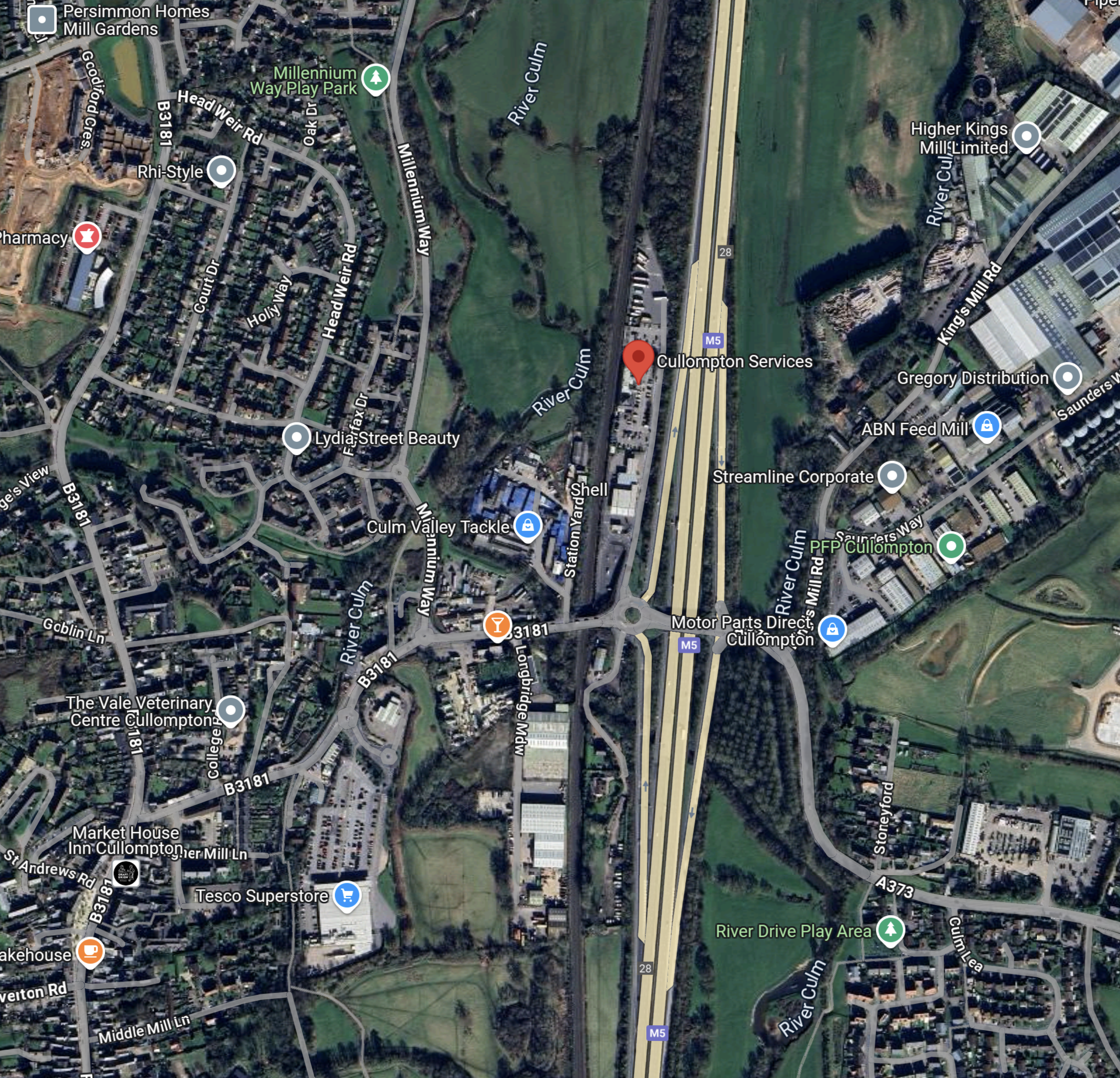
This Google Map shows, the railway and the M5 passing Collumpton.
Note.
- The M5 runs North-South across the map, with Junction 28 about half-way.
- North-west of the junction are Collumpton Motorway Services.
- The Bristol-Exeter Line runs North-South to the West of the services.
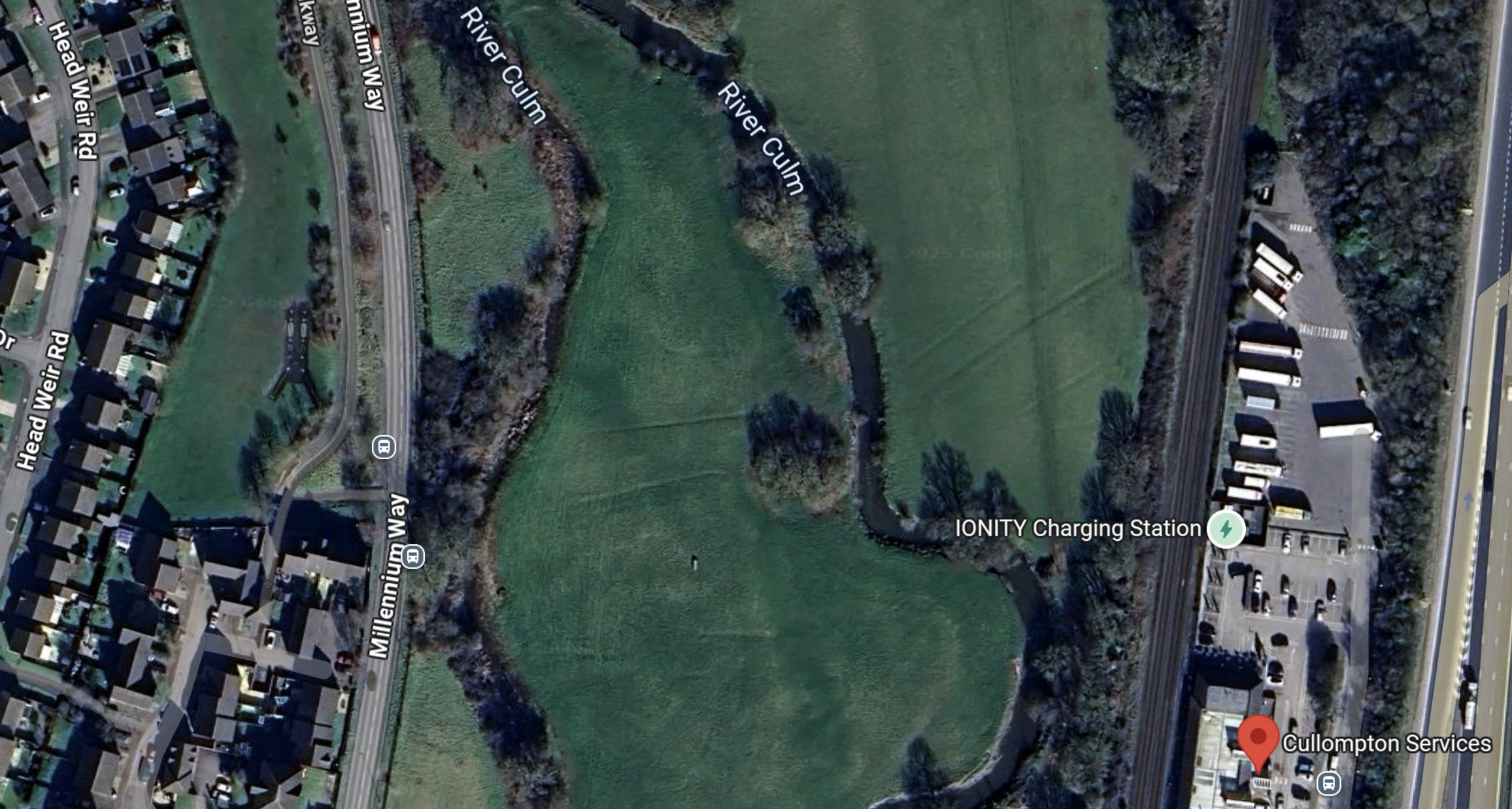
This second Google Map shows the Northern end of the services.
Note.
- Parking at the services appears rather limited.
- Trucks seem to be parked at the Northern end of the services.
- I feel there would be space to put a platform on either side of the rail lines.
- I doubt a bridge with lifts would be a problem.
- The station could share the facilities of the services.
- Could some of the fields to the West of the railway be used to create parking?
- The station could be built to accept nine-car Class 802 trains.
Collumpton station could be built to have a high capacity and direct access to the town and the M5.
I have some thoughts.
Could Collumpton Station Function As A Parkway Station?
I believe it certainly could for Exeter, Bristol and even London.
In Darlington Station – 26th June 2025, I showed how Network Rail are creating a 650-place car park at the station, which could be a major draw for travellers.
Could a large car park be provided here to attract travellers?
South West Rail Resilience Programme
This is the first paragraph of this article on Modern Railways.
The Government has paused the third phase of Midland main line electrification to Sheffield and Nottingham, plus the final phase of the South West Rail Resilience Programme (SWRRP), which involves strengthening cliffs at Holcombe.
If the final phase of the South West Rail Resilience Programme is paused, what happens if God decides to block the line through Teignmouth.
I have thought for some time, that one of the purposes of Okehampton Interchange station is to provide an alternative route to the South-West.
If the sea should destroy the coastal railway, as it did a few years ago, then passengers for the South-West could be ferried to and from Okehampton Interchange station by high-speed hydrogen-powered coaches along the A30, to catch trains to Exeter and London.
So, I would build a hydrogen filling station at Collumpton services, so that if the sea destroys the coastal railway again, the alternative of hydrogen coaches is ready.
If Okehampton Interchange station can also be used as an alternative, two alternatives might just ensure that the alternative routes never need to be used.
A Thought On The Texas Floods
I asked Google AI, if Texas is bad for natural disasters.
This was the reply.
Yes, Texas is known to be susceptible to a high number of natural disasters, particularly when compared to other states in the US. Texas experiences a wide variety of natural hazards, including hurricanes, floods, wildfires, tornadoes, hail storms, sinkholes, and droughts. The state has also experienced earthquakes, potentially linked to the extraction of natural resources like oil and gas.
I certainly wouldn’t want to live there, as my one experience of a bad storm in the UK nearly killed me. I wrote about my experiences in The Great Storm.
Do Animals Lose Water In Low Pressure Weather?
I feel I do and I wrote a post called My Strange Skin, which is explained by water being driven out of my body.
So I asked Dr. Google, the question in the title of this post and got this answer.
Yes, animals can lose more water in low-pressure weather conditions. Lower atmospheric pressure, often associated with unstable weather, can increase water loss through evaporation and other physiological processes.
Here’s why:
Low pressure often means lower relative humidity, which increases the vapor pressure deficit between the animal’s body and the environment. This difference in water vapor concentration drives more water to evaporate from the animal’s body, particularly through the skin.
That’s all very sound physics.
Last night, I was woken by an intense strange itch in the sole of my right foot.
- As I often do, I rubbed the itch on the a genuine Indian rug I have on the floor by my bed, but it didn’t work.
- So I had to get up and apply a dollop of Udrate cream and rub it in.
About, half-an-hour later I got back to sleep.
Today, I got a similar intense itch in the sole of my left foot. Again it was stopped by a dollop of cream rubbed in. But this time it was Body Shop’s Hemp Foot Protector.
Does water find it easier to get out through the soles of my feet?
Exceptionally Low River Levels Raise Fears Over Water Supplies
The title of this post is the same as that of this article on the BBC.
This is the sub-heading.
Many of the UK’s rivers have hit exceptionally low levels and that could worsen in the next three months, according to the Centre for Ecology & Hydrology (CEH), raising questions over supplies to households, farmers and businesses.
These three introductory paragraphs add more details.
The warning comes after the driest spring in England since 1961, with northern regions experiencing the driest start to the year in nearly a century.
Almost all of the UK is expected to have below normal or low river levels in May, apart from the south-west of England.
The Environment Agency has said that the UK is at medium risk of drought and warned households of the risk of water restrictions.
In the 1970s, I was involved in a marginal way, in the planning of the water supply network in the UK, by the then Water Resources Board. My software called SPEED was used to solve the hundreds of differential equations involved.
Since the 1970s, I have felt, that as water supply in the UK has been fairly good, that the engineers, planners and mathematicians of the Water Resources Board didn’t do a bad job.
I don’t think, I can remember a period as long as this without rain.
I am drinking heavily to keep hydrated and I’m already today on my second bottle of Adnams Ghost Ship 0.5 % Beer.
But it just seems to go straight out through my skin, which I talked about in My Strange Skin.
I am Jewish in my father’s male line and Huguenot in my mother’s, so I have lots of ancestors, who lived in poor living conditions. So did Darwinian selection produce my leaky skin, that also heals itself quickly, in the harsh living conditions.
But on the other hand does it make me dehydrated all the time? And also create lots of red spots all over my body?
It’s not something new, as I can remember feeling this this as a child and helping my mother to count all the spots.
I hope that I will be fine, when we get some rain.
 The Anonymous Widower