Hexicon Sells UK TwinHub Floating Wind Project After CfD Termination
The title of this post, is the same as that of this article on Renewables Now.
This is the sub-heading.
Floating wind developer Hexicon AB (STO:HEXI) announced it has divested its 32-MW TwinHub offshore wind project in the UK’s Celtic Sea waters, which recently had its contract for difference (CfD) terminated.
These first three paragraphs add some details.
The Swedish firm said it had entered into and completed a sales and purchase agreement (SPA) related to the TwinHub project company, Wave Hub Ltd. The buyer is an unnamed “leading global provider of advanced maritime and offshore engineering solutions.” Financial details were not provided.
Hexicon bought Wave Hub Ltd in 2021, when the site was permitted for wave energy, and later repurposed it for a floating offshore wind project. The scheme secured a 15-year CfD in the fourth allocation round in 2022, which was a first for a development of this type.
Earlier this month, the UK government confirmed that the CfD for TwinHub had been terminated.
It appears that the new owners will be continuing the project.
Getting To Know More About TwinHub
I like the design of the TwinHub and this link will give you all my posts on the technology.
This link will give you all my
‘Our Wind Farm Won’t Discourage Bronte Tourists’
The title of this post, is the same as that of this article on the BBC.
This is the sub-title.
The developers of England’s largest wind farm have claimed that the turbines will not discourage visitors to moors once loved by the Bronte sisters.
These three paragraphs add more detail.
Calderdale Energy Park is applying to construct 34 turbines on Walshaw Moor, between Hebden Bridge and Haworth – the village associated with Bronte tourism.
As a nine-week public consultation begins, chief executive Christian Egal told objectors that the development would provide “cheap, reliable and stable” energy.
Campaigners who oppose the plans for the West Yorkshire moorland said that the wind farm would turn the scenic area into an “industrial complex”.
It is worth reading the whole BBC article as it gives a lot of detail and if you are worried about this sort of development, you should visit.
I have some thoughts.
Saint Brieuc Wind Farm
This wind farm has a web site.
Christian Egal says this about this wind farm of the coast of Brittany in France.
“There are thousands of visitors every day taking a boat to visit the wind farm, it has been demonstrated that at similar sites the balance is not negative, there are lots of circumstances where wind farms attract a lot of interest.”
The developers should make the wind farm visitor-friendly.
Peat
I know that peat on these and other moors is a sensitive subject and this is said about it.
Access roads will be built over the moor but Egal said: “We avoid deep peat, each turbine is located where the peat is shallow and any peat that is removed will be reinstated locally so the net balance will be zero loss of peat.
That looks to be the right attitude!
Will There Be A Battery?
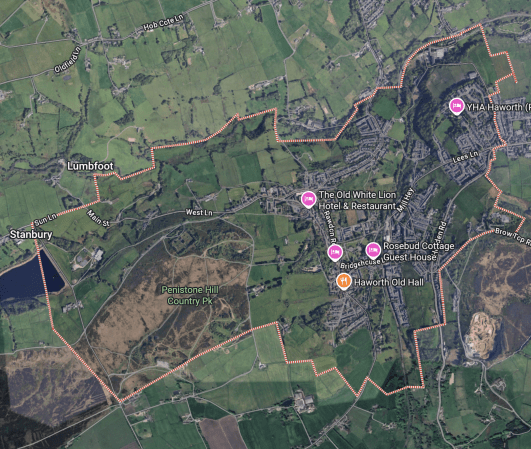
This Google Map shows Haworth.
Note.
- Haworth is outlined in red.
- There appears to be something like a quarry on the Eastern edge of the map.
I wouldn’t be surprised if a suitable space for on of the new technology batteries can be found.
Rheenergise is one company that comes to mind.
Ocasio-Cortez, Markey Ask Trump Admin To Explain Paying TotalEnergies USD 1 Billion ‘In Taxpayer Money’ To Drop Offshore Wind Projects
The title of this post, is the same as that of this article on offshoreWIND.biz.
This is the sub-heading.
US lawmakers Alexandria Ocasio-Cortez and Ed Markey have sent a letter to Secretary of the Interior Doug Burgum on the plan by the Trump administration to pay nearly USD 1 billion to TotalEnergies to cancel offshore wind projects off the US East Coast, calling on the administration to stop the payment and explain the legal basis and funding source for the proposed transfer.
These four paragraphs add detail to the story.
As reported recently, the US government’s agreement with TotalEnergies concerns the company’s exit from offshore wind development in the country by relinquishing leases for projects off New York/New Jersey and North Carolina, for which the administration intends to pay approximately USD 928 million.
The agreement also stipulates that TotalEnergies would redirect that money to oil & gas projects in the US. The company, in a press release issued after signing the agreement with the government, indicated that it would invest proceeds from the payment into a liquefied natural gas export facility in Texas and other oil and gas activities in the US that will support both domestic supply and the demand in Europe.
As reported recently, the US government’s agreement with TotalEnergies concerns the company’s exit from offshore wind development in the country by relinquishing leases for projects off New York/New Jersey and North Carolina, for which the administration intends to pay approximately USD 928 million.
The agreement also stipulates that TotalEnergies would redirect that money to oil & gas projects in the US. The company, in a press release issued after signing the agreement with the government, indicated that it would invest proceeds from the payment into a liquefied natural gas export facility in Texas and other oil and gas activities in the US that will support both domestic supply and the demand in Europe.
Trump may have got what he wanted and stopped development of wind farms, but at what cost to US taxpayers?
Out of curiosity, I asked Google AI, “Which LNG Terminal In Texas Have TotalEnergies Agreed To Develop”, And Received This Answer.
TotalEnergies has agreed to develop and invest in the Rio Grande LNG (RGLNG) project located in South Texas.
Key details regarding TotalEnergies’ involvement include:
Partnership: In June 2023, TotalEnergies signed a framework agreement with NextDecade Corporation to participate in the development of the Rio Grande LNG project.
Ownership and Phase 1: TotalEnergies holds a 16.67% stake in the first phase of the project, which includes three liquefaction trains with an annual capacity of 17.5 million tons per annum (Mtpa).
Offtake Agreement: TotalEnergies has agreed to purchase 5.4 million tons per annum (Mtpa) of LNG from Phase 1 for 20 years.
Expansion (Train 4): As of September 2025, TotalEnergies has reached a Final Investment Decision (FID) for a 10% stake in the joint venture developing Train 4 of the Rio Grande LNG facility.
NextDecade Stake: TotalEnergies also acquired a 17.5% stake in NextDecade Corporation, the developer of the project.
The Rio Grande LNG project is located in Brownsville, Texas, and is expected to contribute to TotalEnergies’ goal of expanding its U.S. LNG export capacity to 15 million tons annually by 2030.
I shall be watching this project. Especially, as several new techniques have come forward in the last few months.
TenneT, National Grid Ink Joint Development Agreement For LionLink Offshore Wind Interconnector
The title of this post, is the same as that of this article on offshoreWIND.biz.
This is the sub-heading.
Transmission system operators (TSOs) TenneT and National Grid Ventures (NGV) have signed a Joint Development Agreement (JDA) to advance LionLink, a hybrid interconnector linking the UK and the Netherlands via a future offshore wind farm in the Dutch North Sea.
These three paragraphs add more details.
The agreement sets out how the two partners will jointly develop LionLink towards a final investment decision (FID), including arrangements on procurement, governance, and planning, while also aiming to increase transparency on project costs ahead of construction.
LionLink is designed to integrate cross-border electricity interconnection with offshore wind by establishing a direct connection between the two countries through a grid link to the planned Nederwiek 3 offshore wind farm. According to the developers, this approach will maximise the use of offshore wind, provide additional system flexibility, and reduce the overall amount of required offshore infrastructure.
The LionLink project was launched in April 2023, when the Netherlands and the UK unveiled their plan to build the interconnector, a first-of-its-kind electricity link to connect offshore wind between the two countries via interconnections.
The same article also said these two paragraphs about the operation of the BritNed interconnector.
While the companies move forward with LionLink, their existing BritNed interconnector is marking 15 years of operation. Since entering service in 2011, the 1 GW subsea link has enabled nearly 93 TWh of electricity trading between Great Britain and the Netherlands.
Over the past five years, BritNed has exchanged enough electricity annually to power around 1.4 million households. The 260-kilometre interconnector remains a key part of both countries’ energy systems and has generated around EUR 1 billion in auction revenues on the Dutch side during its operational lifetime, TenneT said in a press release on 1 April.
It looks like BritNed has been a good investment for all stakeholders.
Note.
- LionLink will be a 2 GW interconnector.
- LionLink will land at Walberswick in Suffolk.
- LionLink has a web site.
- BritNed is a 1 GW interconnector.
- BritNed lands at the Isle of Grain in Kent.
- BritNed has a web site.
- NemoLink is an interconnector between Kent and Belgium.
- NeuConnect will be a 1.4 GW interconnector between the Isle of Grain and Wilhelmshaven, which will be operational by 2028.
- There are two actual and two proposed interconnectors between the UK and France.
The List of high-voltage transmission links in the United Kingdom in Wikipedia is growing.
The Wikipedia entry says this about the Rise of UK Interconnection.
The Department for Energy Security and Net Zero’s Digest of UK Energy Statistics reports that the UK was a net importer of electricity in 2024, with net imports of 33.4 TWh, up 40% from 2023.
Interconnectors allow the trade of electricity between countries with excess generation (for example, intermittent renewable) and those with high demand. Interconnectors play a key part in balancing variable renewable generation, for example the 1.4 GW North Sea Link allows the UK to export excess power to Norway during windy periods to conserve Norwegian hydro stocks, and import Norwegian hydro power on less windy days.
During the 2022 energy crisis, the UK exported record amounts of power to mainland Europe, helping to alleviate the effects of the Russian invasion of Ukraine on European security of supply.
As of 12 November 2024, Great Britain had nine operational international electricity interconnectors.
The UK is becoming an offshore energy substation on Europe’s North-West coast.
EU, France Grant EUR 126 Million For BW Ideol’s Floating Foundation Factory
The title of this post, is the same as that of this article on offshoreWIND.biz.
This is the sub-heading.
BW Ideol has signed the final grant agreement for up to EUR 74 million from the EU Innovation Fund for a factory in Fos-sur-Mer, France, that will produce concrete floating wind foundations. The factory, dubbed Fos3F, has also secured up to EUR 52 million from the French State.
These three paragraphs add more detail.
The final agreement for the EU Innovation Fund grant was signed on 19 March, after BW Ideol revealed in November 2025 that the Fos3F was selected for up to EUR 74 million in funding by the European Commission.
The French government awarded support for the project at the end of 2025 through the C3IV tax credit scheme, dedicated to supporting leading French companies in the Green Industry. The funding from the French State will cover up to EUR 52 million to partially fund development and capital expenditures.
According to BW Ideol, if built, the Fos3F will be a first-of-its-kind factory dedicated to the serial production of concrete floating wind foundations based on the company’s patented Damping Pool.
The factory is stated to have a capacity of thirty foundations per year.
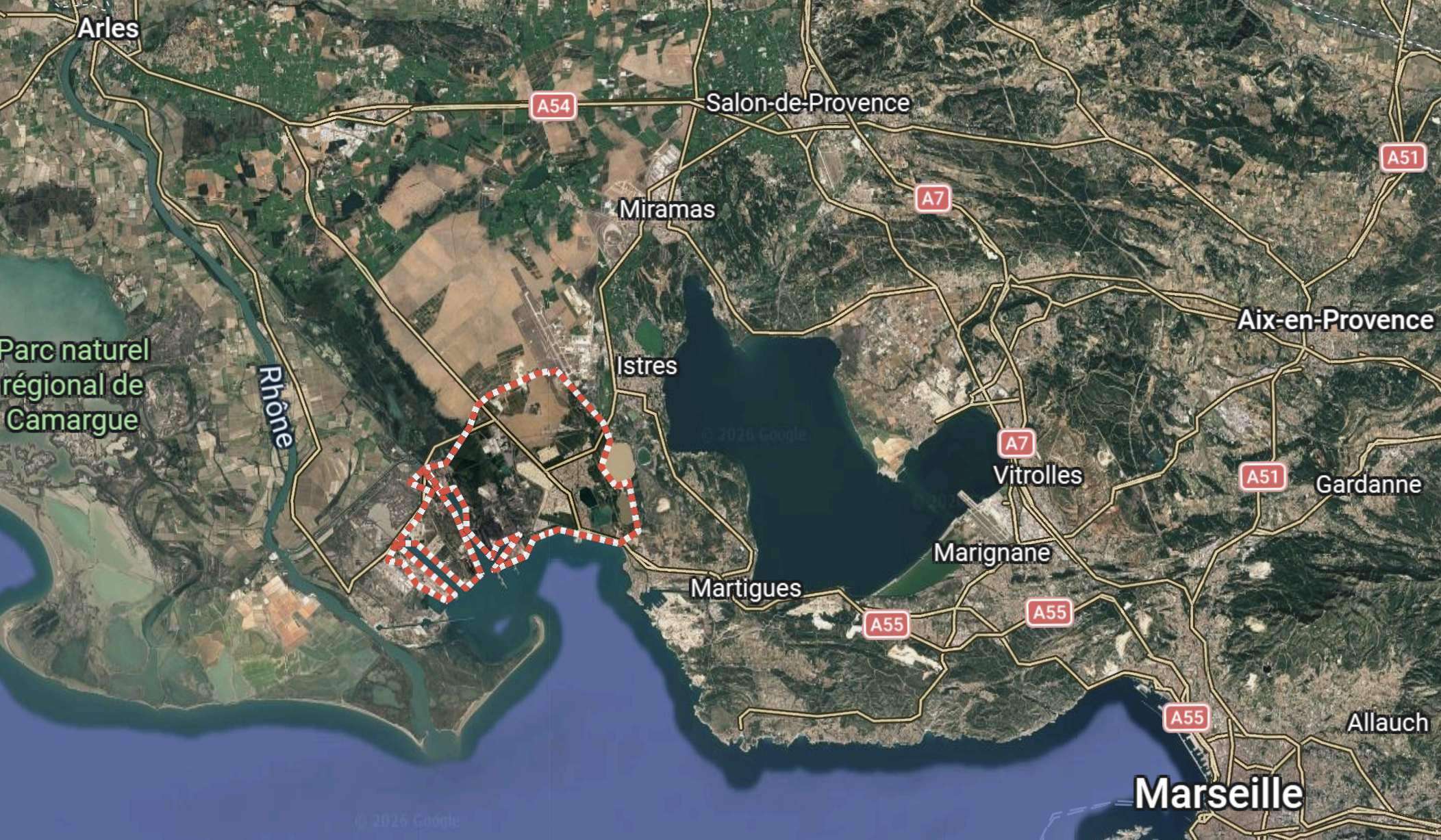
This Google Map shows the location of Fos-sur-Mer.
Note.
- Arles is in the North-West corner.
- Marseille is in the South-East corner.
- The mouth of the Rhône River is in between.
- Fos-sur-Mer is outlined by the red-and-white border.
Google AI says there is significant steel making at the mouth of the Rhône River.
I also asked Google AI, “What turbines will BW Ideol floating foundations support? and received this reply.
BW Ideol’s floating foundations are designed to be universal, supporting all major 15 MW+ offshore wind turbines currently on the market, with scalability to future 20 MW+ platforms. Their concrete barge-type technology—using the Damping Pool® design—is compatible with both existing and next-generation turbine manufacturers.
Key Compatibility Details:
15 MW+ and 20 MW+ Turbines: The foundations are engineered for current large-scale turbines (15 MW+) and are ready to accommodate upcoming 20 MW+ turbines, with designs already certified by DNV.
Proven Technology: The technology has been in operation since 2018 at the Floatgen site in France (using a Vestas V80 2 MW turbine) and in Japan, covering both shallow and deep-water applications.
Universal Application: The design is tailored for diverse metocean conditions and is designed to support the commercial deployment of large turbines in projects like the Buchan Offshore Wind project in Scotland.
Production Scalability: The concrete floating platforms are designed for mass production, capable of being manufactured quickly in a factory setting, such as the proposed Fos-sur-Mer site, to meet the schedules of major developers.
These foundations have received Design Certification from DNV, confirming their suitability for large-scale, commercial floating wind farms.
My Thoughts:
Concrete v. Steel: I used to work with someone, who was a big advocate of concrete yachts. Also check out the Wikipedia entry for the Troll A platform, which is a concrete Norwegian gas platform.
Zero-Carbon: I wouldn’t be surprised if concrete manufacture emits less carbon, than steel.
Port Talbot: Will BW Ideol build a similar factory at Port Talbot? I wrote about the Port Talbot factory in Port Talbot To Become Offshore Wind Hub For Celtic Sea. Both sites are next to a large bay, which would be ideal for parking completed floats and a world-class steelworks.
Buchan: Buchan’s web site says it will use seventy BW Ideol floats and generate I GW, 75 km. to the North-East of Fraserburgh. Google AI said the floats will be built at the Port of Ardersier.
Will A Mini-Steel Mill Be Built At The Port Of Ardersier?
I asked Google AI, the question in the title of this section and received this reply.
Yes, a £300 million green steel mill is planned for the Ardersier Port redevelopment as part of its transformation into a circular Energy Transition Facility. This facility aims to process scrap steel from decommissioned oil rigs into new materials to support offshore wind developments, alongside creating a concrete production plant.
Key details regarding the development:
Purpose: The mill is intended to process scrap from offshore decommissioning.
Technology: It is planned as a green steel plant.
Integration: It is aimed to be integrated into a new, fully circular “Energy Transition Facility”.
Context: While the facility aims for circular steel production, the port is primarily focused on becoming a hub for offshore wind and manufacturing.
Recent developments as of March 2026 suggest a focus on a “scaled back,” more achievable vision by new owners/managers, focusing on floating concrete wind turbine bases. Additionally, recent UK government intervention restricted a large Chinese-backed manufacturing plan at the site due to security concerns.
UK To Launch Next CfD Allocation Round In July
The title of this post, is the same as that of this article on offshoreWIND.biz.
This is the sub-heading.
The UK government has announced that the next Contracts for Difference (CfD) allocation round will open in July 2026.
Contracts for Difference Allocation Round 7 did well and according to Google AI raised these contracts.
Contracts for Difference (CfD) Allocation Round 7 (AR7) results, announced in January 2026, secured a record 8.4 GW of offshore wind capacity, enough to power 12 million homes. The auction awarded contracts to 6.865 GW of fixed-bottom offshore wind and 192.5 MW of floating wind, with strike prices around £91/MWh (2024 prices).
Key Results of AR7:
Capacity Secured: Over 8.4 GW (8,437.5 MW) of offshore wind, with 6,090 MW in England, 1,380 MW in Scotland, and 775 MW in Wales.
Key Winners: RWE secured nearly 6.9 GW across four projects, including Dogger Bank South and Norfolk Vanguard; SSE Renewables secured 1,380 MW for Berwick Bank Phase B; and floating wind projects included Pentland and Erebus.
Strike Prices: Fixed-bottom offshore wind cleared at £91.20/MWh (£89.49/MWh in Scotland), while floating offshore wind cleared at £216.49/MWh.
Investment & Jobs: The projects represent over £22 billion in private investment and support approximately 7,000 jobs.
Timeline: The projects are expected to start delivering power from 2028 onwards.
Out of curiosity, I asked Google AI, “How Many GWs Are Expected To Be Signed Up In The UK’s CfD Round 8” and received this answer.
Allocation Round 8 (AR8) of the UK’s Contracts for Difference (CfD) scheme is expected to launch in July 2026. While specific, finalized GW targets for the winning bids have not yet been announced, the government is adapting the auction to support increasingly large projects, including potential floating offshore wind farms of 1GW+.
Following the record-breaking AR7, which secured 8.4 GW of offshore wind capacity in January 2026, AR8 is expected to focus on continuing this momentum to meet the UK’s “Clean Power 2030” objectives.
Key context regarding expected AR8 capacity includes:
Growing Project Scale: The AR8 consultation indicates that upcoming floating offshore wind projects are likely to be much larger (potentially 1GW+) than previously expected, prompting changes to the scheme to support this scale.
Targeted Procurement: Industry sources previously indicated that the combination of AR7 and AR8 was expected to secure significant capacity to meet 2030 goals, with over 20 GW of offshore wind previously identified as eligible for upcoming rounds.
Supply Chain Focus: The government has issued, or is planning, Supply Chain Plan requirements for solar projects of 300 megawatts or more and for onshore wind, indicating high volumes are anticipated in these sectors.
The application window for AR8’s Clean Industry Bonus is currently planned for May 2026, with the main auction following in July 2026.
Conclusion
It doesn’t really indicate a figure for AR8, but does indicate that AR7 and AR8 together have a joint target of over 20 GW.
- I can do a small calculation.
- AR7 secured 8.4 GW of offshore wind capacity in January 2026.
- As AR7+AR8 are expected to secure 20 GW before 2030, that means AR8 will secure 11.6 GW.
So this means that AR8 could be 38 % bigger than AR7.
Vestas Unveils Plans For V236-15.0 MW Nacelle Factory In Scotland
The title of this post, is the same as that of this article on offshoreWIND.biz.
This is the sub-heading.
Vestas plans to build a nacelle and hub assembly facility in Scotland to support offshore wind projects in the UK and across Europe.
These four paragraphs give what looks to be a full outline of a more or less comprehensive plan.
The proposed factory would require a capital investment of more than EUR 250 million and is planned to manufacture nacelles and hubs for the company’s V236-15.0 MW offshore wind turbine. The new facility is expected to create up to 500 direct jobs, with additional employment across the supply chain.
According to Vestas, the plan to set up the factory follows the results of the Contracts for Difference Allocation Round 7 (AR7) in January 2026, the company’s growing offshore wind order book in the UK, and strategic discussions with the UK and Scottish governments on the next steps to develop and co-invest in the facility.
The plan also includes the potential co-location of suppliers producing other major turbine components, as part of a broader manufacturing setup.
The final investment decision (FID) on the new factory will depend on Vestas securing sufficient UK-based orders for the AR7 projects and those from the upcoming AR8. Subject to the timing of those results and the planning process, the facility could begin production by 2029 or 2030, Vestas said on 25 March.
- V236-15.0 turbines are 15 MW turbines, for which Vestas have 256 orders in the UK for Inchcape, Norfolk Vanguard East and Norfolk Vanguard West.
- In addition to new wind farms, will these large turbines be used for refitting to older wind farms?
- If other manufacturers or components could be involved, this would surely be sensible.
The picture in the original article shows the large size of these nacelles, which would suggest a site with good access to water might be good to ease transport.
Did The Help For Steel, Six Days Ago Help?
On the 19th March, I wrote UK Steel Industry Backed By Major New Trade Measure And Strategy. Did this help for steel to formulate Vestas’s plans? I wouldn’t be surprised, if the steel can be taken to the site Vesta chooses by rail or water.
Port Talbot To Become Offshore Wind Hub For Celtic Sea
The title of this post, is the same as that of this article on the BBC.
This is the sub-heading.
Port Talbot will become the first dedicated hub for floating offshore wind in the Celtic Sea.
These four introductory paragraphs add some detail.
Associated British Ports (ABP) will begin detailed design and engineering work on new port infrastructure after securing grant funding of up to £64m from the UK government.
The project will support the assembly and deployment of floating turbines that will operate in deeper waters off the Welsh coast. ABP said the development could support thousands of jobs and attract hundreds of millions of pounds in further investment.
The UK government said the new port would help deliver clean, homegrown electricity, protect households from volatile fossil fuel markets and create up to 5,000 new jobs.
Redeveloping the port to handle the assembly of wind turbines could position Port Talbot at the centre of a fast-growing clean energy sector.
I have some thoughts.
How Much Wind Power Is Planned For The Western Approaches?
In Ocean Winds Enters Lease Agreement With Crown Estate For 1.5 GW Celtic Sea Floating Wind Project, I published this Google AI estimate of the wind power, that could be developed in the Western Approaches.
How Much Wind Power Is Planned For The Western Approaches?
I asked Google AI, the title of this section and received this answer.
The UK has a target of 50 GW of offshore wind by 2030, with significant projects planned for the Celtic Sea (part of the Western Approaches), which is a key area for 5 GW of floating wind. Total UK offshore wind pipeline capacity exceeds 93 GW, with major developments in this region focusing on floating technology.
Key details regarding wind power in the Western Approaches (specifically the Celtic Sea) include:
Celtic Sea Developments: The area is a primary focus for floating wind projects, designed to capitalize on deep-water potential, with 5 GW of floating wind expected to be deployed across the UK by 2030.
Pipeline and Capacity: The total UK pipeline for offshore wind, which includes the Western Approaches, is 93 GW, and the government is aiming for 43-50 GW of installed offshore capacity by 2030.
Project Status: The region is expected to benefit from the Crown Estate’s leasing rounds aimed at accelerating floating wind, with 15.4 GW of new projects submitted across the UK in 2024.
Wales/South West England Context: Wales has 1.4 GW of projects in the pre-application stage, with some potential for developments off the South West coast.
For more detailed information on specific projects and their development status, you can visit the RenewableUK website and RenewableUK website.
It looks like about 20 GW of offshore wind could be installed in the Western Approaches.
I would expect, a lot of work will be generated in the Port Talbot area.
A Lot Of Steel Will Be Needed
Earlier in the weeek, the UK Government backed the steel industry in Port Talbot, with a press release entitled UK Steel Industry Backed By Major New Trade Measure And Strategy.
Port Talbot Is A Comprehensive, Well-Connected Site
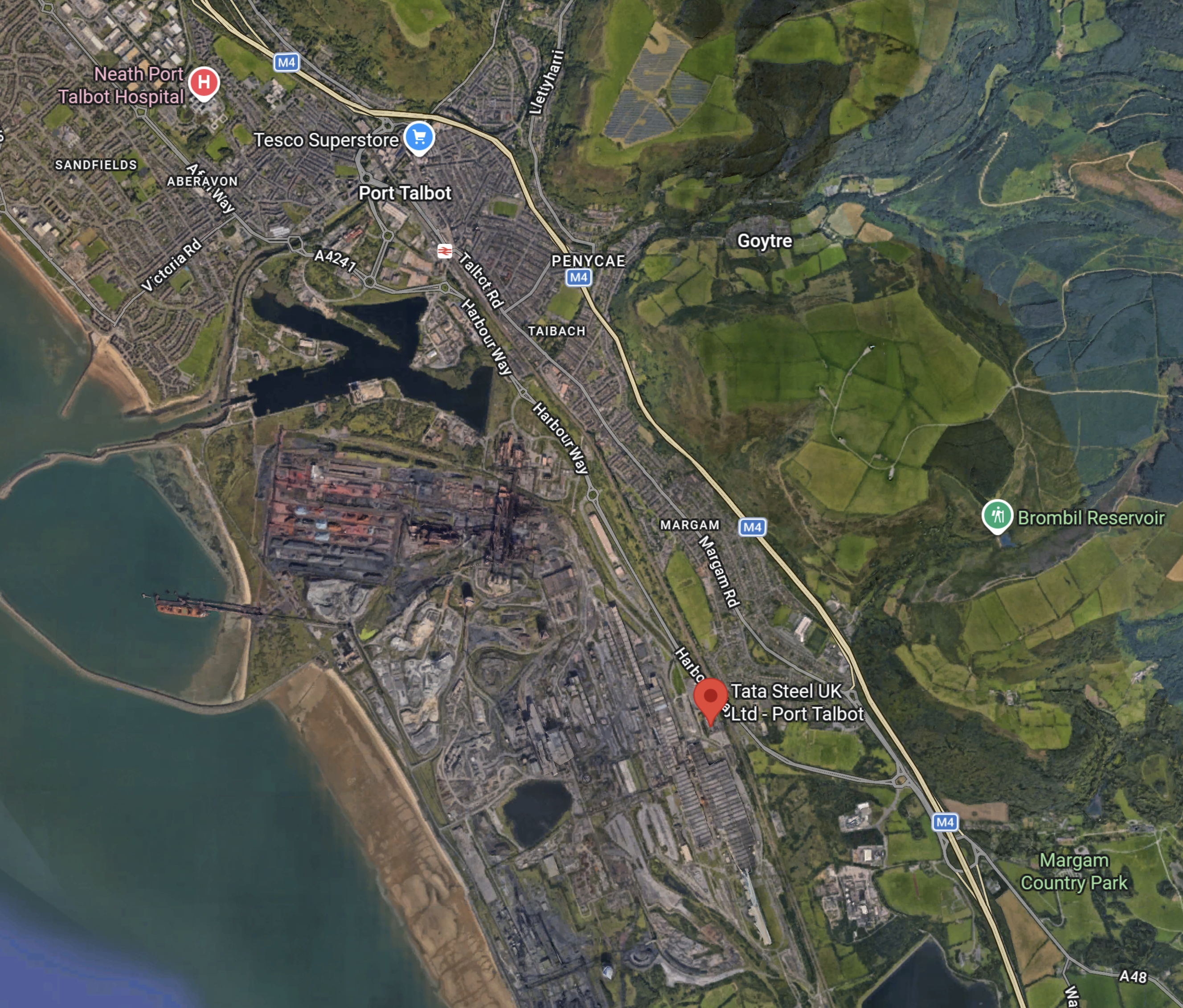
This Google Map shows the site.
Note.
- The M4 running along the site.
- The South Wales Main Line running along the site, with Port Talbot Parkway serving the site.
- The harbour by the station.
- The Tata steelworks marked by the red arrow.
I hope the up to £64 million grant from the government is sufficient for Associated British Ports (ABP) to turn the harbour into a world-class floating wind facility and that the Treasury haven’t been too mean.
BW Ideol, ABP To Explore Serial Production Of Floating Wind Foundations At Port Talbot
I wrote a post with this name in December 2023, before the leases for the Celtic Sea windfarms had been awarded. As one has been awarded to EDf Renewables, BW Ideol seem to have made a good move.
BW Ideol have a web page, which describes their concrete floating wind foundations manufacturing line.
I hope South Wales has got enough concrete?
UK Continues Offshore Wind Expansion With 6 GW Leasing Round Planned For Early 2027
The title of this post, is the same as that of this article on offshoreWIND.biz.
This is the sub-heading.
The Crown Estate has unveiled plans for the UK’s Offshore Wind Leasing Round 6 to be held in the first half of 2027, targeting the development of at least 6 GW of new capacity.
These three paragraphs add some details.
The upcoming leasing process will focus on areas primarily located in the northeast of England. The sites are expected to be suitable for fixed-bottom offshore wind projects and will be brought forward following market and stakeholder engagement, including the National Energy System Operator’s (NESO) strategic plans for energy and for electricity networks, which will inform the exact capacity of the upcoming leasing round and refine specific site details and locations.
The Crown Estate said on 26 March that it had begun a programme of market engagement ahead of the official launch of a new leasing round, and is seeking market views on commercial approaches to the leasing round “to understand the potential viability and market appetite.”
The UK seabed manager said that it had also identified other areas of seabed opportunity across the South West, Wales and other regions which may form the basis of subsequent leasing rounds through the Crown Estate’s new seabed management tool, the Marine Delivery Routemap, which is being used for the first time in Round 6.
In Renewable Power By 2030 In The UK, I calculated how much offshore wind could be commissioned up to 2030.
These were my results.
This gives these yearly totals, if I use pessimistic dates.
- 2025 – 1,235 MW
- 2026 – 4,807 MW
- 2027 – 5,350 MW
- 2028 – 4,998 MW
- 2029 – 9,631 MW
- 2030 – 15,263 MW
This adds up to a total of 58,897 MW.
But This Doesn’t Include Round 5 Or Round 6!
But the article on offshoreWIND.biz does, say this about Round 5.
The Crown Estate’s previous leasing round, Round 5, focused on floating offshore wind in the Celtic Sea, covering areas off South Wales and South West England and targeting up to 4.5 GW of capacity. The round awarded seabed rights to Equinor, Gwynt Glas, and Ocean Winds, with individual project development areas of up to 1.5 GW. Agreements for lease were recently signed for all three Round 5 sites.
The article also indicates that 6 GW can be expected from Round 6.
Which gives a total of 69,397 MW or 69.4 GW.
No wonder the UK Government can back the steel industry, with press releases like this UK Steel Industry Backed By Major New Trade Measure And Strategy.
Lots of renewable energy, is the new rich!
Cardiff And Caerphilly – 24th March 2026
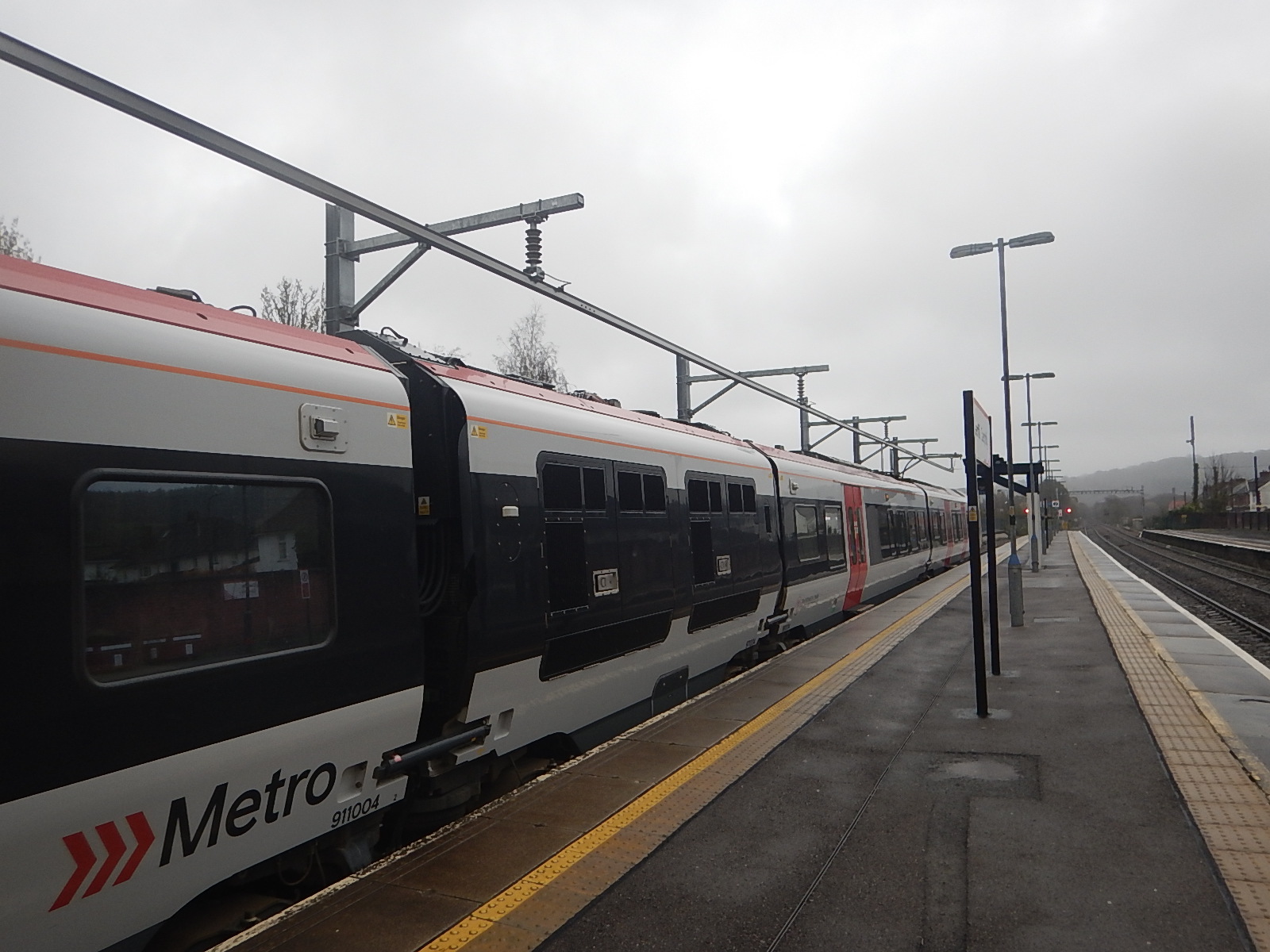
I took this pictures, as I rode up the Rhymney Valley from Cardiff to Caerphilly.
























Note.
- The trains I took up and down the valley were both Class 756 tri-mode trains.
- My train reversed to Penarth in Platform 1.
- I think they were running using the diesel power in the power pack.
- There is an overhead conductor rail in Platform 1 at Caerphilly station to charge trains.
- The electrification North of Caerphilly station can be seen through the bridge in one of the pictures.
- Platforms 2 and 3 are not electrified.
I think Caerphilly station is a very neat electrification layout for occasional charging of battery-electric or tri-mode trains.
I have some specific thoughts.
What Have Caerphilly And St. Pancras Thameslink Stations Got In Common?
These pictures show the rigid conductor rail through St. Pancras Thameslink station.




It looks remarkably similar to that in Platform 1 at Caerphilly station.
Judge in this picture.
The rails are probably out of the same Swiss electrification maker’s parts bin.
Both look equally professional with an I-section conductor, which could be aluminium, as it is lightweight and a good electrical conductor.
Google AI finds this.
The I-beam overhead conductor system used in St. Pancras Thameslink station is made of a hollow extruded aluminium profile. This system, known as a conductor beam, holds a conventional copper contact wire, providing a rigid, low-profile alternative to traditional overhead wires.
Key details:
Material: Extruded aluminium profile.
Structure: Hollow, designed to hold an un-tensioned, conventional copper contact wire.
Application: Developed by Balfour Beatty to reduce the required depth of overhead line equipment.
Installation: Often installed in a sinusoidal wave to ensure consistent wear on the pantograph.
This technology is used in areas with restricted overhead space, such as tunnels and some modern station approaches, to manage 25kV AC electrification.
It looks like it’s been used to provide a charging rail in Caerphilly station.
Is The Conductor Rail In Platform 1 Used To Create A Continuous Electrical Connection Around Caerphilly Station?
Look at this OpenRailwayMap, which shows the completed electrification through Caerphilly station.
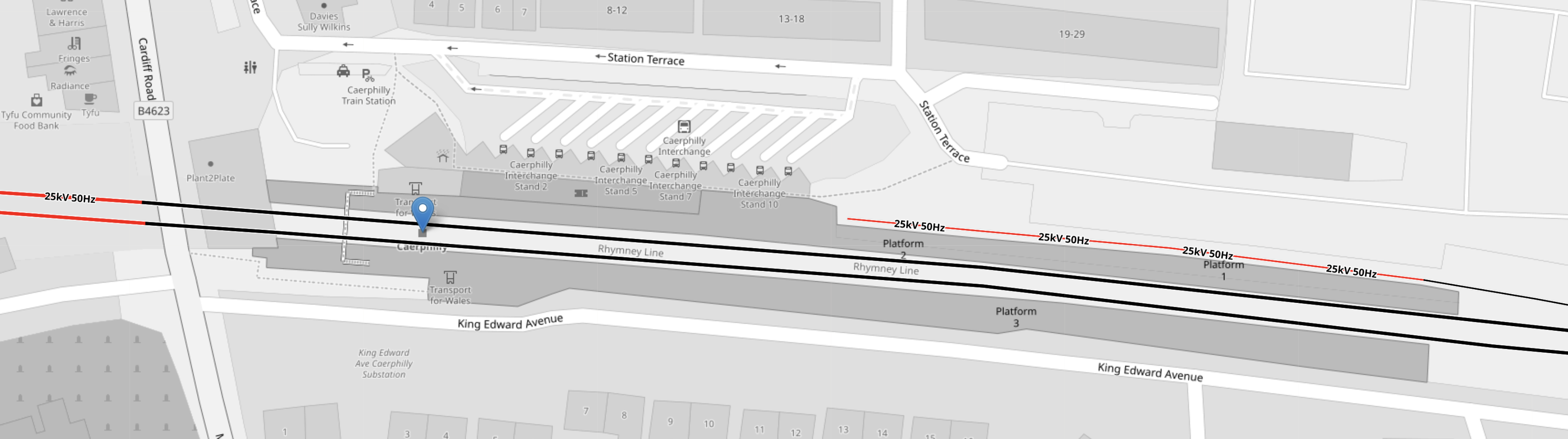
Note.
- Red tracks are electrified.
- Black tracks are not electrified.
- Caerphilly station is indicated by the blue arrow.
- The electrification continues to the Western end of the station.
- The two main platforms 2 & 3 are not electrified.
- The bay platform 1 is electrified to charge trains for return to Cardiff.
- Class 756 tri-mode electric-diesel-battery trains are already in service.
- There appears to be a comprehensive bus interchange.
The power for Platform 1 could come from the electrification at the Western end of the station.
I wouldn’t be surprised that the Rhymney Line will be fed with electricity at the heads of the valleys and it is fully-connected down to Cardiff to give a secure electrical connection.
Will Welsh Wind Power From The Heads Of The Valleys Be Used To Power The Cardiff Valley Lines?
To start with, as I know it can be blowy there, I asked Google AI, this question.
“Is Onshore Wind Planned At The Heads Of The Valleys In South Wales?”
I received this answer.
Yes, there is significant onshore wind energy development planned and in progress along the Heads of the Valleys area in South Wales. This region, encompassing areas like Merthyr Tydfil, Blaenau Gwent, and northern Rhondda Cynon Taf, is part of a broader push to increase onshore wind capacity in Wales, with many projects located on Natural Resources Wales forestry land.
Key Developments and Proposed Projects (2025-2026):
Trydan Gwyrdd Cymru: The Welsh government-owned developer has selected sites in South Wales for new, large-scale wind farms intended to be operational by 2040.
Carreg Wen Wind Farm: A planned 18-turbine project located between Aberdare and Maerdy (Rhondda Cynon Taf), near the Hirwaun/Heads of the Valleys area.
Hirfynydd Renewable Energy Park: A proposed project located on the Hirfynydd mountain range between Seven Sisters and Banwen, north of Neath, near the western end of the Heads of the Valleys.
Mynydd Llanhilleth and Trecelyn Wind Farms: Projects in the pre-application or planning stages by Pennant Walters in the Blaenau Gwent area.
Abergorki Wind Farm: A consented three-turbine project on Mynydd Maerdy (Rhondda Cynon Taf) with construction scheduled for 2026.
Operational Context:
Pen y Cymoedd: Already operational and currently the largest onshore wind farm in England and Wales, situated in the hills above the upper Neath, Afan, Rhondda, and Cynon Valleys.
Grid Infrastructure: Proposed new substations, such as one near Hirwaun (Rhondda Cynon Taf), are intended to connect these new projects to the national grid.
These developments are part of a target to generate 70% of Wales’ electricity from renewable sources by 2030, with a focus on areas previously identified as suitable for large-scale wind development.
Note.
- Pen y Cymoedd is the largest onshore wind farm in Wales and England, with an installed capacity of 228 MW.
- With the right size of battery, I’m fairly sure, that this wind farm could go a long way to powering the Cardiff Valley Lines.
- Carreg Wen Wind Farm is planned to be 108 MW wind farm.
- Hirfynydd Renewable Energy Park is planned to be a 100 MW hybrid development of wind turbines and solar with a battery.
- Mynydd Llanhilleth is planned to be a 48 MW wind farm.
- Trecelyn is planned to be a 20 MW wind farm.
- Abergorki is planned to be a 13 MW wind farm.
The total of new developments is 389 MW, which is about the same size as a Rolls-Royce SMR.
 The Anonymous Widower