The Anonymous Widower

Largest Offshore Wind Project In UK Reaches Development Milestone

The title of this post, is the same as that of this article on offshoreWIND.biz.

This is the sub-heading.

An application to build the up to 4.1 GW Berwick Bank, the UK’s largest offshore wind farm, capable of providing enough electricity to power more than five million homes, has commenced determination, SSE Renewables said.

These two paragraphs outline the current status of the project.

Located roughly 38 kilometers off the East Lothian coast of Scotland, Berwick Bank is the largest offshore wind farm planning application to be submitted in the UK to date and one of the largest globally.

The consent process for the onshore elements of the project has now opened, which is being considered by East Lothian Council.

This process runs alongside the offshore consent process, which kicked off in December 2022 and is being considered by the Scottish Government. A final decision by authorities is expected later in 2023.

SSE Renewables hope to deliver first power by 2027.

March 31, 2023 Posted by | Energy | , , , | Leave a comment

UK Launches GBP 160 Million Floating Wind Funding Round, Industry Not Satisfied With Investment

The title of this post, is the same as that of this article on offshoreWIND.biz.

This is the sub-heading.

The UK Government has announced that up to GBP 160 million in grant funding will be made available for certain investments for the floating offshore wind sector

These three paragraphs outline the scheme,

The Department of Energy Security and Net Zero (DESNZ) has established the Floating Offshore Wind Manufacturing Investment Scheme (FLOWMIS) to distribute GBP 160 million in funding to support critical port infrastructure that could enable the delivery of floating offshore wind.

Through this scheme, the government hopes to enable the delivery of the country’s 5 GW 2030 deployment ambition by securing additional suitable port capacity necessary to scale up and accelerate floating offshore wind deployment in the UK, as well as to increase capability in the UK floating wind supply chain, drive cost reduction, and the commercialisation of floating offshore wind technology.

In addition, the government hopes that this scheme will deliver industrial growth and associated regional economic and social benefits (for example, quality jobs and increased GVA).

Note.

  1. The scheme is called FLOWMIS.
  2. It seems to be geared to improve port infrastructure.
  3. It looks like some of these projects will be needed to support ScotWind and INTOG.
  4. This page on the Government web site, gives the latest state of FLOWMIS.

FLOWMIS could bring forward some interesting projects.

March 31, 2023 Posted by | Energy | , , , , , | 2 Comments

Further Thoughts On BP’s Successful INTOG Bid

I have been searching the web and I feel BP’s successful INTOG bid may be different.

In 13 Offshore Wind Projects Selected In World’s First Innovation And Targeted Oil & Gas Leasing Round, I decided that BP’s bid, which only was for 50 MW of offshore wind would generate hydrogen and send it to shore through the Forties Pipeline System, which is owned by INEOS.

My reasons for feeling that it would generate hydrogen were as follows.

  • In the wider picture of wind in the North Sea, BP’s proposed 50 MW wind farm is a miniscule one. SSE Renewables’s Dogger Bank wind farm is over a hundred times as large.
  • A cable to the shore and substation for just one 50 MW wind farm would surely be expensive.
  • BP Alternative Energy Investments are also developing a 2.9 GW wind farm some sixty miles to the South.
  • It would probably be bad financial planning to put large and small wind farms so close together.

I still believe for these and other reasons, that there is no reason to believe that the proposed 50 MW wind farm is a traditional wind farm and most likely it will be paired with an appropriately-sized electrolyser producing around twenty tonnes of hydrogen per day.

But instead of being sent ashore by using the Forties Pipeline System, could this hydrogen be sent directly to the coast near Aberdeen, in its own personal hydrogen pipeline?

  • Using a variety of maps, I have estimated the distance at only around twenty miles.
  • With all the experience from BP and their suppliers, there must be a solution for a relatively short hydrogen pipeline.

I also found this scientific paper on ScienceDirect, which is entitled Dedicated Large-Scale Floating Offshore Wind To Hydrogen: Assessing Design Variables In Proposed Typologies, which talks about three different layouts.

  • Centralised Onshore Electrolysis
  • Decentralised Offshore Electrolysis
  • Centralised Offshore Electrolysis

All would appear to be feasible.

There is a lot of information in the scientific paper and it leads me to the conclusion, that hydrogen could be generated offshore and transferred by pipeline to storage on the shore.

The paper shows a design for a submarine hydrogen pipeline and schematics of how to design a system.

I believe that BP’s proposed system could deliver around twenty tonnes of hydrogen per day to the shore.

The system could be as simple as this.

  • A few large floating wind turbines would be positioned offshore, perhaps twenty miles from shore.
  • Perhaps 5 x 10 MW, 4 x 12 MW turbines or 3 x 16 MW could be used. Deciding would be one of those calculations, that combines accountancy, data, engineering and finance, which are great fun.
  • The offshore distance would be carefully chosen, so that complaints about seeing them from the shore would be minimised.
  • The generated electricity would be collected at a floating electrolyser, where hydrogen would be created.
  • The hydrogen would be pumped to the shore.
  • The floating electrolyser could also contain hydrogen storage.

I think there is large scope for innovation.

  • I can imagine drones and helicopters delivering equipment and personnel to service the electrolyser.
  • Underwater hydrogen storage could be developed.
  • A standard system could be developed for rolling out anywhere.
  • It could be placed in the sea, by a steelworks or other large hydrogen user.

In its own right the concept would develop new markets, which is one of the wind farm’s aims.

Could This Be The Route To Create Affordable Hydrogen For All?

BP would be failing their customers, employees and shareholders, if they weren’t developing a zero-carbon alternative to diesel and petrol.

Offshore hydrogen electrolysers strategically placed along the coastline, could provide a reliable hydrogen supply to a that sizeable proportion of the world’s population, who live near to the coast.

Could The Technology Be Adapted To Motorway And Large Service Stations?

This document on the UK Government web site, gives the mileage statistics of lorries (HGVs) and has this sub-heading.

In 2019 lorries travelled 17.4 billion vehicle miles, remaining broadly stable (increasing slightly by 0.3%) compared with 2018.

It breaks this figure down, by the class of road.

  • Motorways – 8.0 – 46 %
  • A Roads – 6.3 – 36 %
  • Rural Minor Roads – 0.9 – 5 %
  • Urban A Roads – 1.5 – 9 %
  • Urban Minor Roads – 0.7 – 4 %

Note that 82 % of HGV mileage is on Motorways or A roads. Anybody, who has ever driven a truck bigger than a Ford Transit over a distance of upwards of fifty miles, knows that trucks and vans regularly need to be fuelled up on the road. And that applies to the drivers too, who also by law must take a break, away from the cab.

Charging an electric truck could be a lengthy business and would require service stations to be connected directly to the nation grid and be fitted with a substantial number of heavy duty chargers.

One thing, that would be difficult with an electric truck, would be a Splash-and-Dash, if a truck was nearing the destination  and needed a small amount of charging to meet delivery schedules.

Because of the distances involved, the driving rules, the often tight schedules and the fast filling, I am convinced that there will be a large proportion of hydrogen-powered trucks and vans on the road and these will need a network of service stations where hydrogen is available.

Look at these overhead view of South Mimms Services, where the M25 and the A1(M) cross to the North of London.


I would envisage that at least four 10 MW wind turbines, which have a rotor diameter of around 160-190 metres could be dotted around and inside the site including inside the roundabout.

  • The electrolyser would be slightly smaller than that which would be used at Aberdeen.
  • Perhaps fifteen tons per day of hydrogen could be generated.
  • No hydrogen needed on the site would ever be brought in by truck.
  • Wind-generated electricity could also power the hotels, restaurants and the service station.
  • As the percentage of vehicles running on fossil fuels decreased, the air quality in the area of the service station, should increase.
  • How many people, who lived locally would switch to a hydrogen-powered runabout and fill it up perhaps once a week, when they passed?

Much of the technology needed to add a hydrogen option to a typical large service station has already been developed and some would also be needed to build BP’s 50 MW offshore wind farm with an electrolyser.


March 26, 2023 Posted by | Energy, Hydrogen | , , , , , , , , , , , | 2 Comments

13 Offshore Wind Projects Selected In World’s First Innovation And Targeted Oil & Gas Leasing Round

The title of this post, is the same as that of this article on offshoreWIND.biz.

This is the sub-heading.

Crown Estate Scotland has selected 13 out of a total of 19 applications with a combined capacity of around 5.5 GW in the world’s first leasing round designed to enable offshore wind energy to directly supply offshore oil and gas platforms.

This paragraph outlines INTOG (Innovation and Targeted Oil & Gas) and its objectives.

INTOG, which has been designed in response to demand from government and industry to help achieve the targets of the North Sea Transition Sector Deal through decarbonising North Sea oil and gas operations, is also expected to further stimulate innovation in Scotland’s offshore wind sector, create additional supply chain opportunity, assist companies to enter the renewable energy market, and support net-zero ambitions.

This is undoubtedly the most important news of the day.

  • When complete it will generate 5416 MW of electricity.
  • 4068 MW will be used primarily to decarbonise oil and gas platforms with surplus electricity going to the grid.
  • The amount of carbon dioxide released by oil and gas platforms in the North Sea will be reduced.
  • The gas saved by decarbonising oil and gas platforms, will be transported to the shore and used in the UK gas grid.
  • 449 MW will be generated in innovative ways in small wind farms, with a capacity of less than 100 MW.

One of the benefits of INTOG is that the UK will be able to reduce gas imports, which must increase energy security.

This map from this document from the Crown Estate Scotland, shows the INTOG wind farms.

This is a list of the farms.

  • 1 – Bluefloat Energy/Renantis Partnership – Innovation – Commercial – 99.45 MW
  • 2 – Bluefloat Energy/Renantis Partnership – Innovation – Supply Chain – 99.45 MW
  • 3 – Simply Blue Energy (Scotland) – Innovation – Supply Chain – 100 MW
  • 4 – BP Alternative Energy Investments – Innovation – New Markets – 50 MW
  • 5 – ESB Asset Development – Innovation – Cost Reduction – 100 MW
  • 6 – Floatation Energy – Targeted Oil & Gas – 560 MW
  • 7 – Cerulean Winds – Targeted Oil & Gas – 1008 MW
  • 8 – Harbour Energy – Targeted Oil & Gas – 15 MW
  • 9 – Cerulean Winds – Targeted Oil & Gas – 1008 MW
  • 10 – Cerulean Winds – Targeted Oil & Gas – 1008 MW
  • 11 – Floatation Energy – Targeted Oil & Gas – 1350 MW
  • 12 – TotalEnergies – Targeted Oil & Gas – 3 MW
  • 13 – Harbour Energy – Targeted Oil & Gas – 15 MW

Note.

  1. These total up to 5.42 GW.
  2. The five Innovation sites seem to be as close to the coast as is possible.
  3. I thought some Innovation sites would be closer, so supply difficult to reach communities, but they aren’t.
  4. Floatation Energy and Cerulean Winds seemed to have bagged the lion’s share of the Targeted Oil & Gas.
  5. Sites 6 and 7 sit either side of a square area, where Targeted Oil & Gas will be considered. Is that area, the cluster of oil and gas facilities around Forties Unity, shown on the map in this page on the BP web site?
  6. Harbour Energy have secured two 15 MW sites for Targeted Oil & Gas.

These are my thoughts on the various companies.

Bluefloat Energy

Bluefloat Energy has posted this press release on their web site, which is entitled Bluefloat Energy | Renantis Partnership Bid Success For Two 99mw Innovation Projects In Crown Estate Scotland’s INTOG Process.

The press release starts with these three bullet points.

  • BlueFloat Energy | Renantis Partnership offered exclusivity rights to develop its Sinclair and Scaraben floating wind projects north of Fraserburgh – leveraging synergies via its 900MW Broadshore project.
  • The projects seek to trial innovative floating wind technology solutions, kick-starting supply chain growth and job creation in Scotland and providing a ‘stepping-stone’ to the partnership’s ScotWind projects.
  • Bid proposals include the intention to develop a scalable community benefit model – creating a potential blueprint for floating offshore wind in Scotland.

The first three paragraphs expand the bullet points.

The BlueFloat Energy and Renantis Partnership has been offered seabed exclusivity rights to develop two 99MW projects under the innovation arm of Crown Estate Scotland’s INTOG (Innovation and Targeted Oil & Gas) auction process. The auction saw ten projects bid to bring forward the development of small-scale innovation projects.

The Sinclair and Scaraben projects, located north of Fraserburgh and adjacent to the Partnership’s 900MW Broadshore project, seek to trial innovative foundation technologies, associated fabrication works and mooring systems with a view to maximising opportunities for the Scottish supply chain, driving local investment and job creation.

A key element of the bid proposals is the opportunity to test and adapt a community benefit model, governed independently, and directed by the communities in which the schemes will operate, through collaboration with our supply chain and project partners. The model could create a blueprint, shaping the future of community benefit from floating offshore wind throughout the whole of Scotland. This builds on Renantis’ successful track record of deploying similar schemes via its onshore wind farms in Scotland.

Note.

  1. Companies called Sinclair Offshore Wind Farm and Scaraben Offshore Wind Farm were registered a few months ago in Inverness.
  2. I couldn’t find the websites, so I suspect they’re still being created.
  3. These two projects appear to be pathfinders for the 900 MW Broadshore project, with regards to the supply chain and community involvement.

It certainly looks like the partnership are going about the development of these two projects in a professional manner.

BP Alternative Energy Investments

There has been no press release from BP as I write this, so I will have to deduce what BP are planning.

This map from this document from the Crown Estate Scotland, shows the Southern INTOG wind farms.

Note.

  1. Site 4 is the site of BP Alternative Energy Investments’s proposed wind farm.
  2. Sites 6 and 7 could be either side of the cluster of platforms around Forties Unity.

Consider.

  • In the wider picture of wind in the North Sea, BP’s proposed 50 MW wind farm is a miniscule one. SSE Renewables’s Dogger Bank wind farm is over a hundred times as large.
  • A cable to the shore and substation for just one 50 MW wind farm would surely be expensive.
  • BP Alternative Energy Investments are also developing a 2.9 GW wind farm some sixty miles to the South.
  • It would probably be bad financial planning to put large and small wind farms so close together.

For these are other reasons, I believe that there is no reason to believe that the proposed 50 MW wind farm is a traditional wind farm.

But if I’m right about sites 6 and 7 indicating the location the position of Forties Unity, it might open up other possibilities.

This document from INEOS, who own the Forties Pipeline System, explains how the pipeline works.

The Forties Pipeline System (FPS) is an integrated oil and gas transportation and processing system. It is owned and operated by INEOS and utilises more than 500 miles of pipeline to smoothly transport crude oil and gas from more than 80 offshore fields for processing at the Kinneil Terminal. At Kinneil the oil and gas are separated, with the oil returned as Forties Blend to customers at Hound Point or pumped to the Petroineos refinery at Grangemouth.
At the same time the gas goes to our LPG export facilities or is supplied to the INEOS petrochemical plant. FPS transports around 40% of the UK’s oil production supply and brings over 400,000 barrels ashore every day.

In Can The UK Have A Capacity To Create Five GW Of Green Hydrogen?, I said the following.

Ryze Hydrogen are building the Herne Bay electrolyser.

  • It will consume 23 MW of solar and wind power.
  • It will produce ten tonnes of hydrogen per day.

The electrolyser will consume 552 MWh to produce ten tonnes of hydrogen, so creating one tonne of hydrogen needs 55.2 MWh of electricity.

If BP were to pair the wind farm with a  50 MW electrolyser it will produce 21.7 tonnes of hydrogen per day.

Could it be brought to the shore, by linking it by a pipeline to Forties Unity and then using the Forties Pipeline System?

As the category on site 4, is New Markets, are BP and INEOS investigating new markets for hydrogen and hydrogen blends?

  • Some of the latest electrolysers don’t need pure water and can use sea water. This makes them more affordable.
  • Do BP and/or INEOS have the capability to extract the hydrogen as it passes through the Cruden Bay terminal, to provide the hydrogen for Aberdeen’s buses and other users?
  • INEOS and BP probably have some of the best oil and gas engineers in the world.
  • How many other places in the world have an offshore oil or gas field set in a windy sea, where floating wind- turbine/electrolysers could generate hydrogen and send it ashore in an existing pipeline?
  • Several of these offshore oil and gas fields and the pipelines could even be owned by BP or its associates.
  • Remember that hydrogen is the lightest element, so I suspect it could be separated out by using this property.

This BP site, is to me, one of the most interesting of the successful bids.

  • BP probably have a large collection of bonkers ideas, that have been suggested during their long involvement with offshore oil and gas.
  • Some ideas could be even suggested by employees, whose fathers worked for BP fifty years ago. I’ve met a few BP employees, whose father also did.
  • Will the wind farm, be a floating electrolyser at the centre of a cluster of a few large floating turbines?
  • Will each turbine have its own electrolyser and the substation only handle hydrogen?
  • Will the floating electrolyser have hydrogen storage?
  • Have BP got a floating or semi-submersible platform, that could either go to the breakers or be repurposed as the floating electrolyser?
  • Repurposing a previous platform, would make all the right noises.

So many possibilities and so far, no clues as to what will be built have been given.

See also.

Further Thoughts On BP’s Successful INTOG Bid

Cerulean Winds

In What Is INTOG?, I said this about Cerulean Winds.

Cerulean sounds like it could be a sea monster, but it is a shade of blue.

This article on offshoreWind.biz is entitled Cerulean Reveals 6 GW Floating Offshore Wind Bid Under INTOG Leasing Round.

These are the two introductory paragraphs.

Green energy infrastructure developer Cerulean Winds has revealed it will bid for four seabed lease sites with a combined capacity of 6 GW of floating wind to decarbonise the UK’s oil and gas sector under Crown Estate Scotland’s Innovation and Targeted Oil and Gas (INTOG) leasing round.

This scale will remove more emissions quickly, keep costs lower for platform operators and provide the anchor for large-scale North-South offshore transmission, Cerulean Winds said.

Note.

    1. It is privately-funded project, that needs no government subsidy and will cost £30 billion.
    2. It looks like each site will be a hundred turbines.
    3. If they’re the same, they could be 1.5 GW each.
    4. Each site will need £7.5 billion of investment. So it looks like Cerulean have access to a similar magic money tree as Kwasi Kwarteng.

Effectively, they’re building four 1.5 GW power stations in the seas around us to power a large proportion of the oil and gas rigs.

For more on Cerulean Winds’s massive project see Cerulean Winds Is A Different Type Of Wind Energy Company.

So does it mean, that instead of 6 GW, they were only successful at three sites and the other or others were in the six unsuccessful applications?

There is a press release on the Cerulean Winds web site, which is entitled Cerulean Winds Wins Bid For Three INTOG Floating Wind Sites, where this is said.

Cerulean Winds and Frontier Power International have been awarded three lease options for the Central North Sea in the highly competitive INTOG leasing round, the results of which were announced by Crown Estate Scotland today.

The sites, in the Central North Sea, will enable the green infrastructure developer and its partners to develop large floating offshore windfarms to decarbonise oil and gas assets. The scale of the development will enable a UK wide offshore transmission system, that can offer green energy to offshore assets in any location and create a beneficial export opportunity.

Nothing about unsuccessful applications was said.

This map from this document from the Crown Estate Scotland, shows the Southern INTOG wind farms.

Note.

  1. Sites 7, 9 and 10 are Cerulean’s sites.
  2. Sites 6 and 11 are Floatation Energy’s sites.
  3. Site 4 is BP Alternative Energy Investments’s Innovation site.
  4. Sites 8, 12 and 13 are much smaller sites.

It looks like Cerulean and Floatation Energy are well-placed to power a sizeable proportion of the platforms in the area.

ESB Asset Development

ESB Asset Development appear to be a subsidiary of ESB Group.

The ESB Group is described like this in the first paragraph of their Wikipedia entry.

The Electricity Supply Board is a state owned (95%; the rest are owned by employees) electricity company operating in the Republic of Ireland. While historically a monopoly, the ESB now operates as a commercial semi-state concern in a “liberalised” and competitive market. It is a statutory corporation whose members are appointed by the Government of Ireland.

This press release, is entitled ESB Offered Exclusive Rights To Develop Innovative 100MW Floating Offshore Wind Project In The Malin Sea.

These two paragraphs outline the project.

ESB today welcomes the outcome of Crown Estate Scotland’s latest seabed leasing process which has resulted in the offer of exclusive development rights to ESB for a 100MW floating wind project in Scottish waters off the north coast of Northern Ireland. The successful project, Malin Sea Wind, is a collaborative bid between ESB and leading technology developers Dublin Offshore Technology and Belfast-based CATAGEN. The outcome underscores ESB’s growing capabilities and expanding presence in the offshore wind industry.

The Innovation and Targeted Oil and Gas (INTOG) seabed leasing process, run by Crown Estate Scotland, aims to drive cost reduction in the offshore wind sector by enabling the deployment of new and innovative technologies, and to harness wind energy to decarbonize the oil and gas sector. Malin Sea Wind aims to support the reduction of floating offshore wind costs by demonstrating Dublin Offshore’s patented load-reduction technology. Furthermore, the project will support decarbonisation of the aviation sector by powering sustainable aviation fuel (SAF) production technology currently under development by net-zero technology specialists, CATAGEN.

Note.

  1. I’ve just looked at the Technology page of the Dublin Offshore Technology web site.
  2. In the 1970s, I built large numbers of mathematical models of steel, concrete and water cylinders in my work with a Cambridge University spin-out called Balaena Structures.
  3. I believe, that an experienced mathematically modeller could simulate this clever system.

That would prove if it works or not!

This Google Map shows the Malin Sea.

Note.

  1. Malin Head is marked by the red arrows on the Northern Irish coast.
  2. The most Westerly Scottish island is Islay and the most Easterly is the Isle of Arran.
  3. Between the two islands is the Kintyre peninsula.
  4. Portrush can be picked out on the Northern Irish coast.

By overlaying the two maps, I suspect the centroid of the wind farm will be North of Portrush about a few miles North of the Southern end of Arran.

I suspect that if all goes well, there could be a lot of floating wind turbines in the area.

This Google Map shows the River Foyle estuary and Foyle Port to the North-East of Londonderry/Derry.

Note.

  1. Coolkeeragh ESB and Lisahally biomas power station on the South bank of the River Foyle.
  2. Lisahally biomas power station has a capacity of 16 MW.
  3. There appears to be a large substation at Coolkeeragh ESB.
  4. A tanker of some sort seems to be discharging.

Until told, I’ve guessed wrong, it looks to me like Coolkeeragh ESB could be the destination for the electricity generated by Malin Sea Wind. Given that this project’s aim is cost reduction, a 100 MW wind farm could make a difference.

In addition could Foyle Port be used to assemble and maintain the floating turbines?

Floatation Energy

Floatation Energy have posted this press release on their web site, which is entitled Flotation Energy and Vårgrønn Awarded Exclusivity To Develop Up To 1.9 GW Of Floating Offshore Wind In Scotland.

The first part of the press release, has a graphic.

It shows how their proposed system will work.

  • A floating wind farm will be placed between the shore and oil and gas platforms to be decarbonised.
  • The wind farm will be connected to the shore by means of a bi-directional cable, so that the wind farm can export electricity to the grid and when the wind isn’t blowing the grid can power the platforms.
  • A cable between the wind farm and the platforms completes the system.

It is a simple system, where all elements have been built many times.

Floatation Energy must have been fairly confident that their bids would be successful as they have already named the farms and set up web sites.

The websites are very informative.

The Timeline for 2019-2021 on the Green Volt web site describes the describes the progress so far on the project.

2019 – As construction of the Kindardine offshore floating wind farm kicks off, Flotation Energy identifies the Buzzard oil facility (a relatively new oil and gas platform with a long field life and high electrical load) as the optimal starting point for a significant contribution to the North Sea Transition Deal – the process of replacing large scale, inefficient gas-fired power generation with renewable electricity from offshore wind.

2020 – Flotation Energy begins environmental surveys on the Ettrick/Blackbird oil field, a redundant site nearby Buzzard, which is in the process of decommissioning. The “brownfield” site is confirmed as an exceptional opportunity to create an offshore floating wind farm, with water depths of 90-100m and high quality wind resource.

2021 – Flotation Energy works with regulators to understand the potential for project “Green Volt” to decarbonise offshore power generation for Buzzard. Flotation Energy completes and submits an Environmental Scoping report to Marine Scotland, reaching the first major milestone in the Marine Consent process. Crown Estate Scotland announces a new leasing round for Innovation and Targeted Oil and Gas Decarbonisation (INTOG).

On a section on the Cenos web site, there is a section called Efficient Grid Connection, where this is said.

The power generated by the wind turbines will be Alternating Current (AC) and routed to a substation platform. AC power will be exported to the oil and gas platforms.

For efficient export to the UK grid, the substation platform will include a converter station to change the AC power to Direct Current (DC) before the power is transported to shore. This is due to transporting AC power over long distances leading to much of the power being lost.

Cenos is working in partnership with the consented NorthConnect interconnector project, to utilise their DC cable routing where possible. Cenos will also use the NorthConnect onshore converter station planned for Fourfields near Boddam, which then has an agreed link into the Peterhead Substation. This collaboration minimises the need to construct additional infrastructure for the Cenos project.

That all sounds very practical.

Note.

  1. Floatation Energy delivered the Kincardine offshore floating wind farm.
  2. Both wind farms appear to use the same shore substation.
  3. Buzzard oil field is being expanded, so it could be an even more excellent oil field to decarbonise.
  4. NorthConnect is a bit of an on-off project.

Floatation Energy seem to have made a very professional start to the delivery of their two wind farms.

Harbour Energy

The Wikipedia entry for Harbour Energy describes the company like this.

Harbour Energy plc is an independent oil and gas company based in Edinburgh, Scotland. It is the United Kingdom’s largest independent oil and gas business. It is listed on the London Stock Exchange and is a constituent of the FTSE 250 Index.

But if you look at news items and the share price of the company, things could look better for Harbour Energy.

On their map of UK operations, I can count nearly twenty oil and gas fields.

As they have other oil and gas fields around the world, decarbonisation of their offshore operations could increase production by a few percent and substantially cut their carbon emissions.

That is a philosophy that could be good for profits and ultimately the share price.

So has the company gone for a very simple approach of two identical floating wind turbines?

They have been successful in obtaining leases for sites 8 and 13.

  • Both have a capacity of 15 MW, so are the farms a single 15 MW wind turbine?
  • I think this is likely, unless it is decided to opt for say a 16 MW turbine.
  • Or even a smaller one, if the platform is in a bad place for wind.
  • The wind turbine would be parked by the platform to be decarbonised and connected up, to a simple substation on the platform.
  • I would recommend a battery on the platform, so that if the wind wasn’t blowing, power was still supplied to the platform.
  • There would be no need for any cable between shore and wind farm and the only substation, would be a relatively simple one with a battery on the platform.

It could be a very efficient way of decarbonising a large number of platforms.

Once Harbour Energy have proved the concept, I could build a simple mathematical model in Excel, to work out any change in profitability and carbon emissions for a particular oil or gas platform.

Who Is Britannia Ltd?

In this document from the Crown Estate Scotland, there is a section that gives the partners in each project.

Listed for site 8 are Chrysaor (U.K.) and Britannia Limited and for site 13 is Chryasaor Petroleum Company UK Limited.

This page on the Harbour Energy web site gives the history of Chrysaor and Harbour Energy.

This is the heading.

Chrysaor was founded in 2007 with the purpose of applying development and commercial skills to oil and gas assets and to realise their value safely.

This is the history.

The Group grew rapidly over the years through a series of acquisitions. With backing from Harbour Energy – an investment vehicle formed by EIG Global Energy Partners – Chrysaor acquired significant asset packages in the UK North Sea from Shell (2017) and ConocoPhillips (2019) to become the UK’s largest producer of hydrocarbons.

In 2021, Chrysaor merged with Premier Oil to become Harbour Energy plc.

So that explains the use of the Chrysaor name or Chryasaor as someone misspelt it on the Crown Estate Scotland document.

I asked myself, if Britannia Ltd. could be a technology company, so I checked them out. The only company, I could find was a former investment trust, that was dissolved over ten years ago.

But Britannia is an oil and gas field in the North Sea, which is partially owned by Harbour Energy. It has a page on Harbour Enerrgy’s web site, which is entitled Greater Britannia Area.

This is said about the Britannia field.

Britannia in Block 16/26 of the UK central North Sea sits approximately 210-kilometres north east of Aberdeen. The complex consists of a drilling, production and accommodation platform, a long-term compression module of mono-column design and a 90-metre bridge connected to a production and utilities platform. Britannia is one of the largest natural gas and condensate fields in the North Sea. Commercial production began in 1998. Condensate is delivered through the Forties Pipeline to the oil stabilisation and processing plant at Kerse of Kinneil near Grangemouth and natural gas is transported through a dedicated Britannia pipeline to the Scottish Area Gas Evacuation (SAGE) facility at St Fergus.

Looking at the maps on the Crown Estate Scotland, Harbour Energy and others, it looks like site 8 could be close to the

Greater Britannia Area or even the Britannia field itself.

Simply Blue Energy

Simply Blue Energy are developing the 100 MW Salamander wind farm.

I wrote about this project in The Salamander Project.

Did it get chosen, as it was a project, where the design was at an advanced stage?

TotalEnergies

I wouldn’t be surprised to find out that TotalEnergies have gone a very similar route to Harbour Energy, but they are trying it out with a 3 MW turbine.

Conclusion

They are an excellent group of good ideas and let’s hope that they make others think in better and move innovative ways.

Politics will never save the world, but engineering and science just might!

March 25, 2023 Posted by | Energy, World | , , , , , , , , , , , , , , , , , , , , , , , , , , , , , , , | 4 Comments

Siemens Gamesa, Ørsted Link Up With UK Universities To Boost Wind Turbine Efficiency

The title of this post, is the same as that of this article on offshoreWIND.biz.

This is the sub-heading.

A major collaboration between universities and energy companies has made “vital” improvements to offshore wind turbines, which could help them generate more renewable energy and reduce the UK’s reliance on fossil fuels.

This paragraph outlines the research.

The GBP 7.7 million partnership between the Universities of Sheffield, Durham, Hull, and two global energy companies, Siemens Gamesa Renewable Energy and Ørsted, could help offshore wind turbines run for longer periods of time – boosting the amount of energy each wind farm generates.

We may not manufacture a large proportion of wind turbines, but companies do turn to UK universities, when they need important research to be done.

March 23, 2023 Posted by | Design, Energy | , , , , , , , | Leave a comment

Apollo to Work On Celtic Sea Multi-Connection Offshore Substations

The title of this post, is the same as that of this article on offshoreWIND.biz.

This is the sub-heading.

Celtic Sea Power has awarded the Aberdeen-based engineering consultants, Apollo, with the pre-FEED contract for the 400 MW Pembrokeshire Demonstration Zone Multi-connection Offshore Substation (PDZ MOS) and 2x 1 GW MOSs targeting The Crown Estate Refined Area of Search (RAoS) A offshore Wales

This is the first paragraph.

Located 19 kilometres off the Pembrokeshire coast, the PDZ MOS project is designed to allow offshore renewable energy technology developers easy access to a consented test site complete with a grid connection to prove their technology in the offshore environment.

Sounds like the sort of infrastructure that is needed, so you can tow up your experimental floating wind turbine, secure it and just plug it in.

March 22, 2023 Posted by | Design, Energy | , , , , | Leave a comment

BW Ideol In Talks To Raise EUR 40 Million For Floating Wind Development

The title of this post, is the same as that of this article on offshoreWIND.biz.

This is the sub-heading.

Norway-headquartered BW Ideol and French state-owned investment company ADEME Investissement have agreed to enter into exclusive negotiations for EUR 40 million in funding by ADEME Investissement for BW Ideol’s project development activities.

The rest of the post is all about the clever, but I suspect legal ways, that the € 40 million is raised.

When I needed any advice in that area, I used to consult my late friend the banker; David, who is mentioned in Diversifying A US$200 billion Market: The Alternatives To Li-ion Batteries For Grid-Scale Energy Storage.

When he needed computing advice, that is another story.

March 22, 2023 Posted by | Energy, Finance | , , , , , , | Leave a comment

Thistle Wind Partners Rename 2 GW ScotWind Offshore Wind Projects

The title of this post, is the same as that of this article on offshoreWIND.biz.

This is the sub-heading.

Thistle Wind Partners (TWP), a consortium founded by DEME Concession, Qair, and Aspiravi, has announced the final names for its two ScotWind offshore wind projects

This is the first paragraph.

TWP won the seabed leasing rights for two offshore wind projects in the ScotWind auction last year, in which 25 GW of capacity was awarded.

These paragraphs give details of the new names and an update on the sizes of the turbines.

The consortium plans to build the 1 GW Bowdun offshore wind project, originally named Cluaran Deas Ear, located off the coast of Stonehaven and lying 44 kilometres out from the landmark of Bowdun Head.

The site covers an area of 187 square kilometres (in the E3 leasing zone). The project is planned to feature between 50 and 60 wind turbines with an individual capacity of 18-25 MW each, depending upon the final design choice.

The second wind farm, located 33 kilometres from the East Mainland of Orkney in the NE2 leasing zone, is named the Ayre Offshore Wind Farm, originally called Clearan Ear-Thuath. This will be a 1 GW floating wind project following a similar base case for turbine numbers and capacity as Bowdun.

Note.

  1. They appear to be using 18-25 MW turbines.
  2. These are the first wind farms, that have talked about using such large turbines.
  3. 18 MW turbines would need 55 turbines for a GW.
  4. 25 MW turbines would need 40 turbines for a GW.
  5. Ayre wind farm has a web page, which says that it will have 56 x 18 MW turbines.
  6. Bowden wind farm has a web page, which says that it will have 56 x 18 MW turbines.
  7. The web site does say that the size and number of turbines is provisional.

Construction of both farms should start in 2029, with commissioning in 2033.

A Worthwhile Tailpiece

The article has a good tailpiece in the last paragraph.

TWP is one of the founders of a new initiative from the University of Highlands & Islands to deliver a STEM (Science, Technology, Engineering, and Mathematics) outreach programme for primary schools in Scotland, providing materials and teacher training.

TWP obviously intend to catch the next generation of technologists young.

Conclusion

Thistle Wind Partners have gone for the bold option.


March 20, 2023 Posted by | Energy | , , , , , , , | Leave a comment

The Netherlands Chooses Site For World’s Largest Offshore Wind-to-Hydrogen Project

The title of this post, is the same as that of this article on offshoreWIND.biz.

This is the sub-heading.

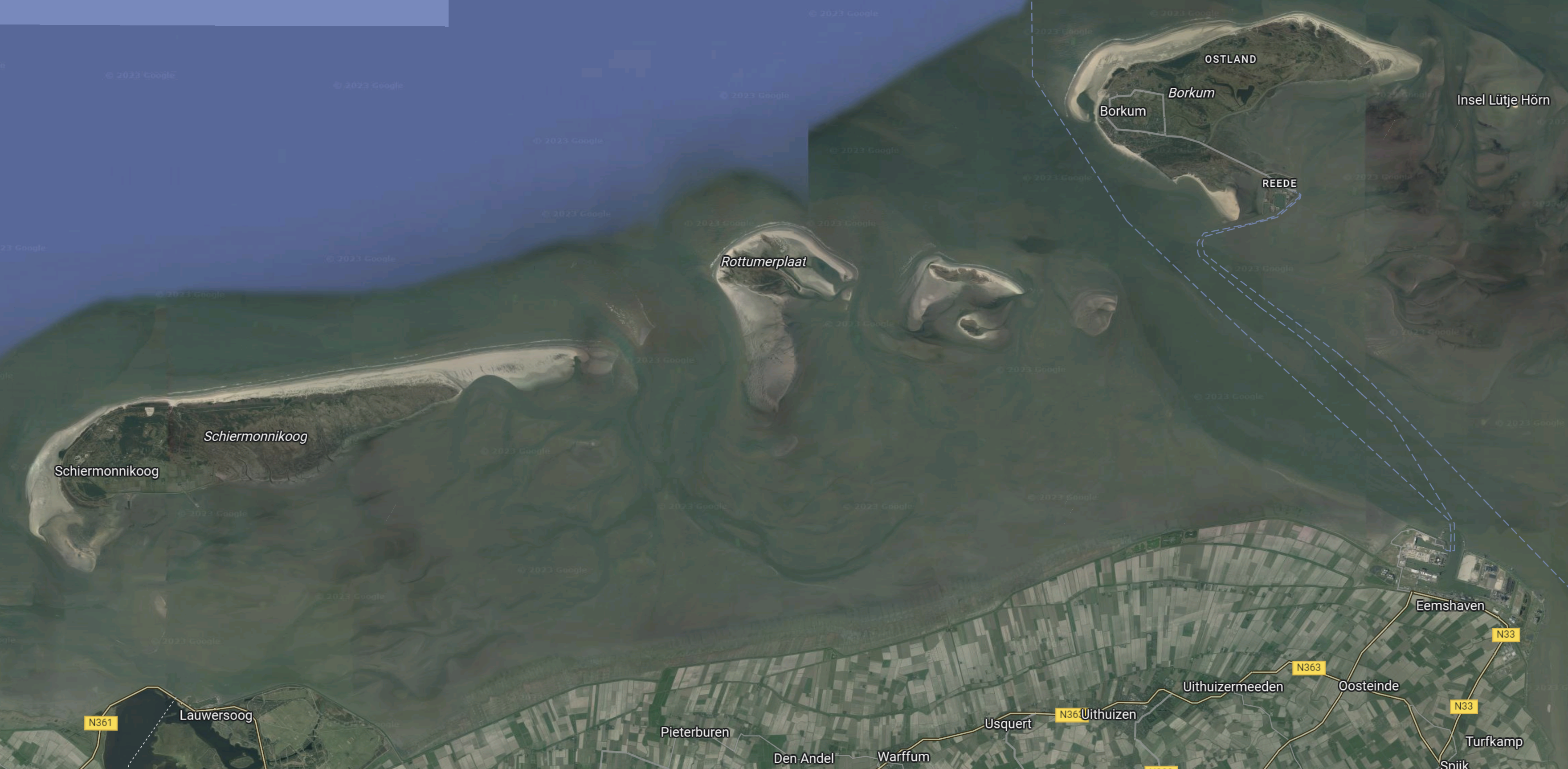
The Dutch government has designated an area for what will become the world’s largest offshore hydrogen production project. That area is Ten noorden van de Waddeneilanden (the North of the Wadden Islands), identified earlier for offshore wind development and deemed most suitable for providing 500 MW of electrolysis capacity and for the transport of hydrogen to land.

This Google Map shows the Wadden Islands.

Note.

  1. Groningen is in the South-East corner of the map.
  2. I wrote about Eemshaven, which is to the North-East of Groningen in The Train Station At The Northern End Of The Netherlands.
  3. The Wadden or Frisian Islands are along the coast.

The Wadden Islands of the Netherlands, Germany and Denmark are a World Heritage Site.

In Can The UK Have A Capacity To Create Five GW Of Green Hydrogen?, I said the following.

Ryze Hydrogen are building the Herne Bay electrolyser.

  • It will consume 23 MW of solar and wind power.
  • It will produce ten tonnes of hydrogen per day.

The electrolyser will consume 552 MWh to produce ten tonnes of hydrogen, so creating one tonne of hydrogen needs 55.2 MWh of electricity.

If the Dutch build a 500 MW electrolyser it will produce 217 tonnes of hydrogen per day.

The Dutch Plan For Hydrogen

This 500 MW electrolyser fits well with the The Dutch Plan For Hydrogen.


March 20, 2023 Posted by | Hydrogen | , , , , , , , , , | Leave a comment

Vattenfall Selects Norfolk Offshore Wind Zone O&M Base

The title of this post, is the same as that of this article on offshoreWIND.biz.

This is the sub-heading.

Vattenfall has selected Peel Ports as the preferred bidder, and its port at Great Yarmouth as the location for the operations and maintenance base of the Norfolk Offshore Wind Zone in the UK.

This was said about the competition to host the facility.

Vattenfall said that the competition was fierce to secure the agreement with an excellent bid from Lowestoft and Associated British Ports. With both ports offering excellent services it is clear that East Anglia’s potential as a superpower of offshore wind is secure.

I have a few thoughts.

Lowestoft In Suffolk And Great Yarmouth In Norfolk Must Work Together

This Google Map shows the coast between the two ports.

Note.

  1. Great Yarmouth is at the top of the map.
  2. Lowestoft is at the bottom of the map.
  3. The two towns are less than twelve miles apart.
  4. The Great Yarmouth Outer Harbour, is towards the top of the map.

The Google Map shows the port in more detail.

Note.

  1. Great Yarmouth Outer Harbour only opened in 2009.
  2. It has an average depth of 10 metres.
  3. It was planned as a container port, but the ships didn’t materialise.
  4. Some consider it to be a bit of a white elephant.

Could the Outer Harbour be used to assemble floating wind turbines?

I think it could but at present, there are no plans to use floating wind turbines off the coast of Norfolk.

I suspect though, if someone decided to build floating wind farms to the East of the Vattenfall’s Norfolk Zone fields, that Great Yarmouth Outer Harbour could be used to assemble the floating wind turbines.

This Google Map shows the Port of Lowestoft.

Note.

  1. There is over a kilometre of quays.
  2. It doesn’t have the water depth of Great Yarmouth.
  3. There is a lot of brownfield sites along the River Waveney.
  4. The East Anglia One wind farm is managed from Lowestoft.

Both harbours have their good and bad points.

  • Both have good rail connections to Norwich.
  • Lowestoft has a rail connection to Ipswich and has been promised a London service.
  • Road connections to Ipswich and Norwich need improvement.

I suspect that it was a close contest, as to the port that got the Vattenfall contract.

A Lowestoft And Great Yarmouth Rail Connection

This map from Open RailwayMap between the two towns.

Note.

  1. The existing railways are shown in yellow.
  2. Former railways are shown in black dotted lines.
  3. There was even a railway along the coast.

The only rail connection between the ports is via Reedham, where the track layout is shown on this second OpenRailwayMap.

Note.

  1. Reedham station is in the North West corner on the line to Norwich.
  2. The line going North-East goes to Great Yarmouth.
  3. The line going South goes to Lowestoft.

There used to be a chord connecting Great Yarmouth and Lowestoft, but it was cancelled by Beeching’s grandfather.

There is certainly scope to improve the rail connection between the two ports.

  • There could be a convenient change at Reedham, if the timetables were adjusted.
  • Trains could reverse at Reedham.
  • The chord could be reopened to allow direct trains.

It wouldn’t be the most challenging rail project to have an hourly rail service between the two ports.

A Lowestoft And London Rail Service

This was promised with a frequency of something like four trains per day (tpd)

I think it should run between London and Yarmouth with a reverse at Lowestoft.

March 17, 2023 Posted by | Energy | , , , , , , , , , , | 9 Comments