National Trust Looks At Car Ban In Lake District
The title of this post is the same as that as that of this article in yesterday’s Sunday Times.
The secondary headline sums up the article.
Nearly 20m visitors a year are ‘loving the national park to death’, and officials are looking at excluding drivers.
So what is to be done?
Can The Railways Help?
In 2015, I spent Three Days in Preston and explored the area by train.
These problems were apparent on the trains and at the stations.
- The capacity, quality and frequency of the trains to Windermere is pitiful.
- The capacity, quality and frequency of the trains along the Cumbrian Coast Line is inadequate.
- Bus information and interchanges could be better.
- Getting a train to Penrith North Lakes station was difficult.
The only line with an acceptable train service is the West Coast Main Line.
Everything else needs major improvements.
These are some random thoughts.
Could Carlisle Become The Rail Tourism Centre For The Borderlands And The Lakes?
These rail lines and services are already or will be connected to Carlisle Citadel station, within the next few years.
- Virgin services on the West Coast Main Line between London and the South and Glasgow and Edinburgh in Central Scotland.
- TransPennine Express services on the West Coast Main Line between Liverpool and Manchester in the South and Glasgow.
- Possible Grand Union services on the West Coast Main Line between London and Stirling for the North of Scotland.
- High Speed Two services between London and the South and Glasgow and Edinburgh in Central Scotland.
- ScotRail services on the Glasgow South Western Line between Carlisle and Glasgow via Dumfries and Kilmarnock.
- ScotRail services on an extended Borders Railway between Carlisle and Edinburgh via Hawick and Galashiels.
- Northern services on the Tyne Valley Line between Carlisle and Newcastle via Hexham and the Metro Centre.
- Northern services on the Settle and Carlisle Line between Carlisle and Leeds.
- Northern services on the Cumbrian Coast Line between Carlisle and Carnforth via Workington, Whitehaven and Barrow.
Carlisle sits at the centre of a network of some of the most scenic rail lines, anywhere in the world.
Rail services in the area with the exception of the through services, provided by Virgin and TransPennine Express are probably considered by their operators to be a pain.
- They are generally not used by commuters.
- There are regular operational problems like floods and landslips.
- They are overcrowded at some times of the year and need expensive new rolling stock.
- Rail tourists from aboard probably complain like mad.
But above all the services probably lose money hand over fist.
What Is The Ideal Train For Scenic Routes?
Two possible trains for scenic routes are now in service in the UK.
The Scottish Solution – Inter7City
ScotRail are now introducing four- and five-car InterCity 125 trains on routes between the seven cities in Scotland.

They will probably do a good job and they have the following.
- Large windows to enjoy the views.
- Many seats have tables.
- An on-board buffet and trolley service.
- Wi-fi and power sockets for phones and laptops.
- The trains should be reliable, as there is a vast knowledge base about running these trains.
- The trains can be easily lengthened, by adding extra cars.
- The trains were 125 mph trains and are probably slower in this application.
But the trains are forty years old and have two enormous diesel engines on each end.
The Swiss Solution – Class 755 train
Greater Anglia are introducing three- and four-car Class 755 trains on rural routes in East Anglia.
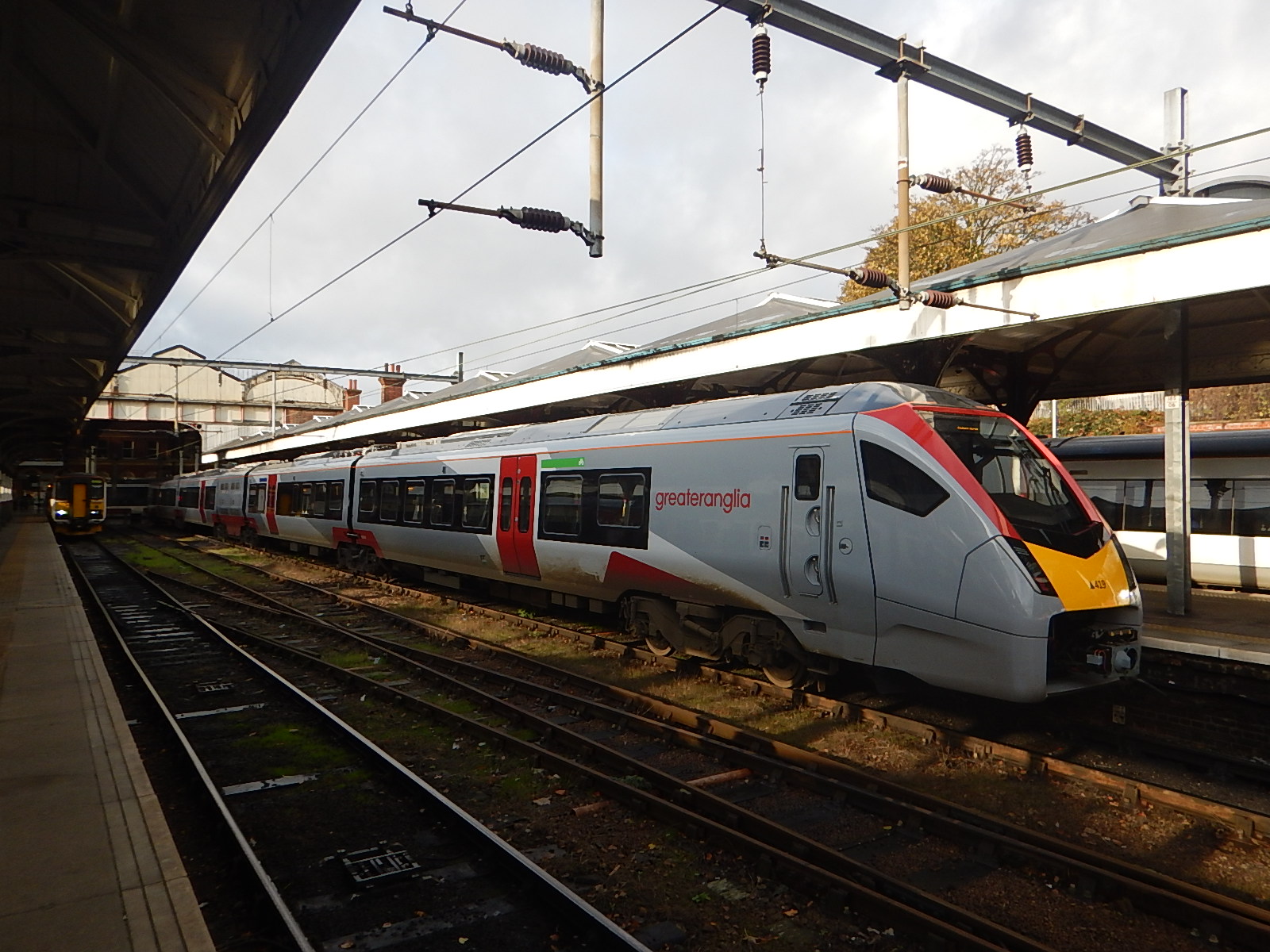
They appear to be doing a good job with high passenger satisfaction and they have the following.
- Large windows to enjoy the views.
- A number of seats have tables.
- Space for bicycles.
- Wi-fi and power sockets for phones and laptops.
- The trains have level access between train and platform.
- Hopefully, the trains will be reliable, as they are brand new and Stadler has been making similar trains for over ten years.
- The trains can use 25 KVAC overhead electrification, where it is available.
- The trains can work in multiple formations.
- The trains can be easily lengthened, by adding extra cars.
- The trains are 100 mph trains.
But the trains still have a diesel power-pack in the middle for operation independently.
In future, these trains will be used to run new services between London and Lowestoft, which is a distance of 118 miles of which 59 miles is electrified.
Similar trains will be fitted with batteries for the South Wales Metro.
Could a train be built with the best of all the features?
I believe the Class 755 train is a pretty good start, but it would have the following extra features.
- Ability to run at up to 125 mph on 25 KVAC overhead or 750 VDC third rail, where the track allows.
- A well-designed buffet.
- 50 mile battery range.
- A stand-by generator.
- The ability to fast-charge the battery at a station stop.
I also think that Hitachi could make a five-car AT-300 train and Bombardier could make an Aventra, that met this specification.
What would a fleet of battery-electric trains do for the rail lines around Carlisle?
- Hopefully, they would become a tourist attraction in their own right and encourage visitors to corm by train.
- Frequencies would be at least two trains per hour on all routes.
This could be a starting point for making the area easier to access.
Should Stations Around The Lakes Be Developed With Bus Interchanges?
I’ve seen the bus interchange at Windermere station, but are other stations around the Lakes as well provided with comprehensive bus routes?
The objective surely should be that if a family wanted to have a day out in the Lakes from their home in Liverpool or Manchester, they should be able to get a train to a convenient station and a bus to their final destination.
Surely, if there is a sensible alternative, then visitors might use it.
Could The Cockermouth, Keswick and Penrith Railway Be Reopened?
The Cockermouth, Keswick and Penrith Railway was finally closed in the 1970s and according to Wikipedia, the track-bed has been used for roads and other developments.
I doubt that the railway could be reopened, but a modern light rail route would probably be a very valuable tourist asset.
But Would Good Train And Bus Routes Cut The Traffic In The Lakes?
I doubt it!
If someone has spent £40,000 or more on an expensive car, they feel they have bought the right to drive it anywhere they want!
The Dutch once talked about road pricing for every vehicle and that government lost the next election.
Conclusion
Traffic congestion in the Lakes, is a problem that threatens other areas, where tourists want to go.
So will as the National Trust are suggesting have to ban cars to restore some sanity?
I suspect so!
But it won’t be popular!
The Mysterious Scotsman
A couple of years ago, I was contacted by a Scot called Andrew, who wanted to talk to me about blogging and my blog in particular.
I said, on my next trip North, why don’t we meet at somewhere like Stirling, which I sometimes use as a base for trips. I wrote about the city as a base in this post called Stirling.
We met and had a pizza in the City and we talked about Stirling’s direct rail connections to London.
This morning, I was looking up Grand Union, who are a proposed open-access train company, who aim to be running a rail service between London Paddington and Wales, within the next few years using InterCity 225 trains.
And what did I find?
The company is also proposing to run a service between London and Scotland. In a London-Scotland section in the Wikipedia entry, this is said.
In August 2019, Grand Union lodged an application to operate three or four trains per day between London Euston and Stirling calling at Milton Keynes Central, Nuneaton, Crewe, Preston, Carlisle, Lockerbie, Motherwell, Whifflet, Greenfaulds and Larbert with InterCity 225s from May 2021.
As I said in my meeting, I feel that a direct London and Stirling service could be invaluable.
- Stirling has good rail connections to the rest of Scotland.
- Stirling will be served by Scotrail’s upmarket Inter7City services.
- The route is fully-electrified between London and Stirling.
I doubt the good burghers of Stirling would object.
I have a few comments.
The Route
The route is interesting, as it gives some new connectivity, that I’m sure will be welcomed by customers.
Milton Keynes
Consider.
- Milton Keynes Central is a well-connected station.
- It will get even better when the East-West Rail Link is opened in a few years.
- Some journeys will be easier with a change at Milton Keynes, rather than in London.
Current services between Milton Keynes and Scotland, go via Birmingham.
Nuneaton
Nuneaton is becoming a busy hub station between Birmingham, Coventry and Leicester and must improve services along the West Coast Main Line to and from the North and Scotland.
Crewe, Preston And Carlisle
The new service will add connectivity to these important hubs.
Lockerbie
Lockerbie station only gets three trains per day in both directions.
If Grand Union stopped all their services, this would double the number of services calling at Lockerbie.
Motherwell, , Whifflet, Greenfaulds And Larbert
These stations should give good connectivity in South-East Glasgow, with links to Ayr in the West and Edinburgh in the East.
Stiring Station
In addition to good rail connectivity, Stirling station is not far from the City Centre and has good facilities.
The Trains
Wikipedia says the services will be run by InterCity 225 trains.
I would assume they will be shortened to perhaps five to seven cars.
The Timings
Currently, the fastest train between Euston and Motherwell is the 17:30, which takes fours and fifteen minutes, with six stops.
As the proposed service would also take six stops between Euston and Motherwell, I would assume that Grand Union would be aiming for a similar time.
Looking at individual timings on the route the train would take between Motherwell snd Stirling via Whifflet, Coatbridge Central, Greenfaulds, Cumbernauld, Carmuirs Junction and Larbert, I am fairly certain that a train running with three scheduled stops could do the trip in around 38-42 minutes.
This is the summary of the times.
- London Euston and Motherwell – four hours and fifteen minutes.
- Motherwell and Stirling – 38-42 minutes.
Which would give a time between Euston and Stirling of around five hours.
This compares with the current best timings.
- London Kings Cross and Stirling – five hours and eighteen minutes
- London Kings Cross and Edinburgh – four hours and twenty minutes
- London Euston and Glasgow – four hours and thirty minutes
So the new service would appear to give the following advantages.
- A faster service between London and Stirling.
- Faster services between London and Whifflet, Greenfaulds and Larbert.
This is in addition to the big advantage of three or four new direct services per day.
Services Between The South And Inverness With A Change At Stirling
Could this be one of the markets that Grand Union are looking to exploit?
Currently, there are two direct services between London and Inverness.
- The daily direct daytime service takes eight hours and runs once a day.
- The Sleeper takes even longer, but you do get an overnight rest.
So could a service between London and Stirling provide extra services?
Consider.
- Currently, Scotrail’s services between Stirling and Inverness take just under three hours and run roughly two-hourly.
- Network Rail are improving the Highland Main Line with passing loops and longer platforms to increase capacity and operating speeds.
- Scotrail are introducing new better quality Inter7City trains on the route.
- The new December 2019 timetable looks like services could be a few minutes faster.
I suspect, if the trains were appropriately timetabled, there could be extra services between Inverness and London Euston.
- There would be a change of train at Stirling.
- Timing could be around seven and a half hours.
- Both trains would be high-quality ones.
I suspect that three new services with times of less than eight hours could be created bertween London and Inverness
The Glasgow By-Pass
If you want to go between Carlisle and Stirling, you will be recommended to take the following route.
- Carlisle to Glasgow Central – Up to four trains per hour (tph)
- Glasgow Central to Glasgow Queen Street – Walk as I do or a bus.
- Glasgow Queen Street to Stirling – three tph
The journey time is just over two and a half hours.
I estimate that Grand Union’s services could go between Carlisle and Stirling in around forty-five minutes less, without a change of train.
The route is also now fully-electrified between Stirling and Carlisle, so could this be used by other services.
High Speed Two
When High Speed Two is completed, there will be two tph to both Edinburgh and Glasgow, with I suspect the trains working as a pair South of Carstairs, where they will split and join.
I suspect that High Speed Two will take the lion’s share of passengers between London and Edinburgh and Glasgow, but the two services could work together.
- It might be quicker to change at Preston to Grand Union, if you’re going to Stirling.
- If Stirling to Aberdeen and/or Inverness were to be electrified, could classic-compatible High Speed Two trains go further North?
- At the Southern end, places like Milton Keynes and Nuneaton will not be served by High Speed Two, but existing and Grand Union services could provide connections.
- North of Crewe, it is planed that High Speed Two will run on an upgraded West Coast Main Line.
For reasons like this High Speed Two will need to be integrated with other services.
Conclusion
Grand Union will make services from London to Stirling and the Northern part of coitland netter and more competitive.
Eden Project Morecambe Now ‘Certain’
The title of this post, is the same as that of this article on the Westmoreland Gazette.
I’ve always liked the Eden Project Morecambe and can’t see why it will not be as big a success, as its Cornish sister.
- It has good transport links.
- It could be served by battery electric trams or trains from the West Coast Main Line.
- It is within an two hours ,of the large population centres of Blackpool, Liverpool, Manchester and North Lancashire.
- It is a complimentary attraction to the Lake District.
But above all, it catches the mood of today’s world.
Hydrogen Fuel Cell Company Shares Take Off After 4 Decades Of Declines
The title of this post is the same as that of this article on Hydrogen Fuel News.
Ballard Power Systems, is the company referred to in the article.


This London bus has a hydrogen fuel cell from Ballard.
Norwich To Sheringham Line Sees New Greater Anglia Trains Enter Service
The title of this post is the same as that of this article on Rail Advent.
This is the introductory paragraph.
Yesterday (6th November) saw the first of the brand new Greater Anglia trains travel on the Bittern Line, between Norwich and Sheringham.
The article also says the new trains will be phased in before the end of the year.
A Chaotic Morning Peak Across The Pennines
I had intended to ride in one of TransPennine Express’s new trains that are formed of a rake of Mark 5A coaches hauled by a Class 68 locomotive.
As they run between Liverpool Lime Street and Scarbough, I thought it best to buy a return ticket between Manchester Victoria and Leeds.
Problem Number 1 – Northern’s Ticket Machine
Northern’s new ticket machines are fine when they work, but for some reason they wouldn’t respond to my fingers.
I find this with some touch screens, which are mainly in Sweden or IKEA in the UK.
So I bought a ticket from the ticket office intending to catch the next Scarborough train.
This had also happened the day before at Leeds.
Problem Number 2 – The Scarborough Train Didn’t Arrive
As the Scarborough train didn’t arrive, I gave up and took the Newcastle train towards Leeds.
Problem Number 3 – Overcrowding At Huddersfield
I took this picture of the crowds at Huddersfield.
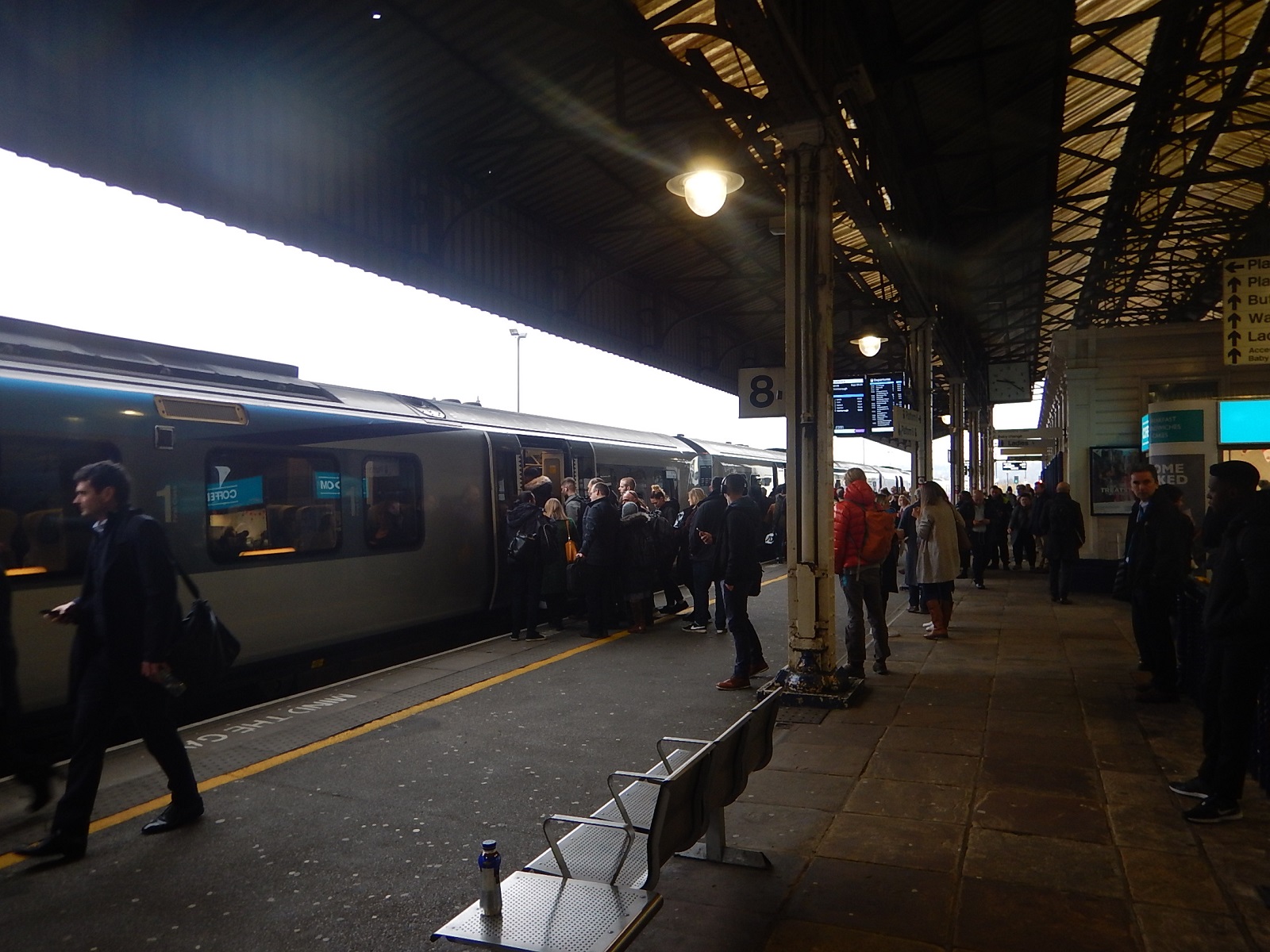
My phone was telling me that the Scarborough train was behind my Newcastle train, so I decided to change at Huddersfield.
But I made a mistake and got on a very crowded train, that was going to Hull via Leeds.
I had to stand to Leeds, but at least I got a roomy and safe standing space.
Problem Number 4 – Class 185 Trains
.The Class 185 trains are just three-cars and totally inadequate for the route.
The trains were ordered in 2003 and were delivered in 2006-2007.
If you read the section entitled Overcrowding And Passenger Feedback, in the Wikipedia entry for the trains., you’ll see from the early days, these trains did not have enough capacity for the route.
I blame the Treasury under Gordon Brown, who specified the trains and as with Class 700 trains, which were also specified by the Treasury, there are serious shortcomings.
Considering that among other routes at this time, the London and Norwich route was being run by eight car trains, what in heaven were they thinking about.
But it was only the North of England! And not London or Scotland!
Problem Number 5 – Crowded Leeds Station
Leeds station was crowded as ever, but it wasn’t helped by an escalator being broken down.
I had hoped, that I would have enough time to go to Harrogate, but I felt as it was all so slow, that it was best to go back to Manchester Victoria station, grab something to eat and then go on to Liverpool Lime Street station, which was my intended destination.
Problem Number 6 – Ticket Machine At Leeds Station
I needed a Single from Leeds to Liverpool Lime Street and try as I might, I couldn’t find it on the machine, so I resorted to the Ticket Office again.
Problem Number 7 – Train Failure At Manchester Victoria Station
The train from Leeds to Manchester Victoria was another Class 185 train and I did get a seat.
But where was the new five-car rake of Mark 5A coaches and a Class 68 locomotive?
I did successfully split my journey at Manchester Victoria station, but there seemed to be problems, so I thought I’d go on immediately to Liverpool and arrive in the city with an hour to spare for my meeting.
As if things could be so simple!
A Class 185 train had failed in the platform and it was nearly an hour, before I got away to Liverpool in a train, that arrived in the bay platform 2, which to get to the West, had to come out of the station and reverse. I suspect TransPennine Express were using a driver in both cabs or driving it from the Liverpool-facing cab at all time.
Problem Number 8 – Late Arrival Into Liverpool Lime Street
I arrived in Liverpool about fifteen minutes late for my meeting, with the rain chucking it down, after it being dry in Manchester.
The weather in itself must be unusual!
My Observations
I was having a text conversation with a friend in London and these were my observations to him, with a few other points added by hindsight.
1. Northern’s Ticket Machines
These need reeducation and the dry-finger problem that I suffer with the screens must be fixed.
2. Northern’s Ticket Offices
Northern needs to open more ticket office windows.
3. Where Is The London-Style Contactless Ticketing?
London has proven, that contactless ticketing based on bank cards increases passenger numbers and revenue and has a high level of passenger satisfaction.
\The area of the North between Liverpool and Blackpool in the West and Leeds and Sheffield in the East is in terms of passenger numbers smaller than London’s contactless ticketing area.
I think there are two reasons, why it doesn’t exist now or in the near future.
- The trains are not big enough to cope with the increased traffic.
- It will result in a reduction of ticket offices and their staff and those in charge are frightened of the RMT.
So visitors like me have to suffer an inadequate ticketing system because of timid management.
4. Buying Tickets In The North In The Future
In future, when I go to the North, I’ll plan my journey in detail and buy my tickets from the intelligent and extremely customer-friendly ticket machines in Dalston Junction station.
It’s strange that both Northern and the London Overground are run by Arriva. How can one get it so right and the other so wrong?
Perhaps it’s because the London Overground only deals with one organisation; Transport for London and Northern deals with a myriad rabble of councillors, MPs, pressure groups, all fighting their own corners.
5. All Trains Must Be At Least Six Cars
More capacity is needed and as there is a lack of train paths across the Pennines, because of lack of investment in the tracks for decades, starting with that enemy of the train; Harold Wilson.The simplest way to increase to increase capacity is to make all trains at least six cars.
But I would go father than that.
- Trains running across the Pennines should all be identical.
- Capable of at least 100 mph.
- Capable of 125 mph, when the route includes the West or East Coast Main Lines.
- Fast acceleration away from stops.
- Identical door configuration with wide double doors on all trains.
- Level access between train and platform.
- Short dwell times in stopping stations.
Identical trains improve timekeeping and give a better service to passengers.
If you look at the Paddington and Oxford service it is now run virtually exclusively using Class 800 or 802 trains. I feel as an occasional passenger that it has improved dramatically, in terms of capacity, comfort and reliability for passengers.
6. What Idiot Decided To Buy Three Different Fleets For TransPennine Express?
The sister company of TransPennine Express is Great Western Railway.
Great Western Railway’s main line services are run by two fleets of trains.
- Hitachi Class 800 and Class 802 trains for long distance services.
- Class 387 trains for electric commuter services.
As some of the Class 387 trains are being converted for Heathrow Express and Crossrail are taking over London and Reading services, I can see a time, when all fast services that go to and from Paddington through Reading will be run by the Hitachi trains.
Consider.
- West of Heathrow, the fast lines are reserved for the 125 mph Hitachi trains.
- The 110 mph Class 387 trains to and from Heathrow, don’t get in the way of the faster Hitachi trains.
- Applying digital signalling to increase paths on the fast lines is easier with identical trains.
- Driver training and rostering must be simpler.
It’s not perfect, but it’s an arrangement that can be made to work well.
If a unified fleet is so good, why did TransPennine Express buy three separate fleets?
Class 802 Trains
Nineteen Class 802 trains will be used for these services.
- Liverpool Lime Street to Edinburgh Waverley via Newcastle (from December 2019)
- Liverpool Lime Street to Newcastle (until December 2019)
- Manchester Airport to Newcastle
This seems to be a sensible and obvious choice.
- A five-car Class 802 train has eighty percent more seats than a three-car Class 185 train.
- A five-car Class 802 train is shorter than a pair of Class 185 trains.
- The trains are 125 mph trains, that can be upgraded to 140 mph with digital in-cab signalling.
- FirstGroup must have a large amount of experience of running Class 802 trains.
- Class 802 trains have an automatic split and join facility.
- East Coast Trains, Hull Trains and LNER will be running similar Hitachi trains on the East Coast Main Line.
In addition the fleet is future-proofed in two important ways.
- If the TransPennine route is ever electrified, their diesel engines can be removed.
- Extra cars can be added to Class 802 trains to increase capacity
Using Class 802 trains is an excellent choice.
Class 68 Locomotive And Mark 5A Coaches
Twelve rakes of four Mark 5A coaches between a Class 68 locomotive and a driving van trailer, will run these routes.
- Liverpool Lime Street to Scarborough via Manchester Victoria.
- Manchester Airport to Redcar Central (In 2019).
I wonder why these services aren’t going to be run by another twelve Class 802 trains.
Consider.
- Pollution would be reduced and the air improved in the electrified Liverpool Lime Street, Manchester Airport and Manchester Airport stations, if TransPennine used Class 802 trains on all services from the station.
- Drivers on the routes across the Pennines would more often be driving the same trains.
- The Class 802 trains are in service on the East Coast Main Line, which must make timekeeping better.
- The Class 802 trains can be upgraded to work at 140 mph on the East Coast Main Line.
It’s rather strange!
Class 397 Trains
Twelve Class 397 trains will be replacing ten Class 350 trains.
- The extra two trains are to provide a Liverpool and Glasgow service.
- The Class 397 trains have an extra car over the Class 350 trains.
- The seating capacity of both trains is 296.
- The Class 397 trains are 125 mph trains, which can mix it with Virgin’s Pendelinos.
- The Class 350 trains are only 110 mph trains, which must get in the way of the Pendelionos.
- I suspect that the Class 397 trains can be upgraded to 140 mph in the future.
The Class 350 trains needed to be increased and replaced with a 125 mph train.
But why aren’t they being replaced with more Class 802 trains?
- The Class 802 train is already in service.
- The Class 802 train has 326 seats as against the 296 of the Class 397 train.
- TransPennineExpress are already buying nineteen Class 802 trains.
- If required, an all-electric version could be ordered.
- West Coast Rail plan to run Hitachi trains on the West Coast Main Line.
It’s rather a puzzle, why TransPennine Express has ordered Class 397 trains, as everything suggests that Class 802 trains could run West Coast services.
All Three Fleets Use The Castlefield Corridor
Believe it or not, but TransPennine Express plan to run these services through the Castlefield Corridor.
- Manchester Airport and Glasgow/Edinburgh – Class 397 trains.
- Manchester Airport and Newcastle – Class 802 trains
- Manchester Airport to Redcar Central – Mark 5A coaches.
Three routes and three different trains!
Was this timetable chosen to confuse staff and passengers?
Possible Reasons For Three Fleets
The only valid reason is that the Hitachi trains can’t work in Scotland.
But it is more likely to do with production schedules at Hitachi or that the fleets were bought by accountants, with very little brain!
I did notice this statement in the Wikipedia entry for the Class 397 trains.
An option for up to 22 extra units was available to TransPennine Express, but it was not exercised.
As 22 trains is close to the nineteen Class 802 trains that were ordered, were TransPennine Express trying to buy a totally-CAF fleet?
7. Track Speed Should Be Improved
Track speeds are slow compared to say the the Great Eastern Main Line,
Improving the track to allow faster speeds may be one of the best decisions to take.
8. There Should Be Better Platform Access At Manchester Victoria And Leeds Stations
These two stations don’t have the best access to the platforms..
They should be improved with more escalators, so that passengers changing trains don’t miss their connections.
Conclusion
Money needs to be spent to remove some of the chaos and constipation in the North.
I
Rescued By Timpsons
Putting my boots back to go to the Football at around five, one of the laces gave up the ghost.
Timpsons? Surely, they could help.
But I would have to hurry, as it shut at six o’clock. I suppose the good peoiple of Manchester have to get up early to work in the satanic mills, so shops close early.
I eventually found a Timpsons in the Arndale Centre and for a few pounds, I got some new laces.
As the price included fitting, that must be three cheers for Timpsons!
As I left the Arndale Centre, many shops were closing.
Could the decline in High Street sales be partly because opening hours no longer fit the times, when the public now want to shop?
I regularly shop for everyday needs in the evening, if the television is rubbish and will go out for a snack supper to say a Leon or Carluccio’s and then perhaps pop-in to a Marks and Spencer to get food for a few days or perhaps some clothes from Eastfield. Usually shops in Inner London close at nine or ten.
My local M & S foodhall in Dalston, which is shutting at ten tonight, is just two bus stops away.
Perhaps, more people need to live in City Centres to revive them?
 The Anonymous Widower