Trump Revokes Landmark Ruling That Greenhouse Gases Endanger Public Health
The title of this post, is the same as that of this article on the BBC.
This is the sub-heading.
US President Donald Trump has reversed a key Obama-era scientific ruling that underpins all federal actions on curbing planet-warming gases.
These three paragraphs add more details to the story.
The so-called 2009 “endangerment finding” concluded that a range of greenhouse gases were a threat to public health. It’s become the legal bedrock of federal efforts to rein in emissions, especially in vehicles.
The White House called the reversal the “largest deregulation in American history”, saying it would make cars cheaper, bringing down costs for automakers by $2,400 per vehicle.
Environmental groups say the move is by far the most significant rollback on climate change yet attempted and are set to challenge it in the courts.
By invoking scientifically incorrect leglislation like this Trump is going to make things a lot worse.
Lets hope his proposed legislation goes the way of his stop to the building of the five wind farms, that I wrote about in All Five Halted US Offshore Wind Farms Resume Construction.
Opening Date For Final Delayed Station Confirmed
The title of this post is the same as that in this article on the BBC.
This is the sub-heading.
The opening date for the final station on a reopened railway line has finally been announced.
These four paragraphs give more details.
The Northumberland Line between Ashington and Newcastle began carrying passengers in December 2024, decades after the old service ended, but Bedlington and Northumberland Park stations remained unfinished.
It was announced in January Northumberland Park would open on 22 February, and now Northumberland County Council has announced Bedlington will officially open to passengers on 29 March.
Conservative leader Glen Sanderson thanked the local community for bearing with the “inevitable disruption”.
The overdue opening of Bedlington was blamed on ageing stonework and a water pipe under the car park, and in August an extra £37.9m was provided to ensure the project was completed.
Will It Be The Day Of The Dogs?
I wonder how many Bedlington terriers will turn up!
I asked Google AI,”Will Bedlington Terriers be going to the opening of Bedlington station?” and received this reply.
Based on current information, it is not confirmed whether the dog breed Bedlington Terriers will be attending the opening of the new Bedlington station, which is expected to open in early 2026 as part of the Northumberland Line. While the town is famous for the breed, no official event details have confirmed their presence at the opening.
If they did, the story would spread everywhere.
Will The Builders Move On To The Leamside Line?
The Leamside Line could be the next one to be rebuilt, as it’s just on the other side of the Tyne.
Or they could extend the Northumberland Line to Newbiggin-by-the-Sea.
But who knows with this Government?
Will the Liverpool Street Rebuild Include Elizabeth Line Improvements?
I asked Google AI, the question in the title of this post and received this reply.
Yes, the proposed redevelopment of London Liverpool Street Station includes improvements to integration with the Elizabeth line, aiming for a fully accessible, multi-modal, and spacious hub. The plans focus on better connecting the main concourse with the Elizabeth line, Underground, and local transport, alongside doubling the concourse size, adding new, more efficient lifts, and increasing the number of ticket barriers.
Will The Liverpool Street Rebuild Have More Platforms?
I asked Google AI, the question in the title of this post and received this reply.
The approved £1bn+ redevelopment of London Liverpool Street Station, greenlit in February 2026, focuses on increasing capacity and accessibility rather than adding new platforms. The plans, to be completed by mid-2036, involve enlarging the concourse by 76%, increasing lifts/escalators, and providing step-free access to all existing platforms.
Platform Changes: While there is no mention of increasing the total number of train platforms, the project will significantly improve access and reduce congestion.
Capacity Enhancements: The project includes a 76% increase in concourse capacity.
Infrastructure Upgrades: Escalators will increase from four to ten, and eight new lifts will be installed.
Accessibility: The project aims to provide full step-free access across all rail and underground platforms.
New Construction: A large, multi-story office building is planned above the station, and the concourse area will be redesigned for better flow.
The project aims to handle over 200 million passengers annually by the time it is finished.
This OpenRailwayMap shows the layout of tracks in the station.
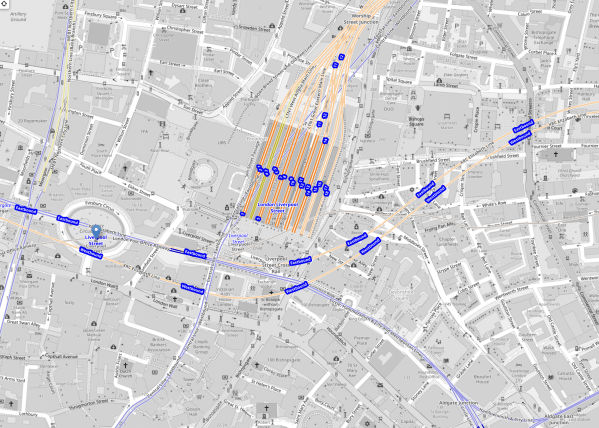
Note.
- The square block in the middle of the map are Platforms 1-18 of the main station.
- Eighteen is in the East and 1 is in the West.
- The Central Line of the London Underground runs diagonally in blue under the main station.
- Running in orange from the West to the North-East in front of the station is the Elizabeth Line.
- Running South of Lizzie in blue are the sub-surface lines of the London Underground.
I wonder, if at some point in the distant future, a terminal platform or two could be added to the very deep Elizabeth Line, that connected to tunnels underneath Liverpool Street station.
This second OpenRailwayMap shows the sub-surface lines and the Elizabeth Line, as they pass across in front of Liverpool Street station.
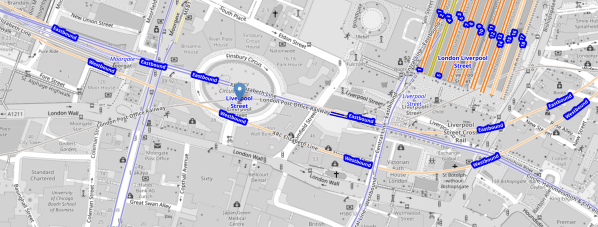
Note.
- Moorgate Station is in the North-West corner of the map
- Moorgate Statation has two virtually unused west facing bay platforms.
- The sub-surface lines are shown in blue.
- The Elizabeth Line is shown in orange.
- Finsbury Circus is in the middle of the map, with the sub-surface lines underneath.
- The Central Line is shown in blue and crosses between Finsbury Square and Liverpool Street station on its way to Bank.
- In front of Liverpool Street station, there is a disused bay platform on the sub-surface lines.
- The Bank branch of the Northern Line and the Great Northern run North from Moorgate station.
- Access to the Great Northern could be improved.
I feel there is scope for more trains to be run on the sub-surface lines through Moorgate and Liverpool Street.
- Accessibility to the sub-surface lines at Moorgate and Liverpool Street station could be improved.
- There has been talk of extending some services to Barking.
There is certainly scope to improve the sub-surface lines.
Planning Approval Granted For Network Rail’s Transformation Of Liverpool Street — Britain’s Busiest Station
The title of this post is the same as that of this article in Rail Technology Magazine.
This is the sub-heading.
Network Rail has secured a major milestone in the redevelopment of Liverpool Street station, following the City of London Planning Committee’s resolution on 10 February to grant full planning permission for the long‑awaited transformation of the UK’s busiest rail hub.
These two paragraphs adds some more detail.
The Eastern Region’s Anglia Route will oversee the upgrade, which aims to futureproof the station for decades as passenger numbers continue to grow sharply. Liverpool Street, last redeveloped in 1991, now handles 118 million passenger movements each year, and demand is projected to rise by 35%, reaching 158 million by 2041.
Looking further ahead, planners expect the station will need to accommodate over 200 million annual journeys, making capacity enhancement essential for maintaining operational performance and customer experience across London, East Anglia and the wider east of England.
To say this is a large project would be a massive understatement and I wish, that this could have been the last project planned and built by the Artemis project management system, that I wrote in a Suffolk attic fifty years ago.
This list summarises the work that will be done.
- 76% increase in overall concourse capacity
- 23% expansion of the lower concourse to smooth passenger flow
- Step‑free access from street to all platforms, including every Underground line for the first time
- Eight new large lifts, replacing the existing four‑person unit
- Escalators increased from four to ten
- New accessible entrances and intuitive wayfinding from Broadgate, Exchange Square, and key interchange points
- Toilets on all levels, including Changing Places facilities and family amenities
Respecting Heritage While Creating New Spaces
The project safeguards the station’s Victorian character, with the iconic trainshed fully preserved. The redevelopment will also create new vantage points overlooking the heritage structures, bringing passengers visually closer to the original architecture.
Above the concourse, a new office building featuring a publicly accessible roof garden will provide one of London’s most sustainably connected workplaces, directly supporting the City Corporation’s long‑term growth and employment aspirations.
Around twenty major contractors and professional firms will be handling the transformation.
Hopefully, I will be able to watch this project as it grows to occupy its place in the City of London.
Do Coeliacs Suffer Badly From Sepsis?
As everybody seems to be getting this these days, I just had to ask Google AI the question in the title of this post.
This is the reply I received.
Sepsis Outcome: While celiac patients are more likely to get sepsis, studies indicate that celiac disease does not significantly influence the survival or prognosis once a patient has developed sepsis.
Are There Some People Who Lose Their B12 Very Quickly?
Many years ago in Suffolk, I was sure, that my three-monthly B12-injection wasn’t done correctly.
It was by a trainee, so I told my GP and she may have repeated the injection. Perhaps the trainee missed the muscle or something?
I’m not sure, but I may have had a repeat injection.
I had another B12 injection about ten days ago and twice in the last two days, I have had symptoms that could be low B12 levels.
Yesterday at one point, I thought I was having a stroke, but a hot bath seemed to improve things.
I then found a Marks & Spencer Liver & Bacon meal-for-one and cooked it, but just eating the Liver & bacon.
I seemed to do the trick.
Today, coming home with shopping, my left leg was painful and so I asked Dr. Google AI for some advice.
I asked if “If low B12 is connected to red feet” and received this answer.
Low vitamin B12 is strongly connected to foot issues, primarily causing peripheral neuropathy that manifests as burning sensations, numbness, tingling (“pins and needles”), and sometimes, color changes like redness, purple, or white due to reduced blood flow or nerve damage. It causes nerve damage, which can lead to painful or “burning” feet.
Key Connections Between B12 Deficiency and Foot Symptoms:
Peripheral Neuropathy: A, the lack of B12 damages the myelin sheath covering nerves, resulting in burning, numbness, or tingling in the feet.
Reduced Blood Flow/Color Changes: Deficiency can lead to, significantly colder feet that may appear red, white, or purple due to impaired circulation.
Painful Sensations: Often described as a burning feeling, which can make feet feel hot or tender.
Muscle Issues: Weakness, cramping, and poor coordination can affect mobility.
Note:
- I certainly had pins and needles in my hands, yesterday.
It certainly, looked to me that I might have had low B12.
‘A Rare Opportunity’: Northern Will Run Service Along Heritage Railway Line For The First Time And Tickets Are Now On Sale
The title of this post, is the as that of this news item from Northern Trains.
This is the sub-heading.
Northern will run a service along a heritage railway line for the first time, to raise money for charity.
These four paragraphs add detail to the story.
Tickets are now on sale for the service, which will set off from Darlington station on Sunday, 22 February and complete a return trip along Weardale Railway before heading back to Darlington.
Northern has been working closely with Weardale Railway to organise this event.
The railway, which opened in 1847, is a popular tourist attraction and allows visitors to travel on heritage trains along a picturesque 16-mile route. It runs between Bishop Auckland West and Stanhope in County Durham.
In 2020, it was saved from administration by The Auckland Project, which has since provided significant investment to fund essential repairs and infrastructure improvements.
Note.
- The train will be one of Northern’s Class 158 trains.
- Tickets are being sold for £25 and the proceeds will be donated to two local charities: The Angel Trust, based in Bishop Auckland, and 123help4familys, based in Stanhope.
- The train will leave Darlington at 09:46 and finishes its trips up and down the Weardale Line at Darlington at 17:44.
I won’t be going, as I can’t fit the day together.
Is There Support For An Extended Service From Bishop Auckland?
I asked Google AI, this question, and got this mildly surprising answer.
Yes, there is support for extended services in Bishop Auckland, primarily through NHS GP extended access, which provides appointments outside of normal hours (6 PM – 8 PM weekdays and weekends) at Bishop Auckland Hospital. The Urgent Treatment Centre is available 24/7, and various community-based support services, including care agencies and mental health support, are also available.
If the hospital and the other medical facilities are open, surely in a rural area, if they are needed, transport should be available.
Is There A Need For More Housing In Bishop Auckland?
Yes, there is a significant, documented need for more housing in Bishop Auckland to address a, “chronic shortage of quality bungalows and assisted living” alongside a broader demand for modern, energy-efficient homes. The town is undergoing a regeneration with plans for increased, “affordable housing” and “100% affordable” developments (e.g., in “Westerton Road” and “Holdforth Crescent”) to meet the growing population and “economic needs”.
Note.
- A regular service to Darlington may make building more housing viable.
- Judging by the amount of new houses along the Northumberland Line, the new railway has encouraged their building.
Services and stations could be added as required, as appears to be being done on the Northumberland Line.
National Grid, TenneT Germany Launch GriffinLink, A First Of A Find Project To Maximise Offshore Wind
The title of this post is the sane as that of this press release from National Grid.
These three bullet points serve as sub headings.
-
National Grid and TenneT Germany announce our cooperation on GriffinLink, a planned GB-Germany multi-purpose interconnector (MPI).
-
GriffinLink would support energy security, accelerate the connection of offshore wind and mark a coordinated approach on supply chains and infrastructure.
-
Announced at the North Sea Summit in Hamburg, the project could maximise shared offshore wind resources in the most efficient way.
These two paragraphs add more detail.
National Grid will partner with TenneT Germany to develop GriffinLink, a new multi-purpose interconnector (MPI) project, which could connect British and German offshore wind to both countries. It marks a step towards a more integrated, flexible, and efficient energy system for both Great Britain and Germany which delivers secure, affordable energy for consumers.
GriffinLink could make an important contribution to security of supply and market integration in northwestern Europe. Cross-border hybrid energy systems such as GriffinLink make it possible to feed cleaner electricity into the grid where it can be generated and transport it exactly where it is needed.
Note this integrated approach means.
- Better utilisation of the grids and is a more efficient use of renewable energy across national borders;
- Lowering the costs involved, and the supply chain materials required and;
- A reduced impact on coastal communities and the environment.
As a ‘multi-purpose’ interconnector connecting wind in two countries, GriffinLink would be the first project of its kind in Europe and a milestone for cross-border energy security and stability.
It will also connect the UK’s offshore wind power to someone someone who needs it and will pay good money for it.
I asked Google AI, “How much energy we will be exporting to Europe in 2030” and received this reply.
By 2030, the UK is expected to be exporting significant amounts of electricity to Germany, largely enabled by the NeuConnect interconnector, which is set to become operational around 2028 and will have a capacity of 1.4 GW. While precise, definitive figures for 2030 are subject to market conditions, key data suggests:
NeuConnect Capacity: The 725km subsea link between Kent (UK) and Wilhelmshaven (Germany) will allow 1.4 GW of electricity to flow in either direction.
Net Export Position: The UK is positioned to become a net exporter of electricity to Europe by the 2030s, fueled by a massive expansion in offshore wind capacity, aiming for up to 50GW by 2030.
Grid Interconnection: By 2030, the UK’s total interconnection capacity to Europe is planned to increase to 18GW, up from 8GW.
Hydrogen Focus: In addition to electricity, the UK is exploring the potential to export up to 35 TWh of hydrogen to Germany by 2030.
That will do nicely!
Are Hitachi’s Tri-Mode Trains Exceeding Expectations?
I asked Google AI, the question in the title of this post and received this answer.
Yes, Hitachi’s tri-mode (battery-hybrid) trains are exceeding expectations, particularly following successful trials in the UK in late 2024. Trials of the battery-equipped Class 802/2 demonstrated superior performance to initial forecasts, leading to a £300 million order for a new fleet to be delivered in 2028.
Key findings from trials and operational expectations:
Performance Exceeded: The trial, conducted with TransPennine Express and Angel Trains, showed fuel cost savings of 35%–50%, surpassing initial predictions of up to 30%.
Operational Capability: The battery technology enabled trains to reach speeds greater than 75 mph and provided enough range for zero-emission, silent running in and out of stations, significantly reducing noise and improving air quality.
Energy Efficiency: The battery matched the weight of a diesel engine, meaning no extra track degradation.
Future Impact: The success of the trial led to an order from Arriva Group for a new fleet for Grand Central services, which will increase seating capacity by 20% and are expected to significantly reduce carbon emissions.
These trains, designed to run on electric, battery, or diesel power, are part of a push to modernize rail services, with the technology allowing for the gradual elimination of diesel-only operation on certain routes.
That is certainly good performance and Hitachi received a £300 million order, which I wrote about in Arriva Group Invests In New Battery Hybrid Train Fleet In Boost To UK Rail Industry
But I don’t think it’s all down to Hitachi, as Hitachi linked up with Sunderland-based Hyperdrive Innovation, who are JCB’s battery supplier. Hyperdrive were taken over by Turntide Technologies in 2021.
In Batteries Ordered For Grand Central Inter-City Trains, I said this.
Hitachi Rail has selected Turntide Technologies to supply lithium iron phosphate batteries for use on electric-diesel-battery hybrid inter-city trainsets it is to build for Arriva’s open access operator Grand Central.
I am coming to the conclusion, that Turntide Technologies use and/or make some very special batteries.
I asked Google AI, “Which make of battery cells does Turntide use?” and received this reply.
Based on recent announcements (2023–2025), Turntide Technologies utilizes advanced Lithium Iron Phosphate (LFP) cells for its next-generation battery systems, particularly for its partnership with Hitachi Rail.
Key details regarding Turntide’s battery cell usage include:
Chemistry Shift:
While previously associated with Nickel-Manganese-Cobalt (NMC) in some applications, Turntide has focused its recent rail projects with Hitachi on LFP technology to enhance safety and allow for more compact, powerful, and lighter battery packs.
Application:
These LFP batteries are used in high-performance, rugged, and space-limited environments, such as Hitachi’s UK battery-operated trains.
Modular Design:
Turntide’s Gen 5 battery systems are designed to be flexible for various applications including construction, agriculture, and mining, using modular, high-energy-density cells.
Previous Technology:
Previously, Turntide (which acquired Hyperdrive Innovation) used Lithium-ion NMC cells for its battery packs.
The search results do not explicitly identify a specific, named manufacturer (e.g., CATL, LG, Samsung) for the cells, but focus on the LFP chemistry utilized by Turntide.
I am also coming to the conclusion, that they took over Hyperdrive Innovation to get control of these compact, powerful, and lighter battery packs.
 The Anonymous Widower