An Art Installation In Front Of Moorgate Station
Today, a new sculpture was installed in front of the new entrance to Moorgate station.
I took a few pictures.
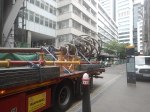
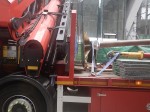
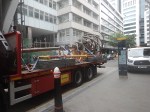

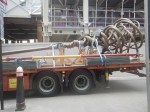
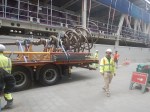
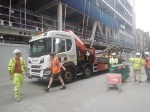

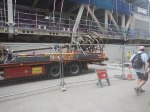
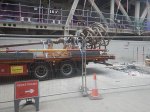
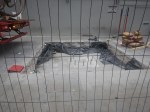



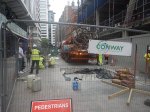







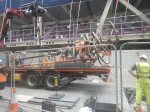

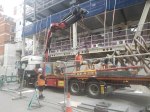

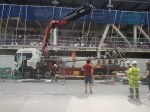

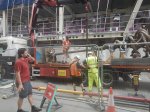

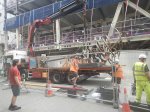

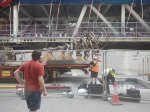




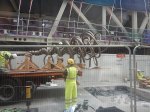
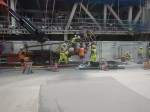






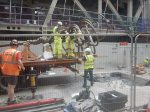


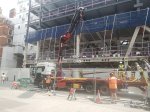
















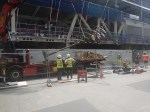


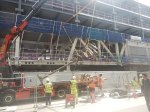







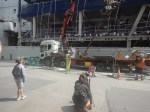







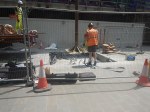















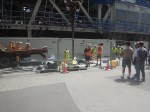







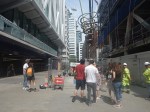




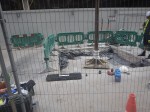



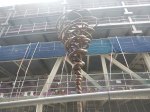


Note.
- The sculpture, which is in bronze and entitled Manifold (Major Third) 5:4, is by Conrad Shawcross, who I talked about briefly in Job Done – I’ve Now Had My First Covid-19 Vaccination.
- Conrad is the guy in red t-shirt, who can be seen in several images.
- I’ve never seen a large sculpture installed before and everything went smoothly!
I have some thoughts.
More On The Sculpture
This page on Art On The Underground is entitled Manifold (Major Third) 5:4, where this description is given.
Manifold (Major Third) 5:4 by British artist Conrad Shawcross RA will be found outside the western entrance to the Elizabeth line station at Liverpool Street later this year. The artwork is a vast bronze sculpture representing a chord falling into silence extrapolated from observations of a Victorian pendulum-driven drawing machine known as a harmonograph, which was instrumental in the birth of the science of synaesthesia. This sculpture is the physical incarnation of the mathematics within a chord.
Note that I am of Conrad’s father’s generation and had a large Meccano set, like many of that generation. I must have built four or five Meccanographs, which were a harmonograph, built out of Meccano.
Bronze
The sculpture is in bronze, which is mainly an alloy of copper and tin.
My uncle; Leslie was an artist, who had won a scholarship to the Slade before the Great War, although he earned his living as an engineer. I do have two of his drawings, of my mother and his wife.
But he was also a capable sculptor, and sculpted and cast a bronze of a Hanoverian horse, which would probably be, the family possession, that C and myself would have loved to have owned. It is now owned by his granddaughter, who was also one of our bridesmaids, when we got married in 1968.
I also have another link to bronze. My father was a letterpress printer and his largest customers was a company called Enfield Rolling Mills, who rolled copper and other non-ferrous metals including bronze into various shapes.
I don’t know whether they invented the process. but sometime around 1960,Enfield Rolling Mills started to continuous cast bronze. I seem to remember that their bronze tubes were used in the original UK nuclear power stations.
Because of my father’s long-established friendship with the owner of Enfield Rolling Mills, I used to earn money there for my studies.
3D Printing
Bronze, other metals and even concrete can now be 3D printed.
I suspect we’ll see 3D printed sculptures appearing with greater regularity.
Other Materials
These pictures show Conrad Shawcross’s sculpture outside the Crick Institute.
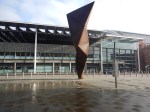


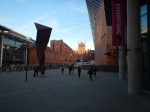
It appears to be made out of weathered steel, which is often seen used in railway bridges and other structures.
In Denmark Hill Station – 4th September 2021, I talk about how the roof at Denmark Hill station is made out of steel covered with solar panels.
Could outdoor sculptures be made with steel covered in solar panels?
Hydrogen Trains Are To Roll Between Stade And Bremervörde
The title of this post is the same as part of the title of this article on Hydrogen Central.
The original title mentions Switzerland, but Bremervörde is in Germany to the North-West of Hamburg.
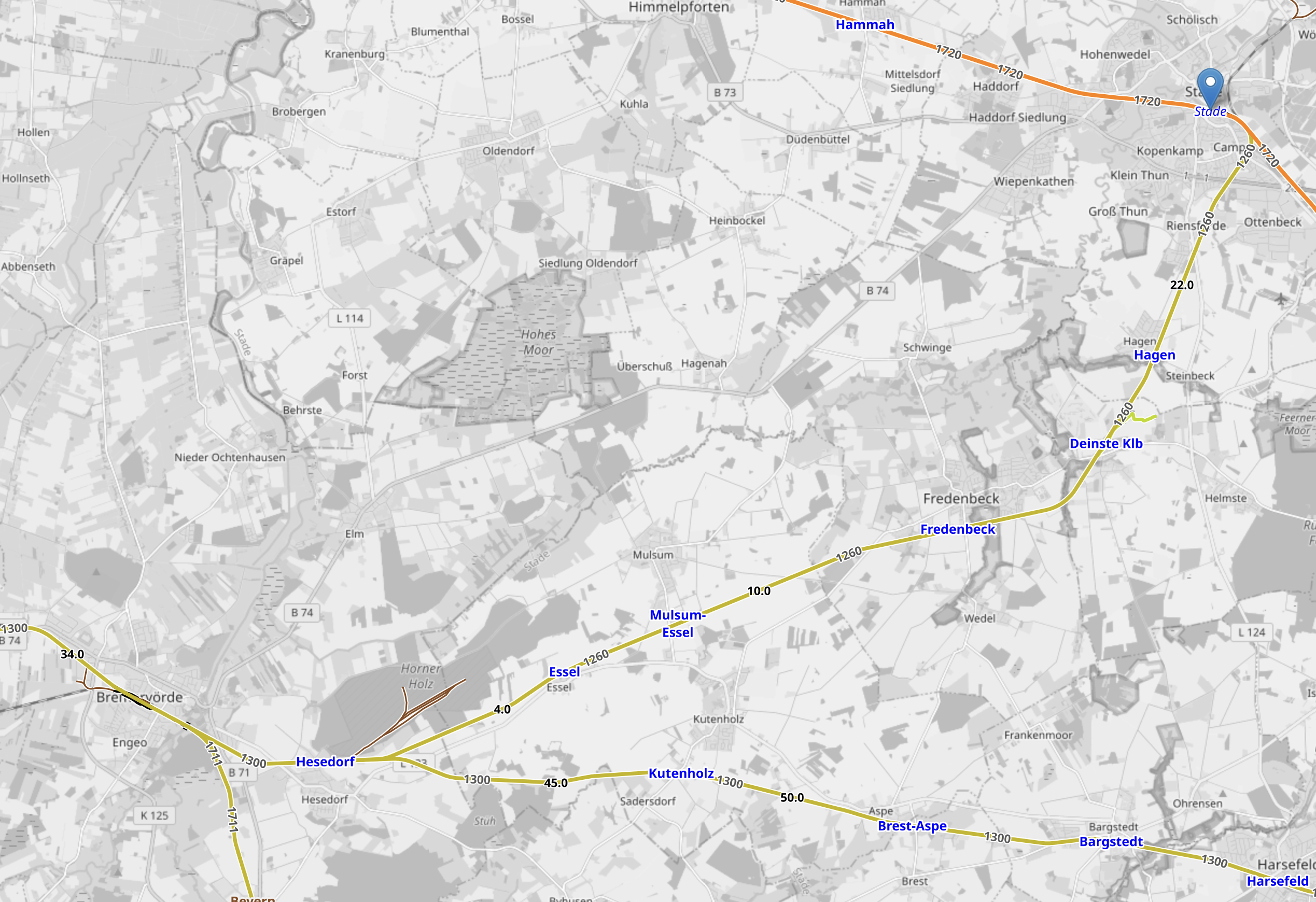
This map from OpenRailwayMap shows the route.
Note.
- Stade is in the North-East corner of the map and marked with a blue arrow.
- Stade station is on the Hamburg S-Bahn and has an hourly fast train between Hamburg and Cuxhaven.
- Bremervörde is in the South-West corner of the map, where the various routes converge.
- Bremervörde station is on the Buxtehude-Cuxhaven Line which is run by the hydrogen-powered Alstom Coradia iLint trains.
- Bremervörde appears to be, where the hydrogen-powered trains are serviced and refuelled.
- Currently, there are no passenger trains between Stade and Bremervörde, except at the weekends, when a heritage service called the Moor Express runs between Bremen Hauptbahnhof and Stade via Bremervörde.
- Freight trains also operate between Stade and Bremervörde.
At first sight it looks like the Stade and Bremervörde route, could be an ideal one to run with hydrogen-powered iLint trains.
- Servicing and refuelling of the trains could be shared with the existing Buxtehude-Cuxhaven service.
- The new service would probably need a few extra identical trains.
- The track is already in use, so probably wouldn’t need too much work.
- As some of the stations are in use by the Moor Express, there may not need to be too much work to bring them up to the required standard.
This re-opening, illustrates the advantage of having a fully-certified, independently-powered train, that can be deployed on non-electrified lines.
SSE Renewables Calls For More Use Of Non-Price Criteria In Offshore Wind Auctions
The title of this post, is the same as that of this article on offshoreWIND.biz.
This is the sub-heading.
SSE Renewables is calling on European governments and regulators and internationally to make greater use of non-price criteria (NPC) in offshore wind energy auctions, whether for seabed or for contracts for difference (CfD).
This is the first paragraph.
The renewable energy company said that the use of non-price criteria in auctions for new offshore wind can help support a sustainable renewable energy sector that delivers long-term value for society.
This document on the SSE Renewables web site is entitled Non-Price Criteria In Renewables Auctions and these are the points from the Executive Summary from the document.
- Use of non-price criteria (NPC) in auctions is important to deliver renewables projects which are deliverable, on time and on budget, and provide long term value to society and the environment.
- NPC must be well-designed, carefully implemented, with transparent assessment and monitoring of commitments to avoid overcomplication and risk of legal challenges.
- Seabed leasing auctions for offshore wind are best suited for use of NPC, as it is early enough in the development stage for commitments to be delivered; and avoids having to rely on purely financial bidding which risks adding to the cost of offshore wind.
- The most appropriate NPC are track record and deliverability of projects. Beyond that, criteria related to sustainability (circularity; workforce and skills); ecological protection and enhancement; and supply chain development.
- NPC in new offshore wind markets should be focused on deliverability and track record, and included as a pre-requisite to participate, rather than a point of competition.
- More diverse non-price criteria are best suited to mature offshore wind markets where there will generally be more competition from developers to build a project.
- It is more complicated to apply non-price criteria into offtake (CfD) auctions, with re-ranking of bidders the best approach to properly incentivise the right behaviour.
- It is important that there is transparency of how successful bidders were scored against NPC; what commitments have been made and how they will be held accountable for delivery at different milestones.
Note.
- It is good to see phrases like “track record and deliverability of projects” being embedded in this list of points.
- As a designer of successful project management software, I know the importance of this.
- I believe, that SSE Renewables are right to desire wider criteria for offshore wind energy auctions.
I suspect too, that there are software ideas in my past, that would make the development of offshore wind easier and more predictable.
Shell And Eneco Joint Venture Looks To Build Greener Offshore Wind Farm
The title of this post, is the same as that of this article on offshoreWIND.biz.
This is the sub-heading.
Ecowende, the joint venture (JV) of Shell and Eneco, has unveiled plans for building an offshore wind farm that will be in harmony with nature, with minimal impact on birds, bats, and marine mammals.
This is the first paragraph.
Ecowende, which presented its holistic approach at WindDay 2023, said it is going to implement various innovations, large-scale mitigating and stimulating ecological measures, and an extensive above and under-water monitoring and research programme.
This is all good stuff.
These two paragraphs outline some ideas that will be tried.
Specific measures include increasing the height of the lowest tip of the rotor blades, creating a corridor to Natura 2000 area by placing the turbines extra far apart, and an option to bring the turbines to a standstill that adapts to the flight movements of birds in the wind farm.
This way, Ecowende expects to minimise the number of bird and bat collisions.
The Natura 2000 areas are described in this web site.
Other innovative ideas are described in these two paragraphs.
Biodegradable reef structures are being constructed using fruit trees sourced from Dutch fruit farms. These tree reefs offer a place for fish to shelter and reproduce, according to the press release.
Ecowende said it will also install various forms of eco-friendly erosion protection and the oyster larvae network will be expanded to spread the native flat oyster population.
It certainly looks like Ecowende are making sure, that Just Stop Oil’s offshoot; Just Stop Wind doesn’t take root!
Climate Change: Y Bryn Wind Farm Aids Net Zero Aim – Developer
The title of this post, is the same as that of this article on the BBC.
This is the sub-heading.
A new onshore wind farm could help Wales move towards its net zero target by 2050, say developers.
These two paragraphs outline the scheme.
But some local people called the Y Bryn plan between Port Talbot and Maesteg a “blight on the landscape”.
The plan, first proposed in 2021, now includes 18 turbines up to 250m (820ft), rather than the original 26.
I feel that we need to develop renewable energy all round the UK.
This project, is obviously felt by the developers to be a serious proposition, judging by the very professional web site.
Some places like the Midlands and the South of England are a long way from large offshore wind and nuclear developments, but Port Talbot and Maesteg may be close enough to planned offshore wind farms, that this wind farm may need not to be developed.
I shall be following this development.
Southern Baptists Expel US Churches With Female Pastors
The title of this post, is the same as that of this article on the BBC.
This is the sub-heading.
The US’s largest Baptist denomination has voted to expel two churches for having female pastors.
These paragraphs outline the article.
A vote by Southern Baptist Convention (SBC) members found Southern Californian megachurch Saddleback and Kentucky’s Fern Creek Baptist Church were “not in friendly cooperation” with SBC, the Baptist Press reported.
SBC’s mission statement says the office of pastor should be “limited to men.”
Fern Creek’s pastor told CBS News it was a “sad day for Southern Baptists”.
I must admit I’m not religious and only enter rarely enter a church, cathedral or other place of worship.
I suspect that the last few religious services, that I have attended have been funerals and I can’t remember one with a male celebrant.
In the parish, where I live, we used to have a female vicar but she has been promoted and we now have a male vicar.
Should the change either way matter to anyone? It’s surely about the quality of the work they do!
Don’t Call Them illegal Immigrants, Sadiq Khan Tells Civil Servants
The title of this post, is the same as that of this article in The Times.
These three paragraphs outline Khan’s new instructions to civil servants.
Sadiq Khan has told civil servants not to use the term “illegal migrants” but instead use “undocumented” migrants or those “with insecure immigration status”, according to internal guidance.
Produced for City Hall workers, the leaked inclusivity guide tells employees that instead of using “men and women’” they should say “people” or “Londoners”. It also advises the estimated 1,300 people who work for the Greater London Authority that the terms “male” and “female” are “dated and medicalised”.
“Similarly, instead of ‘ladies and gentlemen’ say something that doesn’t exclude non-binary people,” it reads.
In the 1970s, I can remember C and myself listening to a magnificent play on BBC Radio 4, by Václav Havel called The Memorandum.
The Wikipedia entry says this about the play.
The play is a black comedy that parodies bureaucracy and conformity. Havel wrote it prior to the Prague Spring of 1968 as an ironic satire dissenting against communist rule. Despite its veiled themes, the play was approved by government censors and published. The Memorandum centers on the introduction of a new language, “Ptydepe”, that is meant to make work more efficient despite having the opposite effect. Sam Walters considers The Memorandum to be Havel’s masterpiece.
Khan has obviously seen the play and feels he should sharpen up his act.
A Cute Refuse Truck
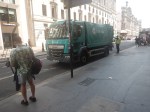
I took these pictures on Moorgate.


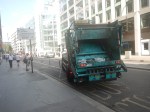
Note.
- This truck was built on a DAF LF chassis.
- It normally has a Cummins B-series diesel engine.
- It looks like it was registered in late 2022.
Some DAF LF chassis have a hybrid transmission.
I have a few thoughts.
Cummins B Series Engine
The Wikipedia entry for the Cummins B Series engine starts like this.
The Cummins B Series is a family of diesel engines produced by American manufacturer Cummins. In production since 1984, the B series engine family is intended for multiple applications on and off-highway, light-duty, and medium-duty. In the automotive industry, it is best known for its use in school buses, public service buses (most commonly the Dennis Dart and the Alexander Dennis Enviro400) in the United Kingdom, and Dodge/Ram pickup trucks.
Since its introduction, three generations of the B series engine have been produced, offered in both inline-four and inline-six configurations in multiple displacements.
Note.
- It is a very versatile engine.
- When I did some data analysis work for Cummins about twenty years ago, they told me, that they are happy to create a new configuration of their engines for a new application.
- Engines for the UK are made in Darlington.
- A version of the B series engine is used in London’s New Routemaster buses.
Cummins have made a lot of these engines.
Cummins And Hydrogen
Cummins realise they have a lot to lose, as the world decarbonises and doesn’t need diesel engines anymore.
Cummins have adopted the hydrogen route to zero-carbon with a large degree of enthusiasm.
- In 2019, they took a majority stake in hydrogen company; Hydrogenics.
- In Cummins Fuel Cell Technology Powers Coradia iLint Fleet In Germany, I described how Cummins supply the fuel cells for Alstom’s hydrogen trains in Germany.
- In Electrolyser System To Linde For Green Hydrogen Production In Niagara Falls, New York, I describe how Cummins are providing a 35 MW hydrogen electrolyser .
- In Cummins Shows Hydrogen Internal Combustion-Engined Concept Truck At IAA Transportation Exhibition, I describe how Cummins have developed and released a powerful hydrogen internal combustion engine based on the B series.
I believe that in Ricardo Supports Industry Leaders To Develop Innovative Dedicated Hydrogen Engine, I talk about the most significant development involving Cummins and hydrogen.
This is how I started the post.
The title of this post, is the same as that of this press release from Ricardo.
This is the sub-heading.
Ricardo, a global strategic, environmental, and engineering consulting company, has delivered a hydrogen-fuelled research engine to global engine specialist Cummins and automotive supplier BorgWarner, as part of Project BRUNEL part funded by the Advanced Propulsion Centre (APC)
These four paragraphs outline the project.
Cummins is a global specialist in diesel and alternative fuel engines and generators, and related components and technology. BorgWarner is an automotive tier 1 supplier and specialist in the design and manufacture of systems for electrified and conventional propulsion types, that includes injection equipment for conventional and renewable fuels. BorgWarner recently announced the intention to spin off its Fuel Systems segment. The intended company name is PHINIA Inc. PHINIA is expected to be a product leader in fuel systems, starters, alternators and aftermarket distribution.
The project aims to support internal combustion engine (ICE) sub-system suppliers to increase their use of hydrogen as an alternative zero-emissions fuel solution across the light commercial vehicle market.
The engine is specifically designed to burn only hydrogen – with no supporting fuels that could give rise to any carbonaceous, or excessive air quality emissions.
Experts in hydrogen technology and integration, Ricardo has provided an engine based upon its world-renowned series of single cylinder research units, which can help the research teams evaluate a wide variety of fuels. The engine is designed to help engineers evaluate a variety of injector types and will support increased fuel efficiency, reduced air quality emissions and the move towards carbon-free heavy-duty propulsion.
Reports of the death of the internal combustion engine are greatly exaggerated.
Cummins already have larger sizes of the B series engine that will run on hydrogen, so are BorgWarner, Cummins and Ricardo going to fill the gap in the range?
Are the companies going to develop B series hydrogen engines for the DAF LF trucks, Dodge RAM pickups and the New Routemaster buses?
North Korea: Residents Tell BBC Of Neighbours Starving To Death
The title of this post, is the same as that of this article on the BBC.
This is the sub-heading.
People in North Korea have told the BBC food is so scarce their neighbours have starved to death.
These are the first two paragraphs.
Exclusive interviews gathered inside the world’s most isolated state suggest the situation is the worst it has been since the 1990s, experts say.
The government sealed its borders in 2020, cutting off vital supplies. It has also tightened control over people’s lives, our interviewees say.
How long are we going to let Kim Jong Un starve his people?
Battery Wagons To Lower Mining Railway Emissions
The title of this post, is the same as that of this article on Railway Gazette.
These two paragraphs introduce the concept of the wagons.
Intramotev is to supply three ReVolt battery wagons to enable regenerative braking on a industrial railway.
The battery and automation technology company said this would be the first deployment of self-propelled battery-electric wagons in a traditional freight train, with regenerative braking and battery technology used to reduce locomotive diesel consumption and thus costs and emissions.
It may seem an unusual concept, but it’s one of those ideas, where if the maths and the costs stack up, it will work.
Intramotev’s web site gives more details on their Product & Technology page, where this is said.
Combining the low energy usage of steel wheels on steel rails with the efficiency of electric drivetrains to create the most energy-efficiency overland transport.
This article on electrek is entitled A Company Is Developing Self-Propelled, Battery-Electric Railcars You Can Control With Your Phone has two paragraphs, which describe their two current products.
In a few short years, the company has been able to develop unique freight solutions using software and battery-electric propulsion technology. This includes the TugVolt battery electric railcar (seen above and below), which can decouple from the consist (the group of railcars as a whole) and operate independently for first and last mile legs.
The company has also developed a ReVolt railcar that can be positioned to stay within the train’s consist and capture energy using regenerative braking to reduce diesel consumption from the line’s locomotive.
As a Control Engineer, I feel strongly, that this technology would work very well in the UK.
 The Anonymous Widower