Equinor Is Counting On Tax Breaks With Plans For North Sea Oilfield
The title of this post, is the same as that, of this article in The Times.
These paragraphs outline the project.
Norway’s state-owned oil company is pushing ahead with plans to develop Britain’s biggest untapped oilfield after confirming that it stands to benefit from “helpful” tax breaks introduced alongside the windfall levy.
Equinor could lower its windfall tax bill by as much as £800 million in the years to come thanks to investment relief if it develops the Rosebank field, according to Uplift, a campaign group.
Rosebank, to the west of Shetland, could cost £4.1 billion to develop and may account for about 8 per cent of British oil output in the second half of this decade, producing 300 million barrels of oil by 2050.
Equinor said yesterday that it hoped to take a final investment decision on the field by next year and to start production by 2026. It has applied for environmental approval from the government.
Needless to say Greenpeace are not amused.
We Have Both Long Term And Short Term Energy Problems
In the UK, energy is generally used as electricity or gas and to power industry and transport.
Electricity
In the long term, we need to decarbonise our electricity production, so that all our electricity is produced from zero-carbon sources like nuclear, solar, tidal, wave and wind.
- As I write this, our electricity production is around 26.8 GW of which 62 % is coming from renewable sources.
- Surprisingly around 45 % of the renewables is coming from solar. Who’d have ever thought that in an predominantly-grey UK?
- As we have committed to around 50 GW of wind power by 2030 and the 3.26 GW Hinckley Point C will be on stream by the end of the decade, the long term future of electricity production looks to be fairly secure.
- It would be even more secure, if we added around 600 GWh of storage, as proposed in Highview Power’s Plan To Add Energy Storage To The UK Power Network, which would be used as backup when the sun doesn’t shine and the wind doesn’t blow.
It looks to me, that our long term electricity problem is capable of being solved.
For the next few years, we will need to rely on our existing gas-fired power stations until the renewables come on stream.
Gas
Gas could be more of a problem.
- I wouldn’t be surprised to see a lot of resistance to the replacement of natural gas for heating, cooking and industrial processes.
- Natural gas is becoming increasingly difficult to source.
- As I said in the previous section, we will still need some gas for electricity generation, until the massive wind farms are completed.
On the other hand, there is HyDeploy.
I like the HyDeploy concept, where up to 20 % of hydrogen is blended with natural gas.
- Using a blend of hydrogen and natural gas doesn’t require any changes to boilers, appliances or industrial processes.
- The hydrogen blend would make the most of our existing world class gas network.
- Customers do not require disruptive and expensive changes in their homes.
- Enormous environmental benefits can be realised through blending low carbon hydrogen with fossil gas.
- The hydrogen blending could happen, where the natural gas enters the network at terminals which receive gas from the UK continental shelf or where liquified natural gas is imported.
- Alternatively, it may be possible to surround a gas production platform with an offshore wind farm. This could enable hydrogen production and blending to be performed offshore.
The amount of gas we need would drop by twenty percent.
In The Mathematics Of Blending Twenty Percent Of Hydrogen Into The UK Gas Grid, I calculated that 148.2 tonnes per hour of hydrogen would be needed, to blend twenty per cent of hydrogen into UK natural gas supplies.
I also said this about the electricity needed.
To create 148.2 tonnes per hour of hydrogen would need 8,180.64 MW of electricity or just under 8.2 GW.
I also calculated the effect of the hydrogen on carbon dioxide emissions.
As twenty percent will be replaced by hydrogen, carbon dioxide emission savings will be 24,120,569.99 tonnes.
I believe that generating the 8.2 GW of electricity and delivering the 148.2 tonnes per hour of hydrogen is feasible.
I also believe that HyDeploy could be a valuable way to reduce our demand for natural gas by twenty per cent.
Transport
Not every vehicle, ship, aircraft and train can be powered by electricity, although batteries will help.
Hydrogen will help, but we must also develop our capability for sustainable fuels made from rubbish diverted from landfill and biologically-derived ingredients like used cooking oil.
Summing Up Our Long Term And Short Term Energy Problems
We obviously have got the problem of creating enough renewable energy for the future, but there is also the problem of how we keep everything going in the interim.
We will need gas, diesel, petrol and other fossil fuel derived products for the next few years.
Is Rosebank Our Short Term Solution?
This page on the Equinor web site is entitled Rosebank Oil And Gas Field.
This introductory paragraph described the field.
Rosebank is an oil and gas field 130 kilometres off the coast of the Shetland Islands. Equinor acquired the operatorship in 2019 and has since then been working to optimise and mature a development solution for the field together with our partners.
Could the field with its resources of oil and gas, be just the sort of field to tide us over in the next few difficult years.
But given the position, it will surely not be an easy field to develop.
These two paragraphs set out Equinor’s strategy in developing the field.
Equinor believes the field can be developed as part of the UK Government North Sea Transition deal, bringing much needed energy security and investment in the UK while supporting the UKs net zero target. According to a socioeconomic study (see link below) based on data and analysis by Wood Mackenzie and Voar Energy, if sanctioned Rosebank is estimated to create GBP 8.1 billion of direct investment, of which GBP 6.3 billion is likely to be invested in UK-based businesses. Over the lifetime of the project, Rosebank will generate a total of GBP 24.1 billion of gross value add (GVA), comprised of direct, indirect and induced economic impacts.
Equinor together with our partners are working with the supply chain to ensure that a substantial part of investment comes to Scotland and the UK. A supplier day was held in Aberdeen in partnership with EIC in order to increase the number of local suppliers to tender.
Note.
- The sums that could accrue to the UK economy are worthwhile.
- The Government North Sea Transition Deal is worth a read.
- A lot of the deal is about converting oil and gas skills to those of a renewable energy economy.
Planned properly, we should get all the oil and gas we need to get through difficult years.
I particularly like these two paragraphs, which are towards the end of the Government North Sea Transition Deal.
Through the Deal, the UK’s oil and gas sector and the government will work together to deliver
the skills, innovation and new infrastructure required to decarbonise North Sea oil and gas
production as well as other carbon intensive industries. Not only will it transform the sector in
preparation for a net zero future, but it will also catalyse growth throughout the UK economy.
Delivering large-scale decarbonisation solutions will strengthen the position of the existing UK
energy sector supply chain in a net zero world, securing new high-value jobs in the UK,
supporting the development of regional economies and competing in clean energy export
markets.
By creating the North Sea Transition Deal, the government and the UK’s oil and gas sector are
ambitiously seeking to tackle the challenges of reaching net zero, while repositioning the UK’s
capabilities to serve the global energy industry. The Deal will take the UKCS through to
maturity and help the sector pivot towards new opportunities to keep the UK at the forefront of
the changing 21st century energy landscape.
I believe that developing Rosebank could enable the following.
- The oil and gas we need in the next few years would be obtained.
- The economic situation of the UK would be improved.
- The skills and techniques we need to decarbonise the UK would be delivered.
- Net-zero would be reached in the required time.
- Jobs will be created.
- The export of surplus oil and gas.
I strongly believe that developing the Rosebank field would be worthwhile to the UK.
I have some other thoughts.
Electrification Of Platforms
This page on the Equinor web site is entitled Electrification Of Platforms.
This paragraph explains what that means.
Electrification means replacing a fossil-based power supply with renewable energy, enabling a reduction in greenhouse gas emissions. Equinor is fully committed to reducing emissions from our offshore oil & gas production.
Note.
- Typically, platforms use gas turbine engines running on natural gas to provide the electricity needed on the platform.
- Platforms in the future will get their electricity from renewable sources like wind and will have an electricity cable to the shore.
- Rosebank will be powered in this way.
This document on the Equinor web site is entitled Rosebank: Investing In Energy Security And Powering A Just Transition, which has a section called How Is Rosebank Different?, where this is said.
The key difference of Rosebank compared to other oil fields is that it
aims to draw on new technology applications to help reduce carbon
emissions from its production, through FPSO electrification.Building offshore installations that can be powered by electricity reduces
reliance on gas powered generators which are the biggest source
of production emissions. The electrification of UKCS assets is vital to
meeting the North Sea Transition Deal’s target of reducing production
emissions by 50% by 2030, with a view to being net zero by 2050.Electrification of Rosebank is a long-term investment that will drastically
cut the carbon emissions caused by using the FPSO’s gas turbines for
power. Using electricity as a power source on Rosebank results in a
reduction in emissions equivalent to taking over 650,000 cars off the
road for a year compared with importing 300 million barrels of oil from
international sources.
Note.
- An FPSO is a Floating Production Storage And Offloading Unit, which is the method of production, that Equinor have chosen for the Rosebank field.
- If we are going to extract fossil fuels then we must extract them in a manner, that doesn’t add to the problem by emitting extra carbon dioxide.
- We will probably extract fossil fuels for some years yet, as they are the easiest route to some important chemicals.
- I also believe that we will increasingly find uses for any carbon dioxide captured in combustion and chemical processes.
I already know of a farmer, who heats greenhouses using a gas-powered combined heat and power unit, who pipes the carbon dioxide to the tomatoes in the greenhouses.
Despite what Greenpeace and others say, carbon dioxide is not all bad.
Energy Security
The last page of this document on the Equinor web site is entitled Rosebank: Investing In Energy Security And Powering A Just Transition, is entitled Energy Security.
Look at the numbers.
- £8.1 billion – Total field investment with 78% of this being spent in the UK
- 1600 – Estimated peak number of direct FTE jobs
- £24.1 billion – Estimated gross value add
- 8 % – Of UK oil production from Rosebank to 2030
- 39 million cubic feet per day – Average daily gas production over the first 10 years of field life, equivalent to almost twice Aberdeen’s daily gas consumption
- 250kt CO2 – Carbon avoided by reusing existing FPSO
And if you have time read it fully.
Could The Rosebank FPSO Be Powered By Floating Offshore Wind?
Floating wind turbines are now being installed around the world.
- They can use the largest turbines.
- Some designs perform in the roughest of seas.
- They have a high capacity factor.
- They are generally brought into a suitable port for servicing and updating.
- Floating wind farms can be connected to floating substations
There is at least 20 GW of floating wind turbines planned for UK waters.
So could an appropriately-sized floating wind farm be placed near the Rosebank FPSO to provide it with electricity?
I don’t see why not, if there were some energy storage in the system, for when the wind wasn’t blowing.
Floating Offshore Wind Close To The Rosebank FPSO Would Be Challenging
Rosebank is an oil and gas field 130 kilometres off the West coast of the Shetland Islands.
That would be a challenging location for floating wind turbines.
But solving the installation problems would set precedents for floating wind farms all over the world.
Could The Rosebank FPSO Handle Hydrogen From Floating Offshore Wind?
It would surely be possible to put an electrolyser in the system somewhere, so that hydrogen was also stored in the tanks of the FPSO.
I also don’t think it unfeasible, that twenty percent of hydrogen could be blended into the natural gas to create the low-carbon natural gas, that has been proposed by the HyDeploy project.
Long Duration Energy Storage Would Reduce The UK’d Gas Usage By 10 Megatonnes By 2035
The title of this post, is the same as that of this press release on the Highview Power web site.
The press release gives these three bullet points.
- UK has wasted over 1,300 GWh of wind since the start of the energy crisis in September 2021 due to an inability to store excess generation – enough to power 500,000 homes a day.
- A new survey from YouGov, commissioned by Highview Power, reveals that 43% of UK adults think the UK imports too much gas, rising to 54% among Conservative voters at the 2019 General Election.
- Long-duration energy storage (LDES) would reduce UK’s gas usage by 10 megatonnes in 2035 and save the grid around £2 billion a year, passing on savings of up to £50 a year.
In Highview Power’s Plan To Add Energy Storage To The UK Power Network, I talked about Highview Power’s possible 30 GWh CRYOBattery.
This project has not been fully revealed and I expect something will be announced before the end of this year.
Rio Tinto’s Big Energy Project Attracts Multiple Bidders
The title of this post, is the same as that of this article on Mining Technology.
The article has this subtitle.
The company seeks to offset its power consumption with a massive renewable plant.
These two paragraphs introduce the project.
British and Australian mining giant Rio Tinto has attracted multiple bids for a massive renewable power infrastructure project.
The company currently seeks suppliers to build up to 4GW of renewable generation for its alumina and aluminium operations in Queensland, Australia. Speaking to the Melbourne Mining Club, the company’s CEO of Australia, Kellie Parker, said that it had received proposals for “a lot more than 4GW”. Parker also said that construction of the project “would not be easy” due to the cost of construction for Australian projects.
In the UK, we may talk of wind farms like Hornsea, which could produce 6 GW, but the Aussies can produce similar amounts of energy from the sun.
This will be the fourth major renewable power development in Australia to be announced in the last few months.
- The Asian Renewable Energy Hub could generate up to 26 GW in Western Australia.
- I wrote about Andrew Forrest’s ambitions in Andrew Forrest Snaps Up Pilbara And Gascoyne Cattle Stations For Green Energy Production.
- The Australia-Asia Power Link will export solar power from Australia to Singapore.
Australia is certainly looking to power the world.
Energy Storage
Rio Tinto are also talking about energy storage, as other systems of this type and size do. Could this be one of a number of Australian projects mentioned on the Highview Power web site?
High Speed Two Works Between Denham And West Ruislip Stations – 5th August 2022
I took these pictures as my Chiltern Train returned from Birmingham Moor Street station tonight.













Note that the pictures were taken looking to the North of the Chiltern Main Line.
The Birmingham Bull – 5th August 2022
The non-human star of the Opening Ceremony of the 2022 Commonwealth Games in Birmingham was a mechanical bull.
This article on the BBC is entitled Commonwealth Games: Scots Creator Reveals Secrets Of Metal Bull.
These three introductory paragraphs give an overview of the design.
The secrets of the mechanical bull that wowed audiences during the opening ceremony of the Commonwealth Games have been revealed by its Scottish creator.
The 10m high scrap metal sculpture was one of the stars of the celebration in Birmingham’s Alexander Stadium.
Michael Dollar, of creative model makers Artem, said it took six people to operate the giant structure.
The BBC also revealed today, that the bull would be parked for a few days in Centenary Square outside the Library of Birmingham.
So as my day had fallen apart, I got on a Chiltern train to Birmingham and took these pictures.




























Note.
- The first picture has the The Library Of Birmingham in the background, with its lattice frontage and gold dome.
- The Bull seems to have been built on a loader chassis.
- There were a large crowd in Centenary Square looking at the Bull.
I have never seen a public work of art surrounded by such a crowd, most of whom were taking selfies or traditional pictures.
This article on the BBC is entitled Birmingham Commonwealth Games: Ceremony Bull To Stay.
The BBC article says this about the future of the bull.
A giant mechanical bull that became the star of the Birmingham Commonwealth Games opening ceremony it set to stay in the city.
The 10m sculpture is on display in Centenary Square after its debut last week, although its future has been less clear.
Largely made of foam, it was due to be dismantled at the end of the Games, sparking public outcry.
But Birmingham City Council has confirmed the bull has won a reprieve.
It will stay in the square until the end of September before being moved indoors.
This wonderful work of engineering art, is far too good and is now too well-loved to be scrapped.
As it needs to go inside, why not bring it inside High Speed Two’s new Curzon Street station, to greet passengers visiting Birmingham?
Barry Station – 3rd August 2022
It was announced last week, that Barry station, now had a step-free bridge, so on my trip to Wales on Wednesday, I had to go and take a look.







It looks like the builders are still working on the site. However, the bridge was delivered early.
Cardiff Central Station’s New Entrance
As I passed through Cardiff Central station, I took these pictures of their new Southern entrance.





Although, it’s mainly for the car park, it may have its uses for me, as there is a ticket office to buy the Day Ranger ticket, I generally use to explore the valleys.
UK CfD Round 4 Offshore Wind Projects Power Forward
The title of this post, is the same as that of this article on offshoreWIND.biz.
These are the first two paragraphs.
All 99 contracts offered through the fourth Allocation Round (AR4) of the UK government’s Contracts for Difference (CfD) scheme have now been signed and returned to Low Carbon Contracts Company (LCCC).
A total of 93 individual projects across Britain will now proceed to work with LCCC to meet the contractual milestones specified in the CfD, supporting projects’ development and the delivery of almost 11 GW of clean energy. The first AR4 projects are due to come online in 2023-24.
It does look like it’s a case of all systems go!
In Will We Run Out Of Power This Winter?, I estimated that these Round 4 projects would come onstream as follows.
- 2024 – Round 4 Solar – 125.7 MW
- 2025 – Round 4 Solar – 1958 MW
- 2025 – Round 4 Onshore Wind – 888 MW
- 2025 – Round 4 Energy from Waste – 30 MW
- 2026 – Round 4 Tidal Stream – 5.62 MW
- 2027 – Round 4 Tidal Stream – 35.2 MW
- 2027 – Round 4 Floating Offshore Wind – 32 MW
- 2027 – Round 4 Offshore Wind – 6994 MW
These are totals for the next four years from these contracts.
- 2024 – 125.7 MW
- 2025 – 2876 MW
- 2026 – 5.62 MW
- 2027 – 7061.2 MW
This is a total of over 10 GW.
Extending The Elizabeth Line – High Speed Trains On The Elizabeth Line
This may seem rather fanciful, but could it be the way to maximise the use of the Elizabeth Line?
- I feel that the Elizabeth Line will eventually serve other destinations like Basingstoke, Beaulieu, Oxford, Southend and Swindon.
- The capacity of the Elizabeth Line will grow to over thirty trains per hour (tph) under control of digital signalling.
These are a few thoughts.
The Design Of The Trains
As any train would have to be compatible with the platform-edge doors in the central tunnel of the Elizabeth Line, the trains would have to be dimensionally identical to the current Class 345 trains.
- Nine cars
- Possibility of lengthening to ten cars.
- 204.73 metres long.
- 6 sets of doors per carriage
- Ability to run under full digital signalling.
They would be designed for a higher speed of at least 110 or 125 mph, to enable running on the fast lines of these routes.
- East Coast Main Line
- Great Western Main Line
- Midland Main Line
- West Coast Main Line
They would also be able to run at 100 mph on the Chiltern Main Line, the Great Eastern Main Line and the North Kent Line.
The faster running would ease scheduling of the trains.
Extra facilities could include.
- Toilets
- Tables
- A third-rail capability for running in Kent.
Effectively, it would be a Class 345 train with more features and considerably more grunt.
Note that in A High Speed Train With An IPEMU-Capability, I started the post with the following.
Bombardier were reported by Ian Walmsley in the April 2016 Edition of Modern Railways, to be developing Aventra, with a 125 mph capability.
Bombardier have also told me, that all Aventras will be wired so they could be fitted with on-board energy storage.
Could it be that the design of a Class 345 train could be modified to run at higher speeds? I wouldn’t be surprised.
Oxford To Southend Victoria
This could be a typical route.
- Between Oxford and Paddington, it would follow a route similar to the GWR’s Oxford service with stops at just Reading and Slough.
- At Paddington the train would take the Central Tunnel of the Elizabeth Line and travel under London, at the same speed as the other trains.
- It would emerge at Stratford and move to the Great Eastern Main Line.
- It would probably stop at Stratford, Romford, Shenfield and all stations to Southend Victoria.
Note.
- Digital signalling would enforce the precise timekeeping needed.
- Much of the Oxford and Paddington section would be up to speeds of at least 125 mph.
- Times in the Central Tunnel of the Elizabeth Line would be identical to the current Class 345 trains.
- Much of the Stratford and Southend section would be up to speeds of at least 100 mph.
I estimate that total time would be a few minutes under two hours.
Connecting To The Central Tunnel Of The Elizabeth Line At Royal Oak
I discuss this in Extending The Elizabeth Line – Connecting Great Western Main Line Services To The Central Tunnel.
Connecting To The Central Tunnel Of The Elizabeth Line At Stratford
I discuss this in Extending The Elizabeth Line – Connecting Great Eastern Main Line Services To The Central Tunnel.
Connecting To The Central Tunnel Of The Elizabeth Line At Abbey Wood
This map from cartometro.com shows the track layout at Abbey Wood.
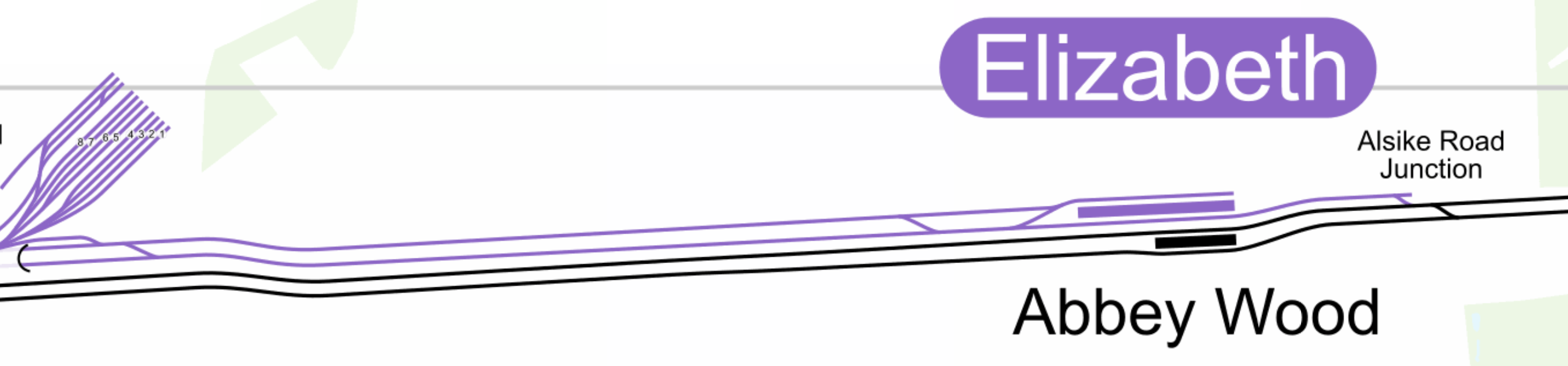
Note.
- The Elizabeth Line is shown in purple.
- The North Kent Line is shown in black.
- The North Kent Line platform to London is the Southernmost platform and is numbered 1.
- The North Kent Line platform from London is the other Southern platform and is numbered 2.
- The Elizabeth Line platforms are numbered 3 and 4.
- Platform 4 is the Northernmost platform.
At present the Elizabeth Line service to Abbey Wood station is twelve tph, with each platform handling six tph.
This picture shows trains in both Platform 3 and 4 looking towards the station buildings.

Note.
- Platform 3 is on the right.
- Platform 4 is on the left.
In Elizabeth Line To Ebbsfleet Extension Could Cost £3.2 Billion, I talk about this proposal as described in this article on Ian Visits.
One of the key features of Crossrail To Ebbsfleet (C2E) project is that instead of all trains terminating at Abbey Wood, trains will terminate as follows.
- Abbey Wood – 4 tph
- Northfleet – 4 tph
- Gravesend – 4 tph
This will mean that 8 tph would pass through Abbey Wood station.
- Platform 4 could certainly handle the four that terminated on the Elizabeth Line.
- Platform 3 would need to handle eight tph in both directions or sixteen tph to fulfil the proposed C2E service.
- This would be one train every 225 seconds.
I believe that digital signalling could handle this easily and safely.
I am fairly sure that the track layout at Abbey Wood allows eight tph to go both ways between the North Kent Line and the Elizabeth Line Central Tunnel.
The Maximum Capacity At Abbey Wood Station
Because of the current track layout at Abbey Wood, I believe that without track modifications, Abbey Wood station will not be able to handle more than 12 tph.
Thameslink
These proposed trains would also be compatible with Thameslink, as this route has no platform edge doors.
No platform extensions would be needed, as the Class 345 trains are shorter than the 12-car Class 700 trains.
If they were 125 mph trains, then this would ease timetabling on the East Coast Main Line, as the trains could mix it with the expresses on the fast lines.
Could These High Speed Trains For The Elizabeth Line Have A Cruising Speed Of 140 mph?
It is likely, when full authority digital ERTMS signalling is installed on main lines out of London, that 140 mph will be possible on some at least these routes.
- East Coast Main Line
- Great Western Main Line
- Midland Main Line
- West Coast Main Line
The extra speed would maximise capacity.
The Case Of The Disappearing Litter Bins
Coming back from Cardiff today, I had some Marks & Spencer sandwiches and some of their still lemonade, which ended up in a carrier bag.
There were no litter bins on the exit of the train I used, so I had to carry my rubbish to the Lizzie Line, where I knew there were bins.

I took this picture in May at Tottenham Court Road station.
But they were missing so I had to bring it home.
I asked one of the station guys and they said, that they kept falling off the wall.
So let’s hope that a solution can be found.
 The Anonymous Widower