When Do Mark 3 Coaches Accept The Inevitable?
What Is A Mark 3 Coach?
This is a preamble to the main post, but if it is not included, you won’t understand a remarkable engineering story about how a nearly fifty-year-old British Rail design lies at the heart of the plans for an upgraded train service on one of the UK’s most important rail lines.
The Wikipedia entry for the British Rail Mark 3 Coach , starts with these two paragraphs.
The British Rail Mark 3 is a type of passenger carriage developed in response to growing competition from airlines and the car in the 1960s. A variant of the Mark 3 became the rolling stock for the High Speed Train (HST).
Originally conceived as locomotive-hauled coaching stock, the first coaches built were for the prototype HST in 1972. Production coaches entered service between 1975 and 1988, and multiple-unit designs based on the Mark 3 bodyshell continued to be built until the early 1990s. The Mark 3 and its derivatives are widely recognised as a safe and reliable design, and most of the surviving fleet is still in revenue service on the British railway network in 2016.
The Mark 3 coach is of an older age.
- The structure was reputedly designed by traditional methods without computer.
- Salford University Engineering Department did a finite-element structural analysis on the structure a few years ago and gave it a very good rating.
- The coaches have a full monocoque construction with an all-welded mild steel stressed skin rather than aluminium.
- Many engineers and passengers feel that it is one of the best-riding coaches in the world.
- The coaches have a reputation for exceptional strength and crash-worthiness, which was proven in the Oxshott A244 Bridge Incident, where a 24 tonne cement mixer lorry, fell fifty metres directly onto a Mark 3-based Class 455 train, without any fatalities.
But in some ways though the trains most worthy characteristic, is that train refurbishment companies and their engineers can convert them to any passenger or traction specification, that an operator wants.
The Mark 3 may only be a humble railway coach, but it is one of the world’s great engineering designs.
First and MTR Take South Western
The front cover of the May 2017 Edition of Modern Railways has the usual variety of headlines to grab the atrtention of passing browsers in station newagents.
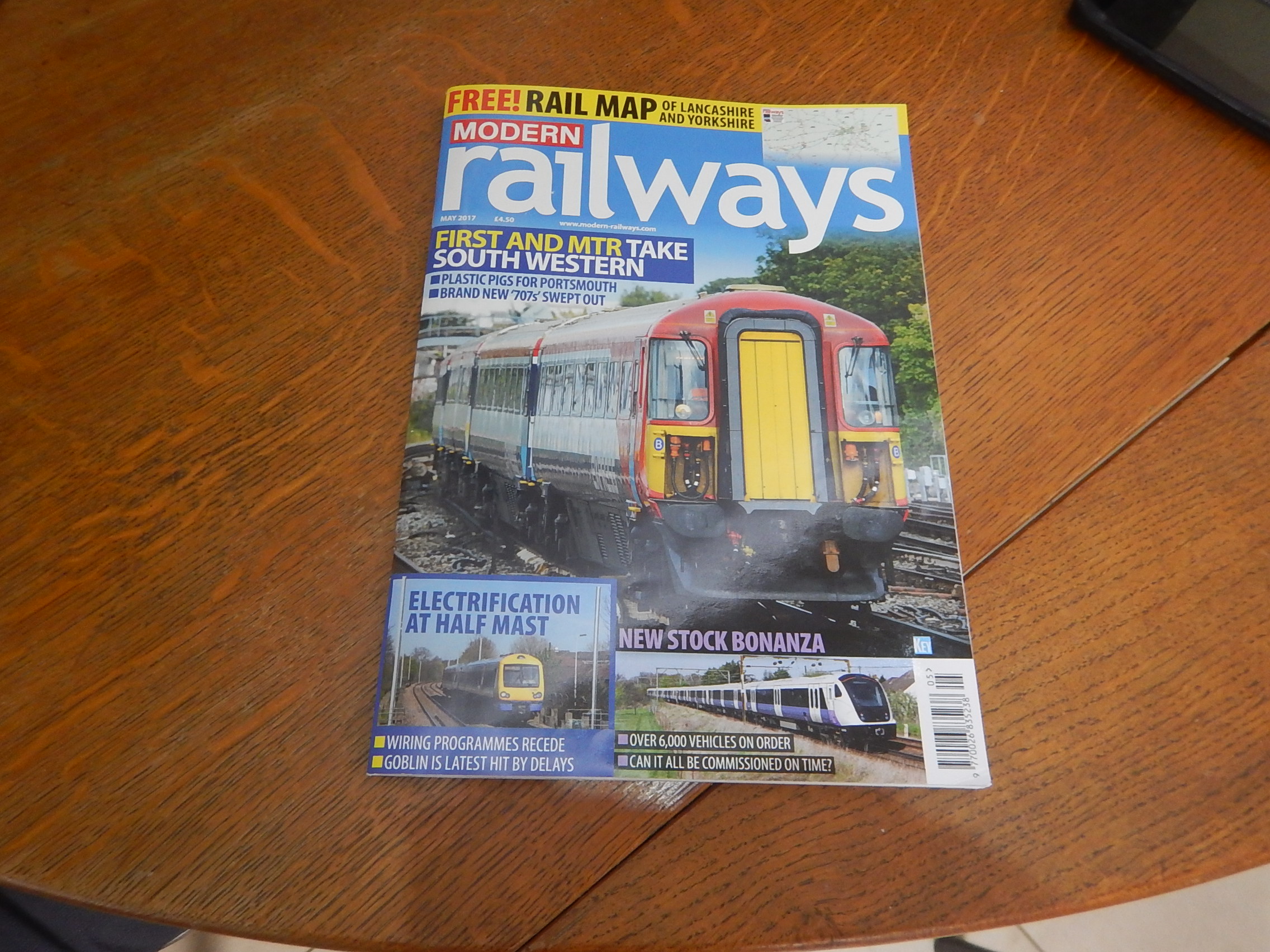
The main headline is First and MTR Take South Western with underneath it two sub-headlines of Plastic Pigs For Portsmouth and Brand New 707s Swept Out.
Further down, there is another headline of New Stock Bonanza.
Bringing Back The Class 442 Trains
Between the various headlines, is a picture, not of one of the new trains, but of one of the plastic pigs. It should be said, that this is the nickname for the Class 442 trains, built by British Rail way back in the late 1980s.
The Class 442 trains were originally built to serve the routes to Weymouth and in some ways they are the ultimate Mark 3-based design. They have proper sliding external doors, that meet all the regulations. This is an extract from Description in the Wikipedia entry for the Class 442 train.
As was common on the British Rail Southern Region, many electrical components – including traction motors and electrical control gear – were salvaged from the Class 432 units they replaced. For this reason the older 4REP and 4TC units had to be withdrawn before their replacements were built.
The Class 442 was one of the first types to make extensive use of plastics in construction, and earned the nickname among staff and rail enthusiasts of “Pigs” or “Piggies”. When they were first introduced the units were plagued by minor technical failures, but they have subsequently become among the most reliable EMUs operating in the UK
With this attitude to saving money, how did anything good ever get built?
I’ve only ever ridden in a Class 442 train once and that was to Gatwick Airport a few years ago. Using the trains on the Gatwick Express was a mistake, as the trains were not friendly to airport passengers, as the luggage space was totally inadequate.
London To Portsmouth In Class 442 Trains
But now South Western Railway are bringing the Class 442 trains back into service between London and Portsmouth.
The May 2017 Edition of Modern Railways says this about the reintroduction of the trains, under a sub-heading of Plastic Pigs’ Revenge.
The Class 442 EMUs built by British Rail for the Bournemouth-Poole-Weymouth electrification in 1988, are to be upgraded, including replacement traction equipment.
The article also mentions that on a demonstration run in April 1988, a Class 442 train claimed a world record of 108 mph for a third-rail train.
Currently, services between London and Portsmouth take the following times.
- London to Portsmouth – Fast – one hour thirty-three minutes with seven stops
- London to Portsmouth – Slow – two hours nine minutes with fourteen stops
- Portsmouth to London – Fast – one hour forty-two minutes with seven stops
- Portsmouth to London – Slow – two hours eight minutes with fourteen stops
With those journey times, I shouldn’t think that it is the easiest route to schedule given the amount of traffic at the London end of the route.
According to Modern Railways, there is an aim to save five minutes on fast services and seven minutes on slower ones.
Could this actually make the scheduling problem easier?
A fast return journey currently takes three hours fifteen minutes plus, whatever it takes to turn the train at both ends of the route. I think that this is a variable amount and is adjusted according to time of day. So knocking ten minutes off the return journey might well enable the turn-round times to be more even and create a more passenger-friendly timetable.
So how will these time savings be achieved?
Upgrading The Class 442 Trains
As I said earlier, Modern Railways are saying that the traction equipment is being replaced.
Seeing that the current traction equipment for a Class 442 train,came from a Class 432 train, which were built in the mid-1960s, I suspect the current design may be reliable, but could be improved upon, with respect to power and electrical efficiency.
The very least we will see will be new traction motors and control systems, with the probable addition of regenerative braking, where the traction motors generate electricity to slow the train.
Note.
- The current Class 442 trains do not have regenerative braking, so a lot of energy is wasted.
- The Class 444 trains which work from London to Portsmouth have regenerative braking, so obviously the track can handle the reverse currents.
So if nothing else, a new traction package which included regenerative braking, would make a sensible saving in electricity.
I suspect, there are engineers in one of the companies that specialise in upgrading traction packages, working to create the ultimate traction package for the Class 442 train. It would deliver.
- Fast acceleration and braking consistent with what is acceptable to passengers.
- Regenerative braking.
- Minimum energy usage.
Some might think a pantograph for 25 KVAC should be fitted, but I think the train is being modified to be a pure and simple; Pompey Rocket. The transformer to allow dual-voltage working would add weight and would rarely be needed.
A Train With An Engine In The Middle
The Class 442 train is unusual in that it only has one powered car and that is the piggie in the middle of each five-car train.
In A Train With The Engine In The Middle, I described the Stadler GTW, which is a three-car train, with one passenger car either side of a power module.
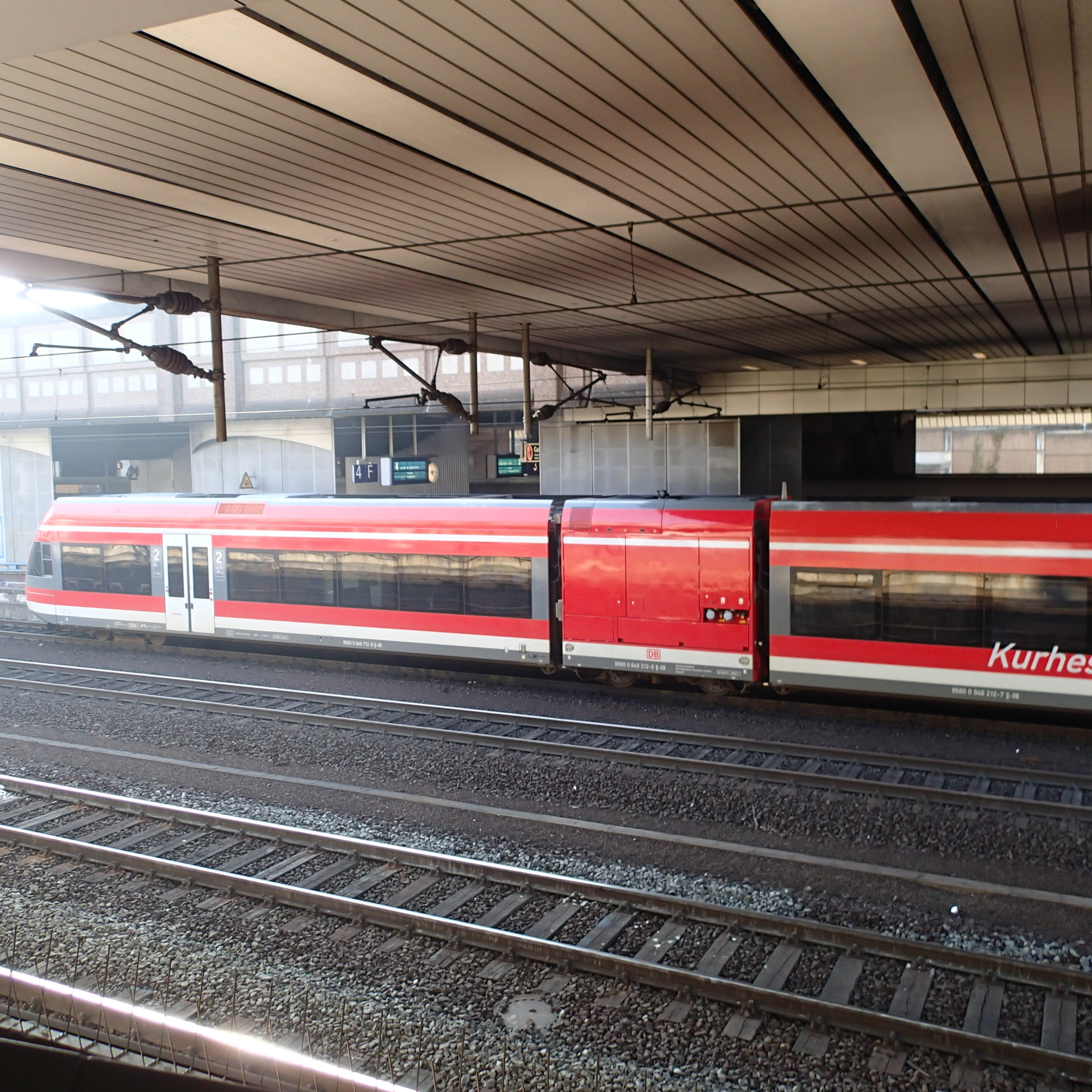
Wikipedia says this under Description for the Stadler GTW.
Although the traction is good for the powered bogies the concept has the same problem as other light railcars with the brakes on the non-powered axles having lower grip than traditional railcars. This has led to actual restrictions when leafs are on the rails as the wheel slide protection can not fully compensate the effect. The central power module has limits with heat dissipation as well which can lead into situations where the power output needs to be limited which is automatically done in this construction concept.
Perhaps because it is a heavier train, the Class 442 trains doesn’t have these problems!
I also have personal memory from about 1970.
At the time, I worked in simulation at ICI Plastics in Welwyn Garden City. I remember reading how British Rail Research at Derby had applied their analogue computer and dynamic modelling skills to the problems of why so many four-wheel freight wagons were derailing. They solved that problem and I have a feeling the work influenced the design of the running gear of the Mark 3 coach.
Could the unusual concept of the powered middle car of five have been influenced by all the research?
Incidentally, five-car Electrostars like Class 377 and Class 378 have unpowered middle cars, with most of the others powered.
Comparing power of a five-car 100 mph Class 442 train with a five-car 100 mph Class 377 train and they both have traction motors rated at a total of 1200 kW. The 442 weighs in at 199.54 long tons, as opposed to the 170.9 long tons of the Class 377 train, so it could appear that the modern train has faster acceleration.
The Class 442 Train And The High Speed Train Compared
By comparison, Wikipedia quotes the at rail power of a Class 43 locomotive as 1,320 kW.
Obviously, it was a deliberate design to put the motored car of the Class 442 train in the middle. But was it also, so that when working as a pair, you had two powerful power cars at 54 long tons separated by four lighter, but very stiff Mark 3 cars at between 35-39 long tons?
After all by the mid-1980s, British Rail had a lot of experience of running Mark 3 coaches between two powerful Class 43 locomotives, in the High Speed Train.
Surprisingly, the Class 43 locomotive is only 15 long tons heavier than the Class 442 motored car.
So could the Class 442 train be considered an electric HST, with a couple of extra cars at each end?
The dynamics could be similar and I suspect British Rail knew the dynamics of Mark 3 coaches and locomotives well.
After all, a few years later High Speed Trains on the East Coast were lengthened from 2+8 to 2+9, with it appears few problems.
The Ease Of A Power Upgrade
Upgrading the power on a Class 442 train could be easier than some.
- All the power systems, except for the current collection, are in piggie numbered three in the middle.
- Changes will be needed in the driver’s cabs, but I suspect that most changes in the rest of the train will be purely cosmetic and for the ease of passengers and crew.
- The interior layout of the powered car has been chopped and changed many times, so it could be rebuilt to see the trains to their final retirement.
- Engineers have plenty of space in which to work.
- The upgrade would be more like updating a locomotive than an electric multiple unit.
I doubt it would be a very high cost upgrade, but the budget won’t need to be small, as an alternative fleet of eighteen 100 mph trains wouldn’t come cheap.
I suspect too, that in the rebuilt power car, no technology that helps the train meet the required performance, will be ruled out on grounds of cost.
Will The Upgrade Include A Battery?
I just wonder, whether onboard energy storage features in the engineers’ thinking?
This page on the Southern Electric Group website, shows a series of side views of the motored car. It would be interesting to see if a battery about the size of the 75 KwH unit in a Routemaster bus could be squeezed underneath.
Suppose the energy generated by the regenerative braking whilst stopping, were to be stored in such a battery.
This would mean.
- Braking energy could be used to accelerate the train after the stop.
- Less energy would need to be transferred from the train using the third-rail.
- Electricity would be saved.
- The train would have a short range on battery power.
In the Wikipedia entry for the Portsmouth Direct Line, there is a section called Topography Of The Line. This is said.
The central part of the route, from Guildford to Havant, runs through relatively thinly populated country. The line was designed on the “undulating principle”; that is, successive relatively steep gradients were accepted to reduce construction cost. In the days of steam operation this made the route difficult for enginemen.
Leaving the Southampton main line at Woking, the line diverges southwards falling to Worplesden and then climbing to Guildford, using the River Wey valley. After gentle gradients, the line then climbs from Godalming for eight miles (13 km) at 1:80/1:82 to a summit near Haslemere; it then falls at 1 in 100, climbing briefly at Liphook and then falling at 1 in 80 to Liss. A second climb of three miles (5 km) follows to a summit at Buriton Tunnel, then falling at 1 in 80 and then more gently for 8 miles (13 km) to Havant.
I’m sure that extensive modelling of the Portsmouth Direct Line has been done and it has been investigated whether a small amount of energy storage would be useful in assisting performance and saving electricity.
Will These Modifications Produce The Proposed Timings?
The upgraded Class 442 trains will probably be able to execute a stop at a station in a shorter time than the current Class 444 trains.
On the slow services, South Western Railway is aiming for a saving of seven minutes on a journey with fourteen stops, or a saving of just thirty seconds a stop.
I also suspect that services on the challenging Portsmouth Direct Line would be helped with a modern traction package and South Western Railway’s goal of a five minute saving is possible, especially as the seven stops might give three and a half minutes.
Conclusion
I suspect that someone will come up with a very innovative traction package.
The inevitable retirement could be a lot of years away yet!
Good Riddance To The Garden Bridge!
This article on the BBC, is entitled Garden Bridge: London mayor Sadiq Khan withdraws support.
It looks like that’s it for the complete waste of money!
Unless of course, some private individual decides to pay for it. Hopefully, Sadiq Khan, will tell the donor, “Thsnks! But no thanks!”
Last ‘319s’ On Thameslink This Summer
The title of this post is the title of an article in the May 2017 Edition of Modern Railways.
This is the first paragraph of the article.
Govia Thameslink Railway plans to withdraw its last Class 319s by the end of June, allowing it to operate a full Class 700 service on Thameslink this summer.
According to Wikipedia on the 28th April 2017, Thameslink still have thirty-five examples (319/0 – 13 and 319/4 – 22) and there are twelve examples Off Lease (319/2 – 1,319/3- 6 and 319/4 – 5)
So it looks like there could be a maximum of forty-seven trains released, of the following types.
In Riding In A Clean Class 319/4 Train, I wrote about riding in a particularly nice Class 319/4 train. If any of the other twenty-six are in as good a condition, operators will want to take them over.
There’s certainly enough trains to keep the refurbishment line busy for four or five years.
There is also plenty of scope for speculation about the specification of the refurbished trains and where the trains will see service.
- How many will end up as bi-mode Class 319 Flex trains?
- How many will retain their third rail capability?
- How many will retain their First Class seats?
- How many will get wi-fi?
- How many will end up in a reserve fleet to cover for train shortages? Think level crossing accidents!
- Will any have a luxury interior, so they can be used as special event trains and shuttles? Think Edinburgh to St. Andrews for the Open or Manchester to Aintree for the Grand National!
- Will any be bought for use in non-passenger roles? Think 100 mph parcel carriers bringing goods into and out of big city stations at three in the morning!
- Will any be bought by Network Rail for engineering purposes? Think testing and checking overhead and third-rail electrification!
Uses will be demand-led and I suspect some will be very surprising.
Operators have never had a train that is both a 100 mph electric train and a 90 mph diesel train, which is available, affordable and proven.
I shall discuss a few of the ideas in detail.
Parcels Trains
Currently, Royal Mail uses the closely-related Class 325 trains to move parcels traffic around the country. These trains have the following specification.
- They are four-car electric units.
- They can run as four, eight and twelve car units.
- They are 100 mph dual-voltage trains.
- Each car can carry twelve tonnes.
- They use the same running gear as the Class 319 trains.
If they have a problem it is that they can only run on electrified lines, so they seem to be confined to the West and East Coast Main Lines.
Royal Mail and their train operator DB Cargo UK, might be interested in some more trains. They might even have use for some Class 319 Flex trains for routes with no or partial electrification.
In A Station At Doncaster Sheffield Airport, I talked of Peel Group’s plans to develop the Airport.
I said this.
It should also be stated that Doncaster Sheffield Airport has air cargo ambitions.
Consider.
- It has a massive runway, that was able to accept the Space Shuttle in an emergency.
- The airport has lots of space for cargo terminals.
- The largest cargo planes, that exist only in the minds of Airbus and Boeing engineers would be welcome.
- The Great Northern and Great Eastern Joint Railway, which is a major freight route between the South East and the North passes the airport.
- Plans exist to create a network of high speed package carrying trains. I’d use Doncaster Shjeffield Airport as a hub.
- Amazon already fly freight to and from the Airport. Deliveries could leave the United States in the evening and be in Edinburgh, Glasgow, Liverpool, London and Manchester for a morning delivery.
It looks like the Peel Group have a plan to create a transport interchange for both passengers and freight for a cost of millions, not billions. But it were to be worth spending billions, I’m certain that they can obtain it.
Could Class 319 trains be the trains delivering the parcels to main-line stations all over the country for onward distribution?
There must also be specialist and possibly perishable cargoes like fish and flowers, perhaps between Cornwall and London. Some of the cargoes now go in the large space in the locomotives of the InterCity 125s , but these trains are being phased out.
Could a Class 319 Flex train substitue with honour?
The Luxury Go-Anywhere Shuttle Train
Look at the venues for the Open Championship and they seem to be tucked away. But supposing there was an all Class 319 Flex train fitted with all First Class seating and a bar, it would make a very good alternative to get spectators to the venue in style.
Other venues within the trains range would include.
- Aintree, Ascvot, Chelternham, Doncaster, Epsom, Goodwood, Haydock Park, Newbury, Newmarket, Sandown Park and York racecourses.
- Glastonbury for the Festival
- Henley for the Regatta.
- Important football and rugby matches.
Travel First Class in any InterCity 125 and you realise the standard that can be applied to a Mark 3 coach.
Reserve Trains
Greater Anglia are often short of a train or two, with the cause often being a level crossing accident.
Their way round the problem is to hire in two Class 68 locomotives and some elderly coaches.
But surely, a better way, would be to have an appropriate number of Class 319 Flex trains available for hire with a driver!
They could deputise for a 100 mph electric train and an up to 90 mph diesel train.
Network Rail Use
Network Rail have a highly-instrumented InterCity 125 called the New Measurement Train, which is used to test the condition of the tracks all over the UK.
But it can only test those tracks where an InterCity 125 train is allowed.
If Network Rail ever need to create a smaller version of the train and especially one to test both overhead and third-rail electrification systems, a Class 319 train would be a candidate.
Conclusion
Porterbrook’s Sales and Marketing Department are going to have fun!
Why Can’t A Train Be More Like A Tram?
This is the title of a two-part article by Ian Walmsley in the May 2017 edition of Modern Railways.
Part 1 – How Hard Can It Be?
In the First Part, which is entitled How Hard Can It Be?, he contrasts tram operation with typical heavy rail operation.
He starts the First Part with this paragraph.
After a career in trains, I wish they could be more like trams, at least for the short-distance commuting market. Big windows, low-back seats, super-cool looking front ends, terrific acceleration and braking, all at half the price. Meanwhile commuter trains are bogged down with legislation, defensive driving and restrictive practice.
He also compares trams and heavy rail with the London Underground, which has the frequency and speed of a tram to get the needed capacity. This is another quote.
Heavy-rail’s answer to capacity is to take a few seats out or declassify a First Class compartment, going faster is too difficult.
These points are also made.
- A turn-up-and-go frequency is made possible by a continuous stream of trams doing the same thing, uninterrupted by inter-city or freight intruders.
- Frequent stops on a tram mean rapid acceleration is essential, so a high proportion of axles must be motored.
- In many heavy rail services, the culture of caution has removed any urgency from the process.
- Separation of light from heavy rail is essential for safety reasons.
- Trams can take tight corners which helps system designers.
- Trams save money by driving on sight.
- Lots of safety regulations apply to heavy rail,but not trams.
He also uses a lot of pictures from the Bordeaux trams, which I wrote about in Bordeaux’s Trams. These trams run catenary-free in the City Centre.
High-Cacapity Cross-City Heavy Rail Lines
It is interesting to note that cross-city heavy rail lines are getting to the following ideals.
- High frequency of upwards of sixteen trains per hour (tph).
- High-capacity trains
- Heavy-rail standards of train and safety.
- Slightly lower levels of passenger comfort.
- Step-free access.
- Several stops in the City Centre.
- Interchange with trams, metros and other heavy rail services.
- Separation from freight services.
- Separation from most inter-city services.
Have the best features of a tram line been added to heavy rail?
Worldwide, these lines include.
- Leipzig – S-Bahn Mitteldeutschland
- Liverpool – Merseyrail Northern Line
- London – Crossrail
- London – East London Line
- London – Thameslink
- Paris – RER
There are obviously others.
Crossrail with up to 30 tph, platform edge doors, fast stopping and accelerating Class 345 trains, and links to several main lines from London could become the world standard for this type of heavy rail link.
30 tph would be considered average for the London Underground and modern signalling improvements and faster stopping trains, will raise frequencies on these cross-city lines.
All of these lines have central tunnels, but this isn’t a prerequisite.
Manchester is achieving the same objective of a high-capacity cross-city rail link with the Ordsall Chord.
Part 2 – Tram-Train, Are You Sure You Really Wnt |To Do This?,
In the Second Part, which is entitled Tram-Train, Are You Sure You Really Wnt |To Do This?,
Ian starts the Second Part with this paragraph.
Anyone with a professional interest in public transport must have been to Karlsruhe in Germany, or at least heard of it.
He then wittily describes an encounter with the diesel tram-train in Nordhausen, which I shall be visiting within a week or so.
He was not impressed!
I like the concept of a tram-train, where the same rail vehicle starts out in the suburbs or the next town as a train, goes through the City Centre as a tram and then goes to a destination on the other side of the city.
But you could also argue that Merseyrail’s Northern Line and London Underground’s Piccadilly and Central Lines achieve the same purpose, by running at all times as a rail line, with the centre section in a tunnel under the City.
The Sheffield Tram-Train Project
Ian then goes on to talk about the Sheffield Tram-Train Project. He says this about the route extension from Meadowhall to Rotherham.
This route extension runs just over three miles and after a series of delays, it will not open until 2018, 10 years, after the first proposal, six after the scheme approval. The cost is £58million. That’s 21 million Rotherham – Meadowhall single fares, for which the existing journey time is six minutes. Bargain.
He also says that because Nick Clegg was a Sheffield MP, the project should stay in Sheffield.
I will add some observations of my own on the Sheffield -Rotherham tram-train.
- The Class 399 tram-train is a variant of the tram-trains used in Karlsruhe – Good
- The route, doesn’t connect to Sheffield station – Bad
- The frequency is only a miserly three tph – Bad
- The route is too short – Bad
Hopefully, the bad points don’t result in a system that nobody wants.
The Expert View Of Rotherham’s Problems
There is an article in the Yorkshire Post, which is entitled Rotherham could get new rail station, which gives detail from a consutant’s report of how to improve services in the town.
- Rotherham Parkgate station should be developed as an inter-regional station, at a cost of up to £53.2 million
- Rotherham Central station would be be more about local services.
- Rotherham should have one tph to Leeds and Manchester, three tph to Doncaster and six tph to Sheffield.
The consultant’s estimate was that this investment could benefit the area by up to £100million.
Ian’s Conclusion
Ian says this and I am coming to agree with him.
I, like many others, have been a fan of tram-train, but a little knowledge is a dangerous thing.
The more I think about it, the more I think trams and trains have their place and mixing them up is fraught with problems.
As I said earlier, I’m off to Karlsruhe ad I’ll see how they’re getting on with the enormous hole in their budget; the new tunnel on the Karleruhe Stadtbahn.
Imagine building a cut-and-cover down Oxford Street in London.
Train Like A Tram
Ian finishes with two further sections, the first of which is Train Like A Tram.
He says this.
Heavy rail needs to recaspture a sense of urgency and realise that more speed = more trains = more capacity. Risk analysis should allow the use of low-back seats and plastics; based on the lower average speeds. All axles need to be motored for tram-like acceleration and lots of regenerative braking.
I agree with what he says, but I’m surprised that he doesn’t mention Zwickau.
In that German town, an extension was built from the Hauptbahnhof to a new station in the town centre. I wrote about Zwickau’s unique system in Riding The Vogtlandbahn
Standard two-car diesel multiple units, run alongside Zwickau’s trams on a dedicated route according to similar operational rules on the three kilometre route.
Surely, there is scope to do this in the UK, on existing and new branch lines or spurs.
- The route must be short.
- All stops would be built like tram stops.
- Trains would be independently-powered by diesel, battery or fuel cell.
- Signalling would be heavy-rail.
In my view this sort of system would be ideal for serving Glasgow, Leeds-Bradford and Liverpool Airports, where off main line running would be done across open country that could be appropriately fenced.
Tram Like A Train
Ian finishes his final section, where he talks about the likelihood of more tram-train systems following Sheffield, with this.
I suspect that the number of follow-on vehicles in the foreseeable future will be about the same as the number of battery EMUs based on the last research trial.
Don’t feel too bad though; do we really want the national rail system full of 50 mph-limited trams?
I feel that Ian and myself would have different views about battery EMUs.
What Do You Do With A Problem Like Rotherham?
I mentioned a consultant’s report earlier and the easiest way to get their recommended frequency of trains through Rotherham would be to expand the electrification network, by wiring the following lines.
- Sheffield to Doncaster
- Leeds to Colton Junction
- Leeds to Selby
- Fitzwilliam to Sheffield
As some of these lines were built or rebuilt recently for the Selby Coalfield, I suspect electrification would be starting from decent documentatyion.
Until the electrification is complete Class 319 Flex trains could work the routes.
Will The Broadgate Reconstruction Remove The Smoking Shelter?
Broadgate is reconstructing the building on the South side, which will face the new piazza in front of Liverpool Street station.
This visualisation shows what the entrance to Crossrail will look like in front of Broadgate.
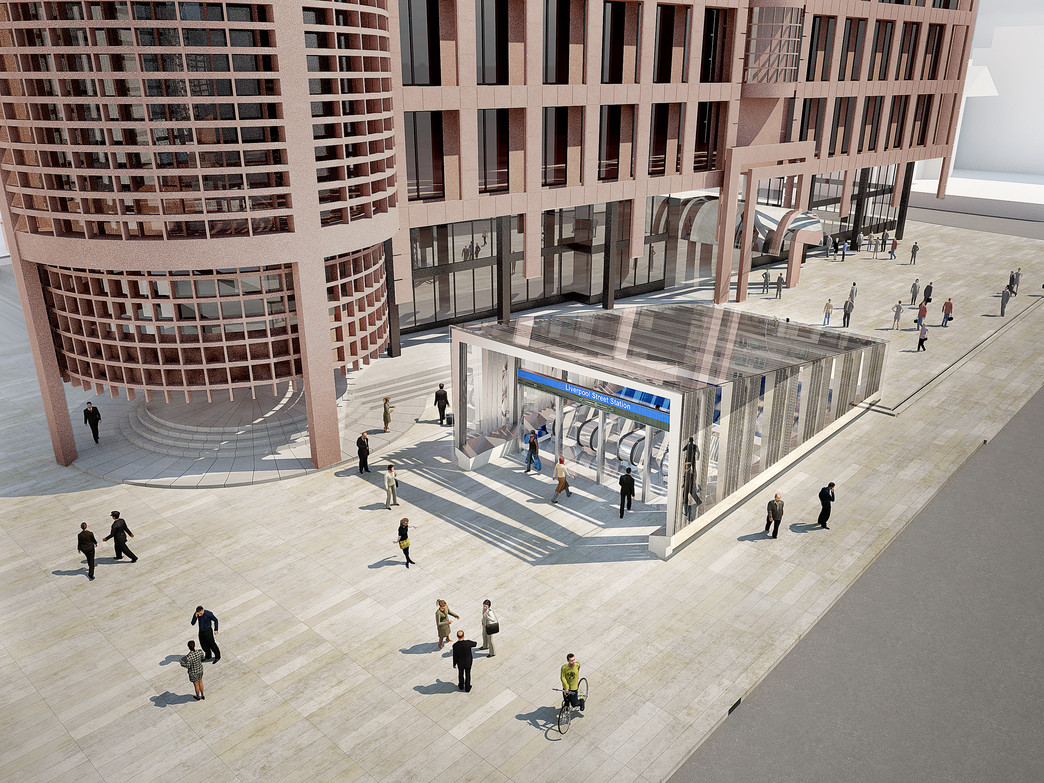
But what are they going to do with the smoking shelter, that sits in the entrance to the main-line station?
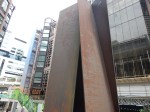


The shelter would be shown on the left of the visualisation, if the image had a wider format.
Stadler To Build Another Special
Stadlet seem to be getting a reputation for building trains for niche markets.
This article on Global Rail News is entitled Stadler to build narrow-gauge EMUs for Stockholm’s Roslagsbanan.
Wikipedia has an entry for the Roslagsbanan.
After trains for the Glasgow Subway and Merseyrail, the Class 88 locomotives and Class 399 tram-trains, they must be one of the companies in prime position for the new Docklands Light Railway trains.
How Will Virgin Trains East Coast Use Class 800/801 Trains?
The following two sections give Virgin Trains East Coast (VTEC) current and future fleets.
Current Fleet
VTEC have a current fleet comprising the following locomotives and coaches.
- 32 – Class 43 locomotives
- 117 – Mark 3 coaches
- 31 – Class 91 locomotives
- 302 – Mark 4 coaches
- 31 – Driving van trailers
The Class 43 locomotives and the Mark 3 coaches are formed into InterCity 125 trains.
- Two locomotives and nine coaches per set.
- 125 mph capability
- Diesel-powered
Which gives thirteen diesel trains.
The Class 91 locomotives and Mark 4 coaches are formed into InterCity 225 trains.
- One locomotive, one driving van trailer and nine coaches per set.
- 140 mph capability
- Electric-powered.
- Ability to run London to Edinburgh in under four hours.
Which gives thirty-one electric trains.
Adding the two figures together gives a total of forty-four nine-car trains.
Future Fleet
VTEC’s future fleet will include.
- 10 – Five-car Class 800 electro-diesel trains.
- 13 – Nine-car Class 800 electro-diesel trains.
- 12 – Five-car Class 801 electric trains.
- 30 – Nine-car Class 801 electric trains.
Adding these together counting the five-car trains as half gives fifty-four nine-car trains.
Or ten more nine-car trains!
In addition six to eight InterCity225 trains could be retained in service to run limited stop trains between London and Edinburgh.
This increase in capacity can only me good for passengers, with more services and destinations.
Questions About Class 800/801 Trains
What is the capacity of a nine-car Class 800/801 train?
I can’t find this on the Internet and I suspect it hasn’t been decided.
Wikipedia gives the capacity of an InterCity 225 train as 406 Standard and 129 First Class seats.
It should also be noted that the car length in a Class 800/801 is twenty-six metres, as opposed to the twenty-three metres of the InterCity 225.
I would hope good design can make excellent use of this space.
Will two Class 800/801 trains be able to work as a pair?
I suspect the answer to this is yes, as the closely-related Class 395 trains regularly do this.
The most common use would be to run two five-car trains as a ten-car set.
This would be a 260 metre long train, which is perhaps fifteen metres longer than an InterCity 225 train.
Some lengthening of platforms may be necessary, but it probably isn’t a major problem.
Will coupling and uncoupling of a pair of Class 800/801 trains be automatic?
In The Impressive Coupling And Uncoupling Of Class 395 Trains, I linked to videos of the closely-related Class 395 trains, doing just this in under a minute.
I would be very surprised if two Class 800/801 trains couldn’t do the same.
Will a Class 800 train and a Class 801 train be able to work as a pair?
There may be circumstances, where this is needed on electrified lines, so I would be very surprised if this is not possible.
At what station will a Class 800/801 train be able to call?
The nine-car trains are 234 metres long and a pair of five car trains will be 260 metres long, so platform length will mean they can’t call at a lot of smaller stations.
But a five-car train will be only 130 metres long, which will be shorter than a pair of four-car multiple-units working together, which are regularly seen on the UK’s rail network.
So the five-car trains will probably be able to serve a surprising number of stations.
Will Class 800/801 trains have a faster turn-round time?
If you look at the times of trains between London and Leeds, this things happen.
- A few minutes after a train leaves the platform at Leeds and Kings Cross, the next incoming service arrives.
- It then waits in the station for nearly half-an-hour before going back.
Effectively, an hour must be added to each Out and Back journey between London and Leeds.
This time will enable.
- Passengers to unload and load.
- Train to be prepared.
- Crew to be changed if required.
Any delay of a few minutes can hopefully be recovered.
Train preparation time will probably be better with the Class 800/801 trains, as hopefully automation and better design will speed the process.
But cutting this thirty minutes substantially would probably require passengers to be marched around like the Brigade of Guards, which is of course not possible.
Hopefully, the new trains will be designed, so that ingress and egress for all passengers will be easier and faster but at some stations like Leeds, the station layout is more of a bottleneck than the train.
A few minutes reduction in turn-round time might be possible, but nothing that would mean a train doesn’t occupy a platform for half-an-hour.
How long will A Class 801 train take between London and Edinburgh?
Currently the fastest journey time using an InterCity 225 is around four hours and twenty minutes, but they have done it in under four hours in test runs.
For marketing reasons, I suspect that VTEC would like to dip under four hours with the fastest trains.
As the Class 800/801 trains have a similar 140 mph performance to the InterCity 225, I suspect that four hours will also be possible.
But the big difference will be that the Class 800/801 trains will probably have faster stop times at any intermediate stations.
So I suspect that the average journey time between London and Edinburgh will drop.
How Will VTEC Use Class 800/801 Trains?
Returning to my original question, I’ll now attempt to answer it in the next few sections.
London-Edinburgh Services
I think we can assume the following.
- There will be at least two trains per hour (tph)
- Trains will usually be nine-car trains.
- Class 800 trains will not normally use diesel power on the route.
- Some trains could be two five-car trains running as a pair.
- A proportion of trains will do the trip in under four hours.
- Intermediate stops as now will be optimised to the passenger traffic.
- Intermediate stops will be faster.
I also think, that the InterCity 225 sets will be improved, so they can match the times of the Class 800/801 trains.
I think that once improved signalling on the East Coast Main Line is working and allowing running faster than 125 mph, we could be seeing trains being able to go from London to Edinburgh and back in under nine hours, assuming a thirty minute turn-round at both ends of the route.
This would mean that a dedicated London to Edinburgh fleet of just eighteen trains would be required to run a two tph service. Three tph would need another nine trains.
Speed up the trains so, that a round trip can be done in eight hours and sixteen trains are needed for the two tph service, with eight more trains needed to up the service to three tph.
Under Future in the Wikipedia entry for Virgin Trains East Coast, this is said.
If VTEC’s application to operate extra limited stops services to Edinburgh is successful, it is proposing to operate these by retaining six to eight InterCity 225 sets.
Interesting! So will some or all hours see a third train between London and Edinburgh.
Are the thirty-year-old InterCity 225 trains, showing the same survival instincts of their ten-year-older predecessors; the InterCity 125s?
London-Aberdeen And London-Inverness Services
Currently times on these routes from London are as follows.
- London-Aberdeen – seven hours and four minutes – three trains per day
- London-Inverness- eight hours and four minutes – one train per day
So what times could a Class 800 achieve on these routes?
Times North of Edinburgh with an InterCity 125 are as follows.
- Edinburgh to Aberdeen takes two hours and thirty-six minutes – Fastest ScotRail takes two hours sixteen minutes.
- Edinburgh to Inverness takes three hours and thirty-one minutes – Fastest ScotRail takes three hours nineteen minutes.
I suspect that a Class 800 train running on diesel power could match the InterCity 125 times and approach the ScotRail times.
But as they would be running on electric power to and from London in four hours, times could be as follows.
- London-Aberdeen – six hours and sixteen minutes
- London-Inverness – seven hours and nineteen minutes
So over half-an-hour could be saved on both routes.
Currently trains leave London at these times.
- 10:00 – Aberdeen
- 12:00 – Inverness
- 14:00 – Aberdeen
- 16:00 – Aberdeen
Note that there is probably no 18:00 train, as that would arrive in Aberdeen at 0110.
That is probably too late, but a well-driven Class 800 train, might get to Aberdeen around 00:30, which could be acceptable.
There is also the possibility of running a pair of five-car Class 800 trains to |Edinburgh, where they split with one train going to Aberdeen and the other to Inverness.
If the 16:00 train were to split, the Inverness portion would finish its journey before midnight.
A schedule like this from London could be possible.
- 10:00 – Aberdeen and Inverness
- 12:00 – Inverness
- 14:00 – Aberdeen and Inverness
- 16:00 – Aberdeen and Inverness
- 18:00 – Aberdeen
Both Northern cities would get four trains per day from London, because of two factors.
- The ability to run on electric power between London and Edinburgh, which knocks time off that section of the route.
- The ability to split and join trains at Edinburgh, which saves paths on the East Coast Main Line.
It should be noted that any electrification North from Edinburgh will help.
Stirling to Edinburgh and Glasgow could be electrified by 2019 or 2020.
- Trains would run to the South of Stirling on electric power.
- Any splitting going North and joining going South would take place at Stirling.
- Trains would still stop at Edinburgh to load and unload passengers.
- Crew change currently takes place at Edinburgh, but that could happen at Stirling.
With a well-executed stop at Stirling, electric power between Stirling and Edinburgh and a few other improvements could we see the following?
- London-Aberdeen – six hours
- London-Inverness – seven hours
It would certainly please VTEC’s Marketing Department.
Services To St. Andrews
The Open Championship was last held at St. Andrews in 2015, so by the next time it is held at the Home of Golf, it is likely that a station will have been built for the town.
This new station must be able to accept Class 800/801 trains, which during a major event might need to run to the area.
This reasoning must apply to lots of places either on or within fifty miles of the East Coast Main Line.
London-Leeds Services
Leeds is generally served by 2 tph from London in around two hours ten minutes.
These are usually nine-car InterCity 225 trains, with a couple of InterCity 125 trains, that go to places like Harrogate, which are not electrified.
As the speed limits on the East Coast Main Line are increased as trains are fitted with in-can signalling, I suspect that VTEC’s Marketing Department will be pushing for times between London and Leeds to be under two hours.
I can’t believe that VTEC will not extend services from Leeds by making use of five-car trains running to Leeds as a pair, where they would divide and join.
I am assuming that Class 800/801 trains can join as well as the closely-related Class 395 trains, which do so it in under a minute.
Places that could be served include.
- Bradford
- Harrogate
- Horsforth
- Huddersfield
- Ilkley
- Keighley
- Shipley
- Skipton
Note.
- Some stations like Harrogate and Horsforth are not electrified, so would need Class 800 electro-diesel trains.
- Five-car trains could serve a lot of stations on the Leeds-Bradford Metro network, thus opening up the possibility of services to places like Headingley for the cricket and rugby and Saltaire for the culture.
- Could a five-car Class 800 electro-diesel train run over the Settle and Carlisle Line to Carlisle and Scotland?
- Extending some services from Leeds may mean that platform space is released at the station.
I think that the possibilities to extend services from Leeds using the five-car Class 800/801 trains are large.
London-Edinburgh Via Leeds
On the West Coast Main Line, some Scottish services from London, go via Birmingham and Wolverhampton.
So if there was a fully electrified route from Leeds to York, then some Scottish trains could go via Leeds.
At present, I don’t think this is possible with an electric train, as part of the route from Leeds to York is not electrified.
The electrification should be well underway by now, but there is no sign of it.
Other Extended Services
What can be done at Leeds can surely be done at other places.
If the two trains can couple and uncouple within a minute, that means that a pair of trains can arrive in a station and go through the following sequence.
- 00:00 -A joined pair of Class 800/801 trains arrive in the station and load and unload passengers.
- 00:03 – Close the train doors
- 00:04 – Start the automatic decoupling process.
- 00:05 – The first train leaves the platform.
- 00:08 – After three minutes the second train leaves the platform.
I believe that the stop could be under ten minutes and the trains would be a safe three minutes apart, as they left the station.
So where could trains be split?
- Newark or Peterborough for Lincoln and Nottingham
- Doncaster for Hull and Sheffield
- York for Scarborough and Harrogate
- York for Middlesbrough and Sunderland
- Newcastle for Ashington and Sunderland
Note.
- Trains could go in a loop to serve several stations.
- Sunderland could be on such a loop.
- As trains would only be five cars, they could stop at most stations in need of a service.
- Stations like Peterborough, Doncaster, York and Newcastle with more than one through platform in each direction would probably be preferred stations for split and join.
- No electrification is needed away from the East Coast Main Line.
Obviously, passenger needs and traffic patterns will decide, where the trains split and join.
Conclusions
The big conclusion will be that more places will receive long distance services to London and the places in between.
But these trains will really put the squeeze on smaller operators like Hull Trains and Grand Central Trains, as VTEC will be serving their station.
I Can Clearly See Through The Hackney Wick Subway
A couple of days and they’re really pushed on at Hackney Wick station.


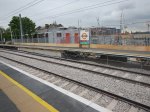
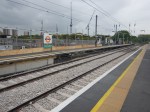


It looks like after the May Bank Holiday, they may have opened up the subway for pedestrians, as barriers seem to be ready to create a walkway.
History Repeats Itself
This article on the BBC is entitled London Marathon 2017: Club runner Josh Griffiths finishes as fastest Briton.
Everybody including Josh, is surprised.
But Josh’s feat is not unique.
Ian Thompson, made up the numbers for his club in the 1973 AAA Marathon Championship.
He then won Commonwealth Gold in 1974 in a record time that still stands.
Good luck, Josh
A Spot Of Bother On The Rother
There is an article in the Sunday Times with the title of Residents Get Up Steam To Halt Eailway Extension.
It has a subtitle of.
A plan to link a heritage line to the national network is dividing a Sussex community.
It’s all about the Rother Valley Railway wanting to create a 2.5 mile link between Robertsbridge and Bodlam.
This section called Future Plans in the Wikipedia entry for the Rother Valley Eailway says a lot more.
There is also this article on Kent Online, which is entitled Rail groups get go-ahead to extend Tenterden-Bodiam line to Robertsbridge.
There are a lot of long comments, of which this from Zaphod is one.
Disgusting. The concoction of smoke billowing out of these things is horrendous. To inflict this on an already over polluted part of Britain is insane. Due ti the travelling nature of this loco it will make sure we all get a lung full. All those with long problems, asthma, bronchitis etc etc are going to suffer. They put grotesque pictures on cig packets to discourage us from smoking then inflict us with this … duh. But I do love these machines & their engineering but unfortunately firing one of these up & running it across the countryside is pure and simple LETHAL.
It doesn’t look to be full steam ahead just yet.
If I have a problem, it is that they propose to use a level crossing to cross the A21.
This Google Map shows the route of the line from Robertsbridge station to the A21.
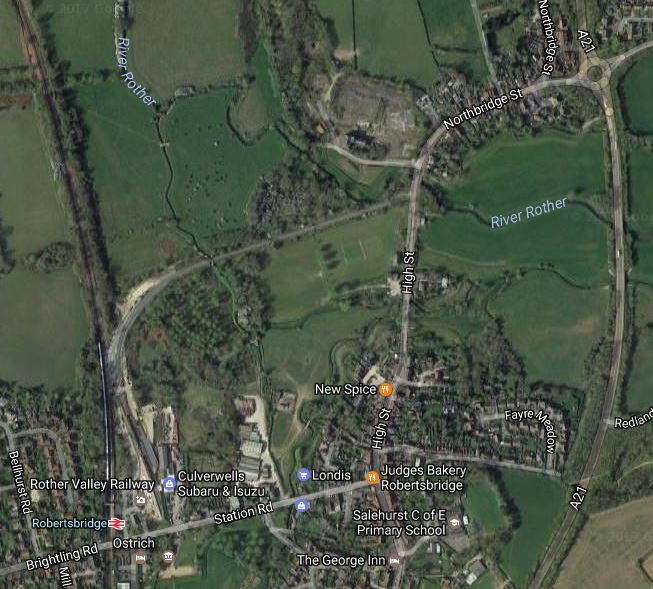
Note that the A21 leads down from the roundabout in the North-East corner of the map.
This map from Wikipedia shows the Western end of the Rother Valley Railway.
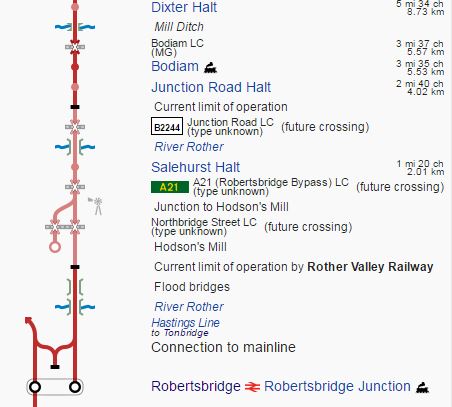
My question is the following.
Why would any sane Planning Authority allow the creation of three new level crossings, given the problems and the strong feelings they create?
Perhaps the economic benefits justify the disruption!
 The Anonymous Widower