The UK’s Pumped Storage Hydroelectricity
This post is a simple list of the UK’s pumped storage hydroelectricity.
- Balliemeanoch – 1500 MW/45 GWh – In Development
- Coire Glas – 1500 MW/30 GWh – Under Construction
- Corrievarkie – 600 MW/14.5 GWh – In Development
- Cruachan – 1000 MW/7.1 GWh – In Operation
- Fearn – 1800 MW/37 GWh – In Development
- Dinorwig – 1800 MW/9.1 GWh – In Operation
- Earba – 900 MW/33 GWh – In Development
- Foyers – 305 MW/10 GWh – In Operation
- Ffestiniog – 360 MW/1.44 GWh – In Operation
- Loch Kemp – 600 MW/9 GWh – In Development
- Loch Sloy – 152.5 MW/25 GWh – In Operation
- Red John – 450 MW/2.8 GWh – Under Construction
Note.
- Cruachan is only 440 MW and is being upgraded.
- The storage capacity at Foyers may be wrong, as I can’t find my original source.
When fully developed the total will be 10969.3 MW/223.94 GWh.
Gravitricity Weighs Up One Of Europe’s Deepest Mines
The title of this post, is the same as that of this article on The Engineer.
This is the sub-heading.
Scotland’s Gravitricity is set to deploy its underground energy storage technology at Pyhäsalmi Mine in central Finland, Europe’s deepest zinc and copper mine.
These two paragraphs outline the scheme.
Located about 450km north of the Finnish capital Helsinki, the Pyhäsalmi Mine extends 1,444m below the Earth. With mine operations at Pyhäsalmi winding down, the local community set up a development company to explore redevelopment projects around the mine’s infrastructure, including energy storage.
Gravitricity is set to deploy its GraviStore energy storage technology in a 530m deep auxiliary shaft. GraviStore can utilise off-peak electricity by raising heavy weights in the mine shaft, releasing the energy back on to the grid during high demand by lowering the weights. It’s claimed the 2MW scheme at Pyhäsalmi will provide grid balancing services to the Finnish network.
There is also this quote from Martin Wright,who is Gravitricity’s executive chairman.
This project will demonstrate at full scale how our technology can offer reliable long life energy storage that can capture and store energy during periods of low demand and release it rapidly when required.
This full-scale project will provide a pathway to other commercial projects and allow our solution to be embedded into mine decommissioning activities, offering a potential future for mines approaching the end of their original service life.
Can it be that Gravitricity is finally on its way?
A New Future Beckons For Scotland’s Historic Canals
The title of this post is the same as that as this article on The Herald.
This is the sub-heading.
Scotland’s canals, created for the industrial revolution but in recent times focused more on leisure than industry, are finding a new purpose as a different revolution, this time a green one, gets underway
The article was found by my Google Alert for the Coire Glas project, which is one of the UK’s largest green projects.
The article describes how Scotland’s canals are helping a green revolution and is well worth a read.
Mortenson Announces Completion Of Edwards & Sanborn Solar + Storage Project
The title of this post, is the same as that of this press release from Mortenson.
These two paragraphs describe the project,
Terra-Gen and Mortenson have announced the full substantial completion of the Edwards & Sanborn Solar + Energy Storage project, the largest solar plus energy storage project in the United States. Mortenson was the full Engineering, Procurement, and Construction (EPC) contractor on both the solar and energy storage scopes for this vanguard project in the energy industry.
This project stretches over 4,600 acres and includes more than 1.9 million First Solar modules. In total, the project generates 875 MWdc of solar energy and has 3,287 megawatt-hours of energy storage with a total interconnection capacity of 1,300 megawatts. The project supplies power to the city of San Jose, Southern California Edison, Pacific Gas & Electric Co. and the Clean Power Alliance, and Starbucks, among others. A portion of the project is situated on the Edwards Air Force Base and was the largest public-private collaboration in U.S. Department of Defense history. The project uses LG Chem, Samsung, and BYD batteries.
Note.
- 4,600 acres is just over seven square miles.
- There’s more about this massive project on this web page.
- Judging by the fact, they use three different makes of batteries, did Mortenson have a problem sourcing the number needed from a single manufacturer or are the contractors seeing, which perform best in the hot desert?
California and other places can build these projects, if there is masses of sun and flat desert.
Shotwick Solar Park is the largest solar farm in the UK. It has a capacity of 72.2 MW.
BESS Projects Represent ‘Encouraging Progress’ in New York Efforts To Replace Dirty And Polluting Peakers
The title of this post, is the same as that of this article on Energy Storage News.
These are the first three paragraphs.
Battery storage is playing an active role in helping New York City retire its fleet of peaker power plants, with around 700MW of its most polluting power generation assets already fully retired.
According to a new report, 4,019MW – about two-thirds of a 6,093MW fleet – has either retired or put in place plans to replace turbines with cleaner technologies since New York adopted its climate goals and environment protection policies in 2019.
In addition to 700MW already retired, around the same amount again is actively being moved towards end of life.
Note.
- Just over 6,000 MW seems a lot of extra peaker power, even for a city as large as New York.
- But at least over 4 GW has been retired or the plans to replace it with cleaner technologies are in place.
- The New Yorkers certainly seem to be getting on with the conversion, with about a GW/per year either retired or planned to do so.
The article says this about batteries.
Battery storage is one of a number of different technologies that can be used to replace peaking capacity. While lithium-ion batteries with 4-hour duration might be the most directly analogous in terms of technical capability to peakers, effectively retiring the power plants could be facilitated with a combination of other resources including rooftop solar, offshore wind and energy efficiency measures.
I find the 4-hour duration interesting, but I suspect the Yanks know what they’re doing.
So if you were going to replace the 240 MW Glanford Brigg power station, which Centrica describe as a peaker station, with energy storage, you’d use a 240 MW/960 MWh battery, if you were working to New York rules.
Batteries in the UK, that I’ve talked about lately include.
Amp Hunterston – 400 MW/800 MWh – 2 hours
Amp Kincardine – 400 MW/800 MWh – 2 hours
- Carlton Energy Park – 1040 MW/2080 MWh – 2 hours – Close to an 884 MW gas-fired power station.
- Coalburn – 500 MW/1000 MWh – 2 hours- Close to a 946 MW collection of wind farms.
- Gateway Energy Centre – 450 MW/900 MWh – 2 hours – Close to an 732 MW gas-fired power station.
- Normanton Energy Reserve – 500 MW/1000 MWh – 2 hours
- Richborough Energy Park – 100 MW/100 MWh – 1 hour
- Spalding Energy Centre – 550 MW/1100 MWh – 2 hours – Close to an 860 MW gas-fired power station.
Note.
- The first field is Output/Storage Capacity.
- The second field is the duration.
- I have assumed Spalding Energy Centre is another two hour duration system, like Gateway Energy Centre, which is also being developed by Intergen.
- Two hours seems to be the most common duration for a UK battery.
Adding the batteries up gives a virtual 3940MW/7780MWh battery.
It amazing how they add up to quite large values. But then every little helps!
And these are only the ones I’ve talked about.
Q4 2023 Sees Largest Quarterly Increase In Battery Energy Storage
The title of this post, is the same as that of this article on Solar Power Portal.
These three paragraphs outline the story.
Energy research consultancy Modo Energy has confirmed that Q4 2023 saw 420MW of new battery energy storage capacity become commercially operational.
This new capacity represents a 13% increase on the previous quarter and, in doing so, becomes the largest ever quarterly increase in operating battery capacity in GB. The previous record was set in Q2 2023 when 413MW was added.
It is worth noting that the additional capacity now means that GB’s operational grid-scale battery energy storage capacity has now reached 4.6GWh. Modo also confirmed that 1.5GW of battery storage was added across 2023 – a record for a one-year period.
Note.
- Modo Energy has a web site.
- Hinckley Point C has a nameplate capacity 3.26 GW.
- The article also says that the average duration of battery storage in GB is now 1.3 hours.
Strangely, this gives a BESS total storage capacity of 4.55 GWh, which is half the capacity of Electric Mountain.
Exagen Given Green light for new 500MW / 1GWh Battery Storage Project In Leicestershire
The title of this post is the same as that of this article on PV Magazine.
This is the outline of the project, which will be called the Normanton Energy Reserve.
The new 500MW / 1GWh battery site will be capable of powering 235,000 homes for two hours, equivalent to 80% of the homes in Leicestershire.
Approximately 45% of the 19-acre site will be set aside to improve biodiversity by extending Normanton Millennium Wood and creating wildflower meadows. The project will deliver more than 25% biodiversity net gain.
Exagen will establish a circa £4M community fund to spend on improvements in the local area, with residents consulted on how the fund is used.
Note.
- A 500MW / 1GWh battery is not small.
- The size probably makes it a good backup for Leicestershire.
- Nineteen acres is a 277 metre square.
- Any biodiversity net gain is worthwhile.
- A £4M community fund is not to be sneezed at.
It all sounds very good.
Normanton Wood has a web site, where this is said on the home page.
Normanton Wood is one of The Woodland Trust’s ‘Woods on Your Doorstep’ woodlands created to commemorate the Millennium. It lies near Earl Shilton Leicestershire and was planted by members of the local community.
This Google map shows the wood.
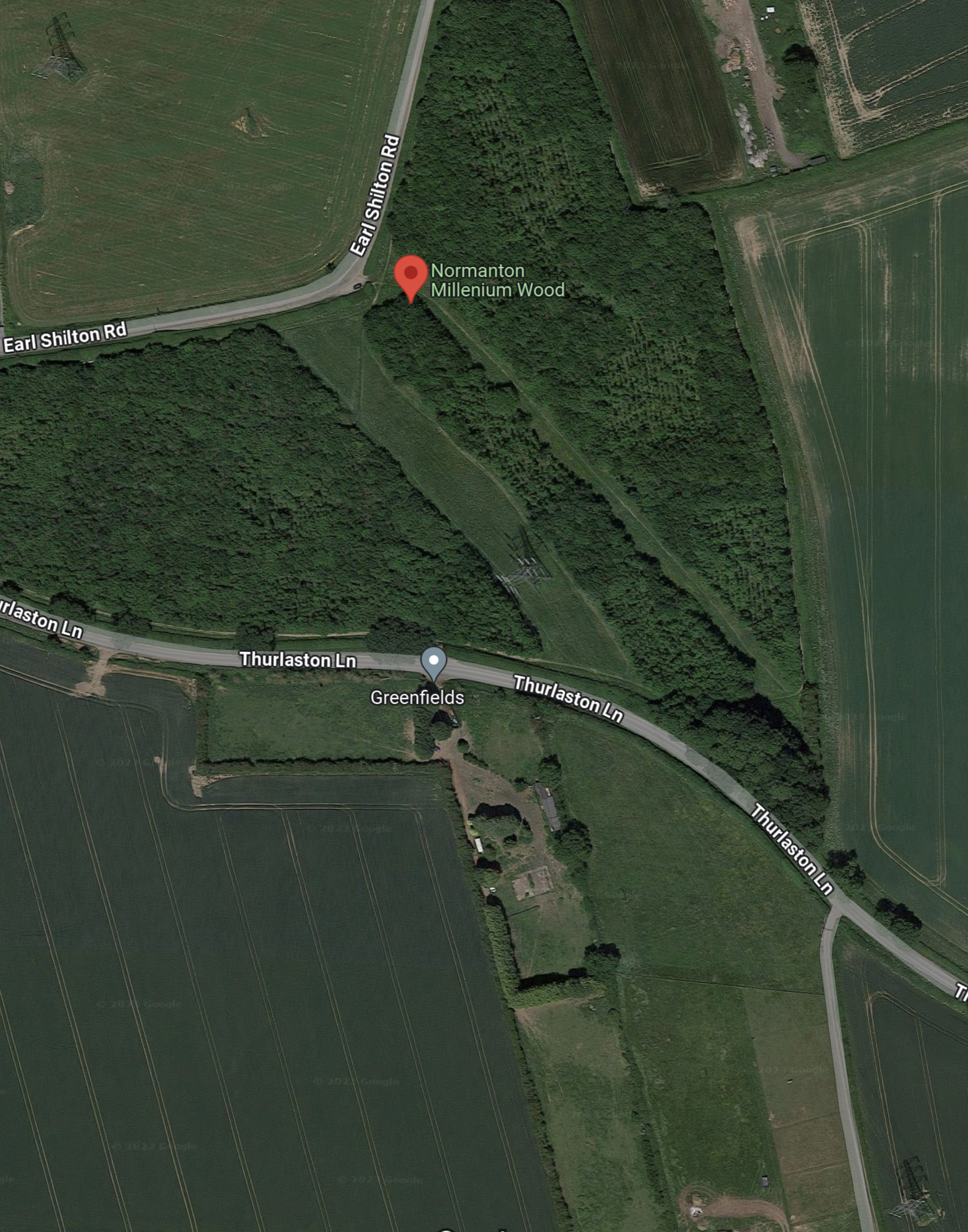
Note.
- The red arrow indicates Normanton Millennium Wood.
- I suspect that cleared space in the woodland leading South-East from the red arrow is about 300 metres long and 15 metres wide, which is about 1.1 acres
- As Normanton Millennium Wood is 16.75 acres, I suspect it includes all the woodland to the East of the red arrow, up to the cultivated farmland.
- If you look carefully, you can see a large electricity pylon in the wider cleared area, to the South of the red arrow.
- When I created this map, I clipped it so that the next pylons to the North-West and South-East were in the respective corners of the map.
This second map shows the land to the West of the red arrow, which is enclosed by the roads.
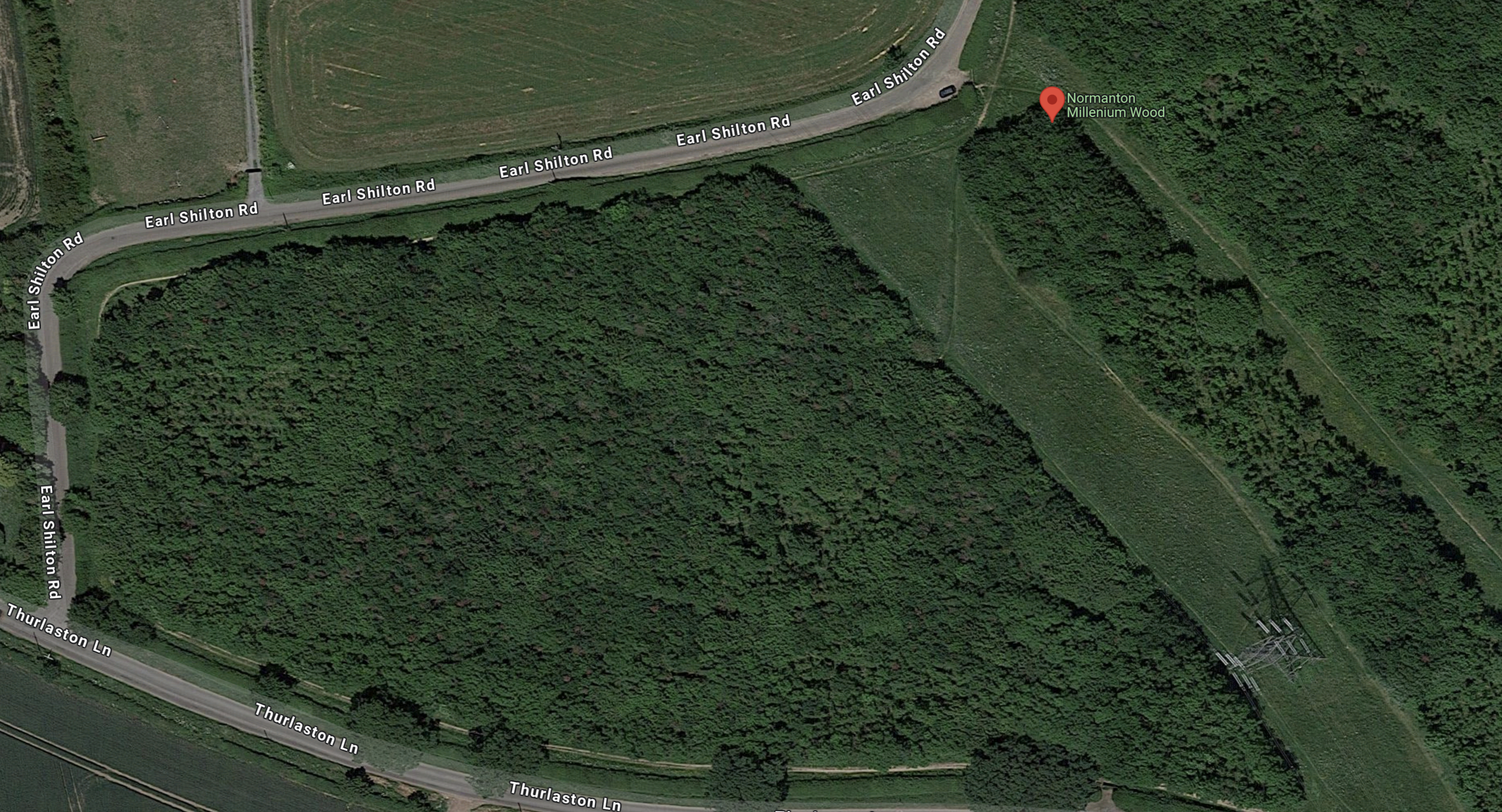
Note.
- As before the red arrow indicates Normanton Millennium Wood.
- The electricity pylon is clearly visible on the cleared strip.
- The land to the East of the cleared strip looks like its been planted with trees in the last decade or so.
- The land to the West of the cleared strip looks more like scrub, that has grown up after years of neglect.
- I estimate that the area of the cleared strip and the scrub, is around nineteen acres.
- This news story from Exagen, is entitled Woodland Planting At Normanton Energy Reserve – Becca Leake is a must-read as it outlines how woodland will be planted at the site.
As there is no local substation, it looks to me, that a new substation will be built close to the electricity pylon, with the battery to its West.
Conclusion
It seems a good design for a large battery site, which will be shielded from neighbours by a large area of woodland.
I am also sure, that this battery and the one talked about in New Octopus Energy Makes First Investment To Develop UK’s Largest Battery, are the same battery.
All the numbers in both articles are identical.
Wales Puts Another Pumped Storage Hydroelectric Power Station Into Play
This page on World Energy is entitled Fortune Hydro AG and Voith Acquire 450 MW Dorothea Lakes Pump Storage.
This paragraph introduced the article.
Fortune Hydro AG, in collaboration with Voith Small Hydro, has acquired the 450 MW Dorothea Lakes Pump Storage project as part of an £800 million (US$1 billion) strategic investment in renewable energy in the UK.
It looks to me that this was a good buy in July 2023, as after last week, when I wrote Price Framework Paves Way For Vast Electricity Storage Scheme, in response to a UK Government announcement about funding pumped storage hydroelectricity.
These two paragraphs give more details of the project.
Located in Snowdonia, Northern Wales, this green storage facility presents a unique opportunity to integrate wind, solar and hydroelectric power, Fortune Hydro said. The Dorothea Lakes site was one of the largest slate quarries in Europe and the largest in North Wales.
Electricity produced by solar and wind during low demand can be stored until demand is there. This storage allows balancing of the production cycle in the large solar and wind farms in the north against the demand cycle of consumers and businesses in central and southern UK. It will generate up to 600 jobs and bring economic development and new business opportunities to the local community, the company said.
This map shows the location of Dorothea Lakes.
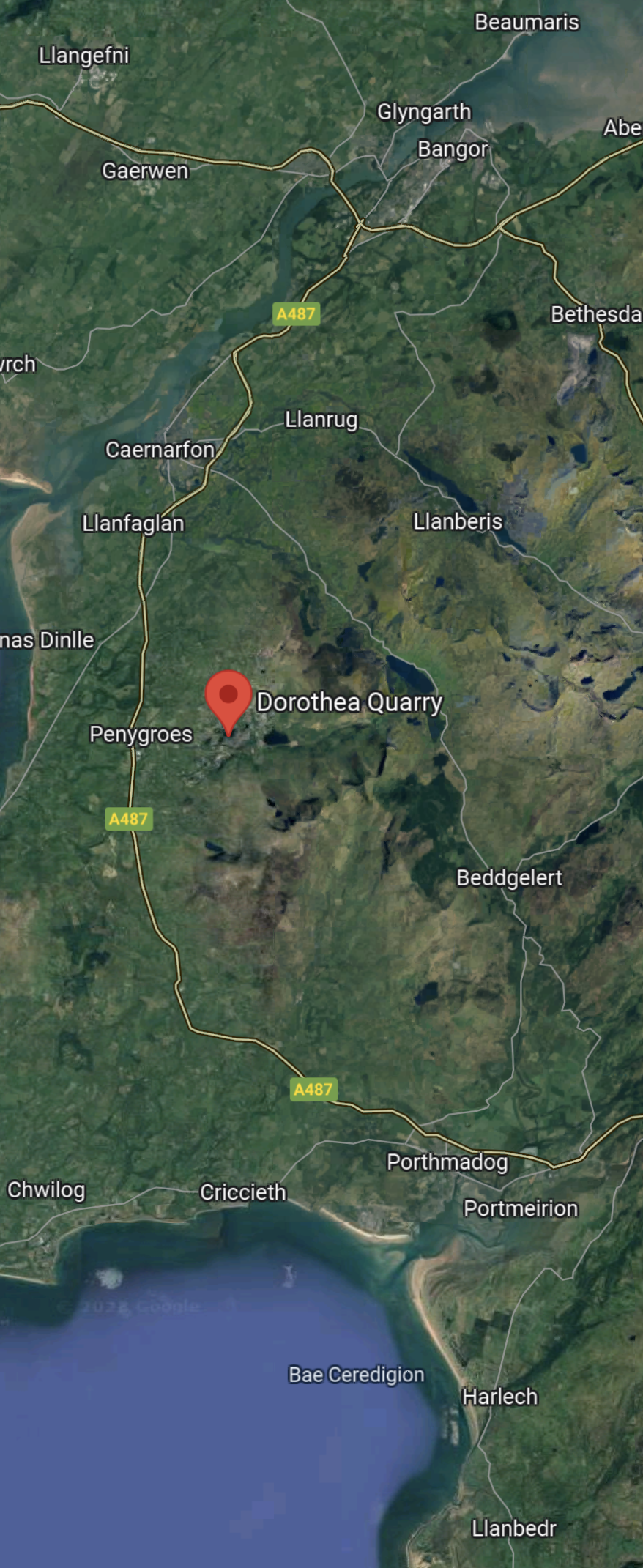
Note.
- Dorothea Lakes is indicated by the red arrow.
- The Menai Strait between Bangor and Caernarfon is at the top of the map.
- It is certainly in a convenient place, with all the wind farms off the North Wales Coast.
At 450 MW, it’s about a third the size of Electric Mountain, so I suspect it could hold about 3 GWh of electricity.
Price Framework Paves Way For Vast Electricity Storage Scheme
The title of this post, is the same as that of this article on The Times.
This is the sub-heading.
SSE welcomes step forward in plans to build the £1.5bn Coire Glas hydroelectric project
These two paragraphs outline the article.
Ministers have provisionally agreed to a power pricing framework that could pave the way for more pumped storage hydroelectricity projects in Britain, including a gigantic £1.5 billion scheme from SSE that is starting to take shape in the Scottish Highlands.
The Department for Energy Security and Net Zero said it intended to develop a “cap and floor” pricing mechanism that would advance the Coire Glas storage project being developed by SSE, the energy company, and could unlock further pumped storage power stations.
Coire Glas will be one of the largest renewable power projects ever built in the UK.
- It will have a power output of 1.5 GW, which is comparable with some of the large wind farms in the North Sea or four gas-fired power station or Rolls-Royce SMRs.
- It will be able to store 30 GWh of electricity and provide 1.5 GW for twenty hours.
- Coire Glas has a web site.
- Coire Glas will more than double pumped storage hydroelectric capacity in the UK.
Bath County Pumped Storage Station in Virginia, US claims to be the world’s largest battery, but Coire Glas will be able to store more electricity.
You wait decades for one of these monsters to come along in the UK and SSE also have another on the way.
- Loch Sloy hydroelectric power station is the largest conventional hydroelectric power station in the UK.
- It has an output of 152 MW.
- It opened in 1950 and was largely built by German and Italian prisoners-of-war.
SSE plan to convert Loch Sloy power station into a pumped storage hydroelectric power station.
- It will be able to store 25 GWh of electricity.
- Loch Sloy will be the upper lake.
- Loch Lomond will be the lower lake.
- The existing dam, upper lake, pipes and powerhouse will be retained.
- The developments have a web page.
The project is aimed at a commissioning date of 2028.
This paragraph explains how the ‘cap and floor’ mechanism works.
In the scheme, operators would be guaranteed a minimum level of revenue, while consumers would be protected by a price ceiling, above which surplus revenue would be returned to them.
And these two paragraphs give SSE’s reaction.
Finlay McCutcheon, 46, director of onshore Europe at SSE, said the pricing framework was welcome news. He said that a deal for Coire Glas was needed by the end of this year to secure a firm investment decision by early 2026. Planning for the project started in 2007.
“Given the time taken to reach this point, much work is now needed to ensure an effective mechanism is finalised and put in place as early as possible to enable Coire Glas to take final investment decisions and move into construction,” he said.
I believe that the negotiations between the Government and SSE will lead to a monster on Loch Lochy and another one on Loch Lomond.
Conclusion
There are also these pumped storage hydroelectric schemes under development.
- Balliemeanoch Pumped Hydro – 1.5 GW/45 GWh
- Balmacaan Pumped Hydro – 600 MW/15-20 GWh
- Corrievarkie Pumped Hydro – 1.5 GW/14.5 GWh
- Fearna Pumped Hydro – 1.8 GW/37 GWh
- Glenmuckloch Pumped Hydro – 400 MW/1.6 GWh
- Loch Earba Pumped Storage Hydro – 900MW/33 GWh
- Loch Kemp Pumped Storage Hydro – 300MW/9 GWh
- Loch Na Cargeach/Red John Pumped Storage Hydro – 450 MW/2.8 GWh
These total up to 7.4 GW/100+ GWh.
This page on the Strathclyde University web site, gives these GWh figures for the possible amounts of pumped-storage that can be added to existing schemes.
- Errochty – 16
- Glasgarnock – 23
- Luichart – 38
- Clunie – 40
- Fannich – 70
- Rannoch – 41
- Fasnakyle – 78
- Tummel – 38
- Ben Lawers – 12
- Nant – 48
- Invermoriston – 22
- Invergarry – 41
- Quoich – 27
- Sloy – 20
That is a total of 514 GWh.
Scotland will be the Saudi Arabia of energy storage.
 The Anonymous Widower