‘Unique’ Solar-Storage Solution Providers Plot 300MW / 3.6GWh Australia Project
The title of this post, is the same as that of this article on Energy Storage News.
The first two paragraphs outline the system.
A 1,200 hectare site in South Australia has been secured by a developer hoping to use it to build a 300MW solar power site with 3.6GWh of energy storage, based on a novel technology solution.
Europe-headquartered renewables company Photon Energy is working to roll out the technology created by Australian company RayGen. It combines a kind of concentrating solar power (CSP) + solar photovoltaics (PV) hybrid that RayGen calls ‘PV Ultra’, paired to a long-duration energy storage tech dubbed ‘thermal hydro’.
Thermal hydro appears to be an interesting concept, which uses hot and cold water reservoirs to store energy. Electricity is retrieved using a Rankin cycle engine and the claimed roundtrip efficiency is seventy percent.
This power plant might seem to be very futuristic, but a 4MW solar with 3MW / 50MWh of energy storage project is already under construction and should go on-line in the middle of next year.
The developer; Photon Energy hopes to get the giga-plant ready-to-build by the end of 2023.
This concept could be a very useful one, where there is enough sun for concentrating solar power.
Hydrophilic Polymers: The Key To A Green Future
The title of this post, is the same as that of this article on Tech Xplore.
This is the first paragraph.
Researchers from the University of Surrey and the University of Bristol are working on innovative devices to tame and store carbon-free renewable energy from unpredictable sources such as wind and solar.
That got me interested and I read the whole article.
This abstract on SpringerLink gives a definition of hydrophilic polymers.
Hydrophilic polymers are those polymers which dissolve in, or are swollen by, water. Many compounds of major technical and economic importance fall within this definition, including many polymers of natural origin. Many foodstuffs—containing substantial amounts of carbohydrate and protein— can be classified as hydrophilic polymers, and some have important technical and industrial uses, apart from their nutritional value. For example, although over 95% of the starches produced from corn (maize), wheat, potato, tapioca, and other vegetable sources are used as foods (human or animal), the remaining quantity represents an important part of the technical polymer market. In fact, more than two-thirds of hydrophilic or water-soluble polymers used in industry are derived from polymers of natural origin, so coming from renewable resources (harvested crops, trees, waste animal products and so on), rather than petrochemical sources of finite availability.
This paragraph from the Tech Xplore article describes the research.
The Chemistry Department at Surrey is working with collaborators at Bristol, Professors Ian Hamerton and David Fermin, and Superdielectrics Ltd., an innovative British Research Company located at the Surrey Research Park to transform simple hydrophilic polymers which were originally developed for use as contact lenses, to realize a second critical energy storage process.
This could lead to the next generation of supercapacitors.
Conclusion
This is fascinating technology and it could save the world.
Long Duration Energy Storage Council — A New Global Industry Body — Launched At COP26
The title of this post, is the same as that of this article on Recharge News.
This is the first paragraph.
The CEO-led organisation aims to ensure that fossil-fuel back-up is replaced with long-lasting zero-carbon alternatives by 2040.
The membership includes major players in energy and energy storage.
Hopefully, they’ll ensure the world has enough energy storage.
Read the article.
Financial Incentive Needed To Drive UK Energy Storage
The title of this post, is the same as that of this article on pv Magazine.
This is the first paragraph.
The lack of an incentive regime for battery projects and the like – whether a fixed feed-in tariff or market-driven contracts-for-difference program – is likely to see the COP26 host miss its 100%-clean-power-by-2035 commitment, according to K2 Management.
As a Control Engineer, I would go for a market-driven contracts-for-difference program, which if properly setup should give feedback, so that eventually, storage and renewable energy production are in equilibrium with the power needed.
It’s not as if, we’re short of ideas for energy storage in the UK.
I think the breakthrough will come, when one of the big energy storage funds like Gresham House or Gore Street decides to back one of the viable environmentally-friendly energy storage concepts, that are currently under development.
I am watching energy storage, as I suspect there could be a big announcement at COP26.
Gore Street Energy Storage Fund Revenues Boosted Amid Market Volatility
Over the last few years, I have blogged about energy storage and two energy storage funds; Gore Street and Gresham House.
According to an article on Proactive Investors, with the same title as this post, Gore Street hasn’t been doing badly lately and says this about their recent performance.
Gore Street Energy Storage Fund PLC said its assets in Great Britain generated revenues two times above forecast in September and added that industry is only at the start of its growth curve.
When I saw the concept of an energy storage fund, as a Control Engineer, I liked it.
The wind doesn’t always blow and the sun doesn’t always shine, so something is needed to cover the gaps in the supply.
The obvious way to cover the gaps is to put a battery in the circuit.
- When the electricity supply is higher than the demand, the surplus electricity can be stored in a convenient battery connected to the grid.
- When the reverse is true and there is a deficit of electricity, the energy in the battery can be used to make up the difference.
The battery works with electricity, just like a bank works with money, except that batteries don’t pay interest.
- The battery owners do make money by buying electricity, when it’s cheap and selling it back at a higher price.
- Tesla and others will sell you both batteries and the controlling software.
- Some areas with perhaps high levels of wind and solar or unreliable power supplies could use batteries improve the robustness of the electricity supply.
- More wind and solar power will inevitably lead to a need for more energy storage.
- Battery technology will get cheaper in terms of the cost per MWh of storage.
- Battery-grid interface hardware will get more capable.
- Management software will get better at balancing the grid.
This all adds up to increasing opportunities at possibly lower costs for energy storage funds like Gore Street and Gresham House.
So we will inevitably see a growth of energy storage funds.
But they will change.
New Battery Technology
There are several new battery technologies, that I believe could prove to be competitive in terms of capacity, cost, efficiency and reliability when compared to lithium-ion batteries.
Some of them will also have the advantage of only using easy-to-source, environmentally-friendly materials in their manufacture.
Some battery technologies are also easier to scale up, in that your have a central unit, which is connected to several stores. So to scale up, you add another store to the central unit. Highview Power’s CRYOBattery works on this principle.
I can see energy storage funds taking off faster, when someone designs the ideal battery for their purposes.
More Energy Storage Funds
We will see more players enter the energy storage fund market, just as we saw more players enter the peer-to-peer lending market. But just as that market attracted men with silly hats, boots and horses, not all will be reputable. But there are signs that banks I might trust are entering the market.
I also think there could be a hybrid model, which is almost a cross between an energy storage fund and peer-to-peer technology.
But be prepared for financial innovation.
And always do due diligence before investing.
Local Energy Storage Funds
I can envisage sensible established players offering investment on a local basis.
So perhaps the residents of a town with a need for a battery, might like to help fund it.
Or just as Aviva with their strong connections to East Anglia helped to fund Greater Anglia’s new trains, they might fund a battery in perhaps Cromer.
Conclusion
I feel the future is very rosy for energy storage funds.
Railfreight Goes Back To Diesel As Electricity Costs Soar
The title of this post, is the same as that of this article on Railnews.
This is the first paragraph.
Some rail freight operators have abandoned electric traction, at least for now, because the price of electricity has been rising sharply. The electricity tariffs include a 40 per cent renewable energy tax, and following the latest rises diesel traction is now cheaper. The drivers’ union ASLEF is calling for the government to intervene, but Freightliner has already taken action.
This quote from the article is from ASLEF General Secretary; Mick Whelan.
Moving freight by rail rather than road is, inherently, a carbon-efficient mode of transport and an environmentally-friendly way of doing business. Electric-hauled freight services reduce emissions by 99 per cent; even moving goods by diesel traction reduces emissions by 76 per cent.
It looks to me, that a reputable and trusted environmental economist could come up with a compromise price and possibly a solution to improve the situation.
Possible solutions could include.
- Use of Biodiesel or Hydrotreated Vegetable Oil
- More energy storage.
Surely, though, the long term solution is hydrogen-powered locomotives. or dual-fuel locomotives, as I wrote about in Freightliner Secures Government Funding For Dual-Fuel Project.
ITM Power Raises £250 million
The title of this post, is the same as that of this media release from ITM Power.
There is a also a sub-title.
Manufacturing Expanded To 5GW Per Annum By 2024
ITM Power are certainly going large.
Given the number of plans for electrolysers published around the world, a 5GW annual production is by no means over ambitious.
Sun Cable’s Australia-Asia PowerLink
Two weeks ago, in How Clean Energy And Jobs Can Flow From Morocco to The UK, I talked about a plan to generate electricity using solar arrays in Southern Morocco and use an underwater interconnector to bring it to the UK.
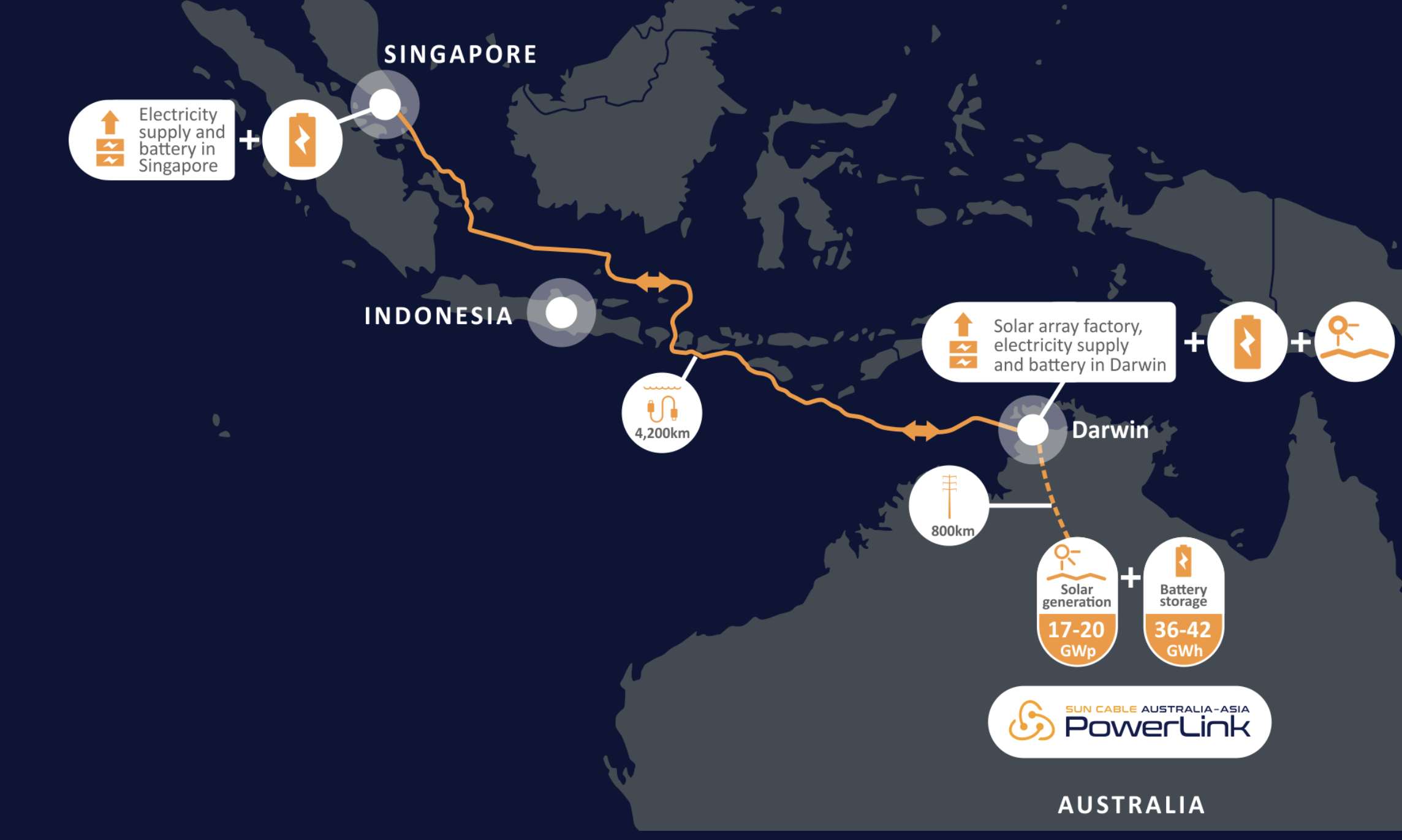
If you think that project was ambitious and distinctly bonkers, then that project is outshone by Sun Cable‘s Australia-Asia PowerLink, which is shown in this SunCable graphic.
These are a few facts about the project.
- Electricity will be generated by solar panels in the Northern Territories of Australia.
- There will be 12,000 hectares of solar panels in Australia, which will create 3.2 GW of electricity for distribution.
- There will be a 36-42 GWh battery in Australia.
- There will be 4,200 km of submarine HVDC cable to deliver the electricity to Singapore and Indonesia.
- It looks like there will be batteries in Darwin and Singapore.
- The link could supply up to fifteen percent of Singapore’s electricity.
It is certainly an ambitious project, that will contain the world’s largest solar array, the world’s largest battery, and the world’s longest submarine power cable.
Note.
- Currently, the largest solar park in the world is Bhadia Solar Park in India, which is half the size of the solar array proposed.
- At 720 km, the North Sea Link is the largest undersea HVDC is operation.
- The largest battery in the UK is Electric Mountain in Snowdonia, which is only 9.1 GWh.
- A Tesla Megapack battery of the required size would probably cost at least ten billion dollars.
This is certainly, a project that is dealing in superlatives.
Is The Australia-Asia PowerLink Possible?
I shall look at the various elements.
The Solar Panels
I have flown a Piper Arrow from Adelaide to Cairns.
- My route was via Coober Pedy, Yulara, Alice Springs and Mount Isa.
- There didn’t seem to be much evidence of rain.
- The circle from South to East took four days of almost continuous flying, as Australia is not a small country.
- It left me with the impression of a flat featureless and hot country.
Having seen solar panels on flat areas in the UK, the Australian Outback could be ideal for solar farms.
Sun Cable are talking about 10,000 hectares of solar panels, which is roughly 38.6 square miles or a 6.2 mile square.
Given enough money to source the solar panels and install them, I would expect that the required solar farm could be realised.
The Cable
Consider.
- The North Sea Link is a 1.4 GW cable that is 720 km. long.
- I would size it as 10008 GW-km, by multiplying the units together.
- The Australia-Asia PowerLink will be 4200 km or nearly six times as long.
- But at 3.2 GW as opposed to 1.4 GW, it will have 2.3 times the capacity.
- I would size it as 13,400 GW-km.
Whichever way you look at it, the amount of cable needed will be massive.
The Battery
Currently, the largest battery in the world is the Bath County Pumped Storage Station, which has these characteristics.
- Peak power of 3 GW
- Storage capacity of 24 GWh.
Sun Cable’s 36-42 GWh battery will be the largest in the world, by a long way.
But I don’t think pumped storage will be suitable in the usually dry climate of Northern Australia.
The largest lithium-ion battery in the world is the Hornsdale Power Reserve in South Australia, which is only 150 MW/194 MWh, so something else will have to be used.
As Highview Power are building a CRYOBattery for the Atacama region in Chile, which I wrote about in The Power Of Solar With A Large Battery, I wonder, if a cluster of these could provide sufficient storage.
Tesla Batteries Power UK Energy Storage Plan
The title of this post, is the same as that of this article on The Times.
Britain’s energy problems could be alleviated by a new scheme to build power-storage sites across the UK using batteries produced by Tesla, the electric carmaker.
Six sites will be built by Harmony Energy Income Trust.
- The trust intends to raise £230 million in a stock market listing.
- The trust was registered on the 1st October 2021.
- The batteries will be built in rural locations.
- The sites will use Tesla Magapack batteries and Autobidder software.
- These batteries charge up in two hours and provide energy for two hours.
- The sites are “shovel ready”
- All planning permissions and contracts have been signed.
It would appear that everything is ready to go.
This is a paragraph in The Times article.
The trust is a spin-off from developer Harmony Energy, which found the six sites and obtained the permissions for construction. The developer will retain a minority stake after the listing.
It is also said in the article that two sites at Holes Bay in Dorset and Contego in West Sussex, have already been developed using Tesla batteries.
The Harmony Energy web site lists fifteen wind projects and thirteen battery projects.
- The average size of the battery projects is an output of 44 MW.
- If they can supply that for two hours, the average capacity would be 88 MWh.
The company does appear to be developing smaller batteries than the two established energy storage funds; Gore Street and Gresham House. But then everyone can use their own plan.
UK National Grid In Talks To Build An Energy Island In The North Sea
The title of this post, is the same as that of this article on the New Scientist.
This is the first paragraph.
UK company National Grid has revealed it is in talks with two other parties about building an “energy island” in the North Sea that would use wind farms to supply clean electricity to millions of homes in north-west Europe.
These are my thoughts.
An Artificial Island on the Dogger Bank
The idea of the North Sea Wind Power Hub in the area of the Dogger Bank has been around for a few years and has a comprehensive Wikipedia entry.
Wikipedia says that it would be an artificial island on the Dutch section of the Dogger Bank and the surrounding sea could eventually host up to 110 GW of wind turbines.
North Sea Wind Power Hub Programme
The Dutch and the Danes seems to have moved on and there is now a web site for the North Sea Wind Power Hub Programme.
The home page is split into two, with the upper half entitled Beyond The Waves and saying.
The incredible story of how the Netherlands went beyond technical engineering as it had ever been seen before. Beyond water management. To secure the lives of millions of inhabitants.
I have met Dutch engineers, who designed and built the Delta Works after the North Sea Floods of 1953 and I have seen the works all over the country and it is an impressive legacy.
And the lower half of the home page is entitled North Sea Wind Power Hub and saying.
Today, climate policy is largely national, decoupled and incremental. We need a new approach to effectively realise the potential of the North Sea and reach the goals of the Paris Agreement. We take a different perspective: harnessing the power of the North Sea requires a transnational and cross-sector approach to take the step-change we need.
Behind each half are two videos, which explain the concept of the programme.
It is a strange web site in a way.
- It is written totally in English with English not American spelling.
- The project is backed by Energinet, Gasunie and TenneT, who are Danish and Dutch companies, that are responsible for gas and electricity distribution networks in Denmark, Ger,many and The Netherlands.
- There are four sections to the web site; Netherlands, Germany, Denmark and North Sea.
It is almost as if the web site has been designed for a British company to join the party.
Hubs And Spokes In North Sea Wind Power Hub Programme
If you watch the videos on the site, they will explain their concept of hubs and spokes, where not one but several energy islands or hubs will be connected by spokes or electricity cables and/or hydrogen pipelines to each other and the shore.
Many electrical networks on land are designed in a similar way, including in the UK, where we have clusters of power stations connected by the electricity grid.
The Dogger Bank
The Dogger Bank is a large sandbank in a shallow area of the North Sea about 100 kilometres off the east coast of England.
Wikipedia says this about the geography of the Dogger Bank.
The bank extends over about 17,600 square kilometres (6,800 sq mi), and is about 260 by 100 kilometres (160 by 60 mi) in extent. The water depth ranges from 15 to 36 metres (50 to 120 ft), about 20 metres (65 ft) shallower than the surrounding sea.
As there are Gunfleet Sands Wind Farm and Scroby Sands Wind Farm and others, on sandbanks in the North Sea, it would appear that the engineering of building wind farms on sandbanks in the North Sea is well understood.
The Dogger Bank Wind Farm
We are already developing the four section Dogger Bank Wind Farm in our portion of the Dogger Bank and these could generate up to 4.8 GW by 2025.
The Dogger Bank Wind Farm has its own web site, which greets you with this statement.
Building the World’s Largest Offshore Wind Farm
At 4.8 GW, it will be 45 % larger than Hinckley Point C nuclear power station, which is only 3.3 GW. So it is not small.
The three wind farms; Dogger Bank A, B and C will occupy 1670 square kilometres and generate a total of 3.6 GW or 0.0021 GW per square kilometre.
If this density of wind turbines could be erected all over the Dogger Bank, we could be looking at nearly 40 GW of capacity in the middle of the North Sea.
Interconnectors Across The North Sea
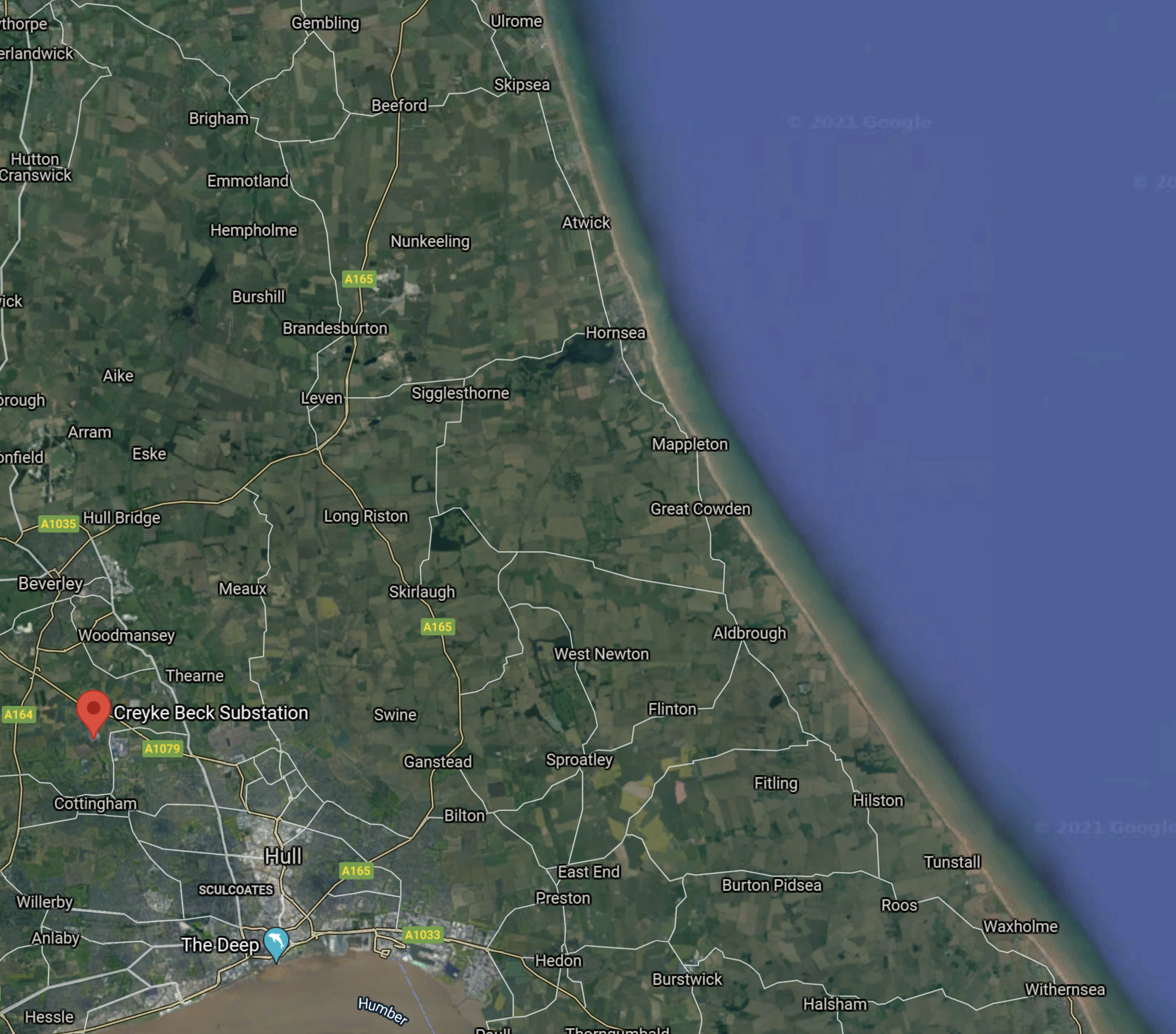
This Google Map shows the onshore route of the cable from the Dogger Bank Wind Farm.
Note.
- Hull and the River Humber at the bottom of the map.
- The red arrow which marks Creyke Beck sub station, where the cable from the Dogger Bank Wind Farm connects to the UK electricity grid.
- At the top of the map on the coast is the village of Ulrome, where the cable comes ashore.
The sub station is also close to the Hull and Scarborough Line, so would be ideal to feed any electrification erected.
I would assume that cables from the Dogger Bank Wind Farm could also link the Wind Farm to the proposed Dutch/Danish North Sea Wind Power Hub.
Given that the cables between the wind farms and Creyke Beck could in future handle at least 4.8 GW and the cables from the North Sea Wind Power Hub to mainland Europe would probably be larger, it looks like there could be a very high capacity interconnector between Yorkshire and Denmark, Germany and The Netherlands.
It almost makes the recently-opened North Sea Link to Norway, which is rated at 1.4 GW seem a bit small.
The North Sea Link
The North Sea Link is a joint project between Statnett and National Grid, which cost €2 billion and appears to have been delivered as planned, when it started operating in October 2021.
So it would appear that National Grid have shown themselves capable of delivering their end of a complex interconnector project.
Project Orion And The Shetlands
In Do BP And The Germans Have A Cunning Plan For European Energy Domination?, I introduced Project Orion, which is an electrification and hydrogen hub and clean energy project in the Shetland Islands.
The project’s scope is described in this graphic.
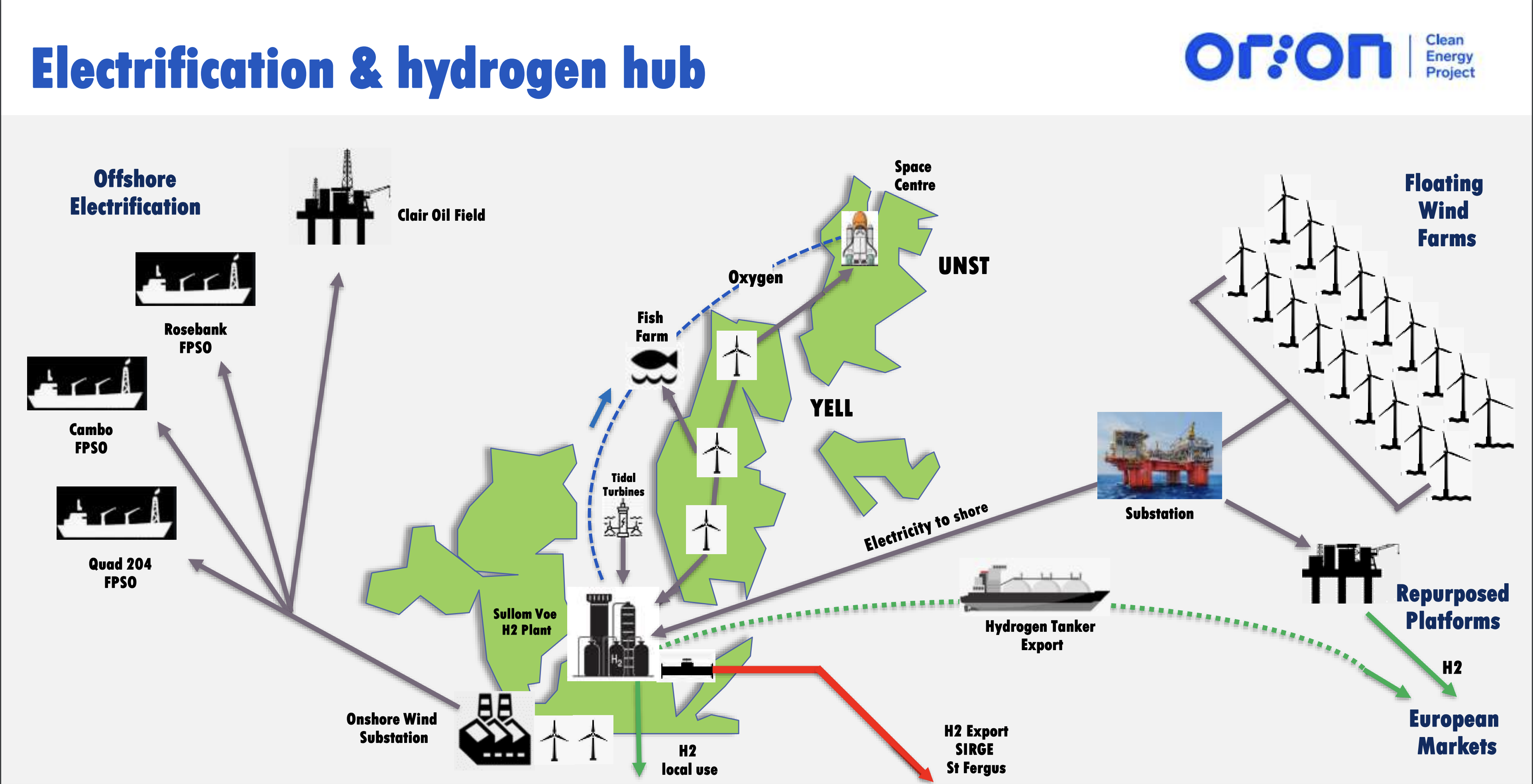
Note that Project Orion now has its own web site.
- Could the Shetlands become an onshore hub for the North Sea Power Hub Programme?
- Could Icelink, which is an interconnector to Iceland be incorporated?
With all this renewable energy and hydrogen, I believe that the Shetlands could become one of the most prosperous areas in Europe.
Funding The Wind Farms And Other Infrastructure In The North Sea
In World’s Largest Wind Farm Attracts Huge Backing From Insurance Giant, I described how Aviva were funding the Hornsea wind farm.
I very much believe that City of London financial institutions will be able to finance a lot of the developments in the North Sea.
After all National Grid managed to find a billion euros in a sock drawer to fund their half of the North Sea Link.
Electrifying The North Sea: A Gamechanger For Wind Power Production?
The title of this section, is the same as that of this article on Engineering and Technology Magazine.
This article in the magazine of the IET is a serious read and puts forward some useful facts and interesting ideas.
- The EU is targeting offshore wind at 60 GW by 2030 and 300 GW by 2050.
- The UK is targeting offshore wind at 40 GW by 2030.
- The article explains why HVDC electricity links should be used.
- The major players in European offshore wind are the UK, Belgium, the Netherlands, Germany, and Denmark.
- The foundations for a North Sea grid, which could also support the wider ambitions for a European super-grid, are already forming.
- A North Sea grid needs co-operation between governments and technology vendors. as well as technological innovation.
- National Grid are thinking hard about HVDC electrical networks.
- By combining HVDC links it can be possible to save a lot of development capital.
- The Danes are already building artificial islands eighty kilometres offshore.
- Electrical sub-stations could be built on the sea-bed.
I can see that by 2050, the North Sea, South of a line between Hull and Esbjerg in Denmark will be full of wind turbines, which could generate around 300 GW.
Further Reading
There are various articles and web pages that cover the possibility of a grid in the North Sea.
- National Grid – Interconnectors
- The Guardian – National Grid In Talks Over Plan For Energy Island In North Sea
- The Times – National Grid Planning ‘Energy Island’ In North Sea
I shall add to these as required.
Conclusion
I am coming to the conclusion that National Grid will be joining the North Sea Wind Power Hub Programme.
- They certainly have the expertise and access to funding to build long cable links.
- The Dogger Bank wind farm would even be one of the hubs in the planned hub and spoke network covering the North Sea.
- Only a short connection would be needed to connect the Dogger Bank wind farm, to where the Dutch and Danes originally planned to build the first energy island.
- There may be other possibilities for wind farm hubs in the UK section of the North Sea. Hornsea Wind Farm, which could be well upwards of 5 GW is surely a possibility.
- Would it also give access to the massive amounts of energy storage in the Norwegian mountains, through the North Sea Link or Nord.Link between Norway and Germany.
Without doubt, I know as a Control Engineer, that the more hubs and spokes in a network, the more stable it will be.
So is National Grid’s main reason to join is to stabilise the UK electricity grid? And in turn, this will stabilise the Danish and Dutch grids.
 The Anonymous Widower