Thoughts On The Morecambe Bay Eden Project
When the BBC reported this on Friday, they got a generally good reaction from the local residents they interviewed.
Articles in the Guardian and The Times have been positive, with support from local and national politicians and other worthies. The Times too, has extensive positive comments from readers.
For a project like this to be built, let alone be successful, it needs to have this sort of response on the first day.
It is a project that obviously touches a happy nerve, sirs memories or just ticks all the right boxes with lots of people.
So where will the Eden Project be built?
This Google Map shows the town of Morecambe and psart of the coast and bay to the North of the town.
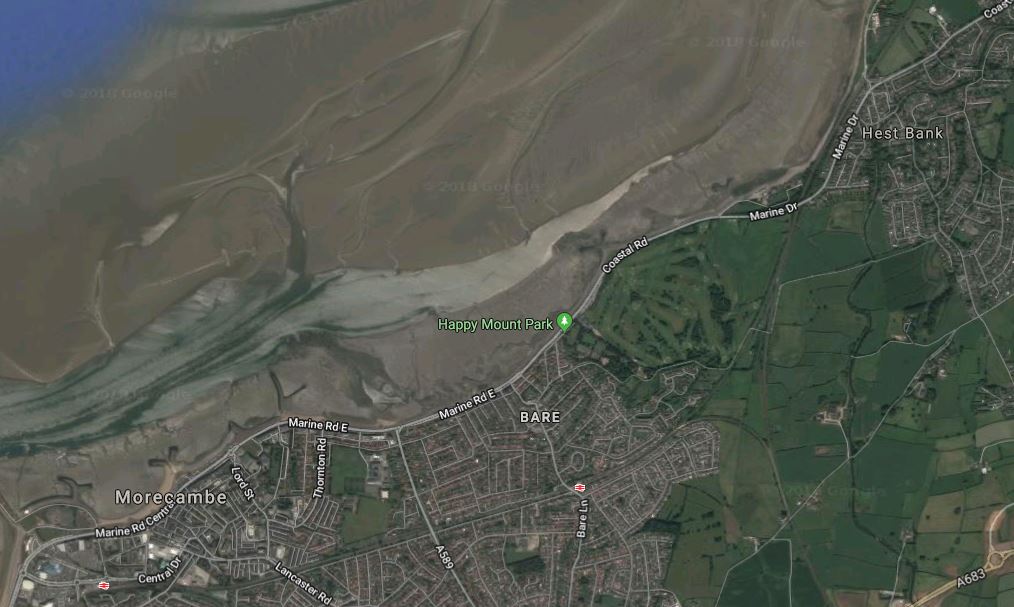
Nothing has been said about the location, but there would appear to be plenty of space.
I’ve only ever been to Morecambe once, when I visited the town on my trek to visit all 92 English football clubs to raise money for pancreatic cancer research at Liverpool University. My brief visit to Morecambe is described in 92 Clubs – Day 21 – Milton Keynes, Morecambe, Newcastle. This was my initial comment on the town.
The town was a bit of a surprise, as I thought it would be like Blackpool only smaller. It is smaller, but it is in much better state than its larger resort down the coast. You wouldn’t see anything as tasteful as this on a roundabout in Blackpool.
My previous visit was very much a quickie, as I had to continue to Newcastle.
The Eden Project By Train
On their web site, the Eden Project, says this about getting to their Cornish attraction by train.
We are just a few miles from St Austell railway station, which is on the main line from London Paddington and is well served by buses to Eden. You could also take the train to Luxulyan, Bugle or Par, for a more scenic journey or to continue your trip on foot or bike.
They also give a discount for visitors that arrive by public transport. As they should!
If I was going, I’d take the Night Riviera to St. Austell and then use a bus to the Eden Project from the bus station at St. Austell station to complete the journey.
The Proposed Morecambe Eden Project By Train
So how would getting to the proposed Eden Project at Morecambe compare?
In Getting To The Proposed Morecambe Eden Project By Train, I laid out how a large zero-carbon rail system could develop around Morecambe.
I also concluded that journeys to and from Birmingham, Edinburgh, Glasgow, Liverpool, London and Manchester, could be made zero-carbon.
How cool is that?
Battery Trains On The Uckfield Branch
The Uckfield Branch is not electrified and it only gets an hourly service to London Bridge.
However a few years ago, all platforms on the line were extended, so that twelve-car trains could run services.
I have always felt that this service was ideal for running using battery trains.
- Trains would run between London Bridge and Hurst Green using the third rail electrification.
- The batteries would be charged between London Bridge and Hurst Green stations.
- South of Hurst Green, the train would run on battery power.
- Top-up charging could be provided during the eleven minute turnround at Uckfield station.
These are distances and times between stations South of Hurst Green.
- Hurst Green – Edenbridge Town – 4.33 miles – 6.98 km. – 6 mins – 7 mins
- Edenbridge Town – Hever – 1.75 miles – 2.81 km – 4 mins – 4 mins
- Hever – Cowden – 2 miles – 3.21 km. – 4 mins – 5 mins
- Cowden – Ashurst – 2.77 miles – 4.47 km. – 4 mins – 4 mins
- Ashurst – Eridge – 2.31 miles – 3.72 km. – 6 mins – 6 mins
- Eridge – Crowborough – 3.74 miles – 6.01 km. – 6 mins – 6 mins
- Crowborough – Buxted – 4.71 miles – 7.58 km – 7 mins – 7 mins
- Buxted – Uckfield – 2.25 miles – 3.62 km – 6 mins – 4 mins
Note.
- The first time is Southbound and the second is Northbound.
- I only calculated distances to two decimal places.
It appears the route has a generally 70 mph operating speed.
What Is The Performance Of The Current Class 171 Trains?
Class 171 trains have the following characteristics.
- 100 mph operating speed
- Acceleration of 0.5 m per second²
- A weight of 90.41 tonnes.
- Seating for 109 passengers.
- On my trip today, the train rarely exceeded 50 mph.
What Would Be The Performance Of A Battery Train?
I will assume that the battery train is something like a Class 701 train fitted with batteries.
- Ten cars
- 100 mph operating speed
- Acceleration of 1.0 m per second² (taken from Class 345 train)
- A weight of 364.9 tonnes. (An estimate based on data from Weight And Dimensions Of A Class 345 Train.
- Based on the Class 345 train, I would reckon the train would have at least eight motored cars.
- I would put a battery in each motored car.
- Capacity of 546 seated and 673 standing passengers.
I will use this information to calculate the energy of the train.
Assuming each passenger with all their baggage is 90 kg., this gives a passenger weight of 109.71 tonnes
This gives a total train weight of 474.61 tonnes.
Calculating the kinetic energy for various speeds gives.
- 30 mph – 11.8 kWh
- 40 mph – 21 kWh
- 50 mph -30.9 kWh
- 70 mph – 64.5 kWh
- 80 mph – 84.3 kWh
- 90 mph – 106.7 kWh
- 100 mph – 131.7 kWh
Even the highest energy figure, which is way above the operating speed of the line could be handled under regenerative braking by a convenient size of battery.
How Would A Battery Train Operate?
This Google Map shows Hurst Green station and Hurst Green Junction, where the Uckfield and East Grinstead branches split.
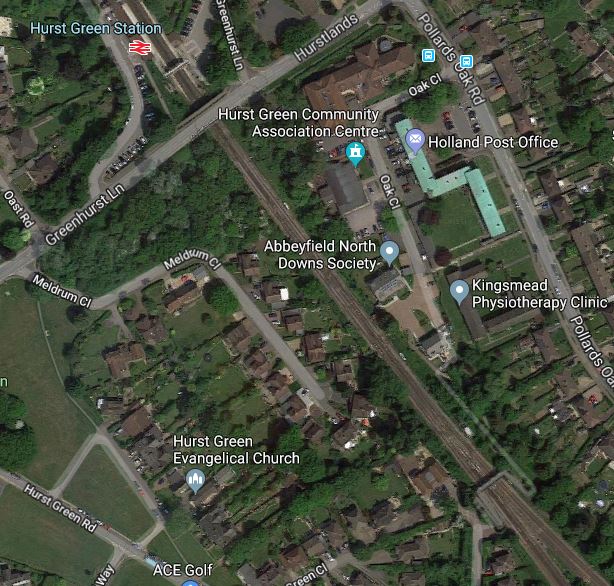
As the East Grinstead branch is electrified, after stopping at Hurst Green station, a train for Uckfield station will have something like two to three hundred metres of electrified track to accelerate it to the operating speed.
At present the operating speed appears to be 70 mph, but if it were higher, the train would enter the section of track without electrification, with more energy.
As it is, the train would probably be entering the branch with batteries, that had been fully-charged on the way from London.
The electrification would have been used like a catapult to impart maximum energy to the train.
At each stop, the following would happen.
- Regenerative braking will convert the train’s kinetic energy into electricity, which will be stored in the batteries.
- Battery power would then accelerate the train after each stop.
As regenerative braking is not 100% efficient, there would be a loss of perhaps fifteen percent of kinetic energy at each stop.
So gradually as the train progresses to Uckfield and back, the battery charge will be depleted.
There are seven stations between Hurst Green and Uckfield,so that means that fifteen stops will have to be made before the train returns to the electrification at Hurst Green.
If the train was operating at 70 mph, the kinetic energy would be 64.5 kWh and the losses in the regenerative braking at fifteen stations would be 64.5 *0.15 *15 or 145.57 kWh.
I will assume each battery train has eight 50 kWh batteries, as Bombardier have a 50 kWh PRIMOVE battery that would be suitable.
So if the train entered the Uckfield branch with 400 kWh in the batteries and 64.5 kWh in the train, it would be carrying 464.5 kWh, that could be used to power the train.
As I said, 145.57 kWh would be lost in braking, so that would leave 318.93 kWh to take a ten car train, a distance of 46 miles.
This works out at a figure of 0.7 kWh per car per mile for the journey.
In an article in the October 2017 Edition of Modern Railways, which is entitled Celling England By The Pound, Ian Walmsley says this in relation to trains running on the Uckfield Branch, which is not very challenging.
A modern EMU needs between 3 and 5 kWh per vehicle mile for this sort of service.
So it looks like running a battery train on the route could be impossible, as there is a large difference between 0.7 and 3.
Let’s see what the mathematics say for various ideas.
Put A 50 kWh battery In Each Car
The larger battery capacity would mean the train will enter the branch carrying 564.5 kWh, that could be used to power the train.
Thus after deducting the regeneration losses of 145.57 kWh, this would leave 418.93 kWh to run the 460 vehicle miles.
This works out at a figure of 0.9 kWh per car per mile for the journey.
Improve The Efficiency Of The Regenerative Braking
Suppose that the energy lost at each stop can be reduced from fifteen to ten percent, how much difference would that make?
If the train was operating at 70 mph, the kinetic energy would be 64.5 kWh and the losses in the regenerative braking would now be 64.5 *0.10 *15 or 96.75 kWh.
Using the 500 kWh battery would mean the train will enter the branch carrying 564.5 kWh, that could be used to power the train.
Thus after deducting the regeneration losses of 96.75 kWh would leave 467.75 kWh to run the 460 vehicle miles.
This works out at a figure of 1 kWh per car per mile for the journey.
Charge the Train At Uckfield
Trains take eleven minutes to turn round at Uckfield station.
So how much power could be put into the batteries in that time?
But the Aventra isn’t a normal train.
Crossrail’s Class 345 trains have the following formation.
DMS+PMS+MS1+MS3+TS(W)+MS3+MS2+PMS+DMS
Note that it is symmetrical with two PMS cars, which have pantographs and the heavy electrical gear.
I suspect that the trains are two half trains with a degree of independent systems, so that if there are problems in the Crossrail tunnel, the train doesn’t get trapped.
I wonder if Thameslink’s Class 700 trains are the same?
So will South Western Railway’s third rail Class 701 trains be similarly designed, so that they can bridge gaps in the third rail electrification. If the third-rail shoes were in the second and ninth cars, they would be around 160 metres apart.
So perhaps a charging point based on third rail technology could be a double one, with a connection to each half-train.
This picture shows the exceedingly long platform at Uckfield station.
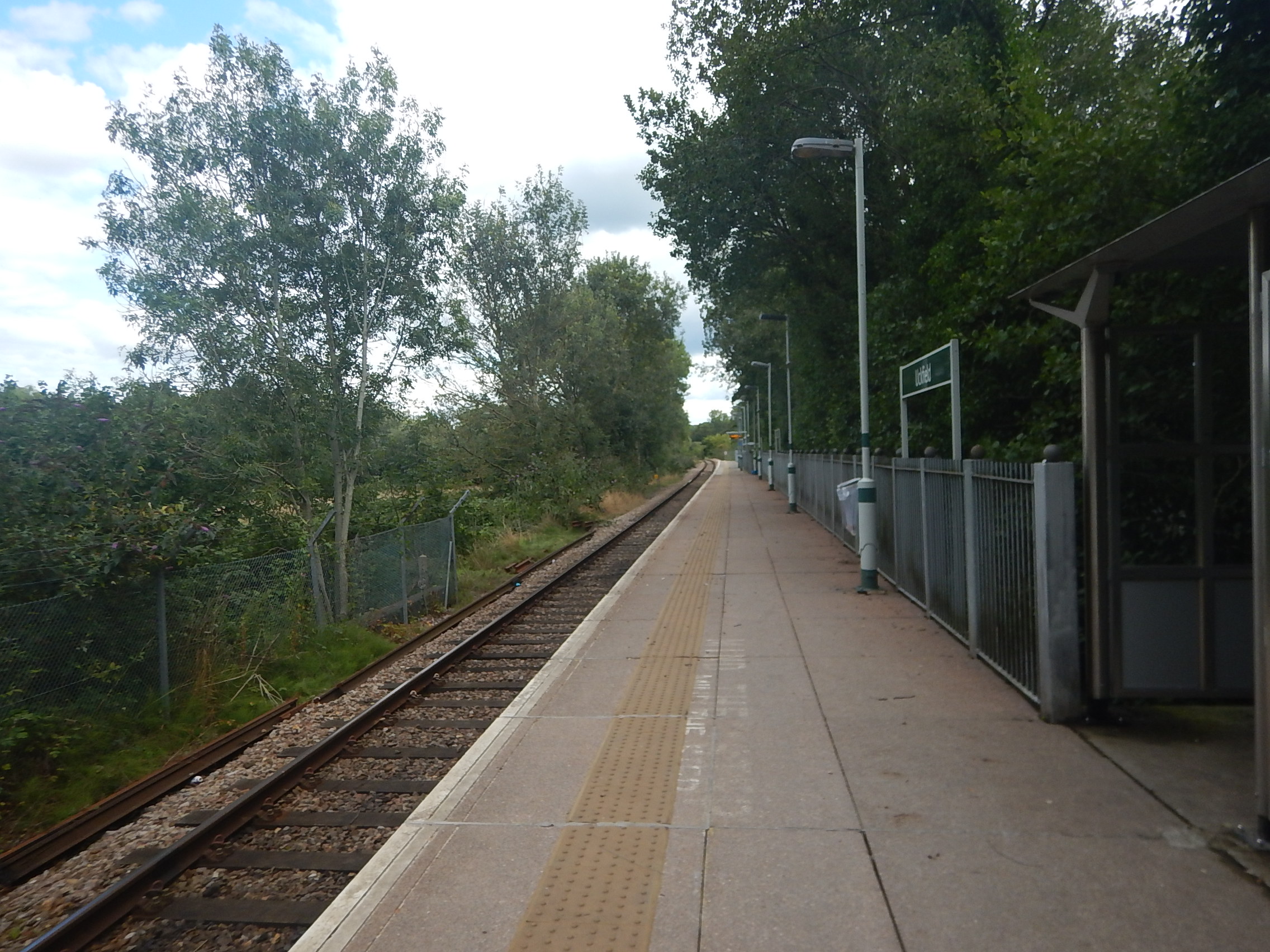
It could certainly accommodate a double third rail-based charging system.
- It would be on the far-side from the platform.
- It would only be activated with a train the platform and connected.
- It could be designed to have no serious safety problems.
The eleven minute charge would be equivalent to one of twenty-two minutes.
There must surely be the option to adjust the timetable, so that trains spend a few minutes longer at Uckfield and a few less at London Bridge, where charging isn’t necessary, as they charge the batteries all the way to and from Hurst Green.
Aventra Trains Have A Low Energy Mode
A few months ago, I was on a Crossrail train and I got talking to one of the driver/trainers.
I asked him what happens, if the power fails in the Crossrail tunnel.
He told me, that the driver switches systems off to reduce power requirements and switches to emergency power to move the train to a safe place to evacuate passengers.
Suppose though, when the train is running on batteries, power-hungry systems like air-conditioning were turned to a low energy mode. With judicious switching and innovation in design, I suspect that energy use can be lowered when running on batteries and raised when running on electrification to compensate.
Suppose, it was a very hot summer’s day.
The air-conditioning would be cooling the train from London Bridge to Hurst Green, getting more than adequate power from the electrification.
At Hurst Green, the train would be just the right temperature and the air-conditioning would be switched to eco-mode.
The train would be well-insulated and this would help maintain the cool environment, until the electrification was regained.
What about a cold day in the winter?
This post is entitled Aventras Have Underfloor Heating. On a cold day will this act a bit like a storage heating and keep the train warm if the power fails?
As I said I don’t think an Aventra is a normal train and although some of this is my deductions, we should be prepared for surprises as more of these trains start running on the UK’s railways.
Will Battery Trains Be Slower?
Much of the battery running on this route will be short hops of a few miles and minutes between stations.
The longest section will be between Crowborough and Buxted stations, which is 4.71 miles and currently takes seven minutes in both directions.
Both the Class 171 trains and the battery trains, will operate each section in the same way.
- Accelerate to the line speed, as fast as possible.
- Run at line speed for a measured distance.
- Slow down and apply braking to stop precisely in the next station.
As the battery train has 1 metre per sec² acceleration, as opposed to 0.5 metre per sec² of the diesel train, the battery train will get to line speed faster
Regenerative braking will also be smoother and possibly greater, than the brakes on the diesel train.
I am fairly sure, that a well-designed battery train will save a few minutes on each leg from Hurst Green to Uckfield.
These time savings could be used to extend the charging time at Uckfield
Conclusion
Running services on the Uckfield branch using battery-powered trains is a feasible proposition.
But these trains must have the following features.
- Regenerative braking to the trains batteries.
- A design where batteries are central to the traction system, not an afterthought.
- The ability to minimise power use for onboard systems.
But above all, the trains must have energy efficient systems.
Bombardier obviously have better figures and information than I do, so I think we should be prepared for surprises.
Brompton’s Electric Bicycle
Brompton were promoting their new electric bicycle at Kings Cross.

It looks a neat front wheel drive, pedal-assisted design.
At nearly £3,000, it would only be a bike for a serious commuter. Although, I suspect many will buy one to potter around their local area.
What I found interesting was that the battery weighs three kilograms and has a capacity of 0.3 kWh.
This energy density is very much in line with the most efficient, large traction batteries in road vehicles, trains and trams.
Did The Queen Ever Ride In This Train?
These pictures show the British Rail BEMU, which was an experimental two-car battery electric multiple unit, that ran on the Deeside Railway between Aberdeen and Ballater stations, in the late 1950s and early 1960s.
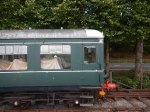
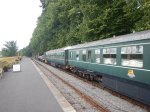
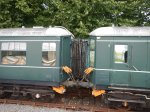
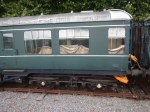
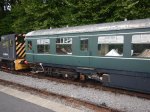


It is now parked at the Royal Deeside Railway awaiting restoration.
As the bodywork is aluminium, it struck me that it wouldn’t be an impossible restoration project.
Someone, I spoke to, said the biggest problem and probably expense were the batteries.
Perhaps, they could use some recycled batteries from electric buses or other vehicles, which some companies are going to use as house storage batteries.
A Memory From A Lady
I travelled to the Royal Deeside Railway on a bus and sat up front on the top deck. Next to me was a lady, who was perhaps in her seventies like me, who remembered using the train several times.
From what she said, it appeared to work reliably for a number of years.
Did Her Majesty Ever Use The Train?
No-one at the Royal Deeside Railway has any proof, that the Queen ever rode in the train.
But they are pretty sure, that the Queen Mother used the train. Apparently, she liked the steady speed as it proceeded through the countryside.
Conclusion
With the current developments in battery transport, I feel that this prototype might well be worth restoring to operation condition.
A Railway That Needs Electric Trains But Doesn’t Need Full Electrification
This article on Rail Magazine is entitled ScotRail Targets Further Electrification Schemes.
This is the first paragraph.
The five years from 2019 could feature more wiring in Scotland, with ScotRail Alliance Managing Director Alex Hynes telling RAIL: “I’d love to see more electrification – Stirling to Perth, East Kilbride and the Edinburgh South Suburban.”
In this post, I will look at electrification of the Busby Railway to East Kilbride station.
- The station is 11.5 miles from Glasgow Central station.
- The station has an altitude of 504 feet.
- It is a single platform station.
- The route to Glasgow is double-track, except for the last section from Busby station, which is single track, with a passing loop at Hairmyres station.
- A two trains per hour (tph) service is provided between Glasgow Central and East Kilbride using two two-car diesel Class 156 trains.
This picture shows East Kilbride station.
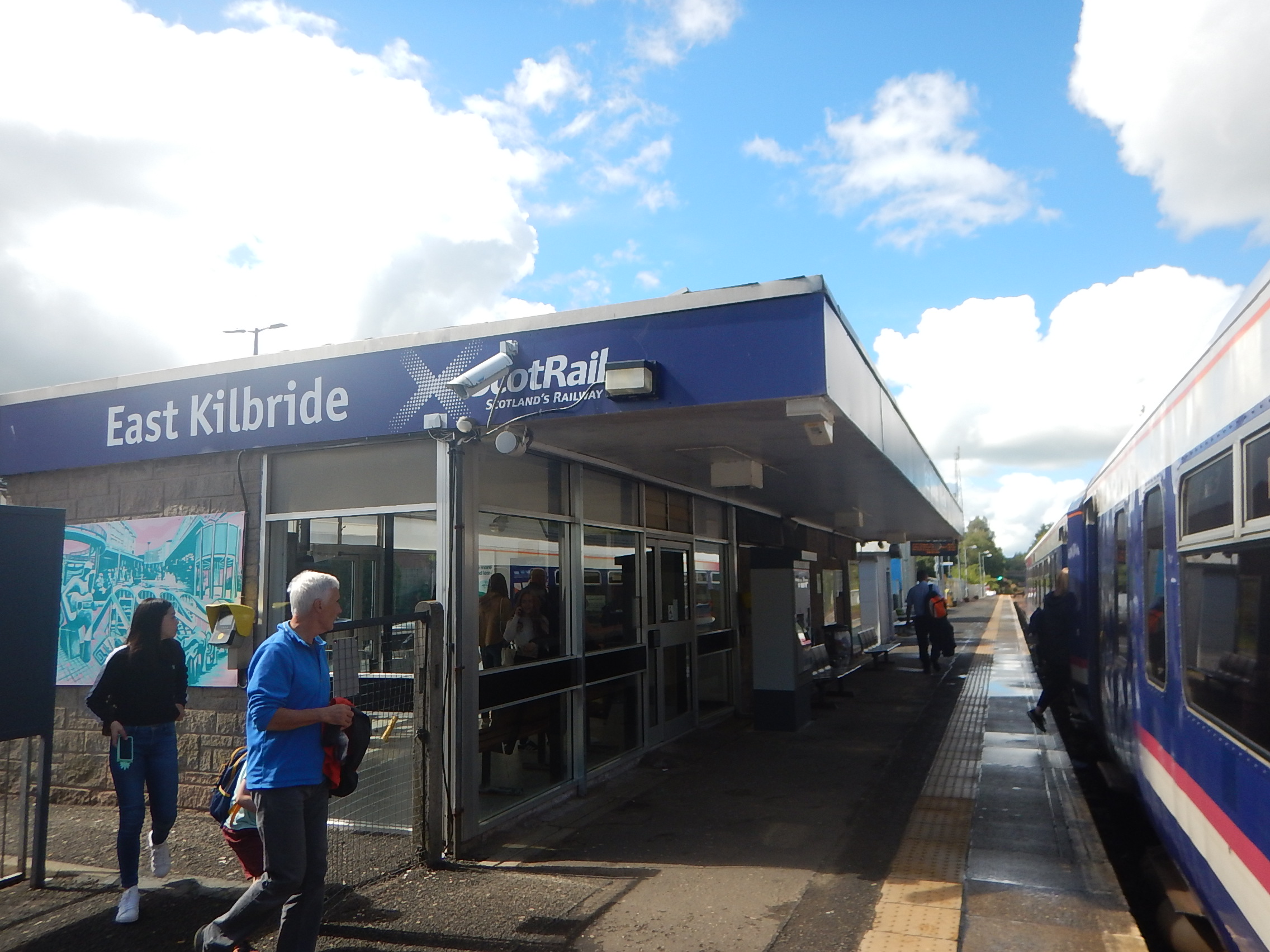
Nothing complicated at this station and it comfortably handles two tph.
In the UK, there are several stations where four tph are handled using a single platform.
- Chester, Kirkby and Ormskirk on Merseyrail.
- Clapham Junction, Dalston Junction, Highbury & Islington, New Cross and West Croydon on the London Overground.
Transport for Wales also intend to run four tph to several single-platform stations including Rhymney, which is high in the valleys.
I suspect that with modern signalling and driver aids, Glasgow’s drivers would be capable of running four tph between Glasgow Central and East Kilbride stations.
Judging by my trip on the route, there is certainly a need for more capacity, as if every seat is taken at two in the afternoon, two-car trains running at a frequency of two tph is just not enough.
So surely running new four-car electric trains to the current timetable, would be the standard solution for this route?
But!
Look at these pictures of the route..




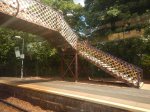
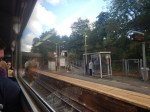
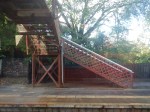
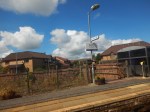
It wouldn’t be a nightmare to electrify, but because of the stone bridges and the steel footbridges, it would be expensive and very disruptive.
The following should also be noted.
- The railway has never gone further than East Kilbride station.
- There is no freight on the line, except for that needed for maintenance.
I am very much drawn to the conclusion, that to electrify the whole route would use money that would probably be better spent on improving step-free access at some of the stations.
Electric Trains To East Kilbride Without Full Electrification
Before I detail the solutions, I shall look at the energy required to raise a train from Glasgow to East Kilbride station.
Consider.
- A four-car electric train like a Class 321 train weighs 138 tonnes.
- This train has 309 seats, so could probably accommodate 400 passengers.
- Assuming each weighs 90 kg with buggies, baggage, bicycles and bagpipes, this gives a train fully-loaded train weight of 174 tonnes.
Using Omni’s Potential Energy Calculator, it would take 73 kWh of energy to raise the train to the 504 feet altitude of East Kilbride station.
It should also be noted that Glasgow Central station and the approaches to the station are fully electrified almost as far as Crossmyloof station.
What solutions are available to have as-new electric trains running between Glasgow Central and East Kilbride station?
The Rhymney Line Solution
The Rhymney Line runs between Cardiff Central and Rhymney stations.
In the design of the new South Wales Metro, the highest section of this line between Ystrad Mynach and Rhymney stations will be run on battery power.
- This section is about eleven miles long.
- It is a mixture of single and double-track.
- The height difference is 410 feet.
This is very similar in severity to the Busby Railway.
Transport for Wales are proposing to use Tri-Mode Stadler Flirt trains on this route.
These trains would be able to handle the East Kilbride route without any modification to the track or electrification.
It would just mean.
- Trains identical to those on the South Wales Metro.
- Building and delivering the trains.
- Training the drivers and other staff.
There would be other advantages.
- Stadler trains seem to be one of the best for step-free access, with automatic gap fillers between platform and train.
- They are 100 mph trains.
- They are ready for modern signalling.
- They can change mode at line speed.
These trains which will be Class 755 trains in Abellio Greater Anglia service, have a central power-pack, that can incorporate diesel or battery power to supplement power from the electrification.
Good engineering design would probably mean.
- The four slots in the power pack, can be fitted with a diesel engine, battery or perhaps even a hydrogen fuel cell to give a power profile tailored to the route.
- The battery would weigh a similar amount to the Deutz diesel engine, which would give a battery capacity of perhaps 100-120 kWh.
- There is an intelligent computer system controlling the power and braking systems.
- The trains come in various lengths from three-cars upwards.
This is a summary of the Stadler multi-mode trains ordered for the UK.
- Abellio Greater Anglia – Electric/Diesel – 14 x three-cars – Two Deutz diesel engines
- Abellio Greater Anglia – Electric/Diesel – 24 x four-cars – Four Deutz diesel engines
- Trains for Wales – Electric/Diesel – 11 x four-cars – Four (?) Deutz diesel engines
- Trains for Wales – Electric/Diesel/Batteries – 7 x three-cars – One Deutz diesel engine and three batteries (?)
- Trains for Wales – Electric/Diesel/Batteries – 17 x four-cars – One Deutz diesel engine and three batteries
I’m sure Abellio Greater Anglia won’t leave Abellio ScotRail, short of operational information.
In addition, they might be ideal for other routes in the Glasgow area.
- The Glasgow South Western Line to Kilmarknock, Dumfries and Carlisle.
- The Ayrshire Coast Line to Ayr and Stranraer.
- The West Highland Line to Oban and Mallaig.
They would use the electrification, when close to Glasgow.
I can’t see any reason, why another version of the Tri-Mode Stadler Flirt won’t be able to run services between Glasgow Central and East Kilbride stations.
The Battery Solution
Transport for Wales intend to run their Tri-Mode Stadler Flirts on battery from Ystrad Mynach to Rhymney. I can’t see any reason why a well-designed battery train can’t do the similar climb to East Kilbride station.
Of the major train manufacturers, only Stadler seem to have declared their hand with the Rhymney Line proposal.
- Bombardier have run prototypes in the UK and Germany, but are very protective with solid information.
- CAF have run battery trams and will introduce them to the UK in the next year or so.
- Hitachi use batteries in their trains and have run battery trains in Japan.
Also, consider that between Glasgow Central and Pollokshields East stations is electrified and extending this electrification to say Busby Junction. where the Busby Railway leaves the Glasgow South Western Line, would have the following benefits.
- The distance to run on batteries would be reduced by about three miles.
- There would be more electrification to ensure that train batteries were full before the climb to East Kilbride.
- If bi-mode trains were to run to Kilmarnock, Dumfries and Carlisle, they would have more electrified line to use.
This short section of electrification would certainly improve the mathematics of running battery trains to East Kilbride.
As Busby Junction to Kilmarnock is around twenty miles, it might even make it possible to run battery trains between Glasgow Central and Kilmarnock stations.
I have no doubts that, a battery train can be built to handle services between Glasgow Central and East Kilbride.
The Hydrogen Solution
I tend to think of trains powered by a hydrogen fuel cell, as battery trains with an environmentally-friendly onboard power source.
The Busby Line route is ideal for battery trains, especially, if there is a few miles of new electrification at the Glasgow Central end of the route.
Alstom’s proposed hydrogen-powered Class 321 train, could also be ideal for this route.
Four-car trains with a decent interior, would certainly solve the overcrowding on the route.
In A Class 321 Renatus, a comment was put, that says that the hydrogen-powered Class 321 trains will share the Renatus interior.
I’d suspected that would be the case, as why would the train’s owners; Eversholt Rail Group, design two different interiors for the same purpose?
The train would be able to leave Glasgow Central station with a full battery and with the help of electricity from the hydogen fuel cell, it would be able to climb to East Kilbride.
Coming down, the train would be partly powered by the battery, but mainly by gravity. Energy generated by the regenerative braking would be stored in the battery.
Alstom will be building a mathematical model of the train and its performance on various routes, so they will know the energy flows, when the train is working.
I said earlier that the following routes would be ideal for Stadler’s bi-mode trains.
- The Glasgow South Western Line to Kilmarknock, Dumfries and Carlisle.
- The Ayrshire Coast Line to Ayr and Stranraer.
- The West Highland Line to Oban and Mallaig.
I feel the same logic applies to Alstom’s hydrogen trains.
Conclusion
All three solutions, I outlined in this post, could be possible.
The solutions have several things in common.
- All will be fully tested elsewhere on the UK rail network.
- None need any electrification between Busby Junction and East Kilbride.
- All would benefit from a few extra miles of electrification between Busby Junction and Glasgow Central station.
- All solutions are backed by respected train building companies.
I think there will be a very keen contest to see who supplies the trains for this and other related routes from Glasgow.
What Is The Battery Size On A Tri-Mode Stadler Flirt?
The power-pack in the middle of a Tri-Mode Stadler Flirt, would appear to have four slots, each of which could take.
- A V8 16-litre Deutz diesel that can produce 478 kW and weighs 1.3 tonnes.
- A battery of about 120 kWh, which would probably weigh about 1.2 tonnes.
Would future versions of these trains accept a hydrogen fuel cell?
Note that, I estimated the battery size, by using typical battery energy densities for a battery of similar weight and physical size to the diesel engine.
Would Electrically-Driven Trains Benefit From Batteries To Handle Regenerative Braking?
There are two basic types of electrically-driven trains.
Electric trains, which include electrical multiple units and trains hauled by electric locomotives like the InterCity 225.
Diesel-electric trains, which include multiple units like Voyagers and the InterCity 125.
Regenerative Braking
In an electrically-driven train, the traction motors can be turned into generators to slow the train, by turning the train’s kinetic energy into electricity.
Many electric trains can do this and the generated electricity is returned through the electrification system, so that it can power other trains nearby.
This all sounds fine and dandy, but there is the disadvantage that all the electrification system must be able to handle the reverse currents, which increases the capital cost of the electrification.
Batteries For Regenerative Braking
Fitting batteries to a train, to handle the electricity that is generated by regenerative braking is an alternative.
A Station Stop
Suppose a four-car train that weighs 200 tonnes is travelling at 125 mph and needs to stop at a station.
My example train would according to Omni’s Kinetic Energy Calculator would have a kinetic energy of 86.7 kWh.
To put that amount of energy into context, the traction battery in a New Routemaster bus is 55 kWh.
So if a battery of this size was put into each car, there is more than enough capacity to store the energy of the train, when it stops at a station.
When the train leaves the station, a proportion of this energy can be used to accelerate the train back to 125 mph.
As regenerative braking is perhaps only eighty percent efficient at present, additional energy will need to be provided.
But even with today’s primitive batteries and less-than-efficient traction motors, there are still substantial energy savings to be achieved.
Hitachi Class 800/801/802 Trains
In Do Class 800/801/802 Trains Use Batteries For Regenerative Braking?, I looked at the question in the title.
I found this document on the Hitachi Rail web site, which is entitled Development of Class 800/801 High-speed Rolling Stock for UK Intercity Express Programme.
It was written in 2013 and I suspect every train designer has read it, as it gives a deep insight into the design of Hitachi’s trains.
The document provides this schematic of the traction system.

Note
- BC which is described as battery charger.
- The battery size is not disclosed.
- The APS supplies the hotel power for the train in two different voltages.
- Can the APS with the battery supply power to the Drive Converter?
After a lot of reasoning, I came to this conclusion.
I will be very surprised if Class 800/801/802 trains don’t have batteries.
Looking at the schematic of the electrical system, the energy captured will at least be used for hotel power on the train.
Hitachi have not said, if the batteries on the Class 800/801/802 trains can be used for traction purposes.
Storing the regenerative energy in a battery can be used for one of two purposes.
Hotel Power
Hitachi’s Class 800 trains certainly use the electricity in the battery to power the hotel functions of the train like air-conditioning, doors, lights, power-sockets, toilets and wi-fi.
In a diesel-electric train, this could give benefits.
- The engines generally won’t need to run in a station to provide hotel power.
- Less fuel will need to be expended to provide hotel power.
- If say the train has to halt perhaps because of a signalling or track fault, hotel power can be provided without running the engines.
- If batteries are supplying the hotel power, the train may have more power for traction.
Overall, the diesel-electric train would be more efficient and would emit less carbon dioxide and pollutants.
Traction Power
There is no engineering reason, why the energy in the battery can’t be used to actually move the train.
But to implement it, could be complicated and expensive on an existing train.
Some Worked Examples
I’ll look at a few examples.
InterCity 125
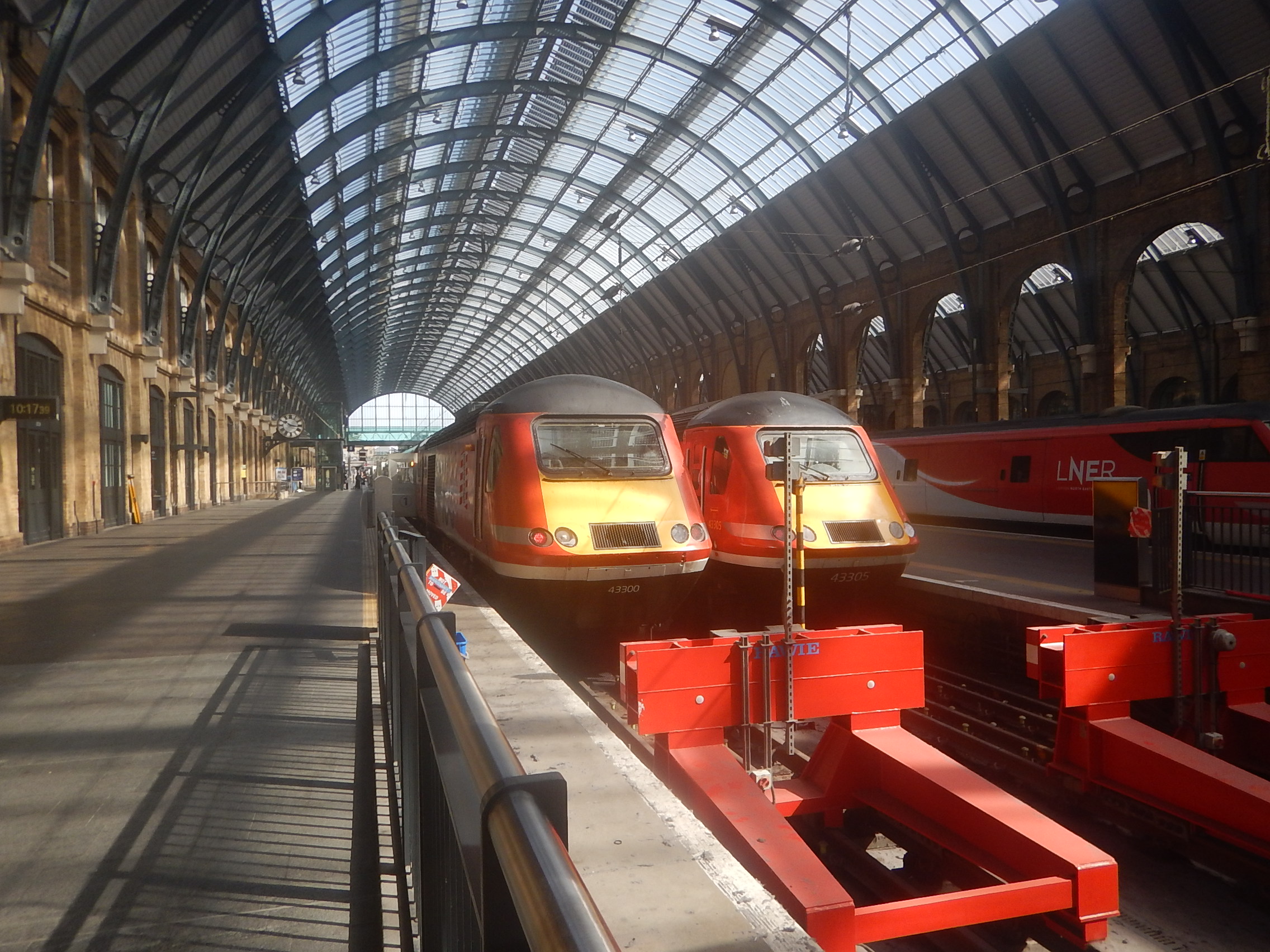
The iconic InterCity 125s are unique, in that they are impossible to scrap. Just as they seem to be approaching the end of their life, a devious engineer or marketing man comes up with a plan to keep them running.
As I write this, Great Western Railway and Abellio ScotRail are testing short-formation InterCity 125s and training drivers for services in the South West of England and Scotland. Both train operating companies appreciate the marketing advantages of Terry Miller‘s world-famous train, that was built as a stop-gap, after the failure of the Advanced Passenger Train.
So what size of battery would need to be fitted to each locomotive to handle the braking energy of a short-formation InterCity 125 with four passenger cars?
Consider.
- Each Class 43 locomotive weighs 70.25 tonnes.
- Each Mark 3 coach weighs 33.60 tonnes.
- An eight car InterCity 125 can carry about 500 passengers.
- I will assume that a four-car InterCity 125 can carry 250 passengers.
- If each passenger weighs 90 Kg with all their bikes, buggies and baggage, that adds up to 22.50 tonnes.
This gives a total train weight of 297.40 tonnes.
Calculating the kinetic energy using Omni’s Kinetic Energy Calculator for various speeds gives.
- 50 mph – 20.6 kWh
- 75 mph – 46.4 kWh
- 90 mph – 66.9 kWh
- 100 mph – 82.5 kWh
A fifty kWh battery in each locomotive would be able to handle the braking energy of the train.
The only problem, is that Class 43 locomotives have DC traction motors, no regenerative braking and air brakes.
But if any operator or rolling stock owner were bonkers enough to fit a new traction system, a diesel/electric/battery Class 43 locomotive is possible for a four-car InterCity 125.
This page on the Hitachi web site is entitled V-TRAIN 2.
Hitachi used a Class 43 power car to prove that diesel/electric/battery trains were feasible, before getting the order for the Class 800 trains.
So fitting batteries to Class 43 locomotives has been done before!
The simplest thing to do would be to use the batteries to provide hotel power for the train.
Class 375 Train
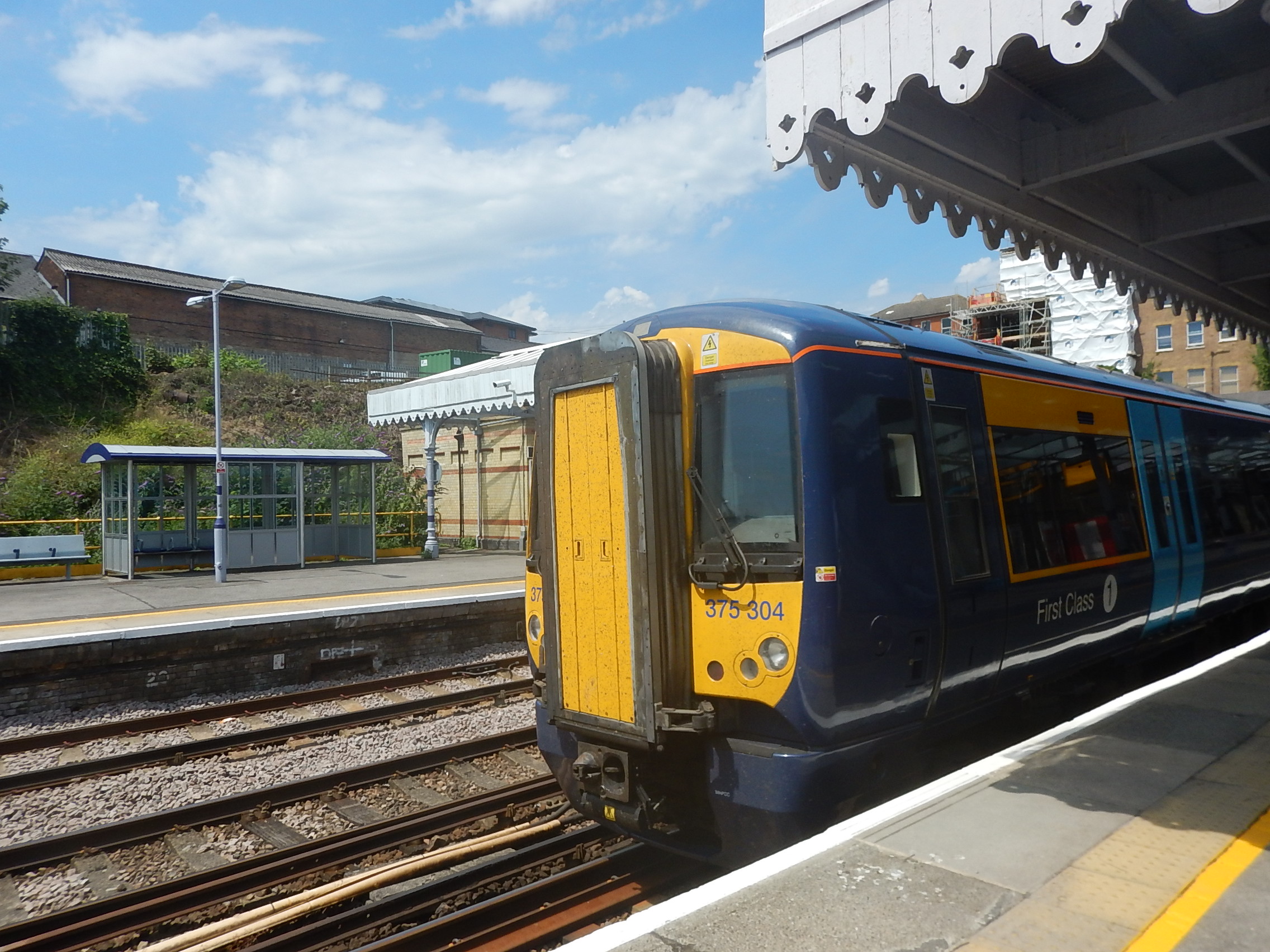
In this exercise, I shall consider a Class 375/6 train, with the following characteristics.
- Four cars
- Three cars are motored.
- Regenerative braking
- A weight of 173.6 tonnes.
- A capacity of 236 seated passengers
- An operating speed of 100 mph.
I will now go through my standard train kinetic energy calculation.
- I will assume three hundred passengers including standees.
- If each passenger weighs 90 Kg with all their bikes, buggies and baggage, that adds up to 27 tonnes.
This gives a total train weight of 200.60 tonnes.
Calculating the kinetic energy using Omni’s Kinetic Energy Calculator for various speeds gives.
- 50 mph – 13.9 kWh
- 80 mph – 35.6 kWh
- 100 mph – 55.7 kWh
It would appear that adding batteries to a Class 375 train would not involve large capacity batteries, especially if one was added to each of the three cars with motors.
As a Control Engineer by training, blending battery and electrification power could run the train more efficiently.
Probably naively on my part, I suspect that using batteries on Class 375 trains to handle regenerative braking, would be one of the easier installations.
Other Electrostars
All Electrostars are fairly similar, so if Class 375 trains could be updated, then I wouldn’t be surprised if all could.
InterCity 225
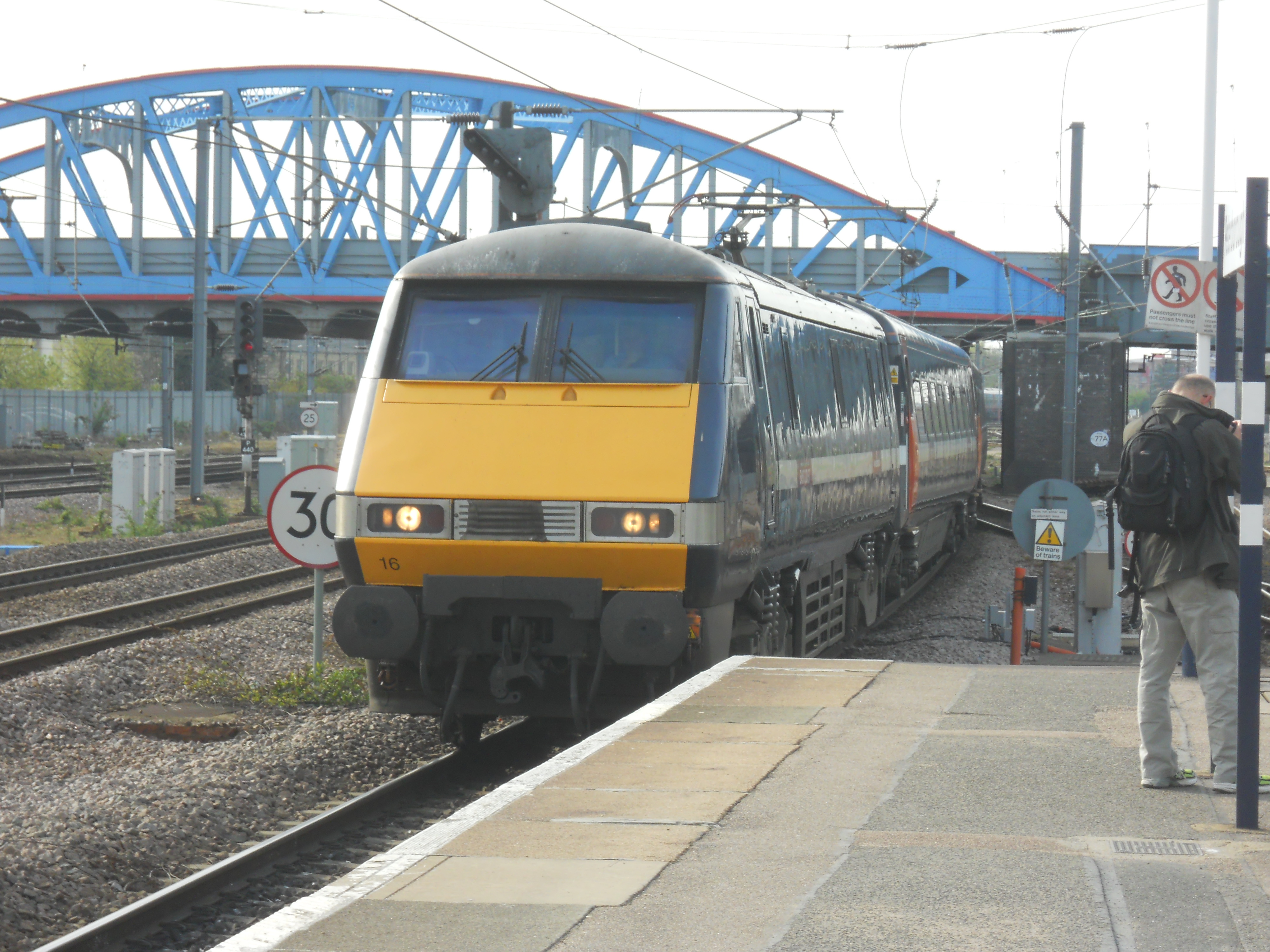
It looks like InterCity 225 trains will be used between London and Blackpool by Alliance Rail Holdings.
Other commentators have suggested that shortened sets run on the Midland Main Line between a diesel locomotive and a Driving Van Trailer (DVT) or two Class 43 locomotives.
I shall do the energy calculation for a five-car InterCity 225.
- A Class 91 locomotive weighs 81.5 tonnes.
- A Mark 4 coach weighs between 40 and 43.5 tonnes.
- A nine-car InterCity 225 seats 535 passengers.
- I will assume that a five-car InterCity 225 will seat around 300 passengers.
- I will assume each passenger weighs 90 Kg. with all their baggage, bikes and buggies.
- A DVT weighs 42.7 tonnes.
For a current nine-car train this gives the following.
- The empty train weight is almost exactly 500 tonnes.
- The passengers weigh 48 tonnes.
- This gives a total weight of 548 tonnes.
At 125 mph, the nine-car InterCity 225 has a kinetic energy of 238 kWh.
For a proposed five-car train this gives the following.
- The empty train weight is almost exactly 333 tonnes.
- The passengers weigh 27 tonnes.
- This gives a total weight of 360 tonnes.
At 125 mph, the five-car InterCity 225 has a kinetic energy of 156 kWh.
Reduce the speed to 110 mph and the kinetic energy drops to 121 kWh.
I suspect that using current technologies, there is not enough space in a Class 91 locomotive for the batteries.
Perhaps a short section of the coach next to the engine could be converted to hold a large enough battery.
Five Mark 4 Coaches And Two Class 43 Locomotives
This has been suggested in Modern Railways by Ian Walmsley and I wrote about it in Midland Mark 4.
Consider.
- A Class 43 locomotive weighs 70.25 tonnes.
- A Mark 4 coach weighs between 40 and 43.5 tonnes.
- A nine-car InterCity 225 seats 535 passengers.
- I will assume that a five-car InterCity 225 will seat around 300 passengers.
This gives the following.
- The empty train weight is 349 tonnes
- The passengers weigh 27 tonnes
- The train weight is 376 tonnes.
At 125 mph this train would have a kinetic energy of 163 kWh.
I’m sure that it would be possible to put a 100 kWh battery in the space behind the engine of a Class 43 locomotive, so I suspect that all the engineering solutions exist to create a train with the following characteristics.
- Two Class 43 locomotives with new traction motors to enable regenerative braking and a 100 kWh battery.
- Five Mark 4 coaches meeting all the regulations.
- The batteries would provide hotel power for the train.
- 125 mph operating speed.
It may be a fantasy, as the economics might not stack up.
Five Mark 4 Coaches, A Driving Van Trailer And A Stadler UKLight Locomotive
I wrote about this combination in Five Mark 4 Coaches, A Driving Van Trailer And A Stadler UKLight Locomotive.
I came to this conclusion.
Using the Mark 4 coaches or new Mark 5A coaches with a new 125 mph diesel/electric/battery hybrid Stadler UKLight locomotive could create an efficient tri-mode train for the UK rail network.
The concept would have lots of worldwide applications in countries that like the UK, are only partially electrified.
The concept or something like it, has possibilities.
Voyagers
In the July 2018 Edition of Modern Railways, there is an article entitled Bi-Mode Aventra Details Revealed.
A lot of the article takes the form of reporting an interview with Des McKeon, who is Bombardier’s Commercial |Director and Global Head of Regional and Intercity.
This is a paragraph.
He also confirmed Bombardier is examining the option of fitting batteries to Voyager DEMUs for use in stations.
The Voyager family of trains has three members.
- Class 220 trains – Voyagers – 34 trains of four cars – operated by CrossCountry.
- Class 221 trains – Super Voyagers – 44 trains of four or five cars – operated by CrossCountry
- Class 222 trains – Meridians – 27 trains of four, five or seven cars – operated by East Midlands Trains.
The trains are diesel-electric and I explore the possibility of using batteries in these trains in Have Bombardier Got A Cunning Plan For Voyagers?.
I felt is was a good plan.
Conclusion
In answer to the question, that I posed in the title of this post, I feel that handling regenerative braking in batteries on the train could be of benefit.
Thoughts On A Hydrogen-Powered Class 321 Train
A hundred and seventeen Class 321 trains were built around 1990 and a hundred and four, which are currently in service with Greater Anglia, are due to be replaced by new Class 720 trains.
Alstom and the trains owners; the Eversholt Rail Group, plan to convert some of these trains to hydrogen power.
The Class 321 Train
The basic characteristics of these trains are as follows.
- They have a 100 mph operating speed.
- They are built for operation on 25 KVAC overhead electrification.
- The closely-related Class 456 trains can run on 750 VDC third-rail electrification.
- They have a formation of DTCO+TSO+MSO+DTSO.
- Note that only the third car is powered.
- Thirty of the trains have been refurbished in the Renatus project, which includes an upgraded interior and a new traction package, which includes regenerative braking.
This picture shows on of the driving trailers of a Class 321 train.
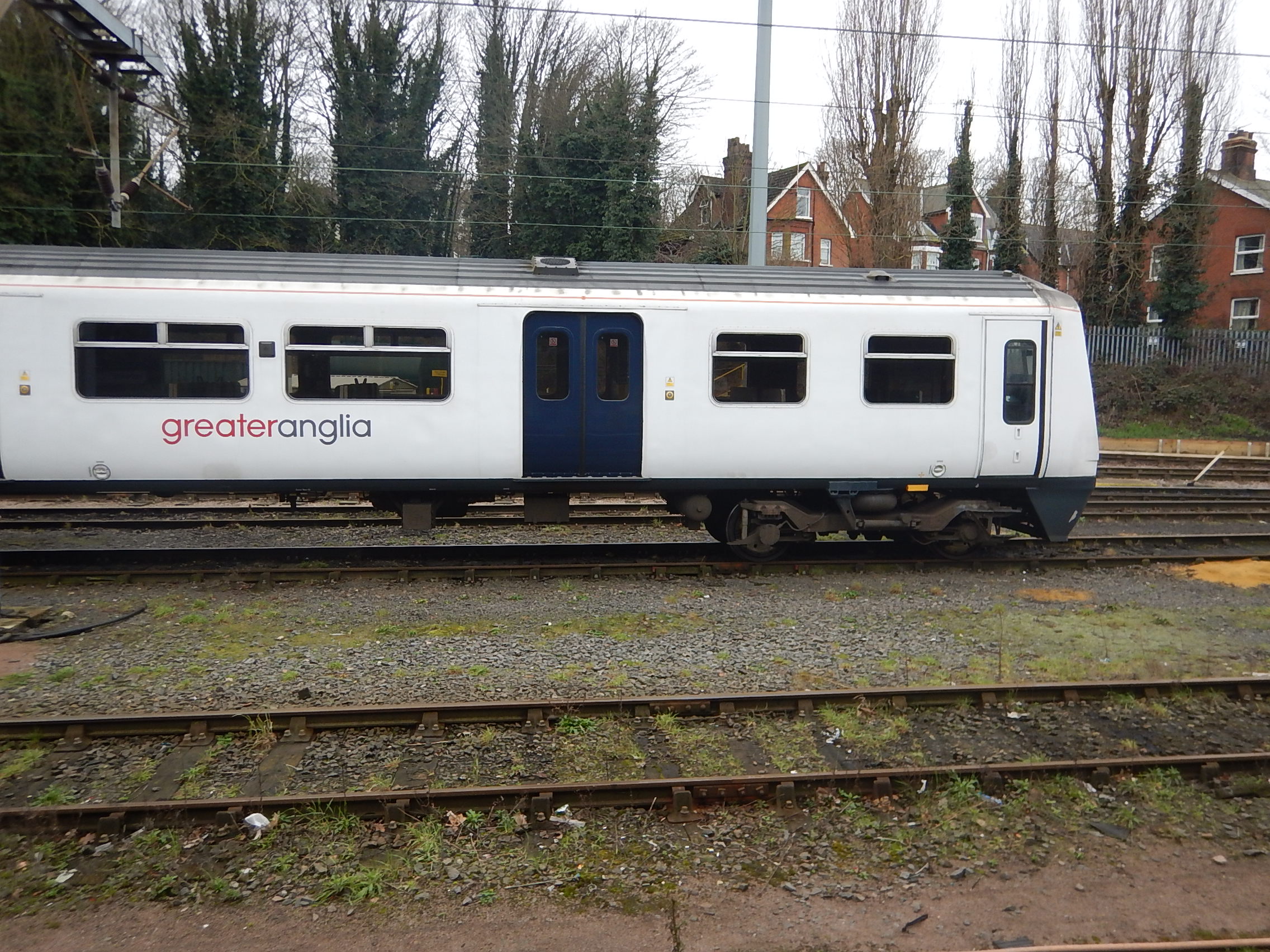
Note the large amount of space underneath.
If the Class 321 train has a problem, when converted to a modern efficient train, it is that the front end of the train has the aerodynamics of a large brick outhouse.
The Electrical System Of A Class 321 Train
I don’t know the electrical system of a Class 321 train, but I do know that of the Class 319 trains, which were built a couple of years earlier in the same factory at York These trains have a 750 VDC bus from one end of the train to the other.
As Class 321 and Class 319 trains have a similar train formation and a common Mark 3 heritage, I suspect that the electrical systems are the same and both have this 750 VDC bus.
Regenerative Braking
Regenerative braking is an important part of any modern train, as it saves energy.
Normally, the energy generated as a train stops, is returned through the electrification to power other nearby trains.
But with a hydrogen-powered train, that may not be connected to the electrification, the energy has to be stored on the train to avoid being wasted.
The Alstom Coradia iLint Train
Alstom have developed a hydrogen-powered version of the Coradia Lint train, which they call an iLint.
This promotional video shows how Alsthom’s hydrogen-powered Coradia iLint works.
<span class=”embed-youtube”></span>
Summarising, Alstom’s video the Coradia iLint works in the following way.
- The hydrogen fuel cell turns hydrogen gas into electricity.
- The electricity is used to power the train or is stored in a lithium-ion battery.
- The computer on the train monitors the system and controls it in an intelligent manner.
I wouldn’t be surprised to find out the system works in the same way as a serial hybrid vehicle like a New Routemaster bus.
- The power source; hydrogen fuel cell in the train or small diesel generator in the New Routemaster, charges the battery directly.
- The power source shuts down automatically, when the charge in the battery reaches a certain high level.
- The power source starts up automatically, when the charge in the battery reaches a certain low level.
- The battery moves the vehicle using one or more electric traction motors.
- The battery powers all the other systems in the vehicle.
- When the vehicle brakes, the traction motors generate electricity, which is stored in the battery.
The great advantage of this system is its simplicity, as the vehicle is effectively powered from a single source; the battery.
There is also an independently-controlled charging system for the battery.
A Possible Layout For A Hydrogen Powered Class 321 Train
Hydrogen powered trains need the following components.
- Hydrogen tank.
- Fuel cell to convert hydrogen to electricity.
- Battery to store energy from both the fuel cell and regenerative braking.
- Intelligent control system to control everything.
Positioning the last item shouldn’t be a problem, but could the other three larger components be placed under the train?
There’s certainly plenty of space under the two driving cars.
The battery would be connected to the following.
- The 750 VDC bus to power the train.
- The regenerative braking system.
- The hydrogen fuel cell.
The train’s computer would control the systems intelligently.
Powering The Class 321 Train From Electrification
Class 321 trains were designed as electric trains and I’m certain they could be made to run on 25 KVAC overhead or 750 VDC third rail electrification.
The electrically similar Class 319 trains are being converted into bi-mode Class 769 trains, so I wouldn’t be surprised to see the hydrogen-powered Class 321 trains being able to use electrification directly.
The Battery Size
How large would a battery need to be to store energy from both the fuel cell and regenerative braking?
I will start by calculating the kinetic energy of a Class 321 train, as the battery must be able to store all the energy generated by regenerative braking, when the train stops in a station from an operating speed of up to 100 mph.
- A Class 321 train weighs 137.9 tonnes
- A train can accommodate a total of about 320 seated and standing passengers.
- With bags, buggies and the other things passengers bring on, let’s assume an average passenger weight of 90 kg, which gives an extra 28.8 tonnes.
- I will assume a total weight of ten tonnes for the battery, hydrogen fuel cell and hydrogen tank
- So I will assume that an in service Class 321 train weighs 176.7 tonnes.
Calculating the kinetic energy of the train for various speeds gives.
- 50 mph – 12.3 kWh
- 75 mph – 28 kWh
- 90 mph – 40 kWh
- 100 mph – 49 kWh
Note that speed increases the kinetic energy much more than weight. This is because kinetic energy is proportional to the square of the speed and only proportional to the weight.
Even if the extra equipment weighed twenty tonnes, the kinetic energy at 100 mph only increases to 51.8 kWh.
As the battery will have to store this energy after a stop from 100 mph, I suspect that the battery will have a capacity somewhere between 50 and 100 kWh.
A Bombardier Primove 50 kWh battery, which is built to power trams and trains, has the following characteristics.
- A weight of under a tonne.
- Dimensions of under two x one x half metres.
- The height is the smallest dimension, which must help installation under the train floor or on the roof.
I conclude that Alstom won’t have any problems designing a battery with sufficient capacity, that can be fitted under the floor of a Class 321 train.
The Train Will Need An Intelligent Computer System
The hydrogen-powered Class 321 train could have up to four methods of charging the battery.
- From 25 KVAC overhead electrification
- From 750 VDC third rail electrification
- From the hydrogen fuel cell.
- From regenerative braking.
The computer would try to ensure the following.
- There was always spare capacity in the battery to accept the energy from regenerative braking.
- Trains stop in a station with a full battery.
- Hydrogen consumption is minimised.
The computer might even be programmed with the route and use GPS or digital signalling to optimise the train to that route.
It’s all very basic Control Engineering.
Alstom’s Marketing Philosophy
Watch Alstom’s video embedded in this post and they stress the environmental credentials of hydrogen power and particularly the Cordadia iLint.
They also show a caption which states that 195 states have made a commitment to zero carbon emissions.
That could be a very big market
The Coradia iLint will probably be a good train, but I suspect it may have a few problems satisfying a large market.
- It is only two cars.
- The current design can’t work on overhead electric power.
- It is based on a Lint 54, which has only 160 seats.
- Operating speed is 140 kph.
- They are new trains and manufacturing may be expensive.
On the other hand, Class 321 trains have the following characteristics.
- They are four car trains.
- The trains can work from 25 KVAC overhead electrification.
- The trains are built to a smaller loading gauge than the iLint.
- I suspect that they could be easily converted to other overhead and third-rail electrification voltages.
- Each train has 309 seats.
- Operating speed is 160 kph.
- They are existing trains and manufacturing may be more affordable.
It should also be said, that there is a massive amount of knowledge accumulated in the UK over thirty and more years, about how to refurbish, modify and update Mark 3-based rolling stock.
Once the concept of a hydrogen-powered Class 321 train is proven and certified, Alstom would probably be able to produce four-car hydrogen-powered trains at a fair rate, as they become available from Greater Anglia.
Conclusion
I have come to the following conclusions.
- The Class 321 train will make a good hydrogen-powered train.
- Alstom would not have looked at converting a thirty-year-old train to hydrogen power, if they thought it would be less than good.
- British Rail’s design of a 750 VDC bus makes a lot of the engineering easier and enables the train to be tailored for world-wide markets, with different electrification systems and voltages.
- Having two different trains will give Alstom better coverage of an emerging market.
I suspect in a few years time, if the hydrogen project is successful, Alstom will design and manufacture, a whole family of hydrogen-powered trains, with different gauges, capacities and operating speeds.
Better Phone Battery Invented By Accident
The title of this post, is the same as that as an article in today’s copy of The Times.
Discussing phone batteries this is said.
Now researchers think they may have found a remedy – a new form of carbon that could double lithium battery capacity, increase the number of charging cycles and significantly reduce the risk of explosion.
Reading the article, it could be that the researchers at Lancaster University may have found the Holy Grail of battery technology.
The Times even gives OSPC-1, as they’ve called the carbon., a leading article.
There’s more on OSPC-1 in this news item on the Lancaster University web site, which is entitled New Carbon Could Signal Step-Change For The World’s Most Popular Batteries.
Stadler Citylink Metro Vehicles
This document on the KeolisAmey web site details their plans for the new Wales and Borders Franchise.
The Stadler Citylink Metro Vehicles in the KeolisAmey document. look very similar to Sheffield Supertram‘s Class 399 tram-trains, that are providing a tram service in Sheffield and will soon be running on the heavy rail network to Rotherham.
- The Citylink vehicles seat 88 with 150 standees.
- They can run using 750 VDC or 25 KVAC overhead electrification.
- The tram-trains are built by Stadler in Spain.
- According to a driver, that I spoke to in Sheffield, the tram-trains have a good hill climbing capability.
These pictures were taken of one of the Class 399 tram-trains operating in Sheffield.
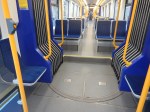
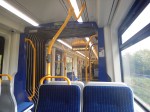
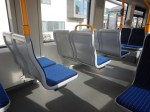
The Keolis/Amey document gives more details on the tram-trains.
- Main power source 25kV overhead line but also operates from battery.
- Capacity of 257 with seats for 129.
- Capable of on-street line-of-sight ‘tramway’ operation.
- They can work in pairs.
I’ve known for some time, that Class 399 tram/trains had a battery.
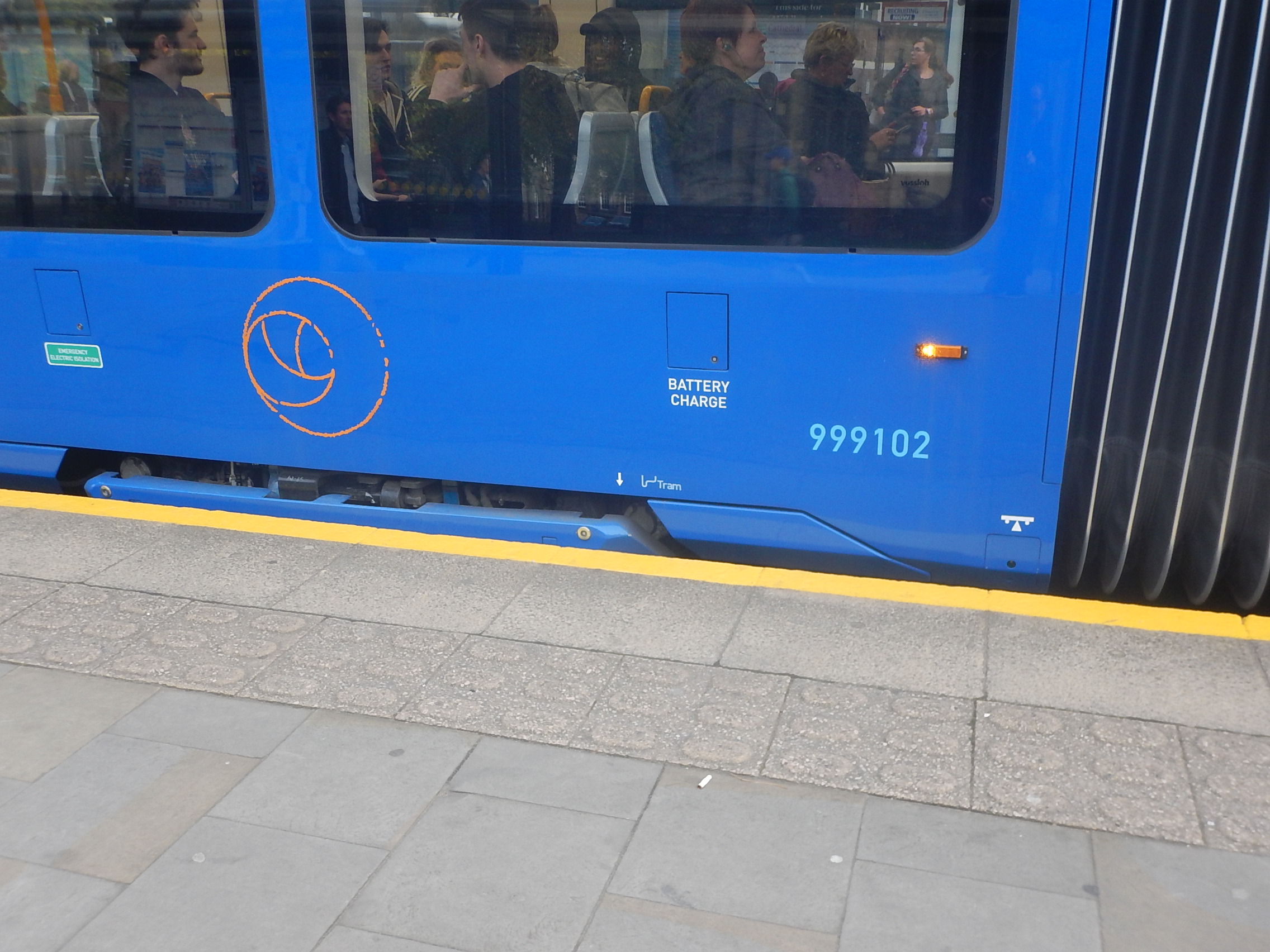
but I thought it was probably for secondary purposes, like making sure the vehicle crossed the boundary, where the two voltages change.
So it looks like in Cardiff, battery power will be used for traction.
How Big Will The Batteries Need To Be?
Consider a Class 399 tram/train, working to and from Merthyr Tydfil.
- Wikipedia gives the weight of the vehicle as 66 tonnes.
- Rhymney has an altitude of 178 metres.
- I will assume 200 passengers at 90 Kg. each, which gives a weight of 12 tonnes.
This means that the train has a potential energy of 41 kWh at Merthyr Tydfil station.
On the way down the hill from Merthyr Tydfil the regenerative braking will convert this potential energy into electricity, which will be stored in the battery.
I would reckon that a battery of about 50 kWh would be an ideal size, but would it be big enough to take the Stadler Citylink Metro Vehicles from Cardiff Queen Street station to The Flourish and back?
That journey is probably about 1.5 miles each way.
How Far Would A Full 50 kWh Battery Take A Stadler Citylink Metro Vehicle?
In an article in the October 2017 Edition of Modern Railways, which is entitled Celling England By The Pound, Ian Walmsley says this in relation to trains running on the Uckfield Branch, which probably has a terrain not much different to the lines to the South and West of Cardiff.
A modern EMU needs between 3 and 5 kWh per vehicle mile for this sort of service.
This would mean that a 50 kWh battery would take a three-car Stadler Citylink Metro Vehicle up to five miles, if the usage of the lighter-weight tram-train was at the lower end of the quoted range.
The battery would certainly take a Stadler Citylink Metro Vehicle from Cardiff Queen Street station to The Flourish and back.
Conclusion
As with the Tri-Mode Stadler Flirts, the Stadler Citylink Metro Vehicle with a battery, looks a very interesting concept.
- Most of the energy is provided by the 25 KVAC electrification, which would power the tram-train up the hill.
- Coming down the hill, the battery would be recharged using the regenerative braking.
- Battery power would used to take the tram-train on routes without electrification to The Flourish station.
Energy efficiency would be high.
 The Anonymous Widower