Highview Power Names Rupert Pearce Chief Executive Officer
The title of this post, is the same as that of this article on business wire.
This is the first paragraph.
Highview Power, a global leader in providing long duration energy storage and essential grid services, has named Rupert Pearce as its new CEO. In this role, Pearce will leverage his expertise in guiding technology companies through significant transformation and globalisation to position Highview Power as a leader in accelerating the energy transition.
He certainly seems to be type of CEO, that Highview needs to succeed.
NeuConnect Awards Two Major Contracts
This page on the NeuConnect web site is entitled NeuConnect Awards Over £1.5 billion Of Major Contracts As First Ever UK-German Energy Link Moves An Important Step Closer.
NeuConnect is a proposed interconnector between England and Germany.
- It will have a capacity of 1.4 GW.
- The interconnector will be around 450 miles long.
- It will be HVDC, like many similar undersea power cables.
- As the title says, it will be the first-ever UK-German energy link.
Wikipedia describes the route like this.
The cable will run between the Greystones substation on the Isle of Grain, in Kent in England to the new Fedderwarden substation in Wilhelmshaven in the Lower Saxony region of Germany. Landfall will be next to Grain Coastal Park, in Kent, and at Hooksiel, near Wilhemshaven in Germany.
Two contracts have been awarded.
- The contract to design, manufacture, install, test and commission the 725km interconnector has been awarded to Prysmian Group.
- The contract to design and build two converter stations in the UK and Germany has been awarded to Siemens Energy.
This sounds like a very simple plan to add an important interconnector between the UK and Germany.
I have some observations and thoughts.
The Isle Of Grain
The Isle of Grain is described in Wikipedia like this.
Isle of Grain (Old English Greon, meaning gravel) is a village and the easternmost point of the Hoo Peninsula within the district of Medway in Kent, south-east England. No longer an island and now forming part of the peninsula, the area is almost all marshland and is a major habitat for diverse wetland birds. The village constitutes a civil parish, which at the 2011 census had a population of 1,648, a net decrease of 83 people in 10 years.
Apart for the birds, over the last few decades it has been home to the following.
- Until 1982, it was the location of a BP oil refinery.
- In the 1990s, the isle was used to make the segments for the lining of the Channel Tunnel.
- Following completion of the Channel Tunnel, the site is now part-occupied by Thamesport, the UK’s third largest container port.
- Next to the former BP site is Grain Power Station, built in the 1970s, which previously burnt oil.
- This power station was demolished in the 2015 and replaced with a 1.275 GW gas-fired power station.
- Another major installation is a new Grain Liquefied Natural Gas (LNG) import facility, which takes heat from the gas-fired power station.
- The Isle of Grain is the landing point for the BritNed undersea power cable between The Netherlands and the UK.
The Google Map shows the Isle of Grain.
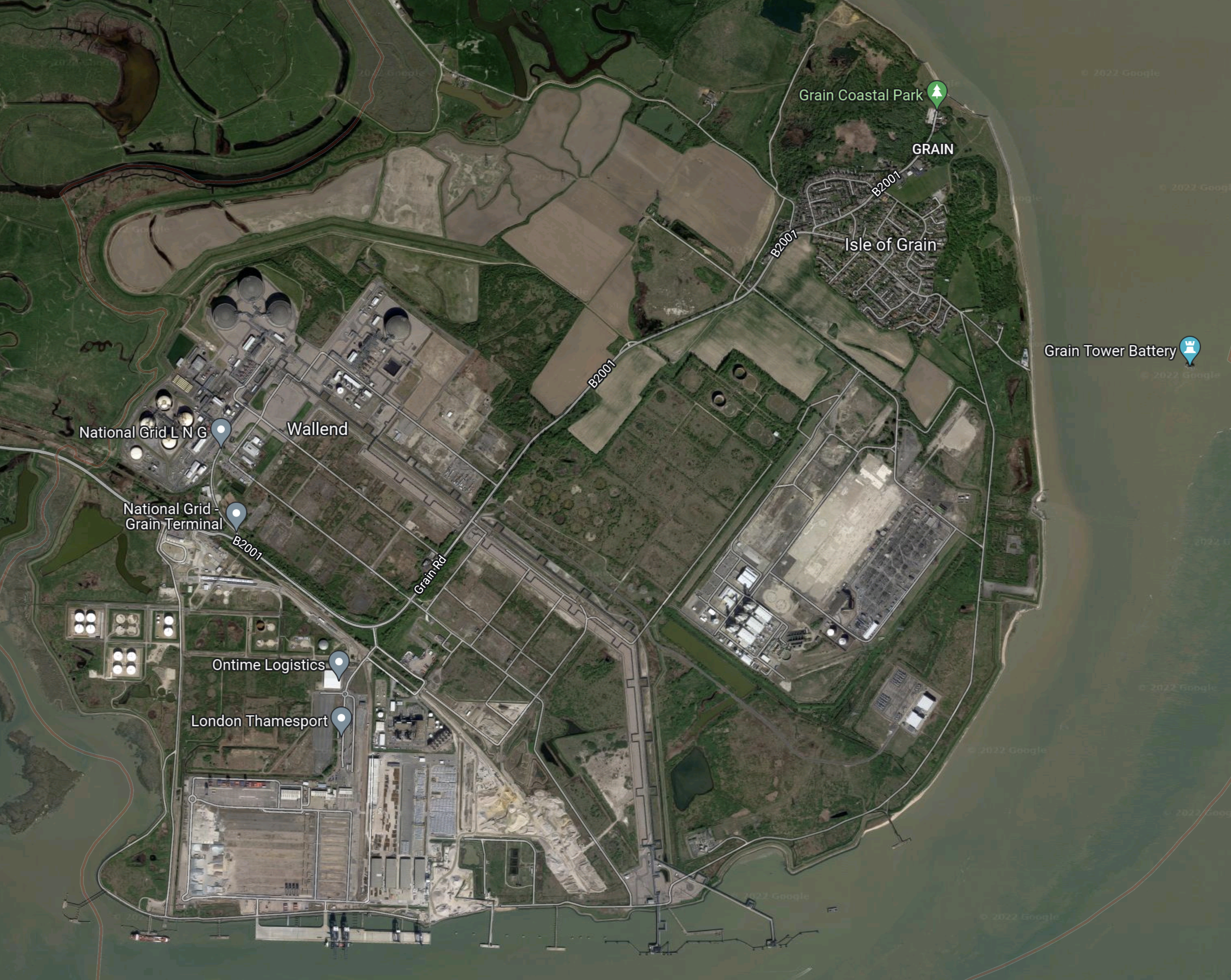
Note.
- Thamesport is in the South-West corner
- To its North is the LNG import facility.
- To the North-East of Thamesport is the 735 MW Medway power station.
- There is a rail connection to Hoo Junction on the North Kent Line.
This second Google Map shows the Eastern side of the Isle.
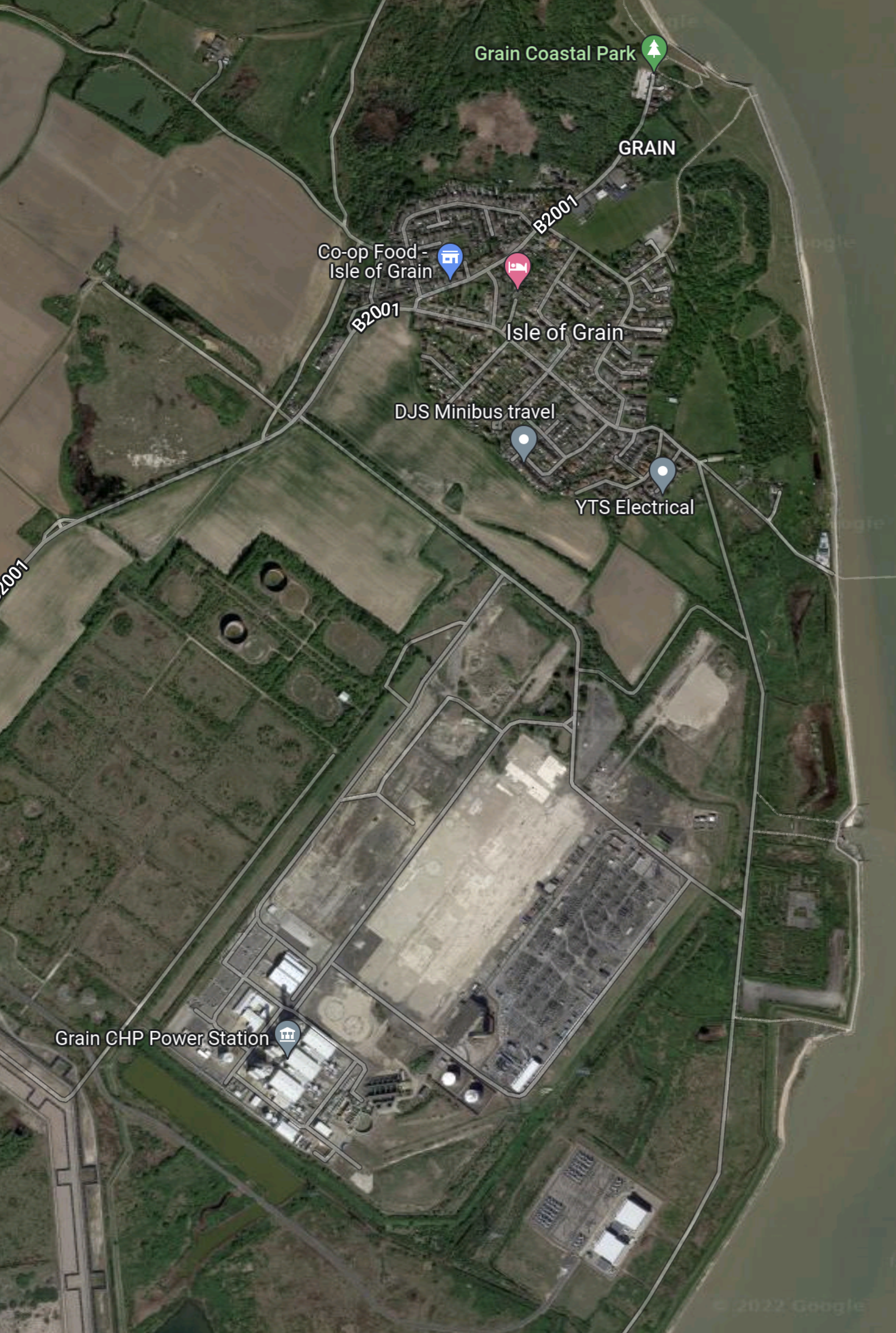
Note.
- Grain Coastal Park, where NeuConnect will make landfall, is marked by the green arrow at the top of the map.
- Towards the South-Eastern corner of the map is the 1.275 GW Grain gas-fired power station.
- To the East of the power station, there is more switchgear than you see in a bad Frankenstein film.
- The smaller square at the bottom with the two white squares could be the converter station for the BritNed interconnector.
I am sure there is space on the island for a connection for NeuConnect.
There is also a total of 2.01 GW of gas-fired power stations on the Isle of Grain.
Wind Power In The Thames Estuary
This Google Map shows the Thames Estuary.
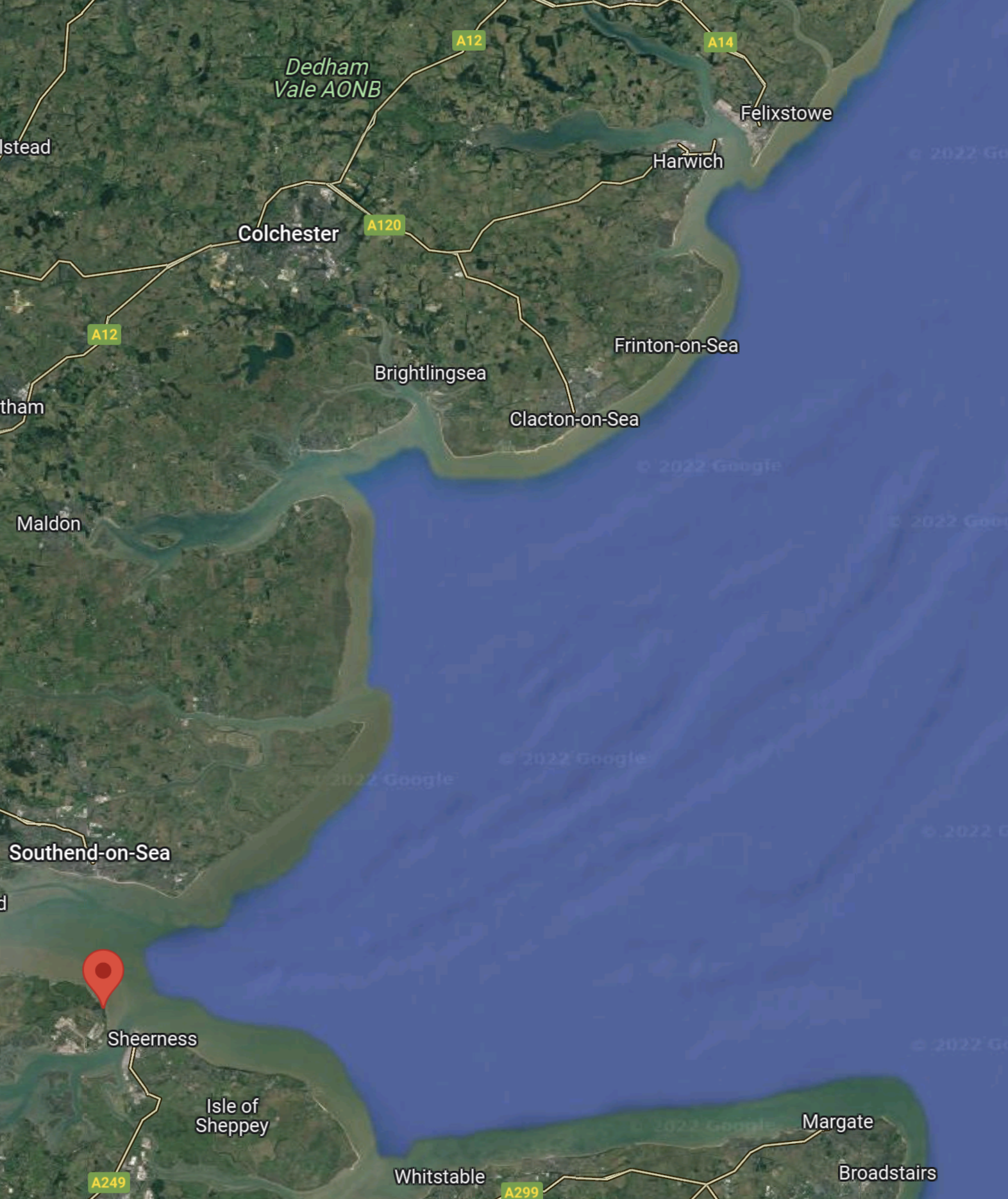
Note that the red arrow indicates the Isle of Grain.
This map from Wikipedia shows the wind farms in the area.
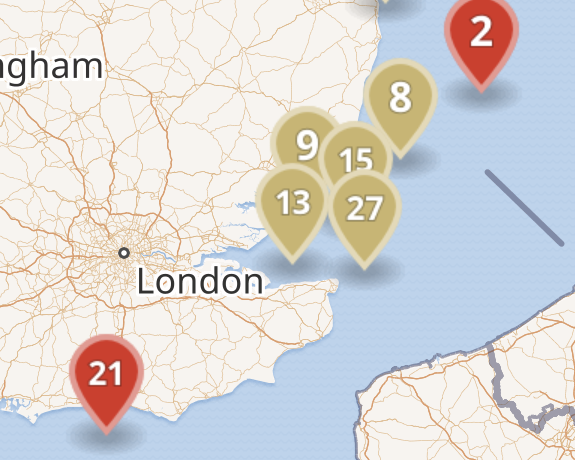
These are the ones that are operational.
- 2 – East Anglia Array – 714 MW
- 8 – Greater Gabbard – 504 MW
- 9 – Gunfleet Sands – 184 MW
- 13 – Kentish Flats – 140 MW
- 15 – London Array – 630 MW
- 27 – Thanet – 300 MW
Note.
- The Isle of Grain is just above the second o in London.
- I have ignored the Ramplion wind farm (21!), as it is too far from the Isle of Grain.
- This is a total of nearly 2.5 GW.
Planned extensions in the area include.
- East Anglia Array – 3.1 GW – Completion date of 2026
But the Wikipedia entry for the East Anglia Array says this about the wind farm.
The target capacity for the entire East Anglia Zone is 7200 MW which could require up to 1200 turbines.
Could we see one of the following?
- A connector from the East Anglia Array to the Isle of Grain.
- One or more new wind farms in the Thames Estuary connected to the Isle of Grain.
- German investment in a wind farm or farms connected to the Isle of Grain.
The Isle of Grain could become an island of energy providing power for London, the South-East of England, Germany and The Netherlands.
An Electrolyser On The Isle Of Grain
Consider.
- There will be plenty of renewable electricity.
- As there is a liquified natural gas terminal, there is plenty of gas storage.
- One or both of the gas-fired power stations can be converted to run on hydrogen.
- As more and more trucks are converted to hydrogen, there will be a large demand for hydrogen for heavy transport.
This must surely make a large electrolyser on the Isle of Grain a possibility.
The BritNed Interconnector
The BritNed interconnector is described like this in Wikipedia.
BritNed is a 1,000 MW high-voltage direct-current (HVDC) submarine power cable between the Isle of Grain in Kent, the United Kingdom; and Maasvlakte in Rotterdam, the Netherlands.
The BritNed interconnector would serve as a link for the foreseeable European super grid project.
Up to now, most of the electricity flow has been to the UK.
But surely, as more wind farms are developed power will flow the other way.
Wilhelmshaven Will Be A German Hub For Green Hydrogen
In Uniper To Make Wilhelmshaven German Hub For Green Hydrogen; Green Ammonia Import Terminal, I described plans by the Germans for a hydrogen hub at Wilhelmshaven.
The original story came from an article with the same name on Green Car Congress.
This is the first two paragraphs.
Under the name “Green Wilhelmshaven,” Germany-based international energy company Uniper plans to establish a German national hub for hydrogen in Wilhelmshaven and is working on a corresponding feasibility study.
Plans include an import terminal for green ammonia. The terminal will be equipped with an ammonia cracker for producing green hydrogen and will also be connected to the planned hydrogen network. A 410-megawatt electrolysis plant is also planned, which—in combination with the import terminal—would be capable of supplying around 295,000 metric tons or 10% of the demand expected for the whole of Germany in 2030.
As I said in the original post, I’m not happy about green ammonia, but the 1.4 GW NeuConnect interconnector has more than enough power to run a 410 MW electrolyser plant at full capacity.
It could even run three electrolysers of this size.
Hooksiel And Wilhelmshaven
NeuConnect will make landfall at Hooksiel.
This Google Map shows Hooksiel and Wilhelmshaven.
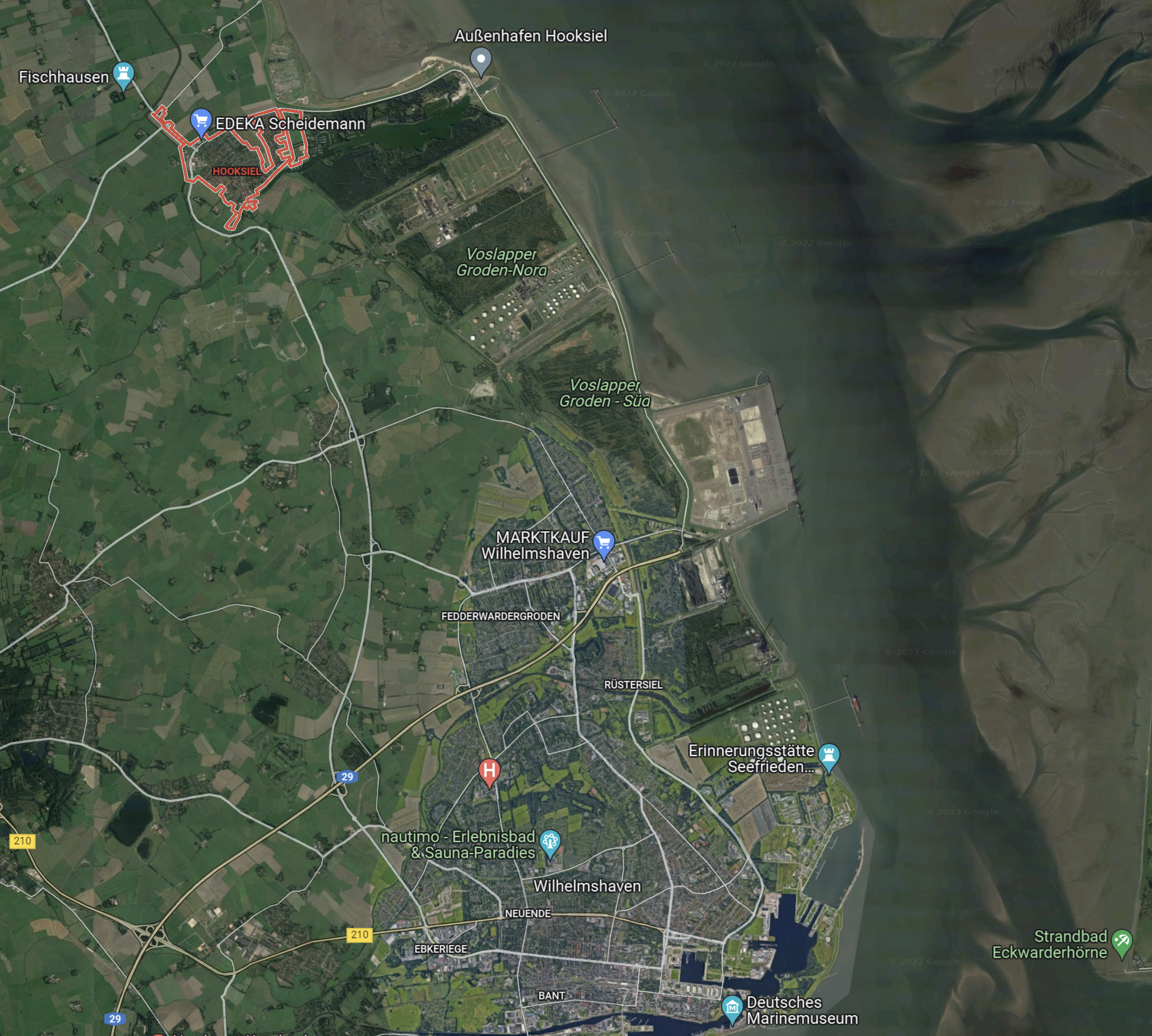
Note.
- Hooksiel is the village outlined in red.
- The water to the right of the map is the Jade Bight.
- The square block sticking out into the bight appears to be a container port.
- There appears to be chemical works or oil refineries North of the port.
- Wilhelmshaven is the town to the South of the port.
There would appear to be plenty of space for Uniper to construct Green Wilhelmshaven.
German And UK Wind Power Production
According to this page on Wikipedia, which is entitled Wind Power By Country, in 2020, these were installed wind power in various countries.
- Germany – 62,184 MW
- Spain – 27,089 MW
- UK – 24,665 MW
- France – 17,382 MW
- Italy – 10,389 MW
- Netherlands – 6,600 MW
In 2020 we were 37.5 GW behind Germany.
It looks like we’ll commission 3.3 GW this year and 6.1 in 2023, with Wikipedia saying that 12.9 GW is under development, which should close the gap to a certain extent.
In ScotWind Offshore Wind Leasing Delivers Major Boost To Scotland’s Net Zero Aspirations, I described how Scotland will add 15.1 GW of floating and 9.7 GW of fixed foundation offshore wind.
It looks like initially, we’ll be buying German wind-generated electricity, but in the future the direction could easily change around.
Boris And Olaf
There were mumblings from Boris, that energy was talked about in their meeting in Downing Street last week.
It does appear there is a lot of ways that the UK and Germany can co-operate in the future with respect to energy.
- German finance can be used to build wind farms in UK waters.
- German companies can build the turbines and the interconnectors we need to develop vast offshore wind farms.
- We can supply surplus energy to Germany through the NeuConnect interconnector.
I wouldn’t be surprised if Boris and Olaf had signed a very comprehensive energy co-operation agreement.
Velocys’s Waste-To-Fuel Project Moves Forward
The title of this post, is the same as that of this article on Let’s Recycle.
This is the first paragraph.
Velocys says it has completed works at its Altalto plant in Immingham, North East Lincolnshire, in preparation for a future connection to the East Coast Carbon Capture and Storage (CCS) cluster.
In partnership with British Airways, Velocys is developing a facility that could convert up to 500,000 tonnes of municipal solid waste into fuel for planes and cars each year.
At last, this very interesting and important project is underway.
I believe that plants like this could be the way we keep flying until hydrogen-powered planes are developed.
Andrew Forrest Snaps Up Pilbara And Gascoyne Cattle Stations For Green Energy Production
The title of this post, is the same as that of this article on the Australian Broadcasting Corporation.
This is the first paragraph.
Australian mining billionaire Andrew Forrest has continued his land acquisition in Western Australia, purchasing another three cattle stations in the state’s north-west to generate renewable energy.
These are some points for the article.
- Andrew Forrest’s Fortescue Future Industries has purchased three cattle stations in northern WA
- The stations will continue to run stock, and contribute to the production of green energy
- FFI says it is looking at other parts of WA to acquire land for similar projects
- The energy created will be used to decarbonise Andrew Forrest’s mining operations by 2030.
- A renewable hub of 340 wind turbines alongside solar panels will be created, which will generate 5 GW of energy.
- The possibility of offshore energy is mentioned.
- There is no mention of energy storage.
I have a few thoughts.
For A Reliable 5 GW Of Energy, Storage Is Surely Needed
I would think that this is probably understood by Fortescue Future Industries and given their ambitions for hydrogen, this must surely be part of an energy storage strategy.
Will Hydrogen Be Exported By Fortescue Future Industries From Australia?
I would expect this depends on three things.
- How much green energy is generated.
- The energy needs of Andrew Forrest’s mining companies.
- How much hydrogen can be sold in Australia.
Fortescue Future Industries will certainly have the market, if they have a surplus.
How Much Energy Will Fortescue Future Industries Generate Per Hectare?
This paragraph from the article gives useful information.
The hub would consist of 340 wind turbines alongside solar panels across Emu Creek and Uaroo Stations, in a development envelope of more than 65,000 hectares of land and a disturbance footprint of more than 10,000 hectares.
- If you look at the 65,000 hectares, as the area of the renewable energy hub, 0.77 MW is generated per hectare.
- If you look at the 10,000 hectares, as the area of the renewable energy hub, 0.5 MW is generated per hectare.
- If you look at Shell’s Scotwind E2 lease, that is 2 GW in 86,000 hectares, where 0.023 MW is generated per hectare.
So on a brief look Australia is a more efficient place for renewable energy, than the seas around the UK.
Conclusion
Andrew Forrest is developing a more detailed plan.
Enter The Dragon
Look at this map of UK offshore wind farms. clipped from Wikipedia.
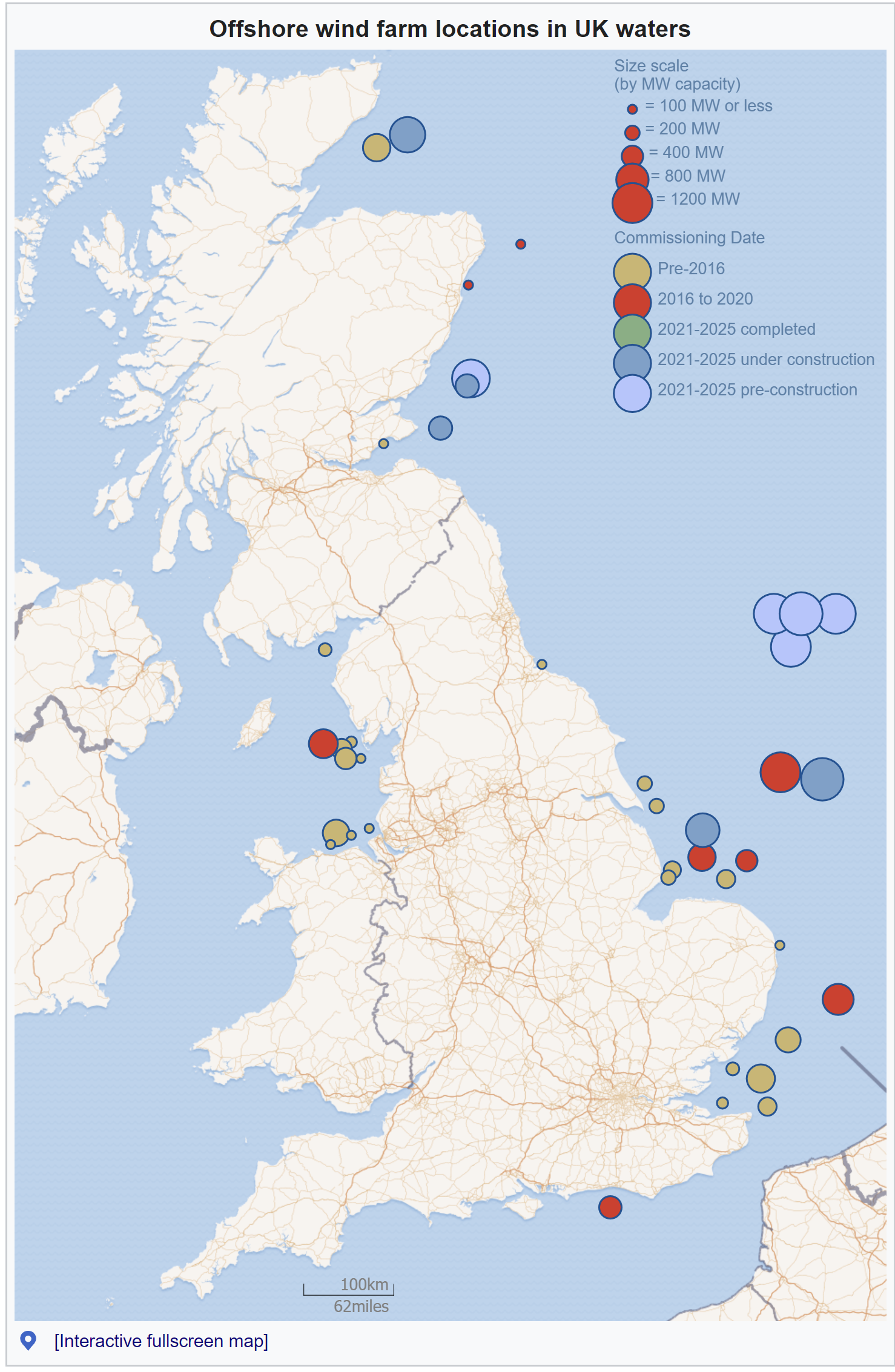
It is only a crude map, but it does show the lack of offshore wind farms around the coasts of Wales and South-West England.
This article on the Engineer is entitled Unlocking The Renewables Potential Of The Celtic Sea.
The article starts with these two paragraphs.
Over the last decade, the UK has become a global leader in renewable marine energy, tapping into the vast resources its coastal geography offers. Offshore wind, in particular, has flourished, with gigawatt-scale projects being deployed off the east coast of England and Scotland, at Hornsea, Dogger Bank and Moray.
However, looking at a map of existing and proposed wind farms, what’s perhaps most striking is the complete absence of projects in the southwest of Britain, off the rugged shores of Wales, Devon and Cornwall, shaped by the fierce North Atlantic. The Celtic Sea – which extends south off Wales and Ireland down past Cornwall and Brittany to the edge of the continental shelf – is estimated to have around 50GW of wind generating capacity alone. What’s more, it also delivers some of the highest tidal ranges in the world, alongside some of the best waters in Europe for generating wave energy. In a country blessed with renewable resources, the Celtic Sea may well be its biggest prize.
The article then discusses how the challenge of developing renewable energy around Wales is being met.
- It describes the relevance of Floating Offshore Wind (FLOW).
- It quotes someone who says. “Eighty per cent of the world’s wind resources are in waters deeper than you would traditionally go with fixed offshore wind.”
- It talks about Blue Gem Wind and their Erebus and Valorous wind farm projects, that I wrote about in Blue Gem Wind.
- It talks of how expertise from offshore oil and gas is being used to develop floating offshore wind.
The article then goes on to talk about tidal power.
The Welsh Government Tidal Lagoon Challenge is mentioned.
- The article notes “The IP for the Swansea Bay Tidal Lagoon has been purchased by a consortium led by Bridgend’s DST Innovations and has been reborn as Blue Eden.”
- Blue Eden is described on this page of the DST Innovations web site. The project is not in the least bit timid or small.
- The article also introduces to the Morlais Tidal Energy Scheme, which has its own web site.
The article then finishes with a few paragraphs about how wind, wave and tidal power can be combined in a single scheme.
Conclusion
The article finishes with this paragraph.
For now, Wales may be lagging slightly behind its Celtic cousin to the north, but if the true potential of the Celtic Sea can be unleashed – FLOW, tidal stream, lagoon and wave – it looks set to play an even more prominent role in the net zero pursuit.
The Red Dragon is entering the battle to replace Vlad the Mad’s tainted energy.
Boris Johnson Wants To Build ‘Colossal’ Irish Sea Wind Farm Within A Year
The title of this post, is the same as that of this article in The Telegraph.
This is the sub-title.
Prime Minister tells industry leaders he has ‘a dream’ that giant floating wind farm could provide ‘gigawatts of energy’
These are the first three paragraphs of the article.
Boris Johnson is pushing energy firms to build a “colossal” offshore wind farm in the Irish Sea within 12 months.
The Prime Minister told industry leaders he has “a dream” that a giant floating wind farm could provide “gigawatts of energy and do it within a year”, according to a government source.
He was addressing wind energy firms at a round table discussion in Downing Street as the Government finalised its energy security strategy.
It is said in the article, that industry leaders smiled at the suggestion.
My feelings though are different and I wonder if Boris has been briefed by an offshore wind expert, who knows what they’re doing.
Quietly and unobtrusively, a new technology has been developed, that allows Boris the luxury to dream.
The World’s Largest Floating Wind Farm
In the UK, we are getting used to superlatives being applied to our offshore wind farms.
- According to Wikipedia at the current time, nine of the fifteenth largest offshore wind farms in the world are in the United Kingdom.
- The Hornsea wind farm, comprises the 1.4 GW Hornsea Two wind farm, which is the largest offshore wind farm in the world.
- Previously, the 1.2 GW Hornsea One wind farm was the largest offshore wind farm in the world.
In this article on offshoreWIND.biz, which is entitled World’s Largest Floating Offshore Wind Farm Fully Operational, this is said.
Located 15 kilometres off the coast of Aberdeenshire, Scotland, in water depths ranging from 60 metres to 80 metres, Kincardine is the largest operating floating wind farm.
The project consists of five Vestas V164-9.5 MW and one V80-2 MW turbine, each installed on WindFloat® semi-submersible platforms designed by Principle Power.
This picture from Cobra Group shows one of the turbines being towed into position at Kincardine.
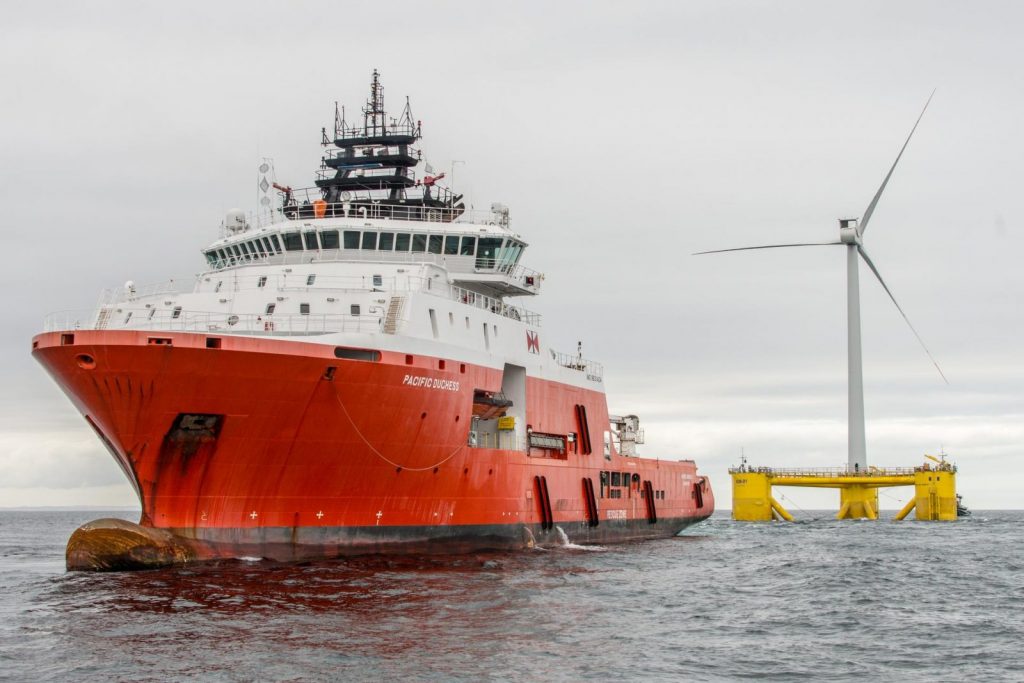
There are more pictures on this web page.
WindFloats would appear to be proven technology, as there are now two commercial wind farms using the technology and several others under development.
Erebus And Valorous
But Kincardine Wind Farm won’t be the world’s largest floating wind farm for long!
The next two wind farms, using the technology are Erebus and Valorous, who will provide a total of 400 MW from a company called Blue Gem Wind, which will use larger 14 MW turbines.
They will be installed to the South-West of the Pembrokeshire Coast.
Blue Gem Wind
Blue Gem Wind are based in Pembroke Dock and are a partnership of Simply Blue Energy, a pioneering Celtic Sea energy developer, and TotalEnergies.
Simply Blue Group are an Irish company, who are also working with Shell on the development of 1.35 GW of wind power to the West of Ireland.
50 GW Of Wind In The Celtic Sea
On the Projects page of the Blue Gem website, this is said about floating wind in the Celtic Sea.
Floating wind is set to become a key technology in the fight against climate change with over 80% of the worlds wind resource in water deeper than 60 metres. Independent studies have suggested there could be as much as 50GW of electricity capacity available in the Celtic Sea waters of the UK and Ireland. This renewable energy resource could play a key role in the UK meeting the 2050 Net-Zero target required to mitigate climate change. Floating wind will provide new low carbon supply chain opportunities, support coastal communities and create long-term benefits for the region.
Is this Boris’s project?
These are my thoughts.
How Many Turbines Would You Need For 50 GW?
If you need 7 x 14 MW turbines for each 100 MW, that would mean you need 3500 turbines and WindFloats for 50 GW.
How Would Each Turbine Be Installed?
It appears from pictures on the Cobra Group web site, that the turbine is mounted on the WindFloat using a large crane on a dock, whilst the WindFloat is alongside.
- The WindFloat and the turbine are then towed out into the desired position.
- It would then be anchored to the sea-bed.
- Finally, it would be connected to the power network.
I would doubt, that one team could probably install more than one turbine per day.
But I suspect more than one team could work in and out of one port at a time.
How Many Ports Could Be Used For Turbine Assembly?
As Blue Gem Wind is based in Pembroke Dock, I would assume that one of the ports would be on Milford Haven Waterway.
But there are other ports on the Welsh and Irish coasts, where the turbine lift could be accomplished.
How Much Capacity Could Be Installed In Twelve Months?
Suppose you had two ports doing assembly, with two teams working at each port, which would mean four turbines could be installed in a day.
- In a month, that would be 4 x 14 x 30 MW per month.
- This is nearly 1.7 GW per month or 20 GW per year.
It does appear to me, that floating wind farms with the right project management could be very much quicker to install than traditional fixed foundation wind turbines.
I believe that if we get the manufacturing and the project management right, that a colossal 20 GW of floating wind can be installed in twelve months.
Conclusion
Most people won’t believe Boris’s claim, but I feel that there is a degree of reality behind it, if we can produce four WindFloats and four turbines per day and enough cables and electrical gubbins to link them all together.
Birds And Offshore Renewable Energy
I have worried about this for some time, as die-hard wind farm opponents use birds being scythed to pieces in wind farms as an emotional reason for not building wind farms.
I searched the Internet and found this academic report from the University of Rhode Island, which is entitled How Are Birds Affected by the Block Island Wind Farm and How Do They Interact With the Wind Turbines?.
Note.
- Block Island Wind Farm is a mildly controversial 30 MW wind farm off the coast of Rhode Island.
- Block Island wind farm is the first commercial offshore wind farm in the United States.
The report gives three ways about how birds interact with wind farms.
Birds Fly Out Of The Way
First, many birds do not experience any interaction with the turbines at all as they fly either at a higher altitude or closer to the shore than the turbines’ locations.
Wind Farms Become A Food Source
The second interaction between birds and offshore wind turbines is a positive one that has been documented throughout Europe; but, with only the Block Island Wind Farm, it is too early to document in the United States. Researchers have found that the base of a wind turbine can create artificial reefs that act as an attractive site to both fish and shellfish. These artificial reefs provide a feeding ground for certain species of birds as the turbines essentially become a central habitat for many bird species’ prey.
Displacement Of The Birds
The final interaction that birds have with offshore wind turbines is displacement. This primary negative effect is experienced when wind turbines are constructed in areas that birds would naturally like to be; but, due to the structures, no longer have access to. To put it simply, he says, “if you put the turbines where the birds want to be, you take away these areas from the birds”.
Conclusion
It appears to me, that if you are putting up wind farms, whether they are offshore or onshore, that it is essential you do your research.
As in this case, experts from the local university are often a good resource to call upon.
Blue Gem Wind
Principle Power are the designers of the WindFloat.
The Projects page of the Principle Power web site led me to a project called Erebus. This is Principle Power’s description of the project.
The Celtic Sea, located between the United Kingdom and Ireland, holds an estimated 50 GW of offshore wind resource. The 96 MW Erebus project, located offshore Pembrokeshire, Wales, is a flagship project planned by Blue Gem Wind, a joint venture between Total and Simply Blue Energy, to unlock the potential of this region.
The project will feature between 7 and 10 turbines on WindFloat® floating platforms located approximately 44 km southwest of the Pembrokeshire coastline.
The Erebus project will see the deployment of a fully industrialized WindFloat® and represents a stepping stone that will allow the local supply chain to build capabilities for the delivery of larger projects under development in the Celtic sea region.
Note.
- Developing 50 GW of offshore wind in the Celtic Sea is not a small amount of wind power.
- The 96 MW Erebus project would appear to be the first project in the Celtic Sea.
- The turbines would be between 9.5 and 14 MW.
- The Principle Power website states that the water depth of the Erebus wind farm is seventy metres.
- The deployment of a fully industrialized WindFloat.
- The Erebus wind farm is being developed by Blue Gem Wind.
It would be larger than the current world’s largest floating wind farm, which is the Kincardine Wind Farm.
Who Are Blue Gem Wind?
Blue Gem Wind have a web site, with a picture of three turbines riding on WindFloats and a couple of support boats and this mission statement.
Floating Offshore Wind
A new generation of energy in the Celtic Sea
The Our Projects page shows a good picture and says this.
Floating wind is set to become a key technology in the fight against climate change with over 80% of the worlds wind resource in water deeper than 60 metres. Independent studies have suggested there could be as much as 50GW of electricity capacity available in the Celtic Sea waters of the UK and Ireland. This renewable energy resource could play a key role in the UK meeting the 2050 Net-Zero target required to mitigate climate change. Floating wind will provide new low carbon supply chain opportunities, support coastal communities and create long-term benefits for the region.
A header indicates a stepping-stones approach to assist the local supply chain and says this.
We believe that a stepping stone approach to the development of floating wind in the Celtic Sea brings a number of benefits. Starting with smaller demonstration and early-commercial projects, increasing in size, will help to capture the highest local supply chain content. It will also maximise knowledge transfer and facilitate a sustainable transfer to a low carbon economy.
Because of this focus on stepping stone projects we have proposed Erebus, a 96MW test and demonstration project followed by Valorous, a 300MW early-commercial project.
These links give more details of the two projects.
- Erebus – 100MW Test & Demonstration project in the Celtic Sea
- Valorous – A 300MW Early Commercial project in the Celtic Sea
It appears that the company is taking a sensible approach.
- They are starting small and building up deployment.
- They are using proven WindFloat technology.
- They are developing a local supply chain.
This Google Map shows the area of the two wind farms.
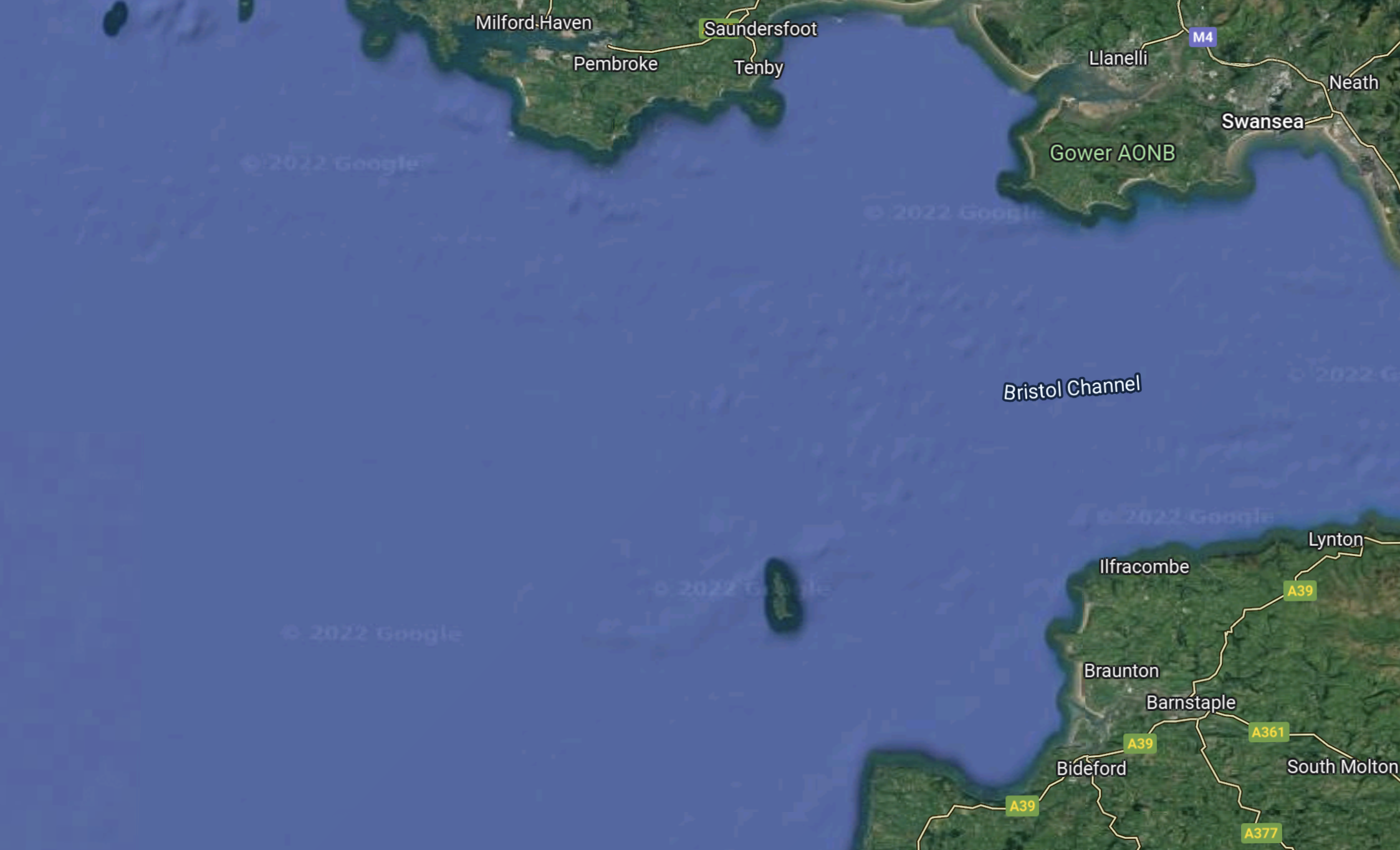
Note.
- Pembroke in the middle at the top of the map.
- Barnstaple and Bideford in Devon in the South-East corner of the map.
- Lundy Island off the Devon coast.
I estimate that the two wind farms will be about the Western edge of this map, with Erebus to the North of Valorous. They wouldn’t want to be too far to the West, as that would put them in the shipping lanes between Ireland and France.
Will The Turbines Be Assembled In The Milford Haven Waterway?
This Google Map shows the Milford Haven Waterway.
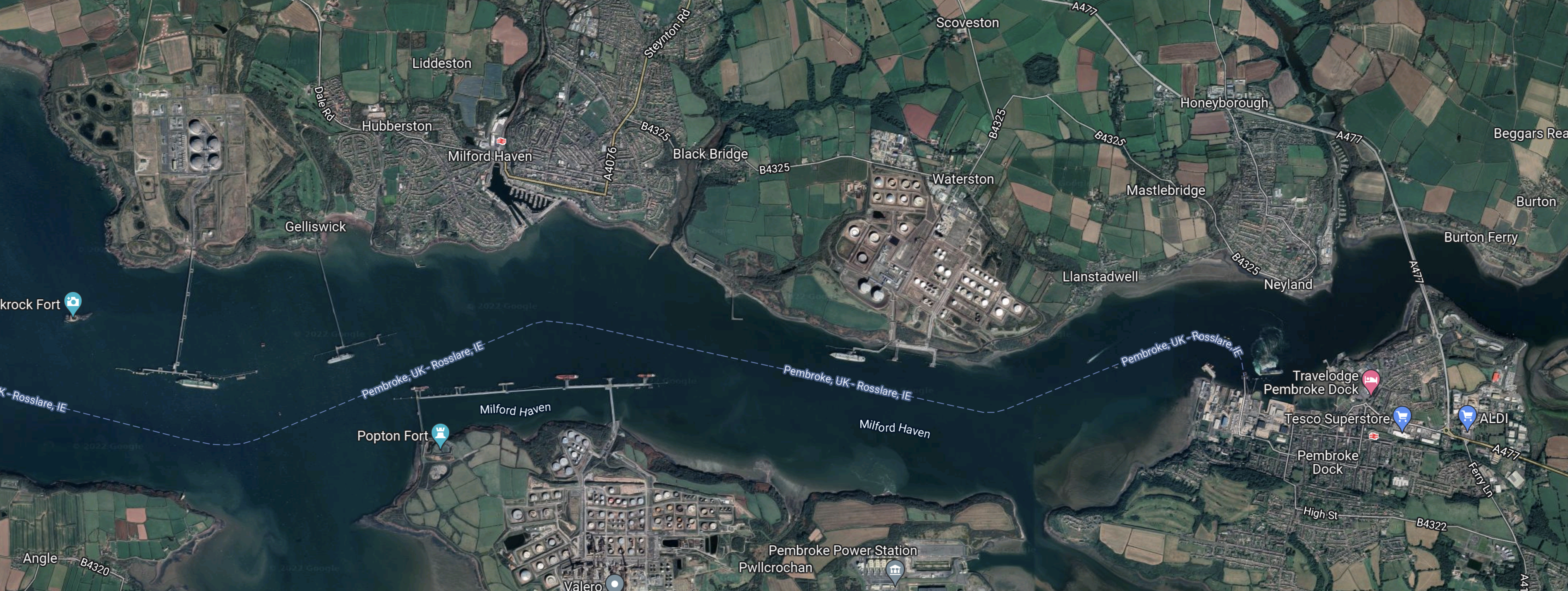
Note.
- Pembroke Dock, where Blue Gem Wind has its offices, is at the Eastern end of the map.
- The oil refineries and LNG terminals.
- Milford Haven on the North side of the waterway.
- The 2.2 GW gas-fired Pembroke power station on the South side of the waterway.
- The ferry route between Rosslare and Pembroke Dock.
But as the waterway is one of the deepest natural harbours in the world, I wouldn’t be surprised to find, that the turbines will be lifted on to the WindFloats in this waterway.
The turbines would be brought in by sea and the WindFloats would be towed in from their manufacturing site.
Where Will The WindFloats And Turbines Be Built?
There could be enough space to build the WindFloats in the Milford Haven Waterway, but I suspect they will be built in a shipyard, which is close to a supply of steel. South Wales is an obvious possibility.
I estimate that for the two wind farms between twenty-eight and forty turbines would be needed and these would probably be brought in by sea and then lifted onto the WindFloats somewhere in the Milford Haven Waterway.
It could be a very efficient process.
Will Pembroke Power Station Have A Future Role?
Consider.
- Pembroke power station is the largest gas-fired power station in Europe.
- It has a capacity of 2.2 GW.
- It was only completed in 2012, so it has many years of life yet!
- It is also probably young enough, to be able to be converted to run on hydrogen.
- It obviously will have a very good connection to the National Grid.
I would suspect that initially, the power cable from Erebus and Valorous, would use the same grid connection as the power station.
But in the future there must be some interesting ways that the wind farms and the power station can work together.
- A large electrolyser could be built to create hydrogen for heavy transport and industrial uses, from excess electricity.
- Could the oxygen from the electrolyser be used for steelmaking in South Wales?
- As natural gas is phased out the power station could be converted to hydrogen power.
- In times of low wind, the power station could make up the shortfall.
- The wind farms could be used as the primary electricity source, with the power station adding the extra power needed to meet demand.
There are certainly ways, the wind farms and the power station can work together.
Conclusion
These two related wind farms seems a good way to start wind developments between the UK and the island of Ireland.
Sizewell C Nuclear Power Station: Government To Take 20% Stake
The title of this post, is the same as that of this article on the BBC.
This is the first three paragraphs.
The government plans to take a 20% stake in a £20bn large-scale nuclear plant at Sizewell, the BBC has learned.
French developer EDF will also take a 20% stake in the Suffolk power station.
Ministers hope the confirmation of two cornerstone investors will encourage infrastructure investors and pension funds to take up the remaining 60%.
I used to live near Sixewell and the general feeling of local Suffolk people is not particularly against having nuclear power stations in their back yards.
There are several small points in favour of Sizewell C.
- Sizewell has been operating nuclear power plants safely since the 1960s.
- Leiston, which is the nearest town, has a very strong engineering tradition.
- Leiston also improved by several notches during the building of Sizewell B.
- The site is accessible by rail and possibly sea with the right ship.
- Nuclear fuel can be brought in and out by train.
- If they spent a small amount on the train service to Saxmundham, construction workers could come in by train.
- Sizewell C has been proposed to be used to generate hydrogen for Freeport East at the Ports of Harwich an Felixstowe.
- The power cable to take electricity from Sizewell C towards London is already built.
- Sizewell is much more convenient to get to from London, than other possible nuclear sites.
Overall, I feel that Sizewell is a good place for nuclear power station.
On the other hand, there are these points against the station.
- There will be at least 6.7 GW of wind farms built off the East Anglian coast before Sizewell C is completed.
- There may be substantial objection to the new power station.
- Large nuclear power stations are rarely built to time and on budget.
- I feel that if we go the nuclear route, that small modular nuclear reactors may be better.
I can understand why Governments like Sizewell as a nuclear power station site.
ScotWind N3 Offshore Wind Farm
I introduced this wind farm in ScotWind Offshore Wind Leasing Delivers Major Boost To Scotland’s Net Zero Aspirations as Lease 15 – The Odd Bid Out.
I said this.
In any design competition, there is usually at least one design, that is not look like any of the others.
In the successful bids for the ScotWind leases, the bid from Magnora ASA stands out.
- The company has an unusual home page on its offshore wind web site.
- This page on their web site outlines their project.
- It will be technology agnostic, with 15MW turbines and a total capacity of 500MW
- It will use floating offshore wind with a concrete floater
- It is estimated, that it will have a capacity factor of 56 %.
- The water depth will be an astonishing 106-125m
- The construction and operation will use local facilities at Stornoway and Kishorn Ports.
- The floater will have local and Scottish content.
- The project will use UK operated vessels.
- Hydrogen is mentioned.
- Consent is planned for 2026, with construction starting in 2028 and completion in 2030.
This project could serve as a model for wind farms all round the world with a 500 MW power station, hydrogen production and local involvement and construction.
I have some thoughts.
The Location Of The Windfarm
This Google Map shows the area between Stornaway and Kishorn.
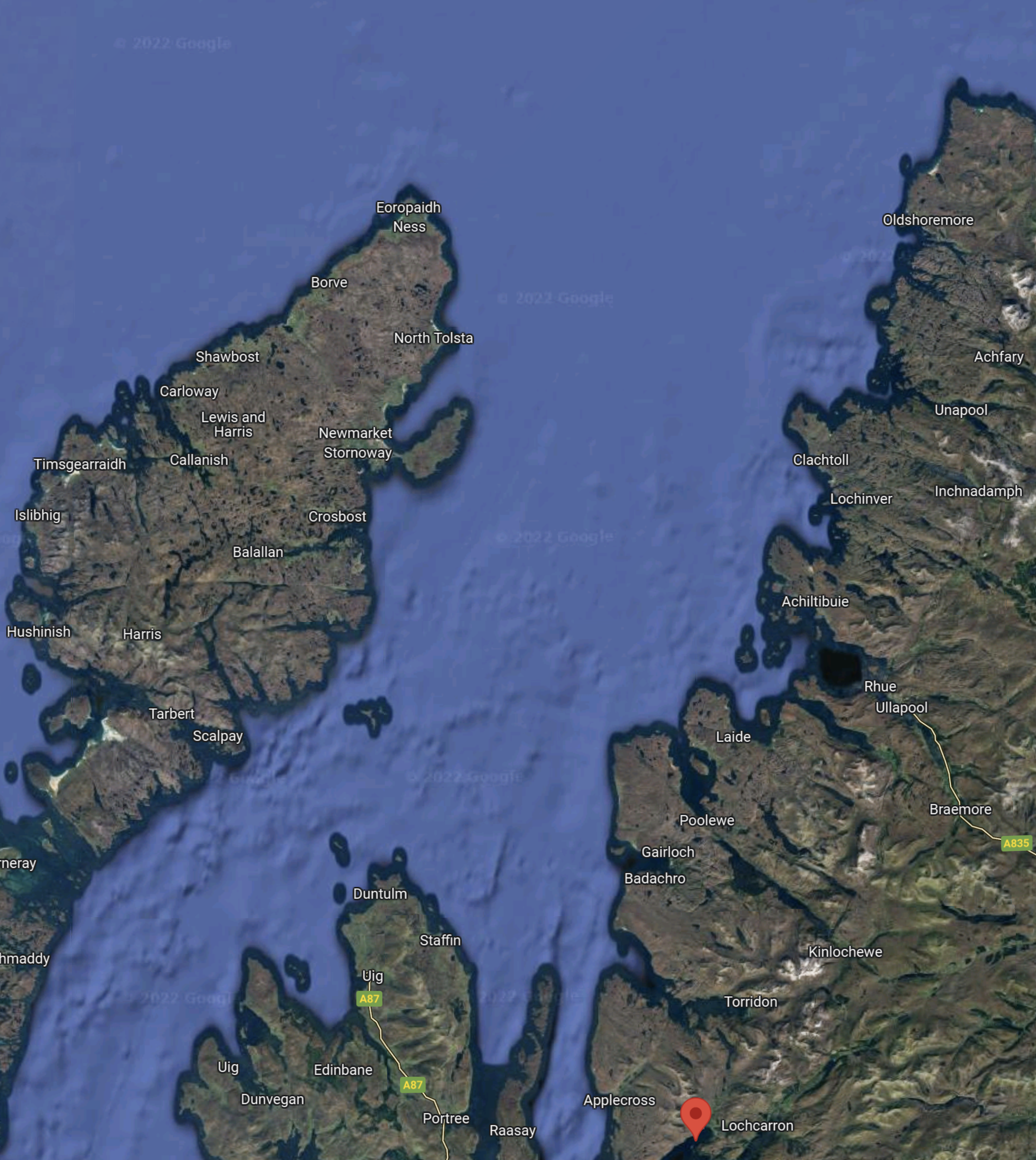
Note.
- The island in the North-West of the map is Lewis and Harris.
- The windfarm will be to the North-West of the island.
- Stornaway is on the isthmus, that connects the small peninsular on the East of the island.
- The port of Stornaway is on the South side of the isthmus.
- The port of Kishorn is shown by the red arrow.
This second Google Map shows the town of Stornaway.
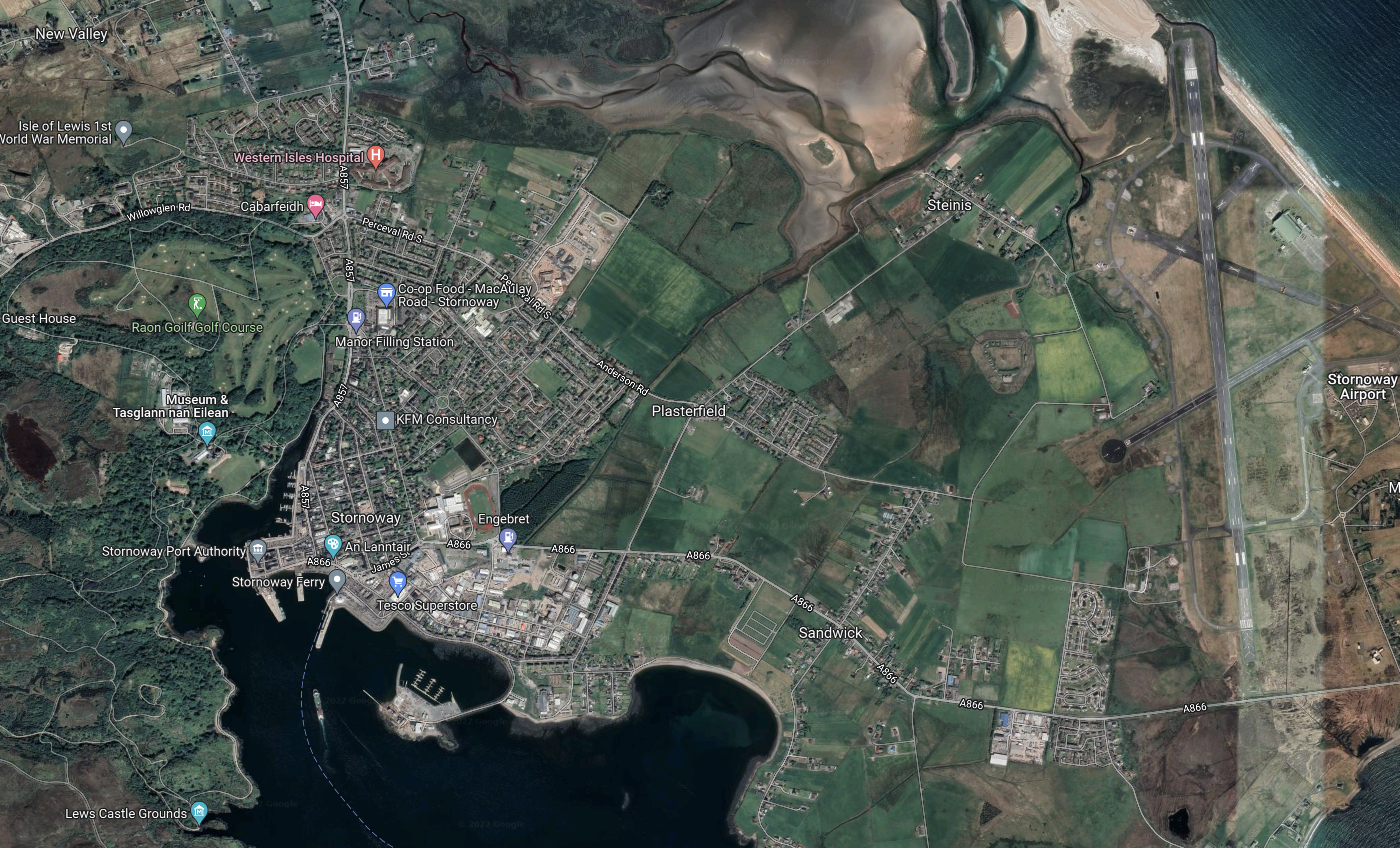
Note that Stornaway has a substantial airport in the East and a large port.
This third Google Map shows Loch Kishorn in more detail.
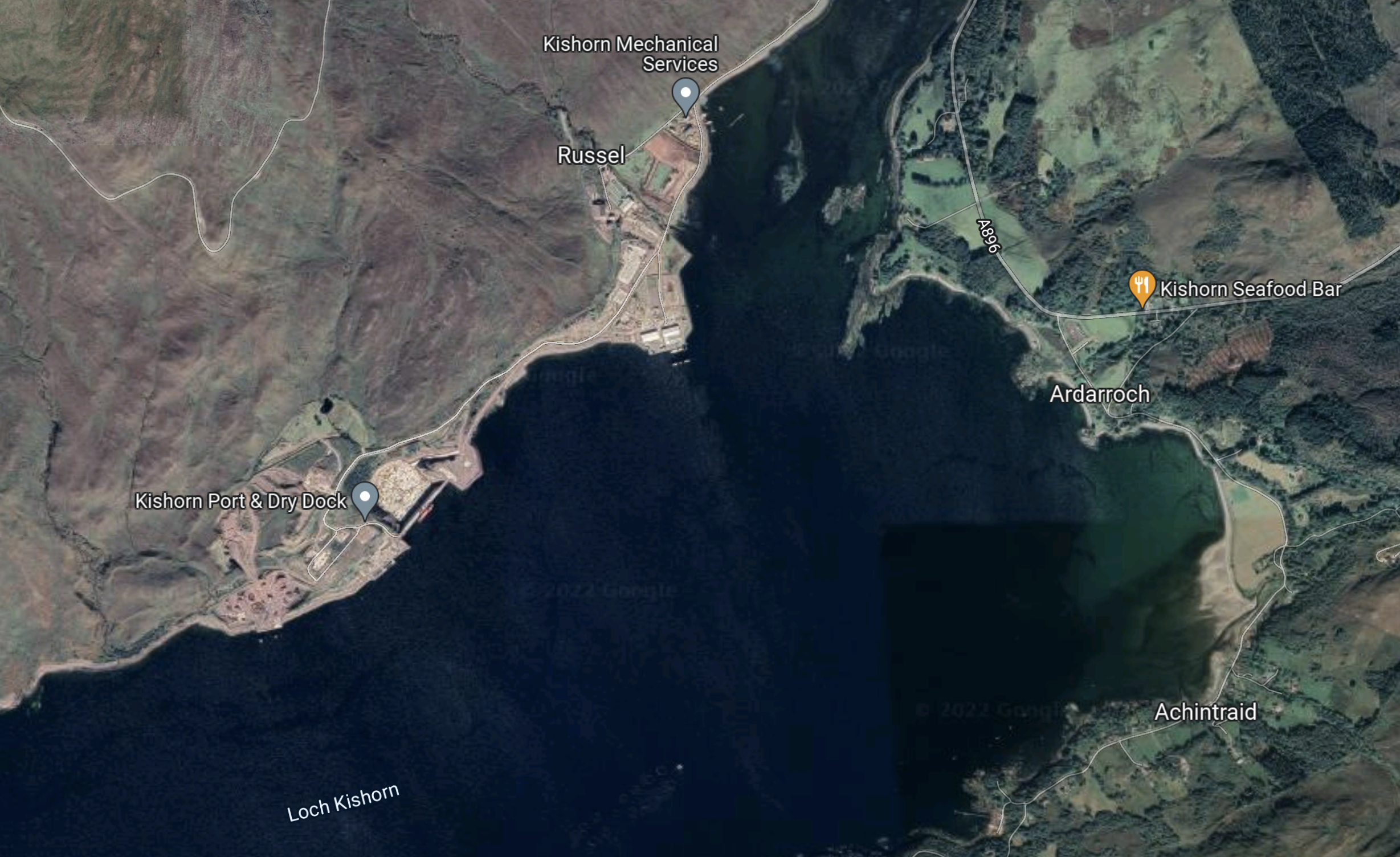
Kishorn Yard at the Kishorn Port was originally built to create the large structures in steel and concrete for the development of North Sea Oil. This is an extract from the Wikipedia entry.
The yard was therefore well suited to build the 600,000-tonne concrete Ninian Central Platform, which was built in 1978. Material was supplied by sea and when complete the platform needed seven tugs to tow it to its operating position in the North Sea. The Ninian Central Platform still holds the record as the largest movable object ever created by man.
If the yard could build the Ninian Central Platform, I’m sure that Magnora ASA intend to build the concrete floater in Loch Kishorn.
The Floating Wind Turbines
In visualisations on the site, the floating wind turbines are shown as sitting on floating three-pointed star structures.
As Technip UK are partners in the project and I suspect they are a subsidiary of TechnipFMC, who are a well-known company described like this in Wikipedia.
TechnipFMC plc is a French-American, UK-domiciled global oil and gas company that provides complete project life cycle services for the energy industry.
The company would certainly have the expertise to design a floating platform for a wind farm.
Like the WindFloat, it could be based on semi-submersible offshore platform technology.
The Magnora web site, say that 15 MW wind turbines will be used, so these will probably be some of the largest wind turbines in the world.
Currently, the largest floating wind turbines are the 9.5 MW units at the Kincardine Wind Farm in Scotland.
33 x 15 MW wind turbines would give a capacity of 495 MW.
I suspect the turbines would be towed to Stornaway or Kishorn for major servicing.
What Will The Concrete Floater Do?
There are a variety of tasks that the concrete floater could handle.
- It could collect the electricity from the wind turbines. I suspect this would give advantages in the connection and disconnection of individual turbines into the windfarm.
- Any electricity conversion necessary would be handled on the floater.
- The floater would handle the seaward end of the connection to the shore.
- There could be a battery or energy storage device on the floater.
- Could a Gravitricity battery or something similar be built into the floater?
- Magnora mention hydrogen on their web site. Could an electrolyser be built on the floater and the hydrogen distributed to Lewis and Harris by pipeline?
Some oil and gas platforms are very comprehensive and there is no reason why there can’t be substantial processing done on the floater.
The Concrete Floater
According to Wikipedia, offshore concrete structures have been in use successfully for about 50 years. Nearly fifty are in use in the oil and gas industry.
Wikipedia introduces its section on floating concrete structures like this.
Since concrete is quite resistant to corrosion from salt water and keeps maintenance costs low, floating concrete structures have become increasingly attractive to the oil and gas industry in the last two decades.
I also wonder if a floating concrete structure would make a good hydrogen storage tank, if there is electrolysis on the floater on the to turn electricity into hydrogen.
Conclusion
My original conclusion after reading about this wind farm was.
This project could serve as a model for wind farms all round the world with a 500 MW power station, hydrogen production and local involvement and construction.
I have no reason to change my mind and feel that the concept may have even more possibilities.
 The Anonymous Widower