Government Approval For Large Solar Farm
The title of this post, is the same as that of this article on the BBC.
This is the sub-heading.
A large solar farm in East Yorkshire has been given the go ahead by the government.
These two introductory paragraphs add more detail.
The 3,155 acre (1,277 hectares) site will be built on land around Gribthorpe, Spaldington and Wressle and Howden.
Its developers said it would produce 400 megawatts of electricity – enough to power 100,000 homes.
Note.
- This solar farm is five square miles or a 2.2 mile square.
- Due to the size of the scheme the planning application was handled by the Planning Inspectorate as it was classed as national infrastructure.
- Ed Miliband may have been involved in the final decision.
- The solar farm would connect to the National Grid at the Drax substation in North Yorkshire.
But the solar farm is not without opposition, as these last three paragraphs indicate.
George McManus, spokesman for East Riding Against Solar Expansion (ERASE), said the approval “brings us a step closer to enormous swathes of agricultural land being blanketed in a million, Chinese manufactured, solar panels.”
He added: “Other projects in the pipeline will see another 20,000 acres disappear under glass.
“The East Riding is being industrialised and people need to wake up to that.”
Nothing is said about where Reform UK’s Mayor for Hull and East Yorkshire sits.
Equinor May Ditch Empire Wind 1 ‘In Coming Days’ Unless Stop-Work Order Lifted – Reports
The title of this post, is the same as that of this article on offshoreWIND.biz.
This is the sub-heading.
Equinor could abandon the Empire Wind 1 offshore wind project “in the coming days” if the stop-work order, issued by the US government soon after the project started offshore construction work, is not lifted, president of Equinor Renewables Americas, Molly Morris, recently shared in an interview.
These are the first three paragraphs.
Morris told Politico that the standstill was costing the company millions each day and USD 50 million (around EUR 45 million) per week but that a lawsuit would take too long as the work offshore needs to get off the ground again soon.
Last month, Anders Opedal, CEO and President of Equinor, called the US government’s order to stop construction activities on Empire Wind 1 “unlawful” and said the company was seeking to engage directly with the US administration to clarify the matter and was considering its legal options.
AP reports that Morris said the project was now at risk of missing the summer construction window as it began this month and would be set back a year if that happens. This is why the company is pushing for the order to be lifted by the government as that would allow for the work to be resumed while legal action could get the project tied up in courts, according to AP’s report.
When this project is late and inevitably loses money, it will be Trump’s fault.
I’ve seen it all before with housing and railway projects in the UK and other countries.
But Trump is bringing pointless political interference for a whole new stupid level.
How
DESNZ Launches Call For Evidence For Solar Carports In The UK
The title of this post is the same as this article on Solar Power Portal.
These three paragraphs introduce the article.
The UK Department for Energy Security and Net Zero (DESNZ) has launched a call for evidence to help increase the number of solar-powered carports in England, Wales, and Northern Ireland.
The likely result of this will be a mandate that car parks have a solar PV installation, as has been the case in France for some time.
Mandating solar on car parks has multiple benefits, which DESNZ is keen to emphasise. It says that a mandate would be a “better deal for motorists and businesses”
I may not be a fan of electric cars, but I’m certainly no fan of spreading solar panels over large areas of quality farmland.
There are some interesting statements.
Take this one.
DESNZ cites estimates that supermarkets, retail parks and offices could save up to £28,000 annually by installing solar carports (this figure calculated for an 80-space car park—the size that France mandates must be covered by solar PV) if all of the electricity generated by the solar array was used onsite.
£28,000 a year is not to be sneezed at!
And this one.
Earlier this year, Norwich-based RenEnergy, a solar carport provider, revealed that installing solar carports in more than half a million suitable parking spaces owned by UK businesses could generate 1.57GW of solar energy.
They do suggest that this figure only scratches the surface.
And then there’s this story from Bentley.
In 2019, Bentley Motors installed a solar car park at its headquarters in Crewe. The site’s 10,000 solar PV modules have a capacity of 2.7MW and cover an area of 16,426m². Along with other installed solar arrays and 6.6MW of battery energy storage, the car park enables all of Bentley’s manufacturing operations to be powered by solar or certified green energy.
How many other businesses could do that?
This Google Map shows the Bentley Motors site at Crewe.

Note.
- It appears to be a large site.
- Bentley employs over 4,000 employees at Crewe.
- In 2023, Bentley delivered 13, 560 cars.
- The solar car ports appear to be at the Western end of the site.
- There would appear to be a lot of scope to add more solar car ports at the Eastern end of the site.
Running along the Southern edge of the site is the North Wales Coast Line, which runs between Crewe and Chester and then on to North Wales.
I would have thought, that a case could be made out to have a station at the Bentley site for employees and visitors.
There also doesn’t seem to be the infrastructure, so that cars to some destinations can be delivered by train, like these from Toyota, which I photographed at Denmark Hill station, which were on the way to Europe, through the Channel Tunnel.

Perhaps sending luxury cars to their future owners by train is the wrong image.
Ørsted Pulls Plug On 2.4 GW Hornsea 4 Offshore Wind Project In UK
The title of this post, is the same as that of this article on offshoreWIND.biz.
This is the sub-heading.
Ørsted has discontinued the development of the UK’s Hornsea 4 offshore wind farm in its current form. The developer said the 2.4 GW project has faced rising supply chain costs, higher interest rates, and increased construction and delivery risks since the Contract for Difference (CfD) award in Allocation Round 6 (AR6) in September 2024.
This introductory paragraph adds more detail.
In combination, these developments have increased the execution risk and deteriorated the value creation of the project, which led to Ørsted stopping further spending on the project at this time and terminating the project’s supply chain contracts, according to the Danish company. This means that the firm will not deliver Hornsea 4 under the CfD awarded in AR6.
Consider.
- Hornsea 4 will be connected to the grid at a new Wanless Beck substation, which will also include a battery and solar farm, which will be South West of the current Creyke Beck substation. Are Ørsted frightened of opposition from the Nimbies to their plans?
- I also wonder if political uncertainty in the UK, and the possibility of a Reform UK government, led by Nigel Farage is worrying companies like Ørsted.
So will factors like these prompt companies like Ørsted to move investment to countries, where they welcome wind turbines like Denmark, Germany and The Netherlands.
Could Ørsted Be Looking At An Alternative?
This is a map of wind farms in the North Sea in the Dogger Bank and Hornsea wind farms, that I clipped from Wikipedia..
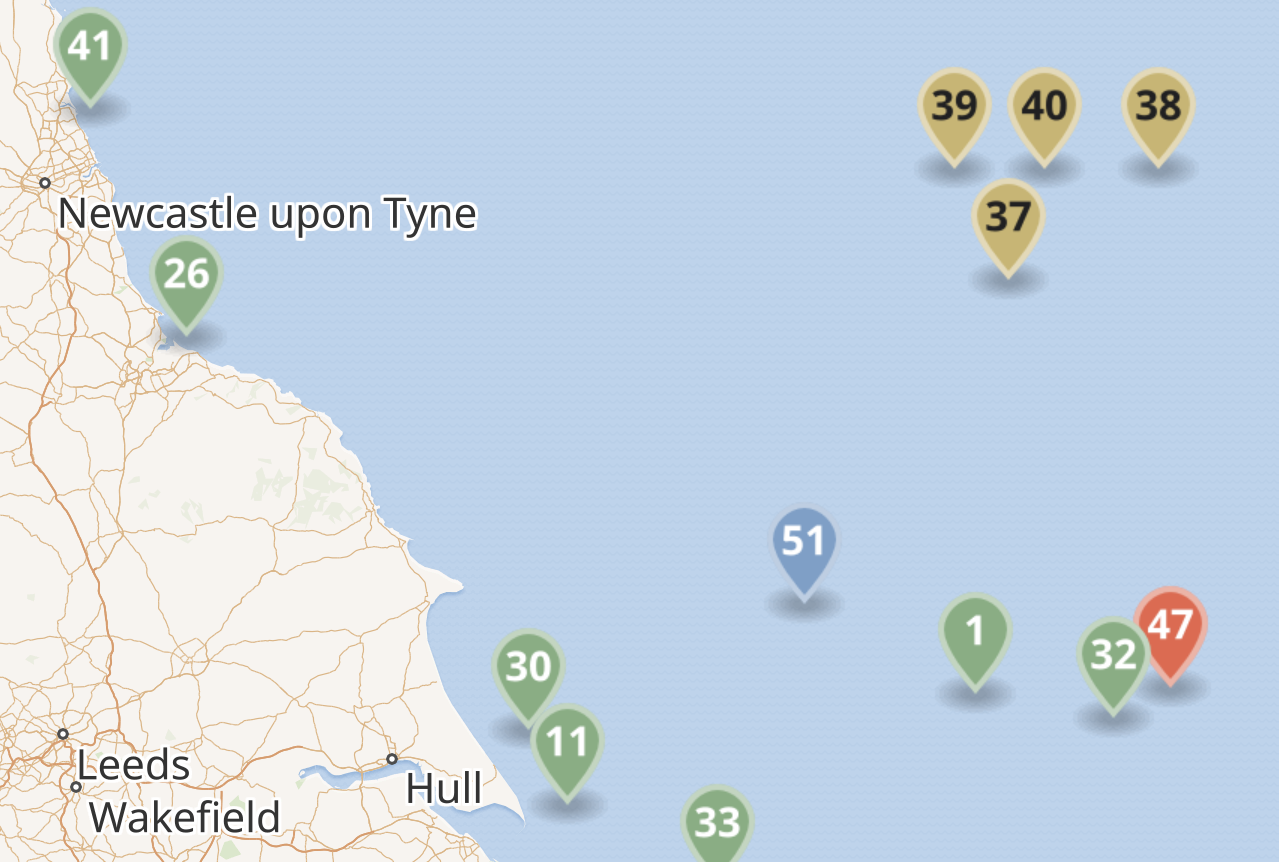
These are the Dogger Bank and Hornsea wind farms and their developers and size
- 37 – Dogger Bank A – SSE Renewables/Equinor – 1,235 MW
- 39 – Dogger Bank B – SSE Renewables/Equinor – 1,235 MW
- 38 – Dogger Bank C – SSE Renewables/Equinor – 1,218 MW
- 40 – Sofia – RWE – 1,400 MW
- 1 – Hornsea 1 – Ørsted/Global Infrstructure Partners – 1,218 MW
- 32 – Hornsea 2 – Ørsted/Global Infrstructure Partners – 1,386 MW
- 47 – Hornsea 3 – Ørsted – 2,852 MW
- 51 – Hornsea 4 – Ørsted – 2,400 MW
Note.
- That is a total of 12, 944 MW, which is probably enough electricity to power all of England and a large part of Wales.
- Wikipedia’s List of offshore wind farms in the United Kingdom, also lists a 3,000 MW wind farm, that is being developed by German company ; RWE called Dogger Bank South,
- The Dogger Bank South wind farm is not shown on the map, but would surely be South of wind farms 37 to 40 and East of 51.
- The Dogger Bank South wind farm will raise the total of electricity in the Dogger Bank and Hornsea wind farms to just short of 16 GW.
Connecting 16 GW of new electricity into the grid, carrying it away to where it is needed and backing it up, so that power is provided, when the wind doesn’t blow, will not be a nightmare, it will be impossible.
An alternative plan is needed!
AquaVentus To The Rescue!
AquaVentus is a German plan to bring 10 GW of green hydrogen to the German mainland from the North Sea, so they can decarbonise German industry and retire their coal-fired power stations.
- I introduce AquaVentus in AquaVentus, which I suggest you read.
- AquaVentus is being developed by RWE.
- AquaVentus connects to a German hydrogen network called H2ercules to actually distribute the hydrogen.
This video shows the structure of AquaVentus.
I clipped this map from the video.

Note.
- The thick white line running North-West/South-East is the spine of AquaVentus, that will deliver hydrogen to Germany.
- There is a link to Esbjerg in Denmark, that is marked DK.
- There appears to be an undeveloped link to Norway, which goes North,
- There appears to be an undeveloped link to Peterhead in Scotland, that is marked UK.
- There appears to be a link to just North of the Humber in England, that is marked UK.
- Just North of the Humber are the two massive gas storage sites of Aldbrough owned by SSE and Brough owned by Centrica.
- Aldbrough and Rough gas storage sites are being converted into two of the largest hydrogen storage sites in the world!
- There appear to be small ships sailing up and down the East Coast of the UK. Are these small coastal tankers, that are distributing the hydrogen to where it is needed?
When it is completed, AquaVentus will be a very comprehensive hydrogen network.
I believe that offshore electrolysers could be built in the area of the Hornsea 4 and Dogger Bank South wind farms and the hydrogen generated would be taken by AquaVentus to either Germany or the UK.
- Both countries get the hydrogen they need.
- Excess hydrogen would be stored in Aldbrough and Rough.
- British Steel gets decarbonised.
- A 1.8 GW hydrogen-fired powerstation at Keadby gets the hydrogen it needs to backup the wind farms.
Germany and the UK get security in the supply of hydrogen.
These may be my best guesses, but they are based on published plans.
18-State Coalition Sues Trump Administration Over Block On Wind Energy Projects
The title of this post, is the same as that of this article on offshoreWIND.biz.
This is the sub-heading.
A coalition of 18 state attorneys general has filed a lawsuit challenging the Trump administration’s directive to stop federal approvals for both onshore and offshore wind energy developments, warning that the policy could seriously damage the wind industry and hinder progress on renewable energy.
These two introductory paragraphs add some details.
The coalition alleges that the administration’s directive and federal agencies’ subsequent implementation of it violate the Administrative Procedure Act and other laws by offering no reasoned justification for reversing federal policy and freezing all approvals.
The lawsuit, led by New York state, also alleges that the sudden halt on all permitting violates numerous federal statutes that prescribe specific procedures and timelines for federal permitting and approvals.
As New York state is mentioned, I wonder if this case could end up in front of The Lady On The Train, who turned out to be a New York State Supreme Court Judge.
Berkeley Scientists Finally Solve 10-Year Puzzle Enabling Efficient CO2-to-Fuel Conversion With Major Climate Impact Potential
The title of this post, is the same as that of this article on Sustainability Times.
This is the sub-heading.
In a groundbreaking advancement, scientists at Lawrence Berkeley National Laboratory and SLAC National Accelerator Laboratory have unveiled the critical mechanisms behind the degradation of copper catalysts, a revelation that promises to revolutionize the production of sustainable fuels by enhancing the efficiency and stability of CO2 conversion processes.
This paragraph gives more details.
Scientists from the Lawrence Berkeley National Laboratory and SLAC National Accelerator Laboratory have made a groundbreaking discovery in the field of artificial photosynthesis. By utilizing advanced X-ray techniques, they have uncovered the critical factors that limit the performance of copper catalysts in converting carbon dioxide and water into useful fuels. This revolutionary insight could significantly enhance the stability and efficiency of catalysts in CO2 conversion processes, potentially accelerating the production of ethanol and ethylene. The research, which tackles a decades-old puzzle, offers promising avenues for the development of more durable catalyst systems, paving the way for future advancements in sustainable energy solutions.
I first came across catalysts in my working life, when I was working at ICI. I was modelling a chemical process called sulphonation for a guy who was trying to find an efficient way to create the monomer of building block for a new engineering plastic.
Some feel that all plastics are bad for the environment, but I think that, if the plastic is designed to replace another material in a long-lasting application, then plastic is good for the environment.
This picture shows my wonderful Sheba cutlery.

Note.
- C and I bought it in the 1960s, when we got married.
- Some have been used every day for over fifty years.
- The important bits are Sheffield stainless steel, with the handles formed of black Delrin plastic.
- Some of the handles have been in the dishwasher too many times and have faded.
- From what I have seen on the Internet, the average worth of pieces could be as much as a tenner.
Perhaps, when I pass on, all the pieces should be divided between my grandchildren.
I have digressed and I will return to my modelling project with one of ICI’s catalyst experts.
I remember him telling me, that if you could improve the way catalysts worked, you would open up whole new areas of chemistry.
It looks to me, that the scientists at Berkeley may have opened up a route to turn carbon dioxide into fuel.
Whether that is a good route to decarbonisation is another long discussion.
Could A Highview Power CRYOBattery Provide Backup Power For A Large Data Centre?
I asked Google AI how much power does a data centre need and got this answer.
The power requirements for an average data center vary greatly depending on its size and purpose, ranging from 1-5 MW for small facilities to 20-100 MW or more for large hyperscale centers. Small data centers, typically with 500-2,000 servers, might need 1-5 MW of power, while large or hyperscale data centers, housing tens of thousands of servers, can consume 20-100 MW or even more.
As Highview Power are currently building four 200 MW/2.5 GWh CRYOBatteries for the UK, I am fairly sure the answer is in the affirmative.
Mayors Head To Parliament With Plan For Northern Arc To Deliver Green Growth
The title of this post, is the same as that of this news item from Liverpool City Region.
These four bullet points act as sub-headings.
- Steve Rotheram and Andy Burnham take case for backing Northern Arc to Treasury – as new data shows North can drive green growth and unlock £90bn for UK economy
- Liverpool City Region and Greater Manchester Mayors will meet with ministers and MPs today, and Andy Burnham will give evidence at Business and Trade Select Committee on the UK’s industrial strategy
- Economic analysis shows that investing in transport infrastructure and a pipeline of projects across the North would benefit the whole UK economy, improving living standards and closing the North-South productivity gap
- Mayors will also address Innovation Zero World Congress in London, showing how city-regions can create high quality jobs by pioneering low-carbon innovation
These two paragraphs add a bit more detail.
The right investment would create a growth corridor, stretching from the Mersey to the Pennines and connecting into West and South Yorkshire, underpinned by transport networks that would include a new railway linking Liverpool and Manchester.
The Northern Arc area spans regions with close economic ties to Lancashire, North Wales, Hull and the North East. With international connections through the Port of Liverpool and Manchester Airport, it’s well positioned for global trade.
If I have a problem with the mayors’ thoughts, the plan outlined in the news item is rather Liverpool/Manchester-based with Hull being the only city outside that area getting a mention. Do Blackburn, Blackpool, Bradford, Burnley, Doncaster, Huddersfield, Leeds, Preston, Rotherham, Scunthorpe, Stockport, Wigan and York exist?
For instance you would expert a report from Liverpool and Manchester’s Mayors to call for a new railway between their two cities. And of course they do!
The current TransPennine Lines has two main routes across the Pennines between East and West.
If ever there was a rail route, designed by Topsy, it is the North TransPennine Route.
- There are six separate services, if you ignore Newcastle and Edinburgh Waverley, which is a shuttle to fill a gap in rail services.
- In the West trains terminate at Huddersfield, Liverpool Lime Street, Manchester Airport, Manchester Piccadilly and Manchester Victoria
- In the East trains terminate at Edinburgh Waverley, Hull, Leeds, Newcastle, Redcar Central, Scarborough and York.
- Terminals like Huddersfield, Hull, Liverpool Lime Street, Newcastle and York are some of the best terminal stations in the UK, but others are very second rate.
I suspect, this North TransPennine Route structure brought about the demise of TransPennine Express.
The South TransPennine Route on the other hand, although it was built by several different railway companies, they were all intent on the same thing. An East-West route across the Pennines through Doncaster, Manchester and Sheffield.
- The Western terminal is Liverpool Lime Street, which in my view is the finest grand terminus in the UK, in terms of architecture, onward connections and operation. It is also the oldest still-operating grand terminus mainline station in the world, in that it dates from 1836.
- The Eastern terminal is Cleethorpes, which is an efficient four-platform recently-refurbished station, that is within a hundred metres of some of the best gluten-free fish and chips, I’ve ever tasted on the pier.
- Intermediate stations include Liverpool South Parkway, Warrington Central, Birchwood, Irlam, Urmston, Manchester Oxford Road, Manchester Piccadilly, Stockport, Sheffield, Meadowhall, Doncaster, Scunthorpe, Barnetby, Habrough and Grimsby Town.
- Liverpool South Parkway has a bus connection to Liverpool Airport
- Liverpool Lime Street, Manchester Oxford Road, Manchester Piccadilly, Stockport, Sheffield and Doncaster are stations with comprehensive onward connections.
- The route is electrified between Liverpool Lime Street and Manchester Piccadilly and at Doncaster.Liverpool Lime Street and Cleethorpes is 148.2 miles
- Hazel Grove and Doncaster is without electrification and is 52.3 miles long.
- Cleethorpes and Doncaster is without electrification and is 52.1 miles long.
- I believe that Hitachi, Siemens and Stadler could supply battery-electric trains, that would be able to work the route, with the addition of a short length of overhead wires at Cleethorpes, so that trains could return to Doncaster.
- Trains go straight through all the intermediate stations, so there are no time-wasting reverses.
- Journey time is just over three and a half hours.
I believe that a mouse-quiet battery-electric train would pack in the punters, if only for the novelty.
But.
A battery-electric train would probably knock perhaps thirty minutes off the journey.
The timetable would be an hourly train at all stations.
The service would pass the mother’s birthday test, in that you could easily visit any station from any other and buy your mother lunch before returning on a convenient train.
There are connections to and from London at Liverpool Lime Street, Manchester Piccadilly, Stockport, Sheffield and Doncaster.
It could be a very useful East-West train service.
Plan For England’s Largest Wind Farm ‘Scaled Back’
The title of this post, is the same as that of this article on the BBC.
This is the sub-heading.
Plans for the largest onshore wind farm in England have been scaled back by a developer.
These two introductory paragraphs add more details.
Calderdale Energy Park said it would apply for permission to build 41 turbines instead of the 65 originally planned on land near Hebden Bridge in West Yorkshire.
A consultation period has now begun and people have been invited to submit their views on the project over the next six weeks.
Note.
- The number of wind turbines has been reduced by 37 %.
- Are the turbines now larger?
- In another paragraph, the developers say the solar element has been removed.
- Batteries, which I feel are essential to smooth the output of wind farms, are not mentioned.
Given comments by Stop Calderdale Wind Farm about peat bogs, there will be a large fight over building this wind farm.
Shawton Energy Joins Up With The Co-Op For Rooftop Solar
The title of this post, is the same as that of this article on Solar Power Portal.
These two paragraphs describe the agreement.
Renewable technology developer Shawton Energy has signed an agreement with the Co-Op group to help support the retail giant’s rollout of rooftop solar PV.
Working with Sol PV as a delivery partner, Shawton Energy will design, develop, fund, and manage rooftop solar PV systems at key Co-op locations using a power purchase agreement (PPA) model. This allows Co-op to make significant energy and cost savings without having to put forward any upfront investment. Co-op will now purchase the power from Shawton Energy at a flat, discounted rate. While this rollout currently only covers some of the Co-Op’s over 2,500 retail locations, there remains potential for expanding this partnership in the future.
This looks to me to be a deal, where all parties benefit.
- Co-op have thousands of locations, that could have solar roofs, which would be good green publicity.
- I suspect that the Co-op own a lot of their properties, so the collateral is there, if the deal goes wrong.
- I suspect many buildings are very similar, so design and installation costs could be reduced.
- Co-op get reduced-cost electricity.
- Shawton Energy can add other technologies like batteries and rooftop turbines to the deal.
From my experience of both sides of the leasing of multiple systems, I believe, that this would be the sort of deal, that reputable banks and finance houses would be very happy to fund.
It looks like the sort of deal that can be replicated.
Especially, as Shawton Energy have already done a deal with the Bannatyne Group, according to these two paragraphs from the article.
This is not the first significant deal with a well-known British chain that Shawton Energy has agreed this year. The company announced in March of this year that it had made an agreement with health and wellness club operator the Bannatyne Group, which has installed solar panels on the rooftops of a number of its health clubs, hotels and spas under a similar PPA agreement to that Shawton Energy has made with the Co-Op.
According to the Bannatyne Group, the installations, which consist of 967 panels and 11 inverters across eight sites around the UK, have already provided significant energy savings to the group. Since their completion, each of the eight sites has reportedly secured energy savings of up to 25%.
Savings of 25 % are worth having.
 The Anonymous Widower