Thoughts On The Future Of Orkney
This article on the BBC is entitled Orkney Votes To Explore ‘Alternative Governance‘
This is the sub-heading.
Orkney councillors have voted to investigate alternative methods of governance amid deep frustrations over funding and opportunities.
These paragraphs outline the story.
Council leader James Stockan said the islands had been “held down” and accused the Scottish and UK governments of discrimination.
His motion led to media speculation that Orkney could leave the UK or become a self-governing territory of Norway.
It was supported by 15 votes to six.
It means council officers have been asked to publish a report to Orkney’s chief executive on options of governance.
This includes looking at the “Nordic connections” of the archipelago and crown dependencies such as Jersey and Guernsey.
A further change which would see the revival of a consultative group on constitutional reform for the islands was accepted without the need for a vote.
My Thoughts On The Economic Future Of The Islands
The economic future of Orkney looks good.
Tourism and the traditional industries are on the up, but the islands could play a large part in renewable energy.
The West of Orkney offshore wind farm, which will be a 2 GW wind farm with fixed foundations, is being developed and a large hydrogen production hub at Flotta is being proposed, along with the development of a large quay in Scapa Flow for the assembly of floating wind farms.
The West of Orkney wind farm could be the first of several.
If the future wind farms are further from shore, they will most likely be based on floating technology, with the turbines and their floats assembled in Scapa Flow, from components shipped in from mainland UK and Europe.
Political Future
With a good financial future assured, I believe that Orkney will be able to choose where its political future lies. It could be a Crown Dependency or join Norway.
Whichever way it goes, it could be an island that effectively prints money, by turning electricity into hydrogen and shipping it to countries like Germany, The Netherlands, Poland and Sweden!
From a UK point of view, a Crown Dependency could be a favourable move.
Would Shetland follow the same route?
Offshore Hydrogen Production And Storage
Orkney is not a large archipelago and is just under a thousand square kilometres in area.
It strikes me, that rather than using up scarce land to host the large electrolysers and hydrogen storage, perhaps it would be better, if hydrogen production and storage was performed offshore.
Aker Northern Horizons
In Is This The World’s Most Ambitious Green Energy Solution?, I talk about Northern Horizons, which is an ambitious project for a 10 GW floating wind farm, which would be built a hundred kilometres to the North-East of Shetland, that would be used to produce hydrogen on Shetland.
Other companies will propose similar projects to the West and East of the Northern islands.
This map shows the sea, that could be carpeted with armadas of floating wind farms.

Consider.
- There are thousands of square miles of sea available.
- As the crow flies, the distance between Bergen Airport and Sumburgh Airport in Shetland is 226 miles.
- A hundred mile square is 10,000 square miles or 2590 square kilometres.
- In ScotWind Offshore Wind Leasing Delivers Major Boost To Scotland’s Net Zero Aspirations, I calculated that the floating wind farms of the Scotwind leasing round had an energy density of 3.5 MW per km².
- It would appear that a hundred mile square could generate, as much as nine GW of green electricity.
How many hundred mile squares can be fitted in around the UK’s Northern islands?
Lloyd’s Register Issues World’s First Rules For Hydrogen Fuel
The title of this post, is the same as that of this article on Hydrogen Central.
These are the first two paragraphs.
Lloyd’s Register issues world’s first rules for hydrogen fuel.
Liam Blackmore, Lead Specialist at Lloyd’s Register, is a busy man. He has led the technical policy writing of many of the class society’s decarbonisation rules. Horizons spoke to him in late April 2023, just a few weeks after LR had published the world’s first maritime rules covering hydrogen as a fuel.
This would appear to be a very sensible move by Lloyds Register, which sets down the rules for using hydrogen fuel on ships.
But surely, if you follow these rules, then you will able to get insurance for your ship.
World’s First Offshore Hydrogen Production Project Yields First Kilograms Of Green Hydrogen
The title of this post, is the same as that of this article on offshoreWIND.biz.
This is the sub-heading.
The offshore hydrogen production platform that Lhyfe is testing in France, named Sealhyfe, began producing its first kilograms of hydrogen on 20 June after it was towed last month to the SEM-REV offshore test site which is connected to BW Ideol’s floating wind turbine Floatgen.
These two paragraphs introduce the article.
Sealhyfe is capable of producing up to 400 kilograms of hydrogen per day.
With the start-of-production milestone now reached, the platform has entered the second phase of testing, which focuses on producing hydrogen in offshore conditions, after eight months of being tested at a quay in the Port of Saint-Nazaire, starting in September 2022.
The setup features a 1 MW electrolyser.
This may only be a small start, but I do feel that we’ll see more offshore hydrogen production.
According to Lhyfe And Centrica To Develop Offshore Renewable Green Hydrogen In The UK, Centrica and Lhyfe seem to be co-operating.
It should be noted that this year, I’ve written seven posts involving Offshore Hydrogen Production.
My Second Ride In A Wrightbus Single-Decker Hydrogen Bus
Or it might have been the third or fourth, but it was the first outside of London in a single-decker Wrightbus hydrogen bus. The earlier rides were in the RV1 route, which I wrote about in London’s Hydrogen Buses.
I took these pictures.


















Note.
The trip was in Crawley and Go-Ahead are building a network of hydrogen buses to link the town and Gatwick Airport.
- It was a high quality bus.
- It was busy.
- It was the first bus, I’d seen in the UK, with a detailed route.
Someone had been thinking about how to design a bus route.
SSE Becomes First Utility To Trial First Hydrogen Fuel Cell EV Van
hydrThe title of this post, is the same as that of this article on Hydrogen Central.
This is the first two paragraphs.
The low-carbon energy infrastructure company will be the first utility to trial the hydrogen-powered vehicle – and the first to put it to the test in real-life fleet operations by deploying the vehicle with SSE engineers.
The project will enable First Hydrogen’s team to gather data on fuel consumption, usage, and efficiency. The trials are being used to inform development of First Hydrogen’s Generation II series, currently in development, and will help enhance Total Cost of Ownership (TCO) data.
The deployment will take place in Aberdeen, as the city has some of the UK’s best hydrogen infrastructure.
The Mayor of London please note how being a hydrogen denier causes London to have more pollution.
Airbus To Trial In-flight Auxiliary Power Entirely Generated By Hydrogen
The title of this post, is the same as that of this press release from Airbus.
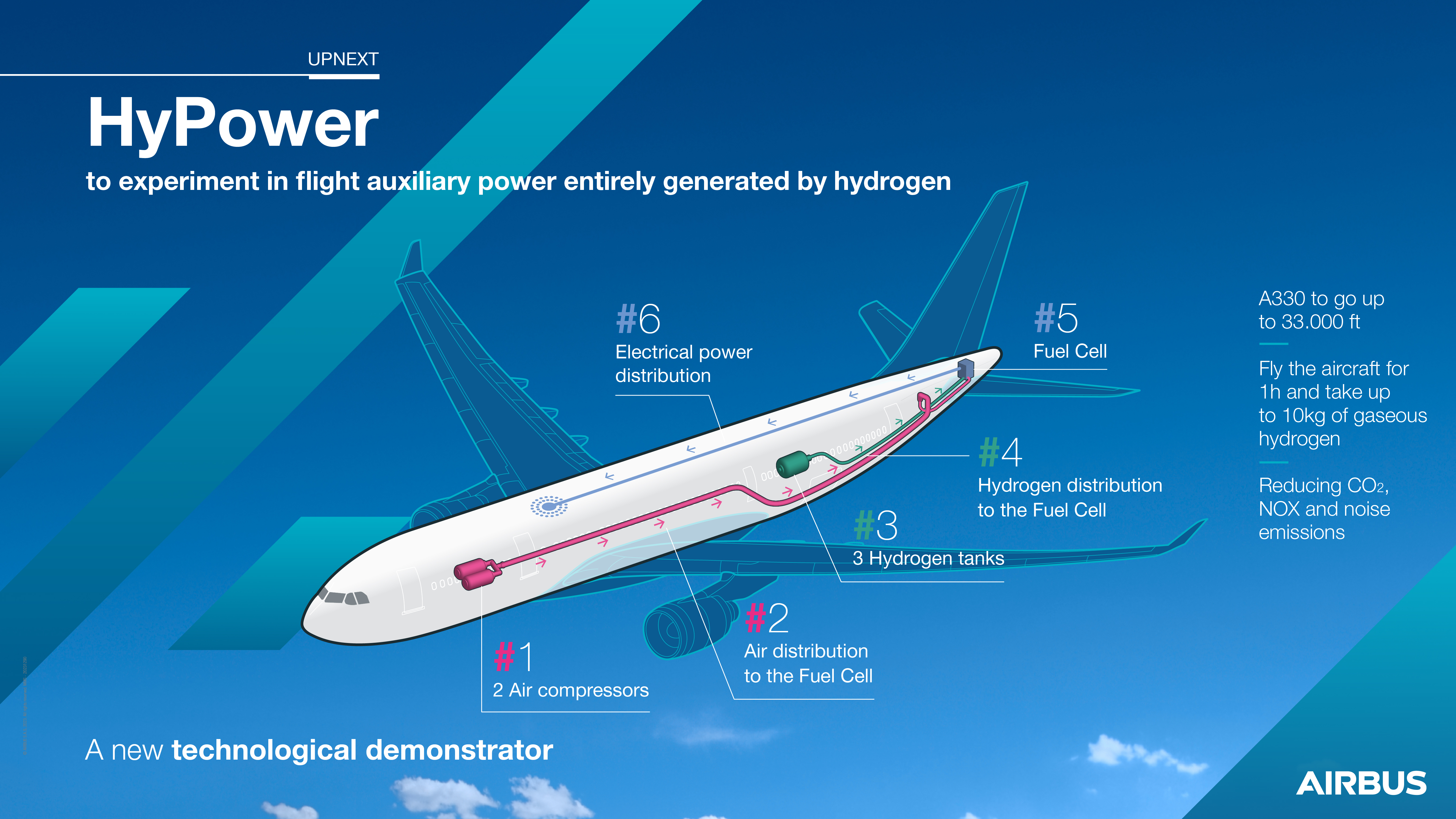
Airbus UpNext has launched a new demonstrator programme to explore, on the ground and in flight, a new architecture for the generation of non propulsive energy through the use of hydrogen fuel cells.
On conventional airliners, the APU (Auxiliary Power Unit), a small additional engine that runs on traditional jet fuel, provides together with the engines the energy required to power a number of non-propulsive aircraft functions, such as air conditioning, onboard lighting and electric power for avionics. With this new technology demonstrator, led from its facilities in Spain, Airbus UpNext will replace the actual APU of an A330 with a hydrogen fuel cell system that will generate electricity. Known as HyPower, the hydrogen fuel cell demonstrator also aims to reduce the emissions of CO2, nitrogen oxides (NOx) and noise levels associated with a traditional APU.
New design features and integration techniques will also contribute to maturing the safety and operations of future hydrogen-powered aircraft and will demonstrate the stable operation of a fuel cell in-flight, including its restart.
This Airbus infographic describes the system.
This looks to be a well-thought out project and I suspect Airbus will learn a lot about hydrogen and how to use it.
I have some thoughts.
The Noise Factor
Reduction of noise is mentioned in both the text and the infographic, so it must be important.
Years ago, I remember a take-off from St. Lucia, where on the previous day, there had been an engine failure on the flight from London. This meant we were treated to the view of a rare site of a five-engined Jumbo Jet, as the next day’s flight brought in a spare engine on the spare mounting under the wing. Engineers then worked all night to put this engine on the previous day’s stricken plane, whilst we had an extra night in the Carribean.
When it eventually came to leaving, we were on the absolutely crammed-full rescue plane, which was an almost new 747-300.
I remember the plane being positioned at the very Western end of the runway and we waited a long time before take-off. From our position towards the rear of the plane, I couldn’t see if they topped up the fuel tanks but they may have done. The pilot then gave us the good news, that we would be going to Heathrow without the usual intermediate stop at Barbados to take on fuel.
We had no problems, but I suspect the airport’s neighbours on the island didn’t like the screaming noise of the APU (Auxiliary Power Unit) disturbing the peace, whilst we waited for take-off.
A hydrogen fuel cell-powered APU could have advantages in some take-offs from perhaps smaller airports. The plane would be towed into position for take-off by a battery-electric aircraft tug, with all aircraft systems running on the hydrogen-powered APU. When everything was ready, the first engine would be started by the power from the APU and then after all engines were started and everything was ready, the plane would take off.
It looks to me, that a hydrogen-powered APU and a zero-carbon aircraft tug, could work together to reduce pre-take off pollution, carbon-dioxide emissions and noise at airports.
The Inflight Restart
Two air incidents, illustrate the need for an inflight restart of the APU.
The Wikipedia entry for the flight describes the crash like this.
British Airways Flight 38 was a scheduled international passenger flight from Beijing Capital International Airport in Beijing, China, to London Heathrow Airport in London, United Kingdom, an 8,100-kilometre (4,400 nmi; 5,000 mi) trip. On 17 January 2008, the Boeing 777-200ER aircraft operating the flight crashed just short of the runway while landing at Heathrow. No fatalities occurred; of the 152 people on board, 47 sustained injuries, one serious. It was the first time in the aircraft type’s history that a Boeing 777 was declared a hull loss, and subsequently written off.
Wikipedia gives this as the cause of the accident.
Ice crystals in the jet fuel were blamed as the cause of the accident, clogging the fuel/oil heat exchanger (FOHE) of each engine. This restricted fuel flow to the engines when thrust was demanded during the final approach to Heathrow.
Suppose this problem had occurred earlier and shut the engines down in the middle of Russia. At the 40,000 feet, they were flying, they could have probably been able to glide into the nearest suitable airport and land without main engine power. But the APU would have been needed to power the aircraft’s systems like instruments and air-conditioning.
One of my favourite books is All Four Engines Have Failed by Betty Toothill, who was a passenger on BA 009 on the 24th June 1982.
The Wikipedia entry of the flight starts like this.
British Airways Flight 009, sometimes referred to by its callsign Speedbird 9 or as the Jakarta incident, was a scheduled British Airways flight from London Heathrow to Auckland, with stops in Bombay, Kuala Lumpur, Perth, and Melbourne.
On 24 June 1982, the route was flown by the City of Edinburgh, a Boeing 747-200 registered as G-BDXH. The aircraft flew into a cloud of volcanic ash thrown up by the eruption of Mount Galunggung around 110 miles (180 km) south-east of Jakarta, Indonesia, resulting in the failure of all four engines. Partly because the event occurred at night, obscuring the cloud, the reason for the failure was not immediately apparent to the crew or air traffic control. The aircraft was diverted to Jakarta in the hope that enough engines could be restarted to allow it to land there. The aircraft glided out of the ash cloud, and all engines were restarted (although one failed again soon after), allowing the aircraft to land safely at the Halim Perdanakusuma Airport in Jakarta.
In this incident, the APU would have been needed to start the engines.
These incidents show how important the APU is to safe flying.
Some might even argue that a hydrogen fuel cell-powered APU running on its own independent hydrogen supply would be preferable than an APU based on a small gas turbine using the same fuel as the main engines.
Riveting Television
I’ve just watched an episode of Fred Dibnah’s Made In Britain, which was entitled Mechanics and Riveters.
It was fascinating stuff, but how do you decarbonise an industry like the making of rivets without using hydrogen?
Why Should I Pay For The ULEZ Scrappage Scheme?
The Mayor’s pet anti-pollution project the ULEZ scheme is controversial to say the least.
This article on the BBC is entitled ULEZ: Labour MPs In London Call For ULEZ Scrappage Scheme Review.
So even MPs in his own party don’t agree with the current policy!
Consider.
- I am a non-driver after a stroke ruined my eyesight.
- The only possible benefit, that I might get, is slightly less pollution around where I live.
- But the jury is out on that and the current evidence is dubious, as the Mayor has paid for it to be collected.
- In 2021, the population of London had the chance to remove Sadiq Khan, but decided to re-elect him, despite his ULEZ policy.
- So I have no sympathy for those, who have to rely on a non-compliant car or van to go about their daily business.
- They knew they had to either get a compliant vehicle, pay the £12.50 per day or move to somewhere with a friendlier transport policy.
- If the Mayor wanted to cut pollution in London, he could at least have a hydrogen policy, which allowed large trucks based in London to use this clean fuel.
We have another Mayoral election in 2024!
I shall not be voting for any candidate, who proposes to use London taxpayers’ hard-earned money for a scrappage scheme or who doesn’t have a feasible hydrogen policy.
Rolls-Royce Considering Switching From BEV To Hydrogen For Future Models
The title of this post, is the same as that of this article on INSIDEEVs.
This is the sub-heading
The luxury carmaker’s CEO rules out hydrogen combustion, but fuel cells are on the table.
This is the first paragraph.
Rolls-Royce is considering ditching all-electric powertrains in favor of fuel cell technology for its future zero-emissions models once the technology is mature enough and can be scaled to meet its demands, according to Autocar, quoting the luxury car brand’s CEO, Torsten Müller-Ötvös.
As the Rolls-Royce Spectre has a kerb weight of almost three tonnes, I suspect that the handling might make someone like Alec Issigonis, Colin Chapman or Stirling Moss have a good laugh.
But the smaller battery that the fuel cell technology would require, might give a better balance between acceleration, handling and performance.
It would be good fun to model the dynamics of such a heavy car.
I do think though that it is these dynamics, that have suggested a move to hydrogen.
Or Torsten Müller-Ötvös, may have made the statement to find out, what the sort of people, who would buy this car, might think!
Hydrogen Trains Are To Roll Between Stade And Bremervörde
The title of this post is the same as part of the title of this article on Hydrogen Central.
The original title mentions Switzerland, but Bremervörde is in Germany to the North-West of Hamburg.
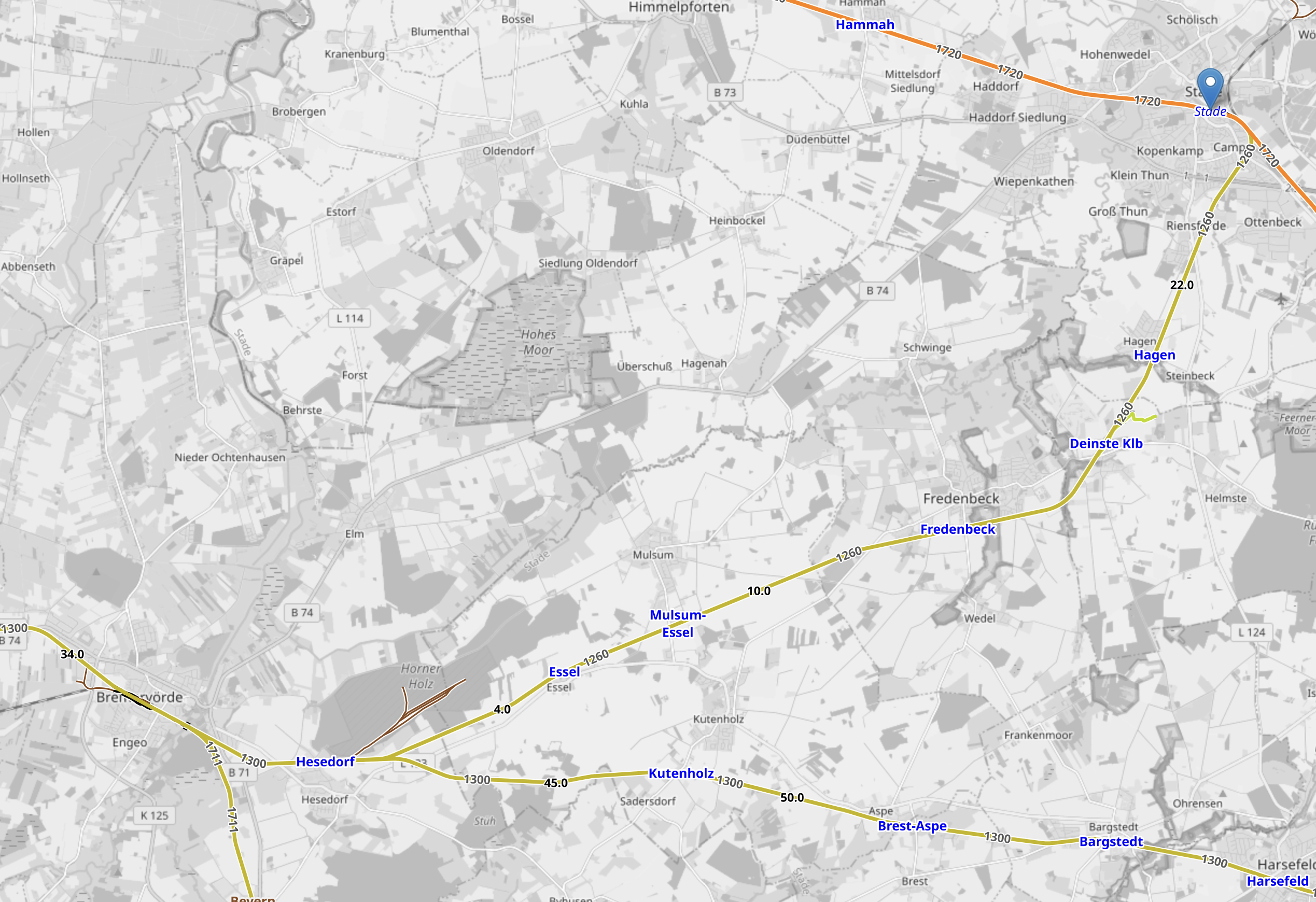
This map from OpenRailwayMap shows the route.
Note.
- Stade is in the North-East corner of the map and marked with a blue arrow.
- Stade station is on the Hamburg S-Bahn and has an hourly fast train between Hamburg and Cuxhaven.
- Bremervörde is in the South-West corner of the map, where the various routes converge.
- Bremervörde station is on the Buxtehude-Cuxhaven Line which is run by the hydrogen-powered Alstom Coradia iLint trains.
- Bremervörde appears to be, where the hydrogen-powered trains are serviced and refuelled.
- Currently, there are no passenger trains between Stade and Bremervörde, except at the weekends, when a heritage service called the Moor Express runs between Bremen Hauptbahnhof and Stade via Bremervörde.
- Freight trains also operate between Stade and Bremervörde.
At first sight it looks like the Stade and Bremervörde route, could be an ideal one to run with hydrogen-powered iLint trains.
- Servicing and refuelling of the trains could be shared with the existing Buxtehude-Cuxhaven service.
- The new service would probably need a few extra identical trains.
- The track is already in use, so probably wouldn’t need too much work.
- As some of the stations are in use by the Moor Express, there may not need to be too much work to bring them up to the required standard.
This re-opening, illustrates the advantage of having a fully-certified, independently-powered train, that can be deployed on non-electrified lines.

