Will Hackney Central Station Get A Second Entrance?
Hackney Central station is a station that has been designed by that well-known architectural practice; Topsy and Partners.
When I moved back to London, the station was very simple with a crude concrete footbridge.
- It has since acquired a step-free footbridge with lifts.
- A high level walkway has also been built to connect Platform 1 at Hackney Downs station.
- Hackney Downs station is also on the latest list of stations to be made step-free as I reported in Hackney Downs Station To Go Step-Free.
And now there is talk of a second entrance at Hackney Central station in Graham Road.
This article on Ian Visits is entitled Hackney Central Overground Station Could Get A Second Entrance
This is the first paragraph.
A second entrance for Hackney Central station to deal with overcrowding is being explored as part of a joint project between the council and Transport for London.
And this Google Map shows the plot of land, where the entrance would be built.
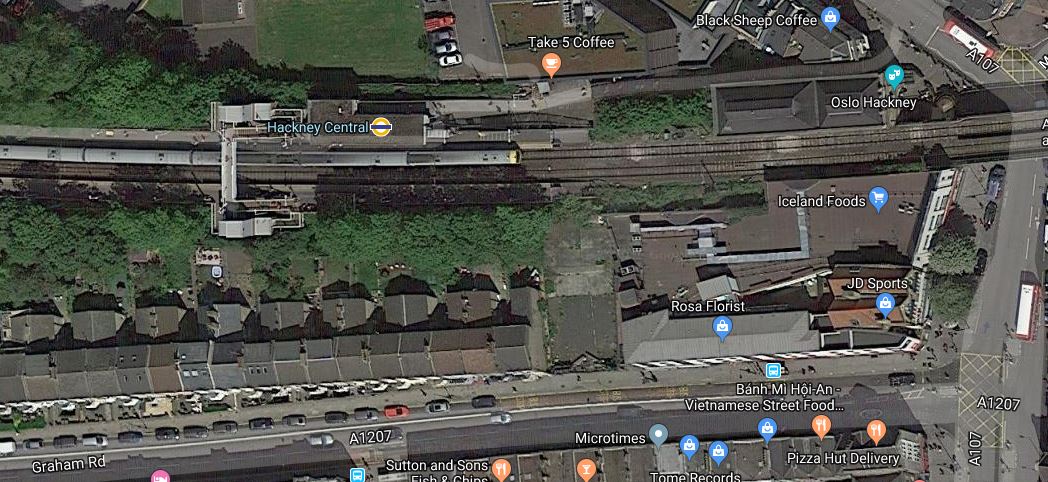
Graham Road runs across the bottom of the map and there is a gap in the houses on the North side, that leads up to the railway.
I took these pictures as I walked from West to East along Graham Road.

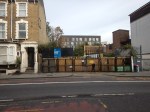

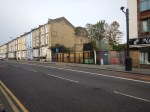
Notice the sign on the site, which says Development Site Sold.
The Ian Visits article says this about development of the second entrance.
Hackney council and TfL have agreed in principle to contribute to the scheme and work together with Network Rail on the project. Initial feasibility work has started and ground investigations are expected to begin in October. Depending on feasibility work and funding arrangements, construction of the second entrance may start next year.
Doubtless the new entrance will be funded by the usual over site development, but it is on the end of a row of residential houses, so a block of flats would not be overly out of place here.
Ian also states that the land is owned by Hackney Council.
Could it be that we’re looking at a plan being put together, by a property developer bearing in mind, the wishes of Hackney Council?
- The Council have sold the land with conditions on development.
- There would be an appropriately-sized block of apartments.
- Some would be affordable.
- The block would contain an entrance to the station.
It would certainly be a well-located housing development.
- It would have a convenience entrance to the station, with trains every few minutes to the North, South, East and West.
- There are three frequent bus services on Graham Road.
- Walk to the North and you are in Hackney’s main shopping area.
- Walk to the South and you come to the Hackney Cultural Quarter that comprises the Town Hall, Library, the Hackney Empire theatre and the cinema.
I doubt there would be much if any car parking in the block and it will be difficult locally.
What Would The Station Entrance Do For Rail Passengers?
Obviously, it would help those who lived by the entrance, but it would also help other groups.
Passengers From The Cultural Quarter Going West
Currently, if you’re going from say the Town Hall to perhaps Highbury & Islington for the Victoria Line of Hampstead Heath for a constitutional, you have to walk under the railway, enter the station on the Stratford-bound platform and then use the footbridge to cross the tracks.
Wjen the second entrance opens, you would use it to go direct to the Westbound platform.
Passengers Arriving From Stratford Wanting To Catch A Bus To The West
I regularly come home from Stratford, after shopping in the big Marks & Spencer in Eastfield.
It is a tricky journey, as whatever way you take, there seems to be steps at some point.
When the second entrance opens, I will use it to catch one of the frequent 38 buses stopping outside the station to get home.
I don’t think, I will be the only person using this route..
Passengers Of Reduced Mobility And Those With Baggage, Bikes And Buggies
A Second Entrance on Graham Road would certainly make it easier for any of these groups of passengers.
Increased Services On The North London Line
Services on the North London Line are currently si-eight trains per hour (tph) and this frequency wil surely increase to reduce overcrowding.
There will be more passengers wanting to use train services at Hackney Central, making an additional entrance more necessary.
Conclusion
A Second Entrance to Hackney Central station on Graham Road would be a valuable additio to the increasingly busy Hackney Central/Hackney Downs station complex.
The Batteries For Bombardier Electrostars
This article on the Railway Gazette is entitle Bombardier And Leclanché Sign Battery Traction MoU.
This is the second paragraph.
According to Bombardier, Leclanché will deliver ‘imminently’ its first performance demonstrator battery systems, after which it will be in line to supply traction equipment worth in excess of €100m for use in more than 10 rolling stock projects.
In Stadler’s New Tri-Mode Class 93 Locomotive, I investigated who was providing two large suitcase-sized batteries for Stadler’s new Class 93 locomotive.
In the related post, I said this about the batteries in the Class 93 locomotive, which I describe as a hybrid locomotive.
The Class 93 Locomotive Is Described As A Hybrid Locomotive
Much of the article is an interview with Karl Watts, who is Chief Executive Officer of Rail Operations (UK) Ltd, who have ordered ten Class 93 locomotives. He says this.
However, the Swiss manufacturer offered a solution involving involving an uprated diesel alternator set plus Lithium Titanate Oxide (LTO) batteries.
Other information on the batteries includes.
- The batteries are used in regenerative braking.
- Batteries can be charged by the alternator or the pantoraph.
- Each locomotive has two batteries slightly bigger than a large suitcase.
Nothing is said about the capacity of the batteries, but each could be say 200 litres in size.
I have looked up manufacturers of lithium-titanate batteries and there is a Swiss manufacturer of the batteries called Leclanche, which has this data sheet, that describes a LT30 Power cell 30Ah.
- This small cell is 285 mm x 178.5 mm x 12 mm.
- It has a storage capacity of 65 Wh
- It has an expedited lifetime of greater than 15,000 cycles.
- It has an energy density of 60 Wh/Kg or 135 Wh/litre
These cells can be built up into much larger batteries.
- A large suitcase is 150 litres and this volume would hold 20 kWh and weigh 333 Kg.
- A battery of 300 litres would hold 40 kWh. Is this a large Swiss suitcase?
- A box 2.5 metres x 1 metre x 0.3 metres underneath a train would hold 100 kWh and weigh 1.7 tonnes
These batteries with their fast charge and discharge are almost like supercapacitors.
, It would appear that, if the large suitcase batteries are used the Class 93 locomotive will have an energy storage capacity of 80 kWh.
I wonder how many of these batteries can be placed under a Bombardier Eectrostar.
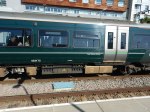
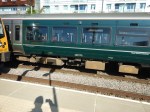
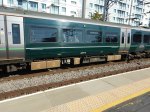
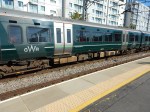
It looks rather cramped under there, but I’m sure Bombardier have the detailed drawings and some ideas for a bit of a shuffle about. For comparison, this is a selection of pictures of the underneath of the driver car of the new Class 710 trains, which are Aventras.

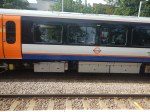
It looks like Bombardier have done a big tidy-up in changing from Electrostars to Aventras.
In Battery Electrostars And The Uckfield Branch, I came to the conclusion that Class 387 trains were the most likely trains to be converted for battery operation.
I also developed Excel spreadsheets that model the operation of battery trains on the Uckfield Branch and the Marshlink Line.
Feel free to download and examine.
Size Of Batteries Needed
My calculations in the two spreadsheets are based on the train needing 3 kWh per vehicle-mile to cruise between stations.
To handle the Uckfield Branch, it appears that 290.3 kWh is needed to go South and 310.3 kWh to go North.
I said this earlier.
A box 2.5 metres x 1 metre x 0.3 metres underneath a train would hold 100 kWh and weigh 1.7 tonnes.
So could we put some of these batteries under the train?
The Effect Of More Efficient Trains
My calculations are based on the train needing 3 kWh per vehicle-mile, but what if the trains are more efficient and use less power?
- 3 – 290.3 – 310.3
- 2.5 – 242.6 – 262.6
- 2 – 194.9 – 214.9
- 1.5 – 147.2 – 167.2
- 1 – 99.4 – 119.4
Note.
- The first figure is Southbound and the second figure is Northbound.
- More power is needed Northbound, as the train has to be accelerated out of Uckfield station on battery power.
The figures clearly show that the more efficient the train, the less battery capacity is needed.
I shall also provide figures for Ashford and Ore.
- 3 – 288
- 2.5 – 239.2
- 2 – 190.4
- 1.5 – 141.5
- 1 – 92.7
Note that Westbound and Eastbound energy needs are the same, as both ends are electrified.
I obviously don’t know Bombardier’s plans, but if the train’s energy consumption could be reduced to around 2 kWh per vehicle-mile, a 250 kWh battery on the train would provide enough energy storage for both routes.
Could this be provided by two of Leclanche’s batteries designed to fit a space under the train?
These would be designed to provide perhaps 250 kWh.
What Would Be The Ultimate Range Of A Class 387 Train On Battery Power?
Suppose you have a four-car Class 387 train with 25 kWh of battery power that leaves an electrified station at 60 mph with a full battery.
How far would it go before it came to a lifeless stop?
The battery energy would be 250 kWh.
There would be 20 kWh of kinetic energy in the train.
Ranges with various average energy consumption in kWh per vehicle-mile are as follows.
- 3 – 22.5 miles
- 2.5 – 27 miles
- 2 – 34 miles
- 1.5 – 45 miles
- 1 – 67.5 miles
Obviously, terrain, other traffic and the quality of the driving will effect the energy consumption.
But I do believe that a well-designed battery-electric train could easily handle a fifty mile electrification gap.
What Would Be The Rescue Range On One Battery?
One of the main reasons for putting batteries on an electrical multiple unit is to move the train to a safe place for passenger evacuation if the electrification should fail.
This week, there have been two electrification failures in London along, one of which was caused by a failing tree in the bad weather.
I’ll assume the following.
- The train is a Class 387 train with one 125 kWh battery.
- The battery is ninety percent charged.
- The train will be moved at 40 mph, which has a kinetic energy around 9 kWh.
- The energy consumption of the train is 3 kWh per vehicle-mile.
The train will use 9 kWh to accelerate the train to line speed, leaving 116 kWh to move the train away from the problem.
With the energy consumption of 3 kWh per vehicle-mile, this would be a very useful 9.5 miles.
Regenerative Braking To Battery On Existing Trains
This has been talked about for the Class 378 trains on the London Overground.
Regenerative braking to batteries on the train, should cut energy use and would the battery help in train recovery from the Thames Tunnel?
What About Aventras?
Comparing the aerodynamics of an Electrostar like a Class 387 train with an Aventra like a Class 710 train, is like comparing a Transit van with a modern streamlined car.
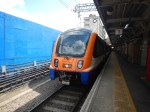
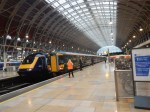
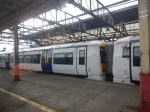
Look at these pictures some of which are full frontal.
It should be noted that in one picture a Class 387 train is shown next to an InterCity 125. Did train designers forget the lessons learned by Terry Miller and his team at Derby.
I wonder how much electricity would be needed to power an Aventra with batteries on the Uckfield branch?
These are various parameters about a Class 387 train.
- Empty Weight – 174.81 tonnes
- Passengers – 283
- Full Weight – 2003 tonnes
- Kinetic Energy at 60 mph – 20.0 kWh
And these are for a Class 710 train.
- Empty Weight – 157.8 tonnes
- Passengers – 700
- Full Weight – 220.8 tonnes
- Kinetic Energy at 60 mph – 22.1 kWh
Note.
- The Aventra is twenty-seven tonnes lighter. But it doesn’t have a toilet and it does have simpler seating with no tables.
- The passenger weight is very significant.
- The full Aventra is heavier, due to the large number of passengers.
- There is very little difference in kinetic energy at a speed of 60 mph.
I have played with the model for some time and the most important factor in determining battery size is the energy consumption in terms of kWh per vehicle-mile. Important factors would include.
- The aerodynamics of the nose of the train.
- The turbulence generated by all the gubbins underneath the train and on the roof.
- The energy requirements for train equipment like air-conditioing, lighting and doors.
- The efficiency of the regenerative braking.
As an example of the improvement included in Aventras look at this picture of the roof of a Class 710 train.
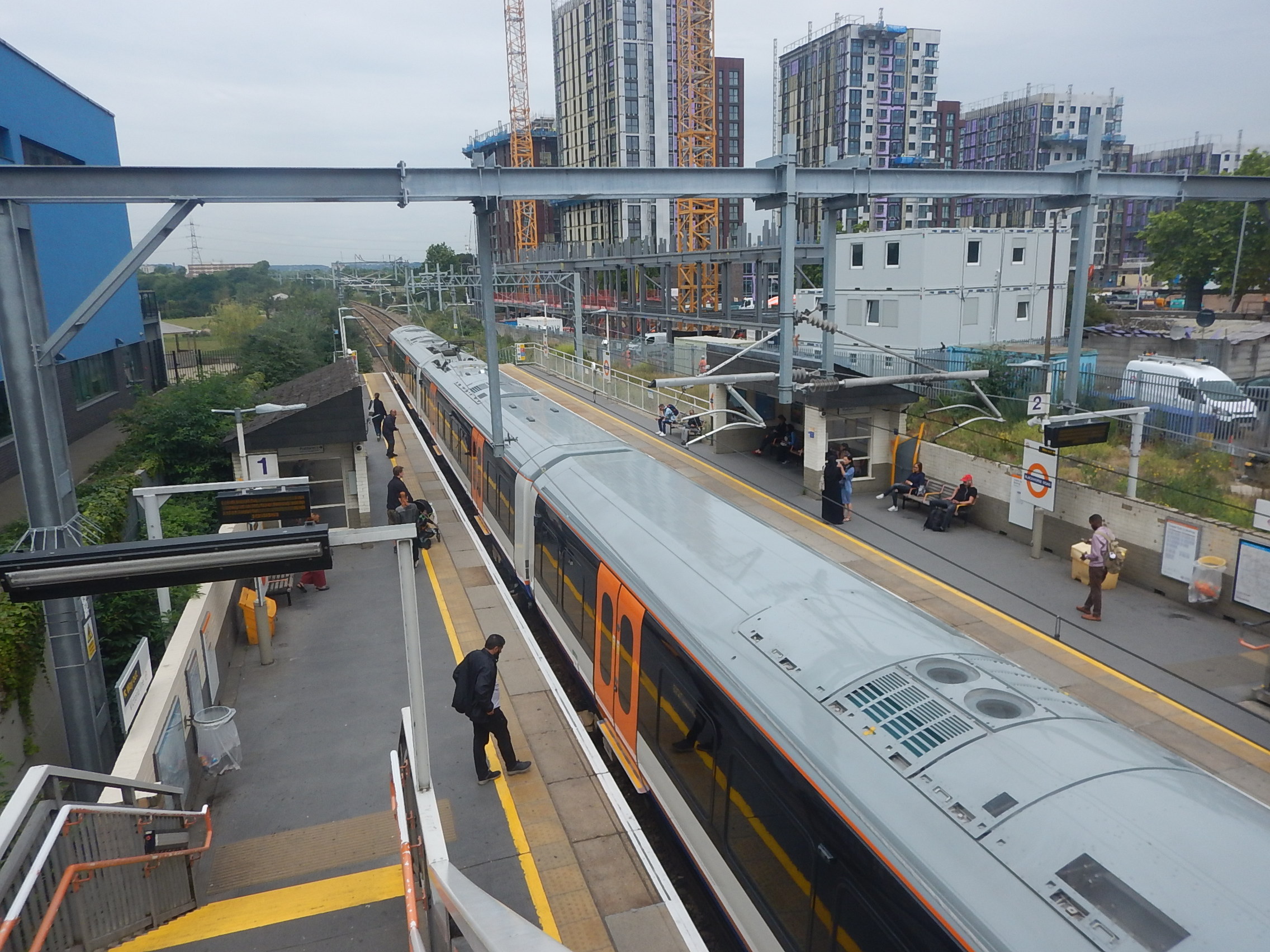
This feature probably can’t be retrofitted, but I suspect many ideas from the Aventra can be applied to Electrostars to reduce their energy consumption.
I wouldn’t be surprised to see Bombardier push the energy consumption of an Electrostar with batteries towards the lower levels that must be possible with Aventras.
Cummins And Hyundai To Collaborate For Fuel Cell Technology
The title of this post is the same as that of this article on Yahoo.
This collaboration between two big beasts could be good for both companies.
But it is just another sign, that those involved in heavy transport like Rolls Royce MTU are planning for a zero-carbon future.
Many pf these companies are finally responding.
Battery Electrostars And The Uckfield Branch
In Rounding Up The Class 170 Trains, I said this, which is based on a quote from an article in the October 2019 Edition of Modern Railways.
Are Battery Electrostars On The Way?
The article finishes with this paragraph about the Class 171 trains, that will come from Govia Thameslink Railway (GTR) and be converted back to Class 170 trains.
GTR currently uses the ‘171s’ on the non-electrified Marshlink and Uckfield lines, and the release of these sets to EMR is contingent on their replacement with converted Electrostar EMUs with bi-mode battery capability, removing these diesel islands of operation from the otherwise all-electric GTR fleet.
So are these battery Electrostars finally on their way?
The article got several comments, which said that some five-car Electrostars were to be converted and they would probably be Class 376 trains, that would be used.
The comments also said that Network Rail were working on using short lengths of third-rail to charge the train batteries.
That sounds like Vivarail’s system to me, that I wrote about in Vivarail Unveils Fast Charging System For Class 230 Battery Trains.
Southern’s Current Diesel Fleet
I will start by looking at Southern’s current diesel fleet that works London Bridge and Uckfield stations and the Marshlink Line.
Currently, Southern has a diesel fleet of Class 171 trains.
- 12 x two-car trains
- 8 x four-car trains.
According to Modern Railways, the following trains will transfer to EMR Regional in September 2021.
- 10 x two car
- 6 x three-car, which will be created by moving a few cars in the four-car trains.
It looks as if after the transfer Southern will be left with eight driver-cars and ten intermediate cars.
This would give them four four-car trains and two spare intermediate cars. I’m sure that someone will have a need for the intermediate cars to lengthen a two-car Class 170 train because of capacity issues.
The Marshlink Line Service
The service on the Marshlink Line is an hourly service between Ashford International and Eastbourne stations.
- It is run by Class 171 diesel trains.
- Trains were four-cars most times I’ve used it.
- Journey times are around one hour and twenty-minutes.
- A round trip takes three hours.
- It would appear that three four-car trains are needed to run the service.
So if there is a spare train, four trains would be ideal, After all the transfers, this is the remaining number of Class 171 trains, that would be left with Southern.
If they wanyted to get rid of the diesel trains, then they could replace the trains on the Marshlink Line with four four-car battery bi-mode Electrostars!
Network Rail’s Plan For The Uckfield Branch
This document on the Network Rail web site from 2016, is entitled Delivering A Better Railway
For A Better Britain – Route Specifications 2016 – South East.
In the document, this is said about the the route between Hurst Green and Uckfield.
The key issue presently is overcrowding on the shorter length services that operate on the route during and close to the peak hours. As the route is operated by Class 171 diesel units, there is only a small fleet available to the TOC to deploy on the route. As a result some peak and shoulder peak services are not able to operate at the maximum length the route is capable of (8-car).
Electrification schemes in the North West will displace rolling stock to strengthen existing peak services to 8-car and eventually of 10-car operation during CP5, so associated platform lengthening is currently being developed, this will also be compatible with 12-car 20m vehicle trains.
Electrification is still an aspiration for this route or use of battery-powered trains (currently under development) if they are deemed successful.
Signalling is controlled by Oxted Signal Box but during CP5 this will be transferred to Three Bridges ROC.
The key point is that the platforms have been lengthened for 240-metre long trains, which will also allow ten-car Class 171 trains, which have 23 metre vehicles.
The Uckfield Branch Service
The service on the Uckfield Branch is an hourly service between London Bridge and Uckfield stations.
- It is currently run by Class 171 diesel trains.
- The platforms on the route can accept ten-car trains with 23 m vehicles or twelve-car trains with 20 metre vehicles.
- A round trip takes three hours.
- It would appear that three ten- or twelve-car trains are needed to run the service.
So if we add in a spare and perhaps an extra train for the rush hour, it would appear that around half-a-dozen ten- or twelve-car battery bi-mode trains will be needed for the service.
- As a ten-car train would be two five-car trains, twelve five-car trains would be needed.
- As a twelve-car train would be three four-car trains, eighteen four-car trains would be needed.
Interestingly, Southern have three trains that could be candidates for conversion to battery bi-modes in their fleet.
- One hundred and fifty-two four-car Class 377 trains.
- Thirty-four five car Class 377 trains.
- Twenty-nine four-car Class 387 trains.
All trains were built for longer commuter journeys,
Which Electrostars Will Be Converted To Battery Operation For The Uckfield Service?
Obviously, the trains must be four- or five-cars and suitable for conversion to battery bi-mode trains, but I feel they must have other features.
- Toilets
- First Class seats.
- Plenty of tables.
- Wi-fi and plug sockets.
- Comfortable interiors.
- End gangways, to ensure staff and passengers can move around the train if required.
I’ll now look at the various fleets of Electrostars.
Class 357 Trains
The Class 357 trains can probably be discounted, as I suspect c2c need them and they are not third rail.
Class 375 Trains
The Class 375 trains can probably be discounted, as I suspect Southeastern need them.
But if the new Southeastern franchise should decide on a complete fleet replacement, as the trains are dual-voltage, they might be very useful if fitted with a battery capability.
Class 376 Trains
The Class 376 trains can probably be discounted, as I suspect Southeastern need them.
The trains are also third-rail only and lack toilets, so would probably need a rebuilt interior.
Class 377 Trains
The Class 377 trains are a possibility as Soiuthern has a large fleet of both four- and five-car trains.
But they would be losing the Class 171 trains, so would probably need to bring in some new trains to have a large enough fleet.
Class 378 Trains
The Class 378 trains can probably be discounted, as London Overground need them.
Class 379 Trains
The Class 379 trains are surely a possibility, as Greater Anglia will be releasing them before the end of 2020.
Consider.
- There have no new home to go to.
- I am suspicious that that NXEA overpaid for these trains and Macquarie are sitting on a very good deal, that will cost Grester Anglia a lot to cancel!
- They appeared to me to be a shoe-in for Corby services, so perhaps they lost out to the Class 360 trains on cost.
- They are only 100 mph trains, whereas others are 110 mph trains.
- They would need to be fitted with third-rail shoes.
- The trains are coming up to nine years old and probably need a refresh.
- They have an interior aimed at airport passengers.
If I was Macquarie, I’d convert these into go-anywhere battery bi-modes for use in small fleets by operators.
But, Porterbrook’s battery-bi-mode conversion of a Class 350 train may be available at a lower price.
Class 387 Trains
The Class 387 trains are surely a serious possibility, for the following reasons.
- Govia already has fifty-six of these trains on lease and in service.
- c2c has six trains, that could come off lease in 2021.
- The trains are dual voltage
- The trains are 110 mph trains.
- They can run as twelve-car walk-through trains.
- Many of the trains are leased from Porterbrook.
I’ve felt for some time, that these trains would make excellent battery bi-modes.
But they are a good fit for Southern, as surely one could be scrounged from their Great Northern fleet to create a prototype for test.
I would feel that having the required number of trains for the Uckfield Branch can be achieved by September 2021, when the Class 171 trains will be sent to the Midlands.
There is also a backstop, in that there are nineteen Class 365 trains in store, which were replaced by Class 387 trains on Great Northern services. If there is a shortage of Class 387 trains during the conversion, surely some of these Class 365 trains could stand in, just as they did successfully in Scotland recently.
My Choice
I would convert Class 387 trains.
- There are quite a few Class 387 trains, that could be converted.
- Southern already have fifty-six Class 387 trains.
- There are enough to convert eighteen for Uckfield and four for the Marshlink
- It could be possible to deliver the full fleet before the Class 171 trains leave.
- If during conversion of the trains, they are short of stock, Southern can hire in some Class 365 trains.
It looks to be a low-risk project.
It will also have collateral benefits.
- The hourly London Bridge and Uckfield service will be raised to maximum capacity without any new infrastructure, except the trains and a number of battery chargers.
- Diesel will be eliminated in London Bridge station making the station electric trains only.
- Diesel will be eliminated between London Bridge and Uckfield stations.
- Efficient regenerative braking to battery would be available on the complete route.
- A ten-car diesel service between East Croydon and London Bridge will be replaced by a twelve-car electric service. stations.
In addition, if the diesel trains on the Marshlink Line were to be replaced by battery bi-modes, Southern would be a diesel-free franchise.
What About New Trains?
It’s all about the money and whether the new trains could be delivered in time.
I would suspect that Bombardier, CAF, Stadler and others are making competitive proposals to Southern, but would they be more affordable and timely, than a conversion of Class 387 trains?
But could they be as competitive if Bombadier and Porterbrook co-operated to convert some of Porterbrook’s Class 387 trains, that are already leased to Great Northern?
You don’t usually move house if you need a new boiler, you replace the boiler!
What About Hydrogen Trains?
The Alstom Breeze based on a Class 321 train is scheduled to first come into service in 2022. This is too late, as the Class 171 trains are scheduled to leave in September 2021.
Hydrogen trains would need a hydrogen filling station.
Kinetic Energy Of Class 387 Trains
I will calculate the kinetic energy of a four-car Class 387 train.
I will assume the following.
- Empty train weight – 174.81 tonnes – Read from the side of the train.
- Seats – 223
- Standees – 60 – Estimated from the seats/standing ratio of a Class 720 train.
- Total passengers – 283
- Each passenger weighs 90 Kg, with baggage, bikes and buggies.
- This gives a passenger weight of 25.47 tonnes and a train weight of 200.28 tonnes
Using Omni’s Kinetic Energy calculator, gives the following kinetic energies.
- 40 mph – 8.89 kWh
- 50 mph – 13.9 kWh
- 60 mph – 20.0 kWh
- 70 mph – 27.2 kWh
- 80 mph – 35.6 kWh
- 90 mph – 45.0 kWh
- 100 mph – 55.6 kWh
- 110 mph – 67.3 kWh
These figures are for a full train, but even so many will think they are low, when you think that 60 kWh batteries are used in hybrid buses.
A Trip To Uckfield
I took a trip to Uckfield today and these are my observations.
- The maximum operating speed of the train was no more than 70 mph.
- For much of the journey the train trundled along at around 40-50 mph.
- The route is reasonably flat with only gentle gradients.
- I hardly noticed the diesel engine under the floor of my car.
- Obviously in the Peak, the engines will have to work harder.
It was a very good demonstration of five Turbostars working in unison.
I can understand why East Midlands Railway are using Class 170 trains, as their standard train for EMR Regional.
Modelling the Route
I have built a mathematical model of the route between Hurst Green and Uckfield using Excel.
Input parameters are.
- Cruise Energy Consumption in kWh per vehicle mile. I assumed 3 kWh per vehicle mile
- Cruise Kinetic Energy in kWh. I assumed a 70 mph cruise and used 20 kWh
- Regeneration Energy Loss as a ratio. I assumed 0.15.
These parameters showed that a battery of between 290 kWh and 350 kWh would be needed, that was full at Hurst Green and was recharged at Uckfield.
Note that Vivarail are talking about putting 424 kWh under a three-car Class 230 train.
This page on the Vivarail web site is entitled Battery Train Update.
This is a paragraph.
Battery trains are not new but battery technology is – and Vivarail is leading the way in new and innovative ways to bring them into service. 230002 has a total of 4 battery rafts each with a capacity of 106 kWh and requires an 8 minute charge at each end of the journey. With a 10 minute charge this range is extended to 50 miles and battery technology is developing all the time so these distances will increase.
So it looks like Vivarail manage to put 212 kWh under each car of their two-car train.
I don’t think putting 350 kWh of batteries under a four-car Class 387 train would be impossible.
I have also created an Excel model for the second route between Ashford and Ore stations.
This shows that a battery of about 300 kWh on the train should cover the route.
It might appear strange that the longer Marshlink route needs a smaller battery, but this is because it leaves both ends of the route with a full battery.
These two links give access to the two Excel models that I have used. Feel free to access and criticise them.
It does appear, that on both these routes, if a train starts with full batteries, the energy in the battery is reduced in these ways as it travels along the route.
- There is an energy use to power the train along the line which is proportional to the vehicle-miles.
- Energy is needed to accelerate the train to line speed after each stop.
- Energy is needed to operate stop-related functions like opening and closing the doors.
But there will also be energy recovered from regenerative braking from line speed, although this won’t cover the subsequent acceleration.
I suspect with better understanding and better data, Bombardier can create a simple formula for battery size needed based on the following.
- The length of the route.
- The number of stations.
- The line speed
- The gradient and speed profile of the route
- The kinetic energy of the train at various loadings and speeds
- The amount of energy needed for each vehicle mile
- The efficiency of the regenerative braking
It is not the most difficult of calculations and I was doing lots of them in the 1960s and early 1970s.
Charging The Train At Uckfield
This picture shows the long platform at Uckfield station.

The platform has been built to accept a twelve-car electric train and if traditional third rail electrification were to be installed, this could be used to charge the batteries.
I would use a Vivarail-style system, which I described fully in Vivarail Unveils Fast Charging System For Class 230 Battery Trains.
As trains take a few minutes at Uckfield to turnback, I’m sure enough time can be arranged in the timetable to charge the batteries with enough power to get back to the electrification at Hurst Green.
The train would switch the charging system on and off by automatically connecting and disconnecting.
Thalys-Eurostar Merger Planned Under Green Speed Initiative
The title of this post is the same as that of this article on Railway Gazette.
This is the first paragraph.
SNCF, SNCB and the Patina Rail investment vehicle announced on September 27 their intention to combine the Eurostar and Thalys high speed rail operations, reporting that outline proposals were being presented to their respective boards.
Eurostar runs or has ambition to run these services.
- London and Paris Nord via Calais and Lille
- London and Marne-la-Vallée–Chessy
- London and Bordeaux via Marne-la-Vallée–Chessy and Tours
- London and Amsterdam via Calais, Lille, Brussels, Antwerp, Ritterdam and Schipol Airport
- London and Frankfurt via Calais, Lille, Brussels, Liege, Aachen and Cologne.
- In Winter services run to skiing resorts.
- In Summer services run to the sun.
Thalys runs these services.
- Paris Nord and Amsterdam via Brussels, Antwerp, Ritterdam and Schipol Airport
- Paris Nord and Cologne via Brussels, Liege and Aachen.
- Marne-la-Vallée–Chessy and Amsterdam via Brussels, Antwerp, Ritterdam and Schipol Airport
- In Winter services run to skiing resorts.
- In Summer services run to the sun.
Eurostar and Thalys seem to have a good fit of routes.
- Both have two Northern terminals; Amsterdam and Cologne or Frankfurt.
- Both serve Schipol Airport
- Both serve Brussels Midi, which is in the city centre.
- Both serve Paris Nord, which is a large well-connected station just to the North of the city centre.
- Both serve Marne-la-Vallée–Chessy, which is in Disneyland Paris, has a connect to Charles de Gaulle airport and is a major hub for French TGV services.
- Both have winter and summer holiday services.
You could almost consider the combined networks to be the following.
- A high-frequency Paris and Brussels service.
- Northern branches to Amsterdam and Cologne or Frankfurt.
- A branch to London via Lille, Calais and the Channel Tunnel.
- A Southern branch to Marne-la-Vallée–Chessy for Disneyland Paris, Charles de Gaulle airport and onward travel to much of France.
It’s all very simple really and as they say Simple is Efficient.
A few thoughts.
London And Amsterdam Services
As an example, suppose you are going from London to Amsterdam at the present time..
- There are three direct services taking around four hours.
- There are four services with a change at Brusseks Midi to Thalys taking ten minutes short of five hours.
You could catch a direct train, but sometimes, you might have to change at Brussels Midi.
There is no problem with immigration control, as that has been done in London.
Going from Amsterdam to London, services are as follows.
- There seems to be eight daily services, taking ten minutes short of five hours.
- They also seem to be very heavily booked.
There is no problem with immigration control, as that is done in a forty-five minute stopover in Brussels.
Experienced travellers, and some following a more relaxed schedule, might appreciate the stopover in Brussels, but most travellers would prefer a direct service through Brussels.
I suspect too that Eurostar or the future joint operator would prefer direct services.
- It would increase capacity between Brussels and Amsterdam via Antwerp, Rotterdam and Schipol Airport.
- It would increase domestic capacity.
- The organisation of the trains and onboard staff would surely be easier.
The only problem, is doing the immigration control on the journey to London.
Solutions have been suggested, where Amsterdam and London services are two half trains; one for domestic passengers and one for those going to London, but I’m sure there is a solution out there.
London And Cologne Or Frankfurt Services
The same rules will apply.
Going out will be easy, but coming back will probably need a change of train at Brussels.
Was There A German Solution?
Some years ago, I remember reading that Deurche Bahn were intending to run services from Amsterdam and Cologne to London, where the two trains divided and combined at Brussels.
Using current Thalys and Eurostar times and assuming a fifteen minute stop at Brussels, would probably have meant these times.
- London to Amsterdam – four hours and thirty minutes.
- London to Cologne – four hours and twenty minutes.
- London to Frankfurt- five hours and forty minutes.
Note.
- Amsterdam and Cologne services are fairly similar times, which must improve the utilisation of the trains.
- Like Amsterdam, the station in Cologne is in the heart of the historic city.
- You can get a train to virtually anywhere in Germany from Cologne. But note that Berlin will be a six-hour journey.
As the London to Amsterdam service has been successful, I’m sure London to Cologne would attract passengers.
Were the Germans going to organise Amsterdam and Cologne services, like this?
- Each service could be a double-train, which could be joined and split quickly, as some operators do.
- This train would meet all the Channel Tunnel regulations.
- Going out from London, the double-train would arrive in Brussels and split with one train going to Amsterdam and the other to Cologne.
- Going into London,, the two trains would join at Brussels and be just another Brussels to London service.
But as with the Amsterdam service, the major problem is immigration control.
There is also the problem of utilising the spare capacity North of Brussels for inbound services to London, which could increase the cash-flow generated by the services.
Or were the Germans thinking in a more innovative manner?
I do wonder if using double trains from Amsterdam and Cologne, with one train for London and the other for Paris or Marne-la-Vallée–Chessy could have been in the German’s minds.
With some creative joining amd splitting in a long platform at Brussels Midi, could it be made to work?
If Eurostar and Thalys were two parts of the same operator, I suspect that it is more likely that a service pattern will be found, that delivers the following.
- More direct services between London and Amsterdam and Cologne.
- Extra capacity between Amsterdam and Cologne and Paris and Marne-la-Vallée–Chessy.
- More efficient utilisation of trains and oboard staff.
It would surely attract more passengers.
Brussels Midi
Brussels Midi station can be considered to be a prototype for the ideal station on both the main network and the London branch.
It will have to do the following.
- Handle through services between Landon and Amsterdam and London and Cologne or Frankfurt.
- Terminate some services between London and Brussels.
- Allow local passengers to use through services to and from London to access other stations on the route.
- Handle through services between Paris or Marne-la-Vallée–Chessy and Amsterdam and Paris or Marne-la-Vallée–Chessy and Cologne or Frankfurt.
- Allow Passengers to and from London to use the other services.
- Handle immigration for passengers to and from London.
- Allow a passenger from London to connect to any onward services at the station.
- Allow a passenger to London to arrive on any train and after checking through immigration catch the train to London.
- The station has full UK Border Control.
It’s complicated, but I suspect that it’s more of an architectural and train design problem than anything else.
Marne-la-Vallée–Chessy
If Brussels Midi can be made to work efficiently, the same thing can be organised at Marne-la-Vallée–Chessy.
- It is very close to Disneyland Paris.
- It has good connection to Charles-de-Gaulle Airport
- There are ten TGV services to other parts of France.
- There are two Oiugo low cost high-speed services to other parts of France.
- There are also some international services.
- The station has full UK Border Control.
Could the plan be to develop this hub close to the airport, with train services to destinations in Belgium, Germany, Italy, Luxembourg, Spain, Switzerland, The Netherlands and the United Kingdom?
London To Marne-la-Vallée–Chessy
Eurostar already has direct services between London and Marne-la-Vallée–Chessy.
- Some services going to destinations further South use this route.
- London to Marne-la-Vallée–Chessy takes two hours forty-nine minutes.
Will the proposed London and Bordeaux service stop at Marne-la-Vallée–Chessy?
- This would give Marne-la-Vallée–Chessy, will all its connections and attractions another service.
- If the service stopped at Lille Europe, this would double the High Speed service between Lille and Bordeaux.
Could it be that the London and Bordeaux service will also improve internal French High Speed services?
If SNCF control Eurostar, Thalys and the French TGVs, this must give scope for the services to compliment each other and run economically.
The UK Immigration Control Problem
I can see UK Immigration Control being centred on the following stations.
- Brussels Midi
- Lille Europe
- Marne-la-Vallée–Chessy
- Paris Nord
These would work as they do now.
Outbound services are not a problem, as it is all handled in London. I have travelled from London to Amsterdam a couple of times and notice how seats vacated in Brussels are used by other passengers between Brussels and The Netherlands.
I believe that it would be possible to develop an efficient system to handle incoming passengers to the UK.
Consider the following.
- Passengers to and from the UK could be asked for passport details when checking in on-line.
- Passengers for the UK would use an automatic passport gate, as is common at airports and on Eurostar.
- Passengers for the UK would sit in a separate part of the train, isolated from the domestic passengers, except in an emergency.
- If a train stopped at say Marne-la-Vallée–Chessy and Lille Europe, UK Border Force could check passengers on the train between these two stations.
These and other ideas can surely be developed.into a system that would satisfy the most xenophobic of polticians and their supporters.
Conclusion
This proposed merger could be good for High Speed rail in Europe and the UK.
The French government also hopes it could be good for France.
TfL Confirms Details Of Reading Services
The title of this post is the same as that of this article on Railway Gazette.
This is first paragraph.
Details of the transfer of London Paddington – Reading stopping services from Great Western Railway to TfL Rail from the December 15 timetable change have been confirmed by Transport for London.
Some significant points to note from the article.
- The service will be run by Class 345 trains.
- Fast services from Reading and some stations to the East will continue to be run by Great Western Railway.
- There will be four trains per hour (tph) in the Peak and two tph in the Off Peak.
- After the New Year Bank Holiday, contactless payments will be available between Paddington and Reading.
- Children under 11 who are accompanied by an adult, as well as people who are eligible for the Freedom Pass, will be able to travel for free to Reading on the TfL service.
- Oyster will not be available to the West of West Drayton.
- Great Western Railway , but not South Western Railway, are expected to bring in contactless ticketing in the New Year.
A few of my thoughts.
What Will Be The Service Pattern?
When the possibility of TfL Rail taking over the services to Reading, I wrote Will Crossrail Open To Reading in 2019?.
The service pattern to Maidenhead to Reading appears to be.
Reading To Paddington – Limited Stop
This service will be run at two trains per hour (tph) in the Peak with no trains in the Off-Peak.
Stops are Twyford, Maidenhead, Slough, West Drayton and Ealing Broadway.
Reading To Paddington – All Stations
This service will be run at two tph all day.
The service will call at all stations except Hanwell and Acton Main Line.
Maidenhead To Paddington
This service will be run at two tph all day.
The service will call at all stations except Hanwell and Acton Main Line.
A Summary Of Peak/Off Peak Calls
Adding these services up, gives the following numbers for Peak and Off Peak calls in trains per hour (tph)
- Reading – 4,2
- Twyford – 4,2
- Maidenhead – 6,4
- Taplow – 4.4
- Burnham 4,4
- Slough – 6,4
- Langley – 4,4
- Iver – 4,4
- West Drayton – 6,4
- Hayes & Harlington – 4.4
- Southall – 4,4
- Hanwell – None to Reading/Maidenhead
- West Ealing – 4.4
- Ealing Broadway – 6,4
- Acton Main Line – None to Reading/Maidenhead
- Paddington – 6,4
Note.
- 4,2 means 4 tph in the Peak and 2 tph in the Off Peak.
- It would appear that all stations except Reading and Twyford have at least four tph all day.
- Stations between Hayes & Harlington and Ealing Broadway will get another six tph all day going to Heathrow.
- Acton Main Line station will get another four tph all day going to Heathrow.
The frequency of trains would appear to satisfy Transport for London’s Turn-Up-And-Go frequency for Metro services.
No one should wait more than fifteen minutes on a Metro for a train!
Freedom Pass Holders Will Be Winners
Being able to use a Freedom Pass between Paddington and Reading will be very useful for many travellers.
It would appear that the cheapest way to use the trains West of Reading for a Freedom Pass Holder, will be to use the pass to get to Reading on TfL Rail and then buy a ticket from Reading to your ultimate destination.
Note that on the Overground, you can buy a ticket between any two UK stations. So if I was going to Bristol, I’d buy a Return at my local Dalston Junction station and use it from Reading, after going there on TfL Rail.
Very covenient and with the best price!
Full Steam Ahead For Eric Parry’s Crossrail Scheme
The title of this post, is the same as that of this article on Building Design.
These points are made in the introduction.
- Plans for a nine-storey Eric Parry scheme above a Crossrail station in the City of London have taken a significant step forward.
- Transport for London inked a deal with Aviva for the overstation development at Liverpool Street station.
- It is one of 12 developments TfL is planning above and around Crossrail sites.
It illustrates how Crossrail is leading to a vast amount of development along the route.
How many cities in the UK and around the world, could benefit from their own cross-city rail line?
Aberdeen, Birmingham, Cardiff, Edinburgh, Glasgow, Leeds, Liverpool and Newcastle have them of various standards, but in some cities getting across the city is a nightmare on public transport and people drive.
Rounding Up The Class 170 Trains
In an article in the October 2019 Edition of Modern Railways, which is entitled EMR Kicks Off New Era, more details are given of the trains that will be used by EMR Regional, which will operate the regional services of East Midlands Railway.
EMR Regional will obtain Class 170 trains from various sources.
- Five three-car from ScotRail
- Twenty-three two-car from West Midlands Trains
- Ten two-car and two three-car from Govia Thameslink Railway
- Four three-car from Govia Thameslink Railway
Note
- Thirty-five trains are owned by Porterbrook, with the rest owned by Eversholt.
- There is some work to do to bring them, all to the same standard.
- It looks like the fleet will end up as something like eighteen three-car trains and fourteen two-car trains.
They will be a great improvement to the trains that currently run the service.
But they could be a better improvement, if the powertrain were to be upgraded to a modern hybrid one!
Porterbrook, who own the largest proportion of these Class 170 trains, are converting some to hybrid drive, using an MTU Hybrid PowerPack.
I talk about the conversion in Looking At The Mathematics Of A Class 170 Train With An MTU Hybrid PowerPack.
So will some or all of these trains be converted?
Thst’s one for the engineers, the accountants and the environmentalists!
Are Battery Electrostars On The Way?
The article finishes with this paragraph about the Class 171 trains, that will come from Govia Thameslink Railway (GTR) and be converted back to Class 170 trains.
GTR currently uses the ‘171s’ on the non-electrified Marshlink and Uckfield lines, and the release of these sets to EMR is contingent on their replacement with converted Electrostar EMUs with bi-mode battery capability, removing these diesel islands of operation from the otherwise all-electric GTR fleet.
So are these battery Electrostars finally on their way?
 The Anonymous Widower