Puzzled By New Fleets For TransPennine Express
TransPennine Express (TPE) are replacing all their trains, but their choice of three different new fleets puzzles me.
The new fleets and their routes are as follows.
Nova1
This is a fleet of nineteen five-car bi-mode Class 802 trains.
According to Wikipedia, they will work the following routes, with probably a frequency of one tph
Liverpool Lime Street and Edinburgh via Newcastle, which I estimate will take 4:15 hours
Manchester Airport and Newcastle, which takes around 2:45 hours
These two services would probably need nine for the Edinburgh service and six for the Manchester Airport service.
This means that there are four extra trains.
If there is a spare or one in maintenance, that means that two trains are available to boost capacity on busy services if needed, by running a ten-car train.
I doubt that ten-car services to Manchester Airport could be run through the Castlefield Corridor due to the inadequate stations, but Liverpool and Edinburgh might be a route for longer trains.
I have some observations on Nova1.
- The trains are 125 mph trains, that can be upgraded to 140 mph with in-cab signalling.
- The trains will share the East Coast Main Line with LNER’s Azumas, which are other members of te same family of Hitachi trains.
The trains have been authorised to start running services.
Nova2
This is a fleet of twelve electric Class 397 trains.
According to Wikipedia, they will work the following routes,
- Manchester Airport and Glasgow Central, which takes around 3:30 hours.
- Manchester Airport and Edinburgh, which takes around 3:15 hours.
- New route – Liverpool Lime Street and Glasgow Central, which could take around 3:30 hours.
Currently, the two existing routes run at a frequency of one train per two hours, which would probably need at least seven trains.
This probably means that there will be four trains left for the service between Liverpool and Glasgow, if it assumed there is one train spare or in maintenance.
As a round trip between the two cities, would probably take eight hours, it looks like the frequency will be one train per two hours.
This would give the following services, all with a frequency of one train per two hours.
- Manchester Airport and Glasgow Central via Manchester Piccadilly
- Manchester Airport and Edinburgh via Manchester Piccadilly
- Liverpool Lime Street and Glasgow Central
Passengers wanting to go between Liverpool Lime Street and Edinburgh should keep reading.
I have some observations on Nova2.
- They are 125 mph trains that are replacing the 110 mph Class 350 trains.
- In the next few years, these 125 mph trains will be sharing the West Coast Main Line with faster trains like Class 390 trains and the trains of High Speed Two, both of which should be capable of 140 mph, when running using in-cab signalling.
- I would assume that the trains can be similarly upgraded, otherwise they will have to be replaced.
- There was an option for more trains, but I suspect the success of Class 802 trains on the Great Western Railway led to it not being taken up.,
The trains should come into service later this year.
Nova3
This is a fleet of five-car rakes of Mark 5A coaches, hauled by a Class 68 diesel locomotive.
There are fourteen locomotives and driving van trailers, with enough coaches for thirteen rakes.
I would suspect that TPE are aiming to have twelve trains available for service.
According to Wikipedia, they will work the following routes, which both have a frequency of one train per hour (tph)
- Liverpool Lime Street and Scarborough via Manchester Victoria, which takes around 2:45 hours.
- Manchester Airport and Middlesbrough, which takes around 2:45 hours.
So with turnround at both ends, I suspect that a six hour round trip is possible. So to provide the two hourly services across the Pennines, TPE will need six trains for each route.
This explains a fleet size of twelve operational trains.
I have two observations on Nova3.
- They are diesel-powered and will be running at times on electrified lines. But I suspect the diesel Class 68 locomotive could be replaced in the future with an electro-diesel Class 88 locomotive.
- Questions have been raised about the speed of exit and entry from the coaches through single end doors of the coaches.
- They have an operating speed of only 100 mph, but opportunities for higher speeds on the routes are limited to perhaps thirty to forty miles on the East Coast Main Line.
At least they should be in service within a couple of months.
Why Didn’t TPE Order A Unified Fleet?
To summarise TPE have ordered the following trains.
- Nova1 – Nineteen Class 802 trains
- Nova2 – Twelve Class 397 trains.
- Nova3 – Thirteen trains consisting of four coaches topped and tailed by a a Class 68 locomotive and driving van trailer.
All forty-four trains are five cars.
Surely, it would have been easier for TPE to have a fleet, where all the trains were the same.
I suspect that all routes can be run using Class 802 trains, so it as not as if there are any special requirements for the trains.
So why didn’t TPE order a fleet of Class 802 trains?
I can only think of these reasons.
- Hitachi couldn’t supply the required number of trains in the appropriate time-scale.
- ,CAF made an offer that TPE couldn’t refuse.
It should also be born in mind that Great Western Railway and Hull Trains, which like TPE are First Group companies, went down the Class 802 route.
The Future
There are various issues, that will arise in the future.
Nova2 And West Coast Main Line Operating Speed
The new Nova trains are running on TPE’s Northern and Scottish routes and as I indicated earlier, the Nova2 trains might not be fast enough in a few years time for the West Coast Main Line, which will have Class 390 trains running at 140 mph using in-cab signalling.
High Speed Two will surely make this incompatibility worse, unless CAF can upgrade the Nova2 trains for 140 mph running.
Replacing the Nova2 trains with Class 802 trains, which are being built for 140 mph running, would solve the problem.
Nova3 And Class 68 Locomotives
There are powerful reasons to replace diesel locomotives on the UK’s railways, with noise, pollution and carbon emissions at the top of the list.
As Northern Powerhouse Rail is created, there will be more electrification between Manchester and York, adding to the pressure to change the traction.
- There could be a change of locomotives to Class 88 or Class 93 locomotives, which would run using the overhead electrification, where it exists.
- The trains could be changed to Class 802 trains.
The Class 68 locomotive is increasingly looking like an interim solution. At least, it’s a less polluting locomotive, than the dreaded and ubiquitous Class 66 locomotive.
Class 185 Replacement
TPE will still have a fleet of diesel three-car Class 185 trains.
- They are running on routes between Manchester and Hull and Cleethorpes via Huddersfield, Leeds and Sheffield.
- These are best described as just-about-adequate trains and are one of The Treasury’s boob-buys.
- As Northern Powerhouse Rail is created, they will be increasingly running under wires.
- Could it be likely that more capacity will be needed on routes run by these trains?
- The capacity of a Class 185 train is 169 seats, as opposed to the 342 seats of a five-car Class 802 train.
I think it could be very likely that instead of running pairs of Class 185 trains, TPE will replace them with five-car Class 802 trains.
Conclusion
I very much feel, that over the next few years, TPE’s fleet will change further in the direction of a one-unified fleet!
Damned If They Did: A Defence Of Crossrail
The title of this post, is the same as that of this article on Global Co9nstruction Review.
It is a must-read!
Leaves On The line? AI Signals End To Commuters’ Train Pain
The title of this article is the same as that of an article, that was on the front page of yesterday’s copy of The Times.
It talks about a system being developed by Hack Partners, that uses a camera to record lineside trees and then a computer using AI directs tree cutting gangs to the right places.
This is one of several systems that are to be funded by the Government. This paragraph summarised the grants.
The DfT and Innovate UK, the government’s technology agency, will announce today that up to £7.8 million is being invested in 24 trials of projects to boost performance on the railway. Each will receive between £250,000 and £350,000.
I particularly like a system from a Dutch company called 4Silence, which is designed to cut the noise of trains, which is described like this.
other schemes being funded include a noise barrier only 1m high topped by a steel grid, developed by the Dutch company 4Silence, which can deflect the sound of passing trains, improving the quality of life for residents near by.
I wonder what percentage of these trials will be winners.
I hope those who judge the success of these schemes, except that not all innovation succeeds.
Turn Off Engine Or Face Parking Ban, Coach Drivers Told
The title of this post is the same as that of an article on page 12 of today’s copy of The Times.
This is the first paragraph.
Tourist coaches face being banned from parking in central London because of concerns that they pumping out toxic fumes as drivers leave engines idling.
Apparently, Westminster Council are thinking of reducing parking for coaches, if the practice continues.
Interestingly, this evening, I walked past two coaches parked close to Kings Cross station with their engines running.
M4: Alternative Solutions To Motorway Travel
The title of this post is the same as that of this article on the BBC.
It is a good read giving both sides of the problems of commuting.
This is an important section from an expert.
Prof Mark Barry, a transport expert at Cardiff University, said the M4 has been important in attracting manufacturing, but there have been negatives.
“The downside is we’ve built a lot more housing, retail and other business parks around the M4, that’s then made us over-dependent on the car,” he said.
I think Professor Barry is highlighting a problem, that is seen all over the UK. Like the United States, housing, office, medical and leisure developments are being built, where the only way to get there is by car.
I don’t drive because my eyesight has been damaged by a stroke, but I still have a full life, with more travel than the average man of 71.
Is There Nothing A Class 319 Train Can’t Do?
If a train every goes into orbit round the world, it will be highly-likely that it will be a Class 319 train!
Electric Trains In North-West England
The fleet of eighty-six trains entered service in 1987 on Thameslink and now twenty-seven are plying their trade on the electrified routes around the North-West of England.
- You don’t hear many complaints about them being called London’s cast-offs.
- Passengers fill them up in Blackpool, Liverpool, Manchester and Preston.
- They still do 100 mph where possible.
- They seem to be reliable.
- They are not the most attractive of trains.
But handsome is as handsome does!
Drivers have told me, that although the suspension may be a bit soft for the bumpy route across Chat Moss, the trains do have superb brakes.
Bi-Mode Class 769 Trains
Nearly thirty of the trains are being converted into bi-mode Class 769 trains for working partially-electrifired routes and although these are running late, they should be in service this year.
Rail Operations Group
Two Class 769 trains have been ordered to be fast logistics trains by Rail Operations Group.
Wikipedia says the trains will be used to transport mail.
But if you read the history of the Rail Operations Group, they make the assets sweat and I’ve read the trains will still have seats, so they might do some other rail operations.
The Hydrogen-Powered Class 799 Train
And now comes the Class 799 train!
This is a demonstrator to prove the concept of conversion to hydrogen power.
The fact that the train now has it’s own number must be of some significance.
Alstom are converting Class 321 trains into Class 321 Breeze trains.
- The conversion will reduce passenger capacity, due to the large hydrogen tank
- It will have a 1,000 km range.
- It will have regenerative breaking.
- It will have a new AC traction package
- It will probably have the interior of a Class 321 Renatus train.
The conversion will obviously build on Alstom’s experience with the Alstom Coradia iLint train and Eversholt’s experience with the Renatus.
When it comes to the Class 799 train, the following will apply.
- Porterbrook have all the experience of creating the bi-mode and dual-voltage Class 769 train.
- Birmingham University’s Birmingham Centre For Railway Research And Education (BCRRE) are providing the expertise to design and convert the Class 319 train to hydrogen power.
- I also wouldn’t be surprised to find out, that the BCRRE has applied some very extensive mathematical modelling to find out the performance of a hydrogen-powered Class 319 train or HydroFLEX train.
- The conversion could be based closely on Class 769 experience and sub-systems,
Could the main purpose be to demonstrate the technology and ascertain the views of train operators and passengers on hydrogen power?
The most important question, is whether the Class 799 train, will have the same passenger capacity as the original Class 319 train?
If it does, then BCRRE must have found a way to store the hydrogen in the roof or under the floor.
It should be noted, that it was only in September 2018, that the contract to develop the Class 799 train was signed and yet less than a year later BCRRE and Porterbrook will be demonstrating the train at a trade show.
This short development time, must mean that there is not enough time to modify the structure of the train to fit a large hydrphen tank inside, as Alstom are proposing.
A smaller hydrogen tank could be placed in one of three places.
- Underneath the train.
- On the roof.
- Inside the train, if it is small enough to fit through the train’s doors.
Note.
- I doubt that anybody would put the tank inside the train for perceived safety reasons from passengers.
- On the roof, would require substantial structural modifications. Is there enough time?
So how do you reduce the size of the hydrogen tank and still store enough hydrogen in it to give the train a useful range?
In Better Storage Might Give Hydrogen The Edge As Renewable Car Fuel, I indicated technology from Lancaster University, that could store four times as much hydrogen in a given size of tank.
This reduced tank size would make the following possible.
- The hydrogen tank, the fuel cell and the batteries could be located underneath the four-cars of the Class 319 train.
- The seating capacity of the Class 799 train could be the same as that of a Class 319 train.
Clever electronics would link everything together.
If BCRRE succeed in their development and produce a working hydrogen-powered Class 799 train, how would the technology be used?
Personally, I don’t think we’ll see too many hydrogen-powered Class 799 trains, running passengers on the UK network.
- The trains are based on a thirty-year-old train.
- The interiors are rather utilitarian and would need a lot of improvement, to satisfy what passengers expect.
- Their market can probably be filled in the short-term by more Class 769 trains.
But I do believe that the technology could be applied to more modern trains.
A Hydrogen-Powered Electrostar
Porterbrook own at least twenty four-car Electrostar trains, which have been built in recent years.
Six Class 387 trains, currently used by c2c, may come off lease in the next few years.
Could these trains be converted into a train with the following specification?
- Modern train interior, with lots of tables and everything passengers want.
- No reduction in passenger capacity.
- 110 mph operating speed using electrification.
- Useful speed and range on hydrogen power.
- ERTMS capability, which Porterbrook are fitting to the Class 387 trains to be used by Heathrow Express.
It should be born in mind, that a closely-related Class 379 train proved the concept of a UK battery train.
- The train was converted by Bombardier.
- It ran successfully for three months between Manningtree and Harwich.
- The interior of the train was untouched.
But what was impressive was that the train was converted to battery operation and back to normal operation in a very short time.
This leads me to think, that adding new power sources to an Electrostar, is not a complicated rebuild of the train’s electrical system.
If the smaller hydrogen tank, fuel cell and batteries can be fitted under a Class 319 train, I suspect that fitting them under an Electrostar will be no more difficult.
I believe that once the technology is proven with the Class 799 train, then there is no reason, why later Electrostars couldn’t be converted to hydrogen power.
- Class 387 trains from c2c, Great Northern and Great Western Railway.
- Class 379 trains, that will be released from Greater Anglia by new Class 745 trains.
- Class 377 trains from Southeastern could be released by the new franchise holder.
In addition, some Class 378 trains on the London Overground could be converted for service on the proposed West London Orbital Railway.
A Hydrogen-Powered Aventra
If the Electrostar can be converted, I don’t see why an Aventra couldn’t be fitted with a similar system.
Conclusion
A smaller hydrogen tank, holding hydrogen at a high-density would enable trains to be converted without major structural modifications or reducing the passenger capacity.
The development of a more efficient method of hydrogen storage, would open up the possibilities for the conversion of trains to electric-hydrogen hybrid trains.
42 Technology To Showcase Adaptable Carriage On Innovation Hub Train
The title of this post is the same as that of this article on Cambridge Network,
This page on the 42 Technology web site, is the original press release.
These are the first two paragraphs.
42 Technology has installed its innovative Adaptable Carriage seating system into a real train carriage for the first time as part of its Innovate UK ‘First of a Kind’ project.
The system has been installed on Porterbrook’s Innovation Hub which will be launched next week at Rail Live 2019 (19-20 June) at Quinton Rail Technology Centre, the dedicated rail testing and trialling site near Stratford-upon-Avon.
Porterbrook’s Innovation Hub is a Class 319 train, that is made available for innovators.
Like 42 Technology, an innovator might have ideas for how to design the inside of a train, or someone might want to run an innovative freight service and wants to design the containers.
At the lowest level, the Innovation Hub, gives innovators, the chance to see inside a real train.
This article on the BBC is entitled Pacer trains ‘could be used as village halls’.
Surely, the leasing companies, who own these trains should park one at a convenient site and allow interested parties and the wider public to look at it.
Who knows what will happen? There are some crazy people with even crazier ideas out there! But successful innovation is liberally sprinkled with people, who were three-quarters of the way to the funny farm.
House Prices And Stations
I clipped this from the Evening Standard.
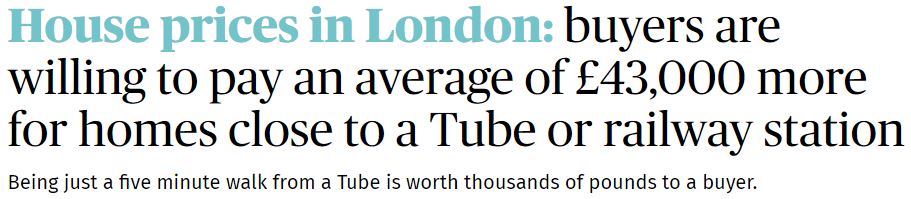
Enough said!
I purposely chose my house to be within ten minutes walk from the two Dalston Overground stations, that would open a couple of years after I moved in.
- It is also within walking distance of twelve major bus routes. All the routes can carry wheel-chairs, if I should ever need one!
- Five routes have stops, within a hundred metres, serving Bank, British Museum, Euston, Harley Street, Kings Cross, London Bridge, Manor House, Moorgate, Piccadilly Circus, Shaftesbury Avenue, St. Pauls, University College Hospital and Victoria.
- I’m only fifty metres from a major cycling route between the City and White Hart Lane.
- I even have a garage, that opens onto the street! But no car!
- My road is wide and there is usually plenty of parking space for visitors or on-line deliveries.
- A taxi ride from Euston, Liverpool Street or Kings Cross is usually under fifteen pounds at all times.
It will get even better!
- When Crossrail opens, I will have 10-12 buses per hour to the Moorgate/Liverpool Street station.
- Dalston Junction station will get a frequency of twenty trains per hour to and from Canada Water, Shoreditch and Whitechapel, that fan out to a selection of places in South London like Crystal Palace, Clapham Junction, Peckham and Penge.
- Dalston Kingsland station will get a frequency of twelve trains per hour to Stratford in the East and Camden, Clapham Junction, Hampstead and High Speed Two in the West.
- I will probably get a series of electric car charging points in the parking spaces in the road, where I live.
- I could put a personal electric car charging point in my garage.
I’m told the value of my house has risen well in the almost ten years, I’ve owned it.
Did somebody once say, that the location of a property, were the three most important things about it?
Conclusion
Make sure your next property has good access to public transport.
 The Anonymous Widower