Hybrid Power On The Railways
In my opinion, one of the best hybrid transmissions is that of London’s New Routemaster bus. This description of the drive-train is from Wikipedia.
The bus is a hybrid diesel-electric driven by a battery-powered electric motor, charged by a diesel fuelled generator and recovering energy during braking by regenerative braking.
It is a classic serial hybrid vehicle.
- There is no mechanical connection between the engine and the driving wheels.
- The diesel engine only runs, when the battery charge is low.
- The electric motor is always powered directly from the battery.
- The control systems for the drive-train are very simple.
- It is very efficient, as the engine only runs when needed and regenerative braking is employed.
- The bus can run on battery power only, for short distances.
- The various components of the drive-train can be placed in convenient places and connected by power and control cables.
In the New Routemaster, the components are placed as follows.
- The diesel engine is half-way up the back stairs.
- The battery is under the front stairs.
- The electric motor is under the floor in front of the rear axle.
This flexibility is very useful in a large vehicle.
Hybrid transmissions are starting to be employed on the railways.
These are the applications in use or planned.
Alstom Coradia iLint
The Alstom Coradia iLint is a hydrogen-powered two-car multiple unit.
This video shows the operation of the train.
<span class=”embed-youtube”></span>
It would appear to be a serial hybrid, where the hydrogen fuel-cell charges the battery and this drives the train through an electric motor,
I suspect most hydrogen trains will work in a similar way.
Class 321 Hydrogen Train
Some Class 321 trains are being converted to run on hydrogen. Unlike the Coradia iLint, the trains will also be able to use electricity from electrification.
MTU Hybrid PowerPacks
MTU have produced a Hybrid PowerPack, which is being retrofitted into several trains, including Class 170 trains in the UK.
Class 93 Locomotive
The recently-announced Class 93 locomotive appears to be a hybrid locomotive with a large diesel engine and about 125 kWh of batteries, that can also use electrification.
High Speed Bi-Mode Aventra
I am sure that Bombardier’s proposed High Speed Bi-Mode Aventra, which features batteries and 125 mph running under both diesel and electric power is a hybrid train.
Conclusion
Just as hybrid cars are becoming more numerous, I suspect we’ll be seeing more hybrid trains in the future.
It’s Not Just Drones We Should Worry About!
In The Private Thoughts of Engineers and Scientists, I talked about a discussion, I had with a chemist about the production of sarin gas.
His view was that if amateurs tried to make the deadly gas, there was a high chance, they’d kill themselves, but he had a better idea to cause havoc in a city, which I will not disclose.
I too, have a couple of non-lethal methods, that would bring an airport or a city to a standstill.
One idea is so simple, that I suspect many terrorists could think it up.
Again, I will not disclose my ideas, but they are probably just two of many.
In some ways, the success of the drones in closing Gatwick Airport will only encourage others to think of new ways to disrupt our lives.
We still don’t now, who were behind the Gatwick Airport drones, but there must be a long list of suspects.
- Extinction Rebellion
- Anti-Airport Protesters
- Russia – It worked better than Novichok!
- North Korea – Unlikely, as they don’t seem to have any spats with the UK.
One thing that may rule out a lot of groups, is that sophisticated high-performance drones are not cheap.
Other groups will be ruled out, because they want to kill hundreds of innocent people and a couple of drones are unlikely to do this.
Class 769 Flex In Action
The title of this post is the same as that of this article on Rail Engineer.
The article describes a ride in a Class 769 train, which is under test on the Grand Central Railway.
The article is very comprehensive, so if you want information on the progress of these trains, you ought to read the article.
One overall impression, I received, was that the train is a lot quieter, than the author expected.
This was the last sentence.
That said, based on the Flex experience, this writer would rather travel on a Class 769 than on a Class 150.
I can’t wait to have a ride, when they enter service in the New Year.
The article also gives a summary of Porterbrook’s various FLEX projects, which are taking redundant, but very serviceable electric-trains and converting them into self-powered trains needed on the UK rail network.
The article also says this about the future of the Class 319 trains.
There are 86 Class 319 four-car units, all of which were made redundant from the Thameslink route. Porterbrook has been successful in placing approximately 45 units for further use – 32 for Northern (eight of which will be converted to Flex specification) and 13 units with West Midlands Trains. In addition, there are Flex orders for five units for Wales, 19 units for Great Western Railway and one for the University of Birmingham (the HydroFLEX). This makes a grand total of 71 of the 86 units, leaving 15 still to find new homes.
I believe that Porterbrook’s reaction to finding that they had a fleet of trains for some of which, there were no obvious uses has been admirable. But also very pragmatic and hopefully financially rewarding in the long-term.
Looking back to the days of British Rail, these trains would probably have been sent to the scrapyard.
London’s Northern Line Extension To Battersea Delayed By A Year
The title of this post is the same as that of this article in the Financial Times.
This is a paragraph.
People close to the project believe that TfL will announce in the new year that the completion date is being pushed back until September 2021.
This delay will heap more financial woes on Transport for London.
Transport for London have already postponed these important upgrades.
- The resignalling of the Piccadilly Line.
- The rebuilding of Camden Town station.
- The rebuilding of Holborn station.
I believe that on financial grounds, the Mayor must reverse his fare-freeze as soon as possible.
The Future Class 93 Locomotive And The Port Of Felixstowe
This is the first paragraph of the Wikipedia entry for the Port of Felixstowe.
The Port of Felixstowe, in Felixstowe, Suffolk is the United Kingdom’s busiest container port, dealing with 42% of Britain’s containerised trade. In 2011, it was ranked as the 35th busiest container port in the world and Europe’s sixth busiest. The port handled 3.74 million twenty-foot equivalent units (TEU) of traffic in 2011.
The sleepy dock of my childhood has become a giant.
Many of the containers going through the port, travel by rail, with upwards of forty trains per day, travelling along the Felixstowe Branch Line, which is mainly single-track and not electrified.
Freight Routes From Felixstowe
There are three main routes for freight trains from Felixstowe to the rest of the country.
Trains from Felixstowe to London take the following route.
- Felixstowe to Ipswich – No electrification – Around an hour.
- Ipswich to London – Electrified and 100 mph line.
Freight trains from Felixstowe to Liverpool, Manchester or Glasgow usually take the following route.
- Felixstowe to Ipswich – No electrification – Around an hour.
- Ipswich to Haughley Junction – Electrified and 100 mph line.
- Haughley Junction to Peterborough – No electrification – Around two hours.
- Peterborough to Werrington Junction – Electrified and 125 mph line.
- Werrington Junction to Nuneaton – No electrification – Just under two hours.
- Nuneaton to Liverpool, Manchester or Glasgow – Electrified and 125 mph line.
Freight trains from Felixstowe to Doncaster, Leeds, Newcastle or Edinburgh usually take the following route.
- Felixstowe to Ipswich – No electrification – Around an hour.
- Ipswich to Haughley Junction – Electrified and 100 mph line.
- Haughley Junction to Peterborough – No electrification – Around two hours.
- Peterborough to Werrington Junction – Electrified and 125 mph line.
- Werrington Junction to Doncaster via Lincoln – No electrification – Around two hours.
- Doncaster to Leeds, Newcastle or Edinburgh – Electrified and 125 mph line.
In most cases they are hauled by a diesel locomotive all the way.
Although in some cases, London trains may change to electric haulage at Ipswich.
An Ideal Freight Locomotive
If you look at these routes, the following should be noted.
- All the electrified sections have an operating speed of 100 mph or more.
- No section without electrification is longer than two hours.
- None of the routes from Felixstowe have any serious gradients.
An ideal locomotive should be able to pull the heaviest freight train in both the following ways.
- Using electric power – At 100 mph on an electrified line, if the operating speed allows.
- Using diesel or hybrid power – For two hours on a line without electrification.
It looks to me that the specification of the Class 93 locomotive fits this specification.
Stadler’s New Tri-Mode Class 93 Locomotive
In Thoughts On A Battery/Electric Replacement For A Class 66 Locomotive, I looked at an electro-diesel freight locomotive with batteries instead of a diesel engine, as a freight locomotive. It would have the size and weight of a Class 70 locomotive and perhaps use similar technology to Stadler’s Class 88 locomotive.
I concluded the article like this.
It would be a heavyweight locomotive with a performance to match.
I believe that such a locomotive would be a very useful addition to the UK’s fleet of freight locomotives.
Stadler have not produced a battery/electric replacement for a Class 66 locomotive, but they have added a diesel/electric/battery Class 93 locomotive with a heavyweight performance to their Class 68/88 or UKLIGHT family of locomotives built at Valencia in Spain.
Details of the locomotive are given in this article in Rail Magazine, which is entitled Rail Operations Fuels Its Ambitions With Tri-Mode Class 93s. There is also a longerand more detailed article in the print edition of the magazine, which I purchased today.
Reading both copies of the article, I can say the following.
A More Powerful Class 88 Locomotive
At a first glance, the Class 93 locomotive appears to be a more powerful version of the Class 88 locomotive.
- The power on electric mode is the same in both locomotives at four megawatt. It would probably use the same electrical systems.
- Some reports give the diesel power of the Class 93 locomotive as 1.34 MW as opposed to 0.7 MW of the Class 88 locomotive.
- The Class 93 locomotive has a top speed of 110 mph, as opposed to the 100 mph of the Class 88 locomotive.
- The article says, “It’s an ’88’ design with the biggest engine we could fit.”
It would also appear that much of the design of the two locomotives is identical, which must make design, building and certification easier.
The Class 93 Locomotive Is Described As A Hybrid Locomotive
Much of the article is an interview with Karl Watts, who is Chief Executive Officer of Rail Operations (UK) Ltd, who have ordered ten Class 93 locomotives. He says this.
However, the Swiss manufacturer offered a solution involving involving an uprated diesel alternator set plus Lithium Titanate Oxide (LTO) batteries.
Other information on the batteries includes.
- The batteries are used in regenerative braking.
- Batteries can be charged by the alternator or the pantoraph.
- Each locomotive has two batteries slightly bigger than a large suitcase.
Nothing is said about the capacity of the batteries, but each could be say 200 litres in size.
I have looked up manufacturers of lithium-titanate batteries and there is a Swiss manufacturer of the batteries called Leclanche, which has this data sheet, that describes a LT30 Power cell 30Ah.
- This small cell is 285 mm x 178.5 mm x 12 mm.
- It has a storage capacity of 65 Wh
- It has an expedited lifetime of greater than 15,000 cycles.
- It has an energy density of 60 Wh/Kg or 135 Wh/litre
These cells can be built up into much larger batteries.
- A large suitcase is 150 litres and this volume would hold 20 kWh and weigh 333 Kg.
- A battery of 300 litres would hold 40 kWh. Is this a large Swiss suitcase?
- A box 2.5 metres x 1 metre x 0.3 metres underneath a train would hold 100 kWh and weigh 1.7 tonnes
These batteries with their fast charge and discharge are almost like supercapacitors.
, It would appear that, if the large suitcase batteries are used the Class 93 locomotive will have an energy storage capacity of 80 kWh.
But this is said about Class 93 locomotive performance..
LTO batteries were chosen because they offer a rapid recharge and can maintain line speed while climbing a gradient, and will recharge when running downhill.
Looking at the batteries, they could provide up to around 40 kW of extra power for perhaps half an hour to help the train climb a gradient and then recharge using regenerative braking or the diesel alternator.
This is a hybrid vehicle, with all the efficiency advantages.
The article does say, that with a light load, the locomotives can do 110 mph on hybrid. Nothing is said about what is a light load.
Could it be a rake of five modern Mark 5A coaches?
In Thoughts On A Battery Electric Class 88 Locomotive On TransPennine Routes, I said this.
It is worth looking at the kinetic energy of a Class 88 locomotive hauling five forty-three tonne CAF Mark 5A coaches containing a full load of 340 passengers, who each weigh 90 Kg with baggage, bikes and buggies. This gives a total weight would be 331.7 tonnes.
The kinetic energy of the train would be as follows for various speeds.
90 mph – 75 kWh
100 mph – 92 kWh
110 mph – 111 kWh
125 mph – 144 kWhThe increase in energy is because kinetic energy is proportional to the square of the speed.
There would be little difference in this calculation, using a Class 93 locomotive, which is only a tonne heavier. The kinetic energy at 100 mph, would be 93 kWh.
This could be very convenient, as it looks like the battery capacity could be almost as large as the kinetic energy of a fully-loaded train.
A train stopping in a station without electrification, would cut diesel running drammatically in the station and when accelerating away.
Similar Weight And Axle Load To A Class 88 Locomotive
The article states that the locomotive will weight 87 tonnes, as opposed to the 86 tonnes of a Class 88 locomotive.
As both locomotives have four axles, this would mean that their axle loading is almost the same.
So anywhere the Class 88 locomotive can go, is most likely to be territory suitable for the Class 93 locomotive.
Again, this must make certification easier.
A Modular Design
In a rail forum, members were saying that the Class 93 locomotive has a modular design.
So will we see other specifications with different sized diesel engines and batteries?
The TransPennine routes, for example, might need a locomotive with a smaller diesel engine, more battery capacity and a 125 mph-capability for the East Coast Main Line.
Stadler have said they specialise in niche markets. Have they developed the tailor-made locomotive?
Power Of Various Locomotives
These are various UK locomotives and their power levels in megawatts.
- Class 43 – Diesel – 1.7
- Class 66 – Diesel – 2.4
- Class 67 – Diesel – 2.4
- Class 68 – Diesel – 2.8
- Class 88 – Electric – 4
- Class 88 – Diesel – 0.7
- Class 90 – Electric – 3.9
- Class 91 – Electric – 4.8
- Class 93 – Electric – 4
- Class 93 – Diesel – 0.9
- Class 93 – Hybrid – 1.3
The interesting figure, is that the Class 93 locomotive has 53 % of the diesel power of a Class 43 locomotive from an InterCity 125. The difference could probably be made up at times using battery power, where needed. The batteries could be partly recharged using regenerative braking.
Could The Locomotive Be Uprated To 125 mph?
Consider.
- The UK has successfully run 125 mph Class 43 and 91 locomotives for many years.
- Stadler has built trains that run at that speed.
- Mark 3, Mark 4 and Mark 5A coaches are all certified for 125 mph.
- There are hundreds of miles of track in the UK, where 125 mph running is possible.
I would think it very unlikely, that the engineers designing the Class 93 locomotive, ruled out the possibility of 125 mph running in the future!
Only Stadler will know!
Could A Battery/Electric Version Of The Locomotive Be Created?
I don’t see why not!
The diesel engine, fuel, exhaust and cooling systems and some ancilliary systems could all be removed and be replaced with an equivalent weight of batteries.
As the C27 diesel engine in a Class 88 locomotive weighs almost seven tonnes, I suspect a ten tonne battery would be possible.
Given the current typical energy density and using the Leclanche figures, this would mean that the batteries would have a total capacity of around 700-700 kWh.
Possible Uses Of The Class 93 Locomotive
The Rail Magazine article goes on to detail some of the uses of a Class 93 locomotive.
Express Freight
Karl Watts says this.
They can operate express freight. In Europe, there are vehicles capable of 100 mph running, and these are perfect for high-speed domestic freight. We have been running intermodals at 75 mph since the 1960s – It’s time to change that.
The locomotive would certainly be able to haul express freight at 100 mph on an electrified main line.
Note the following.
- This would greatly help with freight between Felixstowe and London on the 100 mph Great Eastern Main Line.
- Running freight trains at 100 mph on the major electrified lines would increase capacity, of the lines.
- Ports and freight terminals wouldn’t need to be electrified.
Overall, the proportion of freight mileage, where electric power was used, would grow significantly.
Electrification Gap Jumping
In Thoughts On A Battery/Electric Replacement For A Class 66 Locomotive, I gave a list of typical gaps in the electrification in the UK.
- Didcot and Birmingham – Around two-and-a-half hours
- Didcot and Coventry – Just under two hours
- Felixstowe and Ipswich – Around an hour
- Haughley Junction and Peterborough – Around two hours
- Southampton and Reading – Around one-and-a-half hours
- Werrington Junction and Doncaster via Lincoln – Around two hours
- Werrington Junction and Nuneaton – Just under two hours
How many of these gaps could be bridged by a Class 93 locomotive working in a diesel hybrid mode?
It should be noted, that many of the busiest gaps are in the flatter Eastern areas of England.
I’m sure Stadler and Rail Operations Group have done extensive simulation of possible routes and know where the locomotives are best suited.
Class 66 Locomotive Replacement
I suspect that several of these locomotives will end up replacing duties currently done by Class 66 locomotives.
It could haul an intermodal freight from Felixstowe to Manchester, Liverpool, Glasgow or Doncaster, using electrification where it exists.
And do it at a speed of 100 mph, where speed limits allow!
No other locomotive on the UK network could do that!
Use On Electrified Urban Freight Routes
Near to where I live there are two electrified lines passing through North London; the North London Line and the Gospel Oak To Barking Line.
Both lines have several freight trains a day passing through, that are still hauled by diesel locomotives.
There are other urban freight routes around the UK, where despite electrification, polluting diesel locomotives are still used.
Class 93 locomotives would be an ideal environmentally-friendly replacement locomotive on these routes.
Thunderbird Duties
Karl Watts says this.
They can be used for network recovery as a more comprehensive Thunderbird. Currently, stand-by locomotives are hired or used by an operator to rescue its own trains, but these would be available for anything or anyone. I have sopken to Network Rail about this and they need convincing. But as the network gets busier, so it will be that one failure causes chaos.
Perhaps, a better method for recovering failed trains could be developed.
Passenger Trains
Karl Watts says this.
I can say that the 93s’ feature n two franchise bids, although I cannot say which, due to non-disclosure agreements.
We can only speculate!
Class 93 locomotives could replace the Class 68 locomotives on TransPennine Express services between Liverpool and Scarborough, where Mark 5A coaches will be used.
- Electric mode could be used between Liverpool and Stalybridge and on the East Coast Main Line.
- Diesel or hybrid mode would be used where needed.
- If the locomotives could be uprated to 125 mph, that would help on the East Coast Main Line.
There are certainly, redundant Mark 4 coaches or new Mark 5A coaches that could be used to provide services.
An InterCity 125 For the Twenty-First Century
The InterCity 125 is a masterpiece of engineering, that passengers love.
One of the reasons for the success, is the superb dynamics of the train, which gives them a very comfortable ride.
Could it be that by putting two Class 93 locomotives at each end of a rake of suitable coaches could create a 125 mph train, with the same faultless dynamics?
The answer is probably yes, but in many cases either half-length trains or bi-mode multiple units may be a more affordable or capable train.
The locomotive certainly gives a lot of flexibility.
Conclusion
This is going to be a very useful locomotive.
This was the last paragraph of the printed article, as spoken by Karl Watts.
I don’t think I will be ordering only ten or 20 – there will be more.
I have registered 93001 to 93050.
The word hybrid opens the door.
I think this might be the third member of a very large and widespread family.
Greater Anglia: First Class Seats Scrapped On Most Trains
The title of this post, is the same as that of this article on the BBC.
This is the first three paragraphs.
First class travel is being scrapped on all Greater Anglia trains except intercity services from January 2020, the firm has announced.
The rail operator said it was also bringing in new longer trains from the end of next year.
Both measures would provide 20% more standard seats, it said.
I travel on Greater Anglia a lot and generally travel in the Off Peak.
I always buy a Standard Class ticket, although sometimes on Saturday or Sunday, I’ll add a Weekend First Upgrade on the InterCity train, which I buy onboard.
Why anybody would use First Class on their Class 321 or Class 360 trains, I can’t understand.
The InterCity trains are worth a selective upgrade to First, when they are busy, but the long-distance suburban trains are just a bigger seat and of a standard well below Standard on some excellent Standard Class services.
Now, that Greater Anglia are bringing in new trains, hopefully Standard Class will be up there with the best!
I wonder if Disgusted- in-Frinton will be complaining!
Could Metropolitan Line Trains Run Between Uxbridge In The West And Barking/Upminster In The East?
I read somewhere in Wikipedia, that Transport for London (TfL) were thinking of extending Uxbridge Branch trains on the Metropolitan Line from Aldgate to Barking and/or Upminster stations.
Current Frequencies Between Wembley Park And Upminster Stations
These are the Off Peak frequencies on the various sections of the route in trains per hour (tph)
Wembley Park To Baker Street
- 2 tph – Amersham to Aldgate
- 2 tph – Chesham to Aldgate
- 8 tph – Uxbridge to Aldgate
- 4 tph – Watford to Baker Street
This gives a total of 16 tph
Baker Street To Liverpool Street
- 2 tph – Amersham to Aldgate
- 2 tph – Chesham to Aldgate
- 8 tph – Uxbridge to Aldgate
- 6 tph – Hammersmith to Barking
- 6 tph – Circle Line
This gives a total of 24 tph
Aldgate East to Barking
- 6 tph – Hammersmith to Barking
- 6 tph – Richmond to Upminster
- 6 tph- Ealing Broadway to Upminster
- 3 tph – Wimbledon to Barking
This gives a total of 21 tph
Barking to Upminster
- 6 tph – Richmond to Upminster
- 6 tph – Ealing Broadway to Upminster
This gives a total of 12 tph
Current Frequencies Between Hammersmith And Baker Street
I’ll add this, in case I need it later.
- 6 tph – Hammersmith to Barking
- 6 tph – Circle Line
This gives a total of 12 tph
Current District Line Frequencies Between Hammersmith And Upminster
These are the Off Peak frequencies on the various sections of the route.
Hammersmith to South Kensington
- 6 tph – Richmond to Upminster
- 6 tph – Ealing Broadway to Upminster
This gives a total of 12 tph
South Kensington to Tower Hill
- 6 tph – Richmond to Upminster
- 6 tph – Ealing Broadway to Upminster
- 3 tph – Wimbledon to Barking
- 6 tph – Circle Line
This gives a total of 21 tph
Aldgate East to Barking
- 6 tph – Hammersmith to Barking
- 6 tph – Richmond to Upminster
- 6 tph- Ealing Broadway to Upminster
- 3 tph – Wimbledon to Barking
This gives a total of 21 tph
Barking to Upminster
- 6 tph – Richmond to Upminster
- 6 tph – Ealing Broadway to Upminster
This gives a total of 12 tph
Four Lines Modification
The Four Line Modification is a project to upgrade the following lines.
- Circle Line
- District Line
- Hammersmith & City Line
- Metropolitan Line
New S7 and S8 Stock trains have been delivered and new track and drainage has been installed, but the biggest change will be in the new signalling. TfLsays this abut the new signalling.
Work to install a new signalling and control system began in summer 2016. This will eventually allow the trains to be driven automatically, with a train operator in the cab to open and close the doors. The train operator will be responsible for managing customer information and safety.
Similar technology introduced in recent years on the Jubilee and Northern lines improved performance. The new signalling system allows trains to be run closer together, meaning a more frequent service and shorter waiting times, allowing more people to be carried. This new technology will enable us to reduce delays and improve reliability.
If 32 tph can be run on sections of the four lines, it is an impressive upgrade of capacity.
Currently the frequencies are.
- Wembley Park to Baker Street – 16 tph
- Baker Street to Liverpool Street – 24 tph
- Aldgate East to Barking – 21 tph
- Barking to Upminster – 12 tph
For completeness these frequencies will be added.
Hammersmith to Baker Street – 12 tph
Note
- The frequencies are all at least eight tph below the maximum future operating frequency.
- The busiest section is between Baker Street and Liverpool Street stations.
- The frequency on the two end sections of the Northern East-West section between Hammersmith and Upminster stations is only 12 tph.
It looks like TfL have scope to increase the capacity on the four lines.
Are The Circle/District Line Platforms At Edgware Road Station At Maximum Capacity?
Currently, the following services terminate at Edgware Road station.
- Six tph on the Circle Line.
- Six tph on the District Line from Wimbledon station.
As there are only two platforms to turn the twelve tph, I wouldn’t be surprised if someone told me, that Edgware Road station was at maximum capacity.
If this is the case, then no more trains can be run on the Circle Line, without reducing the frequency to Wimbledon, unless the station were to be rebuilt.
This Google Map shows the station.

And this map from carto.metro.free.fr shows the lines through Edgware Road and Baker Street stations.
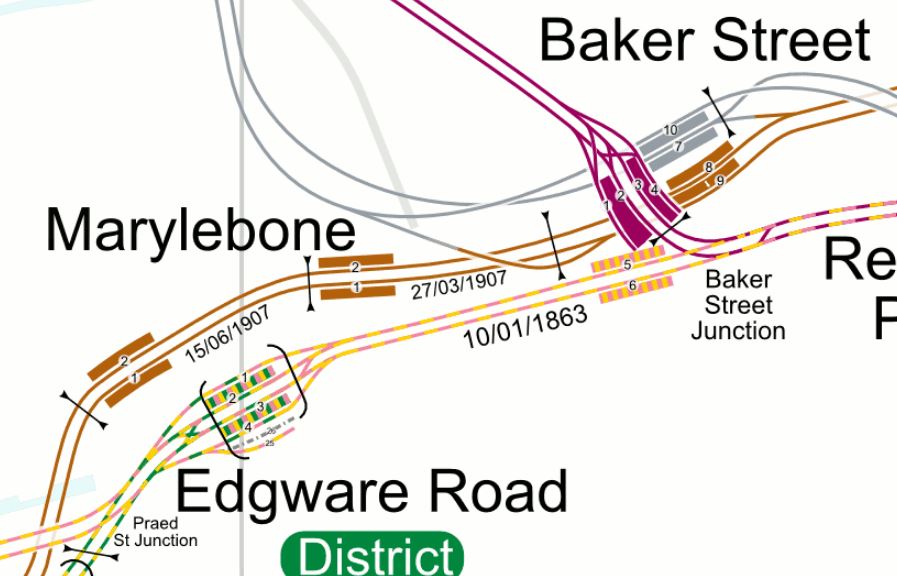
Edgware Road station lies in a cutting, in the midst of some very expensive real estate.
- It is not step-free.
- According to the carto.metro.free.fr map, there used to be or still is a siding or platform to the South of the current four platforms.
- The junctions to the West of the stations are complicated.
- As trains often wait for a few minutes in the station, I suspect it is not operationally efficient.
Could at some time in the future, the station be rebuilt?
- The East-West services might go straight through in two Northern platforms.
- The junction to the West of the station would be simplified, with no crossing of tracks.
- Three terminal platforms could be built for trains coming from the South, which would allow an increase in services.
- Hopefully, the East-West and terminating services could be separated and wouldn’t cross each other.
- Development of tower blocks over the top would provide some funds for the new station.
Would it be possible to increase Circle Line services to ten tph?
Frequencies along the route would be as follows.
- Baker Street to Liverpool Street – 28 tph
- Tower Hill to South Kensington – 25 tph
- High Street Kensington to Edgware Road – 16 tph
My scheduling nous says yes! I also feel, that using good project planning, the station could be built without disrupting services.
Baker Street Issues
Is Aldgate Station At Maximum Capacity?
Currently, the following services terminate at Aldgate station.
- 2 tph from Amersham
- 2 tph from Chesham
- 8 tph from Uxbridge
As there are only two platforms to turn the twelve tph, I wouldn’t be surprised if someone told me, that Aldgate station was at maximum capacity.
This map from carto.metro.free.fr shows the lines at Aldgate station.
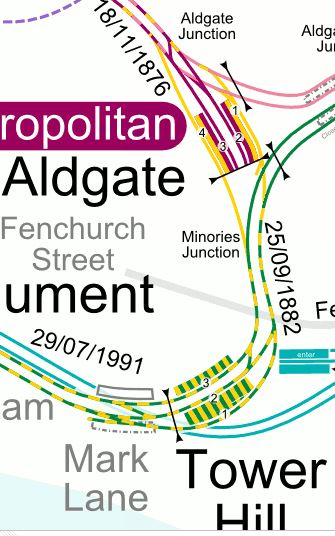
Note
- The two platforms at Aldgate station are sandwiched between the two Circle Line tracks.
- The platforms are curved, which makes step-free access difficult.
I suspect fitting in three straight platforms and full step-free access in the existing station will be very difficult.
This Google Map shows the general area around Aldgate station.

Certainly South of Aldgate High Street, there seems to be a site that could be ripe for development.
Are the District and Circle Lines underneath?
In a comment to this post, Melvyn says that the station could be redeveloped. He said this.
I did read a proposal to make Aldgate accessible linked to property development so this would mean a redesign of the station which could lead to removal of one of the terminal tracks.
I think I will conclude, that whatever happens at Aldgate station, there is no way, the station can handle more than twelve tph.
Could Extra Trains Be Turned At Barking?
This map from carto.metro.free.fr shows Barking station and the sidings to the East.
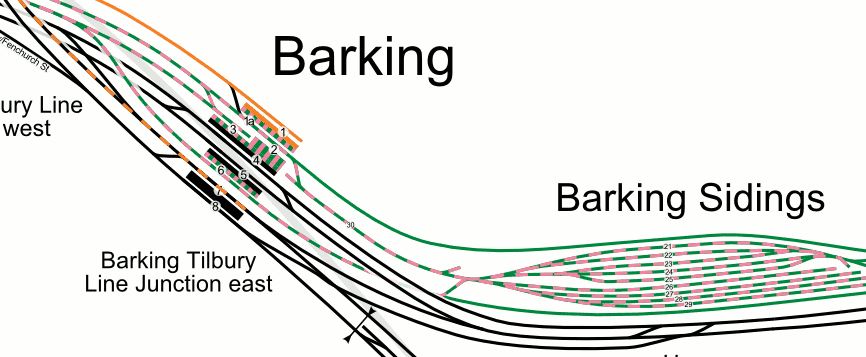
If the eight tph from Uxbridge turned back at Barking, that would mean that seventeen tph would need to be handled at the station.
I’m fairly certain, that this number of trains could be turned at Barking.
It is also worth noting in the map, the cross-platform interchange with c2c.
Could Extra Trains Be Turned At Upminster?
Upminster station has a depot with an impressive maze of sidings to the East.
As the station also has three platforms for District Line trains, I believe the station can handle more than the twelve tph, that it does now!
Increasing The Core Frequency
Suppose extra trains were to be run between Baker Street and Liverpool Street stations.
Ideally, eight extra tph would need to be run to use the maximum capacity of the route.
Where Would The Extra Trains Go In The West?
Extra trains could possibly be run to Hammersmith station, as the three-platform station can probably handle more trains than the twelve tph it does now.
If Edgware Road station is at maximum capacity, then no more Circle Line trains could be run.
But with a rebuild of Edgware Road station in the future, would allow perhaps up to an extra four tph on the Circle Line.
But there could be a few more Hammersmith & City Line services.
There would also be the possibility of more Metropolitan Line services to Amersham, Chesham Uxbridge and Watford stations.
Where Would The Extra Trains Go In The East?
Consider.
- There are four bay platforms at Moorgate station,but are they currently the wrong side of the important Liverpool Street station.
- Moorgate station is being rebuilt for Crossrail and this may open up possibilities for using the bay platforms.
- Aldgate station is at full capacity.
- Extra trains can’t take the Circle Line as Edgware Road station is at frill capacity.
- With a rebuild of Edgware Road station, it might be possible to add four tph to the Circle Line.
So I come to the conclusion, that some extra services must go on to Barking and/or Upminster.
A Possible Timetable
If I assume the extra eight tph go all the way between Wembley Park and Upminster, this gives the following frequencies along the line.
- Wembley Park to Baker Street – 24 tph
- Baker Street to Liverpool Street – 32 tph
- Aldgate East to Barking – 29 tph
- Barking to Upminster – 20 tph
The terminals of the various services could be shared between Aldgate and Upminster.
I also suspect, that the new signalling will allow twelve tph instead of the current eight tph to be terminated at Baker Street station.
Uxbridge To Barking/Upminster Timings
These are the timings for various section of the route.
- Uxbridge to Baker Street – 38 minutes
- Baker Street to Liverpool Street – 13 minutes
- Liverpool Street to Barking – 25 minutes
- Barking to Upminster – 18 minutes
This means that Uxbridge to Upminster could take 94 minutes, with Uxbridge to Barking taking 76 minutes.
These may translate into the following round-trips.
- Uxbridge and Upminster – Four hours, which would need 32 trains.
- Uxbridge and Barking – Three hours, which would need 24 trains.
The current service between Uxbridge and Aldgate has a round trip of two hours, which needs 16 trains.
It would appear that if Uxbridge services go to an alternative terminal, then Barking would be a better choice.
Conclusion
It looks like, that it is very likely, that Metropolitan Line trains will run as far as Barking and/or Upminster stations.
Aberdeen Standard Backs Controversial £1bn Bid For Crossrail Fleet
The title of this post, is the same as that of this article on City AM.
This has been mooted for some time and I believe that Transport for London are taking a sensible action to help get round their funding crisis, caused by three factors.
- The loss of Government subsidy.
- The lateness of Crossrail.
- Sadiq Khan’s bribe to the electorate of a fare freeze.
I also think, that this will be advantageous to London in the long term.
This is a paragraph in the article.
TfL would be able to terminate the 35-year lease in 2020, 2025 and 2030, through a break clause, with an ability to acquire the fleet for just £1 in 2044. TfL will announce the winner at the beginning of next year.
Depending on how TfL’s finance progress in the next few years, the break clause may allow them to cancel and acquire new trains, if they felt it best.
But all these trains need a rebuilding at someyime around twenty years old and this will surely be the responsibility of the leasing company.
Testing Of New Greater Anglia Trains Underway
The title of this post is the same as that of this article on Rail Magazine.
This is the first paragraph.
The first Stadler bi-mode unit for Greater Anglia made its main line debut in the early hours of December 15, when it ran between Diss and Trowse Junction (near Norwich).
I looked on Real Time Trains and found that the train did five trips between Diss and Trowse Junction. After the last trip, the train went back to Crown Point Depot.
It does seem that Greater Anglia have a plan to do the testing.
 The Anonymous Widower