Expanding Charing Cross Station
Network Rail have published the Kent Route Study, which says the following about Charing Cross station.
Charing Cross and Cannon Street stations are effectively full.
Only Platform 1-3 can take the longest trains at Charing Cross station.
The study suggests this as a solution at Charing Cross.
Charing Cross has just six 12-car platforms and Platforms 4, 5
and 6 are very narrow, leading to operational restrictions. Class 465
units cannot operate in 12-car into these platforms and selective
door operation is used on Class 375 units. A major rebuild of the
station could allow it to be extended south over the river, like
Blackfriars, providing compliant platforms and greater passenger
circulation. At concept level, a new link to Waterloo from a southern
entrance to Charing Cross may supersede Waterloo East allowing
the station area to be used for additional track capacity, but there
are likely to be many issues with a project on this scale.
This Google Map shows the station and the Northern |end of the Hungerford Railway Bridge.
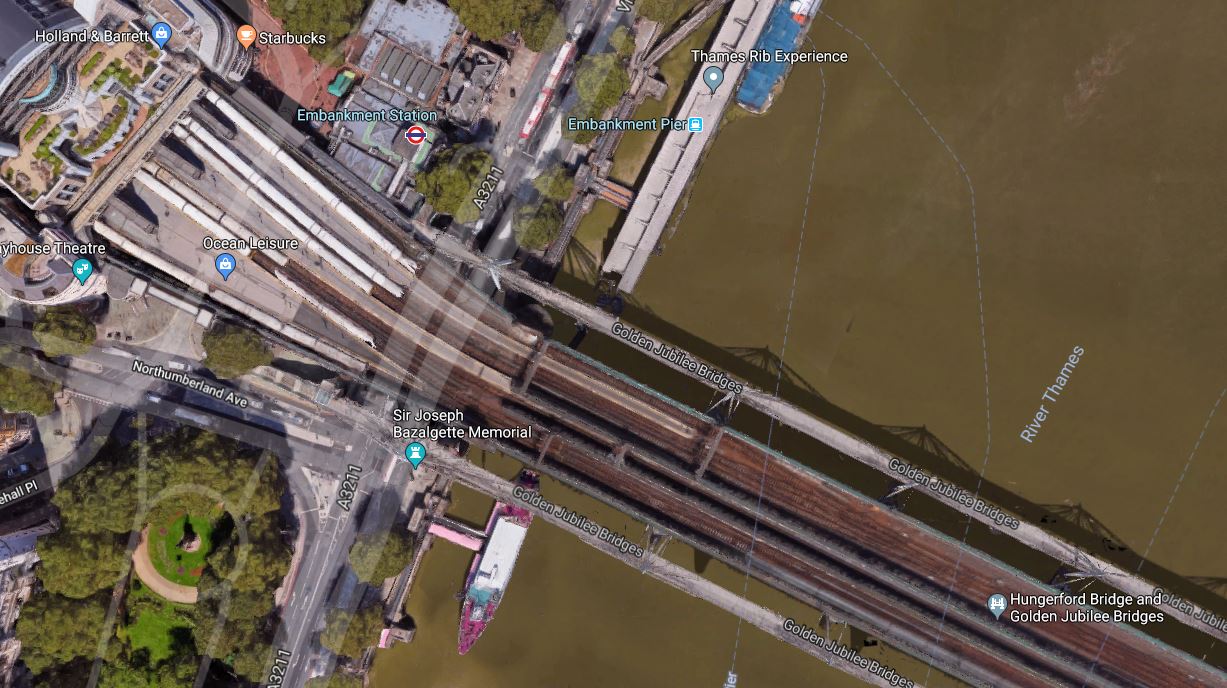
Note.
- Platforms are numbered 1 to 6 from top to bottom.
- The two Golden Jubilee footbridges on either side of the Hungerford bridge.
- There appear to be four or five tracks on the bridge.
- The bridge appears to tracks on either side of a central truss.
I went to Charing Cross station on the train and then walked across the downstream Golden Jubilee Bridge, which is the top one in the Google Map.


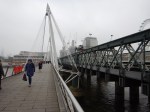


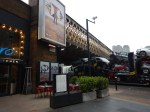

The Hungerford Bridge is certainly a good example of Victorian engineering, which appears to be two separate sections separated by a big truss, with trains running o either side.
A Cross River Charing Cross Station
Network Rail obviously feel that it will be possible to create a cross-River station, as they have published the idea in the Kent Route Study.
I shall outline some thoughts.
Will The Hungerford Bridge Have To Be Replaced?
Consider.
- Replacing the bridge and all the associated steel-work, would be an extensive and expendive project.
- The state of the bridge, which was refurbished about three decades ago, will be very important.
- Modern structural engineering can probably give the bridge sufficient integrity and possibly more space.
- The Golden Jubilee Footbridges, which are some of the busiest pedestrian crossings of the Thjames would obviously stay.
I feel that unless the bridge was in a really poor condition, that the current bridge won’t be replaced, but it will probably be substantially rebuilt.
Will Waterloo East Station Be Closed?
The Kent Route Study said this about Waterloo East station.
At concept level, a new link to Waterloo from a southern
entrance to Charing Cross may supersede Waterloo East allowing
the station area to be used for additional track capacity, but there
are likely to be many issues with a project on this scale.
The issues could include.
- A double-ended Charing Cross station would give benefits similar to those at Blackfriars.
- A Southern entrance to Charing Cross station would possibly be better than Waterloo East station for entertainment on the South Bank.
- Passengers transferring between Charing Cross and Waterloo services might have further to walk.
- Underground connections.
- Cutting out the stop at Waterloo East would save time. It would probably make it easier to stick to the timetabe.
- Some of the Waterloo East site could be released for development.
I wouldn’t be surprised to see Waterloo East station closed.
How Many Trains Could Use Charing Cross Station?
Currently, the six platforms at Charing Cross handle sixteen trains per hour (tph) in the Off Peak.
A well-run platform can turnback four tph, so it could be that the capacity of a well-laid out Charing Cross station could be 24 tph.
Other factors could increase the capacity of the station.
- The platforms could be long enough to handle two full length trains.
- Entrances on both sides of the river would ease passenger flows.
- The next generation of trains will hold more people in a train of a given length.
- Automatic Train Operation could be employed on trains out of Charing Cross.
Obviously, the engineers and architects will have to get the design right, but I believe this frequency could be possible.
Conclusion
I think expanding Charing Cross station across the river is a good plan and not impossible.
But the design could be tricky!
It also looks like the passenger capacity at Charing Cross could be substantially increased.
Custom House DLR Station Reopens – 10th January 2017
Custon House DLR station has now reopened and trains are now stopping again.


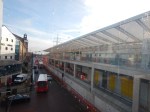


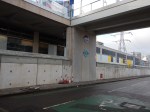
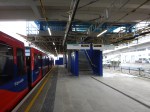
As the pictures show, there is still a fair bit of work to do.
I’m curious, as to what the structure on top of the station is for.
At the moment, it’s just a framework of steel beams, but is it for retail or a ticket office for either Crossrail or Excel.
Crossrail’s information on the design of the station is non-existent.,
A Good Summary Of What’s Happening In Creating New And Updating Old Stations
This article on Rail Engineer is entitled Stations: what happened in CP5 and what’s happening in CP6?
It is an article to read. Especially, if you’re thinking of moving house to a new area!
The Formation Of A Class 707 Train
South Western Railway are starting to use more Class 707 trains.
Wikipedia does not give any details on the formation of the trains.
This morning, I rode an example out of Waterloo to Clapham Junction. So I decided to ascertain the formation, by reading the designations on the ends of the carriage.
- DMSO – Driving Motor Standard Open
- TSO – Trailer Standard Open
- TSO(L)W – Trailer Standard Open with provision for a lavatory and a wheelchair space.
- (P)TSO – Trailer Standard Open with provision for a pantograph.
- DMSO – Driving Motor Standard Open
Wikipedia has a list of British Rail coach designations.
Note.
- The Class 707 train has two motor cars and three trailer cars in the middle.
- The train is wired for a pantograph and has already been tested with one.
- I suspect because of the designation, that a lavatory can be added.
I have been told that the Class 720 trains for Greater Anglia, which like the Class 707 trains are 100 mph five-car trains, have traction motors on every car.
I suspect that this gives faster acceleration and smooth regenerative braking.
But because there are more traction motors, the trains must be more expensive.
So have the Class 707 trains been designed down to a price?
The Western Arcade At London Bridge Station
These pictures show the Western Arcade at London Bridge station, which opened after Christmas.



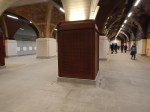

The Arcade connects the spacious double concourse under the tracks of the National Rail station with the Underground station.
All it needs now, is for the shops to be occupied.
The Future Of London To Oakham And Melton Mowbray Rail Services
The bids for the future East Midlands Franchise are expected in April 2018, with the new franchise starting in April 2019.
A Statement From The Department for Transport
In the consultation about the Future of the East Midlands Franchise, this is said in a paragraph entitled Oakham and Melton Mowbray.
A consequence of operating electric trains between London and
Corby could be the loss of direct services between London and
Oakham and Melton Mowbray as there are no plans to electrify
beyond Corby on this route.
Can the Department for Transport really believe that this is a viable idea?
Efficient Train Operation
As I understand it, one of the reasons for the Oakham and Melton Mowbray service to London at six in the morning from Derby, is so they can get their trains positioned for an efficient service to London.
A Useful Diversion Route
The route from London to Derby via Oakham and Melton Mowbray also gives a useful diversion route, if there is engineering works at Leicester. These will happen, at some time in the next few years, as plans to work on the station and possible electrification could happen.
Track Improvements Between London And Kettering And Corby
- The London to Kettering section is being upgraded.
- Double-track to Corby.
- Four-track between London and Kettering.
- As much 125 mph operating speed as possible.
There may also be other track improvements to come.
Bi-Mode Trains
The new franchise will be using 125 mph bi-mode trains, to decrease the times between London and the Midlands and Yorkshire, without the need for more electrification.
Class 800 trains must be in the pole position, but Bombardier wouldn’t want another company’s products to be speeding past their factory gate, so I suspect we can expect them to offer a 125 mph bi-mode Aventra. In Is A Bi-Mode Aventra A Silly Idea?, I linked to this article on Christian Wolmar’s web site which is entitled Bombardier’s Survival Was The Right Kind Of Politics, where this is said in the article.
Bombardier is not resting on its laurels. Interestingly, the company has been watching the problems over electrification and the fact that more of Hitachi’s new trains will now be bi-mode because the wires have not been put up in time. McKeon has a team looking at whether Bombardier will go into the bi-mode market: ‘The Hitachi bi-mode trains can only go 110 mph when using diesel. Based on Aventra designs, we could build one that went 125 mph. This would help Network Rail as it would not have to electrify everywhere.’ He cites East Midlands, CrossCountry and Wales as potential users of this technology.
Note the statement that Bombardier could build an Aventra that could do 125 mph running on diesel.
Could Class 387 Or Class 379 Trains Run Between London And Corby?
Once the route between Corby and London is fully electrified could the route be run by high-end Electrostars like Class 387 or Class 379 trains?
In theory, the answer is yes, but there is one major problem!
The Class 387 trains are 110 mph trains, but the Class 379 trains are only 100 mph trains.
They are just too slow.
Currently, London to Corby takes seventy minutes with a 125 mph Class 222 train.
These trains run on diesel, but after the track improvements between Corby and London, that will allow more 125 mph running, I would expect that the new franchise holder will be able to run these trains on the route in under an hour.
The trains may even be able to do a London to Corby round trip in under two hours, which would mean that the route would need less trains for the current level of service.
In addition to being too slow for the Corby route, the Electrostars would cause timetabling problems between Kettering and London, where they would be sharing the 125 mph Midland Main Line with a succession to 125 mph trains going between London and the North.
A Possible Solution
In my view the solution is obvious.
The current 125 mph diesel fleet, must be replaced by a 125 mph bi-mode fleet.
This would give the following advantages.
- Faster or at least no slower journey times between London and the North, without any electrification North of Kettering and Corby.
- 125 mph electric running between London and Kettering/Corby.
- Efficient 125 mph running between London and Bedford, where possible.
- The ability to use the route from Corby to Derby via Oakham and Melton Mowbray for passenger services or diversions.
- Surely, the maintenance of a unified fleet is more affordable.
But that is not everything, as modern trains have other advantages.
Take for instance, Hitachi’s Class 800 trains, which have the ability to split and join in less than a couple of minutes at a station.
Some Corby services start or finish at Derby and stop North of Corby at Oakham, Melton Mowbray and East Midlands Parkway.
One possibility could be that some services could start in London as two five-car trains, running as a ten-car train.
- The combined train would run fast to Corby.
- At Corby the trains would split.
- The front train would continue to Derby with stops at Oakham, Melton Mowbray and East Midlands Parkway.
- The rear train would return to London.
- Some trains would join up with a train from Derby before returning to London.
The London to Corby service would be two trains per hour, with an hourly train going on to Derby.
Looking at timings, I reckon that the round trip between Corby and Derby could be done in three hours, so it would fit neatly with a half-hourly service between London and Corby that took two hours for the round trip.
This is just speculation, but Class 395 trains have been doing the splitting and joining at Ashford for years.
Conclusion
If the new franchise holder goes for the conservative solution of Class 800 trains, I believe that it would be possible to run an hourly service from Derby to London with stops at Corby, Oakham, Melton Mowbray and East Midlands Parkway.
If
Rail Engineer On Hydrogen Trains
This article on Rail Engineer is entitled Hydrail Comes Of Age.
It is a serious look at hydrogen-powered trains.
This is typical information-packed paragraph.
Instead of diesel engines, the iLint has underframe-mounted traction motors driven by a traction inverter. Also mounted on the underframe is a lithium-ion battery pack supplied by Akasol and an auxiliary converter to power the train’s systems. On the roof is a Hydrogenics HD200-AT power pack which packages six HyPMTM HD30 fuel cells, with common manifolds and controls, and X-STORE hydrogen tanks supplied by Hexagon xperion which store 89kg of hydrogen on each car at 350 bar. These lightweight tanks have a polymer inner liner, covered with carbon fibres soaked in resin and wrapped in fibreglass.
They have interesting things to say about the trains and the production and delivery of the hydrogen, which can be what they call green hydrogen produced by electricity generated by wind power.
This is said about supplying the hydrogen.
It takes 15 minutes to refuel the iLint, which holds 178kg of hydrogen supplied at a pressure 350 bar. It consumes this at the rate of 0.3kg per kilometre. Thus, Lower Saxony’s fleet of 14 trains, covering, say, 600 kilometres a day, will require 2.5 tonnes of hydrogen per day. If this was produced by electrolysis, a wind farm of 10MW generating capacity would be required to power the required electrolysis plant with suitable back up. This, and sufficient hydrogen storage, will be required to ensure resilience of supply.
These are the concluding paragraphs.
With all these benefits, a long-term future in which all DMUs have been replaced by HMUs is a realistic goal. However, the replacement, or retrofitting, of 3,000 DMUs and the provision of the required hydrogen infrastructure would be a costly investment taking many years.
Germany has already taken its first steps towards this goal.
For myself, I am not sceptical about the technology that creates electricity from pure hydrogen, but I think there are design issues with hydrogen-powered trains in the UK.
The German trains, which are built by Alsthom and should start test runs in 2018, take advantage of the space above the train in the loading gauge to place the tanks for the hydrogen.
Our smaller loading gauge would probably preclude this and the tanks might need to take up some of the passenger space.
But in my view, we have another much more serious problem.
Over the last twenty years, a large number of high quality trains like electric Desiros, Electrostars and Junipers, and diesel Turbostars have been delivered and are still running on the UK network.
It could be that these trains couldn’t be converted to hydrogen, without perhaps devoting a carriage to the hydrogen tank, the electricity generator and the battery needed to support the hydrogen power.
It is for this reason, that I believe that if we use hydrogen power, it should be used with traditional electrification and virtually unmodified trains.
A Typical Modern Electric Train
Well! Perhaps not yet, but my view of what a typical electric multiple unit, will look like in ten years is as follows.
- Ability to work with 25 KVAC overhead or 750 VDC third-rail electrification or onboard battery power.
- Ability to switch power source automatically.
- Batteries would handle regenerative braking.
- Energy-efficient train design.
- Good aerodynamics.
- Most axles would be powered for fast acceleration and smooth braking.
- Efficient interior design to maximise passenger numbers that can be carried in comfort.
- A sophisticated computer with route and weather profiles, passenger numbers would optimise the train.
The battery would be sized, such that it gave a range, that was appropriate to the route.
In an article in the October 2017 Edition of Modern Railways, which is entitled Celling England By The Pound, Ian Walmsley says this in relation to trains running on the Uckfield Branch.
A modern EMU needs between 3 and 5 kWh per vehicle mile for this sort of service.
As I’m talking about a train that has taken energy efficiency to the ultimate, I think it would be reasonable to assume that 3 kWh per vehicle mile is attainable.
As I believe that most axles would be powered, I feel that it would be electrically efficient for a battery to be fitted into each car.
Suppose we had a five-car train with a 30 kWh battery in each car.
This would give a total installed battery capacity of 150 kWh. Divide by five and three and this gives a useful emergency range of ten miles.
These facts put the battery size into perspective.
- , 30 kWh is the size of the larger battery available for a Nissan Leaf.
- A New Routemaster bus has a battery of 75 kWh.
Where will improved battery technology take us in the next decade?
Use Of Hydrogen Power With 750 VDC Third-Rail Electrification
This extract from the Wikipedia entry for third-rail, explains the working of third-rail electrification.
The trains have metal contact blocks called shoes (or contact shoes or pickup shoes) which make contact with the conductor rail. The traction current is returned to the generating station through the running rails. The conductor rail is usually made of high conductivity steel, and the running rails are electrically connected using wire bonds or other devices, to minimize resistance in the electric circuit. Contact shoes can be positioned below, above, or beside the third rail, depending on the type of third rail used; these third rails are referred to as bottom-contact, top-contact, or side-contact, respectively.
If a line is powered by third-rail electrification, it needs to be fed with power every two miles or so, due to the losses incurred in electricity passing along the steel conductor rail.
I suspect that Network Rail and our world-leading rail manufacturers have done as much as they can to reduce electrical losses.
Or have they? Wikipedia says this.
One method for reducing current losses (and thus increase the spacing of feeder/sub stations, a major cost in third rail electrification) is to use a composite conductor rail of a hybrid aluminium/steel design. The aluminium is a better conductor of electricity, and a running face of stainless steel gives better wear.
Suppose instead of having continuous third-rail electrification, lengths of electrification with the following characteristic were to be installed.
- Hybrid aluminium/steel rails.
- Power is supplied at the middle.
- Power is only supplied when a train is in contact with the rail.
All trains would need to have batteries to run between electrified sections.
The length and frequency of the electrified sections would vary.
- If a section was centred on a station, then the length must be such, that a train accelerating away can use third-rail power to get to operating speed.
- Sections could be installed on uphill parts of the line.
- On long level sections of line without junctions, the electrified sections could be more widely spaced.
- Battery power could be used to take trains through complicated junctions and crossovers, to cut costs and the difficulties of electrification.
- Electrified section woulds generally be placed , where power was easy to provide.
So where does hydrogen-power come in?
Obtaining the power for the track will not always be easy, so some form of distributed power will be needed.
- A small solar farm could be used.
- A couple of wind turbines might be appropriate.
- In some places, small-scale hydro-electric power could even be used.
Hydrogen power and especially green hydrogen power could be a viable alternative.
- It would comprise a hydrogen tank, an electricity generator and a battery to store energy.
- The tank could be buried for safety reasons.
- The installation would be placed at trackside to allow easy replenishment by tanker-train.
- It could also be used in conjunction with intermittent solar and wind power.
The tanker-train would have these characteristics.
- It could be a converted electrical multiple unit like a four-car Class 319 train.
- Both 750 VDC and 25 KVAC operating capability would be retained.
- One car would have a large hydrogen tank.
- A hydrogen-powered electricity generator would be fitted to allow running on non-electrified lines and give a go-anywhere capability.
- A battery would probably be needed, to handle discontinuous electrification efficiently.
- It might even have facilities for a workshop, so checks could be performed on the trackside power system
Modern digital signalling, which is being installed across the UK, may will certainly have a part to play in the operation of the trackside power systems.
The position of all trains will be accurately known, so the trackside power system would switch itself on, as the train approached, if it was a train that could use the power.
Use Of Hydrogen Power With 25 KVAC Overhead |Electrification
The big difference between installation of 25 KVAC overhead electrification and 750 VDC third-rail electrification, is that the the overhead installation is more complicated.
- Installing the piling for the gantries seems to have a tremendous propensity to go wrong.
- Documentation of what lies around tracks installed in the Victorian Age can be scant.
- The Victorians used to like digging tunnels.
- Bridges and other structures need to be raised to give clearance for the overhead wires.
- There are also those, who don’t like the visual impact of overhead electrification.
On the plus side though, getting power to 25 KVAC overhead electrification often needs just a connection at one or both ends.
The electrification in the Crossrail tunnel for instance, is only fed with electricity from the ends.
So how could hydrogen help with overhead electrification?
Electrifying some routes like those through the Pennines are challenging to say the least.
- Long tunnels are common.
- There are stations like Hebden Bridge in remote locations, that are Listed Victorian gems.
- There are also those, who object to the wires and gantries.
- Some areas have severe weather in the winter that is capable of bringing down the wires.
In some ways, the Government’s decision not to electrify, but use bi-mode trains is not only a cost-saving one, but a prudent one too.
Bi-mode trains across the Pennines would have the advantage, that they could use short lengths of electrification to avoid the use of environmentally-unfriendly diesel.
I have read and lost an article, where Greater Anglia have said, that they would take advantage of short lengths of electrification with their new Class 755 trains.
Electrifying Tunnels
If there is one place, where Network Rail have not had any electrification problems, it is in tunnels, where Crossrail and the Severn Tunnel have been electrified without any major problems being reported.
Tunnels could be developed as islands of electrification, that allow the next generation of trains to run on electricity and charge their batteries.
But they would need to have a reliable power source.
As with third-rail electrification, wind and solar power, backed by hydrogen could be a reliable source of power.
Electrifying Stations With Third Rail
It should be noted, that the current generation of new trains like Aventra, Desiro Cities and Hitachi’s A-trains can all work on both 25 KVAC overhead or 750 VDC third-rail systems, when the appropriate methods of current collection are fitted.
Network Rail have shown recently over Christmas, where they installed several short lengths of new third-rail electrification South of London, that installing third-rail electrification, is not a challenging process, provided you can find the power.
If the power supply to the third-rail is intelligent and is only switched on, when a train is on top, the railway will be no more a safety risk, than a route run by diesel.
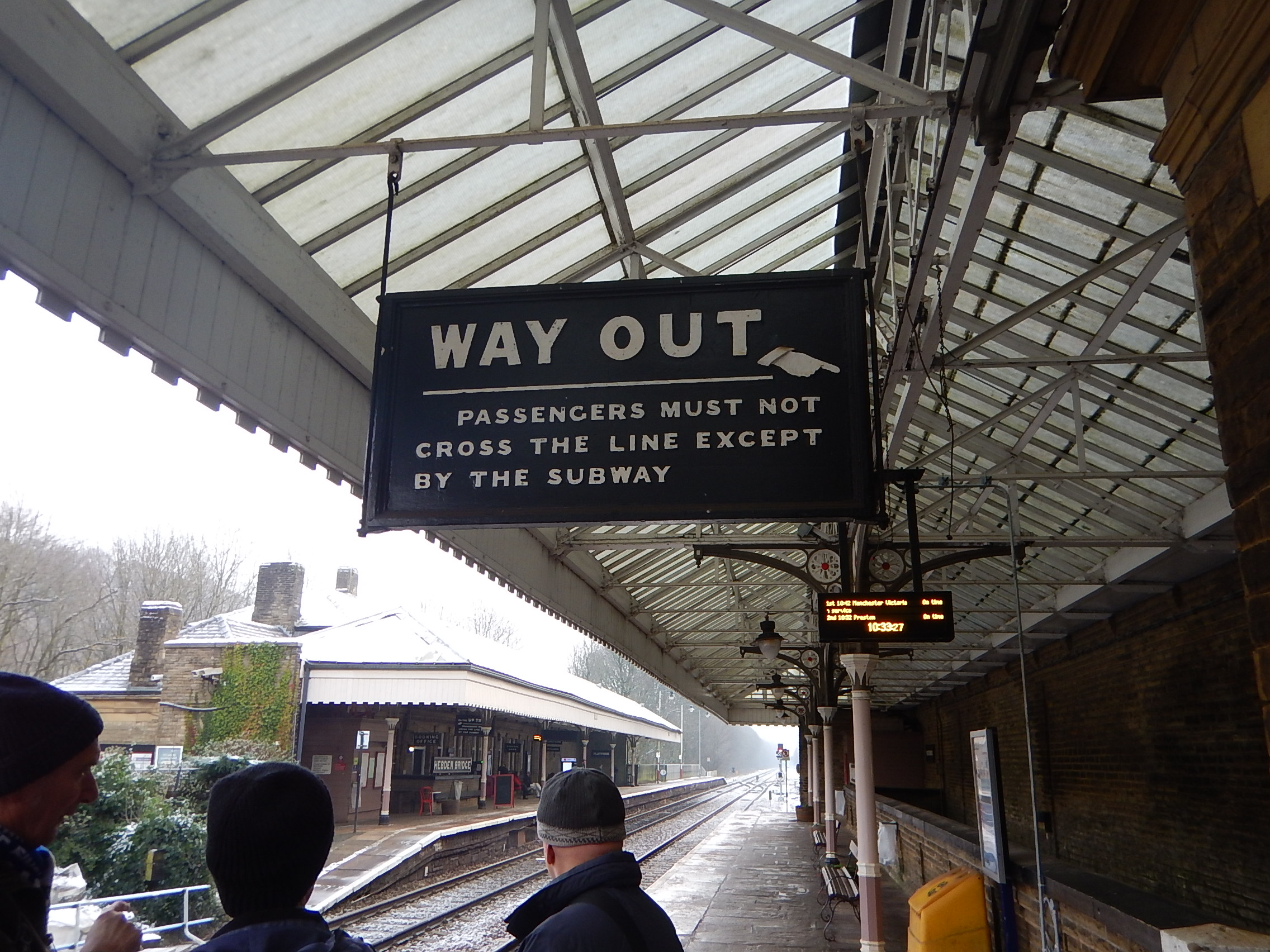
The picture shows the Grade II Listed Hebden Bridge station.
Third-rail electrification with an independent reliable power supply could be a way of speeding hybrid trains on their way.
Power Supply In Remote Places
Communications are essential to the modern railway.
Trains and train operators need to be able to have good radio connections to signalling and control systems.
Passengers want to access wi-fi and 4G mobile phone networks.
More base stations for communication networks will be needed in remote locations.
Wind, solar and hydrogen will all play their part.
I believe in the future, that remote routes in places like Wales, Scotland and parts of England, will see increasing numbers of trains and consequently passengers., many of whom will be walking in the countryside.
Could this lead to upgrading of remote stations and the need for reliable independent power supplies?
Conclusion
I am very much coming to the conclusion, that because of the small UK loading gauge, hydrogen-powered trains would only have limited applications in the UK. Unless the train manufacturers come up with a really special design.
But using hydrogen as an environmentally-friendly power source for UK railways to power electrification, perhaps in combination with wind and solar is a definite possibility!
.
Thameslink Begins Testing At Redeveloped London Bridge
The title of this post, is the same as that of this article in Rail Magazine.
This is said.
Direct trains from Blackfriars to London Bridge stopped in January 2015, but will resume this month once further testing and driver training has been completed. A full service introduction is planned for May.
That sounds like good news to me!
Legal & General To Invest £350m in UK Rail Infrastructure
The title of this post, is the same as this article on Railway Technology.
Wikipedia says this about Legal & General.
The company offers a wide range of products for individuals and corporate businesses. Its investment management is the UK’s largest investment manager of UK pension fund assets and has a growing US business, based in Chicago, Illinois.
So in a few years time, your pension might own a couple of nuts and bolts on a train.
MP Calling For Borders Link To High-Speed Rail Network
The title of this post, is the same as that of this article in the Southern Reporter.
My feeling is that I don’t think the MP should worry about this one.
Consider.
- When High Speed 2 opens to Crewe in 2027, London to Glasgow trains will take under four hours.
- The West Coast Main Line will be improved between Carlisle and Glasgow.
- Freight traffic between England and Scotland is increasing.
- A large freight interchange could be built at Longtown.
- Increased services between Liverpool/Manchester and Edinburgh/Glasgow are starting.
- Carlisle station is being refurbished.
All this will lead to more through traffic at Carlisle.
I would think it would be extremely likely, that the West Coast Main Line between Carlisle and Longtown will be improved substantially.
If this happens, then any extension of the Borders Railway will have a fast link to HS2 at Carlisle, from where it will probably join the West Coast Main Line in the Longtown area.
It should also be noted, that High Speed 2 is being designed to give benefits to as many places as possible.
A Borders Railway connected to Carlisle fits this strategy.
 The Anonymous Widower