Thameslink To Rainham
Modern Railways in August 2016, said that Thameslink would be running a two trains per hour (tph) service between Luton and Rainham via Greenwich and Dartford.
GTR’s Proposals
This document on their web site gives these outline proposals for Kent Thameslink services.
This is the opening paragraph.
Proposed new all-day Monday to Friday, Saturday and Sunday Thameslink service on the North Kent line via Greenwich, Dartford and Medway Towns.
They describe it in more detail later.
New cross-London journey opportunities providing multiple connectivity opportunities will be created between Luton – St Albans City – West Hampstead Thameslink – Central London (via London Bridge) – Greenwich – Abbey Wood – Dartford – Rochester – Rainham. This new route will provide multiple new connections with the new east to west Elizabeth Line (formally Crossrail) at Abbey Wood. The route can also be operated by 8 or 12 car trains.
I will now add a few comments.
The Eastern Terminal
In Rainham (Kent) Station, I took a look at the proposed terminal.
- Rainham station is Thameslink-ready with a bay platform 0 of sufficient length for a twelve-car Class 700 train.
- Rainham station can probably handle the two trains per hour (tph) from Luton without undue fuss.
- Rainham as a terminal means the string of important stations in the Medway towns, which includes Gravesend, Strood, Rochester, Chatham and Gillingham, could all be served by Thameslink.
- The only other station beyond Gravesend with a bay platform is Rochester.
- Terminating at Rainham doesn’t increase the train frequency over the busy level crossing.
- Terminating at Rainham gives 5 tph from Gravesend to Rainham and 7 tph between Rochester and Rainham, which creates a high-capacity frequent route through the Medway Towns.
It would appear to be the sort of choice, that is difficult to fault.
Should The Thameslink Service Stop At More Stations?
Coming back from Rainham today, I took a Highspeed service to Gravesend, from where I caught a Gillingham to Charing Cross service that was following a few minutes behind.
As there are several stopping services on the line, perhaps stopping at a few important stations will be sufficient.
- Greenhithe for the shopping at Bluewater.
- Dartford for all the connectivity.
- Abbey Wood for Crossrail.
- Greenwich for the culture and the Docklands Light Railway.
Stopping patterns could be altered to fit traffic patterns, passengers requirements and new property developments
Eight-Or Twelve-Car Trains
It would all depend on the traffic, but there doesn’t seem to be any reason why either train size can’t be used between Luton and Rainham.
Related Posts
A Design Crime – Ebbsfleet International Station
Between Abbey Wood And Belvedere Stations
Connecting North Kent And The Medway Towns To Ebbsfleet International Station
Extending Crossrail To Gravesend
What Do You Do With A Problem Like Sheppey?
A Twelve-Car Ready Railway
On my trip to Rainham station in Kent, I went through numerous stations.
I took this picture.

A Twelve-Car Ready Railway
Note the blue 10-12 sign, which indicates the stopping point for trains between ten and twelve cars.
I’m pretty certain that all stations between London Bridge and Rainham can accommodate trains of this length, as there were blue twelves everywhere.
To the East of Rainham, a good proportion of the services are run by six-car Class 395 trains. As these can run in 12-car formations, I suspect that most platforms have been made long enough.
This railway is probably future-proofed with regards to train length.
It will certainly accept.
- Crossrail’s Class 345 trains.
- Highspeed’s Class 395 trains running as a twelve-car.
- Thameslink’s Class 700 trains, running as eight-car or twelve-car.
- Electrostars in various lengths.
Sadly, not all rail lines in the UK have been built with long enough platforms and extending some will be difficult.
Related Posts
A Design Crime – Ebbsfleet International Station
Between Abbey Wood And Belvedere Stations
Connecting North Kent And The Medway Towns To Ebbsfleet International Station
Rainham (Kent) Station
There are two stations with the same name and this Rainham station is the one in Kent, which is to the East of Gillingham on the Chatham Main Line.
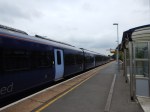
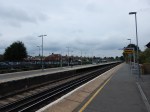

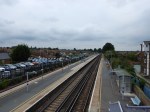
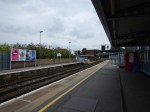


It is a busy station, which has these typical off-peak services.
- 2 trains per hour (tph) to London St Pancras via Chatham and Ebbsfleet International
- 3 tph to London Victoria via Chatham and Bromley South (1ph calling at Denmark Hill)
- 1 tph to Sittingbourne and Faversham only
- 2 tph to Dover Priory via Canterbury East
- 2 tph to Ramsgate via Margate
Adding them up gives 5 tph in both directions, with a choice of Highspeed or traditional services to and from two London termini.
The station has benefited from the East Kent Resignalling Project. This is said in Wikipedia.
Rainham has a new bay platform off the up-line, which can accommodate a 12-car train, labelled Platform 0. It is now being used as a Terminus for a couple of evening rush hour trains.
It would appear to be an extra platform, that has been fitted well into the layout of the station.
If Thameslink does run a service from Rainham to Luton from 2018, the platform would have no difficulty turning the two trains per hour.
This will give a 2 tph service to three London termini; London Bridge, Blackfriars and St. Pancras on its way to Luton.
The level crossing at the station, probably limits the number of trains through Rainham station, despite the fact that some may be timed to pass in the station, which reduces the number of times it closes to road traffic.
So using the bay platform 0 for Thameslink, increases the frequency to the West of the station to 7 tph, but leaves that through the crossing at 5 tph.
It seems to be a sensible way to increase train frequencies without choking road traffic too much.
I very much like the thinking behind the design.
Related Posts
A Design Crime – Ebbsfleet International Station
Between Abbey Wood And Belvedere Stations
Connecting North Kent And The Medway Towns To Ebbsfleet International Station
Extending Crossrail To Gravesend
What Do You Do With A Problem Like Sheppey?
The Great Northern Metro
Govia Thameslink Railway have just announced their proposals to create a Great Northern Metro.
This was something I speculated about in A North London Metro.
GTR’s Proposals
This document on their web site gives these outline proposals.
- 2018 timetable will provide new connections and increase capacity.
- More frequent trains to provide a ‘true’ metro service.
- New air-conditioned trains from 2018.
It looks like I got those right
These are other proposals.
14 Trains Per Hour To/From Moorgate in The High Peak
Currently, a maximum of 12 trains per hour (tph) can get in and out from Moorgate station in the High Peak.
Raising it by two to 14 tph surprised me, but it says that they have found a way with the new trains to save time possibly by using better technology to change the voltage quicker at Drayton Park.
Effectively, the headway between trains is being reduced from five minutes to four and a half minutes.
One big advantage for people like me, who live close to a Southern station on the line, as I do with Essex Road station, is that going North in the morning rush and South in the evening rush, will be easy.
Services To/From Moorgate in The Off Peak
This is a summary of the changes in the Off Peak.
- 6 tph to Hertford North – Up from 3 tph
- 4 tph to Welwyn Garden City – Up from 3 tph
- 2 tph to Stevenage – Up from 1 tph
- Sunday services are 4 tph to both branches and 2 tph to Stevenage.
On the other hand, it appears there will now be no direct trains between Moorgate and Letchworth Garden City.
My local station is Essex Road and I regularly use the line to go North and South between Moorgate and Alexandra Palace.
Instead of a measly six tph, I’ll now be getting 10 tph all day, with 8 tph on Sundays.
I thought it would be four tph to Hertford North and Welwyn Garden City, so they’re actually going to do better than I thought they would.
An Eastward Shift In Services
The two branches used to be treated fairly equally with 3 tph on each.
But now it appears that Hertford North gets preference.
But then the East Coast Main Line will be getting Thameslink services.
- 6 tph stopping at Finsbury Park
- 0 tph stopping at Alexandra Palace
- 2 tph stopping at Potters Bar
- 2 tph stopping at Welwyn Garden City
- 6 tph stopping at Stevenage
Note that these are very much a summary.
Problem! – Will Thameslink Stop At Alexandra Palace?
,I do hope that Thameslink services not stopping at Alexandra Palace, when they stop at places like Oakleigh Park is a typo.
Consider.
- Alexandra Palace is the last station before the Hertford Loop Line splits from the East Coast Main Line.
- Alexandra Palace has an attraction that passengers might want to visit.
- Alexandra Palace station may well be served by Crossrail 2.
But most importantly, Alexandra Palace could have a cross-platform and/or same-platform interchange between Great Northern Metro services on both routes and Thameslink.
So it would be a good interchange for eighty-year-old Aunt Mabel going from Enfield Chase to Gatwick Airport with her suitacse full of presents for her grandchildren.
My Link To Thameslink Going North
I laid this out in My Links to Thameslink and I suspect from 2018, I’ll take bus to Essex Road station and then take the Great Northern Metro to Finsbury Park.
I don’t think I’ll be alone, in using the Great Northern Metro to get access to Thameslink to go North.
My Link To Thameslink Going South
I laid this out in My Links to Thameslink and I suspect from 2018, I accept what GTR offer or take the Essex Road and Finsbury Park route.
- Highbury And Islington Station
But what would help everybody within a couple of miles or so of Highbury and Islington station, is to upgrade the station to the Twentieth Century.
- Provide a second entrance on the North side of Highbury Corner roundabout, where there is a disused station entrance.
- Provide a better connection between the Northbound and Southbound deep-level platforms.
- Provide full step-free access to the deep-level platforms.
- Improve the lighting and ambience in the deep-level platforms.
Talking to someone who works in the station and is obviously familiar with the tunnels, he felt, as I do, that there are fairly simple solutions to sorting out the deep-level platforms.
I would do the following.
- Open up the second entrance.
- Create a subway under Holloway Road.
- Improve the walking routes and access to buses outside the station.
- Put lift access from the new entrance to a passage that would cross all four deep-level lines.
- Provide step-free access from the cross-passage to the four deep-level lines.
- Replace the stairs connecting the two Southbound platforms
Unfortunately, I suspect that the new road bridge over the railway in front of the station has probably been built without leaving space for the subway.
The Link To Crossrail
In Liverpool Street Crossrail Station Disentangled, I showed that changing between Crossrail and the Northern City Line at Moorgate could be easy.
Now that the service into Moorgate will be 10 tph all day, with 8 tph on Sundays, the line will become an important link to Crossrail for a large area of North London.
Consider.
- The Piccadlly Line has no connection with Crossrail, so changing at Finsbury Park for Moorgate might be the quickest way to get to the new line.
- The Victoria Line has no connection with Crossrail, but there is cross-platform interchange at Highbury and Islington with the Great Northern Metro.
- The North London Line connects to the Great Northern Metro at Highbury and Islington.
Taken together, the Piccadilly Line, Victoria Line and the Great Northern Metro, with help from more local transport methods like bikes and buses, will certainly improve the link to Crossrail for a large area of Enfield, Hackney, Haringey, Islington and Waltham Forest.
My only worry, is that as the Great Northern Metro gives such good access to Crossrail for such a wide area of London and South Hertfordshire, that the planned 10 tph into Moorgate all day, with 8 tph on Sundays, will be too low.
At least the improvements to the service are coming in around 2018, which would be before Crossrail opens in 2019.
Once Crossrail opens, I suspect, it will give me a better link to Thameslink, especially when I need to go South.
Conclusions
The service is a great improvement on the current one. But I predicted that!
The service is going to meet what I suspect, GTR hope it will.
As an average punter on the Northern City route from Essex Road, I will get a lot more trains.
I shall certainly use Essex Road and Finsbury Park to get to Cambridge.
It’s a pity it doesn’t help to use Thameslink in the difficult direction to the South.
Related Posts
GTR’s 2018 Timetable Consultation
Liverpool Street Crossrail Station Disentangled
Japanese Trains With Batteries
If Bombardier in Derby and the Germans in Chemnitz (Karl Marx Stadt to Jeremy and the Corbedians) are addressing battery technology, you could be sure that the Japanese would have ideas and there is this article in Railway Gazette, which is entitled Emergency batteries for Tokyo Metro trains.
This is said.
Nippon Sharyo Series 1000 trainsets operating on Tokyo Metro’s Ginza Line have been fitted with Toshiba onboard emergency batteries so that they can reach the next station under their own power in the event of a traction supply failure.
Toshiba says the SCiB lithium-ion battery is well-suited to emergency use, being resistant to external shock, internal short circuits and thermal runaway. It recharges rapidly, has a long life and a high effective capacity over a wide range of environmental conditions.
The battery draws power from the third rail during normal operation, and can supply the traction system in the event of power outage or other emergency. It can also be used for train movements within depots.
I also said this in Bombardier’s Plug-and-Play Train,
I wouldn’t rule out that all Class 345 trains were fitted with some form of onboard energy storage.
The main reasons are all given in the article about Japanese trains.
German Trains With Batteries
One of my Google alerts found this article on Rail Journal, which is entitled DB to convert DMUs to bi-mode hybrid trains.
This is said.
GERMAN Rail (DB) has announced it is working with technical universities in Chemnitz and Dresden to develop bi-mode (diesel and electric) trains with lithium-ion battery storage. Between 2017 and 2021 DB intends to convert 13 existing Siemens class 642 Desiro Classic DMUs to hybrid bi-mode configuration.
It seems the Germans share my belief that trains with batteries are the future.
Along The North Kent Line
The North Kent Line has seen some changes in the last few years and could see some more in the next few.
Starting from the terminal in London Bridge, which itself is going through a massive upgrade, these improvements have been done or will happen.
Woolwich Arsenal
Woolwich Arsenal station has from 2009 provided a direct link to the Docklands Light Railway, giving a direct connection to London City Airport and Bank.
In 2019, Woolwich station on Crossrail will open, which will be two hundred metres away from Woolwich Arsenal station. This will probably not have a direct effect on Woolwich Arsenal station, but two stations will certainly stimulate development in the area.
I doubt many will use this station to interchange between the North Kent Line and Crossrail, as it looks like the connection at Abbey Wood station could be easier.
Abbey Wood
Abbey Wood station is being rebuilt and in December 2018, Crossrail will start services at the station to Paddington via Canary Wharf and the central tunnel.
Wikipedia says this about Crossrail services at Abbey Wood station.
Abbey Wood is the terminus of one of two eastern branches of Crossrail and will offer cross-platform interchange between terminating Crossrail services (at 12 trains per hour on new line) and existing Southeastern services (along existing tracks)
Plans are always being talked about to link Abbey Wood station to the North Bank of the Thames at either Gallions Reach or Barking Riverside.
I doubt it will happen in the next ten years.
Dartford
Dartford station has from the beginning of this year been one of London’s contactless ticketing stations, as is reported in Oyster and Contactless Bank Cards, under the station’s Wikipedia entry.
Don’t be surprised if this creeps outwards from London.
Greenhithe
Greenhithe station was rebuilt in 2008 and is the station for Bluewater.
Because of the Shopping Centre, Greenhithe will probably be a station that could benefit from contactless ticketing.
Northfleet
Northfleet station is the closest to Ebbsfleet International and we could see an improved link between the two stations.
As Northfleet could have upwards of four trains per hour (tph) stopping in both directions, a frequent shuttle bus, could be an affordable option.
Smaller Stations
There are several smaller stations between London Bridge and Gravesend.
I’m obviously not sure, but on a quick look all of them seem ready to accept the long trains, that will be used by both Thameslink and Crossrail.
Gravesend
Gravesend station was remodelled in 2013 and now has two long through platforms and a bay platform.
Crossrail to Gravesend
Under Future in the Wikipedia for Gravesend station, this is said.
In December 2008, the local authority for Gravesend (Gravesham Council), was formally requested by Crossrail and the Department for Transport, to sanction the revised Crossrail Safeguarding. This safeguarding provides for a potential service extension, from the current south of Thames terminus at Abbey Wood, to continue via the North Kent Line to Gravesend station. The Crossrail route extension from Abbey Wood to Gravesend and Hoo Junction, remains on statute. With current services from Gravesend to London Bridge, Waterloo East and London Charing Cross being supplemented by highspeed trains from the end of 2009 to St Pancras, the potential in having Crossrail services from central London, London Heathrow, Maidenhead and/or Reading, terminating at Gravesend, would not only raise the station to hub status but greatly contribute towards the town’s regeneration.
At present, Gravesend station has the following services.
Typical off-peak services are:
- 2 tph Highspeed services in each direction between London St. Pancras, Ebbsfleet intewrnation and Faversham and the East.
- 2 tph Southeastern services between London Charing Cross and Gillingham.
- 4 tph Southeastern services between London Charing Cross and Gravesend.
From 2019, Thameslink are saying that they will be running two tph between Rainham and Luton via Dartford and Greenwich.
This will mean that eight tph in each direction will go between Gravesend and Dartford, with another two tph going between Gravesend and Ebbsfleet International.
Because of the new Thameslink service, the train frequency between Gravesend and Gillingham will increase from the current four tph to six tph.
I think that although Gravesend will be the nominated terninal for Crossrail, the trains will actually reverse direction at Hoo Junction, so there will no need to use any platform space at Gravesend to prepare the train for its return journey.
At present, Wikipedia is saying this will be the Morning Peak service from Abbey Wood station.
- 4 tph to Heathrow Terminal 4
- 6 tph to Paddington
- 2 tph to West Drayton
With this Off Peak service.
- 4 tph to Heathrow Terminal 4
- 4 tph to Paddington
What the current North Kent Line can handle would probably determine how many Croosrail trains went to Gravesend and Hoo Junction.
But Crossrail won’t be short of seats to really provide a superb service to and from the Medway Towns.
I have a feeling that once Crossrail is running successfully, the traffic will define, if, when and how any extension to Gravesend is built.
But the creation of the extension to Gravesend and Hoo Junction will not be a massive undertaking.
- The depot and other facilities at Hoo Junction will have to be built.
- Could the depot at Hoo Junction be without electrification? If the Class 345 trains have sufficient onboard energy storage, which I believe could be the case and I wrote about in Bombardier’s Plug-and-Play Train, then this is a serious possibility, which would save money and time in building the depot.
- All platforms are probably long enough for the Class 345 trains.
- The Crossrail train specification says that trains must have the potential to be converted for third rail operation. The similar Class 710 trains will have this capability.
- Judging by my observations in Between Abbey Wood And Belvedere Stations, I feel that Abbey Wood station is probably capable of handling the same number of trains going further down the line.
- The signalling would have to be adjusted for the new service pattern.
But there would be no tunnelling and no major electrification on the North Kent Line.
Perhaps, the only major expenses would be.
- Building the depot/reversing sidings and facilities at Hoo Junction.
- Any extra trains needed.
- The cost of any rail link into Ebbsfleet International station.
So I doubt, we’ll be talking large numbers of billions.
Class 395 Trains
The Class 395 trains are normally six-car trains, but they can work in pairs as twelve-cars.
This probably means that any station, where the Highspeed service calls can handle a twelve-car train.
Strood
Strood station was updated in 2009 for the Highspeed service. Ready for Crossrail/Thameslink.
Rochester
Rochester station was rebuilt in 2016. Ready for Crossrail/Thameslink.
Chatham
Chatham station accepts twelve-car trains. Ready for Crossrail/Thameslink.
Gillingham
Ready for Crossrail/Thameslink.
Gillingham station is an interchange with two long platforms and a bay platform.
Five tph including two Highspeed services pass through the station and two tph go to and from London Charing Cross.
From 2019, there will be another two Thameslink tph between Luton and Rainham stopping at the station.
All this adds up to comprehensive service which stretches out to several London termini and the Kent Coast.
London Bridge, Abbey Wood and Gravesend all have at least four tph from Gillingham.
Rainham
Ready for Crossrail/Thameslink.
Rainham station has been updated in the last couple of years. An Update section in the Wikipedia entry, says this.
As part of the rebuild of Rochester Station, a new Up Bay Platform has been added.
Trains are now able to use this new platform as the East Kent Resignalling Project has been completed. At present, only a couple of trains use it in the evening rush hour.
The East Kent Resignalling Project is described on this page of the Southeastern web site.
These improvements are noted.
- New £26 million station at Rochester
- 250 new signals to replace old signalling equipment
- Disabled access at Strood station
- New bay platform at Rainham
- Safer level crossings fitted with obstacle detection technology at Aylesford, Yalding, Beltring, Wateringbury, East Farleigh, Cuxton and Snodland
- Centralisation of signalling control to Gillingham and the decommissioning of several signal boxes.
It would appear that a updated railway and a short series of good stations through the Medway Towns has been created, that can handle the increased frequencies.
Thameslink To Rainham
Modern Railways in August 2016, said that Thameslink would be running a two tph service between Luton and Rainham via Greenwich and Dartford.
The new bay platform at Rainham would be ideal for this service.
Onward From Rainham
There doesn’t seem to be many changes to what services are run now.
Conclusions
Everything seems to fit together rather well.
- Twelve-car platforms seem universal or at least where needed.
- The signalling is up to scratch.
- The new bay platform at Rainham makes the new two tph Thameslink service to Luton deliverable.
- To extend Crossrail to Gravesend probably just needs the new depot at Hoo Junction.
- Dartford to Rainham gets at least a four tph service with six car or longer trains.
The only area, where nothing has been published, is how to incorporate Ebbsfleet International station into the network.
I think it could suffer from London Overground Syndrome. This is my definition of the disease.
This disease, which is probably a modern version of the Victorian railway mania, was first identified in East London in 2011, when it was found that the newly-refurbished East London Line and North London Line were inadequate due to high passenger satisfaction and much increased usage. It has now spread across other parts of the capital and across the UK, despite various eradication programs.
It is usually solved by adding more capacity.
Related Posts
A Design Crime – Ebbsfleet International Station
Between Abbey Wood And Belvedere Stations
Connecting North Kent And The Medway Towns To Ebbsfleet International Station
Extending Crossrail To Gravesend
What Do You Do With A Problem Like Sheppey?
Under Crossrail And The DLR
Walking between the Queen Elizabeth Olympic Park and Pudding Mill Lane DLR station takes you under both Crossrail And The DLR.
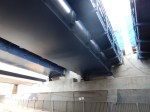
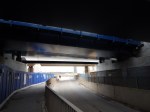

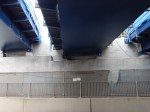
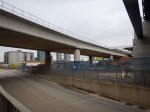


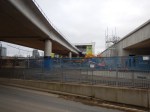
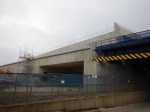
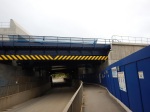
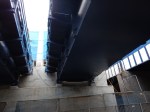
Note that the Crossrail bridge is blue steel and theat for the DLR is concreate.
They are certainly a set of impressive bridges from underneath.
From The Greenway To Stratford International Station
These are pictures, I took whilst walking and riding from the ~Old Ford Recycling Centre on the Greenway to Stratford station.
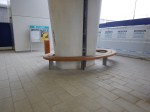
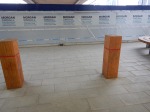
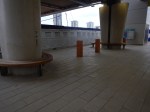


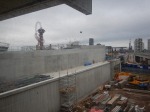
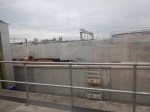
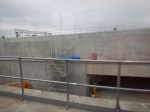

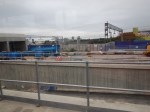



Note.
A Design Crime – Ebbsfleet International Station
If there is one station in the UK, that has been deliberately designed to be difficult to use, it is Ebbsfleet #international station.
Take this evening, when I had taken a lift to the station after the football at Ipswich, as the Great Eastern Main Line was having its annual rebuild and I didn’t want to spend an hour in a rickety bus, rather than in a comfortable Mark 3 coach.
Arrive at most stations in the UK or the world for that matter, and the first thing that you see is a ticket office or a ticket machine.
But not at Ebbsfleet International!
You are presented with a departure board, which tells you where trains will be going and if like me, you are going to St. Pancras International station, you notice that alternative trains leave from platform 2 and 5. Platform 2 is to the left on the level and platform 5 is to the right down a set of steps
So if you have just a fewminutes before your train, perhaps it would be a good idea to buy a ticket, as you enter the station.
But you can’t, as the only ticket machines are by the platforms. on either side.
Whose stupid idea was this?
If ever a station needed a ticket machine as you come in, with a sign saying that the next St. Pancras train leaves from platform X, it is Ebbsfleet International.
As it was, after about four minutes, I was able to determine that I had twelve minutes before the next train from platform 5, so I was able to walk down the set of steps, buy a ticket and get to the draughty platform about eight minutes before the train arrived.
Is Ebbsfleet International, the only station in the UK, where to transfer across a concourse between two ends, there is a set of steps in the middle?
It could be considered that Manchester Piccadilly has steps, but it does have fifteen platforms and was designed over a period of well over a hundred years.
The entry problem could be eliminated by more or relocated ticket machines and a small display telling passengers for St. Pancras, where to go.
It is all down to the bizarre layout of the station.
This Google Map shows the two-station layout of the station.
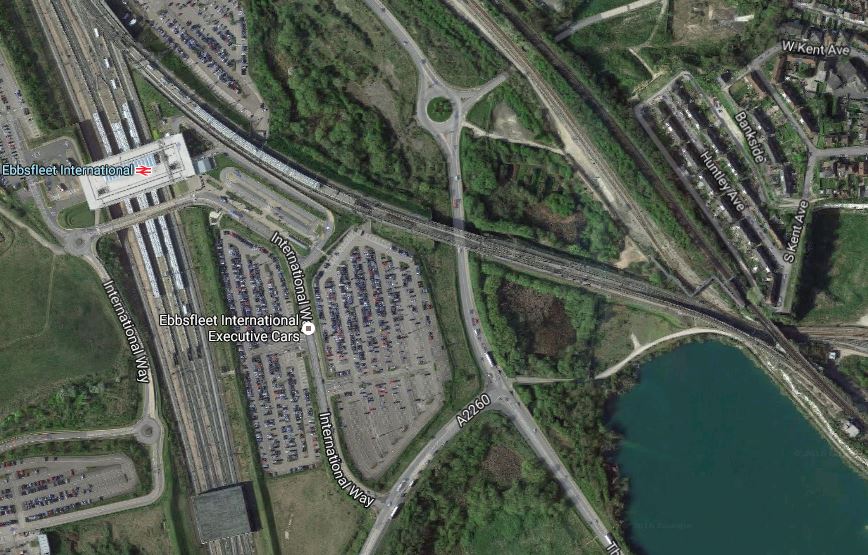
Ebbsfleet International Station
The lines going North South through the station are the Eurostar and the HighSpeed domestic services between St. Pancras International and Ashford International stations. The lines branching off to the South East, take the Highspeed domestic services to Faversham.
The Faversham lines have their own platforms 5 and 6 and there are two other platforms 2 and 3 in the other side of the station, sandwiched in-between the Eurostar lines.
This station was built on a green field site with plenty of space, so surely a better layout of lines could have been provided so that all Highspeed domestic services used the same pair of platforms.
Getting There
Ebbsfleet International was certainly designed to be difficult to get to from other parts of the London and the South East.
Romford is a major station in East London, with this recommended route to Ebbfleet Inyternational.
- TfL Rail to Stratford
- DLR to Stratford International
- Highspeed to Ebbsfleet International.
It may be step-free, but there is certainly quite a distance on the flat.
This is the route from Guildford
- South West Trains to Vauxhall
- Victoria Line to St. Pancras
- Highspeed to Ebbsfleet International
Not a route that I’d recommend to anybody with a heavy case or any difficulty in walking.
This is the route from Greenwich.
- Southeastern to Charlton
- Southeastern to Gravesend
- Highspeed to Ebbsfleet International
That route truly is a corker.
This one might improve as according to Modern Railways for August 2016, that Thameslink will be starting a service between Luton and Rainham via Dartford and Greenwich. Hopefully this would mean a route from Greenwich to Ebbsfleet Internation as follows.
- Thameslink to Gravesend
- Highspeed to Ebbsfleet International
That is only one change, but you’d still need to go over the step-free bridge at Gravesend.
The solution would be to do either of the following.
- Create a proper passenger connection between Northfleet and Ebbsfleet International stations.
- Allow North Kent services that go to and from Dartford to call at Ebbsfleet International station.
Why didn’t the traditional North Kent services call at Ebbsfleet International station from Day 1?
Get the connection right and all those stations between London Bridge and Rainham would have a two trains per hour service to Ebbsfleet International.
Future Expansion
Ebbsfleet International also seems to be designed deliberately to make extension difficult.
Space for extra platforms for these possible services seems not to have been left.
- Termination of Continental services, should St. Pancras get too busy.
- A Crossrail extension from Abbey Wood station.
- An East-West service from Reading and Gatwick.
Expansion can only probably be achieved by adding further complication and difficulties for passengers at this truly dreadful station.
The designer’s dictionary, certainly didn’t include that important word future-proofing.
He certainly gave Eurostar and the Highspeed domestic services, one of the least passenger-friendly stations in the world. that fits well with Eurostar’s other crap stations.
- The extremely passenger-unfriendly St. Pancras.
- The bleak, isolated and draughty Stratford International
Perhaps the airline industry had a hand in its design, in the hope they could strangle the whole enterprise!
Stratford and Ebbsfleet could also have been designed the way they are, so that they didn’t have easy and quick interchanges with Crossrail.
That would have meant, that passengers would use this more affordable service rather than the expensive Highspeed domestic ones, that always seem half-empty, when I use them.
The three stations are all certainly design crimes and taken together they make the Channel Tunnel Rail Link a design crime of the most immense proportions
But given that it is impossible to do much with the station, what should be done now?
- The draughty space between the two separate stations, should be made more welcoming.
- Information should tell passengers the next trains to all stations.
- Ticket machines must be provided as you enter, rather than being hidden away.
- The steps to platforms 5 and 6, should be replaced by short escalators and an inclined lift.
Perhaps most importantly, contactless ticketing using bank cards and Oyster must be available on all Highspeed domestic services. I can use that to get to Gatwick Airport, so why not Ebbsfleet International?
Related Posts
Between Abbey Wood And Belvedere Stations
Connecting North Kent And The Medway Towns To Ebbsfleet International Station
Extending Crossrail To Gravesend
What Do You Do With A Problem Like Sheppey?
 The Anonymous Widower