Destination Manchester
The title of this post is the same as the title of this page on the London North Western Railway web site.
The page introduces, the operator’s proposed new service to Manchester.
As a progressive rail operator we’re always looking to develop our services and timetables to provide a better travelling experience for our customers. We are ambitious and our team seek innovative solutions to create new journey opportunities.
That’s why we have developed proposals for our trains to begin serving Manchester for the first time. Under the plans, our existing hourly service between Crewe and London Euston would be extended to Manchester city centre from summer 2026.
Following the cancellation of the northern leg of HS2, these proposals will provide much-needed connectivity between Manchester, the West Midlands and London, with thousands of extra seats every day.
In more detail, the extended London Euston and Crewe service to Manchester Victoria station, will create the following.
- Additional capacity and comfortable, affordable journeys to and from Manchester city centre
- A great alternative to car and coach travel, with fares up to 50% cheaper than the main intercity train operator
- New regular direct services to Warrington for passengers at Milton Keynes, Rugby and Lichfield
- New regular direct services to Manchester for passengers at Rugeley, Lichfield, Tamworth and Atherstone
Note.
- The service will pass through Warrington Bank Quay, Stockport, Earlestown, Newton-le-Willows, Eccles and Salford Central to reach Manchester Victoria, so could be a comprehensive service to the Northern and Western parts of Manchester City Centre. It would just depend on the stopping pattern in the City Centre.
- There would be good connections to Manchester Metrolink at Eccles and Manchester Victoria.
- All stations on the Manchester Metrolink can be reached either direct or with a single change from Manchester Victoria.
- Manchester Metrolink is touch-in and out with a credit card.
- Manchester Victoria is very well connected by rail to cities and important destinations across the North including Blackburn, Blackpool, Bradford, Burnley, Halifax, Hebden Bridge, Huddersfield, Leeds, Liverpool, Preston, Wigan and York.
- The page talks of a London Euston and Manchester Victoria time of three hours and ten minutes.
- Manchester Stations is a group of the four stations; Manchester Piccadilly, Manchester Oxford Road, Manchester Victoria and Deansgate. Often a ticket to Manchester Stations is a few pounds cheaper and more convenient, if you are visiting several places in the City Centre.
The London Euston and Manchester Victoria service looks to me to be a well-thought out proposal.
A New Connection To Manchester Airport
Under a title of Anything Else on the page on the London North Western Railway web site, this is said.
As well as the proposal to extend our London Euston-Crewe services to Manchester Victoria, we are also proposing to begin running trains to Manchester Airport. This will involve extending our existing service between Stafford and Crewe, providing direct connectivity to the airport from Stoke-on-Trent and Staffordshire. More details on this proposal will be announced in due course.
Note.
- The extended Stafford and Manchester Airport service could call at Stone, Stoke-on-Trent, Longport, Kidsgrove, Alsager, Crewe, and possibly Wilmslow and Styal.
- Stafford, Stone, Stoke-on-Trent, Longport, Kidsgrove and Alsager would gain direct services to and from Manchester Airport.
- It would appear that the current Stafford and Crewe service waits in Stafford station for at least fifteen minutes.
- The current Stafford and Crewe service appears to always use platform 6 at Stafford.
- The current Euston and Crewe service appears to always use platform 3 at Stafford.
- The current Crewe and Euston service appears to always use platform 1 at Stafford.
- The current Birmingham and Liverpool service appears to always use platform 5 at Stafford.
- The current Liverpool and Birmingham service appears to always use platform 4 at Stafford.
I suspect that trains can be timetabled, so that the following is possible.
- An hourly London Euston and Manchester Airport service with a quick step-free change at Stafford between the London Euston and Manchester Victoria service and the Stafford and Manchester Airport service.
- An hourly Manchester Airport and London Euston service with a quick step-free change at Stafford between the Manchester Airport and Stafford service and the Manchester Victoria and London Euston service.
- An hourly Birmingham New Street and Manchester Airport service with a quick cross-platform change at Stafford between the Birmingham New Street and Liverpool Lime Street service and the Stafford and Manchester Airport service.
- An hourly Manchester Airport and Birmingham New Street service with a quick step-free change at Stafford between the Manchester Airport and Stafford service and the Liverpool Lime Street and Birmingham New Street service.
Note.
- I suspect more changes at Stafford could be cross-platform.
- I also suspect that it is possible to arrange that all services to the same destination, leave from the same platform, at the same time or times each hour.
- It would appear too, that if you want a cheap ticket price to Liverpool Lime Street, Manchester Victoria or Stoke-on-Trent, then you may have to change at Stafford.
It appears all more affordable London Northwestern Railway trains will go via Stafford.
I have some further thoughts.
Stafford And Manchester Airport Timings
With all the stops, it looks like Stafford and Manchester Airport will take about 78 minutes, but if they used the West Coast Main Line and didn’t stop the time could be reduced to just under an hour.
The Class 730 Trains
The services will be run by 110 mph Class 730 trains.
In 2018, there was talk of a bi-mode 125 mph Aventra, which I wrote about in Bombardier Bi-Mode Aventra To Feature Battery Power.
Currently, the Class 730 trains are 110 mph trains.
Would it help timetabling and capacity if these trains could be stretched to 125 mph?
Avanti West Coast
Several Avanti West Coast services stop at Stafford.
Their services could be half-an-hour quicker to Stafford, but they wouldn’t have the same stopping patterns.
In response to the competition, Avanti West Coast might run a few Manchester Airport Expresses using their new Class 805 trains.
A Second Service Between Stoke And Manchester Airport
I feel this might be needed and perhaps it could be faster, by using the direct route between Stafford and Crewe.
Avanti West Coast could use it to create a one-change fast service between London Euston and Manchester Airport, if they felt such a service were to be needed.
Conclusion
I like this proposal.
But there is a lot of fine tuning to do!
RWE Plans Hydrogen-Ready Combined-Cycle Gas Turbine At Gersteinwerk In Werne
The title of this post, is the same as that of this press release from RWE.
These two bullet points act as sub-headings.
- Italian-Spanish consortium commissioned to plan 800-megawatt plant
- Investment decision to be made once H2 grid connection and regulatory framework are in place and economic viability has been established
These two paragraphs introduce the project.
RWE is planning to build hydrogen-ready gas-fired power plants at the company’s power plant sites in Germany to contribute to a successful coal phase-out by 2030. Following Weisweiler in the Rhenish mining area, the company is now pressing ahead with plans for such a plant at a possible second site in Werne in the southern Münsterland region. An H2-ready combined-cycle gas turbine (CCGT) power plant with a nominal capacity of around 800 megawatts may be built at the Gersteinwerk power plant.
Following intensive technical soundings, RWE has commissioned an Italian-Spanish consortium to plan the project. Work on the planning approval process is already underway.
These are my thoughts.
The current coal-fired power station at Gersteinwerk has a capacity of 2127 MW and was built in 1984.
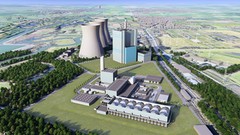
This is a visualisation of the two power stations.
Note.
- The new gas/hydrogen-fired power station is in the foreground.
- The coal-fired power station, with its three cooling towers is behind.
This Google Map shows the site.
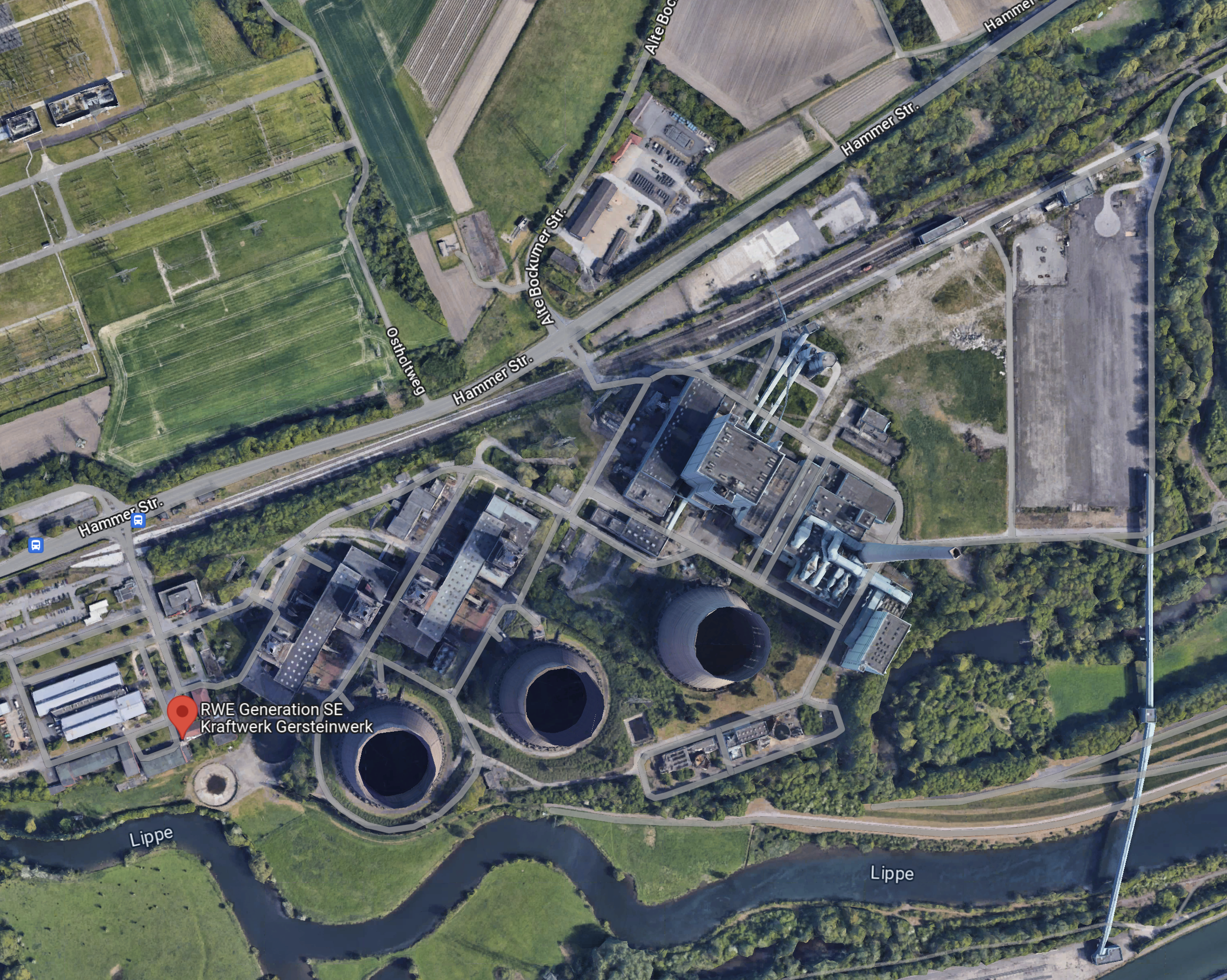
I suspect that due to the size of the original coal-fired power station, more than one hydrogen-fired power station will be needed.
Project Timeline
These paragraphs lay out the project timeline and the route to 100 % hydrogen operation.
Work on the planning process is already underway. This is the prerequisite for RWE to be able to start implementing the project as soon as an investment decision has been made.
According to current planning, the plant in Werne could start producing electricity by 2030.
At the time of commissioning, the plant should be able to use a fuel mix with at least 50 per cent hydrogen content, and it is intended to run it entirely on hydrogen at a later stage.
Germany is aiming for a coal phase-out by 2030.
The Scale Of German Power Decarbonisation
This article on Power Technology is entitled Germany To Invest €16bn In Hydrogen-Ready Gas-Fired Power Plants.
These are the first two paragraphs.
Germany’s Ministry for Economic Affairs and Climate Action (BMWK) has agreed to provide subsidies of €16bn for the construction of 10GW of hydrogen-ready gas-fired power plants.
The subsidy scheme has been significantly reduced since August 2023 when the proposal was first unveiled. A maximum of 23.8GW was anticipated at that time.
These power stations will need a lot of green hydrogen and I believe the most convenient place to source some of the hydrogen, will come from the windy waters of the UK’s North Sea.
RWE already have leases to build 7.2 GW of wind farms in UK waters.
Liberty Lines Commissions First High-Speed Ferry With mtu Hybrid System From Rolls-Royce
The title of this post, is the same as that of this press release from Rolls-Royce.
These two bullet points act as sub-headings.
- “Vittorio Morace” the world’s first hybrid high-speed ferry to IMO HSC standard with a length of almost 40 metres is fast at sea and emission-free in harbour
- A further 8 Liberty Lines ferries with mtu hybrid systems will enter into service in Italy, Slovenia and Croatia
This picture shows the first of the fleet.

This is the first paragraph.
On 27 June 2024, the Italian shipping company Liberty Lines ceremonially launched the world’s first hybrid fast ferry of this category and size in Trapani, Sicily, powered by an mtu hybrid propulsion system from Rolls-Royce. The 39.5 meter long ship has a capacity of 251 passengers, reaches a speed of over 30 knots and will significantly reduce the impact of ship operations on the environment. The “Vittorio Morace”, built by the Spanish shipyard Astilleros Armon and designed by Incat Crowther, is the world’s first IMO HSC (High-Speed Craft) hybrid fast ferry of this size and has been classified as a “Green Plus” ship by the Italian classification society RINA.
This ferry can truly be considered to be a Ship-of-the-World, with a design from an Australian-headquartered International company and German engines, that has been built in Spain.
This paragraph describes the power-train.
The battery-electric part of the drive is used for locally emission-free driving in the harbour area and as a booster. CO2 emissions are reduced by the particularly efficient mtu Series 4000 diesel engines which can also run on the renewable diesel (HVO, hydrotreated vegetable oil). Its use can lower the CO2 footprint by up to 90 per cent. Furthermore, the comparatively low overall weight of both the engines and the hybrid drive system contributes to high vessel propulsion efficiency, thereby reducing fuel consumption and emissions.
Over the last thirty years, I’ve been to several of the places served by Liberty Lines, so some excellent journeys, will be made faster, quieter and better.
Appropriate Nutrient Supplementation In Coeliac Disease
The title of this post, is the same as that of this article on PubMed.
I choose this article, as the abstract gave a good list of related problems to coeliac disease.
This is the abstract.
Reduced levels of iron, folate, vitamin B12, vitamin D, zinc, and magnesium are common in untreated celiac disease (CD) patients probably due to loss of brush border proteins and enzymes needed for the absorption of these nutrients. In the majority of patients, removal of gluten from the diet leads to histological recovery and normalization of iron, vitamin, and mineral levels. Iron deficiency anemia is the most common extra-intestinal sign of CD and usually resolves with adherence to a gluten-free diet. However, deficiencies of both folate and vitamin B12 may persist in some patients on a gluten-free diet, thus requiring vitamin supplementation to improve subjective health status. Similarly, exclusion of gluten from the diet does not always normalize bone mineral density; in these cases, supplementation of vitamin D and calcium is recommended. Resolution of mucosal inflammation may not be sufficient to abrogate magnesium deficiency. Since gluten-free cereal products have a lower magnesium content as compared with gluten-containing counterparts, a magnesium-enriched diet should be encouraged in CD patients. In this article we discuss the frequency and clinical relevance of nutrient deficiency in CD and whether and when nutrient supplementation is needed.
I am coeliac and was diagnosed at fifty, by by a mixture of the suspicions of an elderly locum, the very modern genetic test and the classic endoscopic test , in the last few years of the twentieth century.
I have to admit, that being diagnosed was a bit of a surprise.
Are Bodies Cleverer Than We Think?
Because, I had a serious stroke thirteen years ago, I am on Warfarin for life to thin my blood, so that I don’t have another stroke.
INR is short for International Normalized Ratio, which diverts on Wikipedia to the Wikipedia entry for Prothrombin Time, where these is the first two paragraphs.
The prothrombin time (PT) – along with its derived measures of prothrombin ratio (PR) and international normalized ratio (INR) – is an assay for evaluating the extrinsic pathway and common pathway of coagulation. This blood test is also called protime INR and PT/INR. They are used to determine the clotting tendency of blood, in such things as the measure of warfarin dosage, liver damage, and vitamin K status. PT measures the following coagulation factors: I (fibrinogen), II (prothrombin), V (proaccelerin), VII (proconvertin), and X (Stuart–Prower factor).
PT is often used in conjunction with the activated partial thromboplastin time (aPTT) which measures the intrinsic pathway and common pathway of coagulation.
That is very technical and complicated, but what does it mean practically?
Those on Warfarin to thin their blood are generally supposed to keep their INR between 2 and 3.
I test the INR myself with a Coaguchek meter from Roche and have done so for nearly ten years.
Every, so often, I discuss the level of Warfarin with my GP and we adjust the level accordingly.
Typically, NHS patients on Warfarin have their INR checked every few weeks.
But as I am a Graduate Control Engineer, who has written control strategies for chemical plants, I feel this checking every few weeks, is not enough.
At times, I have checked at a higher frequency.
Four times, I have had minor operations.With the first operation, I agreed with the surgeon, that I would lower my INR to 2.1 for the operation and raise it back to 2.5 after the operation.
It all went well and I repeated the exercise for the three other minor operations.
I have checked daily since about the beginning of April, before which, I generally tested on Mondays and Thursdays.
There were two reasons for the change of frequency.
- Regular storms seemed to roll in and for some reason, they tended to lower my INR.
- I also wrote Do Thunderstorms Cause Strokes?, after reading a paper from the United States about the relationship between thunderstorms and strokes.
So I took the prudent decision to test my INR daily.
Then on the 30th May, disaster struck.
My Coaguchek meter found out it had the wrong firmware and Roche implored me to change it.
But I am not a hardware person, so I was left unable to check my INR.
Luckily, I remembered a story from the 1960s about one of ICI’s chemical plants.
This plant was one of the first fully-digitally controlled plants controlled by an IBM 1800 computer.
It also ran 24 hours a day, seven days week.
So in the middle of the night, the plant operators got out all the computer printouts, which showed how the computer had set all the valves and controllers.
One-by-one they reset all the controls on the plant to the settings that the computer had used for the last few days.
Using, this computer-assisted mode the plant was kept running, until engineers could fix the computer.
On the 30th May, my INR was a little bit high at 2.9 and I was using a dosage of Warfarin of 4 mg. one day and 3.5 mg. the next.
The strange dosage was one, that I know from experiment over time produces an INR of 2.5.
My actual average Warfarin dose was 3.73 over the last thirty days and my INR, as measured most days was 2.6 over the same period.
So, I did what the engineers did on the chemical plant, kept calm and carried on.
Yesterday my son fixed the Coaguchek meter and I was able to take my first reading for 17 days. It was 2.7 and only 0.1 higher than the 30-day average on the 30th May.
I had successfully jumped the gap in the readings.
Conclusion
Most systems have an equilibrium. Make sure you know it.
Wood To Optimise Hydrogen Storage For Centrica’s Rough Field
The title of this post, is the same as that of this press release from Wood plc.
These are the first three paragraphs.
Wood, a global leader in consulting and engineering, has been awarded a contract by Centrica Energy Storage (CES) for the redevelopment of the UK’s Rough field in readiness for future hydrogen storage.
The Rough reservoir, located in the Southern North Sea, has been used to store natural gas safely for over thirty years and has the potential to provide over half of the UK’s hydrogen storage requirements.
The front-end engineering design (FEED) contract, awarded to Wood, entails new pipelines, a new unmanned installation, as well as onshore injection facilities at the Easington Gas Terminal, is the first step in making the field hydrogen ready.
Offshore Magazine has this article about the deal, which is entitled Wood Assessing Hydrogen Storage Needs For North Sea Rough Reservoir.
This is a paragraph from the Offshore Magazine article.
Centrica aims to position the Rough Field as the world’s largest long-duration hydrogen storage facility, although FID on the redevelopment project would depend on government support.
It would be a very important project.
Why would Centrica be planning for this massive increase in hydrogen storage?
There could only be one reason.
There is going to be a massive increase in hydrogen production and use.
In Where’s The Plan, Rishi?, I laid out what I believe will happen in the next few years.
- In RWE Goes For An Additional 10 GW Of Offshore Wind In UK Waters In 2030, I detailed how RWE intended to add an extra 10 GW of offshore wind to the seas around the UK.
- As our current offshore wind capacity is around 15 GW, so another 10 GW would surely be very welcome.
- The Germans will develop H2ercules, which is their massive project to create a hydrogen network to bring hydrogen to Southern Germany.
- A hydrogen hub at Wilhelmshaven is being built by Uniper to feed H2ercules with green hydrogen from around the world.
But would it not be better, if instead of feeding H2ercules with hydrogen from around the world, some came from the UK, a few hundred miles across the North Sea?
- RWE are developing the 3 GW Dogger Bank South wind farm, which is not in the best place for a cable to the UK. So could this wind farm have an offshore electrolyser and send the hydrogen to Wilhelmshaven, by pipeline or coastal tanker?
- RWE are also developing the 4.2 GW Norfolk cluster of wind farms to the North-East of Great Yarmouth. It might be better, if the output of these wind farms took a hydrogen route to Wilhelmshaven.
- I also believe that a third offshore electrolyser might be situated North of the Wash to bring more hydrogen to Germany.
- Hydrogen could also be sent from the Rough facility to Wilhelmshaven.
The coastal tanker route gives flexibility, so green hydrogen could be sent as required to the UK mainland.
Rishi Sunak’s Manifesto Speech – June 11
I also reported on Rishi Sunak’s Manifesto Speech, which he made on June 11th. This is an extract
This document on the Policy Mogul web site is entitled Rishi Sunak – Conservative Party Manifesto Speech – Jun 11.
These are three paragraphs from the speech.
We don’t just need military and border security. As Putin’s invasion of Ukraine has shown, we need energy security too. It is only by having reliable, home-grown sources of energy that we can deny dictators the ability to send our bills soaring. So, in our approach to energy policy we will put security and your family finances ahead of unaffordable eco zealotry.
Unlike Labour we don’t believe that we will achieve that energy security via a state-controlled energy company that doesn’t in fact produce any energy. That will only increase costs, and as Penny said on Friday there’s only one thing that GB in Starmer and Miliband’s GB Energy stands for, and that’s giant bills.
Our clear plan is to achieve energy security through new gas-powered stations, trebling our offshore wind capacity and by having new fleets of small modular reactors. These will make the UK a net exporter of electricity, giving us greater energy independence and security from the aggressive actions of dictators . Now let me just reiterate that, with our plan, we will produce enough electricity to both meet our domestic needs and export to our neighbours. Look at that. A clear, Conservative plan not only generating security, but also prosperity for our country.
It is now nineteen days since Rishi made that speech and I can’t remember any reports about an energy security policy, which he outlined in the last paragraph of my extract from his speech.
He particularly mentioned.
- New gas-powered stations
- Trebling our offshore wind capacity
- Having new fleets of small modular reactors.
He also said we would have sufficient electricity to export to our neighbours. As I said earlier some of this energy will be in the form of hydrogen, which has been created by offshore electrolysers.
If we are exporting electricity and hydrogen to Europe, this is likely to have three effects.
- An improvement in Europe’s energy security.
- H2ercules will improve and decarbonise German industry, using UK hydrogen.
- The finances of UK plc will improve.
It looks like there will be winners all round.
Conclusion
Centrica’s plan for a massive hydrogen store at Rough, close to SSE’s existing gas storage in the salt caverns at Aldbrough, would appear to make sense, if the UK’s excess of offshore wind is converted into green hydrogen, which is then stored and distributed as needed.
Heat-Related Hospital Admissions And Deaths In London
I never saw my father ride on a deep Underground line, like the Northern or the Piccadilly, as he always said the air was terrible.
That was despite we lived within walking distance of Oakwood station and his print works was just a hundred metres from Wood Green Underground station.
But then he was a man, who always had a car, when I knew him, so I suppose he felt he better use it.
On one occasion, he took me to the Printing Industries Fair at Earl’s Court, which is just seventeen stops on the Piccadilly Line from Wood Green Underground station, as it still is today.
His route was as follows.
He left his MG Magnette outside the print works on Station Road.
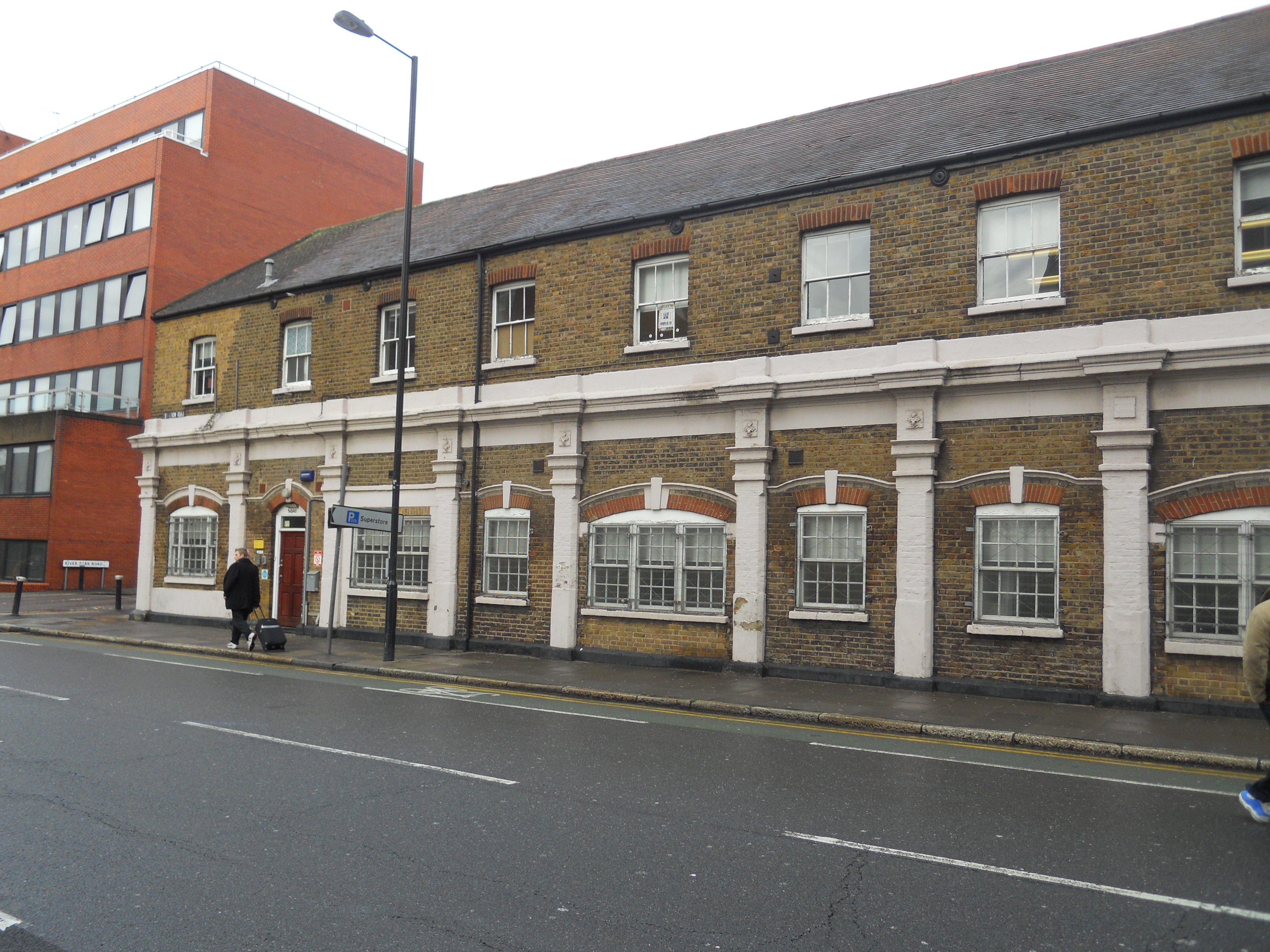
As this picture I took in 2012 shows, parking wasn’t too difficult.
We then walked up the hill to Wood Green station, which is now called Alexandra Palace, from where we took a steam-hauled local train into King’s Cross.
From King’s Cross, we took a Metropolitan Line train to Hammersmith station.
At Hammersmith, we changed stations and then took a train to Baron’s Court station for Earl’s Court Exhibition Centre.
Today, the route between Alexandra Palace and Earl’s Court stations is very different.
- You can change trains at Moorgate, Farringdon or King’s Cross.
- The oldest trains, that you’ll travel on would have been built in 2008.
- All trains will be fully air-conditioned.
I feel, that I could probably get my father to use this route. Although, I doubt it would happen, as he would have turned 120, at the start of this year.
The Growth Of Air Conditioning
Many cars since the 1980s have been airconditioned and now trains are following that route.
In London these are some dates, when trains were air-conditioned.
- Circle, District, Hammersmith & City and Metropolitan from 2008.
- Elisabeth Line from 2017.
- Gospel Oak and Barking from 2019.
- Greater Anglia from 2019/20.
- Lee Valley Lines from 2019.
- London Midland from 2023.
- London Overground from 2009.
- Southern from 2003.
- Southeastern from 2003.
- Thameslink from 2014.
Each year, more and more trains will be air-conditioned.
Conclusion
Has this growth of air-conditioning reduced the number of cases of heatstroke and other heat related admissions to hospitals?
Centrica Business Solutions And Highview Power
Centrica Business Solutions is one of Centrica’s business units.
It has its own web page, with this sub heading.
Helping Organisations Balance Planet And Profit
This is followed by this mission statement.
Centrica Business Solutions helps organisations to balance the demands of planet and profit, by delivering integrated energy solutions that help you save money and become a sustainable business.
Several pictures show some of the solutions, that Centrica Business Solutions can provide.
Centrica Business Solutions In Numbers
These numbers are given about the customers of Centrica Business Solutions.
- Customer Sites Globally – 7000
- Solar PV Installations Delivered Worldwide – 16,380+
- Solar PV Installations Delivered Power – 240 MW
- CHP Units Operated And Maintained Globally – 700 MW+
- Energy Data Points Collected Each Month Globally – 29 billion
Theses are large numbers.
How Would Centrica Business Solutions Use Highview Power’s Batteries?
The obvious use of Highview Power’s batteries is to connect them between a solar or wind farm and the grid, for when the sun isn’t shining or when the wind isn’t blowing.
Currently, there are three sizes of Highview Power batteries, either working on under development.
5MW/15 MWh
This is the demonstration system, which is described on this page of the Highview web site.
Surely, if a system of this size is very useful for Viridor, there may be other applications and customers out there.
This system will provide 5 MW for three hours.
50MW/300MWh
This is the Carrington system, which is described on this page of the Highview web site.
The Highview web site says this about output potential and connectivity.
The facility will store enough clean, renewable energy to serve the needs of 480,000 homes, as well as providing essential grid stabilisation services. The site will use existing substation and transmission infrastructure.
This system will provide 50 MW for six hours.
200MW/2.5GWh
This is the larger system for Scotland and the North East, which is under development and described on this page of the Highview web site.
The Highview web site says this about output their use.
These will be located on the national transmission network where the wind is being generated and therefore will enable these regions to unleash their untapped renewable energy potential and store excess wind power at scale.
This system will provide 200 MW for 12.5 hours.
In Rio Tinto Punts On British Start-Up To Plug Renewables Gap, I said this.
In Britain, Highview hopes to be putting four 2.5-gigawatt assets into planning this year – one in Scotland, three with Orsted in England.
This sentence was originally published in this article on the Australian Financial Review.
I believe that Centrica could find applications for all three sizes of Highview’s batteries.
Suppose, though Centrica find that an application needs say a 100 MW/1 GWh battery.
From the mathematics, I did at ICI in the 1970s, when looking at the scaling of chemical plants, I believe that Highview’s battery design could be scalable, by just using appropriately-sized turbomachinery, matched to the right number of tanks.
So the customer would get the battery size they needed!
How Much Electricity Could One Of Highview’s Batteries Store?
This image shows large LNG tanks at Milford Haven.
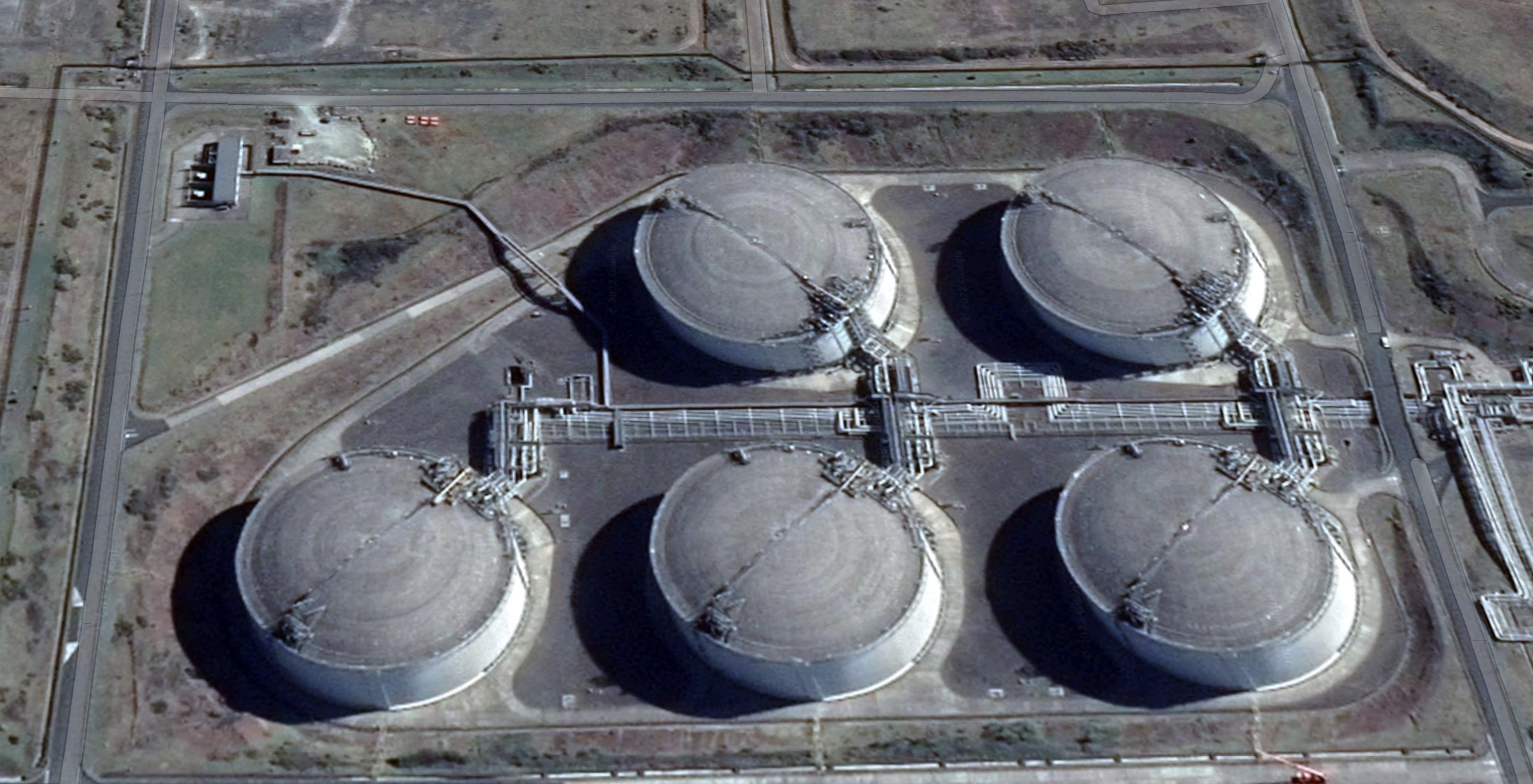
In Could A Highview Power CRYOBattery Use A LNG Tank For Liquid Air Storage?, I did a rough calculation and found that the largest LNG tanks could hold enough liquid air, that would be the equivalent of around one GWh.
So the image above could be a 5 GWh battery.
This image clipped from Highview’s web site, shows large tanks for liquified gas storage.
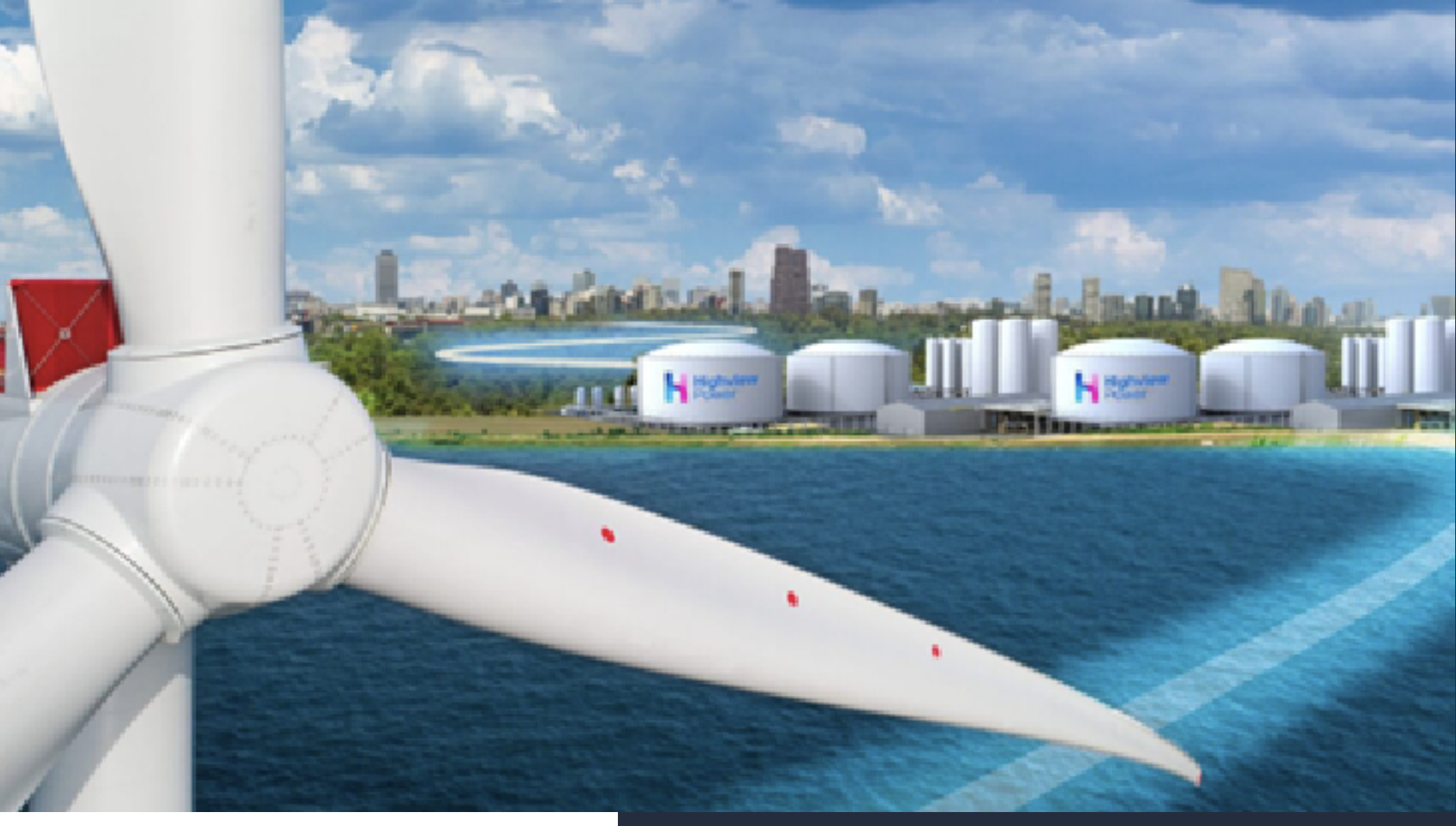
With tanks like these, Highview could be building batteries with storage to rival the smaller pumped storage hydroelectric power stations.
In Grid Powers Up With One Of Europe’s Biggest Battery Storage Sites, I talked about how Ørsted were planning the Swardeston BESS, where the 2852 MW Hornsea Three wind farm connects to the grid.
The chosen battery will be from Tessla with an output of 300 MW and a capacity of 600 MWh.
I suspect Ørsted couldn’t wait for Highview, but circumstances might have changed now, with the financing deal for the Carrington battery!
Are Combined Heat And Power Units And Highview’s Batteries Interchangeable And Complementary Technologies?
According to the Centrica Business Systems web site, they have deployed over 700 MW of CHP systems globally.
I wonder how many of these systems could have used a standard Highview battery?
Perhaps, Centrica Business Systems have done a survey and found that it could be quite a few.
So, perhaps if Centrica Business Systems had access to Highview’s technology, it would increase their sales.
In addition how many of Centrica Business Systems existing CHP systems, would be improved with the addition of a Highview battery?
It appears to me, that if Centrica Business Systems were to develop a series of standard solutions based on Highview’s technology, they could substantially increase their sales.
What Could Centrica Business Systems Do For Highview Power?
Centrica Business Systems could probably develop several standard applications with Hoghview’s technology, which would be to the benefit of both companies.
But, I believe that as Centrica Business Systems are supporting large number of systems globally, that they are in a good place to help develop and possibly run Highview Power’s support network.
Conclusion
I can see Centrica Business Systems and Highview Power having a long and profitable relationship.
The Chemical Engineer Magazine On Highview Power
This is said in the Wikipedia entry for The Chemical Engineer Magazine.
The Chemical Engineer is a monthly chemical engineering technical and news magazine published by the Institution of Chemical Engineers (IChemE).
I first read the magazine perhaps fifty years ago, when it explained a chemical process, I was working on at ICI.
It is one of several well-respected magazines published by UK scientific, medical and engineering institutions.
This article in the magazine is entitled Energy Stored As Liquefied Air: £300m Investment Triggers Construction Of UK’s First Commercial-Scale Plant.
These three paragraphs introduce the investment.
HIGHVIEW POWER has received £300m (US$379m) in funding to build the UK’s first commercial-scale liquid air energy storage plant (LAES), designed to balance peaks and troughs in power demand as more renewable energy sources are brought online.
Construction of the facility is now underway in Carrington near Manchester. It is scheduled to begin operations in early 2026 and the company predicts it will provide more than 700 jobs in construction and the supply chain.
The plant will have a storage capacity of 300 MWh and an output of 50 MW per hour for six hours.
The rest of the article is just two sections.
- How Will Highview’s New Plant Work?
- Why Is The Technology Needed?
This article in the magazine is an absolute must read.
Centrica Invests In Renewable Energy Storage Capabilities To Boost UK’s Energy Security And Accelerate Transition To Net Zero
The title of this post, is the same as that of this press release from Centrica.
These two paragraphs are effectively headings.
Centrica plc announces a strategic partnership and £70 million investment in Highview Power and its first clean energy storage project in Carrington, Manchester.
Centrica’s investment will be a key part of a £300 million funding package to develop the first commercial-scale Liquid Air Energy Storage plant in the UK, which will boost the UK’s energy security and accelerate the transition to net zero.
These four paragraphs give more details on the deal.
The investment, which forms part of our plans to invest between £600m – £800m a year until 2028, will be structured as £25m of convertible debt at Highview Enterprises Limited, being the Highview Power holding company and £45m of debt funding at the Carrington Liquid Air Energy Storage project, phased over the project construction. The investment delivers several benefits to Centrica:
Robust standalone returns aligned with Centrica’s capital allocation framework and returns thresholds
Aligned to our green-focused investment programme targeting assets which complement our existing capabilities, provide balance to the portfolio, and align to the needs of the energy transition
Includes rights to equity participation and energy optimisation from future projects in Highview’s £9 billion project pipeline.
At a first look, it appears to give Centrica robust returns and some security for their £70 million investment.
But it is the last paragraph that I like. Does it mean that Centrica can cherry-pick, the projects that it likes and fit its own objectives and expertise from Highview’s £9 billion project pipeline and take-up some equity?
Whatever it means, It looks like it will be good for Centrica.
Do the other partners have similar rights to equity?
Suppose Goldman Sachs have a long-term client in the Mid-West of the United States, who are an electricity generator, with perhaps half-a-dozen coal-fired power stations.
As the client needs to decarbonise and it is believed that Highview’s long duration batteries can replace small coal-fired power stations, it is likely that a Highview solution will at least be examined.
If the client goes down the Highview route, Goldman Sachs might like to continue their long-term relationship, by taking a share in the equity.
 The Anonymous Widower