Extending The Elizabeth Line – Could Open Access Services Use The Elizabeth Line?
In the February 2024 Edition of Modern Railways, there is an article which is entitled First Bid For Sheffield To King’s Cross Paths.
The article is mainly about FirstGroup’s proposal for a new Sheffield and London service, running under the Hull Trains brand.
But, this is the last paragraph.
Modern Railways understands First is working on a number of proposals for additional open access services, and this is an early statement of intent. Other existing open access proposals include Grand Union Trains’ plans for London to Stirling and Cardiff to Edinburgh services, along with an already approved London to Carmarthen service, and the recently submitted Wrexham, Shropshire and Midland Railway application for a London to Wrexham service. It is understood other organisations, including MTR and Virgin, are also working up plans for new open access services.
The respected Modern Railways magazine seem to think, that we’ll be seeing more open access services on UK railways.
These are my thoughts.
A Simple Example – London Crosslink
In Extending The Elizabeth Line – London Crosslink, I said this.
In the Wikipedia entry for the London Crosslink, this is the introduction.
London Crosslink was a passenger train service operated by Anglia Railways between Norwich and Basingstoke, using the North London Line to bypass central London. Class 170 Turbostar diesel multiple units were used, and the service operated between 22 May 2000 and 28 September 2002, supported by funding from the Strategic Rail Authority through its Rail Passenger Partnership fund.
As it was discontinued and it doesn’t seem to be sadly missed, I’m not advocating its reinstatement, but just looking how it might be run after the full opening of the Elizabeth Line.
But surely, there were good reasons, why the service was run in the first place and there might be a need in the future.
These are some characteristics of the service.
- There were about half-a-dozen services in both directions every day.
- At its full length it ran between Norwich and Basingstoke.
- Stops included Diss, Stowmarket, Ipswich, Colchester, Witham, Chelmsford, Ingatestone, Romford, Stratford, Highbury & Islington, Camden Road, West Hampstead, Brentford, Feltham, Staines, Woking and Farnborough (Main).
- Each service seemed to have a different stopping pattern.
- The timetable wasn’t very regular.
- The route wasn’t fully electrified.
It appears that it may have been a difficult service to timetable.
I lived North of Ipswich for some years.
I never used the London CrossLink service, as I had moved away before the service started in 2000.
- I would have found the change to the Central Line at Stratford station useful.
- I would have found the change to the Victoria Line at Highbury & Islington station useful.
- I would have found the change to Thameslink at West Hampstead station useful.
- Basingstoke would have given access to Greater South-West England.
- I could have got a bus to Heathrow from Feltham.
But getting to Marylebone, Paddington and Waterloo would have still been tedious.
Could a replacement for the London CrossLink be routed via the Elizabeth Line?
- The service would use the Elizabeth Line between Stratford and Reading.
- The service would use the Reading and Basingstoke Line between Reading and Basingstoke.
The route has some advantages over the original route.
- Except for the 13.6 miles between Southcote Junction and Basingstoke, the route is fully-electrified.
- Whitechapel will give access to London Overground services.
- Farringdon will give access to Thameslink services.
- There will be a lot of connections at Tottenham Court Road and Bond Street.
- Paddington and Reading will give access to Heathrow, Oxford and West of England services.
- Basingstoke will give access to Greater South-West England.
It is certainly an as-useful route as the original, if not more so.
The Trains
In Extending The Elizabeth Line – Will There Be A Need For Long Distance Class 345 Train?, I set out how a standard Class 345 train could be updated with faster running and a more appropriate interior.
As the Elizabeth Line is likely to need some more trains if High Speed Two is delayed, perhaps some extra trains should be ordered fairly soon.
The Routes
Consider.
- A terminal station would probably need to be electrified to the Elizabeth Line route.
- It would need the infrastructure to turn the trains.
These stations could probably be used as terminal stations.
- Basingstoke
- Bristol
- Cardiff
- Colchester
- Faversham
- Hoo – See Extending The Elizabeth Line – A Branch To The Isle Of Grain.
- Ipswich
- Northfleet – For European services at Ebbsfleet International.
- Norwich
- Oxford
- Rochester
- Southampton
- Southend Victoria
There will certainly be others.
Why Use Open Access?
Suppose an operator wants to run a service between Bristol Parkway and Northfleet to give the West Country access to European services.
- The operator takes all the risk and Network Rail get track access charges.
- Do Transport for London get track access charges for the Elizabeth Line tunnels?
- If they get their predictions and sums wrong, they lose the money.
But if they get it right, they probably sell it to an infrastructure company at a profit.
Conclusion
I think open access operation might work through the Elizabeth Line Tunnels.
South Korean Team To Develop SMR-Powered Ships
The title of this post is the same as that of this article on Neutron Bytes.
This is the introductory paragraph.
Nine South Korean organizations have signed a memorandum of understanding (MoU) to cooperate on the development and demonstration of ships and offshore systems powered with small modular reactors (SMRs). The partners will also develop marine systems and the production of hydrogen using molten salt reactors (MSRs).
These points are listed about nuclear-powered ships.
- Over 160 ships are powered by more than 200 small nuclear reactors.
- Most are submarines, but they range from icebreakers to aircraft carriers.
- In future, constraints on fossil fuel use in transport may bring marine nuclear propulsion into more widespread use.
- So far, exaggerated fears about safety have caused political restrictions on port access.
Note.
- When as a child, I used to watch the large container ships at Felixstowe, I thought then, that they could be nuclear-powered.
- One engineering lecturer at Liverpool University in the 1960s, was talking about nuclear-powered tunneling machines.
- Rolls-Royce to name just one company must have the reactor technology.
I just wonder, when the Korean President and his wife visited the UK, just before Christmas, that nuclear-powered ships were discussed.
Mortenson Announces Completion Of Edwards & Sanborn Solar + Storage Project
The title of this post, is the same as that of this press release from Mortenson.
These two paragraphs describe the project,
Terra-Gen and Mortenson have announced the full substantial completion of the Edwards & Sanborn Solar + Energy Storage project, the largest solar plus energy storage project in the United States. Mortenson was the full Engineering, Procurement, and Construction (EPC) contractor on both the solar and energy storage scopes for this vanguard project in the energy industry.
This project stretches over 4,600 acres and includes more than 1.9 million First Solar modules. In total, the project generates 875 MWdc of solar energy and has 3,287 megawatt-hours of energy storage with a total interconnection capacity of 1,300 megawatts. The project supplies power to the city of San Jose, Southern California Edison, Pacific Gas & Electric Co. and the Clean Power Alliance, and Starbucks, among others. A portion of the project is situated on the Edwards Air Force Base and was the largest public-private collaboration in U.S. Department of Defense history. The project uses LG Chem, Samsung, and BYD batteries.
Note.
- 4,600 acres is just over seven square miles.
- There’s more about this massive project on this web page.
- Judging by the fact, they use three different makes of batteries, did Mortenson have a problem sourcing the number needed from a single manufacturer or are the contractors seeing, which perform best in the hot desert?
California and other places can build these projects, if there is masses of sun and flat desert.
Shotwick Solar Park is the largest solar farm in the UK. It has a capacity of 72.2 MW.
Project To Improve Mobile Connectivity On East Coast Main Lone Reaches Key Milestone
The title of this post, is the same as that of this press release on LNER.
This is the sub-heading.
LNER, Network Rail and Mobile Network Operators (MNOs) are collaborating to improve mobile connectivity on the East Coast Main Line.
These three paragraphs outline the project.
The joint project, which is delivering new mobile phone infrastructure into tunnels outside London King’s Cross station, has reached an important milestone, with the installation of a bespoke antenna. The work inside Gasworks and Copenhagen tunnels will mean most customers can expect a more reliable and consistent mobile phone and on-train Wi-Fi connection and see the removal of ‘not-spots’ customers can experience when travelling through the tunnels.
The successful delivery of the project, funded by LNER working in collaboration with Network Rail and major mobile network operators, will mean the tunnels will be the first on the country’s operational railway to be fitted with the bespoke solution, with the system installed by rail connectivity and technology integration specialist Linbrooke. Rigorous testing has been carried out at Network Rail’s Innovation and Development Centre between Network Rail and the phone companies before introduction onto the network.
The technology will mean from later this year most customers will be able to maintain direct voice and data access to their mobile provider, keeping their calls connected and meetings online as they approach and leave the capital.
Anything that improves connectivity is to be welcomed.
The Cure For White Coat Hypertension
At one of my previous GP practices the two excellent nurses had banned my GP from taking blood pressure as she always raised the patient’s blood pressure, by the way she took the pressure.
This page on a blog at the London Cadiovascular Clinic is entitled White Coat Hypertension, gives this definition.
White coat syndrome, also known as white coat hypertension is a phenomenon in which your blood pressure is artificially raised due to the stress of being in a clinic, hospital, or even just taking your own blood pressure. This usually happens due to the stress and anxiety associated with having medical investigations done. Your reading will be higher than it would be if you measured it at home.
A week ago, I had a message from my GP practice to come in and measure my blood pressure in their machine in the waiting room.
So I went in and took my blood pressure about an hour ago.


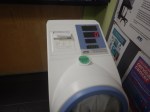


I just put my hand in the hole at the front, shook hands with the machine, pressed the green button on top and it inflated a glove around my hand and lower arm to take the pressure.
Ears Are A Black Body
When I worked for ICI in Runcorn in 1968, one of my colleagues; John Baxendale developed or acquired one of the first remote infra-red thermometers.
ICI needed one for taking the temperature of hot vessels , pipes and reactors on chemical plants and in laboratories. John’s thermometer solved the problem, by measuring the black body radiation of the object.
John found that to calibrate his instrument he could point it at a colleague’s ear. As the ears emit black body radiation, the device should have read 36.9°C, as it generally did.
These so-called tympanic thermometers are now in regular use and cost about twenty pounds.
John is one of those people that has stuck in my mind from all those years in the past. He was a surfer and probably the only one, I’ve ever met in my life. I remember some weekends, he used to take his Morris Minor Traveller all the way to the North of Scotland to go surfing. Visiting that area has been on my bucket list for years. The closest I got, was to fly in my Cessna 340A to the Orkneys.
Poo power To Heat Homes In West London As Thames Water Continues To Reduce Its Carbon Footprint
The title of this post, is the same as that of this press release from Thames Water.
These are the three bullet points.
- Thames Water unveils its second successful gas-to-grid project.
- Around 4000 homes in West London will be heated using converted sewage sludge from Mogden sewage treatment works starting early this year.
- This initiative is part of Thames Water’s commitment to reduce its carbon emissions across its operations thereby reducing its contribution to the causes of climate change.
These three paragraphs outline the project.
Thames Water has announced sewage sludge will be used to heat homes in West London early this year, after successfully delivering its second gas-to-grid (G2G) project, at its Mogden Sewage Treatment Works (STW).
The success of the gas-to-grid model established at Deephams STW in North London in 2021, where biogas is converted into biomethane to heat homes in Enfield, served as the blueprint for the project at Mogden.
Currently serving over 2 million customers, Mogden is the third largest STW in the UK, and has the potential to reach and supply gas to 4000 homes in West London. This comes as part of the company’s commitment on energy transition, by transforming the way it creates and uses power to reach net zero carbon emissions.
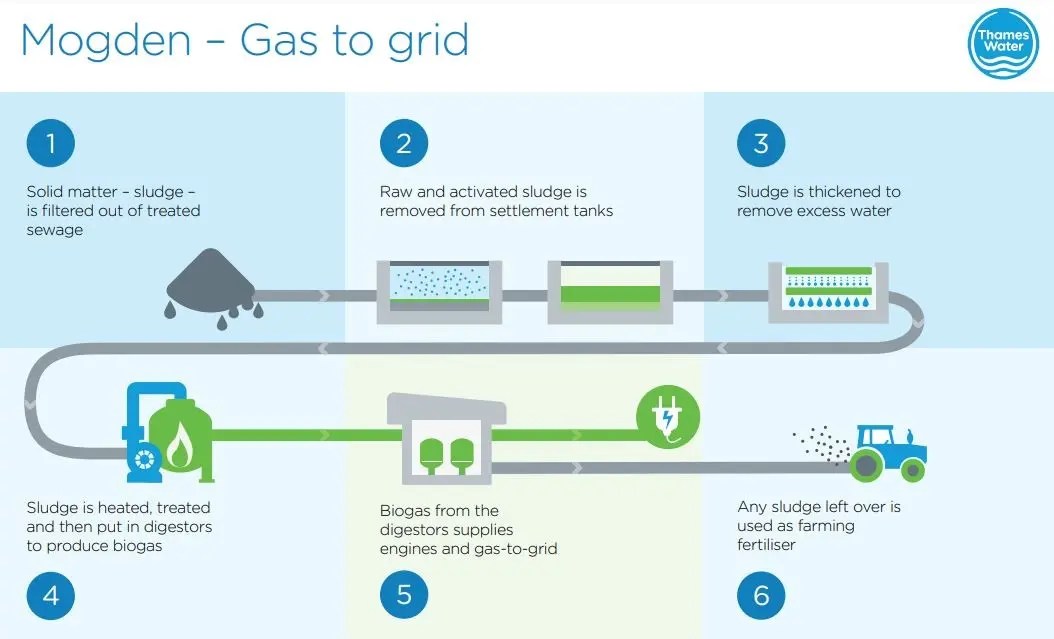
The press release then gives a paragraph of explanation as to how the system works.
A byproduct of the sewage treatment process is sewage sludge, which is then digested to produce BioGas. Mogden STW then generates electricity with this BioGas via Combined Heat and Power (CHP) engines. The Gas-to-Grid plant, which will be managed by gas supplier SGN, intends to take a proportion of this BioGas and to ‘uprate’ it to export quality which is achieved by filtering, scrubbing and then compressing gas so it can be used as fuel for cooking and heating.
This Thames Water graphic illustrates the process.
This press release is not Thames Water’s image from many of its customers.
RWE And National Grid Answer New York Offshore Wind Call
The title of this post, is the same as that of this article on offshoreWIND.biz.
This is the sub-heading.
Community Offshore Wind, a joint venture of RWE and National Grid Ventures, has submitted a proposal to the New York State Energy Research and Development Authority (NYSERDA) to develop 1.3 GW of new offshore wind capacity in response to New York’s expedited fourth competitive offshore wind solicitation.
These four paragraphs add more details.
This next phase of the project builds upon Community Offshore Wind’s provisional offtake award to deliver 1.3 GW of wind capacity as part of New York’s third solicitation for offshore wind. In total, the projects are expected to generate USD 4.4 billion in economic benefits to New York.
Combined with its provisionally awarded New York project, Community Offshore Wind is on track to deliver nearly USD 100 million in workforce and economic development investments, the developer said.
The new proposal includes nearly USD 50 million in funding for workforce and community initiatives, with a focus on creating opportunities for diverse New Yorkers and supporting local non-profit organizations.
The proposal also includes an investment of up to USD 10 million in the offshore wind supply chain, to help New York businesses prepare for the economic opportunities the growing industry will create. All of these commitments are contingent on NYSERDA’s final selections.
is this partly a result of the meeting between Energy Security Secretary Claire Coutinho and Germany’s Vice Chancellor, Robert Habeck, that I wrote abut in UK And Germany Boost Offshore Renewables Ties?
We certainly seem to be getting some good deals on renewable energy these days with the Germans and the Koreans.
Perhaps someone in the government is doing something right?
New British Steel Rail Stocking Facility Will Boost Network Rail Supply Chain
The title of this post, is the same as that of this article on RailUK.
These four paragraphs outline the new facility and how it will work.
British Steel is building a new £10 million rail stocking facility, the biggest of its kind in the country.
The facility, at the company’s Scunthorpe site, is scheduled to be completed this summer and will stock around 25,000 tonnes of 108-metre finished rail.
The investment is part of our British Steel’s strategy to support the supply of 56E1 and 60E2 section rails for Network Rail, ensuring there is rail stock readily available for its supply chain.
Rails stocked in the new facility will all have undergone the stringent testing and quality assurance checks required to meet the specification to allow immediate dispatch or welding into 216-metre lengths to the customer.
With all the gloom in the steel industry, It’s good to see someone investing in new facilities.
Ten Spanish Companies Join Forces To Apply Hydrogen Propulsion To A High-Speed Train For The First Time
The title of this post, is the same as that of this press release from Talgo.
These are the three bullet points.
- The Hympulso project is part of the Strategic Projects for Economic Recovery and Transformation (PERTES)
- A new technical car with hydrogen and batteries to be developed for a Talgo 250 train, allowing it to run on clean energy on non-electrified lines.
- The main partners are Talgo, Golendus, Ingeteam, Repsol, Sener and Optimus3D.
These are the first four paragraphs.
Ten Spanish companies have joined forces to design, build and install, for the first time in the world, a propulsion system based on renewable hydrogen fuel cells on a high-speed train. Under the Hympulso project, the companies will develop a set of technologies that can be applied to the Talgo 250 ‘all-terrain’ train, making it possible to electrify the rail network with energy generated entirely from renewable sources, even on lines without overhead power lines.
Led by Talgo, Hympulso also includes Golendus, Ingeteam, Optimus3D, Repsol and Sener as partners. Universidad Pontificia Comillas and Tecnalia are collaborators, while Adif is an observer. The initiative has received a grant of €6.5 million and is part of the Incentive Programme for the Innovative Value Chain and Knowledge of Renewable Hydrogen, as part of the Recovery, Transformation and Resilience Plan.
Hympulso will be comprehensive in nature: it will activate the entire renewable hydrogen value chain in the railway system, from production to consumption. The project will also make it possible to analyse the impact of the future transition on the various railway infrastructure assets managed by Adif, such as maintenance facilities or the track.
Thus, the project will result in a joint output of hydrogen supply installations adapted to railways -both mobile and static- and a pioneering prototype of a hybrid bimodal train for passengers with automatic track-gauge change, which will be able to run both on conventional and high-speed networks, using catenary supply when available, or hydrogen and batteries in those corridors that are not electrified.
This picture shows a visualisation of the train.
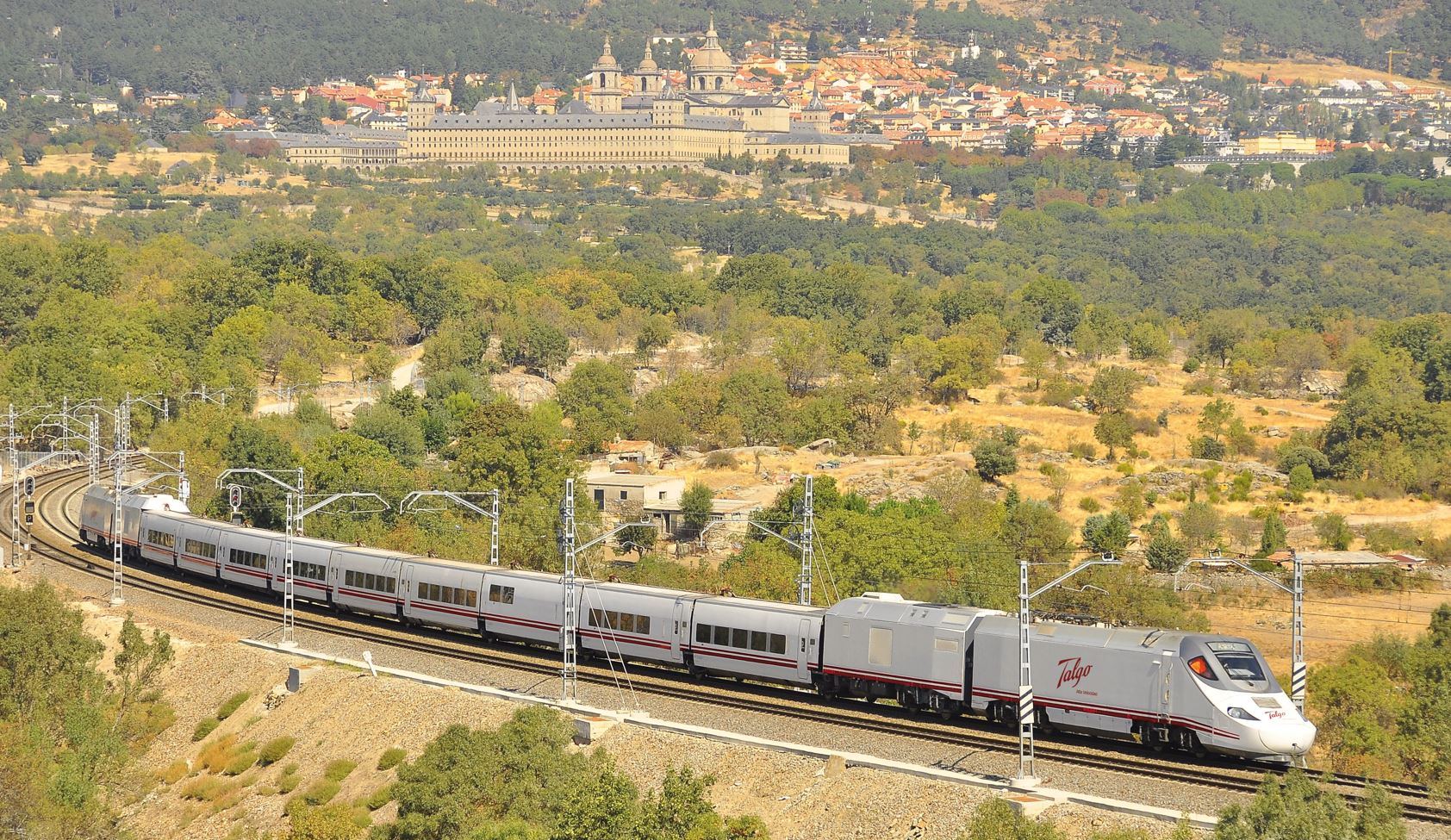
Note.
- There is a power car containing the hydrogen fuel cells and other gubbins behind the one or both locomotives.
- Hydrogen power is used, where there is no electrification.
- Talgo already make a high speed train with a diesel power pack, so engineering would only involve developing a new hydrogen power pack.
My only questions are.
- Do the trains come without gauge-changing?
- Could they be run on a typical UK rail line?
- Do they speak, Cornish, Gaelic and Welsh?
If the answer to all questions is yes, then this must be the ideal train for these routes.
- London Euston and Aberystwyth
- London Euston and Holyhead
- London King’s Cross and Aberdeen.
- London King’s Cross and Cleethorpes/Grimsby
- London King’s Cross and Inverness.
- London King’s Cross and Thurso/Wick.
- London Paddington and Carmarthen
- London Paddington and Penzance
Note.
- No more electrification on these routes would be needed.
- The trains could use High Speed Two to wherever it goes.
- The trains could do 140 mph on the Great Western Main Line, East Coast Main Line and West Coast Main Line.
Hympulso looks a very comprehensive, professional and practical plan, that could easily be adapted to the UK mainland.
 The Anonymous Widower