Vattenfall: Dolphins Unfazed By Offshore Wind Construction Work
The title of this post, is the same as that of this article on offshoreWIND.biz.
This is the sub-heading.
Concerns have been raised that the installation of the monopiles of the Vesterhav North wind farm offshore Denmark could cause a small pod of dolphins to leave the area. The dolphins have, however, neither left the area nor have they changed their behaviour, Vattenfall, the owner and developer of the wind farm, said.
These are the first two paragraphs.
In 2020, wildlife and underwater photographer Lars Mikkelsen discovered a pod of seven Common Bottlenose dolphins during a sailing trip in the canal between the North Sea and the Limfjord at the Danish coastal town of Thyborøn. Since then, Mikkelsen has been closely following the dolphins that are rare guests in the seas around Denmark.
The small pod of dolphins has for the past three years established residence in the area of the Danish part of the North Sea where Vattenfall is constructing its Vesterhav offshore wind farms.
This Google Map shows the Limfjord, which stretches between the North Sea and the Kattegat.
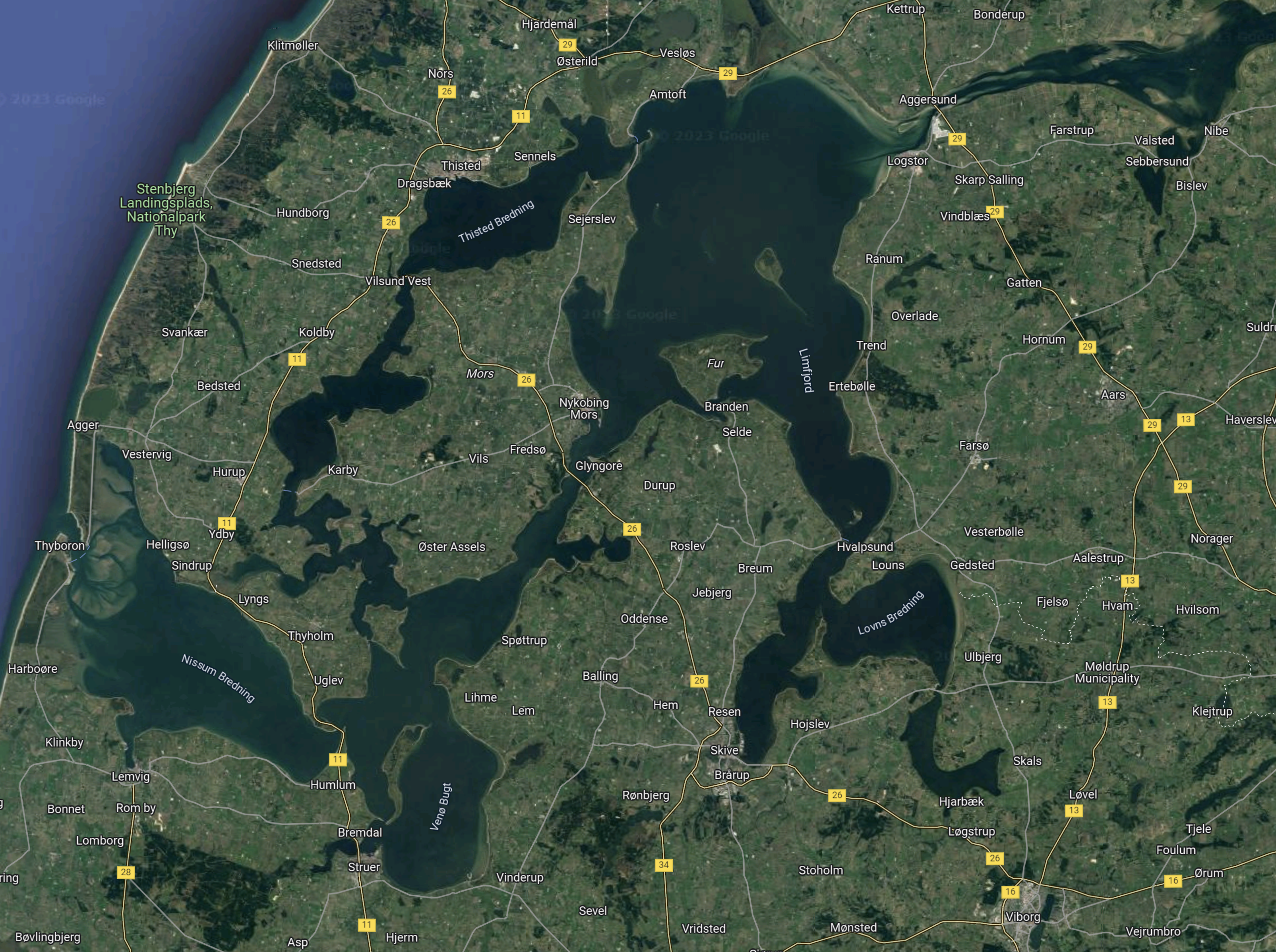
Thyborøn, is at the Western entrance to the Limfjord, which leads into the large area of water in the South-West of the map.
From its Wikipedia entry, the Limfjord seems to be an ecologically-interesting place.
This paragraph sums up how the construction affected the dolphins.
So, when concerns were raised that the installation of the wind farm’s monopiles could cause the dolphins to leave the area, Vattenfall initiated a collaborative monitoring effort. Fortunately, it showed that the dolphins were still present and have not changed behaviour after completion of the monopile installation.
Note.
- Vattenfall did adopt measures to mitigate the noise, as is detailed in the article.
- A university also took a series of measurements.
But the exercise does show it is possible to install offshore wind farms without disturbing the inhabitants.
Green Hydrogen Project Win
The title of this post, is the same as that of this news item from Nova Innovation.
These are the first two paragraphs.
Nova and consortium partners The University of Strathclyde, Shetland Islands Council and Ricardo Energy, have been awarded funding from the Scottish Government’s Emerging Energy Technologies Fund – Hydrogen Innovation Scheme for their GHOST project.
The GHOST project (Green Hydrogen and Oxygen Supply from Tidal Energy) will look at the potential of producing green hydrogen and oxygen from Nova’s tidal energy projects in Shetland.
They plan to generate hydrogen from tidal energy around the island of Yell. The oxygen, which is often just released into the air, will be used in aquaculture and possibly as rocket fuel at SaxaVord Spaceport.
This map shows Shetland.
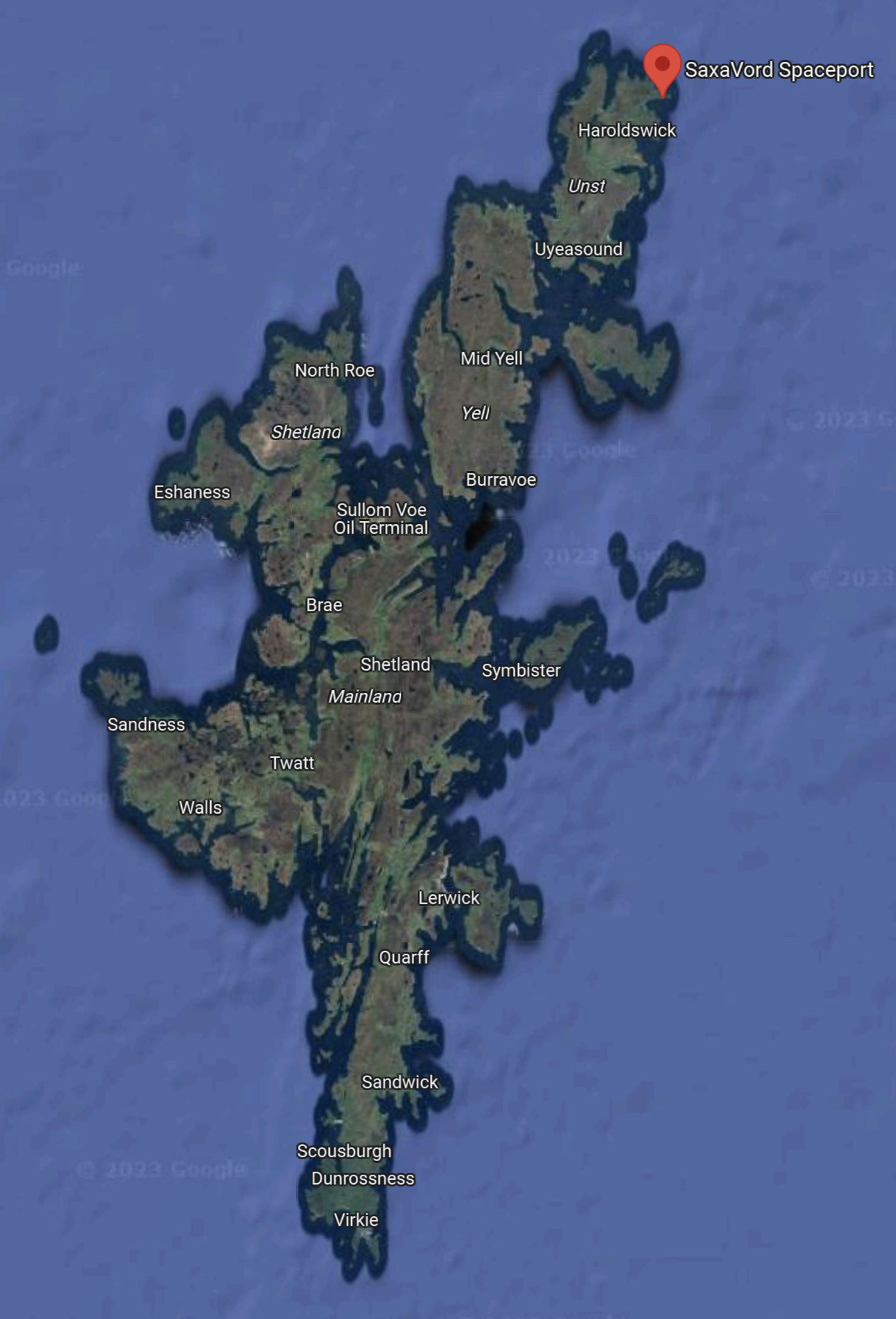
SaxaVord Spaceport is marked by the red arrow at the North end of the archipelago on the island of Unst and Yell is the next island to the South.
If GHOST is successful, it looks like they will have a ready market for their fuel.
Hydrogen Buses Start Running Across Region
The title of this post, is the same as that of this article on the BBC.
These are the main points.
-
A fleet of 20 hydrogen powered buses start running in Merseyside
-
The zero emission buses will improve air quality, Mayor Steve Rotheram said
-
He wants the Liverpool City Region to be net zero carbon by 2040
The buses will operate on the 10A route between St Helens, Knowsley and Liverpool city centre.
I wonder, if they’ll go past my old digs on Huyton Lane.
ESB, Irish Port Team Up To Make Shannon Estuary Go-To Place For Floating Wind
The title of this post, is the same as that of this article on offshoreWIND.biz.
This is the sub-heading.
Irish energy company ESB and Shannon Foynes Port, the company with statutory jurisdiction over all marine activities on the Shannon Estuary, have entered into a collaboration to develop the region into a centre for the deployment of floating offshore wind projects in both Irish and international waters.
This is the introductory paragraph.
Back in 2021, ESB and its then-partner Equinor announced the development of the 1.4 GW Moneypoint floating wind farm in Ireland, with a broader plan under its Green Atlantic @ Moneypoint project to transform the Moneypoint power station in County Clare into a green energy hub and to support wider plans of Shannon Foynes Port to help make the Shannon Estuary a focal point for the offshore wind industry in Europe.
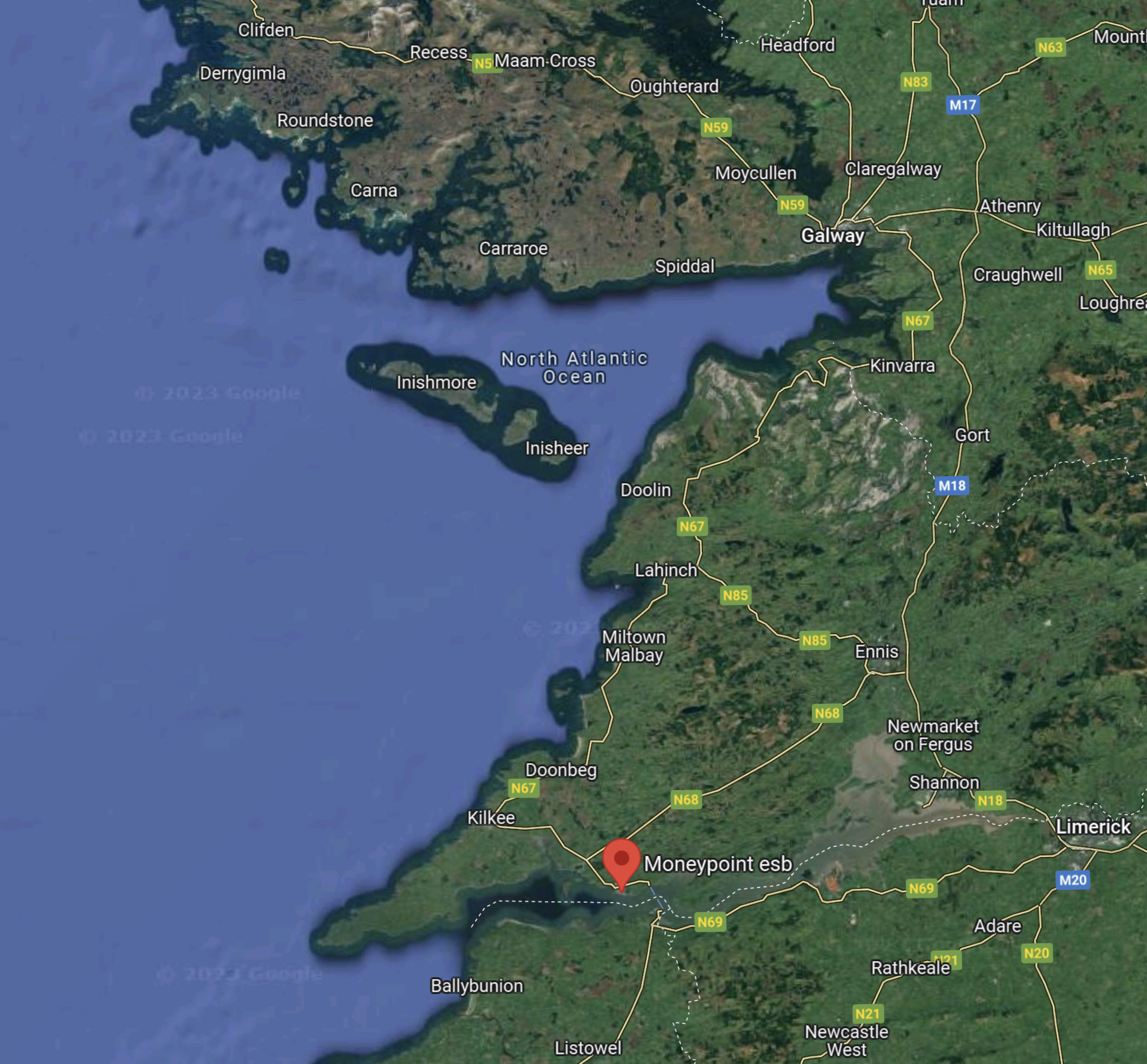
This Google Map shows the location of Moneypoint power station with respect to the Shannon Estuary.
Note.
- Moneypoint power station, which is indicated by the red arrow is on the River Shannon.
- The city pf Limerick is to the East of Moneypoint.
- There’s certainly a lot of water in the West for floating wind turbines.
This second Google Map shows a close-up of the power station.
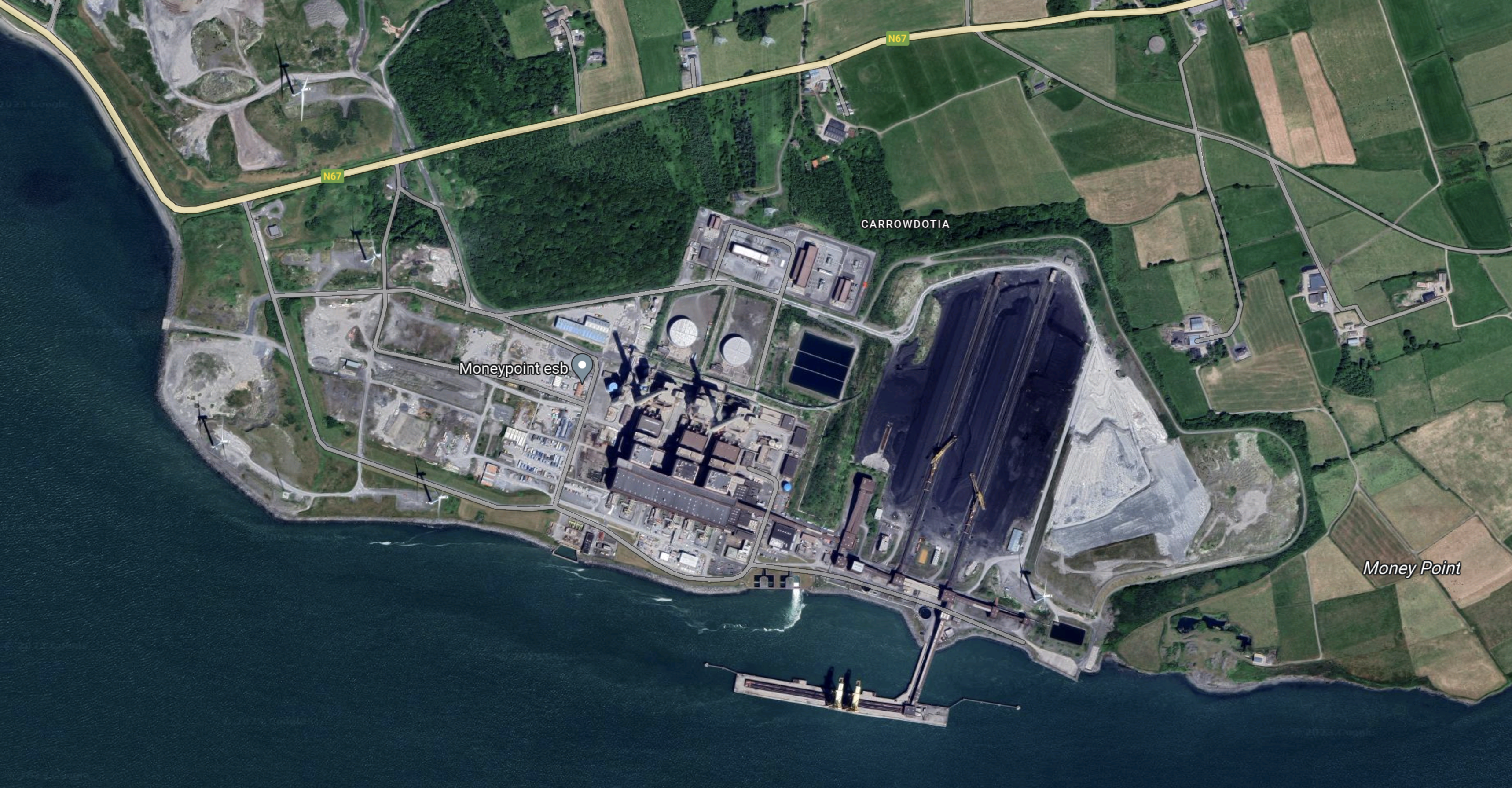
This is a shortened version of the first paragraph of the Wikipedia entry for the power station.
Moneypoint power station is Ireland’s largest electricity generation station (output 915 MW) and only coal-fired power station. Commissioned between 1985 and 1987, it is located on the River Shannon near Kilrush, County Clare. It was constructed at a cost of more than £700m in one of the largest capital projects in the history of the state. The station operates largely on coal, making it both unique in the context of Irish electricity production and the country’s single largest emitter of greenhouse gases. It is capable of meeting around 25% of customer demand across the country. It has two Heavy Fuel Oil (HFO) storage tanks with a capacity of 50,000 tonnes which can be used as a back-up fuel if required.
In some ways, the only good things about this power station are the grid connection that can handle most of a GW and the large site, which could be used for a variety of energy-related purposes, like green hydrogen generation and storage.
In Shannon Estuary Could Support Build-Out of 30 GW Of Floating Wind, House 2 GW of Electrolysis Capacity, I wrote about the potential of this area.
Those figures of 30 GW of floating wind ans 2 GW of electrolysers will certainly mean a lot of investment going into Moneypoint!
I would also feel, that Moneypoint will need a lot of energy storage to support and balance the grid.
Masons Of Yorkshire Distillery Enters Partnership With LNER
The title of this post, is the same as that of this article on Rail Advent.
These two paragraphs outline the partnership.
A Yorkshire Distillery has entered a partnership with London North Eastern Railway for its vodka to be served in the railway’s first-class carriages.
In the agreement, Classic Vodka from the highly awarded Masons of Yorkshire Distillery will be the only vodka served on all first-class routes between Inverness, London Kings Cross, and Aberdeen and Kings Cross.
As the railways are now effectively controlled by the UK Government, perhaps we should see more British food and drink featuring on trains.
SeaTwirl, Kontiki Winds To Explore Powering Oil & Gas Assets With Floating Wind
The title of this post, is the same as that of this article on offshoreWIND.biz.
This is the sub-heading.
The Sweden-headquartered SeaTwirl has signed a Memorandum of Understanding (MoU) with Kontiki Winds to identify and discuss the opportunities to electrify oil and gas assets and other offshore applications, with the use of SeaTwirl’s floating wind turbines.
And this is the first paragraph.
Under the MoU, the two companies will explore new opportunities in the market to implement offshore wind into new and existing oil and gas assets and microgrid applications such as the powering of fish farms, desalination plants and/or other small-scale applications that currently are based on fossil fuel electricity generation.
Note.
- The current turbines are only 1 MW.
- They appear to be mounted on a long monopole foundation.
- My mathematical modelling experience suggests to me, that these could be very stable devices.
- I suspect they could be built into specialist equipment like a buoy with a light to mark something.
I suspect that there will be large numbers of applications, especially if the manufacture and installation of Sea Twirl’s turbines is an efficient process.
Simon Reeve’s South America
I am just watching episode two of this television series on BBC2.
It is definitely a must-watch. You can watch it here.
Interestingly, the program was giving a similar message about the rain forest, that I talked about in The Enforcer From The World Bank.
British Wind Farms Outstrip Gas-Fired Electricity Generation For The First Time
The title of this post, is the same as that of this article on offshoreWIND.biz.
This is the sub-heading.
Wind farms in Britain generated more electricity than gas-fired power stations for the first time in the first quarter of 2023. Offshore and onshore wind turbines supplied 32.4 per cent of electricity while gas-fired power stations delivered 31.7 per cent during the first three months of this year.
It does appear that we’re progressing in the right direction.
There’s a detailed graph showing the UK’s energy generation by source going back to 2010.
Kit Kat Cereal Proves Failure On Sugar, Say Charities
The title of this post, is the same as that of this article on The Times.
This is the sub-heading.
Nestlé promotes ‘nutritious’ product that is a quarter sugar
And this is the caption for the picture.
With 24.7g of sugar per 100g, a bowl of Kit Kat cereal accounts for a third of a seven-year-old’s suggested intake
This is the first two paragraphs.
The launch of a Kit Kat breakfast cereal shows the government strategy of relying on food companies to help fight obesity has failed, campaigners have claimed.
Charities such as the British Heart Foundation have accused Nestlé of “irresponsible” promotion of a product which is a quarter sugar, arguing that it makes the case for state intervention to make food healthier.
After this start, I thought I’d better check the ingredients on the product page on Nestlé’s web site!
Under a heading of Our Carefully Selected Ingredients, this is said.
Whole grain WHEAT (31.4%), maize semolina, sugar, dextrose, palm oil, WHEAT flour, cocoa powder* (5.4%), glucose syrup, WHEAT starch, skimmed MILK powder, calcium carbonate, BARLEY malt extract, fat-reduced cocoa powder*, flavourings, cocoa butter*, salt, cocoa mass*, emulsifier: lecithin, whey powder (MILK), MILK fat, antioxidant: tocopherols, iron, vitamin B3, B5, B6, B2, B9.
May contain NUTS.
*Rainforest Alliance Certified. Find out more at ra.org.
This product on their own admission contains over thirty per cent wheat.
Now let’s add a very large dollop of peer-reviewed science.
Coeliac Disease: Can We Avert The Impending Epidemic In India? is the title as that of this peer-reviewed paper on the Indian Journal Of Research Medicine.
This is an extract.
The time of first exposure to wheat influences the development of celiac disease. In countries such as Finland, Estonia, and Denmark, characterized by low gluten consumption in infancy, celiac disease prevalence is much lower than in Sweden where gluten consumption is high in infancy. A natural experiment occurred in Sweden about two decades ago when national recommendations were made to introduce wheat into the diet after cessation of breast feeding at six months. This change was coupled with increased wheat gluten consumption through infant feeds. Together these measures resulted in a two-fold increase in incidence of celiac disease in Sweden, which was attributed to introduction of wheat into the diet after cessation of breast feeding.
In 1996 this recommendation was changed to introduce gluten in gradually increasing amounts while the infant was still being breast fed. This led to a dramatic decrease in celiac disease incidence.
Should we be following the route of these Scandinavian countries and eat wheat sensibly and reduce the amount we give our children or should we follow what Nestlé’s marketeers want us to do?
As a coeliac, who is allergic to the gluten in wheat, I wouldn’t touch this product with a spoon certified by my cardiologist.
The author also says this about wheat.
The other dimension to this problem is that not all wheat is alike when it comes to inducing celiac disease. The ancient or diploid wheats (e.g. Triticum monococcum) are poorly antigenic, while the modern hexaploid wheats (e.g. Triticum aestivum) have highly antigenic glutens, more capable of inducing celiac disease. India, for centuries, grew diploid and later tetraploid wheat which is less antigenic, while hexaploid wheat used in making bread is recently introduced. Thus a change back to older varieties of wheat may have public health consequences. Public health authorities may well want to examine both these avenues, i.e. infant feeding recommendations and wheat varieties cultivated in the country, for opportunities to avert the epidemic of celiac disease which is impending in our country.
The author may be talking about India, but as he says modern wheats have highly antigenic glutens and will cause an epidemic of coeliac disease.
I may not have had any medical training, but I spent a miserable first fifty years of my life as an undiagnosed coeliac.
Conclusion
KitKat Cereal should be labelled that it may cause coeliac disease.
 The Anonymous Widower