The African Nation Aiming To Be A Hydrogen Superpower
The title of this post, is the same as that as this article on the BBC.
It is a fascinating tale of how Namibia aims to modernise its economy, by becoming a major producer of hydrogen using electricity generated by wind and solar power.
Conclusion
Could other countries follow Namibia’s lead?
Kawasaki’s Liquefied Hydrogen Carrier Departs To Pick Up First Cargo
The title of this post, is the same as that of this article on Green Car Congress.
This is the first paragraph.
Kawasaki Heavy Industries’ Suiso Frontier, the world’s first liquefied hydrogen carrier, has left Japan to pick up its first hydrogen cargo in Australia. A return to Japan is expected around late February.
As the cargo is only seventy-five tonnes of liquid hydrogen, I have my doubts about shipping hydrogen from Australia to Japan.
Late February is two months away, so this represents a production rate of 37.5 tonnes per month.
In Can The UK Have A Capacity To Create Five GW Of Green Hydrogen?, I said the following.
Ryze Hydrogen are building the Herne Bay electrolyser.
- It will consume 23 MW of solar and wind power.
- It will produce ten tonnes of hydrogen per day.
The electrolyser will consume 552 MWh to produce ten tonnes of hydrogen, so creating one tonne of hydrogen needs 55.2 MWh of electricity.
This would mean that if the Japanese built one Herne Bay-size electrolyser, then it would produce around three hundred tonnes of hydrogen in an average month.
The only possible use for this ship at the moment, is as a research project to identify the problems of the transportation of hydrogen over long distances by sea.
But we may need to use ships for the coastal transportation of hydrogen in the UK and to Europe.
Lumo Allows Passengers From London To Edinburgh To Pre-Order Meals
The title of this post, is the same as that of this article on Rail Advent.
I just tried it out and what I saw was a good start.
They even had gluten-free sandwiches and other items from Marks & Spencer.
You can access it here.
AstraZeneca May Explain Britain’s Lower Death Rate
The title for this post, is the same as that of this article on the The Times.
These are the second and third paragraph of the article.
Dr Clive Dix said he believed that the jab could help to stave off serious Covid-19 illness for longer than RNA-based alternatives made by Pfizer and Moderna. “If you look across Europe, with the rise in cases, there’s also a corresponding lagged rise in deaths, but not in the UK,” he told The Daily Telegraph. “I personally believe that’s because most of our vulnerable people were given the AstraZeneca vaccine.”
Dix suggested that the T cell response to the AstraZeneca jab may explain the lower level of hospital admissions and deaths.
Dr, Clive Dix is a former Deputy Chair of the Vaccines Taskforce.
I think that Dr. Dix may have a point.
I am coeliac and I know I have a strong immune system.
When I had my dose of AstraZeneca vaccine, I was fairly sure that my immune system gave the viral vector vaccine a good kicking, as it thought the chimpanzee adenovirus on which it is based could be a dangerous intruder.
But with the second dose, I got no reaction. Had my immune system decided that the vaccine was a friend?
I have mentioned this reaction to people and I have found some coeliacs, who had a similar reaction to the one that I had with the AstraZeneca vaccine.
But more significantly, this summer, I suffered badly from hay fever. My GP told me that the high level could have been because the AstraZeneca vaccine had boosted my immune system.
I’ve only had it as bad once before and I suspect that was a couple of years after I went gluten-free, after being diagnosed as a coeliac. I suspect that that would have boosted my immune system.
I can do a small calculation.
I suspect, that there are about 40,000,000 in the UK who have been vaccinated with two doses of the AstraZeneca vaccine.
If we assume coeliacs are 1-in-100 of the population, as stated on this page on the NHS web site, and most have been vaccinated, as they tend to be cautious about their food and health, that equates to 400,000 people who could be fully vaccinated and have an immune system with all the defensive strength of a whole regiment of special forces soldiers on steroids.
For some time now, various sources have been saying the models of the pandemic aren’t right.
I do wonder, if coeliacs with the AstraZeneca vaccine are super-immune and they are skewing the models. After all 400,000 with a super-immunity is a large number in comparison to the total number of deaths from the Covids in the UK, which stood at 171,801 with the Covids on their death certificate tonight.
Conclusion
I am drawn to one big conclusion and that is more research needs to be done.
It would be a great help, if we knew how many coeliacs on long-term gluten-free diets had ended up in hospital.
I wouldn’t ask the doctors, but the catering departments, who would be providing the gluten-free food, that the coeliacs will be demanding.
Road-Rail Services Inaugurated
The title of this post, is the same as that as this article on Railway Gazette.
This first paragraph tells all.
The start of regular road-rail services on the Asa Kaigan Tetsudo in southeast Shikoku was marked with a ceremony at Awa-Kainan-Bunkamura on December 25.
I have found this video of the vehicles.
I do wonder if there is a simpler way.
In Zwickau in Germany on the Vogtlandbahn, standard Stadler diesel multiple units, run through the streets from the main station to a tram-stop like station in the centre of the town.




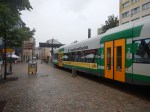



They are more of a train-tram, than a tram-train.
- The train is fitted with orange warning lights.
- The train shares the same corridor with a tram, that uses a different gauge, using three-rail track.
- Access between the train and platform is more-or-less level and as good as, if not better than most German trains.
- The platform at Zwickau Zentrum is an island platform, where the trams call at the other side.
- The concept would work with any independently-powered multiple unit.
I am sure, where there are places where this will work in the UK.
We almost do the same thing at some seaside stations like Saltburn, Sheringham and St. Ives.
‘New Era’ As German Coalition Prioritises Rail Spending Over Road
The title of this post, is the same as that of this article on Railway Gazette.
This is the first paragraph.
The so-called ‘traffic light coalition’ formed by the Social Democratic, Green and Free Democratic parties as the next federal government has committed to launching a ‘Rapid Capacity Expansion’ to enhance railway infrastructure as part of its wider transport strategy.
Other policies would include.
- A national regular interval timetable as a matter of priority.
- Increasing rail’s share of the freight transport market from the current 19% to 25% by 2030.
- Doubling passenger traffic by the end of the decade.
- Electrify 75 % of the network by 2030.
- Road tolls for trucks would be increased to reflect CO2 emissions.
- New commercial and industrial developments would be mandated to examine the potential for incorporating a rail connection.
- A pressure group, whose name translates as Alliance Pro Rail is in favour.
But will the average German voter in their Audi, BMW, Mercedes or Volkswagen cruising down the autobahn be in favour?
It certainly looks like it will be all change on German railways and roads.
The article is also linked to three in depth articles on the future of German railways published by Railway Gazette in the last few months.
- Comment: Climate Goals To Trump Profits
- German Associations Seek More Competition In Second Rail Reform
- Rail Reopenings To Support Climate-Friendly Transport
It certainly is all change.
Platform Construction Underway At Winslow On New East West Railway
The title of this post, is the same as that as this article on Rail Advent.
This picture from Network Rail shows the Winslow station construction site.

This paragraph from the Rail Advent article describes the operation.
A 250 tonne crawler crane is being used to lift over 500 pre-cast concrete platform units into position within new railway cutting. As there is limited space available on site, a smartphone app has been developed to allow the platform units to be called for delivery in the exact construction sequence. The crane’ ‘lattice boom’ is 62-metres long , which is taller than Nelson’s Column.
That all sounds like good project management to me.
More ICE Sprinters Offer Alternative To Flying
The title of this post, is the same as that of this article on Railway Gazette.
The first two paragraphs, give an overview of the changes being made.
Deutsche Bahn introduced more limited-stop Sprinter ICE services on long-distance inter-city routes with the timetable change on December 12.
Sprinter-branded ICE services now operate on eight domestic routes, while a daily Frankfurt am Main – Paris service calling at Mannheim and Karlsruhe also carries the branding. Intended to appeal to business travellers, many of the Sprinter services are timed to depart early in the morning with return trips in the evening. This ensures a full day at the destination and offers a viable alternative to domestic flights.
It would appears that these services now have trains that are under the acceptable four hours.
- Cologne and Berlin
- Cologne and Munich
- Hamburg and Frankfurt Airport
If Deutsche Bahn are serious about competing with the airlines, they must surely increase the frequency.
In 2018, I travelled between Berlin and Munich in under four hours and wrote about it in From Berlin To Munich In Four Hours By Train.
This is how I started that post.
The length of the East Coast Main Line between London Kings Cross and Edinburgh is 632 kilometres.
Deutsche Bahn have recently completed an upgraded High Speed Line between Berlin and Munich, which has a length of 623 kilometres.
Both lines are not the very fastest of High Speed Lines, but lines where a consistent two hundred kilometres per hour is possible.
The East Coast Main Line was built in Victorian times and services typically take around twenty minutes over four hours, with nine -car InterCity 225 trains running twice an hour.
The Berlin-Munich route was originally built over two centuries ago, but the Germans have spent twenty-five years and many billions of euros punching a new route between Berlin and Nuremberg, through the difficult countryside of Thuringen Forest.
The route may allow the Germans to travel from Berlin to Munich in three hours fifty-five minutes, but at present you can only do it three times a day in a six-car train.
I took the lunchtime train and sat in First Class for a hundred and fourteen euros.
Deutsche Bahn have increased the trains on this route to five trains per day, but compared to London and Edinburgh on LNER, it is too infrequent, expensive with questionable customer service and not enough seats to give the airlines a run for their money.
A quick look on Rail Europe indicates that these routes have fast services at an hourly frequency or better.
- Madrid and Barcelona
- Milan and Rome
- Paris and Bordeaux
- Paris and Cologne
- Paris and Marseilles
- Venice and Naples
German rail services might be getting better, but not fast enough to take on the airlines.
Caterpillar To Launch Demonstration Project Using Hydrogen Fuel Cell Technology For Backup Power At Microsoft Data Center
The title of this post, is the same as that of this press release on the Caterpillar web site.
This is the first two paragraphs.
Caterpillar Inc. today announced a three-year project through a collaboration with Microsoft and Ballard Power Systems to demonstrate a power system incorporating large-format hydrogen fuel cells to produce reliable and sustainable backup power for Microsoft data centers. The project is supported and partially funded by the U.S. Department of Energy (DOE) under the H2@Scale initiative and backed by the National Renewable Energy Lab (NREL).
“At Caterpillar, we focus on supporting our customers with reliable, resilient and economical power solutions while achieving their climate-related goals,” said Jason Kaiser, vice president for Caterpillar’s Electric Power Division. “This hydrogen fuel cell demonstration project enables us to collaborate with industry leaders to take a large step toward commercially viable power solutions that also support our customers in making their operations more sustainable.”
It certainly looks like Caterpillar are turning to the use of hydrogen to keep their existing markets.
This press release explains the cooperation in a paragraph.
Caterpillar experts in advanced power technologies, controls and system integration are working alongside Microsoft experts in data center design and Ballard experts in fuel cell design to demonstrate a 1.5 MW backup power delivery and control system that would meet or exceed the expectations set by current diesel engine systems.
Elsewhere the press release says that Caterpillar aims to be carbon negative by 2030.
Conclusion
We will see lots of systems like this providing reliable and sustainable power systems for entities like airports, city centres, data centres, hospitals, ports, shopping malls and other large users of electricity.
Infection, Mortality And Severity Of Covid-19 In Coeliac Disease – Prof Jonas Ludvigsson
The title of this post is the same as that of this presentation on the Coeliac UK web site.
If you are coeliac and worried about catching the Covids, I suggest you watch the presentation.
The presentation is about eighteen minutes long and this is the last-but-one screen.
Coeliac Disease and Covid-19
- No increased risk of death from Covid-19
- No increased risk of ICU for Covid-19
- No increased risk of any (!) Covid-19
THEN: Coeliac patients with Covid-19, have no increased risk of death compared to other patients with Covid-19.
Conclusion
The professor concludes it is good news and there is no need for coeliac patients to get the jab earlier than other people.
I would also like to add my fourpennyworth!
The professor was only analysing diagnosed coeliacs, who were probably on a long-term gluten-free diet.
My son was an undiagnosed coeliac, who lived the rock and roll lifestyle, generally living on ciggies, high-strength cannabis and Subways. His immune system, probably gave him all the protection of a plastic colander.
He died at just 37 from pancreatic cancer.
 The Anonymous Widower