Rolls-Royce SMR Advances To Final Stage In Swedish Nuclear Competition
The title of this post, is the same as that of this press release from Rolls-Royce.
This is the sub-heading.
Rolls-Royce SMR has been selected by Vattenfall as one of only two companies to reach the final stage in the process to identify Sweden’s nuclear technology partner.
These are the first two paragraphs, which add details.
After being shortlisted in 2024, Rolls-Royce SMR has progressed through a detailed assessment and will now work with Vattenfall through the final technology selection which could initially result in Rolls-Royce SMR delivering three SMRs.
This positive news is testament to Rolls-Royce SMR’s transformative approach to delivering proven nuclear technology in an innovative way through modularisation and builds on our successful selection in both the United Kingdom and Czech Republic.
Some other points from the press release.
- Sweden is initially looking to build three SMRs.
- Each SMR will supply 470MWe of clean low-carbon electricity.
- They are expected to have a lifetime of sixty years. Sizewell B was originally expected to have a lifetime of forty years, but appears to be being extended to sixty years, so I will accept Rolls-Royce’s expected lifetime.
- The first units will be at the Ringhals site on the Värö Peninsula, where there is an existing nuclear power station.
This Google Map shows the Ringhals site in relation to Gothenburg.
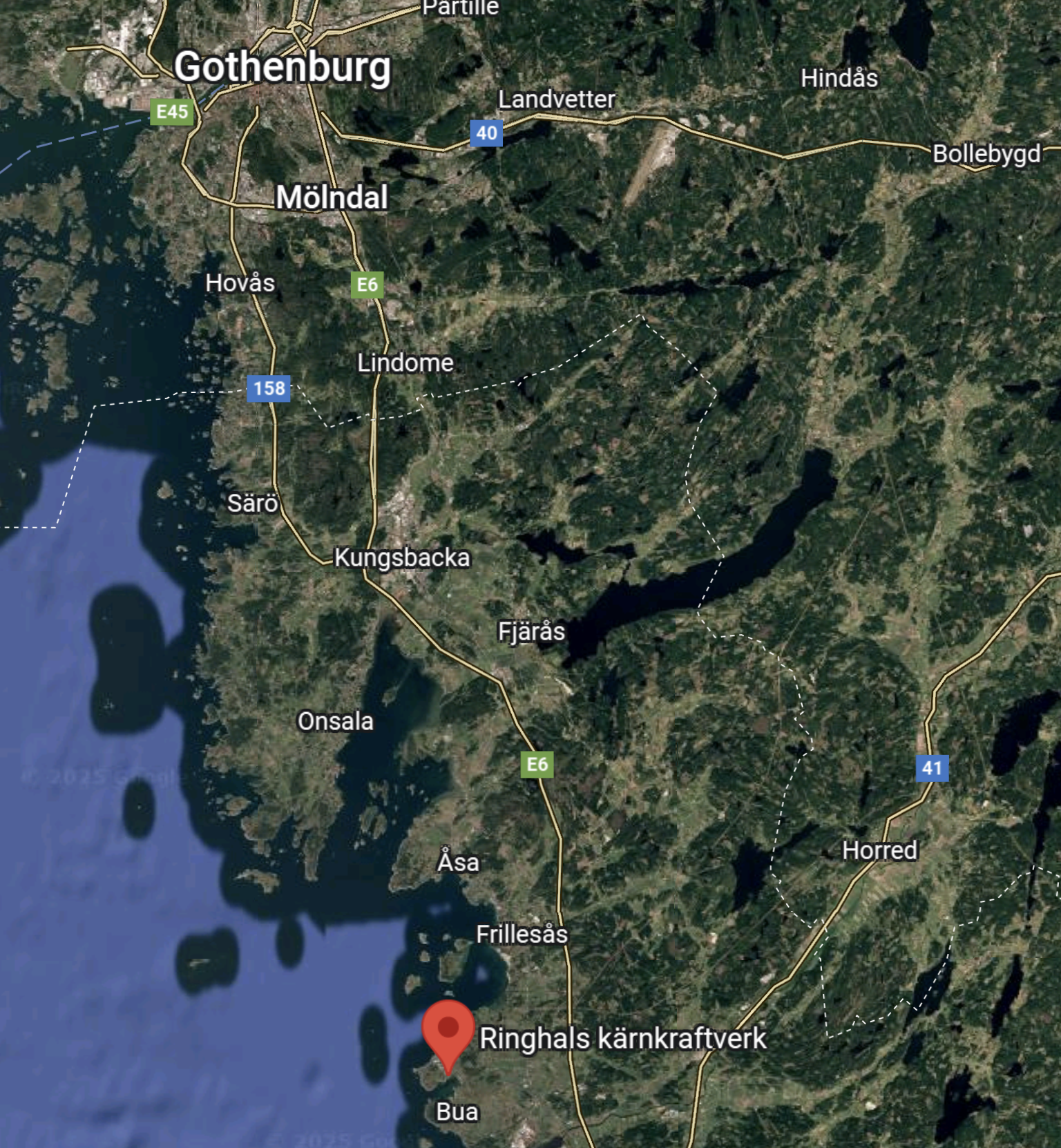
The site is marked by the red arrow.
On taking a closer look, it appears to be a site with expansion possibilities.
The British Media Don’t Seem Very Interested
It is now the 31st of August and the only paper to report the story has been the Financial Times.
DB And PKP To Expand Cross-Border Rail Services Between Germany And Poland
The title of this post, is the same of that as this article on Railway=News.
These two introductory paragraphs add more detail.
From mid-December 2025, Deutsche Bahn (DB) and PKP Intercity (PKP) are expanding their joint long-distance rail services, increasing the number of direct daily connections between Germany and Poland by more than 50 percent.
Starting on 14 December, 17 daily train pairs will operate across the border, up from the current 11. The additional capacity will provide a two-hourly service on the Berlin–Warsaw route, with seven trains in each direction.
I did a lot of this route, when I did a Home Run From Krakov.
I feel this German-Polish route will attract a lot of passengers, as it serves three excellent Polish cities Gdansk, Krakov and Warsaw, where you can spend a few days and it connects you to Berlin.
‘This Has Nothing To Do With National Security’ | Revolution Wind Halt Leaves Connecticut Leaders Demanding Answers
The title of this post, is the same as that of this article on offshoreWIND.biz.
This is the sub-heading.
Connecticut officials say they have been left in the dark about why the US federal government suddenly ordered construction of the Revolution Wind offshore project to stop, even as billions of US dollars, hundreds of jobs, and counted-on grid capacity hang in the balance.
This paragraph outlines what has happened.
On 25 August, the Connecticut State Government, joined by congressional leaders and representatives from the offshore wind supply chain, held a press conference at the New London State Pier after the Bureau of Ocean Energy Management (BOEM) issued a directive on 22 August halting all offshore activities on the almost-completed Revolution Wind, citing national security concerns and interference with US waters.
This may only appear to be about Trump stopping the erection of a wind farm in its tracks, but it is classic example of how to not do things.
He has left two states very angry, because of his prejudices.
Green Hydrogen – Meranti Green Steel Launches Green Iron Project In Oman
The title of this post is the same as that of this article on Hydrogen Central.
The title shows how if you have plenty of energy, you can produce green steel.
Surely, if the Omanis can do it, we can attract a company to make green steel in the UK, as we have lots of renewable energy around our shores.
All the current steelmakers do is blackmail the UK Government into paying them subsidies.
Siemens Mobility Looks To Build Battery Trains In Goole
The title of this post, is the same as that of this article on Railway News.
These first three paragraphs add more details.
Siemens Mobility has announced plans to build battery-powered trains in Goole, Yorkshire, to replace ageing fleets on Britain’s railway.
The manufacturer envisions that battery trains could replace rolling stock for operators such as Chiltern, Great Western Railway (GWR), Northern, ScotRail, TransPennine Express (TPE) and Transport for Wales (TfW) within the next decade.
This would mitigate the need to electrify all sections of the track to deliver zero-emission solutions. In doing so, 3.5 billion GBP could be saved and 12 million tonnes of CO2 emissions could be avoided over 35 years.
Note.
- The post is dated in June 2024, so I am sorry I didn’t spot it earlier.
- It talks in detail about Siemens’ plans for battery-electric trains.
- It also talks about the Siemens’ Rail Charging Converter, which can power short lengths of overhead wires for charging trains from the domestic grid.
- I also talked about Siemens’ technology in Technology Behind Siemens Mobility’s British Battery Trains Hits The Tracks.
It is certainly a must-read article.
Coventry To Leicester In A Flash? New Rail Plans Promise Faster, Greener Travel!
The title of this post, is the same as this article on Rail Technology Magazine.
This is the sub-heading.
Passengers travelling between Coventry, Leicester and Nottingham have outlined their support for proposed upgrades to reconnect the cities by direct rail for the first time in over two decades.
These first two paragraphs add some detail.
Despite being located just 23 miles apart, travelling between the cities requires passengers to change trains in Nuneaton, with wait times for the connection often exceeding 30 minutes. As a result, just 3% of trips between Coventry and Leicester are made by train; compared to 30% of journeys made between Coventry and Birmingham.
Midlands Connect recently visited Nuneaton railway station to speak with passengers travelling between the cities, waiting for their onward connection, about the proposed upgrades and how they would be impacted.
This OpenRailwayMap shows the route between Coventry and Leicester.
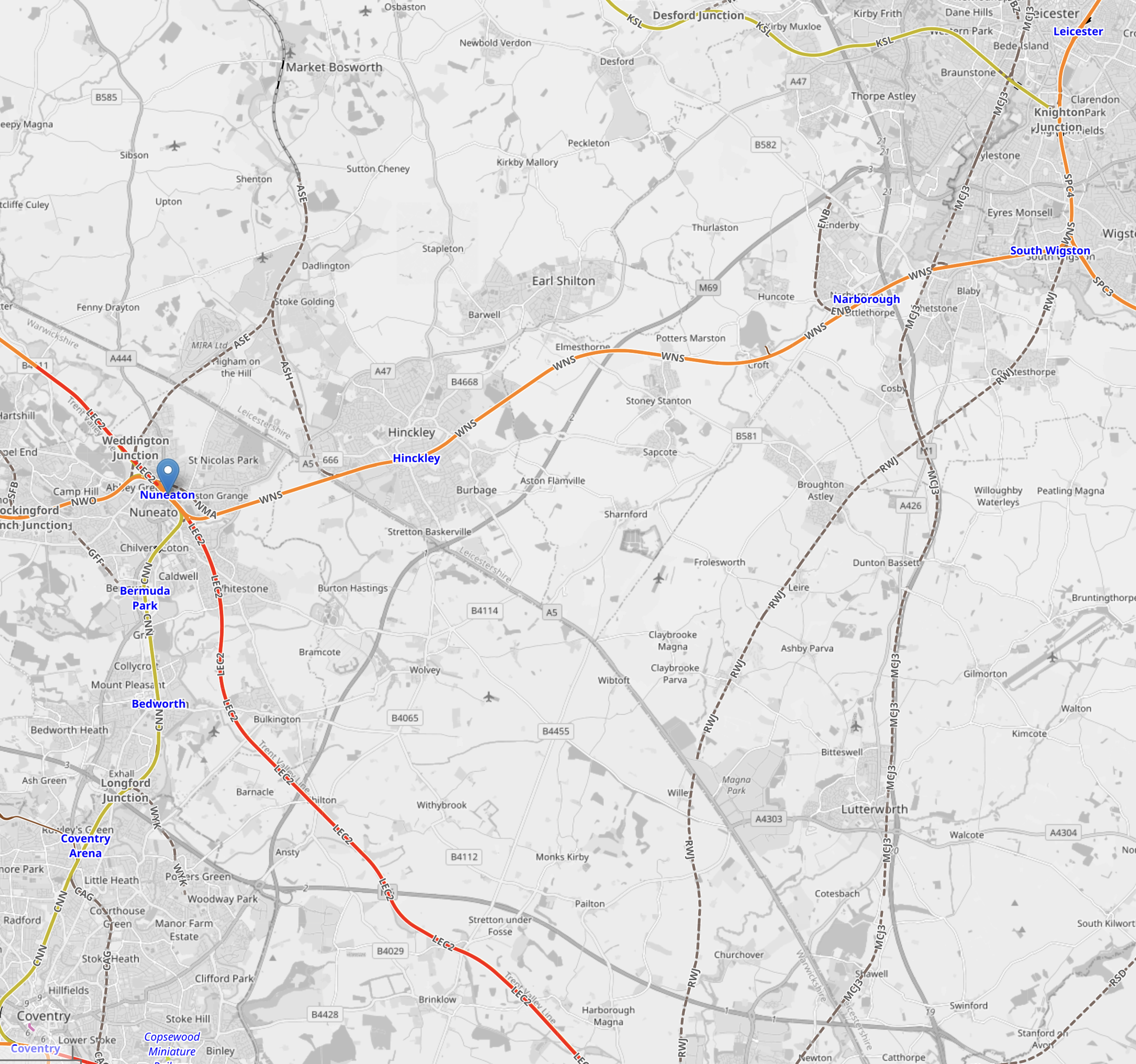
Note.
- Coventry is in the South-West corner of the map.
- Leicester is in the North-East corner of the map.
- Nuneaton, where you currently have to change trains,is marked by a blue arrow.
- The red track passing through Nuneaton station, is the Trent Valley Line.
Services between Coventry, Leicester and Nuneaton are run by two companies.
- CrossCountry run a half-hourly service between between Birmingham New Street and Leicester via Nuneaton.
- West Midlands Trains run an hourly service between Leamington Spa and Nuneaton via Coventry.
I feel ideally, that Leicester and Coventry need a half-hourly service, but an hourly service would be easy and a half-hourly service would mean a four-trains per hour (tph) service between Leicester and Nuneaton.
Probably, the easiest service would be to extend the hourly Leamington Spa and Nuneaton to Leicester, with a reverse at Nuneaton.
What Does The Article Mean By Greener Trains?
I would expect the article means battery-electric trains, but the only mention is in the title.
Could Leicester And Coventry Be Served By Battery-Electric Trains?
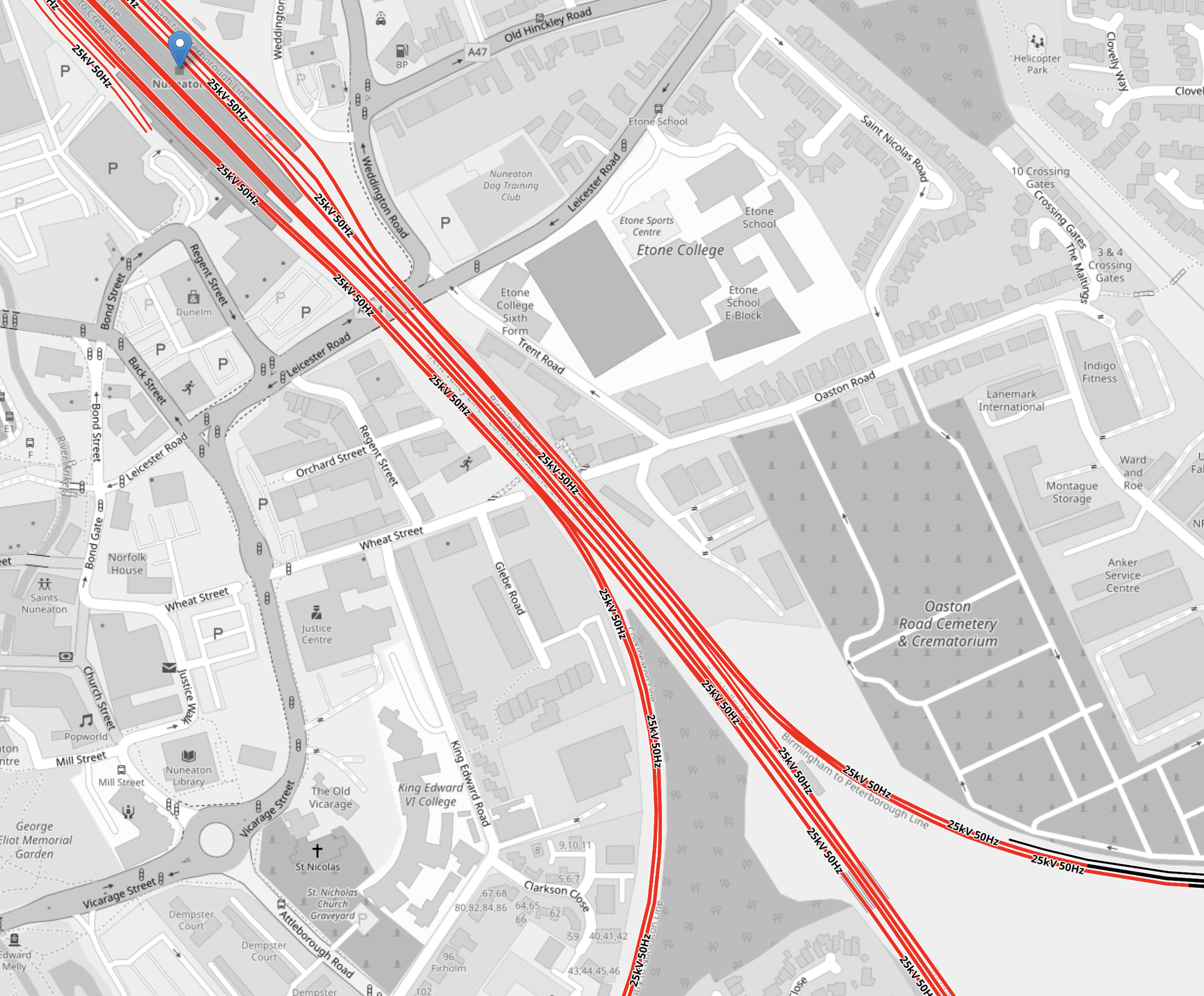
This OpenRailwayMap shows the track layout at Nuneaton station.
And this OpenRailwayMap shows the track layout at Coventry station.
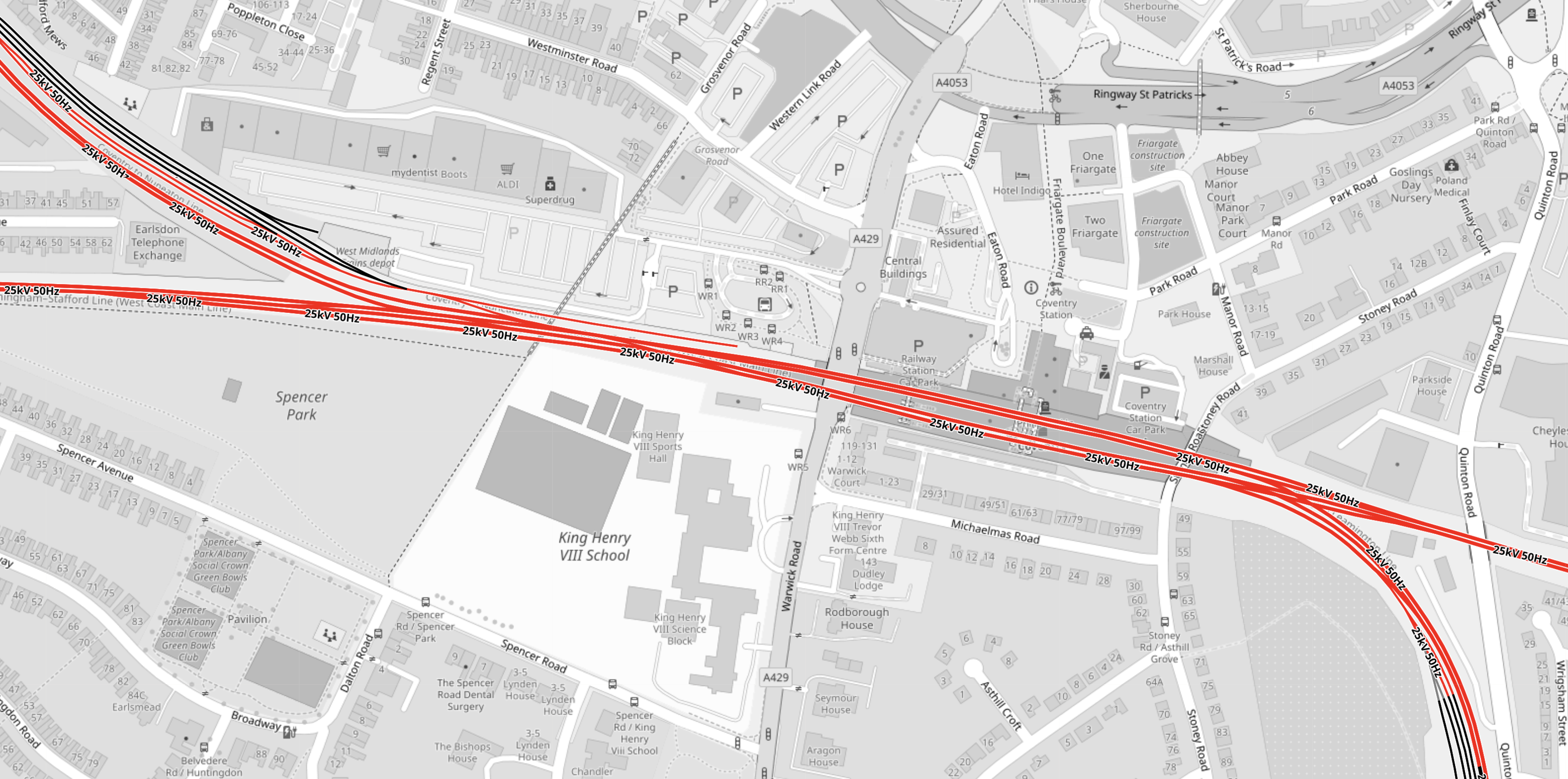
As electrified tracks are shown in red, it would appear that all tracks at both stations are electrified.
The platforms at Coventry and Nuneaton, may be good enough for a quick Splash and Dash, but trains don’t spend long enough in the stations for a full charge.
- Perhaps the solution is to install one of Siemens’s Rail Charging Converters in Leamington Spa and Leicester stations.
- The distance between Leamington Spa and Leicester stations is 48.3 miles, which is well within the range of a battery-electric train.
- Leamington Spa and Nuneaton takes 38 minutes.
- Leicester and Nuneaton takes 27 minutes.
I feel an efficient hourly service could be created between Leicester and Leamington Spa using battery-electric trains.
Onward To Nottingham
Nottingham is another 27.5 miles from Leicester and currently takes 48 minutes in a Class 170 train.
Connections To The North-West And Scotland At Coventry And Nuneaton
They are good and could be more numerous and better.
Could Hydrogen-Powered Trains Be Used?
Yes! If a UK hydrogen-powered train existed!
Cost Of The Project
As reasonably modern trains happily use the route between Leamington Spa and Leicester every day, I suspect that little needs to be done on the full route to create a new service.
So the cost of the project would be sufficient new battery-electric trains and the ability to charge them at Leamington Spa and Leicester.
Conclusion
I believe that Coventry and Leicester would be an easy route to run using an hourly battery-electric train.
It could be extended to Leamington Spa at one end and Nottingham at the other.
Electrification – The Baldrick Way
Electrification In England
There are two major electrification projects underway in England at the moment; the Midland Main Line to Sheffield and Nottingham and the TransPennine Upgrade between Church Fenton and Stalybridge via Leeds and Huddersfield.
In addition, there are other important routes, that need to be electrified around the UK.
- Edinburgh and Aberdeen
- Crewe and Holyhead
- Newbury and Taunton
- Cardiff and Fishguard
- Bristol and Penzance
- Peterborough and Birmingham
- Peterborough and Doncaster via Lincoln
- Felixstowe and Peterborough
There must be loads of other important routes.
Do We Need Electrification Or A Zero-Carbon Railway?
A zero-carbon Railway is probably sufficient, as that would include traditional electrification.
Are The Electrification On The Midland Main Line And The TransPennine Upgrade Working To Similar Objectives?
The Midland Main Line carries the following services.
- Long distance expresses between London St. Pancras and Derby, Nottingham and Sheffield, which will be run in the future, by Hitachi bi-mode express trains.
- Local suburban electrics between London St. Pancras and Bedford and Corby.
- A variety of heavy freight trains between Chesterfield and London.
- Various regional services run by diesel multiple units.
The Midland Main Line is a typical mixed railway.
It is electrified between London St. Pancras and Wigston Junction, which is a total of 95.3 miles.
Sheffield is a further 69.4 miles from Wigston and Nottingham is just 31.1 miles.
The maximum range needed by a battery-electric train is 69.4 miles.
The TransPennine Route carries the following services.
- Long distance expresses between Liverpool and Newcastle and Hull via Manchester, Huddersfield, Bradford and Leeds, which are run by Hitachi bi-mode express trains and diesel multiple units.
- Local suburban electrics around Liverpool, Manchester and Leeds
- A variety of heavy freight trains along the route.
- Various regional services run by diesel multiple units.
The TransPennine Route is another typical mixed railway and carries a similar traffic mix to the Midland Main Line.
Much of the TransPennine Route is electrified, with these exceptions.
- Cleethorpes and Doncaster 52.1 miles
- Doncaster and Manchester Piccadilly – 61.2 miles
- Manchester United FC and Liverpool South Parkway – 26.2 miles
- Hull and Leeds – 51.8 miles
- Redcar and Northallerton – 28.1 miles
- Scarborough and York – 42.1 miles
- Stalybridge and Church Fenton – 50 miles
The maximum range needed by a battery-electric train is 61.2 miles.
This brief analysis indicates to me, that Hitachi battery-electric bi-modes with a range of eighty miles on batteries and charging at selective stations like Cleethorpes, Hull, Nottingham, Redcar, Scarborough and Sheffield could run electric high speed trains on both the Midland Main Line and the TransPennine Route with very little extra infrastructure.
I asked Google AI what is the range of a Class 802 train on batteries and received this reply.
A Class 802 train converted for a battery-electric trial, known as BEMU, has demonstrated the capability to run up to 60 miles (approximately 97 km) on batteries in a trial setting, with real-world data suggesting potential future trains could achieve a range of 100 to 150 km (62 to 93 miles). This technology is intended to allow these trains to cover non-electrified sections of track, reducing the need for overhead wires and potentially saving on electrification costs for intercity routes.
In What Will Be The Range Of A Hitachi Class 800 Battery Train?, I came to this conclusion.
The first version of the battery-electric train will have a range of around a hundred miles, so that they can handle the Great Northern and Great Eastern Joint Line diversion, which is 93.7 miles, on battery power.
But fairly soon after introduction into service, I will be very surprised if they don’t claim the Guinness world record by running farther than the Stadler FLIRT Akku’s 139 miles.
No-one likes being second!
The 93.7 miles needed for the East Coast Main Line diversion via the Great Northern and Great Eastern Joint Line through Lincoln will be more than enough range for Hitachi’s battery-electric trains to run the full length of both the Midland Main Line and the TransPennine Route.
Electrifying A Route
I think that Network Rail have identified an efficient way to electrify an express route.
You start by doing these actions.
- Get the track layout right, so that trains can use the route at the optimal speed.
- Update the signalling to a high standard. I suspect digital signalling would be a good idea, to maximise the capacity of a route.
- Make sure, that the chosen battery-electric express trains can handle the route.
- Charging stations would be installed as required.
The battery-electric trains would be introduced as soon as the route is ready.
Hopefully with good project management, there would be the following benefits compared to traditional electrification.
- Difficult sections like tunnels could be left without electrification.
- Fewer bridges would need to be demolished and rebuilt.
- There would be less disruption to local residents.
- Siemens have developed a Rail Charging Converter, which connects to the domestic rather than the National Grid, so is easier to install.
But the big benefit is that new electric trains could probably be introduced earlier, which hopefully should increase ridership and revenue.
Once the expresses were working well, the best way to decarbonise the rest of the services on the route can be ascertained and actioned.
South Eastern Railway Deploys IsoMat Thermal Technology To Keep Trains On The Tonbridge To Hastings Line Running In Hot Weather
The title of this post, is the same as that of this news item on the Network Rail web site.
This is the sub-heading.
A new type of technology is being trialled on the Tonbridge to Hastings railway line to help keep trains running in hotter weather, and more reliable journeys for passengers and freight customers.
These two paragraphs add more details.
The South Eastern Railway has partnered with UK green tech start-up Flint Engineering to combat excessive heat in railway signalling cabinets that can exceed 70°C, with a new patented system that requires no power, maintenance, or internal cabinet modifications, and can be installed in under an hour.
Flint’s innovative IsoMat technology delivers peak temperature reductions of over 21%, on the hottest days, transferring thermal energy thousands of times more efficiently than copper or aluminium alone.
This is one of those ideas, that could be filed under Too Good To Be True.
This picture shows the device in operation.
I can see this device having many uses, in the most surprising places.
National Grid Has Awarded £12bn In HVDC Supply Chain Agreements
The title of this post, is the same as that of this press release from National Grid.
These are the first three paragraphs.
National Grid has completed the award of its High Voltage Direct Current (HVDC) civil works supply chain framework, with £12bn worth of agreements confirmed. This announcement marks the third and final stage of our £59bn supply chain framework awards and underlines the commitment to delivering the energy infrastructure needed to support the Great Grid Upgrade and the UK’s energy transition.
A total of six HVDC converter civil works suppliers have been awarded positions on Lot 1 of the Framework Agreement totalling approximately £9.07bn. In addition, three HVDC onshore cable civil works suppliers being awarded places on Lot 2 of the Framework, worth an estimated £3.7bn. The successful HVDC converter civils suppliers are Balfour Beatty, BAM Nuttall, Galliford Try, Laing O’Rourke, Skanska and Taylor Woodrow. The HVDC onshore cable civils Framework has been awarded to Balfour Beatty, Murphy, and VolkerFitzpatrick.
Contracts have been secured for a five-year period, with the potential to extend for a further three years. Both Frameworks cover confirmed and anticipated projects, including Eastern Green Link 4, in partnership with SP Energy Networks and LionLink in partnership with TenneT .
These are a lot of money allocated to projects, that will be delivered in the next few years.
Where’s the consolidated plan for capital expenditure from the Water Industry?
Water is also simpler, than electricity, as you are only dealing with one country. If you go through the paragraphs above, you’ll find TenneT, who do a similar job to National Grid in the Netherlands and parts of Germany.
I also found this advert from Thames Water, in a Southeastern train last week.
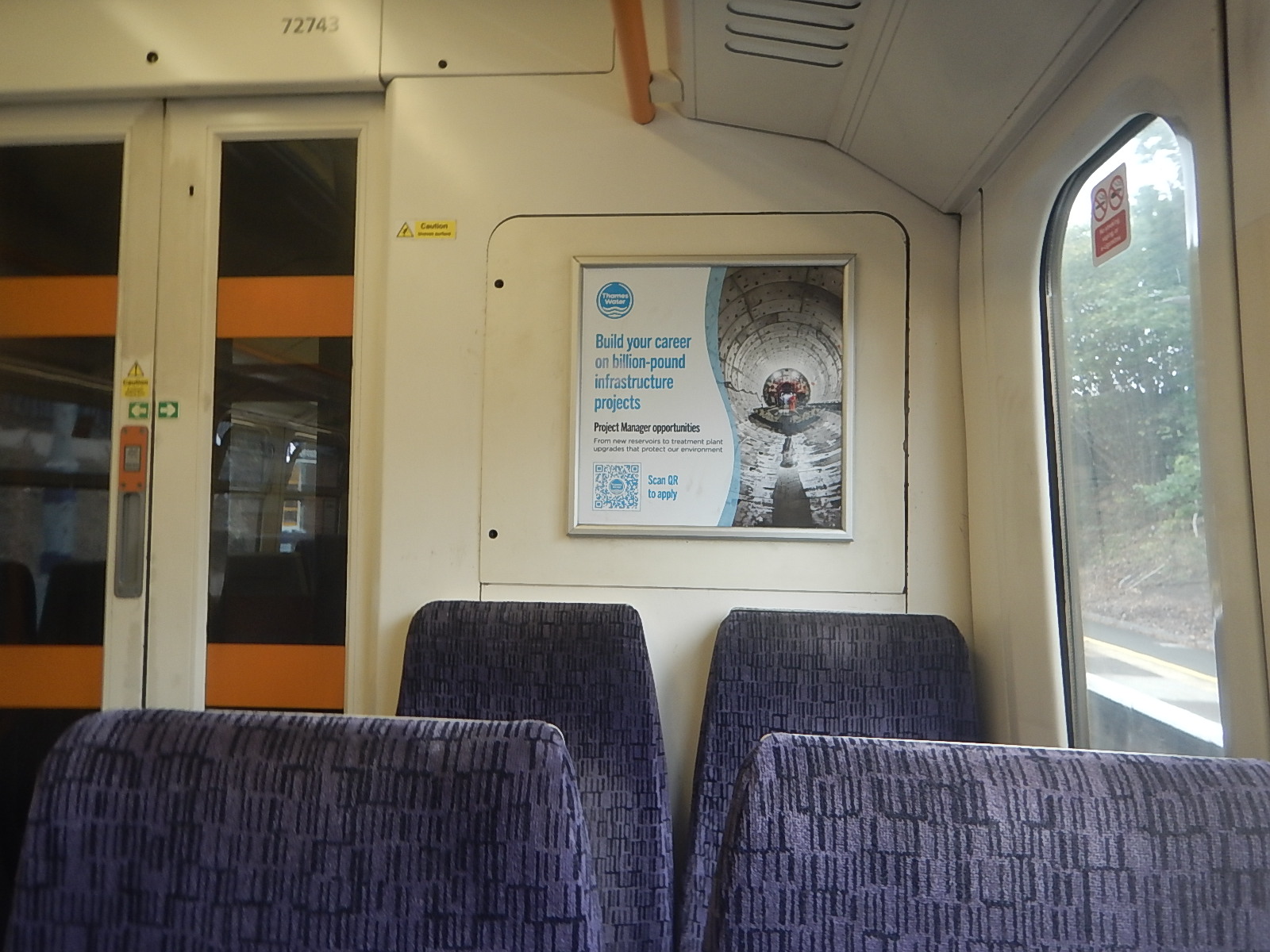
Does this indicate that Thames Water has project management problems?
 The Anonymous Widower