Will The Return Of Strictly Cause The Number Of Cases Of The Covids To Drop?
The phrase Bread and Circuses, was apparently first used by Juvenal, who was a Roman poet
During the covids, Asda, Morrisons, Sainsburys, Tesco, Waitrose and others have delivered the bread.
And now the BBC is bringing on the circuses with the start of the new series of Strictly from tomorrow.
If the rate does drop, the Government should buy up the latest James Bond film and show it on a Friday night.
Why Is Manchester The Odd City Out?
I find the different reactions of the large Northern cities interesting.
I have seen no comment and moaning from Leeds, Newcastle and Sheffield, and Liverpool and the rest of Lancashire seems to have accepted their Tier 3. fate.
Only Manchester seems to have a serious objection.
I know Liverpool well, as I went to Liverpool University in the 1960s, met my late wife there and we lived together in the city for a couple of years.
I still visit the City regularly, as I like the city’s weather and outlook and do business with my old University.
I have visited Manchester many times, often for football (I support Ipswich, despite being a Londoner!) and I find the city very different to Liverpool.
But I don’t seem to warm to Manchester, as I do to Liverpool and the other large cities of the North.
Or is it Manchester doesn’t warm to me?
Andy Burnham is not a Mancunian and could it be, that his hard stand against the Government, is driven by wanting to be more Mancunian, than the Mancunians.
Manchester puzzles me, but it does seem to be out of step with the rest of the North.
Feltham Depot – 13th October 2020
On my trip to Feltham Station, I passed the construction site of Feltham Depot.








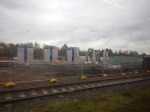



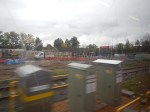
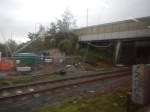


It seems to be progressing.
It’s a pity that the train, that I used to take the pictures, had such badly scored windows.
All Change At The Broadgate Entrance To Liverpool Street Station
Everything seems to have changed at the Broadgate Entrance To Liverpool Street Station, as these pictures show.






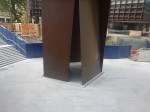





Note.
- You now enter at street level, rather than through a subway.
- You ascend a gentle ramp to walk through some upmarket shops and then descend into the station using an escalator.
- You can also walk through the shops to the bus station between the rail station and Broadgate.
The only thing, that hasn’t changed is the rusty smoking shelter.
Interview: Hitachi’s Nick Hughes On Driving Innovation In Rail Propulsion
The title of this post is the same as that of this article on The Engineer.
As with the article I discuss in Hydrogen On The Line, it is another well-written and informative article from The Engineer, where those at the sharp end of innovative rail technologies give their views.
This is the introductory paragraph.
As part of a series of articles exploring the propulsion technologies that will shape the future of key transport sectors The Engineer spoke to Hitachi Rail’s Nick Hughes about the innovations that will propel the rail sector into a low carbon future.
The Engineer asked these questions.
- What propulsion innovations will help power the rail sector towards net zero?
- Can you outline some of your organisation’s own key activities in this area?
- What are the key obstacles and challenges to developments in this area?
- What is your vision for the long-term future of propulsion in your sector?
I find the answer to the last question most interesting.
Rail is going to become increasingly digitised and integrated into other sectors involved in smart cities, mobility-as-a-service and flexible green grid. Therefore, Hitachi Rail won’t be able to stay at the forefront of innovation by its self. This is why we are focused on building partnerships with other like-minded, innovative, clean tech companies like Hyperdrive Innovation, Perpetuum and Hitachi group companies such as Hitachi ABB.
Hyperdrive Innovation is going to apply its knowledge and expertise from the automotive sector, to develop a market leading battery for Hitachi trains. Perpetuum predictive analytics improve reliability and availability of existing trains. Meanwhile, Hitachi ABB’s experience of the power sector allows our battery train solution to incorporate charging, storage and grid management. These partnerships creates an entry point into the rail market for our partners, potentially leading to future growth and jobs.
However, it is important to recognise that the established technologies of today – battery trains, discontinuous electrification and high-speed trains – are the technologies will help achieve the 2050 net zero emission target.
I would very much agree with all that is said.
How Covids-Unfriendly Is A Class 345 Train?
These pictures show Crossrail’s Class 345 trains.
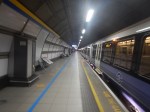



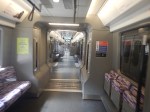

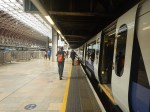

Note.
- This example was a nine-car train going to Heathrow.
- It is 205 metres long and can carry 1500 passengers.
- As with most London Underground trains, most of the passengers sit longitudinally.
- Having watched people on these trains several times in the last few weeks and feel that the design encourages social-distancing
But there are other big advantages, when it comes to suppressing the virus.
- Each car has three sets of sliding doors on each side, which is more than most trains. As the lobbies on the train are spacious, does this help the maintaining of social-distancing, when entering and leaving the train.
- The trains are walk-through, so if you end up with a car, that is full of mask deniers, it is easy to move.
- The trains have full air-conditioning, which should reduce the amount of virus in the air.
I hope Transport for London are watching the statistics for the covids, to see if they go up or down, as more new trains are introduced on Crossrail routes.
Hydrogen On The Line
This article on The Engineer is entitled On Track: Advances In UK Hydrogen Rail.
This sub-heading introduces the article.
An expert panel from Vivarail, Birmingham University and Alstom discuss UK developments in hydrogen powered rail transport.
The article is a very readable article, that explains, the whys, wherefores and hows of hydrogen powered rail transport in the UK.
Lithium Project Raises Millions In A Day
The title of this post, is the same as that of this article on Cornish Stuff.
This is the introductory paragraph.
Cornish Lithium raised over £3m yesterday to fund new exploration and today opens up the crowd fund to the community.
It does seem to have been a very successful funding.
This to me is a key paragraph.
The company say they are delighted to note that approximately 15% of the pre-registered investors were from Cornwall.
The Cornishmen and Cornishwomen seem to be backing their local business!
How Would Opening Crossrail Affect The Covids In London?
There seems to be very little on the Internet about this, that I can find, Partly because if you search for Crossrail and Covid-19 you get lots of articles about how the virus is delaying construction.
These are a few of my thoughts.
The Class 345 Trains
Crossrail’s Class 345 trains are 205 metres long and can hold 1500 passengers.
- The passenger density is 7.3 passengers per metre, but the trains have three doors per car, as opposed to others like the Class 700 trains, which have a similar passenger density and only two doors.
- Would the space and the wide doors, make social-distancing easier at all times?
- I’ve ridden these trains several times during the pandemic and their full air-conditioning for the tunnels, would surely be ideal to help keep the trains free of the virus, by changing the air regularly.
- The trains are walk-through, which means you can walk-away from someone who looks dodgy.
There will probably be some better trains to reduce the spreading of the virus, but I doubt there will be that many.
The Stations
I’ve only been in two Crossrail stations.
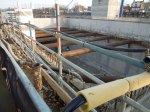
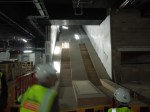
These are pictures taken in the Woolwich station box.







And these pictures were taken inside the Canary Wharf station box






Note.
- I think we can assume that the platforms and associated station tunnels are not small.
- All underground platforms will have platform edge doors.
- The stations will be fully air-conditioned.
- Both picture sets were taken in 2013.
Will passengers be safer and less likely to contract the virus compared to the cramped stations of the Central Line?
Crossrail Will Increase Capacity On London’s Rail System
Crossrail will add nearly twenty per cent of extra capacity to London’s East-West rail network.
That will have two major effects.
- More passengers will use rail transport, rather, than buses or their own cars.
- There will be more space, that will make social-distancing easier on rail journeys.
I can’t see either increasing the spread of the covids.
Will Passengers Who Can, Swap To Crossrail From Other Lines?
Consider.
- The Central Line will have interchanges with Crossrail at Stratford, Tottenham Court Road, Bond Street and Ealing Broadway.
- Stratford and Ealing Broadway currently takes 52 minutes on the Central Line and will take 27 minutes on Crossrail.
- The Hammersmith and City Line will have interchanges with Crossrail at Whitechapel, Liverpool Street and Paddington.
- Whitechapel and Paddington currently takes 40 minutes on the Hammersmith and City Line and will take 13 minutes on Crossrail.
- The Jubilee Line will have interchanges with Crossrail at Canary Wharf, Stratford and Bond Street.
- Stratford and Ealing Broadway currently takes 32 minutes on the Jubilee Line and will take 15 minutes on Crossrail.
Looking at speed alone, there will be good reasons to change to Crossrail for many.
But there will also be journeys that currently require a change will be direct because of Crossrail.
- Slough and Liverpool Street or Canary Wharf
- Woolwich and Heathrow
- Gidea Park and Paddington,
And there will be round-the corner journeys with a cross-platform interchange at Whitechapel.
Ilford and Canary Wharf currently takes 33 minutes and will take 17 minutes after Crossrail opens.
I am absolutely sure, that after Crossrail opens, passengers will use the route for a faster journey and one because of more spacious trains and stations, a more socially-distanced one.
An Air-Conditioned Journey
The proportion of time on a typical journey in London, spent in an air-conditioned train or station will increase.
This can only be a good thing for fighting the covids.
Conclusion
It looks to my eye, that Crossrail will not increase the spread of the covids and it could be a powerful weapon to reduce the levels of the virus across London.
I think it should be opened as soon as possible.
Could Crossrail Be Opened In Sections?
Unlike some of London’s Underground lines, which were provided with below-ground turnbacks, there appears to be no turnback on Crossrail between Whitechapel and Paddington.
Compare that with the Piccadilly Line, which has turnbacks at Wood Green and Hyde Park Corner, which are near the end of the central tunnel.
Crossrail does have crossovers at Custom House, Whitechapel and between Farringdon and Tottenham Court Road, so could any of these be used to improvise a turnback.
What effects would there be if say a four trains per hour (tph) preview service were to be run between Abbey Wood and Whitechapel?
- It would allow Crossrail to test systems.
- It would improve connections to Canary Wharf.
- It would give Londoners and others a small cup of much-needed cheer.
I also doubt, it would increase the number of cases of the covids in London, if everybody behaved themselves.
It would need Abbey Wood, Woolwich, Custom House, Canary Wharf and Whitechapel stations to be certified safe to open.
- Abbey Wood station is already open for National Rail services and could surely be easy to finish and certify.
- Woolwich, Custom House and Canary Wharf are more or less independent buildings and again should be easy to open.
- Only Whitechapel looks difficult with a lot of work to do.
Perhaps the preview service should terminate at Custom House? But that doesn’t include the important Canary Wharf!
- Could trains just pass through Whitechapel station and still use the turnback? The platform edge doors would ensure safety.
- Could trains even use an improvised turnback on the Western side of Farringdon, where there is a crossover?
- As stations at Liverpool Street and Farringdon became available, they could be added to the route.
I’m sure that there’s a solution in there, that could allow Crossrail to open gradually, rather than as a big bang.
I hope Crossrail are looking at it, as the design and architecture of this railway could be a weapon in the fight against covids.
How Many Diesel Multiple Units In The UK Have Voith Hydraulic Transmissions?
This may seem to be a funny question to ask, but all will come clear later in the week.
Doing a quick search through Wikipedia finds the following trains.
- Class 150 – 135 – two-car – 2 x 213 kW
- Class 150 – 2 – three-car – 3 x 213 kW
- Class 153 – 56 – one-car – 1 x 213 kW
- Class 155 – 7 – two-car – 2 x 213 kW
- Class 156 – 114 – two-car – 2 x 213 kW
- Class 158 – 149 – two-car – 2 x 260-300 kW
- Class 158 – 23 – three-car – 3 x 260-300 kW
- Class 159 – 30 – three-car – 3 x 260-300 kW
- Class 165 – 48 – two-car – 2 x 261 kW
- Class 165 – 27 – three-car – 3 x 261 kW
- Class 166 – 21 – three-car – 3 x 261 kW
- Class 168 – 9 – two-car – 2 x 315 kW
- Class 168 – 8 – three-car – 3 x 315 kW
- Class 168 – 11 – four-car – 4 x 315 kW
- Class 170 – 41 – two-car – 2 x 315 kW
- Class 170 – 88 – three-car – 3 x 315 kW
- Class 171 – 12 – two-car – 2 x 315 kW
- Class 171 – 8 – four-car – 4 x 315 kW
- Class 175 – 27 – two-car – 2 x 340 kW
Note.
- The three fields after the train class are the number of trains, the number of cars in each train and the number andsize of engines per train.
- All trains seem to have one diesel engine per car.
- All trains seem to have the same or similar Voith transmission.
There are a total of 816 trains of various lengths.
 The Anonymous Widower