Class 319 Train Used In GB Railfreight Parcel Test At London Euston
The title of this post is the same as that of this article on Rail Advent.
This is the introductory paragraph.
GB Railfreight has used a Class 319 train during a successful trial of former commuter trains for express parcel delivery services.
Other points from the article.
- Standard roll-cages can be loaded and offloaded at most major stations.
- A substantial amount of cargo can be carried.
- GBRf is talking to the Government about deliveries to hospitals.
It should be noted that the Class 325 trains that are used to move goods for Royal Mail are based on Class 319 trains.
- Both trains are based on the legendary Mark 3 coach.
- There are sixteen of these Royal Mail trains.
- Each train is four cars.
- Each car can hold up to twelve tonnes.
- They are capable of 100 mph like the Class 319 trains.
- Class 319 trains are being converted into bi-mode Class 769 trains for use by Rail Operations Group as parcel trains.
As there are still at least fifty Class 319 trains still available for modification, will it mean a more will be converted into parcels trains?
Did Boris Meet The Devil?
Boris was in good form in his statement this morning.
I suspect that Boris felt a bit like I did, when I was released from Addenbrookes after my stroke. The term demob-happy comes to mind.
At some point in my recovery, I met the Devil. She told me, that I was a troublemaker and a disruptive influence! So she threw me out!
Did Boris have a similar experience?
Health Lessons From Lockdown
Are some of us learning things about ourselves during lockdown?
For myself!
Mental Health
I certainly think, that I’m handling the mental side well, as I’ve had several lockdowns in the past, usually when I want to get some software written.
Another programmer has told me, that he has used lockdowns to get software written in the past.
I am certainly getting bored though! You can only do so many serious puzzles from The Times.
Normally, if I feel bored, I get on a train or a bus and go somewhere interesting.
Exercise
I’m taking exercise regularly and go for a regular walk most days. I’d probably walk more, if I felt like taking public transport more. But, I do feel, buses and trains could be a place to catch COVID-19.
Drinking
My house tends to get a bit warm, so I’m drinking a lot.
Not strong alcohol, although there is quite a bit of 0.5% Adnams beer going down my throat, but mainly, still lemonade, tea and water.
The amount of fluid seems to have cured my periodic constipation.
On the other hand it does seem to have increased my INR, so I have reduced my Warfarin dosage from 4 to 3.5 mg. per day.
Sleep
I seem to be sleeping well! But then I always do!
Conclusion
Except for the boredom, I think, that I’m doing OK.
DB Launches New Spanish-Anglo Freight Service
The title of this post is the same as that of this article on Rail Magazine.
This is the introductory paragraph.
A 72-hour freight service carrying essential hygiene, medical and food products from Spain to London has been launched by DB Cargo UK and sister company Transfesa Logistics.
These are some points made in the article.
- Trains will run between Valencia and Murcia in Spain and Barking in London.
- Obviously the Channel Tunnel and High Speed One, will be used.
I think in the coming days and months, we’ll see more services like this.
Ripple Lane Intermodal Terminal And Cross-Channel Freight Traffic
Wikipedia has a sub-section about Ripple Lane.
Some points from the sub-section.
- The terminal was developed by Ford to deliver parts from Europe to their massive Dagenham complex.
- It is now a base for various Continental services.
- Since 2009, there has been a refrigerated service from Valencia in Spain, which takes pallets back on the return journey.
Will the new Spanish service replace or augment the current one?
My First Real Telephone Consultation With A GP
Last Monday, I had my three-monthly B12 injection, as I have since I was diagnosed as a coeliac around twenty years ago.
I said that I needed to see my GP, or at least talk to him, as it was time for my Warfarin review, where we check my dose and order more tablets, as appropriate.
The receptionist said, she’ll get him to give me a call and professionally checked that they had my correct telephone number.
I’d been home about thirty minutes, when the GP phoned and we review the Warfarin and he said, he’d sent a prescription to Boots. I also told him, that my hand would need a proper examination after we’d got rid of the menace of COVID-19.
The call took about five minutes and I suspect that we’d both rate the outcome with at least four stars.
I find it strange, that in my seventy-two years, I’ve never before had a telephone consultation with a GP.
Even, when my wife and son, were dying of cancer, I never spoke to my GP at the time by phone. I did occasionally send messages by FAX to the surgery, as that was the only way to leave a message, as e-mail and text wasn’t an option.
Surely, though simple systems could be developed, so that everybody can have a telephone or video consultation with their GP, if the patient has the technical knowledge.
With my Warfarin review, I might send a message, by phone, e-mail or text, saying I need the review.
- The GP’s system might then text me to say, my phone appointment was at 14:00 on the 17th, in much the way it does now!
- I would be able to use a simple reply system to say that was OK or not!
- The doctor would hopefully be able to phone at the appropriate time.
All sorts of systems would be possible. I’m sure Zoom has something suitable.
If COVID-19 means that GP capacity is increased because of the need to social distance, so be it!
There is also the benefit, that on a wet and windy day, walking to the GP, might not be what I want to do.
A Minister For Hydrogen – Yes Please, Prime Minister
The title of this post is the same as that of this article on H2 View.
Sounds like a good idea to me!
Thirsty High-Rollers … Mining’s Heavy Haulers Prime Candidates For Hydrogen Conversion
The title of this post, is the same as that of this article on ecogeneration.
You understand, what the author means about mining’s heavy haulers, when you open the article.
This paragraph describes their carbon emissions.
One large scale dump truck, depending on the haul road it is using, will use between 100 and 140 litres of diesel per 100km. These vehicles operate all day every day except for maintenance down time. That’s between 260kg and 360kg of CO2 per 100km per truck.
Large open pit mines have tens of these vehicles operating continuously, so the numbers build up very quickly.
The author then goes on to say why, that converting these vehicles to green hydrogen makes a lot of sense.
The dump trucks are already diesel/electric, which means that the diesel generator can be replaced with a hydrogen fuel cell and a battery.
Mining giant; Anglo-American will be introducing a prototype hydrogen-powered dump truck at a platinum mine in South Africa this year.
These paragraphs describe the transmission.
The vehicle, which is called a fuel cell electric vehicle (FCEV) haul truck, will be powered by a hydrogen fuel cell module paired with Williams Advanced Engineering’s scalable high-power modular lithium-ion battery system. Williams provides batteries for FIA’s E-Formula motorsport.
This arrangement will replace the existing vehicle’s diesel engine, delivering in excess of 1MWh of energy storage. The battery system will be capable of recovering energy through regenerative braking as the haul truck travels downhill.
Note that the truck has more energy storage than is proposed for a four-car battery-electric train, like the Class 756 train, which has only 600 kWh.
The author finishes with this concluding paragraph.
With the major mining companies focusing on making significant strides in decarbonisation by 2030 expect there to be more announcements such as this focusing this “low hanging fruit” for the mining industry’s to materially reduce its carbon foot print.
Reading this, I can’t help feeling that replacement of a Class 66 locomotive with a zero-carbon hydrogen-battery-electric hybrid unit could be possible.
What Percentage Of People In The UK Survive COVID-19?
This is only a simple analysis based on the COVID-19 statistics published on Sunday, 26th April.
- So far 152,840 people have been lab confirmed as having COVID-19.
- There has also been 20,732 deaths in hospitals.
- Suppose another 25% have died in care homes or in their own bed.
- That would give a total of 25,915 deaths.
- So rather crudely, if you get tested positive for COVID-19, you have a 17% chance of dying. What is the chance of dying from a serious stroke or breast cancer?
- On the other hand 126,925 or 83% have survived.
- Some, let’s say 20,000 are in ICU beds in hospitals, reducing the figures to 106,925 or 70% that survived.
We should be examining these seventy percent to see why they survived.
The official statistics concentrate on the negative side, but don’t publish figures like how many left hospital for convalescence at home or in an ordinary hospital ward!
Update – 27th April 2020
The actual figure of those in ICU beds yesterday was 18,667, which makes the figures 108, 258 and 71% have survived.
Steventon Listed Railway Bridge Saved From Demolition
The title of this post, is the same as that of this article on the BBC.
On the face of it it looks like victory for the Nimbys, who have saved a rather ordinary and possibly decrepit bridge from demolition.
But I believe there is more to this story than meets the eye.
The Bridge
The bridge at the centre of the argument may be Grade 2 Listed, but there are lots of similar bridges on UK railways in better condition with similar heritage, that don’t have a listing.
Type “steventon bridge electrification” into a search engine and you’ll find lots of images of the bridge.
- One picture shows, the bridge with the railway flooded, which puts an interesting slant on the debate. What are the foundations like?
- Notice, that the bridge seemed to suffer a rather botched repair at the hands of British Rail’s finest engineers.
- Having read a lot about this story, I suspect that the locals’ main reason for objecting, is that they don’t want the disruption, whilst it is rebuilt.
- Incidentally, I suspect Great Western Railway don’t want the bridge rebuilt either, as closure will be a long disruption to all services.
I have been involved in the refurbishment of several buildings of around the same age or even older than the bridge. This is the sort of construction, that will have to be replaced at some time. If it’s not replaced, some of the novel techniques that are now available to Network Rail will have to be applied.
Network Rail
The article says this about Network Rail’s solution to the problem.
But following what the company described as ‘extensive and breakthrough testing’ using computer simulations it found a speed reduction to 110mph through the village meant wires could pass underneath the existing bridge.
I do think, that 110 mph is rather convenient. if you look at the maximum operating speeds of trains and locomotives that will pass through.
- Class 801 train with digital signalling -140 mph
- Class 801 with conventional signalling – 125 mph
- Class 800/802 train on diesel power – 100 mph
- Class 80x train on battery power – 100 mph
- Class 387 train – 110 mph
- Class 90 locomotive – 110 mph
- Class 91 locomotive – 125 mph
- Class 93 locomotive – 110 mph
- High Speed Train – 125 mph
Very few trains will have to slow down.
Any train that used onboard power, like a High Speed Train or a Class 80x with batteries, could theoretically go through at the maximum speed, track, signalling and train taken together would allow.
Hitachi
In Issue 898 of Rail Magazine, there is an article, which is entitled Sparking A Revolution, which describes Hitachi’s work and plans on battery-powered trains. This is an extract.
Battery power can be used as part of electrification schemes, allowing trains to bridge the gaps in overhead wires where the costs of altering the infrastructure are high – in tunnels or bridges, for example. This would also have the immediate benefit of reducing noise and emissions in stations or built-up areas.
Elsewhere in the article, it is said that Hitachi trains will be able to do 100 mph on battery power for up to 60 miles.
But would they be able to do 125 mph on battery power for perhaps five miles? I can’t see why not!
The Google Map shows the track through Steventon.
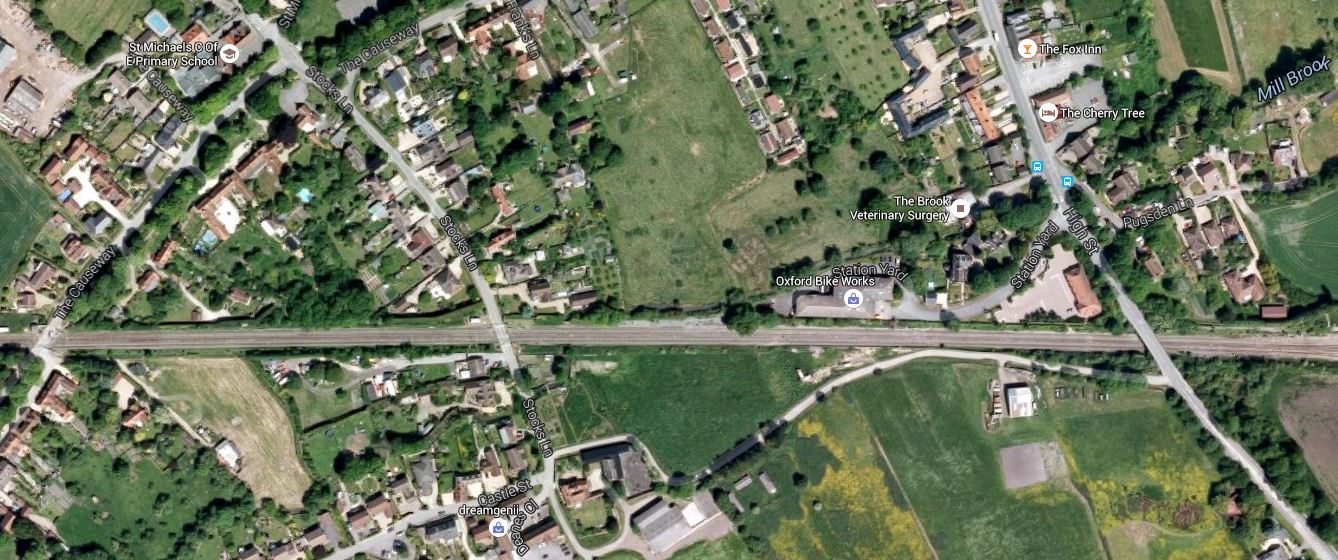
Note.
- The bridge in question is at the East.
- There are also a couple of level crossings in this stretch of track, where the height of wires is also regulated.
Perhaps, the pantograph should be dropped before going through section and raised afterwards, with power in the section taken from a battery.
Avoiding obstacles like this, may be an economic alternative, but it does require that all electric trains using the section are able to use battery power.
I have a feeling, I’ve read somewhere that a Class 88 locomotive can do a similar trick using the onboard diesel engine.
As a Control Engineer, who trained in the 1960s, I would expect that all pantographs can now be raised or lowered with all the precision and repeatability of an Olympic gold-medal gymnast!
I do wonder, if the Great Western Electrification Project had been designed around discontinuous electrification and battery-electric trains, the project would have gone better.
For instance, the Severn Tunnel is 7,000 metres long and trains take under four minutes to pass through. The Wikipedia entry for the tunnel has a section on Electrification, which details the complicated design and the trouble that there has been with corrosion.
Given that battery-electric trains have other advantages, design by hindsight, says that a tunnel without electrification and battery trains may have been a better solution.
Conclusion
Network Rail and Hitachi will get the speed of trains through Steventon up to 125 or even 140 mph, possibly by using battery power.
But whatever happens, I’m certain that the bridge will have to be rebuilt! It has the air of a derelict house, that will suck up all your money.
When The New Newport Railway Line To Cater For Major Events Is Set To Open
The title of this post is the same as that of this article on Wales Online.
If you’ve ever been to a major event at the Principality Stadium in Cardiff, as I have a couple of times, you’ll know that getting your train back to England can be a long wait.
So the Welsh have come up with a cunning plan to build a staging area, where they can hold trains near the former Llanwern steelworks site at Newport.
- It will be 2.4 km. long.
- I estimate that a nine-car Class 801 train is 234 metres long and holds 611 passengers, so the siding can hold ten trains which have a capacity of over six thusand passengers.
- It is part of a £50million plan for a new Llanwern station, which is part of the South Wales Metro.
- It will also be used for the testing of trains. It is very handy for CAF’s Newport factory.
This Google Map shows the site, with CAF’s factory highlighted.
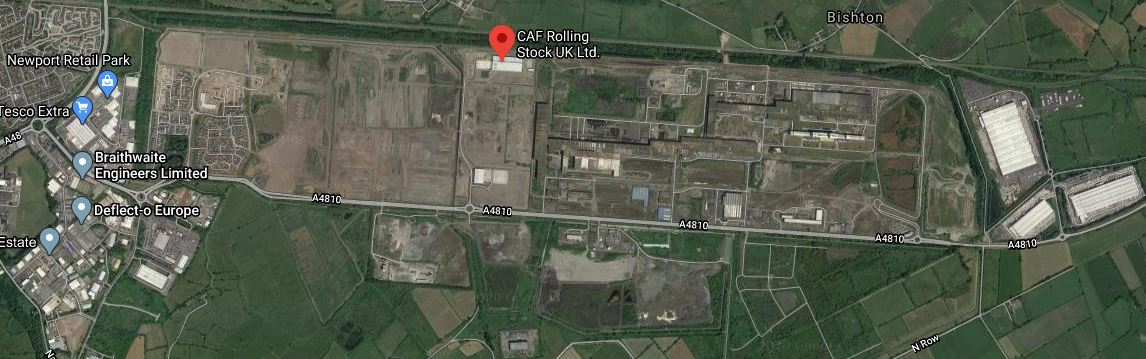
Note the South Wales Main Line running along the North of the massive steelworks site. So if the staging area, is built between the main line and the steelworks site, which contains the CAF factory, it will be convenient for both uses.
This looks to be a good plan, that will solve more multiple problems and needs.
 The Anonymous Widower