Rugby Is A Team Game And So Is Formula One!
On Saturday morning, the Japanese rugby team, showed how teamwork is important, as they hardly seemed to make a mistake.
The Welsh and the Australians, both played their parts in an excellent match.
And then we had the Russian Grand Prix at lunchtime!
Mercedes got the teamwork like clockwork and they won.
As to Ferrari, the two drivers felt out with each other and Vettel didn’t obey team orders.
I have watched Formula One for many years, and every so often Ferrari seem to lose the plot!
TfL Confirms Details Of Reading Services
The title of this post is the same as that of this article on Railway Gazette.
This is first paragraph.
Details of the transfer of London Paddington – Reading stopping services from Great Western Railway to TfL Rail from the December 15 timetable change have been confirmed by Transport for London.
Some significant points to note from the article.
- The service will be run by Class 345 trains.
- Fast services from Reading and some stations to the East will continue to be run by Great Western Railway.
- There will be four trains per hour (tph) in the Peak and two tph in the Off Peak.
- After the New Year Bank Holiday, contactless payments will be available between Paddington and Reading.
- Children under 11 who are accompanied by an adult, as well as people who are eligible for the Freedom Pass, will be able to travel for free to Reading on the TfL service.
- Oyster will not be available to the West of West Drayton.
- Great Western Railway , but not South Western Railway, are expected to bring in contactless ticketing in the New Year.
A few of my thoughts.
What Will Be The Service Pattern?
When the possibility of TfL Rail taking over the services to Reading, I wrote Will Crossrail Open To Reading in 2019?.
The service pattern to Maidenhead to Reading appears to be.
Reading To Paddington – Limited Stop
This service will be run at two trains per hour (tph) in the Peak with no trains in the Off-Peak.
Stops are Twyford, Maidenhead, Slough, West Drayton and Ealing Broadway.
Reading To Paddington – All Stations
This service will be run at two tph all day.
The service will call at all stations except Hanwell and Acton Main Line.
Maidenhead To Paddington
This service will be run at two tph all day.
The service will call at all stations except Hanwell and Acton Main Line.
A Summary Of Peak/Off Peak Calls
Adding these services up, gives the following numbers for Peak and Off Peak calls in trains per hour (tph)
- Reading – 4,2
- Twyford – 4,2
- Maidenhead – 6,4
- Taplow – 4.4
- Burnham 4,4
- Slough – 6,4
- Langley – 4,4
- Iver – 4,4
- West Drayton – 6,4
- Hayes & Harlington – 4.4
- Southall – 4,4
- Hanwell – None to Reading/Maidenhead
- West Ealing – 4.4
- Ealing Broadway – 6,4
- Acton Main Line – None to Reading/Maidenhead
- Paddington – 6,4
Note.
- 4,2 means 4 tph in the Peak and 2 tph in the Off Peak.
- It would appear that all stations except Reading and Twyford have at least four tph all day.
- Stations between Hayes & Harlington and Ealing Broadway will get another six tph all day going to Heathrow.
- Acton Main Line station will get another four tph all day going to Heathrow.
The frequency of trains would appear to satisfy Transport for London’s Turn-Up-And-Go frequency for Metro services.
No one should wait more than fifteen minutes on a Metro for a train!
Freedom Pass Holders Will Be Winners
Being able to use a Freedom Pass between Paddington and Reading will be very useful for many travellers.
It would appear that the cheapest way to use the trains West of Reading for a Freedom Pass Holder, will be to use the pass to get to Reading on TfL Rail and then buy a ticket from Reading to your ultimate destination.
Note that on the Overground, you can buy a ticket between any two UK stations. So if I was going to Bristol, I’d buy a Return at my local Dalston Junction station and use it from Reading, after going there on TfL Rail.
Very covenient and with the best price!
Full Steam Ahead For Eric Parry’s Crossrail Scheme
The title of this post, is the same as that of this article on Building Design.
These points are made in the introduction.
- Plans for a nine-storey Eric Parry scheme above a Crossrail station in the City of London have taken a significant step forward.
- Transport for London inked a deal with Aviva for the overstation development at Liverpool Street station.
- It is one of 12 developments TfL is planning above and around Crossrail sites.
It illustrates how Crossrail is leading to a vast amount of development along the route.
How many cities in the UK and around the world, could benefit from their own cross-city rail line?
Aberdeen, Birmingham, Cardiff, Edinburgh, Glasgow, Leeds, Liverpool and Newcastle have them of various standards, but in some cities getting across the city is a nightmare on public transport and people drive.
Rounding Up The Class 170 Trains
In an article in the October 2019 Edition of Modern Railways, which is entitled EMR Kicks Off New Era, more details are given of the trains that will be used by EMR Regional, which will operate the regional services of East Midlands Railway.
EMR Regional will obtain Class 170 trains from various sources.
- Five three-car from ScotRail
- Twenty-three two-car from West Midlands Trains
- Ten two-car and two three-car from Govia Thameslink Railway
- Four three-car from Govia Thameslink Railway
Note
- Thirty-five trains are owned by Porterbrook, with the rest owned by Eversholt.
- There is some work to do to bring them, all to the same standard.
- It looks like the fleet will end up as something like eighteen three-car trains and fourteen two-car trains.
They will be a great improvement to the trains that currently run the service.
But they could be a better improvement, if the powertrain were to be upgraded to a modern hybrid one!
Porterbrook, who own the largest proportion of these Class 170 trains, are converting some to hybrid drive, using an MTU Hybrid PowerPack.
I talk about the conversion in Looking At The Mathematics Of A Class 170 Train With An MTU Hybrid PowerPack.
So will some or all of these trains be converted?
Thst’s one for the engineers, the accountants and the environmentalists!
Are Battery Electrostars On The Way?
The article finishes with this paragraph about the Class 171 trains, that will come from Govia Thameslink Railway (GTR) and be converted back to Class 170 trains.
GTR currently uses the ‘171s’ on the non-electrified Marshlink and Uckfield lines, and the release of these sets to EMR is contingent on their replacement with converted Electrostar EMUs with bi-mode battery capability, removing these diesel islands of operation from the otherwise all-electric GTR fleet.
So are these battery Electrostars finally on their way?
Boeing ‘Misjudged 737 Max Pilot Reactions’
The title of this post, is the same as that of this article on the BBC.
This is the introductory paragraph.
Boeing needs to pay more heed to how pilots react to emergencies in its safety assessment of the 737 Max plane, US transport chiefs have said.
That is very true. But worldwide there are thousands of pilots who are certified to fly a 737.
If Boeing had designed the plane correctly, it would be a strength, and a very strong reason, why airlines would buy the plane.
Pilots don’t want to kill anybody! Especially themselves!!” And they tend to be very risk averse!
So how many of those thousands of pilots would trust a 737 MAX?
If one has a serious incident, I’m sure social media will be buzzing.
Amsterdam – London Through Train Agreement To Be Signed Shortly
The title of this post is the same as that of this article on Railway Gazette.
This is the first paragraph.
The international agreement which would permit the operation of through passenger services between the Netherlands and the UK is expected to be signed in October, State Secretary for Justice & Security Ankie Broekers-Knol told the Dutch parliament’s lower house on September 25.
I can’t wait!
Hopefully, a similar agreement will be signed soon with the Germans to allow direct London and Frankfurt services via Cologne.
I can only see one problem!
What if Amsterdam, Germany, Bordeaux and all the other destinations that are being talked about are hugh successes?
Will St.Pancras cope?
Bombardier And Hitachi Come Up With Similar Car Lengths
In an article in the October 2019 Edition of Modern Railways, which is entitled EMR Kicks Off New Era, more details of the new Hitachi bi-mode trains for East Midlands Railway are given.
This is said.
The first train is required to be available for testing in December 2021 with service entry between April and December 2022.
The EMR bi-modes will be able to run at 125 mph in diesel mode, matching Meridian performance in a step-up from the capabilities of the existing Class 80x units in service with other franchises. They will have 24 metre vehicles (rather than 26 metres), a slightly different nose to the ‘800s’ and ‘802s’, and will have four diesel engines rather than three.
I will examine this extract further.
Car Length
If you look at Bombardier’s Class 720 train, the five-car trains are 122 metres long, giving a 24 metre car length.
The ten car Class 720 train is 243 metres long, which is a similar length to three Class 360 trains running as a twelve-car train and only a few metres longer than three Class 321 trains running together.
This must be good for Greater Anglia’s train renewal, as it will minimise expensive platform lengthening.
It looks to me, that two of the new EMR InterCity trains running as a pair will be of a similar length to a twelve-car formation of Class 360 trains.
Consider.
- As trains for EMR InterCity and EMR Electrics will share platforms at some stations, platform lengthening will again be minimised.
- If you divide 240 by 10, you usually get the same answer of 24.
- But if 26 metre cars were to be used, a nine-car EMR bi-mode would be 234 meres long. and two five-car trains working together would be 260 metres long.
- Twelve-car Class 700 trains are 242.6 metres long.
These points lead me to believe that 24 metre cars are a better length for the Hitachi trains as ten-car formations are the same length as twelve-car formations of many of the UK’s older multiple units.
Maximum Speed On Diesel
Consider.
- Various places on the Internet say that the maximum speed on diesel of a Class 800 train is 118 mph.
- Maximum speed of a train is probably more determined by the aerodynamic drag of the train, which is proportional to the square of the speed.
- So if a Class 800 train needs 3 * 560 kW to maintain 118 mph, it will need 1885 kW or 12.2 percent more power to maintain 125 mph
- A fourth 560 kW diesel engine will add 33.3 percent more power.
This rough calculation shows that a fourth engine will allow the train to more than attain and hold 125 mph on the same track where a Class 800 train can hold 118 mph.
But adding a fourth engine is a bit of a crude solution.
- It will add more dead weight to the train.
- It will be useful when accelerating the train, but probably not necessary.
- It will add more noise under the train. Especially, if four cars had engines underneath.
- It could cause overheating problems, which have been reported on the current trains.
I’ll return to this later.
Aerodynamics
Power required to maintain 125 mph can be reduced in another much more subtle way; by improving the aerodynamics.
- I have stood on a platform, as an Aventra has silently passed at speed. It is very quiet, indicating that the aerodynamics are good.
- But then Bombardier are an aerospace company as well as a train builder.
I’ve no idea if a Bombardier Class 720 train has less aerodynamic drag, than a Hitachi Class 800 train, but I’m sure that aerodynamic wizards from Formula One could improve the aerodynamics of the average modern train.
Could better aerodynamics explain why the EMR InterCity bi-modes are stated to have a different nose?
Look at the noses on these Spanish High Speed trains, which were built by Talgo!
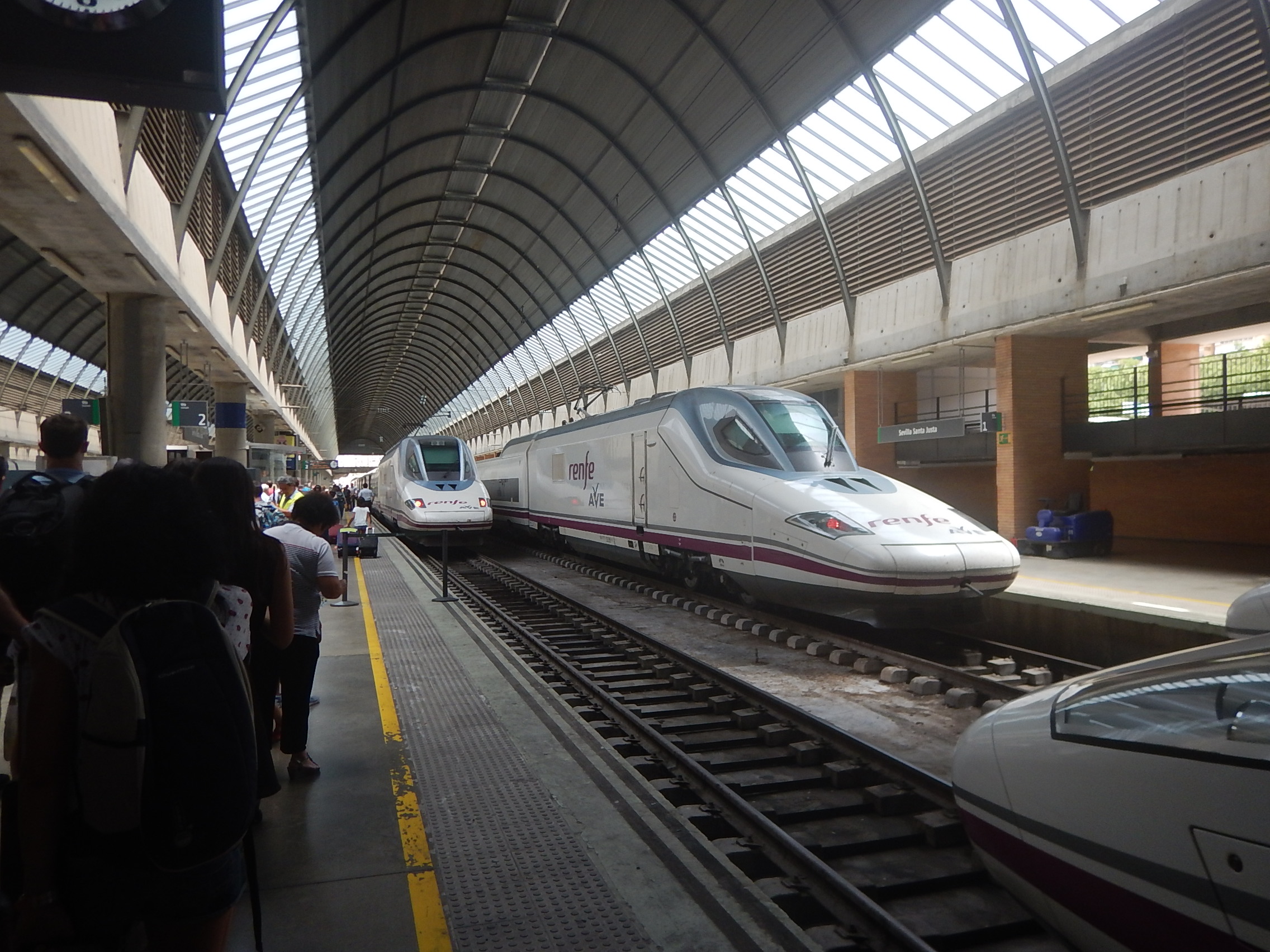
Are they more aerodynamic? Do they exert a higher down-force making the train more stable?
They certainly are different and they obviously work., as these are very fast trains.
Incidentally, these trains, are nicknamed pato in Spanish, which means duck in English.
Aerodynamic drag is proportional to a drag coefficient for the object and the square of the speed.
Let’s assume the following.
- The drag coefficient for the current train is d.
- The drag coefficient for the train with the aerodynamic nose is a.
- The terminal velocity of the train with the aerodynamic nose is v.
If the current Class 800 train travels at 118 mph on full power of 1680 kW, what speed would the train with an improved aerodynamic nose do on the same power, for various values of a?
If the new nose gives a five percent reduction in aerodynamic drag, then a = 0.95 * d, then the maximum speed of the train will be given by this formula
d * 118 * 118 = .0.95 * d * v* v
Solving this gives a speed of 121 mph.
Completing the table, I get the following.
- A one percent reduction in drag gives 119 mph
- A two percent reduction in drag gives 119 mph
- A three percent reduction in drag gives 120 mph
- A four percent reduction in drag gives 120 mph
- A five percent reduction in drag gives 121 mph
- A six percent reduction in drag gives 122 mph
- A seven percent reduction in drag gives 122 mph
- An eight percent reduction in drag gives 123 mph
- A nine percent reduction in drag gives 124 mph
- A ten percent reduction in drag gives 124 mph
- An eleven percent reduction in drag gives 125 mph
I can certainly understand why Talgo have developed the duck-like nose.
The conclusion is that if you can achieve an eleven percent reduction in drag over the current train, then with the same installed power can raise the speed from 118 mph to 125 mph.
Why Have A Fourth Engine?
If aerodynamics can make a major contribution to the increase in speed under diesel, why add a fourth engine?
- It might be better to fit four slightly smaller engines to obtain the same power.
- It might be better to put a pair of engines under two cars, rather than a single engine under four cars, as pairs of engines might share ancillaries like cooling systems.
- Extra power might be needed for acceleration.
- Four engines gives a level of redundancy, if only three are needed to power the train.
I wouldn’t be surprised to find out, that Hitachi are having a major rethink in the traction department.
Will The Trains Have Regenerative Braking To Batteries?
I would be very surprised if they don’t, as it’s the only sensible way to do regenerative braking on diesel power.
Will The Trains Be Built Around An MTU Hybrid PowerPack?
This or something like it from Hitachi’s diesel engine supplier; MTU, is certainly a possibility and it would surely mean someone else is responsible for all the tricky software development.
It would give the following.
- Regenersative braking to batteries.
- Appropriate power.
- Easier design and manufacture.
- MTU would probably produce the sophisticated power control system for the train.
- MTU could probably produce a twin-engined PowerPack
Rolls Royce MTU and Hitachi would all add to the perception of the train.
I would rate Hitachi using MTU Hybrid PowerPacks quite likely!
Would Two Pairs Of Engines Be Better?
The current formation of a five-car Class 800 train is as follows.
DPTS-MS-MS-MC-DPTF
Note.
- Both driver cars are trailers.
- The middle three cars all have generators, that are rated at 560 kW for a Class 800 train and 700 kW for a Class 802 train.
- Take a trip between Paddington and Oxford and you can feel the engines underneath the floor.
- The engines seem to be reasonably well insulated from the passenger cabin.
The system works, but could it be improved.
If I’m right about the aerodynamic gains that could be possible, then it may be possible to cruise at 125 mph using a power of somewhere around 1,800 kW or four diesel generators of 450 kW each.
Putting a diesel generator in four cars, would mean one of the driver cars would receive an engine, which might upset the balance of the train.
But putting say two diesel generators in car 2 and car 4 could have advantages.
- A Class 800 train has a fuel capacity of 1,300 litres, which weighs 11.06 tonnes. and is held in three tanks. Would train dynamics be better with two larger tanks in car 2 and 4?
- Could other ancillaries like cooling systems be shared between the two engines?
- Could a substantial battery pack be placed underneath car 3, which now has no engine and no fuel tank?
- As the engines are smaller will they be easier to isolate from the cabin?
The only problem would be fitting two generators underneath the shorter 24 metre car.
What size of battery could be fitted in car 3?
- According to this datasheet on the MTU web site, the engine weighs between five and six tonnes.
- I think this weight doesn’t include the generator and the cooling systems.
- Removing the fuel tank would save 3.7 tonnes
I suspect that a ten tonne battery could replace the diesel engine and its support systems in car 3..
On current battery energy densities that would be a battery of around 1000 kWh.
In How Much Power Is Needed To Run A Train At 125 mph?, I estimates that an electric Class 801 train needs 3.42 kWh per vehicle mile to maintain 125 mph.
This would give a range of almost sixty miles on battery power.
The battery would also enable.
- Regenerative braking to batteries, which saves energy at station stops.
- Diesel engines would not need to be run in stations or sensitive areas.
- Battery power could be used to boost acceleration and save diesel fuel.
You can almost think of the battery as an auxiliary engine powered by electrification and regenerative braking, that can also be topped up from the diesel generators.
It should also be noted, that by the time these trains enter service, the Midland Main Line will be electrified as far as Kettering and possibly Market Harborough.
This will enable the following.
- Trains will leave the electrification going North with a full battery.
- As Nottingham is less than sixty miles from Kettering and the trains will certainly have regeneratinve braking, I would not be surprised to see Northbound services to Nottingham being almost zero-carbon.
- A charging station at Nottingham would enable Southbound services to reach the electrification, thus making these services almost zero-carbon.
- Trains would be able to travel between Derby and Chesterfield, which is only 23 miles, through the World Heritage Site of the Derwent Valley Mills, on battery power.
- Corby and Melton Mowbray are just 26 miles apart, so the bi-mode trains could run a zero-carbon service to Oakham and Melton Mowbray.
- Trains could also run between Corby and Leicester on battery power.
- If and when the Northern end of the route is electrified between Sheffield and Clay Cross North Junction in conjunction with High Speed Two, the electrification gap between Clay Cross North Junction and Market Harborough will be under seventy miles, so the trains should be able to be almost zero carbon between London and Sheffield.
It does appear that if a battery the same weight as a diesel generator, fuel tank and ancillaries is placed in the middle car, the services on the Midland Main Line will be substantially zero-carbon.
What Would Be The Size Of |The Diesel Engines?
If the battery can be considered like a fifth auxiliary engine, I would suspect that the engines could be much smaller than the 560 kWh units in a Class 800 train.
Improved aerodynamics would also reduce the power needed to maintain 125 mph.
There would also be other advantages to having smaller engines.
- There would be less weight to accelerate and lug around.
- The noise from smaller engines would be easier to insulate from passengers.
- Engines could be used selectively according to the train load.
- Engines might be less prone to overheating.
The mathematics and economics will decide the actual size of the four engines.
Earlier, I estimated that a 10-11 % decrease in the trains aerodynamic drag could enable 124-5 mph with 1680 kW.
So if this power was provided by four engines instead of three, they would be 420 kW engines.
Conclusion
The Hitachi bi-modes for East Midlands Railway will be very different trains, to their current Class 80x trains.
 The Anonymous Widower