Greater Anglia’s Norwich And Stansted Airport Service Starts On December 15th 2019
The annual December timetable change on December 15th 2019, will see Greater Anglia bringing in their new service between Norwich and Stansted Airport stations start as an hourly service.
The Route
Between Norwich and Ely stations, the route is on the Breckland Line.
- It is not electrified, except for a short section at the Norwich end.
- It is a full double-track, except for the single-track Trowse Bridge, that it shares with the Great Eastern Main Line on the approach to Norwich.
- The operating speed is between 75-90 mph.
- There are intermediate stations at Shippea Hill, Lakenheath, Brandon, Thetford, Attleborough, Spooner Row and Wymondham.
There is potential to increase the line speed, perhaps add some extra stations and remove the antiquated Trowse Bridge.
South from Ely through Cambridge to Stansted Airport, the route is a busy, fully-electrified double-track line.
The New Timetable
The Sunday journeys are as follows
- Journey time appears to be a couple of minutes over two hours both ways.
- Most services seem to leave Stansted at XX:09
- First Northbound train is 08:18
- Last Northbound train is 21:11
- Most services seem to leave Norwich at XX:03
- First Southbound train is 09:03
- Last Southbound train is 20:03
- Calling points appear to be Audley End, Wittlesford Parkway, Cambridge, Cambridge North, Ely, Brandon, Thetford, Attleborough and Wymondham.
Weekday services appear to be more-or-less similar.
- Northbound services take around 6-9 minutes less than two hours.
- Most services seem to leave Stansted at XX:48
- First Northbound train is 05:27
- Last Northbound train is 21:11
- Southbound services take around 3-9 minutes less than two hours.
- Most services seem to leave Norwich at XX:27 or XX:33
- First Southbound train is 08:33
- Last Southbound train is 19:27
- Calling points are the same.
My Observations follow.
Convenience And Capacity
It is currently actually quicker by a few minutes to use the following services.
- East Midland Railway’s service between Norwich and Ely
- CrossCountry’s service between Ely and Stansted Airport.
These two trains can be very overcrowded at times and the new four-car Class 755 trains are much better and have more capacity, than the other services, which are often just two-car Class 158 or Class 170 trains.
Two Trains Per Hour Between Norwich And Stansted Airport
It also appears that the service with the single change at Ely will still be possible after the timetable change.
Thjis means that Norwich and Stansted Airport will have a two trains per hour (tph) service.
Train Timings
It would appear that the times between Cambridge and Norwich are very similar before and after the timetable change.
So it doesn’t appear that Greater Anglia are taking advantage of the superior performance of the new Class 755 trains.
How Many Trains Will Greater Anglia Need For The Norwich And Stansted Airport Service?
The current service between Norwich and Cambridge stations has a three hour round trip, so three trains are needed to provide the hourly service.
It looks like the Norwich and Stansted Airport service has a four hour round trip, so four trains will be needed to provide the hourly service.
Extending the Norwich and Cambridge service to Stansted Airport needs just one extra train.
How many extra passengers will Greater Anglia attract?
Whittlesford Parkway Gets An Extra Hourly Service To And From Cambridge
The extended hourly service between Norwich and Stansted Airport will call at Whittlesford Parkway station, which will increase the frequency on the busy commuter route between the Parkway station and Cambridge City Centre.
When we lived near Newmarket and C was practising as a barrister, she would sometimes go to Norwich up to tyree times a week. I wouldn’t be surprised to find that travellers between Whittlesford Parkway and Norwich stations are rather more numerous than the forecast.
- The train will take about ninety minutes and driving about seventy-five.
- The Class 755 trains have wi-fi.
- There is a lot of parking at Whittlesford Parkway station.
- Will Greater Anglia put a snack trolley on the train?
C would have certainly used the service, as Whittleford Parkway station was around fifteen minutes from where we lived.
What Will Greater Anglia Do With Lakenheath And Shippea Hill Stations?
These two stations are By Request and only get a few services a week.
Consider.
- The modern Class 755 trains with their high performance and short dwell times could probably selectively stop at these stations without degrading the train timings.
- Cambridge needs satellite development to provide housing and commercial development.
- The future of RAF Mildenhall is uncertain and it could be sold for housing.
- It could be argued that Cambridge needs a new Park-and-Ride station to the North to take the pressure off Ely station.
This Google Map shows RAF Lakenheath and the Breckland Line running Easy-West between Ely and Norwich.
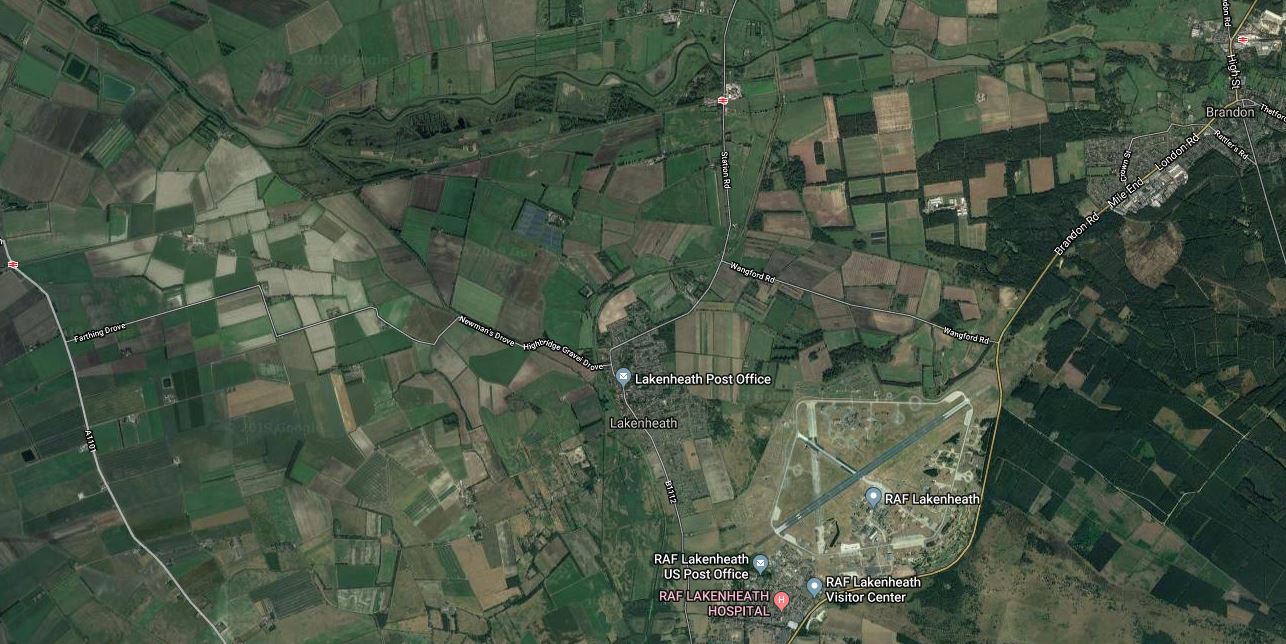
Note.
- RAF Mildenhall is to the South-West of RAF Lakenheath.
- The railway going across the North side of the map through Shippea Hill, Lakenheath and Brandon stations.
- Most of the land is aricultural and very flat.
I wouldn’t be surprised to see substantial development of the railway through the area in the next ten or twenty years.
What Will Greater Anglia Do With Spooner Row Station?
Spooner Row station is another By Request station on the Breckland Line bertween Attleborough and Wymondham stations..
Spooner Row is not a busy station, although as this Google Map shows it is just off the main A11 road.
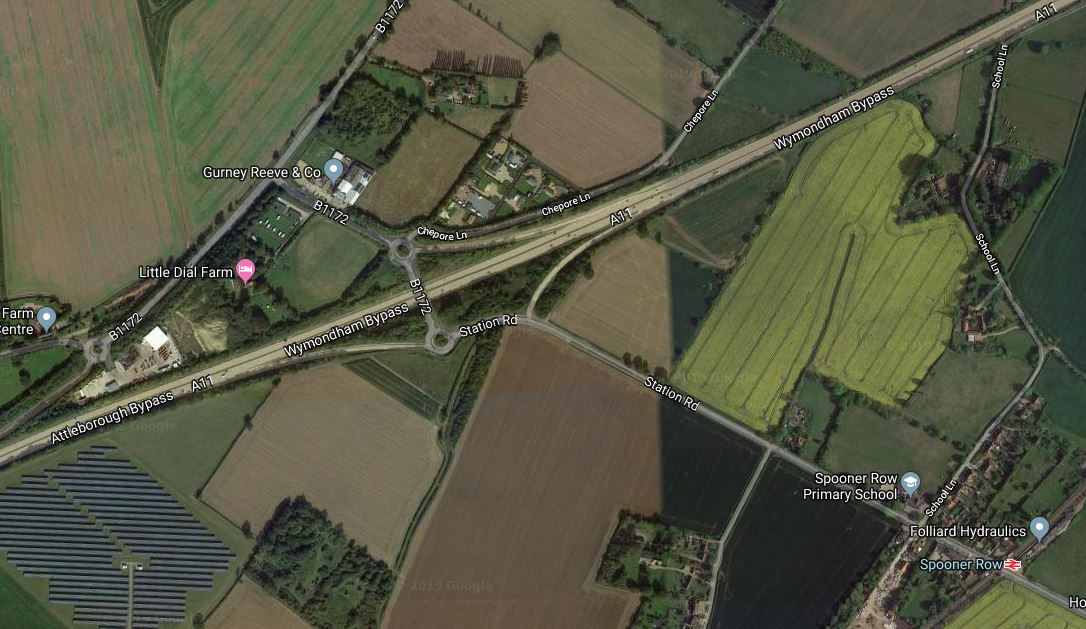
Noyr that Spooner Row station is in the South-East corner of the map.
Perhaps with more services and some increased car parking, it might pick up commuters and shoppers for Cambridge and Norwich it might become a convenient station for local residents travelling to and from Stansted Airport.
Could There Be A Norwich And Dereham Service?
Greater Anglia seems to be working closely with the Mid Norfolk Railway, which runs between Wymondham station on the Breckland Line to the town of Dereham.
- In Aerial Pictures Show New Trains Housed In Mid-Norfolk, I showed how the heritage railway was storing trains for Greater Anglia.
- According to Wikipedia, it would appear that several million pounds were spent to i8mprove the railway and its signalling, so that Greater Anglia’s new trains could be safely stored.
- The line is mainly single track and signalled for an hourly service.
- The yard at Dereham station seems to be regularly used for freight purposes, including loading damaged rolling stock on to road vehicles. It is also used by Network Rail for storage of track plant.
- Train operating companies and heritage railways are increasingly working together for their mutual benefit.
As an InterCity 125 trains has recently been beyond Dereham, I wouldn’t rule out Greater Anglia running a new service between Norwich and Dereham, with a future aim of extension to Fakenham.
Because of the limitations of the track, it could probably only be a limited service.
Can Capacity Be Increased If Needed?
Having lived near Cambridge for nearly thirty years of my life, I believe that there will come a time, when one four-car train between Norwich and Stansted Airport will not be enough.
- Two tph could be run on the route, which is relatively lightly used by other services.
- Longer trains could be created or two three-car trains could be run as a six-car train.
- The current speed limit of 75-90 mph of the Breckland Line, can probably be increased closer to the 100 mph of the Great Eastern Main Line.
Higher speeds would shorten journey times and increase capacity.
Could We See 125 mph Trains From Kings Cross To Kings Lynn And Norwich?
In Call For ETCS On King’s Lynn Route, I talked about putting digital signalling on the Kings Cross and Kings Lynn route and running 125 mph trains via Cambridge.
If the Kings Cross and Kings Lynn route were to be upgraded for faster running, this would also upgrade the proposed Kings Cross and Norwich route as far as Ely.
This would make it very feasible to run the following serrvices using 125 mph trains like Class 800 trains.
- Kings Cross and Kings Lynn
- Kings Cross and Norwich
Because of their speed these trains would help to open up capacity between Hitchin and Kings Cross.
I feel that these 125 mph bi-mode trains could do the trip between Kings Cross and Norwich in ninety minutes, which would match the time via Ipswich.
Do I Have Any Criticism?
My main criticism is that the service between Norwich and Stansted Airport, doesn’t have trains that run early and late enough.
Wil lthe service be timed to better fit the services out of the Airport?
Further Development Of The Breckland Line
This report in the Ely Standard from 2015, is entitled Could Railway Revolution See New Station Built at Ely North?.
These improvements are listed.
- A new four-platform station North of Ely would improve connectivity.
- A service between Kings Cross and Norwich via Cambridge is suggested.
- Improvements in services across East Anglia.
A cost of a billion pounds is mentioned.
125 mph Trains From Kings Cross To Kings Lynn And Norwich
In Call For ETCS On King’s Lynn Route, I talked about putting digital signalling on the Kings Cross and Kings Lynn route and running 125 mph trains via Cambridge.
If the Kings Cross and Kings Lynn route were to be upgraded for faster running, this would also upgrade the proposed Kings Cross and Norwich route as far as Ely.
This would make it very feasible to run the following serrvices using 125 mph trains like five-car Class 800 trains.
- Kings Cross and Kings Lynn
- Kings Cross and Norwich
The two services could even split and join at the proposed Ely North station to make full use of the paths into Kings Cross.
The 125 mph or more operating speed of these trains on the East Coast Main line would help to increase capacity between Hitchin and Kings Cross.
I estimate that these 125 mph bi-mode trains could do the trip between Kings Cross and Norwich in ninety minutes, which would match the time via Ipswich.
Norwich could have the following services.
- Three tph to and from London via Ipswich
- Two tph to and from London via Cambridge
- Two tph to and from Stansted Airport via Cambridge.
It sounds fantastic, but if we are to get travellers out of their cars, they must be given a high quality train service.
Conclusion
The improved Norwich and Stansted Airport service will be the first major improvement brought in by Greater Anglia.
New Rail Testing Scheme Launched For Small Businesses
The title of this post is the same as that of this article on Rail Technology Magazine.
This is the first two paragraphs.
Businesses in the West Midlands are being offered subsidised access to test and trial facilities as a way to boost railway innovation.
The University of Birmingham has joined forces with Quinton Rail Technology Centre (QRTC) to offer access to the UK’s only privately owned and independent outdoor rail testing and trialling site.
There would appear to be one major condition, companies must be signed up to the DIGI-RAIL program at the Uiversity of Birmingham.
I think this concept is an excellent idea, as often finding a way to test a new product, is the most difficult part of the development process.
But why restrict the process to rail developments?
I have had friends in Cambridge, who have been involved in medical developments.
Finding a route to test their product, often means finding an overseas partner, as much of the NHS and its research partners almost have a policy to exclude, ideas that they didn’t think of.
As someone, who helped fund the successful development of a metered-dose inhaler for asthma drugs, I can honestly say, we would have been greatly helped by a far-sighted agency attached to a reputable University.
Should We Have An Electronic Vote On Brexit?
We need to do something quick and radical to sort out Brexit.
Surely, if electronic voting is good enough for Estonia, it’s good enough for us!
Also if we can work out a secure system for Strictly Come Dancing and Love Island, we must have the technology for a secure vote!
Try getting that proposal through the House of Commons
LNER Confirms Dates For Azuma Introduction Onto Highland Services
This title of this post is the same as that of this article on Rail Magazine.
The dates when Class 800 trains will enter service to the Highlands are as follows.
- Aberdeen on November 25th 2019.
- Inverness on December 9th 2019
InterCity 125s are being replaced.
Soon there won’t be many of these iconic trains running on the East Coast Main Line.
Boris Gets Screwed, Glued And Tattooed
I voted Remain, but just wish that this Brexit rubbish can be sorted one way or another!
With my circumstances as a non-driving, single pensioner living alone in a comfortable house with a more than adequate pension, Remain or Leave will probably make no or little difference to the rest of my life.
But other things could!
- Increasing air pollution in London and other cities.
- Global warming.
- A government that raided my pension fund or pursued policies that would reduce its value.
- The closure of more restaurants that are good at gluten-free food!
- A government that didn’t back public transport.
- Increasing violence on the streets.
- A government that didn’t back serious research in Universities.
I have listed them in a rough order.
Should We Leave Now?
I actually feel now, that we should leave the EU, as to disobey the referendum would set a bad and dangerous precedent.
Especially, if we have a second referendum, in the hope of getting a result more acceptable to government and/or parliament and it proves just as close.
Imagine a controversial referendum in the future, such as bringing back the death penalty or imposing high carbon taxes.
If the government and/or parliament does’t get an acceptable result, will they go for further referendums until they do?
Where Now?
Boris is in a corner of his own making!
In the days of Rab Butler, Joe Grimond and Harold Wilson, the solution would have been to call in The Queen, who would give the nod to the next Prime Minister chosen by the Great and Good of the strongest party in the House of Commons.
Now with more democratically elected party leaders and the Fixed Term Parliament Act, such old-fashioned methods are now considered undemocratic.
But will the current crop of comedians in the House break the deadlock?
Conclusion
House Of Cards has nothing on this!
Battery Power Lined Up For ‘755s’
In Issue 888 of Rail Magazine, there is a short article, which is entitled Battery Power Lined Up For ‘755s.‘
This is said.
Class 755s could be fitted with battery power when they undergo their first overhaul.
Stadler built the trains with diesel and electric power.
The Swiss manufacturer believes batteries to be the alternative power source for rail of the future, and is to build tri-mode trains for Transport for Wales, with these entering traffic in 2023.
Rock Rail owns the Greater Anglia fleet. Chief Operating Office Mike Kean told RAIL on September 4 it was possible that when a four-car ‘755/4’ requires an overhaul, one of its four diesel engines will be removed and replaced by a battery.
These are some thoughts.
What Is The Capacity Of A Single Battery?
This picture shows the PowerPack of a Class 755 train.

Note the two ventilated doors on the side. Currently, a diesel engine is behind each!
The PowerPack has four slots,; two on either side of the central corridor.
Each of the slots could take.
- A V8 16-litre Deutz diesel that can produce 478 kW and weighs 1.3 tonnes.
- A battery of a similar physical size.
- Possibly a hydrogen fuel-cell!
I would assume that the battery module is plug-compatible, the same physical size and similar weight to the diesel engine module, as this would make the design and dynamics of the train easier.
A 1.2 tonnes battery would hold around 120 kWh.
Kinetic Energy Of The Train
I will use my standard calculation.
- The basic train weight is 114.3 tonnes.
- If each of the 229 passengers weighs 90 kg with Baggage, bikes and buggies, this gives a passenger weight of 20.34 tonnes.
- This gives a total weight of 134.64 tonnes.
Using Omni’s Kinetic Energy Calculator gives these figures for the Kinetic energy.
- 50 mph – 9.34 kWh
- 60 mph – 13.5 kWh
- 75 mph – 21 kWh
- 90 mph – 30.3 kWh
- 100 mph – 37.4 kWh
- 125 mph – 58.4 kWh
Note.
- Class 755 trains will not be able to run at 125 mph, but I have been told by someone who should know, that the trains have probably been designed, to enable this in other versions of the trains in the future.
- The kinetic energy of the train at typical Greater Anglia service speeds is not very high.
These amounts of kinetic energy can be easily handled in a 120 kWh battery under regenerative braking, to improve the efficiency of the trains.
Range On Battery Power
Assuming that the train uses 3 kWh per vehicle mile (SeeHow Much Power Is Needed To Run A Train At 125 mph?) , this would give.
- A four-car train a range of ten miles.
- A three-car train a range of 13.3 miles.
This probably isn’t long enough given that these are Greater Anglia’s electrification gaps.
- Ely and Peterborough – 30 miles
- Ipswich and Cambridge – 41 miles
- Ipswich and Ely – 37 miles
- Ipswich and Felixstowe – 14 miles
- Ipswich and Lowestoft – 45 miles
- Marks Tey and Sudbury – 12 miles
- Norwich and Ely – 50 miles
- Norwich and Great Yarmouth – 18 miles
- Norwich and Lowestoft – 20 miles
- Norwich and Sheringham – 30 miles
It would appear that more battery capacity is needed, as the required range is around sixty miles on some routes.
In the July 2018 Edition of Modern Railways, there is an article entitled KeolisAmey Wins Welsh Franchise.
This is said about the Stadler Tri-Mode Flirts on the South Wales Metro.
The units will be able to run for 40 miles between charging, thanks to their three large batteries.
So does this mean that these Flirts have just one Deutz diesel engine of 478 kW and three batteries in the four slots of the power-pack?
Assuming that the Flirts use 3 kWh per vehicle mile, this gives these ranges.
- A four-car train a range of thirty miles.
- A three-car train a range of forty miles.
These ranges might give enough range for many the of East Anglian routes. Improvements in train efficiency and battery storage would only increase these ranges.
Class 755 Trains In Electric Mode
Being able to do this, is important, as if the Class 755 trains are to use battery power, then they will need to use 25 KVAC overhead electrification in the various electric islands around East Anglia to charge the batteries.
The article in Issue 888 of Rail Magazine, says this about running in electric mode.
GA Joint Project Manage Steve Mitchell told RAIL that the ‘755s’ can already operate on electric power between Norwich and London, but they must carry out Electro Magnetic Current testing on the Ely-Cambridge route.
When that is complete, they will operate Notwich-Ely in diesel mode, and Ely-Cambridge in electric.
At least it appears that the Northern bay platforms at Cambridge are electrified.
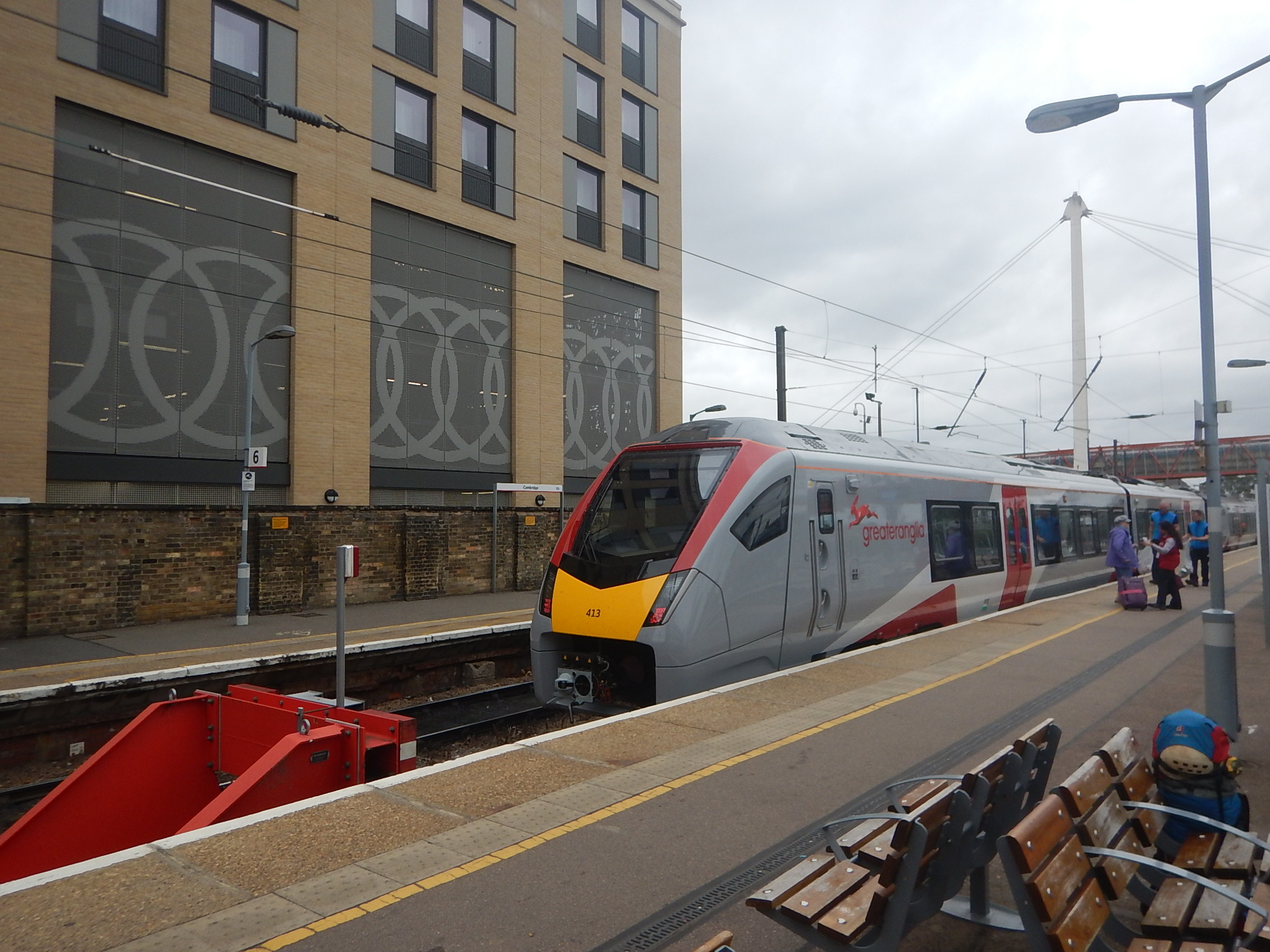
This would probably mean that no new infrastructure is needed.
As both Ipswich and Norwich stations are fully electrified, charging the batteries on hourly shuttles between the three stations, wouldn’t be a problem, if and when the trains are fitted with enough battery capacity to bridge the fifty mile gaps in the electrification on the routes.
Three-Car Trains And Batteries
The two short Southern routes; Coclester Town and Sudbury and Ipswich and Felixstowe will probably be run by three-car Class 755 trains, which have two diesel engines and two spare slots in the PowerPack.
Battery modules in both spare slots would give a twenty-seven mile range, which could enable the following.
- Running a return trip between Marks Tey and Sudbury, after charging the batteries on the main line between Colchester Town and Marks Tey.
- Running a return trip between Ipswich and Felixstowe, provided enough charge can be taken on at Ipswich.
The article in Issue 888 of Rail Magazine, also says this about the new Class 755 trains entering service.
The last line to receive them will be Sudbury-Marks Tey, will exclusively be operated by three-car Class 755/3s due to infrastructure restraints on the branch. No date has been given.
It should also be noted that the three-car trains are going to be the last to be delivered.
I feel that Stadler and Greater Anglia are following a cautious and very professional route.
Consider.
- They introduced the new trains on the Wherry Lines, which are close to the Crown Point Depot.
- Services between Norwich and Sheringham and Norwich and Cambridge were introduced next.
- All the initial services have used four-car trains
- Greater Anglia held on to the standby train of two Class 37 locomotives and Mark 2 coaches until last week.
- They have stated that training of Ipswich drivers is starting, ahead of services from the town to Cambridge, Felixstowe, Lowestoft and Peterborough.
- All the Ipswich cervices can be run using four-car trains.
- As I said earlier, the only service that needs a three-car train is Sudbury and Marks Tey.
- A three-car train could probably be thoroughly tested on one of the Norwich routes before deplayment to Sudbury.
- It should also be noted that a three-car train is only a four-car train with two less diesel engines and one less trailer car.
So far everything seems to have gone very well, with no adverse reports in the media.
Stadler have orders for further bi-mode trains for South Wales and other places in Europe. At least one of these orders, that for the South Wales Metro, includes a number of diesel/electric/battery versions.
Given the problems, that Bombardier and others have had with getting the complex software of these trains to work correctly, if I was Stadler’s Project Manager on multi-mode Flirts, I would be testing the trains and their software morning, noon and night!
So could the planned later arrival of the three-car Class 755 trains, be partly to enable Stadler to fully investigate the characteristics of a multi-mode Flirt?
After all, Greater Anglia only need a couple of three-car trains to start the service between Sudbury and Marks Tey, of the fourteen on order. And they have twenty-four four-car trains on order for the other routes.
They are also replacing twenty-four assorted diesel multiple units with thirty-eight longer new bi-mode multiple units.
I do wonder, if there is a cunning plan being hatched between Greater Anglia and Stadler.
- Stadler finalises the design and the software for a PowerPack, that contains both diesel and battery modules.
- Stadler thoroughly tests the design using a Greater Anglia three-car train in Switzerland.
- Stadler shows the concept to other prospective customers.
- Greater Anglia certifies the three-car Class 755 bi-mode train in the UK.
- Greater Anglia runs three-car 755 trains between Colchester Town and Sudbury, using the electrification between Marks Tey and Colchester Town, as they have planned for some time.
- When ready, Class 755 trains with batteries are introduced between Sudbury and Colchester Town.
Greater Anglia would be running the first battery-electric service using bi-mode battery-electric trains in the UK.
Austria Scraps Its Sun Tax
The eye-catching title of this post is the same vas that of this article on PV Magazine.
This is the introductory paragraph.
The nation’s political parties have found agreement on a green electricity package which is expected to create stable conditions for the next three years. From next year, €36 million will be made available annually for the further support of PV systems and energy storage.
As to the Sun Tax, this is explained further on.
The association has already seen one of its other demands met with the cancellation on Thursday of the ‘sun tax’ on the consumption of power generated by householders with rooftop arrays. Under the previous rules, solar households could consume 25 MWh of self-generated solar free of charge but then had to pay a €0.015 levy on every subsequent kilowatt-hour consumed during the life of the PV system.
|All parties seem pleased with the scrapping of the tax.
Two Unrelated (?) Stories About Rail Freight
Today there are two news stories about rail freight on the Internet.
- There Has ‘Never Been A Better Time’ To Invest In Rail Freight–Report on Railnews
- New Owner For GB Railfreight on Rail Magazine.
I’ll sketch out a few details from both stories.
Invest In Rail Freight
This is the first paragraph of the news story.
A new report published by the Rail Freight Group today is outlining how an ‘ambitious growth strategy’ for rail freight over the next ten years could be worth between £75 billion and £90 billion in environmental and economic benefits.
The report was written by well-respected rail commentator; Stephen Joseph
Recommendations include.
- A new approach from national and local government.
- New investment
- More investment in the Strategic Freight Network.
- Increased electrification
- New rail linked terminals
- Reforms to planning laws
- High speed freight services to city centres.
- Road pricing could also be used to encourage a shift to rail.
The Rail Freight group’s director general Maggie Simpson is quoted as saying. With renewed focus on the environment, and with new trade opportunities on the horizon, there has never been a better time to invest in rail freight.
Note that invest or investment is mentioned five times in the short news story.
New Owner For GB Railfreight
This is the first paragraph of the news story.
Hector Rail Group has sold GB Railfreight to Infracapital – the unlisted infrastructure equity arm of M&GPrudential.
This article in Rail Magazine was published in July 2017 and is entitled GB Railfreight In ‘Locomotive Acquisition’ Talks.
GB Railfreight has a fleet of seventy-eight Class 66 locomotives with other locomotives in the ageing category. Some of their work like hauling the Caledonian Sleeper needs well-presented reliable locomotives, so perhaps they need to update their image.
Would being owned by Infracapital give the company better access to finance for a renewed fleet?
The previous article indicated, that new investment in infrastructure, like selective electrification, railfreight terminals and perhaps freight loops is needed in the UK Strategic Freight Network.
Would Infracapital be prepared to fund this infrastructure, where it made their locomotives more profitable?
Consider.
- Partial electrification of the Felixstowe Branch Line might enable a hybrid Class 93 locomotive to haul the heaviest intermodal freight trains between Felixstowe and Ipswich. This improvement would also allow Greater Anglia’s Class 755 trains to run partially on electricity on the route.
- Doubling of the single-track between Soham and Ely would increase the number of freight paths across Suffolk.
- Reworking of junctions at Haughley and Ely would also speed up freight trains across Suffolk.
These are just three examples from an area I know well, but in how many places in the UK would smaller projects improve the profitability of new locomotives.
Infracapital would also be paid track access charges for their small sections of infrastructure. So well-planned improvements would have two revenue streams. And both would have a lifetime of thirty to forty years.
Case Study – Partial Electrification Of Felixstowe Branch Line
The Felixstowe Branch Line has now been double-tracked to create a passing loop to the West of Trimley, which allows more freight trains per day into and out of the Port of Felixstowe.
I believe that if sections of the branch line were to be electrified, that a diesel/electric/battery Class 93 locomotive would be able to haul a maximum weight intermodal freight train from Felixstowe to Ipswich.
The freight train would continue South and would use electric power to go to Bristol, Cardiff, Glasgow, Liverpool and Manchester using existing electrified routes through London.
In Issue 888 of Rail Magazine, there is a short article, which is entitled Battery Power Lined Up For ‘755s.‘
This is said.
Class 755s could be fitted with battery power when they undergo their first overhaul.
Stadler built the trains with diesel and electric power.
The Swiss manufacturer believes batteries to be the alternative power source for rail of the future, and is to build tri-mode trains for Transport for Wales, with these entering traffic in 2023.
Rock Rail owns the Greater Anglia fleet. Chief Operating Office Mike Kean told RAIL on September 4 it was possible that when a four-car ‘755/4’ requires an overhaul, one of its four diesel engines will be removed and replaced by a battery.
I suspect the battery size and electrification can be designed, so that the trains can work the twelve mile branch without using diesel power.
I can envisage a time, when the following trains on the Felixstowe Branch are zero-carbon.
- Freight trains between Felixstowe and London via Ipswich.
- Passenger services.
That will be a substantial improvement in environmental credentials.
Conclusion
There is more to this than an insurance and fund management company, funding locomotives.
Suppose GB Railfreight see an opportunity to deploy a new fleet of locomotives on a valuable contract, but perhaps a missing piece of infrastructure, stops them from running the service. Will they then approach their parent company; Infracapital, to see if they can help?
Are we seeing the first green shoots of realism in the financing of much-needed improvements to the UK rail network.
If it works out well, I don’t think that Infracapital will mind the good publicity.
,
Thomas Cook Collapses As Rescue Talks Fail
The title of this post, is the same as that of this article on the BBC.
The title says it all and I’m listening to a phone-in on BBC Radio 5 about the collapse.
What puzzles me, is that, this collapse has been on the cards for some months, with travel experts, like Simon Calder,, advising anybody booking with Thomas Cook to take precautions like get full insurance and use a credit card.
If I had been buying a package deal, I certainly wouldn’t have touched Thomas Cook with a bargepole.
Did people still book, as they knew the Government would pick up the tab?
Why should I pay extra taxes because of the stupidity of others?
The biggest stupidity of all, is that the Directors of Thomas Cook decided to keep trading, when they were obviously insolvent.
I thought that was a criminal offence, so surely some long jail sentences are in order.
Heathrow Congestion Charge Is Expected To Raise £1.2bn A Year
The title of this post is the same as that of this article in The Times.
This is the first paragraph.
Heathrow airport could make £1.2 billion a year from a congestion charge levied on drivers arriving at the airport by car, according to analysis.
The article also says.
- The charge will start when the third runway opens.
- The charge will be levied on all cars, even the cleanest.
It is designed to encourage drivers to use public transport, like buses, coaches and trains.
I don’t believe that you can force a lot of passengers to give up their cars, when going to the Airport,. But then for the sake of the planet, they must give up their diesel 4x4s and large cars.
As a non-driver and almost a non-flyer, I’m not affected!
 The Anonymous Widower